How to Get Leads for Free: 9 Methods That Actually Work
Free lead generation is real, but only if you pick the right channels. Here are nine methods that produce qualified B2B leads at zero cost, plus where free stops working.
TL;DR
- Free leads are real, but they cost time instead of money. The cheapest channel is the one your team can actually sustain for 90 days.
- The highest-yield free methods in 2026: LinkedIn search plus manual enrichment, community participation, free-tier finder credits, competitor review mining on G2, and reverse-engineering your own website traffic.
- Free tiers of paid tools (Tomba's 25 searches/month, Apollo's limited credits, Clay's starter runs) are the fastest path from "I have a name" to "I have a verified email."
- Scraped or bought lists are not free — they cost you deliverability, and repairing a burned domain takes months.
- The realistic ceiling on fully free lead gen is roughly 50–150 qualified contacts per month per rep. Past that, you pay for data or you stall.
What does "free leads" actually mean in B2B?#
Free means you spend no cash, not that you spend nothing. Every method below trades money for one of three things: your time, your existing audience, or your tolerance for manual work.
That distinction matters because most "get leads for free" advice collapses the moment you calculate hourly cost. If a rep spends six hours assembling 40 contacts, and that rep costs $35/hour, you paid $5.25 per lead. A paid database might have delivered the same list for $0.30 per record in eleven minutes. Free wins when you're pre-revenue, testing a new segment, or working a niche too small for any vendor to have covered properly.
Three categories are worth separating:
- Genuinely free forever — communities, content, referrals, your own website traffic, public directories. No credit card, no expiry.
- Free tiers with hard caps — Tomba's 25 searches/month, LinkedIn's basic search, HubSpot's free CRM. Free until the volume gets serious.
- Free but fake — scraped lists, purchased CSVs, "1 million B2B contacts" torrents. These carry real costs in bounce rate, domain reputation, and in some jurisdictions, GDPR exposure.
Stay in categories one and two. Category three burns the asset you can't buy back: your sending domain.
Which free lead generation methods actually produce pipeline?#
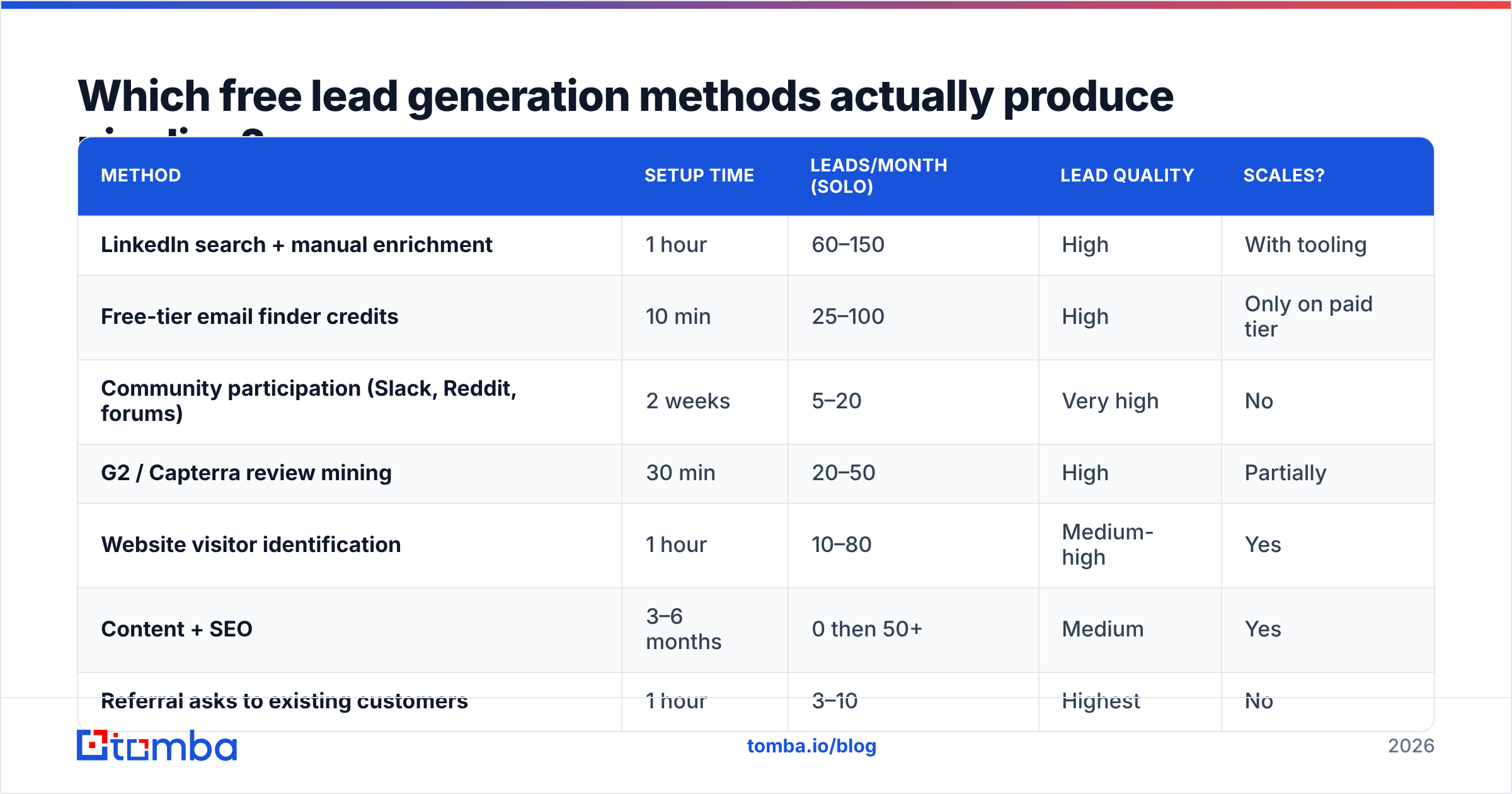
Here's the honest ranking, based on how much qualified pipeline each channel produces per hour invested for a typical B2B SaaS or agency team.
| Method | Setup time | Leads/month (solo) | Lead quality | Scales? |
|---|---|---|---|---|
| LinkedIn search + manual enrichment | 1 hour | 60–150 | High | With tooling |
| Free-tier email finder credits | 10 min | 25–100 | High | Only on paid tier |
| Community participation (Slack, Reddit, forums) | 2 weeks | 5–20 | Very high | No |
| G2 / Capterra review mining | 30 min | 20–50 | High | Partially |
| Website visitor identification | 1 hour | 10–80 | Medium-high | Yes |
| Content + SEO | 3–6 months | 0 then 50+ | Medium | Yes |
| Referral asks to existing customers | 1 hour | 3–10 | Highest | No |
| Public directories + association lists | 2 hours | 40–200 | Low-medium | Partially |
| Podcast/newsletter guest appearances | 1 month | 5–30 | High | No |
The pattern: the highest-quality free leads come from channels that don't scale, and the scalable ones need either months of lead time or a tool budget eventually. Plan for both — run one relationship channel and one volume channel simultaneously.

How do you find emails for free once you have names?#
You need three things to turn a name into a contact: the person, the company domain, and the email pattern. Free methods cover all three if you sequence them correctly.
Step 1 — Build the name list. LinkedIn's free search returns roughly 100 results per query with filters on title, company, and location. Boolean operators still work in the free tier: ("VP Marketing" OR "Head of Marketing") AND "Series B". Export nothing — LinkedIn's terms prohibit scraping — but you can work through results manually or use a compliant browser extension.
Step 2 — Determine the company email pattern. Most companies use one of five formats: first.last@, flast@, first@, firstl@, or f.last@. A free company email pattern checker resolves this in seconds for a given domain. Once you know the pattern for a company, every additional contact at that company is free.
Step 3 — Generate and verify. Combine the pattern with each name using an email permutator, then verify before sending. Verification is the step people skip, and it's the one that protects your domain. Free verification allowances exist across most vendors; use them on your riskiest guesses rather than your obvious ones.
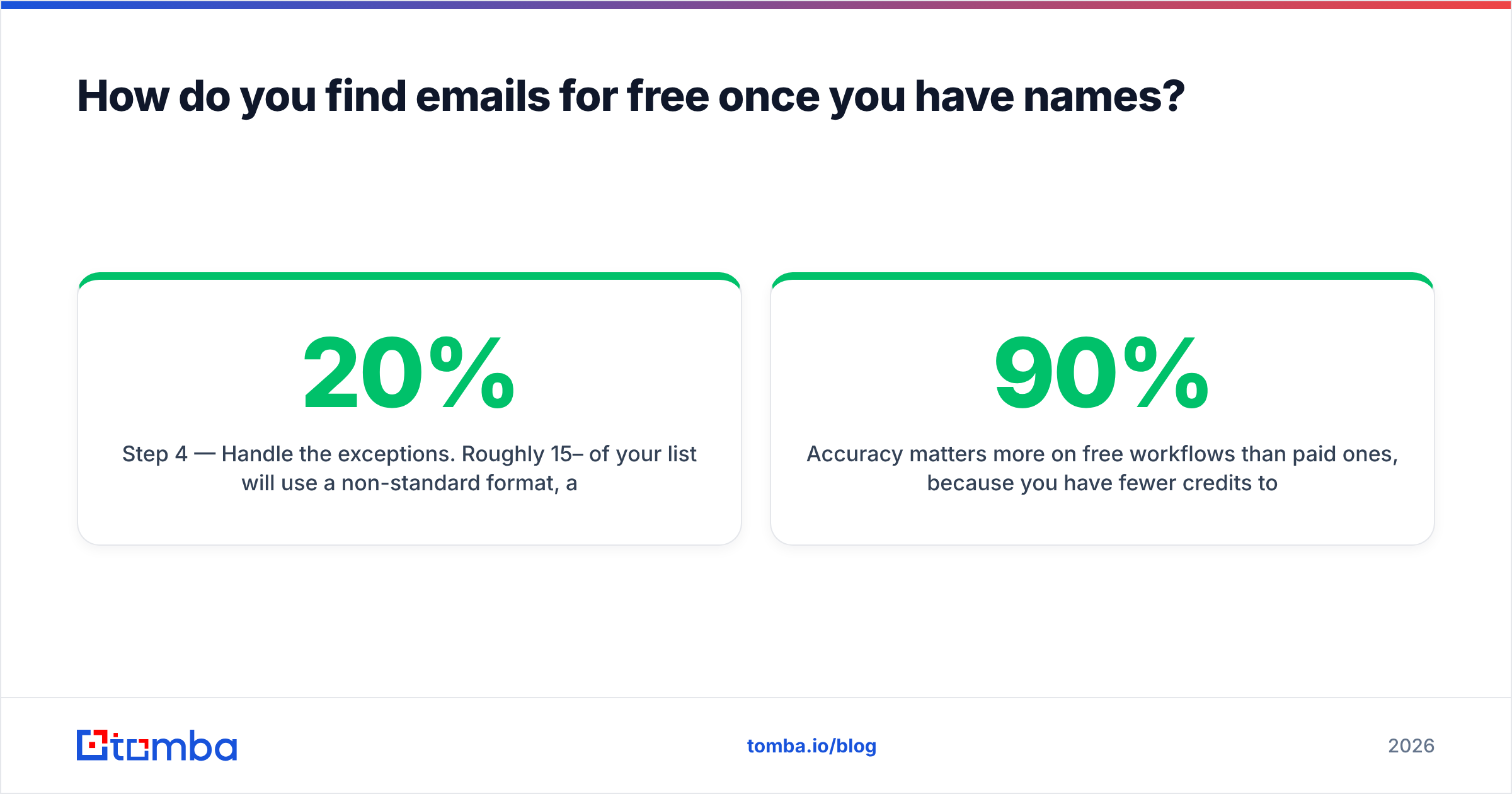
Step 4 — Handle the exceptions. Roughly 15–20% of your list will use a non-standard format, a catch-all domain, or an alias. Catch-all domains accept every address at the SMTP layer, so standard verification returns "unknown." A catch-all verifier applies additional signals to guess deliverability, but for genuinely free workflows, the pragmatic move is to deprioritize catch-alls and work your confirmed contacts first.
Step 5 — Log everything. A free CRM (HubSpot's free tier handles up to a million contacts) prevents the single biggest waste in free lead gen: rebuilding a list you already built because nobody saved it.

Accuracy matters more on free workflows than paid ones, because you have fewer credits to burn on retries. When a free tier gives you 25 searches, a tool with 90% accuracy hands you roughly 22 usable contacts; a tool at 65% hands you 16. That gap compounds across a month.
What do the free tiers of the major tools actually give you?#
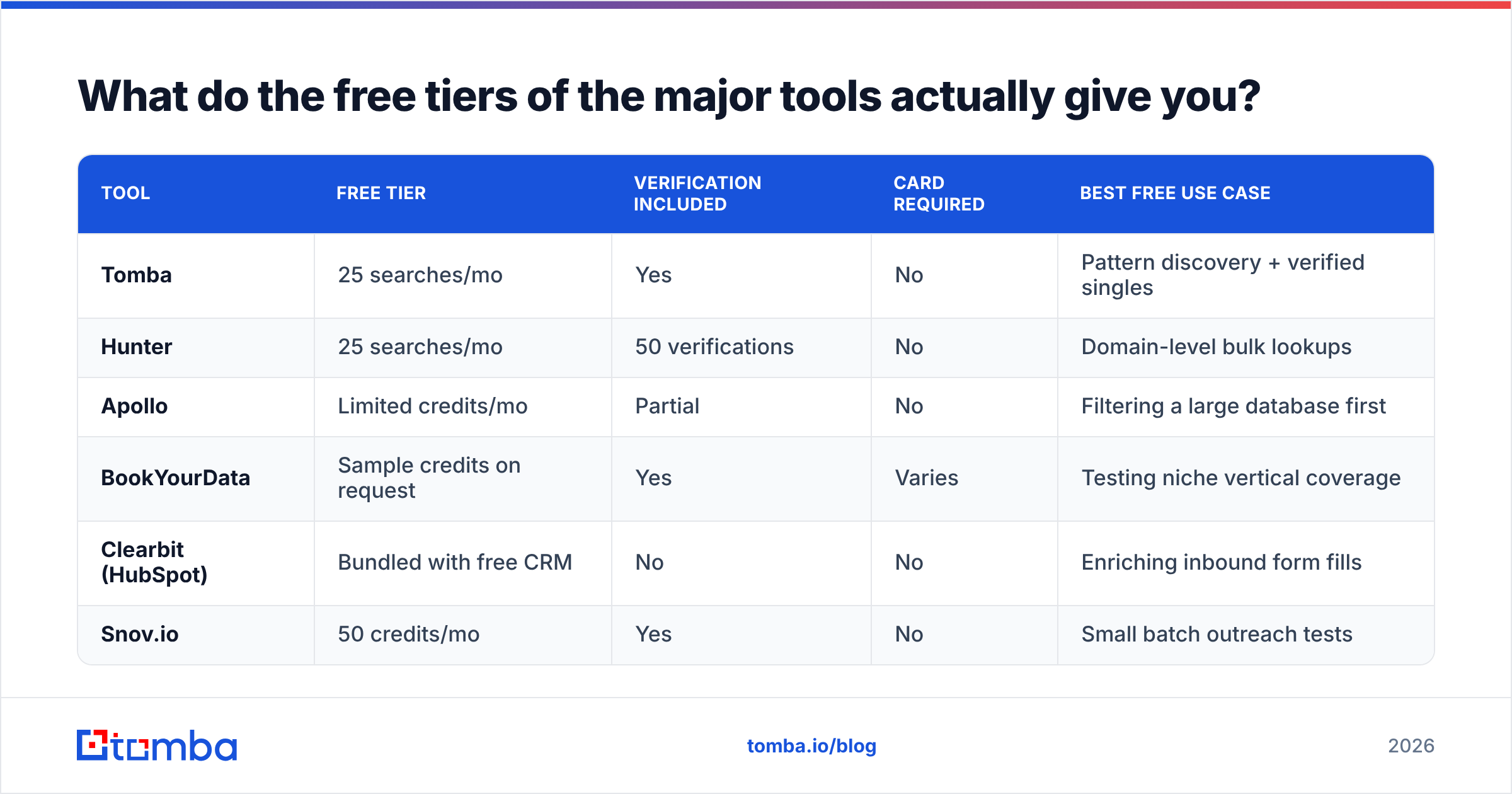
Every finder vendor offers something free. The differences are in credit count, whether verification is bundled, and what happens to your data.
| Tool | Free tier | Verification included | Card required | Best free use case |
|---|---|---|---|---|
| Tomba | 25 searches/mo | Yes | No | Pattern discovery + verified singles |
| Hunter | 25 searches/mo | 50 verifications | No | Domain-level bulk lookups |
| Apollo | Limited credits/mo | Partial | No | Filtering a large database first |
| BookYourData | Sample credits on request | Yes | Varies | Testing niche vertical coverage |
| Clearbit (HubSpot) | Bundled with free CRM | No | No | Enriching inbound form fills |
| Snov.io | 50 credits/mo | Yes | No | Small batch outreach tests |

Two practical notes. First, stacking free tiers works — 25 searches here, 50 credits there — but it fragments your data across five dashboards and you will lose track. Pick two, not six. Second, read what each vendor does with your uploaded lists. Some free tiers are explicitly funded by contributing your contacts back to a shared database. That may be fine, or it may be a compliance problem depending on your market.
Once you're consistently exhausting free credits by the second week of the month, you've found your signal. That's the point where Tomba pricing at $49/mo for the Starter plan costs less than the hours you're spending on workarounds.

Can you get leads for free from your own website?#
Yes, and it's the most underused free channel in B2B. Somewhere between 95% and 98% of your site visitors leave without filling in a form. Some of them are your best-fit accounts doing research.
Three free or near-free approaches:
- Reverse-IP company identification. Tools resolve visiting IP addresses to company names. Free tiers typically cap at a few hundred identified companies per month. You get the company, not the person — pair it with a domain search to find the right contact inside that account.
- Form abandonment capture. If your form captures email on field-blur before submit, you keep partial leads. Check your privacy policy covers it and that you're honest about it.
- Content gating done sparingly. Gate one high-value asset — a benchmark report, a calculator, a template pack — and leave everything else open. Gating everything kills the SEO that generates the traffic in the first place.
The visitor data only becomes a lead when you can reach a human at that company. That's the handoff point where a free-tier email finder turns "acme.com visited your pricing page four times" into a named prospect with a verified address.
How do you get free leads from communities without getting banned?#
The rule is simple: contribute thirty times before you ask once. Communities are the highest-converting free channel and the easiest to destroy through impatience.
What works:
- Answer questions in your actual area of expertise. Not adjacent, not stretched. If you sell warehouse software, answer warehouse questions. Your profile does the selling.
- Publish something useful and free before pitching anything. A spreadsheet, a checklist, a teardown. People DM the person who made the useful thing.
- Track who engages. Anyone who comments, upvotes, or asks a follow-up is a warm contact. That's your list.
- Move to email only after a real exchange. A cold DM after one comment reads as extraction. A follow-up email after a genuine thread reads as continuity.
- Never post your link in the first message. Every moderator on every platform is watching for exactly that.
Reddit's industry subreddits, vertical Slack groups, Discord servers for technical products, and LinkedIn comment sections on relevant posts all work. According to HubSpot's research on inbound, trust-first channels consistently outperform interruption-based ones on close rate — and that gap gets wider the higher your price point.
The tradeoff is honest: this generates 5–20 leads a month, not 500. But those leads close at multiples of cold outbound rates, so the pipeline value can match a much larger cold list.
What about review sites, directories, and public data?#
Review platforms are a free intent goldmine that most teams ignore. On G2, you can read reviews of your direct competitors, find companies that rated them 3 stars or lower, and identify the specific complaint. That's a qualified lead with a documented pain point and a stated budget — they already bought a tool in your category.
The workflow: filter competitor reviews by low rating, note the reviewer's company and role (G2 shows company size and industry even when the reviewer is anonymized), then find the contact. Same pattern applies to Capterra, TrustRadius, and app-store reviews for product-led categories.
Other public sources worth mining:
- Job boards. A company hiring three SDRs is scaling outbound and buying sales tools. A company hiring a "Head of Data" has a data problem you might solve.
- Funding announcements. Crunchbase's free tier plus a saved search covers new rounds in your ICP.
- Conference speaker and sponsor lists. Public, structured, and pre-qualified by budget.
- Industry association member directories. Often public, often complete, rarely mined.
- Podcast guest archives. Every guest is a decision-maker who has already demonstrated they'll say yes to an outreach request.
For content-driven sources — bylines, guest posts, industry publications — an author finder resolves an article URL to the writer's contact details, which is faster than working backwards from a name.
When does free stop being worth it?#
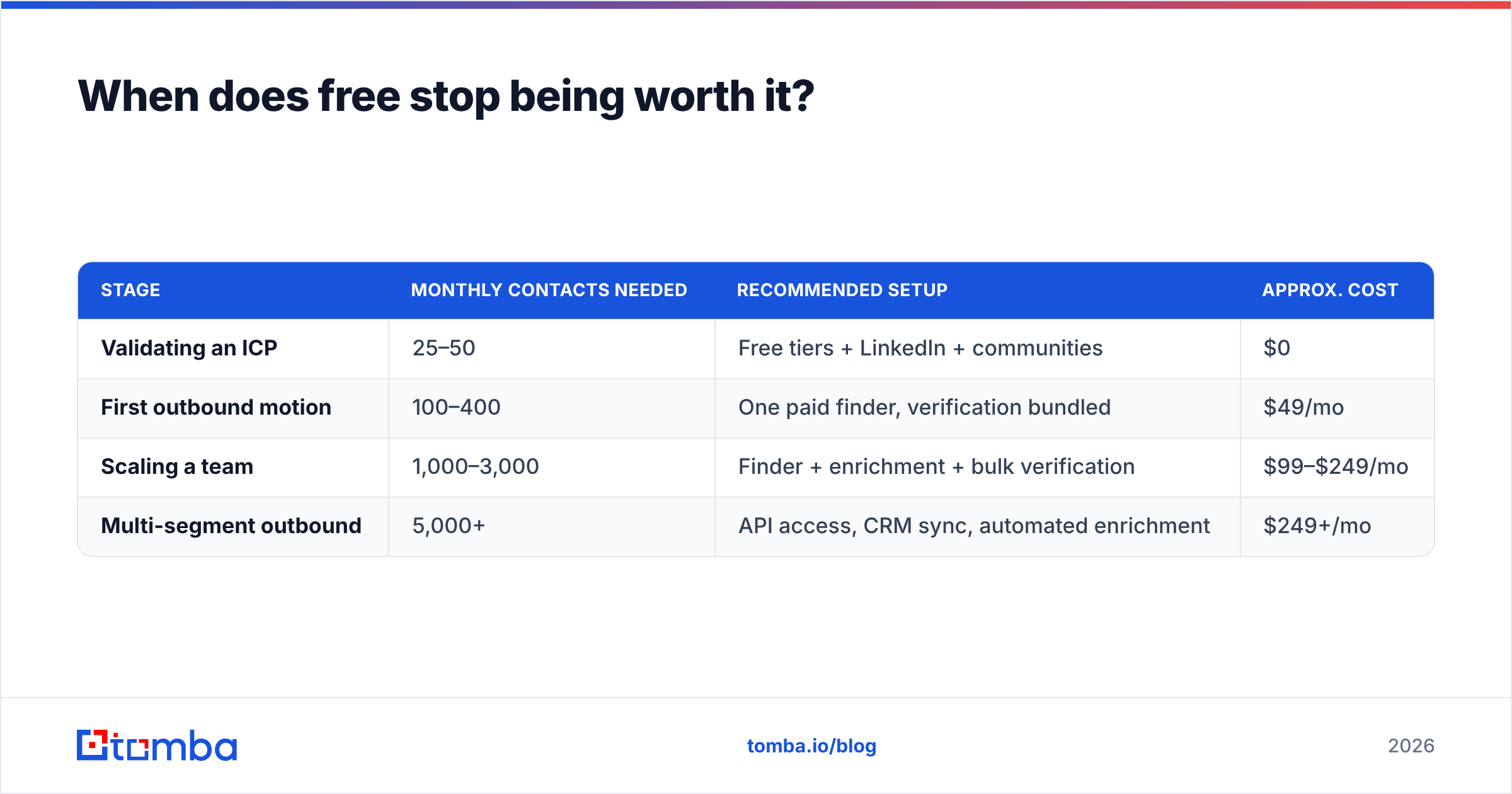
Three signals tell you to start paying.
Signal one: your time cost exceeds the data cost. Track hours honestly for two weeks. If you're at 8+ hours a month on manual list-building, the math has already flipped.
Signal two: your bounce rate climbs above 3%. Free workflows lean on guessing and unverified addresses. A bounce rate over 3% starts damaging sender reputation, and the recovery cost — weeks of throttled sending and warmup — dwarfs any subscription you avoided.
Signal three: you need volume you can't reach manually. Free tiers cap around 25–100 contacts a month. If your model needs 1,000 touches a month to hit quota, no combination of free tiers gets you there.
The transition doesn't have to be expensive. Going from stacked free tiers to a single $49/mo Starter plan usually buys back more hours than it costs in the first week. What you're really buying at that point is consolidation: one source of truth, one verification standard, one export format.
| Stage | Monthly contacts needed | Recommended setup | Approx. cost |
|---|---|---|---|
| Validating an ICP | 25–50 | Free tiers + LinkedIn + communities | $0 |
| First outbound motion | 100–400 | One paid finder, verification bundled | $49/mo |
| Scaling a team | 1,000–3,000 | Finder + enrichment + bulk verification | $99–$249/mo |
| Multi-segment outbound | 5,000+ | API access, CRM sync, automated enrichment | $249+/mo |
What's the fastest free workflow to run this week?#
A concrete 90-minute sequence you can execute today:
- Minutes 0–20: Define one narrow ICP — one industry, one company size band, one title. Narrow beats broad every time on free volume.
- Minutes 20–50: Run three LinkedIn searches against that ICP. Collect 40 names, companies, and titles in a spreadsheet.
- Minutes 50–65: Identify email patterns for the 10 most common domains in your list using a free pattern checker. This covers most of your contacts.
- Minutes 65–80: Generate addresses from patterns and verify with your free-tier credits, prioritizing your top 25 targets.
- Minutes 80–90: Write one message. Not a sequence — one message, referencing something specific and true about each account.
That produces roughly 25 verified, qualified contacts at zero cash cost. Repeat weekly and you have 100 a month, which is a functional outbound motion for a founder or a single rep.
Where it breaks down is at the second rep, or the second segment, or the point where you want the whole thing running on a schedule instead of a Friday afternoon. At that point, bulk email finder workflows and API access replace the manual steps you've been doing by hand — and by then you'll know exactly what you need, because you'll have done every step yourself.
Start with the free tier and see what your list is worth#
The best free lead generation strategy is the one that proves your ICP before you spend anything. Build the list manually, verify what you can, send twenty honest messages, and read the replies. If the replies come back, you've validated a channel worth funding. If they don't, you saved a subscription.
The Tomba Email Finder free tier gives you 25 searches a month with verification included and no credit card required — enough to test a full ICP hypothesis end to end. When your outbound outgrows it, the Starter plan is $49/mo, and everything you built during the free phase carries straight across.
Related guides#
// get started
Find, verify and enrich your first contacts today
Start on the free plan with 25 searches a month, then scale when your team is ready.
Free plan · No credit card required · GDPR & CCPA
Get the Tomba newsletter
Product and data updates
// about the author