How to Get Targeted Leads for Free: 9 Methods That Work
Free lead generation works, but only if you define "targeted" before you start collecting names. Here are nine free sources, the real volume ceiling of each, and the point where staying free starts costing you more than paying.
TL;DR
- "Free" and "targeted" pull in opposite directions. Free sources give you volume; targeting comes from the filters you apply before you collect a single contact.
- The nine methods below cover roughly 200-600 genuinely targeted contacts per month at zero spend, if you work them consistently.
- Stacking free tiers across three or four tools beats squeezing one tool. Most free plans reset monthly, so a rolling stack compounds.
- Free contact data decays and misfires more than paid data. Verify everything before it touches your sending domain, or you buy the "savings" back in bounce damage.
- The break-even point is usually around 300-500 contacts a month. Past that, a $49/mo plan costs less than the hours you spend stitching free sources together.
What does "targeted" actually mean when the leads are free?#
Targeted means the contact matches a defined ideal customer profile on at least three axes: firmographic (industry, headcount, revenue band), role (title or function with budget authority), and trigger (something happened recently that makes them care right now).
Most people who ask how to get targeted leads for free skip straight to the collecting. That is why free lead lists usually underperform. A scraped list of 5,000 "marketing managers" is not targeted, it is just large. A list of 60 marketing managers at Series A B2B SaaS companies that posted a demand-gen job opening in the last 21 days is targeted, and you can build that list for nothing in an afternoon.
Write your filter down before you start. Something like:
- Industry and model — B2B SaaS, 20-200 employees, subscription revenue.
- Role — Head of Growth, VP Marketing, or Demand Gen Manager. Not the CEO unless headcount is under 20.
- Trigger — hiring for outbound, recently raised, migrated tooling, published on a topic you solve for.
- Geography and language — where you can actually deliver and support.
- Disqualifiers — the reverse filter matters as much. Agencies, students, competitors, anyone on a free plan of a competing product.
- Reachable channel — you need a verified work email or a phone number, not just a profile URL.
That six-line filter is what converts free data into targeted data. Everything after this is mechanics.

Where can you get targeted leads for free in 2026?#
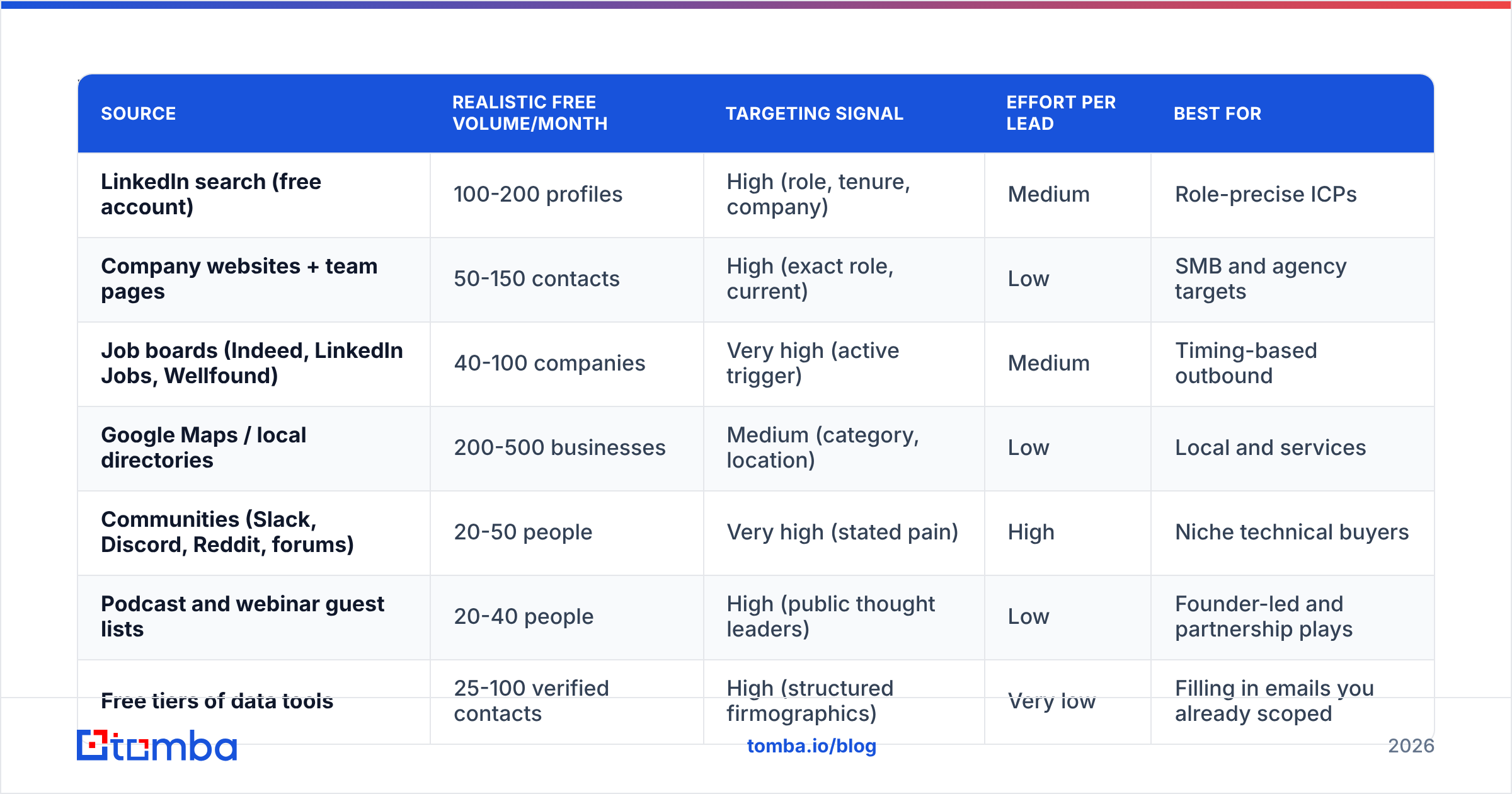
There are more free sources than most teams use. The difference between them is not just volume, it is how much targeting signal comes attached to each record.
| Source | Realistic free volume/month | Targeting signal | Effort per lead | Best for |
|---|---|---|---|---|
| LinkedIn search (free account) | 100-200 profiles | High (role, tenure, company) | Medium | Role-precise ICPs |
| Company websites + team pages | 50-150 contacts | High (exact role, current) | Low | SMB and agency targets |
| Job boards (Indeed, LinkedIn Jobs, Wellfound) | 40-100 companies | Very high (active trigger) | Medium | Timing-based outbound |
| Google Maps / local directories | 200-500 businesses | Medium (category, location) | Low | Local and services |
| Communities (Slack, Discord, Reddit, forums) | 20-50 people | Very high (stated pain) | High | Niche technical buyers |
| Podcast and webinar guest lists | 20-40 people | High (public thought leaders) | Low | Founder-led and partnership plays |
| Free tiers of data tools | 25-100 verified contacts | High (structured firmographics) | Very low | Filling in emails you already scoped |
| G2 / Capterra review profiles | 30-80 people | Very high (uses a competitor) | Medium | Displacement campaigns |
| Your own website traffic | Varies | Very high (already interested) | Low | Warm-ish outbound |
A quick read of that table: the highest-signal sources are the slowest, and the fastest sources have the weakest signal. The workable strategy is to source targeting signal from the slow channels and source contact details from the fast ones.
How do you build a free targeted lead list step by step?#
Here is the loop that produces the best ratio of effort to usable contacts. It takes about 90 minutes the first time and 30 minutes after that.
Step 1 — Build a company list, not a people list. Start with 40-60 companies that match your firmographic filter. Job boards are the fastest free path here because a job posting is a public budget signal. Search for the role your product supports (for example "SDR" or "RevOps") filtered to your target headcount range. Every company hiring for that function is spending money on that function right now.
Step 2 — Identify the right person at each company. Use LinkedIn's free search or the company's own team page. You want a name and a title, not an email yet. Aim for one primary and one backup contact per company. Skip companies where you cannot find a plausible owner of the problem, they will waste your credits later.
Step 3 — Confirm the email pattern once per domain. Nearly every company uses one format across the whole organization. Once you know that acme.com uses first.last@, you can construct the rest of the org for free. A company email pattern check does this in a few seconds per domain, and an email permutator generates the candidate variants when a pattern is not published anywhere.
Step 4 — Resolve the actual addresses. This is where free tiers earn their keep. Pull the exact addresses through an email finder rather than guessing, because a guessed address that lands on a catch-all domain tells you nothing and still counts as a send.
Step 5 — Verify before anything leaves your outbox. Free-sourced data is stale more often than paid data. Run every address through an email verifier and drop anything that comes back invalid, risky, or role-based (info@, sales@, hello@). This single step is the difference between a free list that works and a free list that gets your domain flagged.
Step 6 — Log the trigger with the contact. Store the reason you added each person in the same row as their email: "hiring 2 SDRs, posted Aug 14." That note is what makes the first line of your email specific, and specificity is the only advantage a small free list has over a big paid one.
Which free tiers give you the most usable volume?#
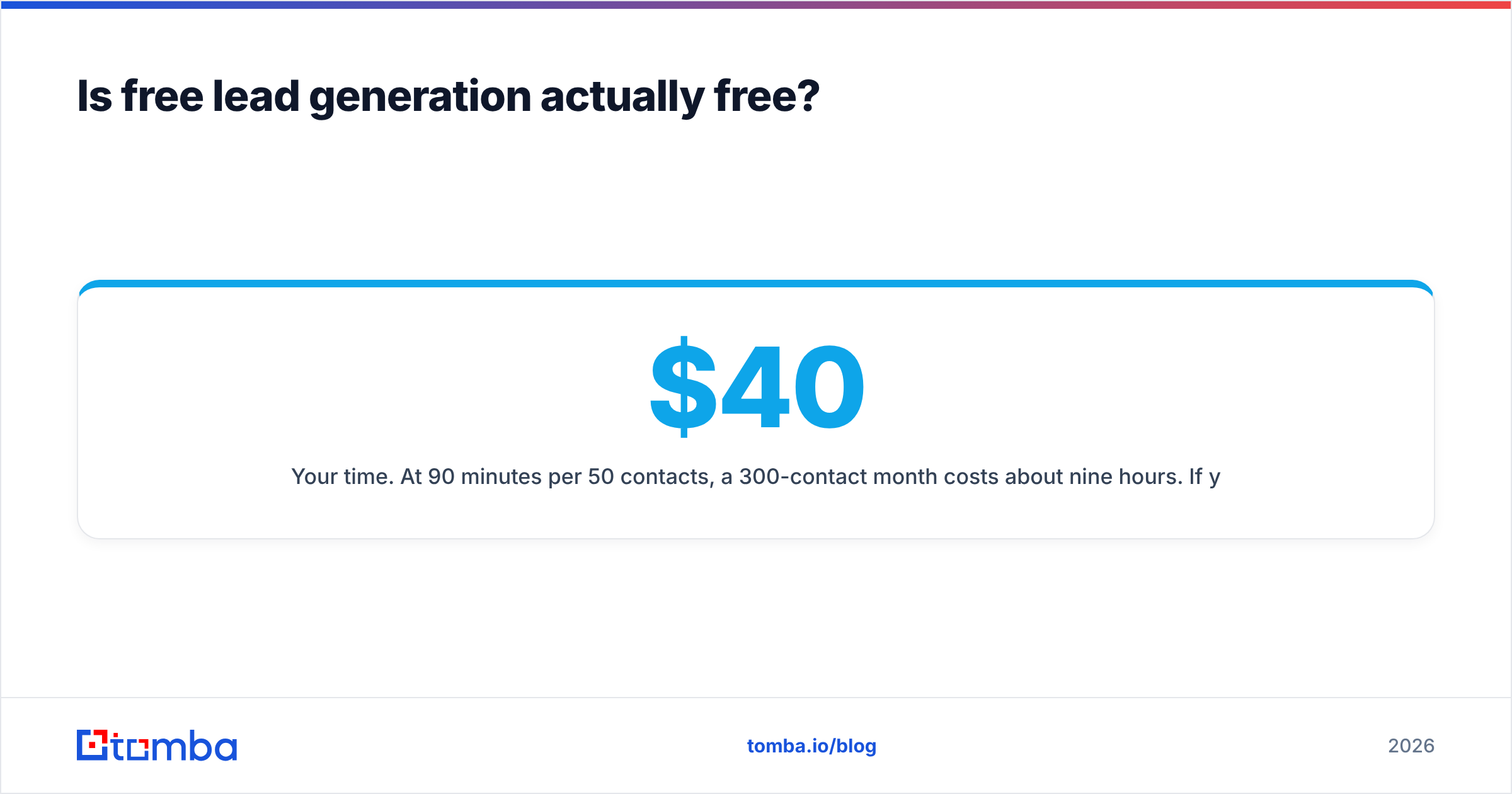
Free tiers change often, so treat these as a starting shape and confirm on each vendor's own pricing page before you plan around them. The pattern that matters: some tools give you finding credits, some give you verification credits, and very few give you both.
| Tool | Free tier shape | Verification included | Paid entry point | Where it fits in a free stack |
|---|---|---|---|---|
| Tomba | 25 searches/month, no card | Yes, verifier included | $49/mo Starter | Finding and verifying in one place |
| Hunter | Limited monthly searches | Partial | Mid-range monthly | Domain-level discovery |
| Apollo | Free plan with capped credits | Basic | Mid-range monthly | Firmographic filtering at volume |
| BookYourData | Sample credits on signup | Yes, accuracy-guaranteed data | Pay-as-you-go credits | Buying a clean, targeted slice without a subscription |
| Clearbit / enrichment vendors | Usually trial only | N/A | Enterprise-leaning | Enriching an existing list |
Two notes worth flagging. First, BookYourData is a credit-based model rather than a subscription, which makes it genuinely useful when your free tiers run dry mid-month and you do not want to commit to a recurring plan. Second, pay attention to whether a free plan gives you exports or only on-screen views. A tier you cannot export from is a demo, not a source.
Stacking is the real technique. Three free tiers at 25-50 credits each, refreshed monthly, plus manual sourcing from job boards and team pages, realistically produces 150-300 verified, targeted contacts a month. That is enough to run a focused campaign against a well-defined niche.
Is free lead generation actually free?#
No, and being honest about that is what keeps this strategy from backfiring.
The costs are real, they just do not show up on a card statement:
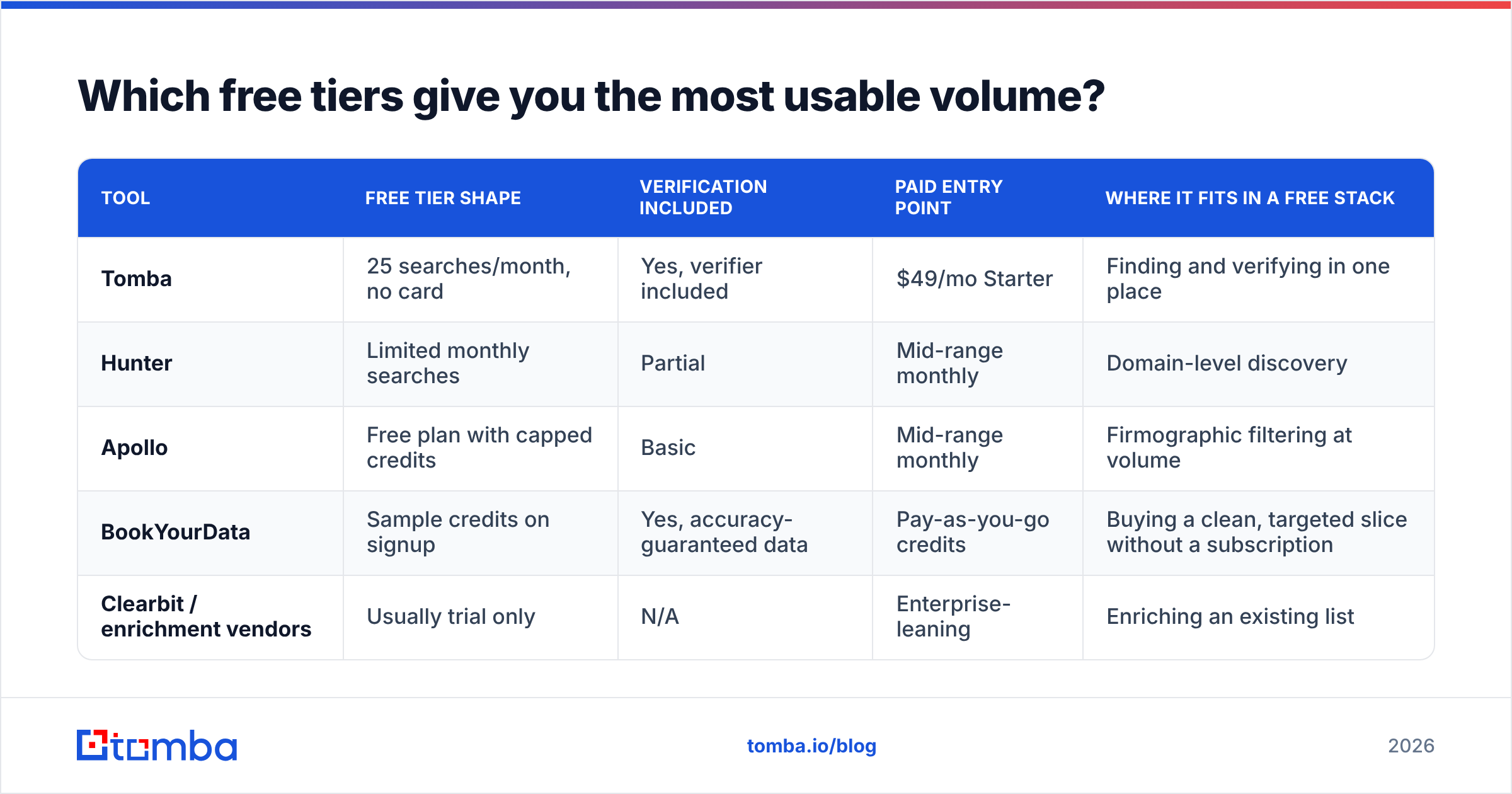
- Your time. At 90 minutes per 50 contacts, a 300-contact month costs about nine hours. If your loaded hourly cost is $40, that is $360 of labor to avoid a $49 subscription.
- Deliverability risk. Unverified free data bounces at meaningfully higher rates than verified data. Mailbox providers read bounce rate as a spam signal, and sender reputation is slow to rebuild once damaged. HubSpot's email deliverability guidance is blunt about this: list hygiene is the input, inbox placement is the output.
- Opportunity cost. Hours spent manually resolving emails are hours not spent on follow-up, which is where most of the pipeline actually comes from.
- Compliance exposure. Scraping personal data carries obligations in the EU and UK under GDPR. Free sourcing does not exempt you from lawful basis, disclosure, and opt-out requirements.
Free lead generation is best understood as a way to validate a niche before you spend, not as a permanent operating model.

How do you protect deliverability when the data is free?#
Free data is noisier, so your guardrails need to be tighter than they would be on a paid list.
Enforce these five rules and free-sourced lists behave nearly as well as paid ones:
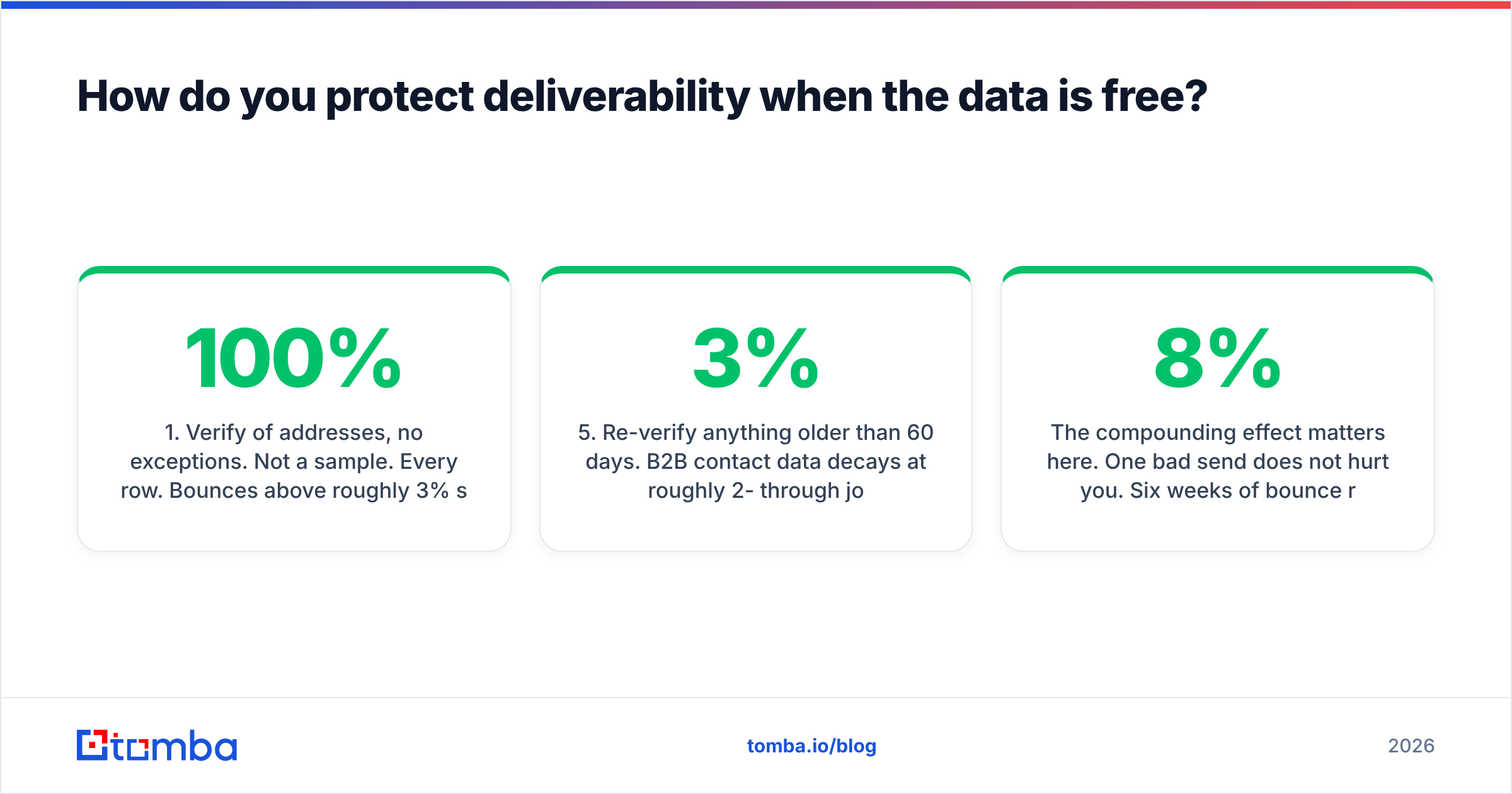
- Verify 100% of addresses, no exceptions. Not a sample. Every row. Bounces above roughly 3% start attracting filtering attention.
- Delete role accounts. info@, support@, contact@, admin@. They are technically valid and functionally worthless, and they generate complaints faster than personal addresses.
- Handle catch-all domains separately. A catch-all accepts everything, so a "valid" result there is not confirmation. Segment those into a lower-priority list or run a catch-all verifier before including them.
- Cap daily volume per mailbox. 30-50 cold sends per mailbox per day is the safe band. Free lists tempt you to blast, which is exactly how new domains get burned.
- Re-verify anything older than 60 days. B2B contact data decays at roughly 2-3% per month through job changes alone. A list you built in March is materially wrong by June.
- Warm the domain first. If the sending domain is under a few months old, spend two to three weeks warming before the first real campaign, regardless of how good the list is.
The compounding effect matters here. One bad send does not hurt you. Six weeks of 8% bounce rates on a fresh domain does, and no amount of free data is worth rebuilding a domain reputation.
When should you stop doing this for free?#
The switch point is arithmetic, not philosophy. Ask three questions:
Are you spending more than five hours a month on sourcing? At that point a paid plan is cheaper than your own time, even at modest hourly rates.
Do you need more than about 300 contacts a month? Free tiers cap out. Stacking four of them is manageable; stacking eight is a part-time job with worse data hygiene than one paid account.
Is contact data on your critical path to revenue? If your pipeline stalls when the free credits run out mid-month, you have made a $49 problem into a revenue problem.
For reference, Tomba pricing starts free at 25 searches per month, then $49/mo for Starter, $99/mo for Growth, and $249/mo for Pro, with Enterprise priced on request. The free tier is genuinely usable for validating a niche. The Starter plan is where most teams land once outbound becomes a weekly habit rather than an experiment.
Independent review sites like G2 are useful for sanity-checking any vendor's claims before you commit. Read the two-star reviews specifically, they tell you more about data coverage gaps than the five-star ones.
What does a good free lead-gen week actually look like?#
Concretely, here is a repeatable weekly cadence that produces roughly 60-80 targeted, verified contacts without spending anything:
- Monday, 30 minutes. Pull new job postings matching your trigger. Add 15-20 companies to the sheet with the posting date and role.
- Tuesday, 30 minutes. Identify the decision-maker at each company via LinkedIn or the team page. One primary, one backup.
- Wednesday, 20 minutes. Resolve email patterns per domain, then spend your free finder credits on the primary contacts only.
- Thursday, 15 minutes. Verify everything. Drop invalids, segment catch-alls, remove role accounts.
- Friday, 30 minutes. Write the campaign using the stored trigger note as the personalization anchor. Send in batches under your daily cap.
Four weeks of that is 240-320 targeted contacts. That is a real pipeline input, built from public sources and free tiers, and it will outperform a purchased 10,000-row list almost every time because every row has a reason attached to it.
Start with the free tier, then scale what works#
If you take one thing from this: targeting is a filtering discipline, not a data-buying decision. Define the ICP tightly, source triggers from public channels, and use free tool credits only for the last mile of resolving and verifying addresses.
When you are ready to start collecting, the Tomba Email Finder gives you 25 searches a month free with no card required, and it includes verification so you are not stitching two tools together to get one clean list. Build your first 25-contact test list this week, run it, and let the reply rate tell you whether the niche is worth paying to scale.
Related guides#
Ready to find emails that actually work?
Join 150,000+ professionals who stopped guessing and started sending. Free credits on signup — no credit card required.
Get the Tomba newsletter
Practical outbound tactics and product updates — once every two weeks.
About the author