How to Hit Sales Quota in 2026: A Rep's Working Playbook
Only about half of B2B reps hit quota in a normal year. Here is the math, the weekly cadence, and the pipeline habits that separate the reps who land at 110% from the ones who close at 68%.
TL;DR
- Quota attainment is an arithmetic problem before it is a motivation problem. Work backwards from your number to required pipeline, then to required conversations, then to required contacts.
- Most reps miss because of a coverage gap discovered in week 9 of a 13-week quarter. Check coverage weekly, not monthly.
- 3x pipeline coverage is the floor for a healthy funnel; if your win rate is under 20%, you need 5x.
- Bad contact data silently eats 20-35% of outbound capacity. Verify before you send, not after you bounce.
- A fixed weekly operating rhythm — Monday pipeline review, daily prospecting block, Friday forecast update — beats sporadic heroics every single quarter.
What does "hitting quota" actually require?#
It requires a number of closed deals that your current activity level either does or does not mathematically produce. That is the whole thing.
Think of quota like a road trip with a hard arrival time. You do not get there by driving harder on the last day. You get there by knowing the distance, dividing by the hours available, and checking your average speed every morning. Reps who miss quota almost never miss because of a single bad call. They miss because they never computed the required speed.
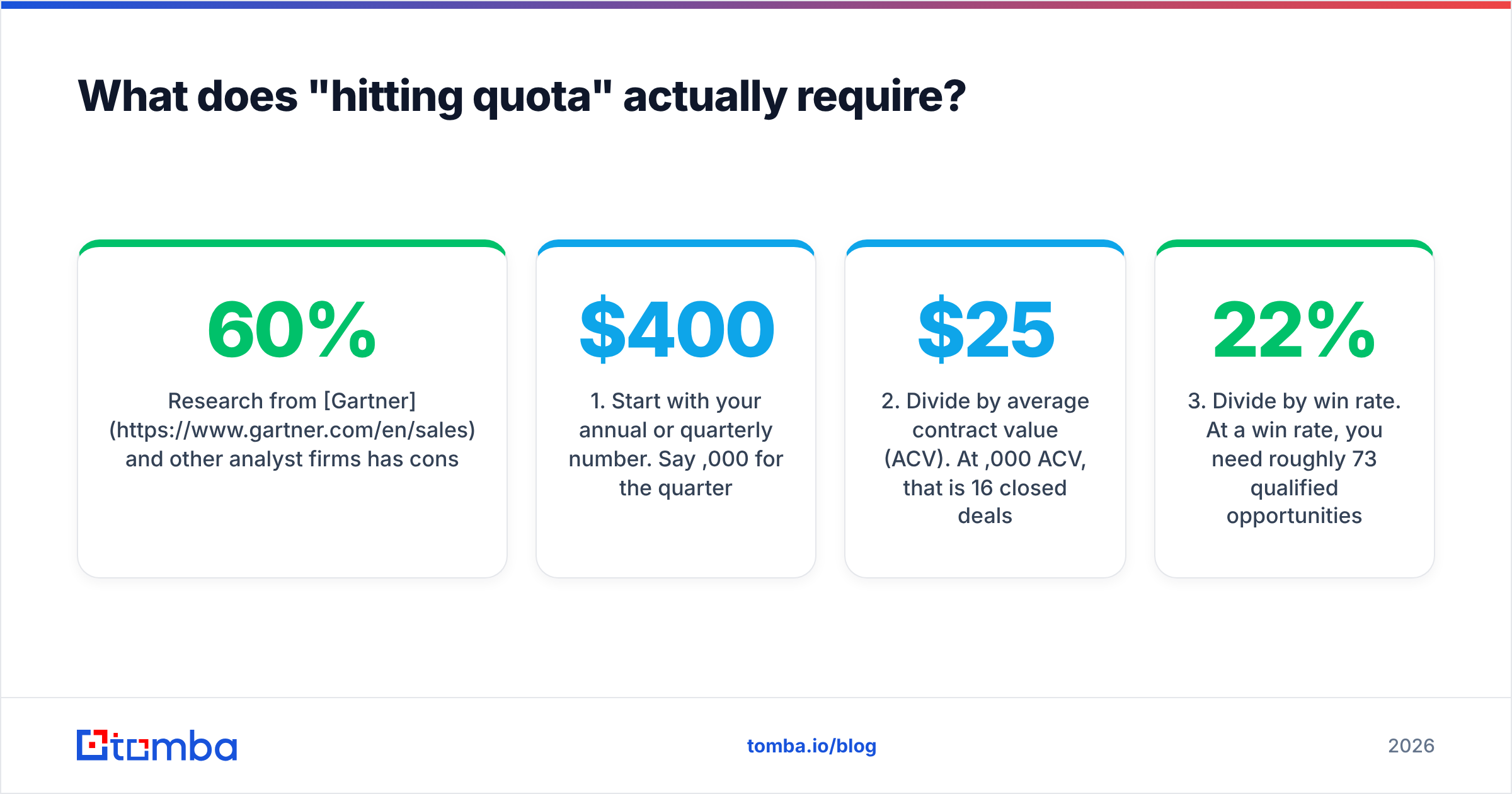
Research from Gartner and other analyst firms has consistently put B2B quota attainment somewhere in the 45-60% band, which means roughly half the reps on any given team end the year short. That is not a talent distribution. It is a planning distribution.
Here is the backwards math you should be able to recite from memory:
- Start with your annual or quarterly number. Say $400,000 for the quarter.
- Divide by average contract value (ACV). At $25,000 ACV, that is 16 closed deals.
- Divide by win rate. At a 22% win rate, you need roughly 73 qualified opportunities.
- Divide by opportunity conversion. If 30% of discovery calls become opportunities, you need about 243 discovery calls.
- Divide by meeting-book rate. At a 4% reply-to-meeting rate on cold outbound, you are looking at roughly 6,000 targeted contacts — or a much smaller number if you blend in referrals, inbound, and existing accounts.
That last line is where most quota plans quietly break. Nobody wants to write down "6,000 contacts." So they write down "prospect more" instead, and the quarter decides itself.
How much pipeline coverage do you actually need?#
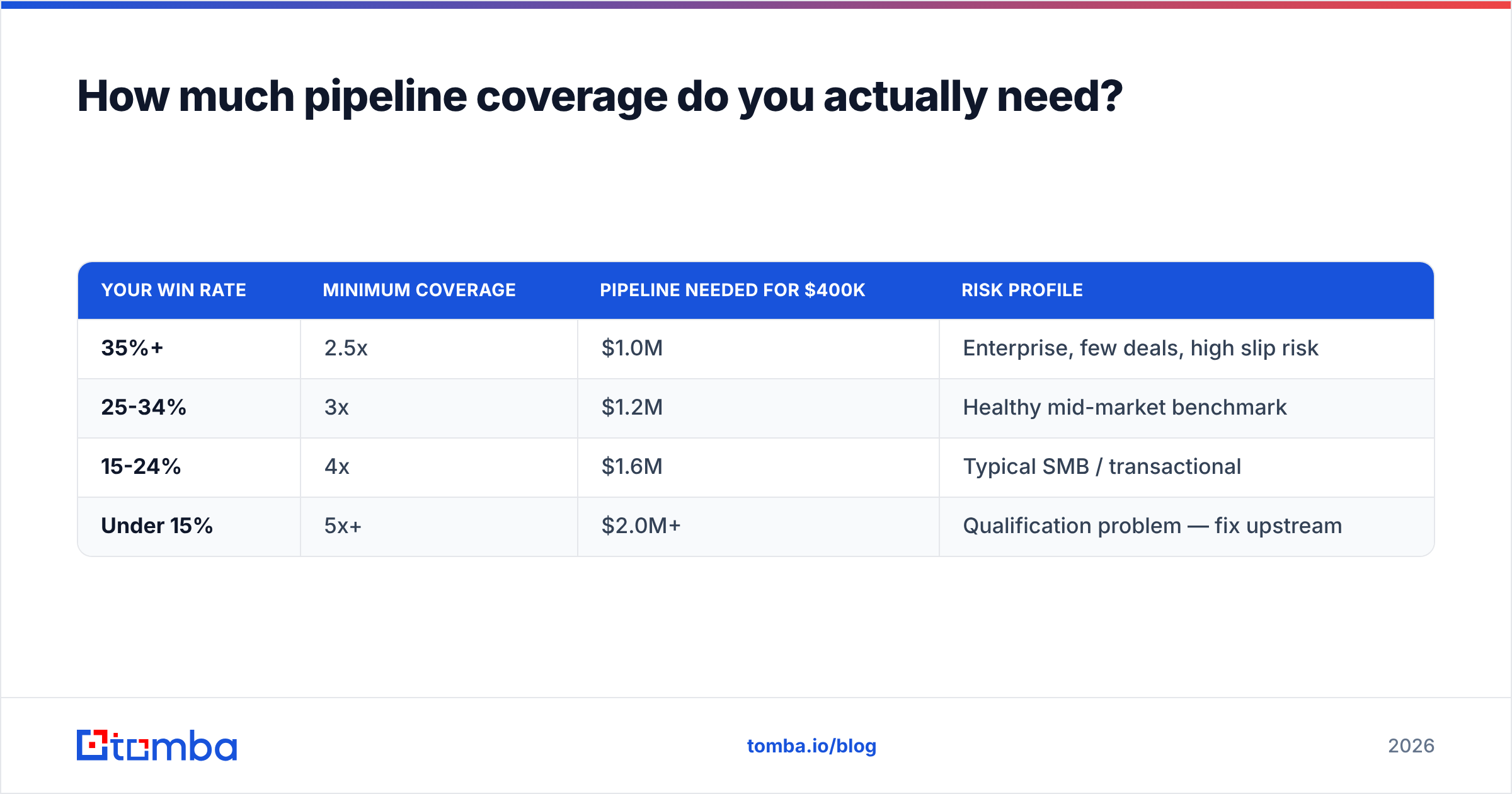
Multiply your remaining quota by the inverse of your win rate, then add a buffer for slippage. In practice that lands most reps between 3x and 5x.
| Your win rate | Minimum coverage | Pipeline needed for $400K | Risk profile |
|---|---|---|---|
| 35%+ | 2.5x | $1.0M | Enterprise, few deals, high slip risk |
| 25-34% | 3x | $1.2M | Healthy mid-market benchmark |
| 15-24% | 4x | $1.6M | Typical SMB / transactional |
| Under 15% | 5x+ | $2.0M+ | Qualification problem — fix upstream |
Two things people get wrong about coverage.
First, coverage is measured against remaining quota and remaining time, not the full-quarter number. In week 10 with $180,000 left to close, you need coverage on $180,000 in deals that can realistically close in three weeks — not on your original target.
Second, stale pipeline is not pipeline. An opportunity that has not moved a stage in 45 days is a story you are telling your manager. Purge it, or reclassify it to next quarter, and look at the honest number. Reps who inflate coverage to look safe in week 4 are the ones panicking in week 11.

What weekly rhythm do quota-hitters run?#
A fixed cadence, repeated without negotiation. The specific blocks matter less than the fact that they never move.
- Monday — pipeline hygiene (60 min). Update every open opportunity: stage, next step, date, and a one-line reason it is still alive. Anything without a scheduled next step gets one or gets closed.
- Tuesday through Thursday — prospecting block (90 min, same time daily). Calendar-blocked, phone on do-not-disturb. New contacts sourced, sequences launched, calls dialed. This is the block that pays your salary in 90 days.
- Wednesday — deal strategy (45 min). Pick your top three deals. For each, name the economic buyer, the compelling event, the competing option, and what could kill it. If you cannot name all four, that is this week's work.
- Thursday — multithreading sweep (30 min). Every deal over ACV should have at least three contacts engaged. Single-threaded deals are the number-one source of "we decided to go a different direction" in week 12.
- Friday — forecast and gap check (30 min). Update commit/best-case/pipeline. Compare coverage to the table above. If you are short, next week's prospecting block doubles.
That is roughly five hours a week of structure. Most reps spend more than that rewriting the same email in a different font.
The multithreading point deserves its own note. HubSpot's sales research and most enterprise buying studies put the average B2B buying committee at six to ten people. If you are talking to one, you are not running a deal — you are running a hope. Use a LinkedIn finder or domain search to map the rest of the account before your second call, not after your champion goes quiet.
Why do reps with good activity still miss?#
Because activity volume and activity quality are different variables, and the second one is where the leverage lives.
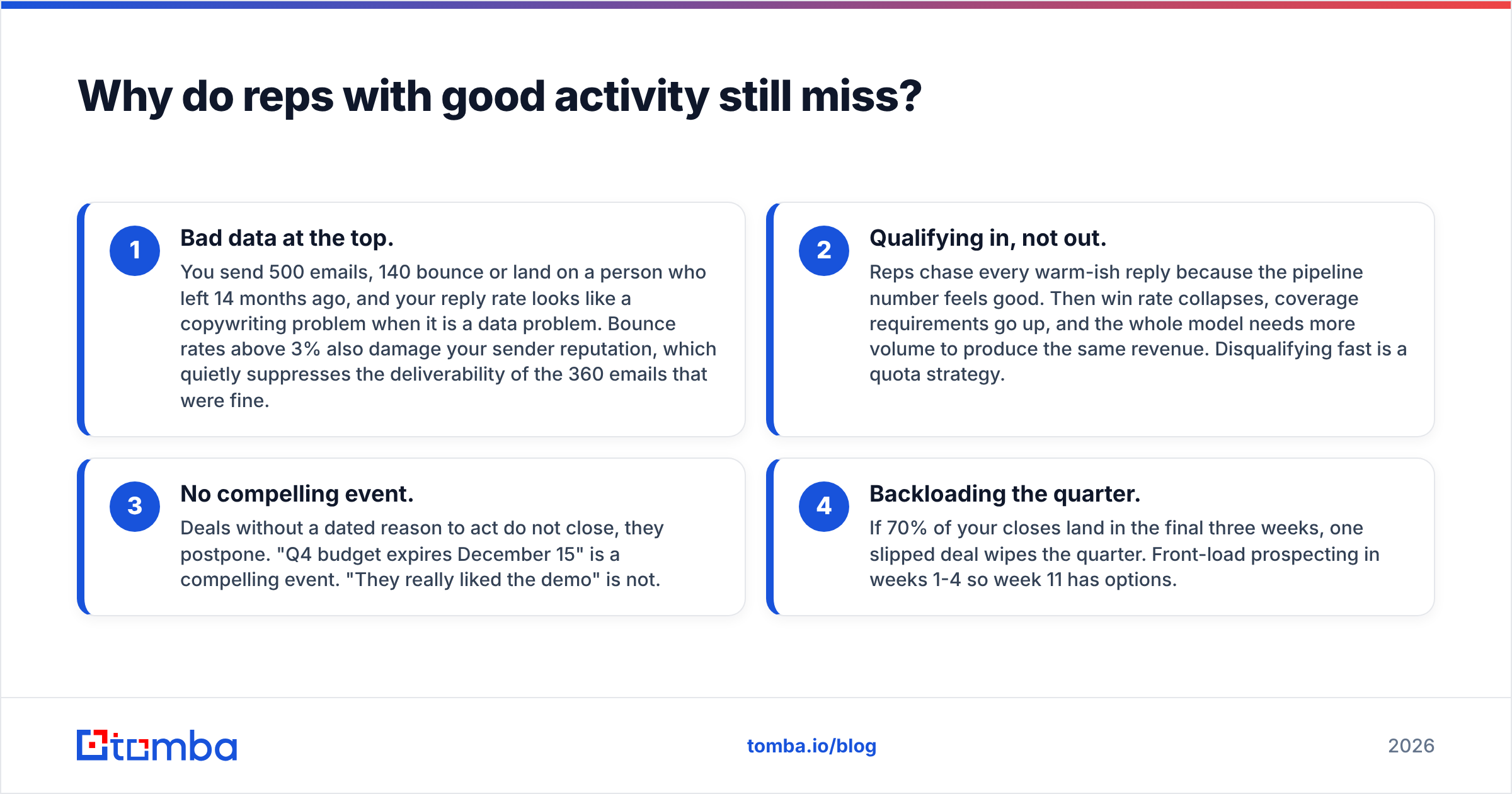
Four failure modes account for most misses:
- Bad data at the top. You send 500 emails, 140 bounce or land on a person who left 14 months ago, and your reply rate looks like a copywriting problem when it is a data problem. Bounce rates above 3% also damage your sender reputation, which quietly suppresses the deliverability of the 360 emails that were fine.
- Qualifying in, not out. Reps chase every warm-ish reply because the pipeline number feels good. Then win rate collapses, coverage requirements go up, and the whole model needs more volume to produce the same revenue. Disqualifying fast is a quota strategy.
- No compelling event. Deals without a dated reason to act do not close, they postpone. "Q4 budget expires December 15" is a compelling event. "They really liked the demo" is not.
- Backloading the quarter. If 70% of your closes land in the final three weeks, one slipped deal wipes the quarter. Front-load prospecting in weeks 1-4 so week 11 has options.
The data problem is the cheapest one to fix, and it is the one most reps ignore because it does not feel like selling. It is. Every hour spent on a contact who cannot receive your email is an hour not spent on one who can. Running your list through an email verifier before launch typically costs minutes and returns capacity you can measure.
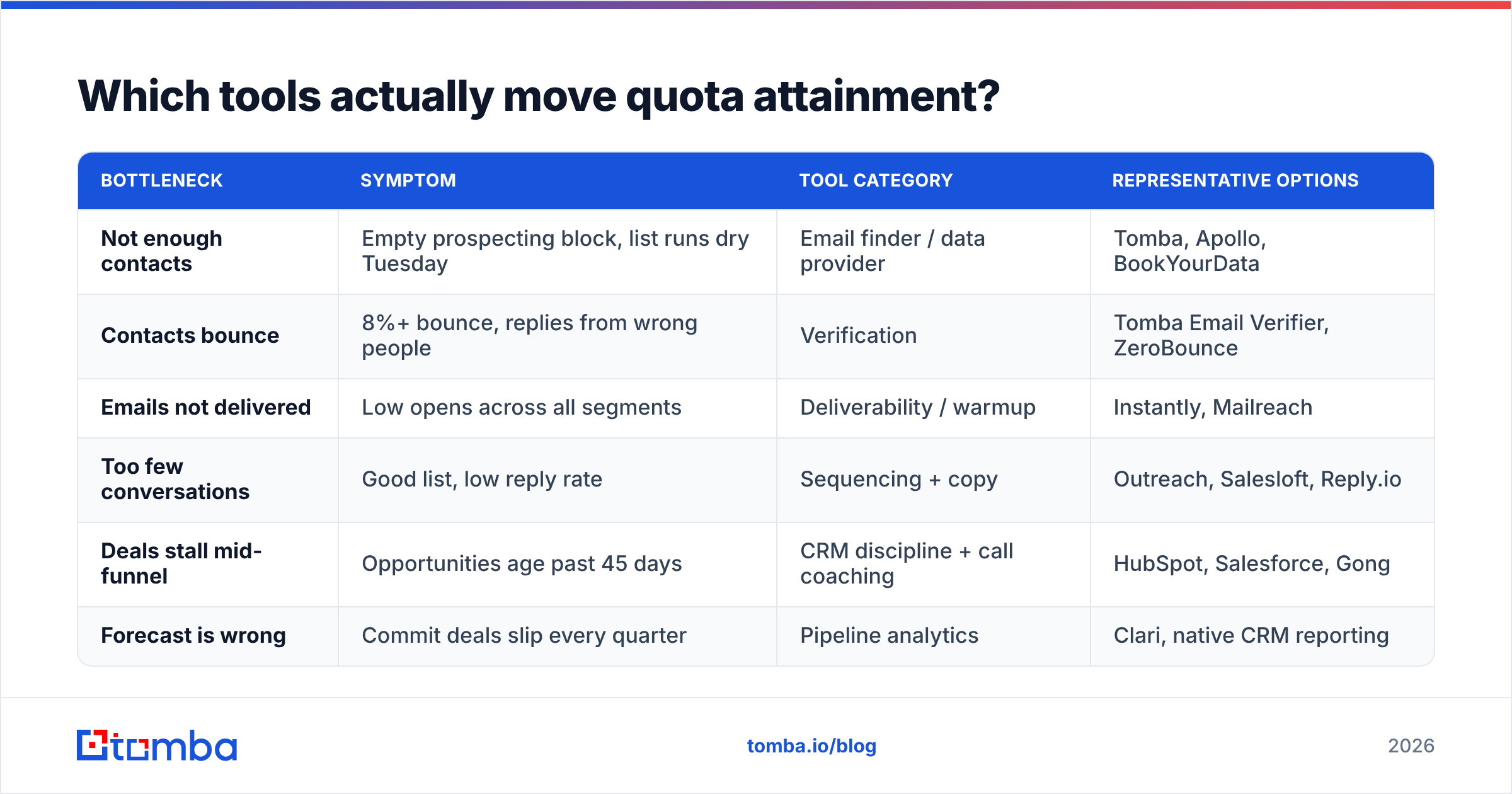
Which tools actually move quota attainment?#
Different bottlenecks need different tools. The mistake is buying a sequencer when your problem is that you have nobody to sequence.
| Bottleneck | Symptom | Tool category | Representative options |
|---|---|---|---|
| Not enough contacts | Empty prospecting block, list runs dry Tuesday | Email finder / data provider | Tomba, Apollo, BookYourData |
| Contacts bounce | 8%+ bounce, replies from wrong people | Verification | Tomba Email Verifier, ZeroBounce |
| Emails not delivered | Low opens across all segments | Deliverability / warmup | Instantly, Mailreach |
| Too few conversations | Good list, low reply rate | Sequencing + copy | Outreach, Salesloft, Reply.io |
| Deals stall mid-funnel | Opportunities age past 45 days | CRM discipline + call coaching | HubSpot, Salesforce, Gong |
| Forecast is wrong | Commit deals slip every quarter | Pipeline analytics | Clari, native CRM reporting |
A practical read on the first two rows: BookYourData is a strong option if you want a prepaid, pay-as-you-go list you own outright, which suits teams doing a few large campaigns per year. Tomba fits the other pattern — continuous, per-lookup sourcing and verification wired into your daily workflow, with Tomba pricing starting at a free tier of 25 searches/month, Starter at $49/mo, Growth at $99/mo, and Pro at $249/mo. Apollo bundles data with sequencing, which is convenient until you want to swap either half.
Choose based on whether your gap is a one-time list or a daily habit. Both are legitimate; they just cost differently over twelve months.
How do you close a mid-quarter gap without panic?#
Triage in this order, and give each step a fixed time box.
Week 1 of the gap — audit, do not accelerate. Pull every open opportunity. Score each on three questions: is there a compelling event, is the economic buyer engaged, and has it moved a stage in 30 days? Deals scoring zero out of three are not gap-closers. Knowing your real number is worth more than three days of frantic dialing.
Week 2 — mine the accounts you already touched. Closed-lost from two quarters ago, deals that went dark, and current customers with expansion room convert at multiples of cold outbound. Pull the contact list, check who has changed roles, and re-approach with a genuinely new reason. A reverse email lookup or a quick data enrichment pass will tell you which of your old contacts moved companies — and a champion who moved is the warmest lead you will get all quarter.
Week 3 — compress the top of funnel deliberately. Build one tightly-defined segment (same industry, same trigger, same pain), source verified contacts for it, and run a short high-relevance sequence. One hundred well-researched contacts in a single segment will outperform a thousand scattered ones, and the follow-up is easier because the message is the same.
Week 4 onward — protect the next quarter. This is the discipline almost nobody keeps. If you burn all remaining time on this quarter's gap, you start next quarter with zero pipeline and repeat the cycle. Preserve at least half your prospecting block for deals that close 90 days out.
One more note on the ordering: do not start with discounting. Price concessions to hit a date train buyers to wait, compress your ACV, and raise the deal count you need next quarter. Use them last and use them in exchange for something — a faster signature, a longer term, a reference commitment.
What metrics should you track weekly?#
Five numbers. Not fifteen. If you cannot recite them on Friday afternoon, you are not managing your quota, you are watching it.
- Pipeline coverage ratio — open pipeline that can close this period, divided by remaining quota. Target from the table above.
- Win rate, trailing 90 days — the denominator for everything else. If it moves, your whole plan changes.
- New qualified opportunities created this week — the single best leading indicator of next quarter. A zero here is an emergency even in a great month.
- Average deal age by stage — flags stalls before they become losses. Anything past 1.5x your normal stage duration gets a decision: advance or close.
- Reply-to-meeting rate on outbound — the health check on your list quality and messaging together. A sudden drop usually means data decay, not a copy failure.
Track them in a single sheet or a saved CRM view. The Google Sheets add-on is a reasonable place to keep your prospecting side of this if your CRM reporting is slow, and a free email checker is worth a bookmark for one-off verification before you send something important.
Also watch your response rate trend rather than any single week. Weekly outbound numbers are noisy; four-week rolling averages tell the truth.
What separates 110% reps from 68% reps?#
Not talent, and rarely territory. Three habits show up consistently.
They front-load. Prospecting effort peaks in weeks 1-5 of the quarter, when nobody feels urgency. That is exactly why it works — the pipeline they build in week 3 is what closes in week 12.
They disqualify without guilt. A 68% rep keeps a dead deal in the forecast because removing it makes the pipeline look thin. A 110% rep removes it in week 2 and spends the recovered hours on two live accounts.
They treat data as part of the craft. The list, the verification, the enrichment, the account map — they do this work themselves rather than treating it as beneath selling. It is the cheapest edge available, and it compounds because a clean list keeps deliverability healthy, which keeps reply rates stable, which keeps the whole funnel model predictable.
None of this is complicated. It is arithmetic, a calendar, and the willingness to look at a real number in week 4 instead of week 11.
Where should you start this week?#
Do the backwards math for your remaining quota today. Then compare the contacts-required line to how many verified, reachable contacts you actually have. For most reps, that comparison explains the entire quarter.
If the gap is on the contact side, the fastest fix is sourcing accurate, verified contacts for a tightly-defined segment rather than buying more volume. The Tomba Email Finder gives you professional emails by domain, name, or company, with verification built into the same workflow, so the list you build on Monday is a list that lands on Tuesday. Start on the free tier at 25 searches a month, and scale to Starter at $49/mo once you know how many contacts your quota math actually demands.
Related guides#
// get started
Find, verify and enrich your first contacts today
Start on the free plan with 25 searches a month, then scale when your team is ready.
Free plan · No credit card required · GDPR & CCPA
// about the author