How to Run a QBR: The 2026 Playbook for Sales Teams
Most QBRs are a slide deck nobody remembers. Here is a step-by-step agenda, prep checklist, and scorecard that turns your quarterly business review into a renewal and expansion engine.
TL;DR
- A QBR is not a status update. It is a 45-60 minute decision meeting where you and your customer agree on what changed, what it was worth, and what happens next quarter.
- The prep-to-meeting ratio that works: roughly 3 hours of data pulling and stakeholder mapping for every 1 hour in the room.
- Run it in seven blocks: outcomes recap, scorecard, gaps, roadmap, risks, expansion, next-quarter commitments. Nothing else.
- Bring one number the customer's boss cares about. Everything else is supporting evidence.
- The biggest QBR failure mode isn't the deck. It's inviting the wrong people — the economic buyer changed and nobody re-mapped the account.
What is a QBR, and what is it actually for?#
A QBR — quarterly business review — is a scheduled meeting between your team and a customer's team to review results from the last 90 days and align on the next 90. That's the textbook definition. It's also the one that produces useless meetings.
Here's the better frame: a QBR is a renewal rehearsal. Everything you say in it is a preview of the argument you'll make when the contract comes up. If you can't defend the value you delivered in a low-stakes quarterly meeting, you definitely can't defend it against a procurement team with a 15% cut target.
Three things separate a QBR from a regular check-in call:
- Attendance goes up a level. Your day-to-day champion is there, but so is someone who controls budget. If no budget holder is in the room, you scheduled a status call and mislabeled it.
- The unit of discussion is business outcome, not product usage. "Seats activated" is a check-in metric. "Time-to-first-response dropped from 14 hours to 3, which is why your CSAT moved 6 points" is a QBR metric.
- It ends in written commitments. Both sides leave with dated actions. No commitments means no meeting.
Internal QBRs — where a sales leader reviews a rep's or region's numbers — share the structure but flip the audience. Most of this playbook applies to both; where they diverge, I'll flag it.
When should you run a QBR (and when should you skip it)?#
Not every account earns one. Running QBRs on accounts that can't absorb them burns your CS team's calendar and irritates customers who have nothing to review.
Use a simple threshold: run QBRs on accounts in your top revenue tier, accounts with a renewal inside two quarters, and accounts flagged at-risk. Everything else gets a lighter-weight semi-annual touch or an automated value report.
Timing matters more than people admit. Schedule the QBR in week 2 or 3 of the new quarter — late enough that last quarter's data is closed, early enough that the commitments you make still have 10 weeks to land. Running it in week 8 means you're reviewing stale data and asking for changes nobody can execute.
Skip the QBR entirely when:
- The account has been live under 60 days. You have no trend line. Run an onboarding review instead.
- Your champion just left and you haven't re-mapped the account. Fix the mapping first — see the stakeholder section below.
- There's an open escalation. Solve the fire, then review. A QBR on top of an unresolved outage reads as tone-deaf.
How do you prepare for a QBR?#
Prep is where QBRs are won. The meeting is just delivery.
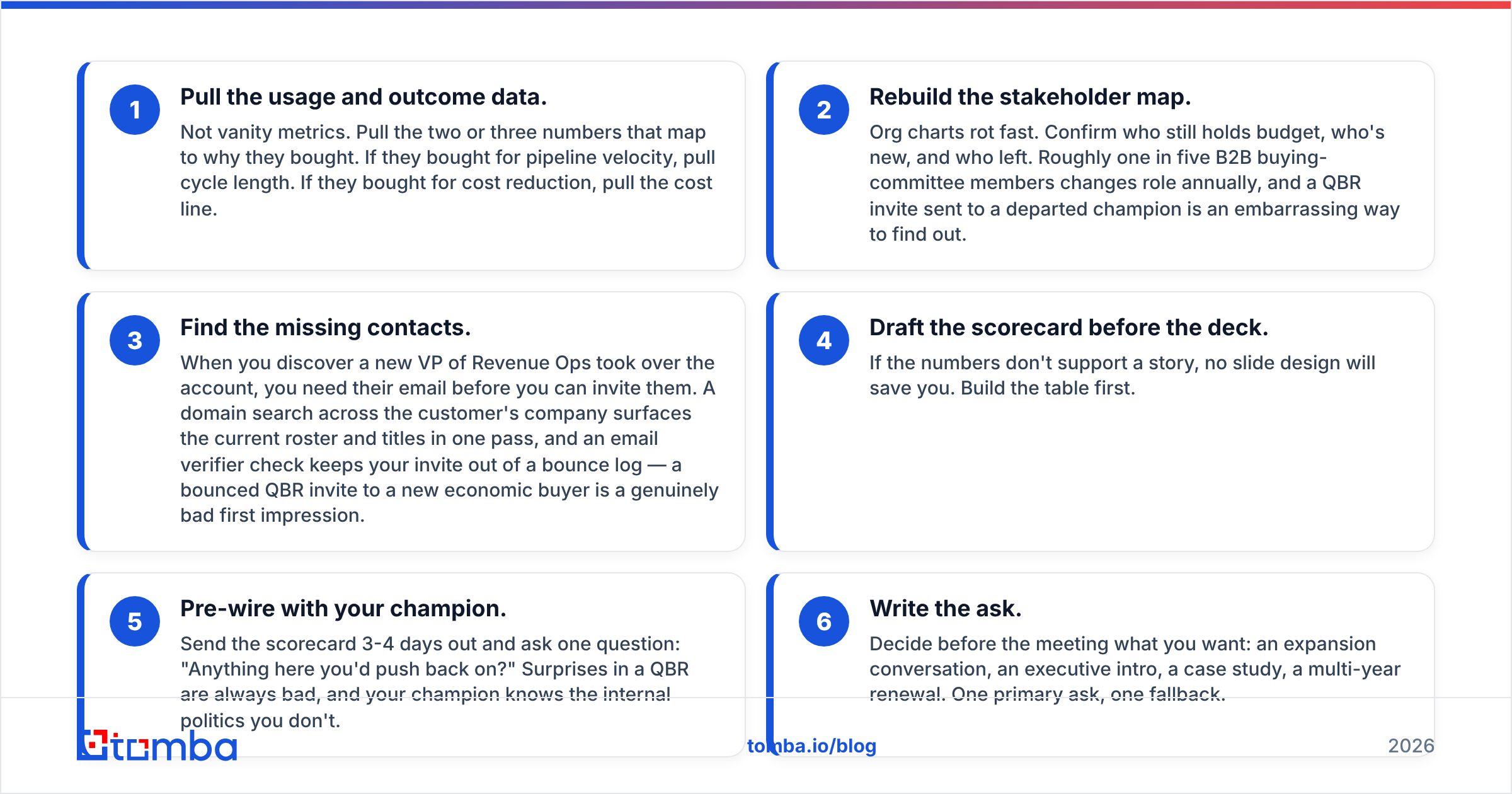
Budget three hours of prep for every hour of meeting. Here's what those hours go into:
- Pull the usage and outcome data. Not vanity metrics. Pull the two or three numbers that map to why they bought. If they bought for pipeline velocity, pull cycle length. If they bought for cost reduction, pull the cost line.
- Rebuild the stakeholder map. Org charts rot fast. Confirm who still holds budget, who's new, and who left. Roughly one in five B2B buying-committee members changes role annually, and a QBR invite sent to a departed champion is an embarrassing way to find out.
- Find the missing contacts. When you discover a new VP of Revenue Ops took over the account, you need their email before you can invite them. A domain search across the customer's company surfaces the current roster and titles in one pass, and an email verifier check keeps your invite out of a bounce log — a bounced QBR invite to a new economic buyer is a genuinely bad first impression.
- Draft the scorecard before the deck. If the numbers don't support a story, no slide design will save you. Build the table first.
- Pre-wire with your champion. Send the scorecard 3-4 days out and ask one question: "Anything here you'd push back on?" Surprises in a QBR are always bad, and your champion knows the internal politics you don't.
- Write the ask. Decide before the meeting what you want: an expansion conversation, an executive intro, a case study, a multi-year renewal. One primary ask, one fallback.
That third step is the one teams skip and then regret. Keeping account contact data current — titles, emails, direct lines — is unglamorous work, but it's the difference between a QBR with the decision maker and a QBR with a note-taker. Bulk-refreshing your account roster through data enrichment before quarter-end takes an afternoon and saves you the whole quarter.
What does a good QBR agenda look like?#
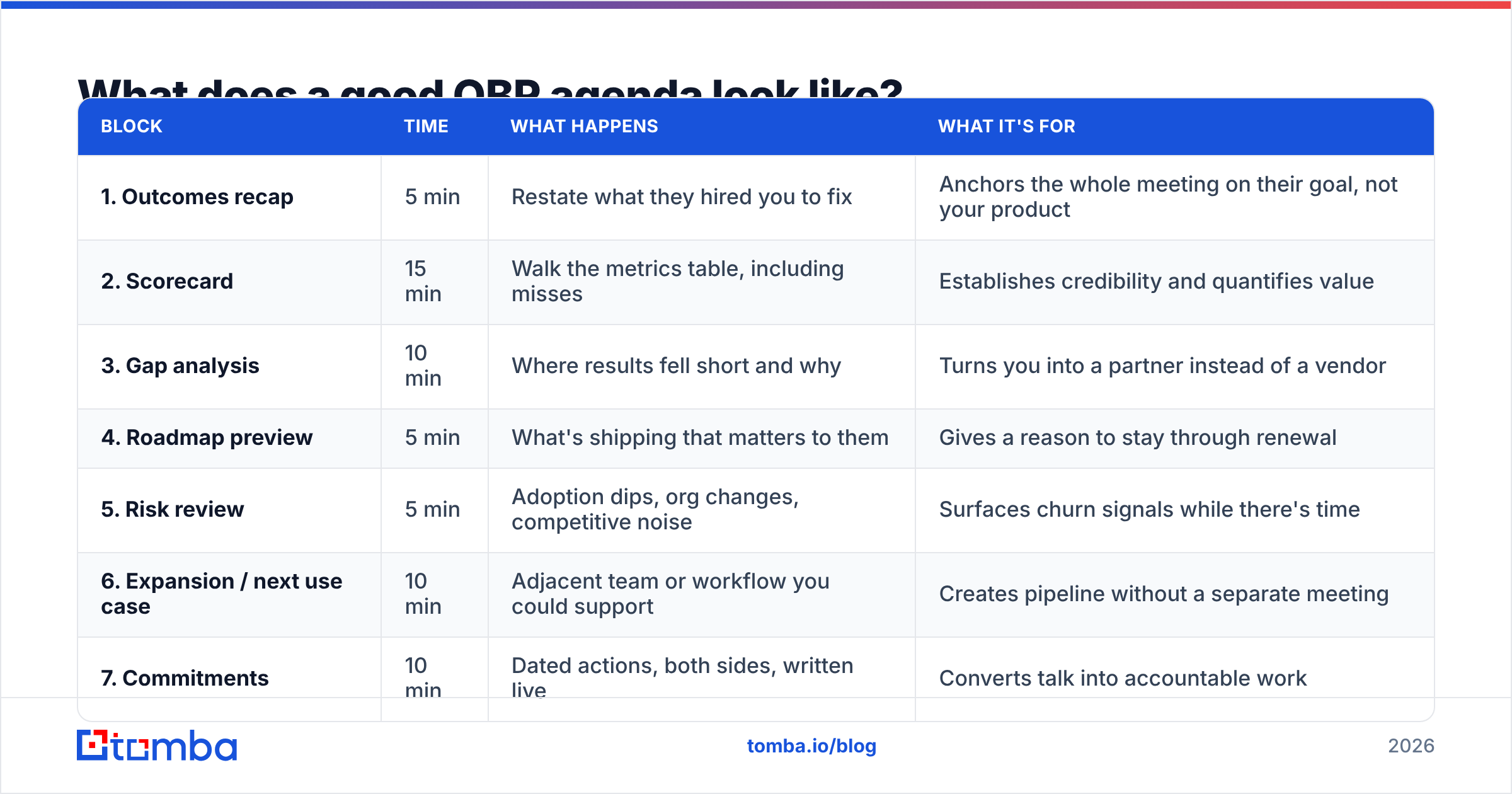
Sixty minutes, seven blocks. If you're running 30 minutes, cut blocks 4 and 6, not block 2.
| Block | Time | What happens | What it's for |
|---|---|---|---|
| 1. Outcomes recap | 5 min | Restate what they hired you to fix | Anchors the whole meeting on their goal, not your product |
| 2. Scorecard | 15 min | Walk the metrics table, including misses | Establishes credibility and quantifies value |
| 3. Gap analysis | 10 min | Where results fell short and why | Turns you into a partner instead of a vendor |
| 4. Roadmap preview | 5 min | What's shipping that matters to them | Gives a reason to stay through renewal |
| 5. Risk review | 5 min | Adoption dips, org changes, competitive noise | Surfaces churn signals while there's time |
| 6. Expansion / next use case | 10 min | Adjacent team or workflow you could support | Creates pipeline without a separate meeting |
| 7. Commitments | 10 min | Dated actions, both sides, written live | Converts talk into accountable work |
Two rules about this agenda. First, block 3 is non-negotiable. Presenting only wins makes every future claim suspect. Naming a miss before the customer does buys you more credibility than three green metrics. Second, block 7 happens on a shared screen, typed live, with owners and dates. Sending notes afterward is not the same thing — half the room stops paying attention once they believe someone else is writing it down.
Internal QBRs swap block 6 for a forecast-commitment review, and block 4 for territory or quota changes. Same skeleton.
Which metrics belong on a QBR scorecard?#
The scorecard is the meeting. Everything else is context.
Pick 5-7 metrics, no more. Each one needs a baseline, a current value, a target, and a plain-language "so what." A number without a "so what" is a number the customer will forget by lunch.
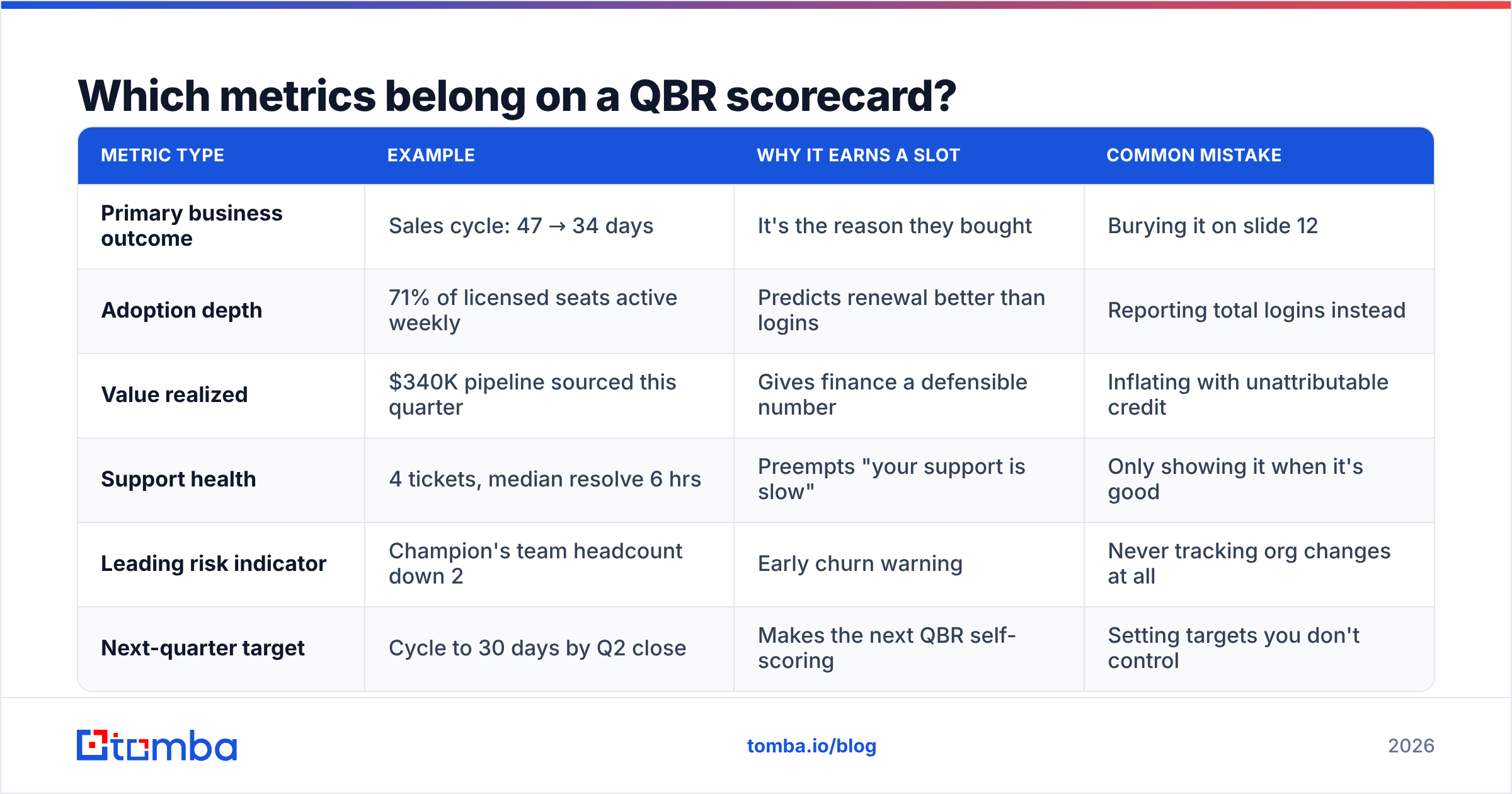
| Metric type | Example | Why it earns a slot | Common mistake |
|---|---|---|---|
| Primary business outcome | Sales cycle: 47 → 34 days | It's the reason they bought | Burying it on slide 12 |
| Adoption depth | 71% of licensed seats active weekly | Predicts renewal better than logins | Reporting total logins instead |
| Value realized | $340K pipeline sourced this quarter | Gives finance a defensible number | Inflating with unattributable credit |
| Support health | 4 tickets, median resolve 6 hrs | Preempts "your support is slow" | Only showing it when it's good |
| Leading risk indicator | Champion's team headcount down 2 | Early churn warning | Never tracking org changes at all |
| Next-quarter target | Cycle to 30 days by Q2 close | Makes the next QBR self-scoring | Setting targets you don't control |
A few hard-won notes on metric hygiene:
- Use their numbers, not yours, wherever possible. A figure pulled from the customer's own CRM beats the same figure from your dashboard. It's unarguable.
- Show the trend, not the snapshot. Four quarters of a line beats one quarter of a bar. Trends survive skeptical CFOs; snapshots don't.
- Attribute honestly. If their pipeline grew 40% and they also hired six reps, say so. Overclaiming is the fastest way to lose the executive in the room. Gartner's research on buyer trust consistently finds that suppliers who acknowledge limits close more, not less — see Gartner's B2B buying research for the underlying data.
- Track response rate and cycle metrics the same way each quarter. Changing definitions between QBRs destroys the trend line, and someone will notice.
How do you handle a QBR when the numbers are bad?#
You run it anyway, earlier, with a shorter deck.
The instinct to postpone a QBR during a rough quarter is exactly backwards. A bad-quarter QBR that you initiate is a partnership conversation. A bad-quarter QBR that the customer initiates is a save call with a worse seat at the table.
Structure it differently:
- Lead with the miss. First 90 seconds. "Adoption is at 34% against a 60% target. Here's what we think happened and what we're proposing."
- Separate causes into yours, theirs, and shared. Own yours completely and specifically. Name theirs without accusation — "the two admins who ran the rollout both moved to the new platform team" is a fact, not a jab.
- Bring a remediation plan with dates and named owners on your side. Not "we'll improve enablement." Rather: "Priya runs a 45-minute admin refresh on the 14th, and I'll send adoption deltas weekly for six weeks."
- Ask for one thing from them. Usually access — to a team, an exec, or a workflow you've been locked out of.
- Set a 30-day checkpoint. Don't wait a full quarter to find out if the fix worked.
The pattern to avoid: a beautifully designed 40-slide deck that spends 35 slides on activity and 5 on results. Activity slides are what teams produce when results are thin, and every experienced buyer knows it. Fewer slides, harder numbers.
What tools do you need to run QBRs at scale?#
You need four capabilities, and most teams already own three of them under different names.
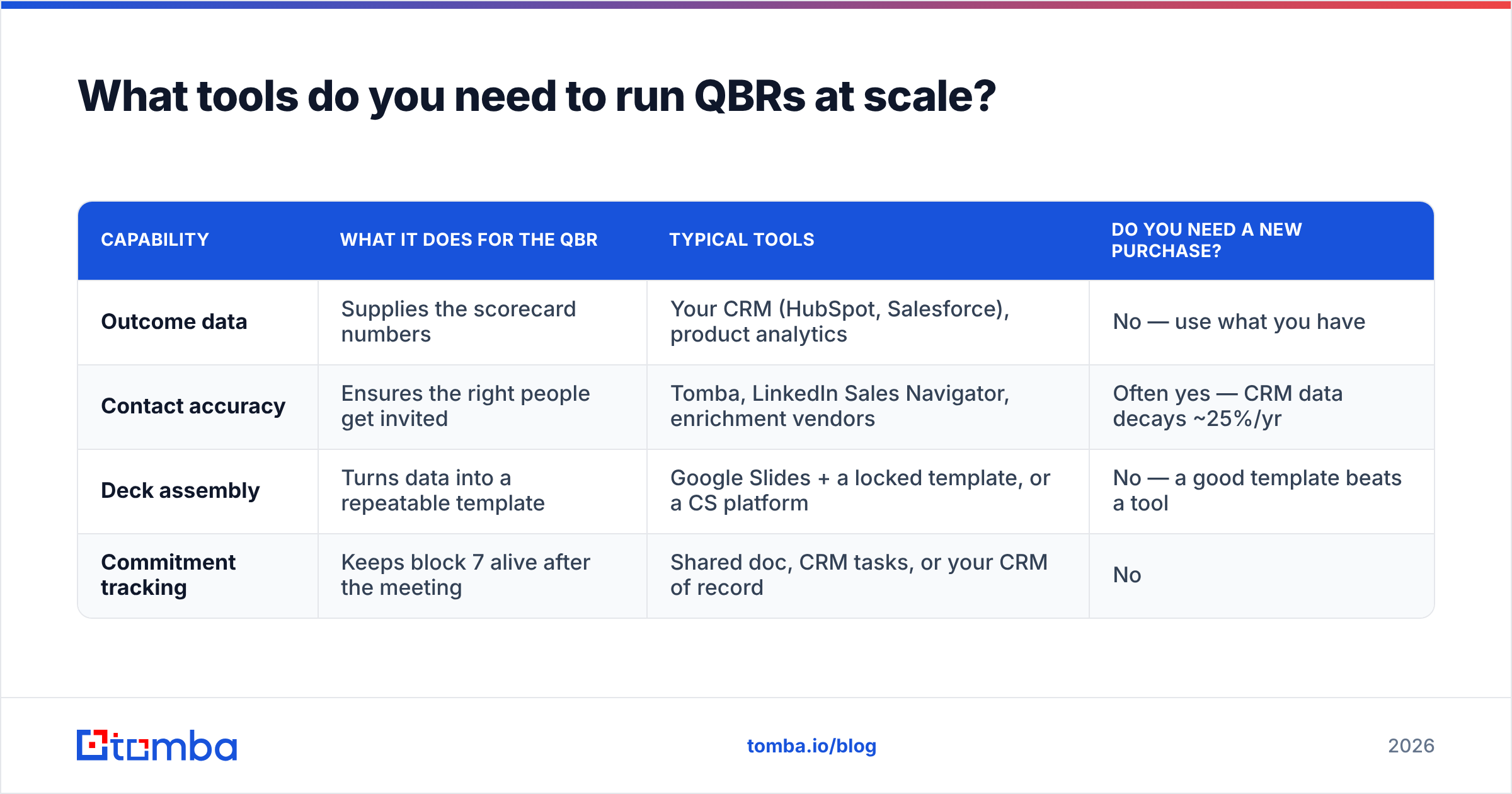
| Capability | What it does for the QBR | Typical tools | Do you need a new purchase? |
|---|---|---|---|
| Outcome data | Supplies the scorecard numbers | Your CRM (HubSpot, Salesforce), product analytics | No — use what you have |
| Contact accuracy | Ensures the right people get invited | Tomba, LinkedIn Sales Navigator, enrichment vendors | Often yes — CRM data decays ~25%/yr |
| Deck assembly | Turns data into a repeatable template | Google Slides + a locked template, or a CS platform | No — a good template beats a tool |
| Commitment tracking | Keeps block 7 alive after the meeting | Shared doc, CRM tasks, or your CRM of record | No |
The only line where teams routinely underinvest is contact accuracy. Everything else in a QBR is process discipline you can install for free. But if the invite goes to a stale distribution list, the process discipline doesn't matter — you'll deliver a flawless meeting to the wrong audience.
Practical pattern for a 40-account book: once a quarter, export your account contacts, run them through a bulk verify pass to catch dead addresses, then use domain search on any account where you lost more than one contact. You'll typically surface two or three new stakeholders per account you didn't know existed. That's your invite list, and it's also your expansion list.
For pricing context: Tomba's free tier covers 25 searches a month, which is enough to test the workflow on a handful of accounts. Starter runs $49/mo and Growth $99/mo — see Tomba pricing for the full breakdown. Peer tools like BookYourData take a different route with prepaid list credits, which suits teams buying contact data in large one-off batches rather than refreshing an existing book continuously. Both models work; pick based on whether your need is bursty or recurring. G2's sales intelligence category is a reasonable place to compare the field without vendor framing.
How do you follow up after a QBR?#
Within 24 hours, send a recap that a person who wasn't there could act on. Structure:
- Three-line summary of what was agreed. No preamble.
- The commitments table, copied verbatim from block 7, with owners and dates.
- The scorecard, attached or linked — not re-explained.
- One next date, already on the calendar.
Then do the unglamorous part: put every commitment into your CRM as a task with the real due date, including yours. QBR commitments that live only in an email thread have a completion rate somewhere close to nothing. Commitments in a pipeline system get chased.
At the 30-day mark, send a two-paragraph progress note against those commitments. This single habit is what makes the next QBR easy — you show up with a completed action list instead of a fresh apology, and your win rate on renewals climbs for reasons that have nothing to do with your product.
What does a QBR look like end to end?#
Putting the whole thing together for one account, one quarter:
- T-21 days: Confirm date, send hold to champion, ask who else should attend.
- T-14 days: Re-map stakeholders, find and verify new contacts, send invites.
- T-10 days: Pull data, build the scorecard table, identify the one miss you'll lead with.
- T-4 days: Pre-wire with the champion. Send the scorecard. Ask what you got wrong.
- T-1 day: Finalize deck (target: 8-12 slides), rehearse the first two minutes out loud.
- Day 0: Run the seven blocks. Type commitments live.
- T+1 day: Recap email with commitments table.
- T+30 days: Progress note against commitments.
- T+45 days: Book the next QBR.
That's it. No QBR needs to be more complicated than this, and most that are complicated are compensating for thin results.
Get the right people in the room#
The single highest-leverage fix for most QBR programs isn't the agenda or the deck template — it's making sure the invite reaches the person who signs the renewal. Champions move, budgets shift, and CRM contact records go stale faster than anyone budgets for.
Before your next quarter-end, run your account list through the Tomba Email Finder to surface and verify current decision-maker contacts at every account you're reviewing. Start on the free tier with 25 searches to pressure-test it against a few accounts, then scale up if the new stakeholders you uncover justify it. A QBR delivered to the right room is worth ten delivered to the wrong one.
Related guides#
// get started
Find, verify and enrich your first contacts today
Start on the free plan with 25 searches a month, then scale when your team is ready.
Free plan · No credit card required · GDPR & CCPA
Get the Tomba newsletter
Product and data updates
// about the author