Sales Playbooks and Battlecards: A 2026 Enablement Guide
Playbooks tell reps what to do; battlecards tell them what to say when a deal gets hard. Here's how to build both inside Sales Hub and make them stick in 2026.
TL;DR
- A sales playbook is the repeatable process for a play (the discovery call, the renewal, the multi-threaded enterprise deal). A battlecard is the in-the-moment answer when a prospect names a competitor, raises a pricing objection, or stalls.
- Sales Hub (HubSpot) ships native Playbooks as interactive call guides; battlecards usually live as snippets, knowledge-base cards, or a connected tool — and the magic is wiring them to the deal stage so they surface automatically.
- Static PDFs die in a shared drive. The enablement content reps actually use is short, embedded in the CRM, and updated the week competitors change pricing.
- Measure adoption (open rate, attach rate to closed-won) before you measure volume. A library of 80 unopened playbooks is worse than four that every rep runs.
- Good data feeds good plays: a battlecard is useless if the contact record is wrong. Clean, enriched records make every play land.
What is the difference between a sales playbook and a battlecard?#
Here's the one-line version: a playbook is a process, a battlecard is a script fragment. A playbook walks a rep through an entire motion — the qualification call, the security review, the win-back. A battlecard is the quick-reference card they glance at when a single moment goes sideways: "They said Salesforce is cheaper," "They want SOC 2 proof," "Procurement wants a 20% discount."
Think of it like a restaurant. The playbook is the recipe and prep list for the whole dinner service — order of operations, timing, what good looks like. The battlecard is the laminated card taped above the line that says "if the salmon comes back, fire a new one and comp the app." One is the plan; the other is the fast answer when the plan meets reality.
Both belong to sales enablement, the discipline of giving reps the content, training, and tools to sell consistently. In 2026 the bar is higher: buyers arrive more informed, cycles involve more stakeholders, and a rep who improvises every objection loses to one who has a tested answer ready. According to Gartner research on B2B buying, buyers spend only a fraction of the cycle with any single vendor — so the minutes you do get have to be high-signal. That is exactly what playbooks and battlecards protect.
Why do most playbooks and battlecards fail?#
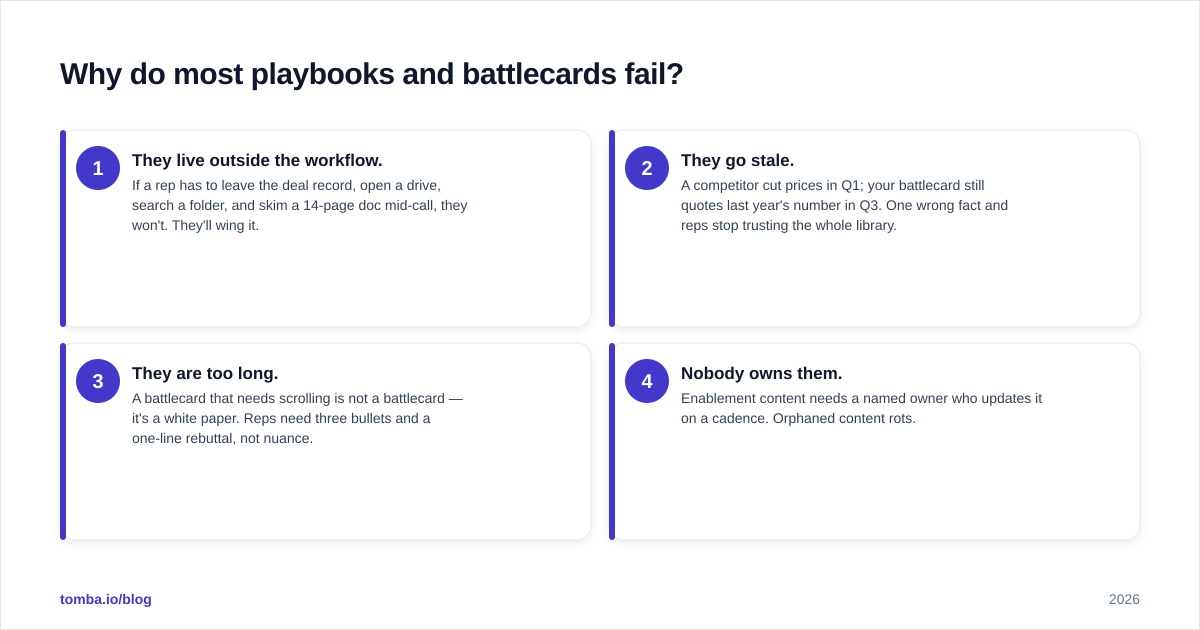
Because they are built once, exported to PDF, and forgotten. The failure pattern is predictable:
- They live outside the workflow. If a rep has to leave the deal record, open a drive, search a folder, and skim a 14-page doc mid-call, they won't. They'll wing it.
- They go stale. A competitor cut prices in Q1; your battlecard still quotes last year's number in Q3. One wrong fact and reps stop trusting the whole library.
- They are too long. A battlecard that needs scrolling is not a battlecard — it's a white paper. Reps need three bullets and a one-line rebuttal, not nuance.
- Nobody owns them. Enablement content needs a named owner who updates it on a cadence. Orphaned content rots.
The fix is structural, not motivational. You don't get adoption by telling reps to "use the playbook more." You get it by putting the right card in front of them at the exact deal stage where they need it, and by keeping it current. That's the whole game.
How does Sales Hub handle playbooks and battlecards?#
HubSpot's Sales Hub treats Playbooks as a first-class object: interactive, in-record guides that a rep opens directly on a contact, company, or deal. A playbook can embed standardized question fields (so discovery answers write back to CRM properties), step-by-step talk tracks, and links to supporting content. Because it lives on the record, the rep never leaves the deal.
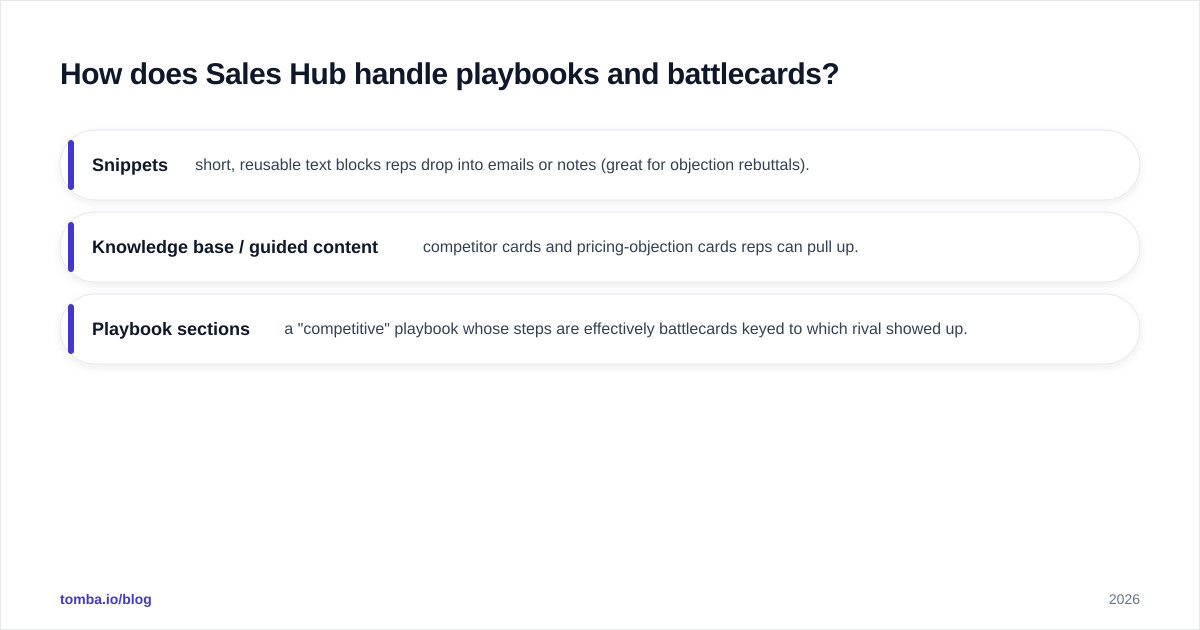
Battlecards are handled a little differently. Sales Hub doesn't ship a object literally named "battlecard," so teams build them as:
- Snippets — short, reusable text blocks reps drop into emails or notes (great for objection rebuttals).
- Knowledge base / guided content — competitor cards and pricing-objection cards reps can pull up.
- Playbook sections — a "competitive" playbook whose steps are effectively battlecards keyed to which rival showed up.
The strategic move is to connect both to deal stage and deal properties. When a deal flips to "Evaluating competitors," the competitive playbook should be one click away. When a contact's industry is "Healthcare," the HIPAA battlecard surfaces. This is where clean CRM data earns its keep — and why a connected enrichment layer like the HubSpot integration matters: the play is only as smart as the record it reads from.
Playbook vs. battlecard: which do you build first?#
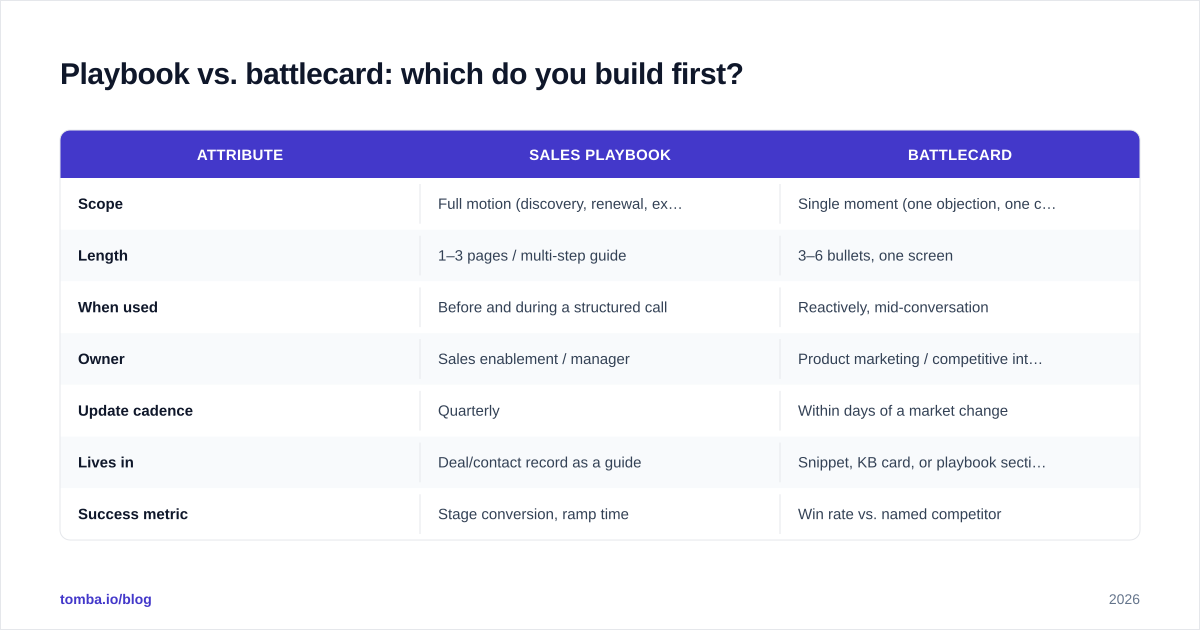
Build the playbook for your highest-volume motion first, then carve battlecards out of the objections that show up inside it. Here's how the two compare on the attributes that decide where each fits:
| Attribute | Sales Playbook | Battlecard |
|---|---|---|
| Scope | Full motion (discovery, renewal, expansion) | Single moment (one objection, one competitor) |
| Length | 1–3 pages / multi-step guide | 3–6 bullets, one screen |
| When used | Before and during a structured call | Reactively, mid-conversation |
| Owner | Sales enablement / manager | Product marketing / competitive intel |
| Update cadence | Quarterly | Within days of a market change |
| Lives in | Deal/contact record as a guide | Snippet, KB card, or playbook section |
| Success metric | Stage conversion, ramp time | Win rate vs. named competitor |
The sequencing matters. If you try to write battlecards before you understand the motion, you'll cover objections that never come up and miss the three that kill deals. Run the playbook for a quarter, log every objection in the CRM, then build battlecards for the top five. Let real losses — not imagined ones — set your priorities.
What goes into a battlecard that reps actually use?#
Keep it to a single screen and lead with the rebuttal, not the background. A competitive battlecard that works in 2026 has five parts:
- The trigger — when to pull this card ("prospect mentions [Competitor]").
- Their pitch in one line — what the competitor claims, stated fairly. Strawmen get reps caught off guard.
- Your wedge — the one or two dimensions where you genuinely win. Be honest; reps can feel a fake claim and so can buyers.
- The landmines — questions to plant that expose the competitor's weak spots ("Ask them how long catch-all verification takes").
- Proof — one customer quote or stat, linked, not pasted in full.
Cross-check your competitive claims against a neutral source like G2 category grids so the card reflects how buyers actually compare, not just internal opinion. Reps trust cards that match what the prospect already read.
For pricing-objection battlecards, the structure is the same but the wedge is value framing, not feature parity. "We're more expensive because X costs you Y when it breaks" beats "we have more features." Tie it to a metric the buyer owns — pipeline created, hours saved, win rate lifted.
How do you keep enablement content from going stale?#
Assign an owner, set a review cadence, and instrument adoption. The three controls:
1. Ownership. Every playbook and battlecard gets a named owner and a "last reviewed" date visible on the card. No date, no trust.
2. Cadence by volatility. Competitive battlecards review monthly or whenever a rival changes pricing or ships a major feature. Process playbooks review quarterly. Foundational cards (your ICP, your discovery framework) review twice a year. Match the cadence to how fast the underlying truth moves.
3. Adoption instrumentation. Track open rate per playbook, attach rate to closed-won deals, and which battlecards correlate with wins against each competitor. In Sales Hub you can report on playbook usage; pair that with deal outcomes to see which content earns its place. Kill the bottom quartile every quarter — a lean, trusted library beats a bloated one.
This is also where sales automation helps: automatically prompt the right play when a deal hits a stage, auto-surface the competitor card when a competitor field is set, and nudge managers when a high-value deal stalls without the relevant playbook ever being opened.
Where does data quality fit into playbooks and battlecards?#
A battlecard fires on the wrong contact and the whole play misfires. Enablement content is downstream of data: the play assumes the record is right — right title, right company, right industry, reachable email. If your "enterprise security review" playbook triggers on a deal where the champion's contact info is three jobs out of date, the rep runs the right play against the wrong person.
That's why the unglamorous layer underneath enablement is contact accuracy and reachability. Before a rep ever opens a playbook, the motion depends on having a verified decision-maker to run it against. Tools that find and verify professional contacts — like an email finder and an email verifier — keep the records clean enough that your plays target real, current buyers instead of bounced ghosts. Garbage in, wasted play out.
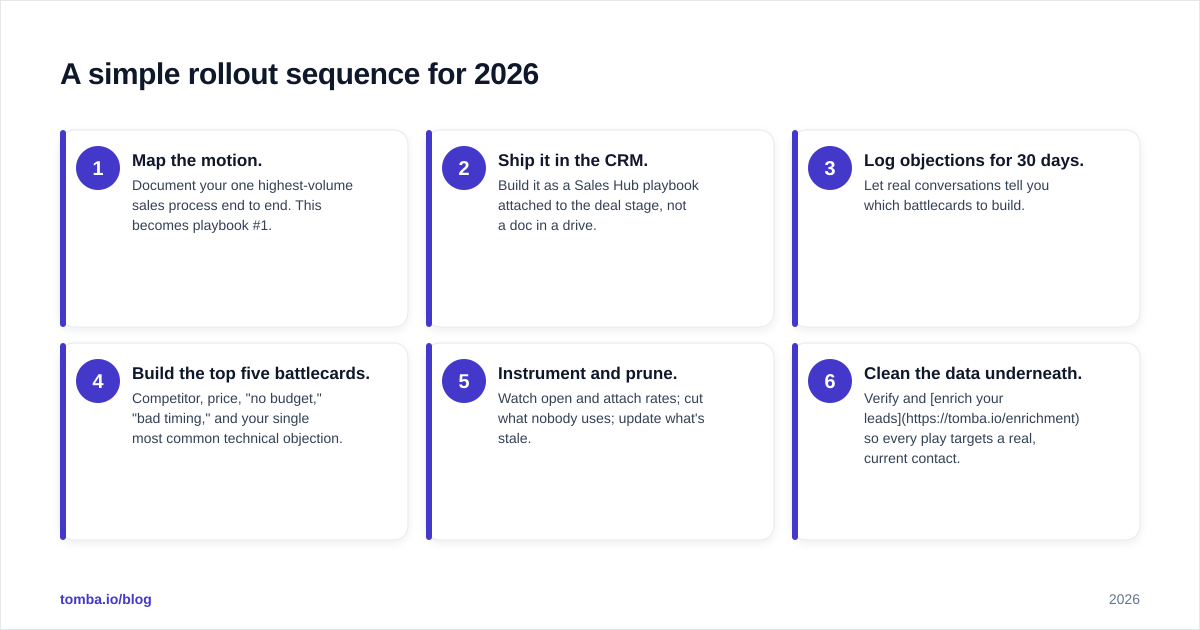
A simple rollout sequence for 2026#
If you're starting from a blank slate, run this order rather than trying to build everything at once:
- Map the motion. Document your one highest-volume sales process end to end. This becomes playbook #1.
- Ship it in the CRM. Build it as a Sales Hub playbook attached to the deal stage, not a doc in a drive.
- Log objections for 30 days. Let real conversations tell you which battlecards to build.
- Build the top five battlecards. Competitor, price, "no budget," "bad timing," and your single most common technical objection.
- Instrument and prune. Watch open and attach rates; cut what nobody uses; update what's stale.
- Clean the data underneath. Verify and enrich your leads so every play targets a real, current contact.
Notice what's not on the list: building 50 playbooks, perfecting design, or buying a separate enablement platform before you've proven adoption on four pieces of content. Earn the right to scale by proving the small library works first.
Frequently asked questions#
Do I need a dedicated enablement tool, or is Sales Hub enough? For most teams under a few hundred reps, native Sales Hub Playbooks plus snippets and a knowledge base cover the job. Dedicated platforms (Highspot, Seismic) earn their cost when you need deep content analytics, large asset libraries, and tight learning-management integration. Start native; graduate when adoption data proves you've outgrown it.
How long should a battlecard be? One screen, no scrolling. If it doesn't fit, it's a playbook, not a battlecard. Reps use it mid-conversation — they have seconds, not minutes.
Who should own competitive battlecards? Product marketing or a competitive-intel owner, with input from your best reps. The people closest to lost deals know which claims actually land.
How do playbooks affect ramp time? A documented, in-CRM motion is the single biggest lever on new-rep ramp. Instead of shadowing for months, a new rep runs the same play your top performer runs, with the talk track in front of them. Measure ramp before and after — it's usually the clearest ROI you'll show.
Build the data layer your plays run on#
Playbooks and battlecards are only as good as the contacts they target. Before you script the perfect competitive rebuttal, make sure your reps are running it against verified, current decision-makers — not stale records that bounce. Tomba's Email Finder finds and verifies professional email addresses by name, company, or domain, so every play in your library lands on a real person who can actually say yes. Check the Tomba pricing tiers — there's a free plan to test it — and connect it to your CRM so your enablement content always fires on clean data. Build the plays; we'll keep the records honest.
// get started
Find, verify and enrich your first contacts today
Start on the free plan with 25 searches a month, then scale when your team is ready.
Free plan · No credit card required · GDPR & CCPA
// about the author