Hubforce Pricing, Reviews, Pros and Cons: The 2026 Verdict
Hubforce sold a digital sales room at $30 per user. Then the company was dissolved. Here is the archived pricing, the honest pros and cons, why the review footprint was empty, and what to do if it is still on your shortlist.
TL;DR#
- Hubforce was a digital sales room platform, not a CRM and not a HubSpot/Salesforce integration. It sold buyer-facing microsites with engagement analytics, mutual action plans, and embedded content.
- The company behind it is gone. HUBFORCE LTD (UK company 14520347) was dissolved on 1 September 2026.
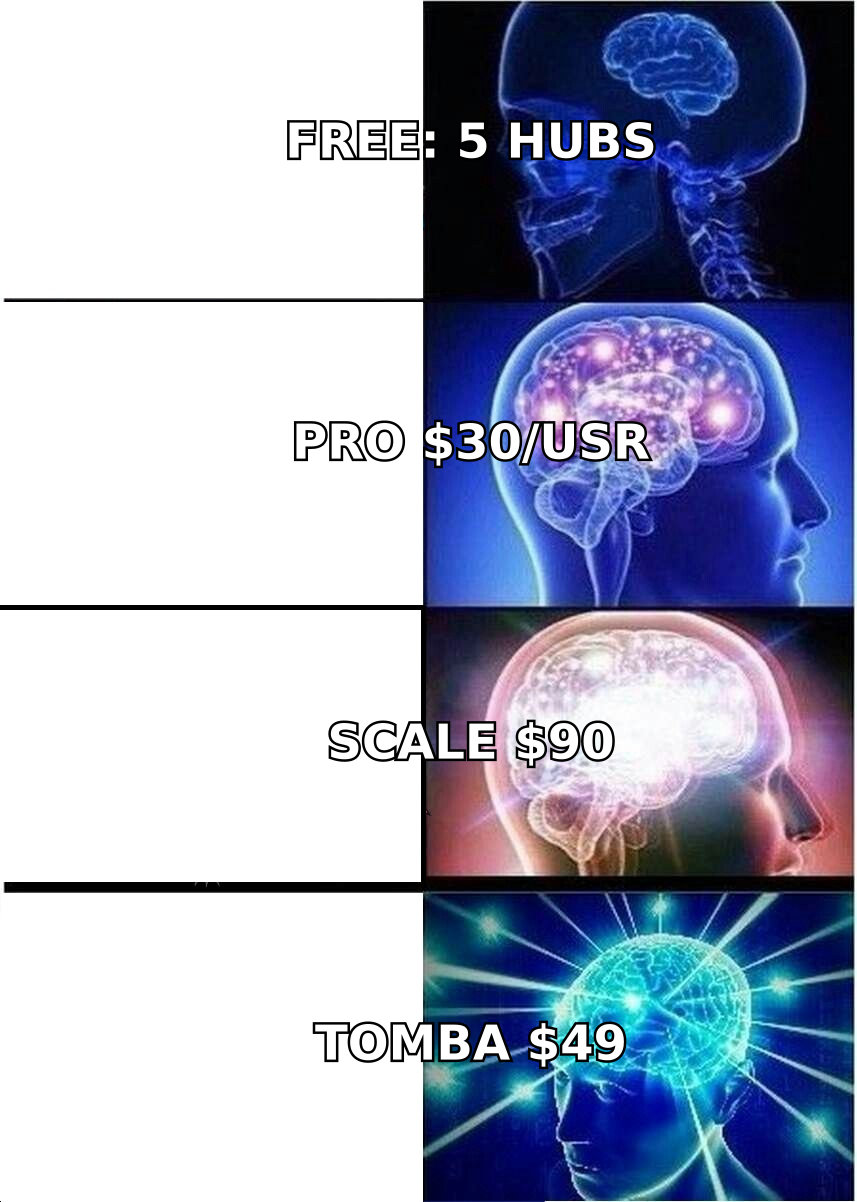
hubforce.comnow serves a single stub page;/pricing,/blog, and the app login subdomain no longer resolve. - Last published Hubforce pricing (archived November 2024): Free Starter, Pro at $30/user/month, Scale at $90/month per team of 10, Enterprise custom.
- The review footprint was effectively zero — no G2 or Capterra listing surfaces, and its Product Hunt page still reads "No reviews yet." That absence was the loudest signal in the whole evaluation.
- If Hubforce is still on a shortlist you inherited, treat this as a post-mortem. The pros and cons remain useful for judging any digital sales room, and the pipeline problem underneath it is solved with data, not decks.
What was Hubforce, exactly?#
Hubforce was a buyer-enablement tool. The product let a rep spin up a branded microsite — a "hub" — for a single deal, then drop the proposal, pricing, recorded demo, security docs, and a mutual action plan into it. The buyer got one link instead of eleven attachments. The rep got engagement analytics: who opened it, which section they lingered on, when the CFO finally showed up.
That category has a name — digital sales room — and it is crowded. Trumpet, Aligned, GetAccept, Flowla, and Storylane all sell variations of the same promise. Hubforce differentiated on speed of setup and an AI hub generator that assembled a first draft from your existing assets, plus native embeds for Notion, Loom, Figma, and Calendly so nothing had to be re-uploaded.
Two clarifications, because the name misleads people:
- Hubforce was not a HubSpot plus Salesforce product. The name reads like a portmanteau, and search traffic reflects that confusion, but there is no evidence anyone in the industry used "Hubforce" as shorthand for a combined stack. If that is what you actually want, start at HubSpot's own Salesforce integration page.
- Hubforce was not a lead source. It did nothing to fill your pipeline. It packaged deals that already existed. Buying it to fix a top-of-funnel problem would have been a category error even when the company was healthy.
It was incorporated in December 2022, launched publicly on Product Hunt in 2023 to a respectable but modest reception, and operated out of a registered address in Finsbury Pavement, London.

What did Hubforce pricing actually cost?#
Here is the last pricing page Hubforce published, captured in the Wayback Machine snapshot from 5 November 2024. Treat every figure as historical. Nothing on this table is purchasable today.
| Tier | Archived 2024 price | What was included | Status in 2026 |
|---|---|---|---|
| Starter | Free | 5 hubs, 5 templates, Hubforce AI, engagement analytics, 5 GB storage | Unavailable — signup gone |
| Pro | $30 per user / month | Unlimited hubs, templates and guests, 100 GB storage | Unavailable |
| Scale | $90 / month per team of 10 | Custom hub access rules, SSO via SAML/Okta/OneLogin, 250 GB | Unavailable |
| Enterprise | Custom quote | Dedicated account manager, custom integrations, unlimited storage | Unavailable |
The pricing itself was reasonable for the category. Two things stand out.
First, the Scale tier was oddly cheap — $90/month for ten seats works out to $9 per user, a third of what Pro charged per head. That is inverted from how most SaaS ladders work, where the higher tier costs more per seat and adds governance features. Selling SSO at a per-seat discount is usually a sign that a team is optimising for logo count and expansion revenue rather than gross margin. Sometimes that is a deliberate land-and-expand play. Sometimes it is a runway problem being solved with discounting.
Second, the free tier was genuinely usable. Five hubs and AI generation with no card is enough for a solo AE to run their top five open opportunities. That is a real product decision, not a demo gate, and it made the tool easy to try.
Why can't you buy Hubforce in 2026?#
Because HUBFORCE LTD was dissolved. The Companies House record for company 14520347 shows the company incorporated on 2 December 2022 and dissolved on 1 September 2026.
The web presence matches. As of this writing:
hubforce.comreturns 200, but the page is a single-screen stub built in Lovable, with a footer that still reads "© 2023."/pricing,/blog, and product sub-pages return 404. The pricing table above only survives in archive.- The
auth.app subdomain does not resolve. There is no login, which means there is no product behind the marketing page. hubforce.iodoes not resolve, andhubforce.aiis a parked domain redirecting to a lander.
None of that is ambiguous. If a vendor's authentication subdomain has stopped resolving and the registrar record says dissolved, the evaluation is over. Do not book a demo. Do not chase the founders for a private deal on a codebase with no support contract behind it.
What do Hubforce reviews actually say?#
Almost nothing, and that is the finding.
There is no G2 product page for Hubforce that surfaces in search — queries return Hub, Hubflo, Hubtype, and Webforce instead. No Capterra, GetApp, SoftwareAdvice, or TrustRadius listing appears either. The Product Hunt page exists and explicitly states "No reviews yet." One honest caveat: G2 and Capterra block automated fetches, so this is an absence of evidence gathered from search coverage rather than a proven zero. But for a product that had been live for roughly three years, that is a thin trail.
Review volume is a proxy for two things buyers care about: installed base and renewal behaviour. Vendors with hundreds of paying accounts accumulate reviews whether they ask for them or not, because procurement teams and G2 incentive campaigns drag them out. A product with a free tier, a Product Hunt launch, and effectively no third-party reviews after three years usually has a small paid base and short average tenure.
That signal was available in 2024 and 2025, well before the dissolution. It is the cheapest due-diligence check there is, and it costs you four minutes.
What were the real pros and cons of Hubforce?#
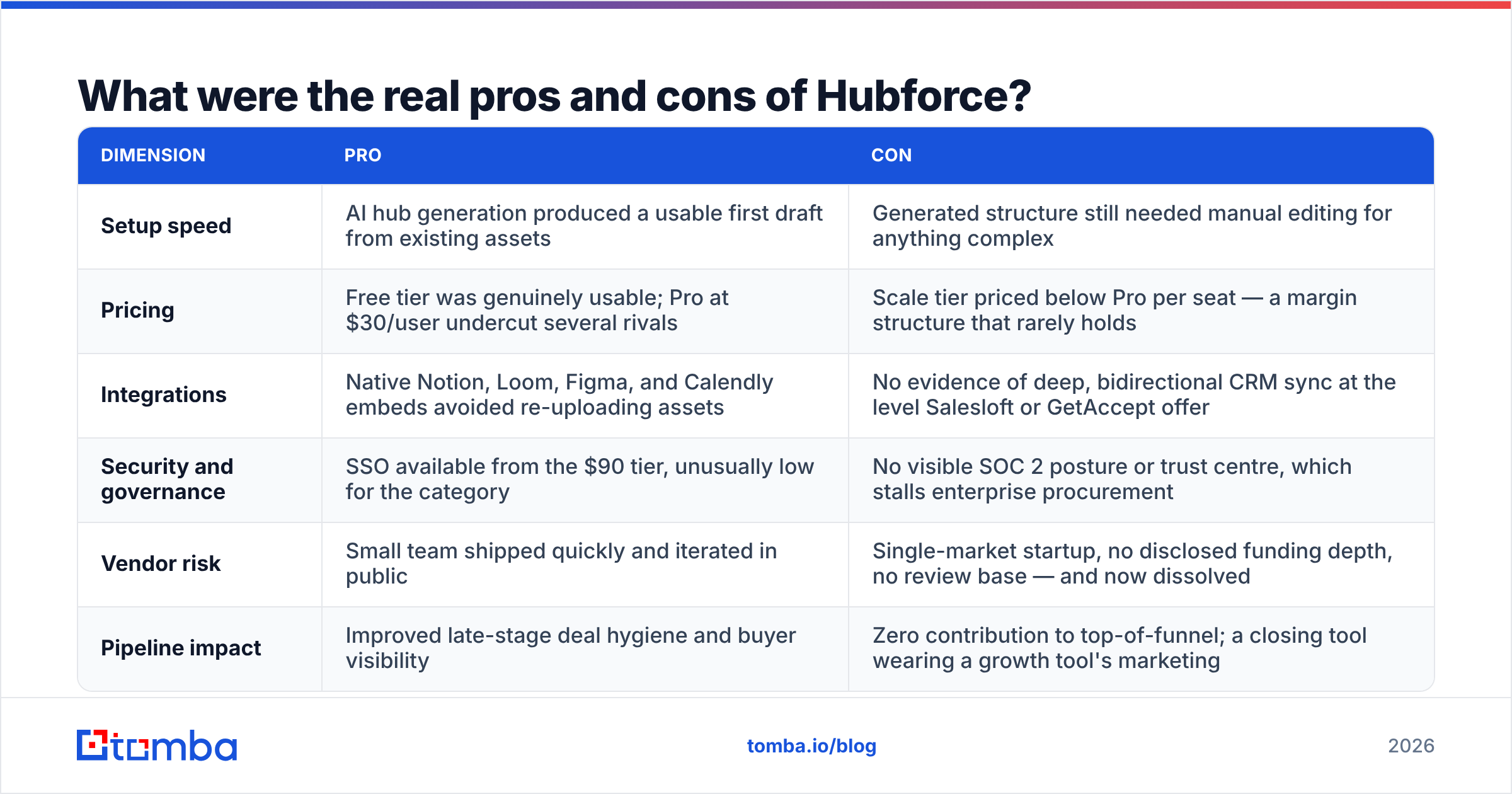
Judged on the product as it shipped, ignoring the corporate outcome:
| Dimension | Pro | Con |
|---|---|---|
| Setup speed | AI hub generation produced a usable first draft from existing assets | Generated structure still needed manual editing for anything complex |
| Pricing | Free tier was genuinely usable; Pro at $30/user undercut several rivals | Scale tier priced below Pro per seat — a margin structure that rarely holds |
| Integrations | Native Notion, Loom, Figma, and Calendly embeds avoided re-uploading assets | No evidence of deep, bidirectional CRM sync at the level Salesloft or GetAccept offer |
| Security and governance | SSO available from the $90 tier, unusually low for the category | No visible SOC 2 posture or trust centre, which stalls enterprise procurement |
| Vendor risk | Small team shipped quickly and iterated in public | Single-market startup, no disclosed funding depth, no review base — and now dissolved |
| Pipeline impact | Improved late-stage deal hygiene and buyer visibility | Zero contribution to top-of-funnel; a closing tool wearing a growth tool's marketing |
The honest summary: Hubforce was a competent product in a category where product quality was not the constraint. Digital sales rooms are a nice-to-have layered on top of deals you already sourced. When budgets tighten, nice-to-haves are the first line item cut, which compresses a small vendor's retention exactly when it needs runway most. The product did not fail because it was bad. It failed because the category is hard to defend at $30 a seat.
How should you evaluate a replacement?#
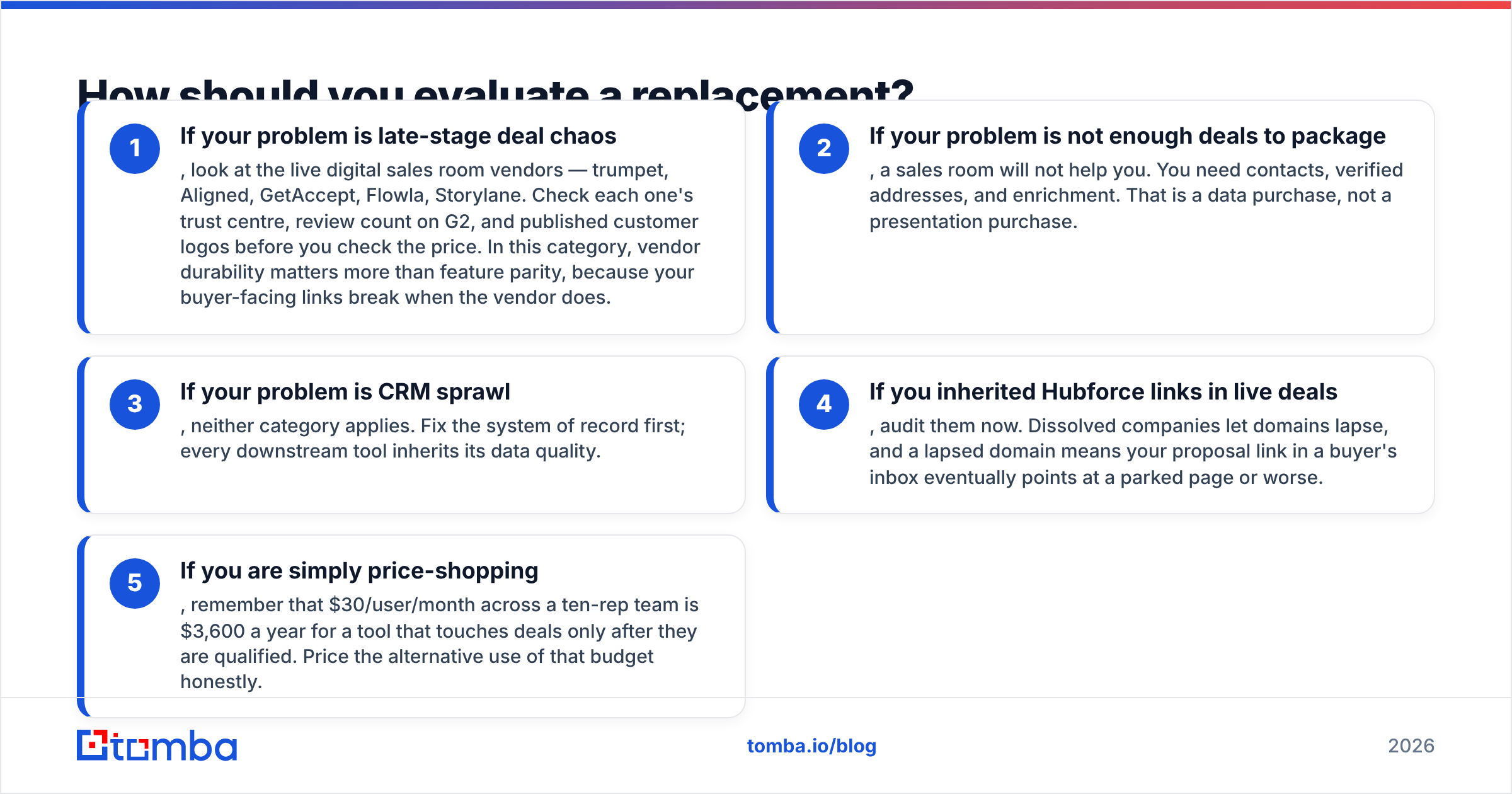
If you were shopping Hubforce, you have two separate jobs. Decide which one you actually have before you spend money.
- If your problem is late-stage deal chaos, look at the live digital sales room vendors — trumpet, Aligned, GetAccept, Flowla, Storylane. Check each one's trust centre, review count on G2, and published customer logos before you check the price. In this category, vendor durability matters more than feature parity, because your buyer-facing links break when the vendor does.
- If your problem is not enough deals to package, a sales room will not help you. You need contacts, verified addresses, and enrichment. That is a data purchase, not a presentation purchase.
- If your problem is CRM sprawl, neither category applies. Fix the system of record first; every downstream tool inherits its data quality.
- If you inherited Hubforce links in live deals, audit them now. Dissolved companies let domains lapse, and a lapsed domain means your proposal link in a buyer's inbox eventually points at a parked page or worse.
- If you are simply price-shopping, remember that $30/user/month across a ten-rep team is $3,600 a year for a tool that touches deals only after they are qualified. Price the alternative use of that budget honestly.
What does this teach you about buying seed-stage sales software?#
Five checks, each of which would have flagged Hubforce as elevated risk before you signed:
- Check the registry, not the website. Companies House, or the equivalent in the vendor's jurisdiction, is free and authoritative. Filing history that stops, or a "proposal to strike off" notice, tells you more than any G2 badge.
- Count third-party reviews, not testimonials. Testimonials are curated by the vendor. Reviews are not. Fewer than twenty across all major directories after two years of general availability is a yellow flag.
- Check whether the app subdomain resolves. It sounds absurd, but
auth.andapp.subdomains die before marketing sites do, because the marketing site is a cheap static page and the app costs money to run. - Ask about data export before you ask about features. If your buyer-facing content lives only in their hosted hubs, you own nothing. Confirm bulk export exists and works, and run it once during the trial.
- Price the category, not the vendor. If every competitor charges $30 to $50 a seat and one charges less at a higher tier, ask why. Cheap SSO is often a runway signal.
None of this requires a procurement team. It is roughly fifteen minutes of work that protects you from re-platforming mid-quarter.
What should you spend that budget on instead?#
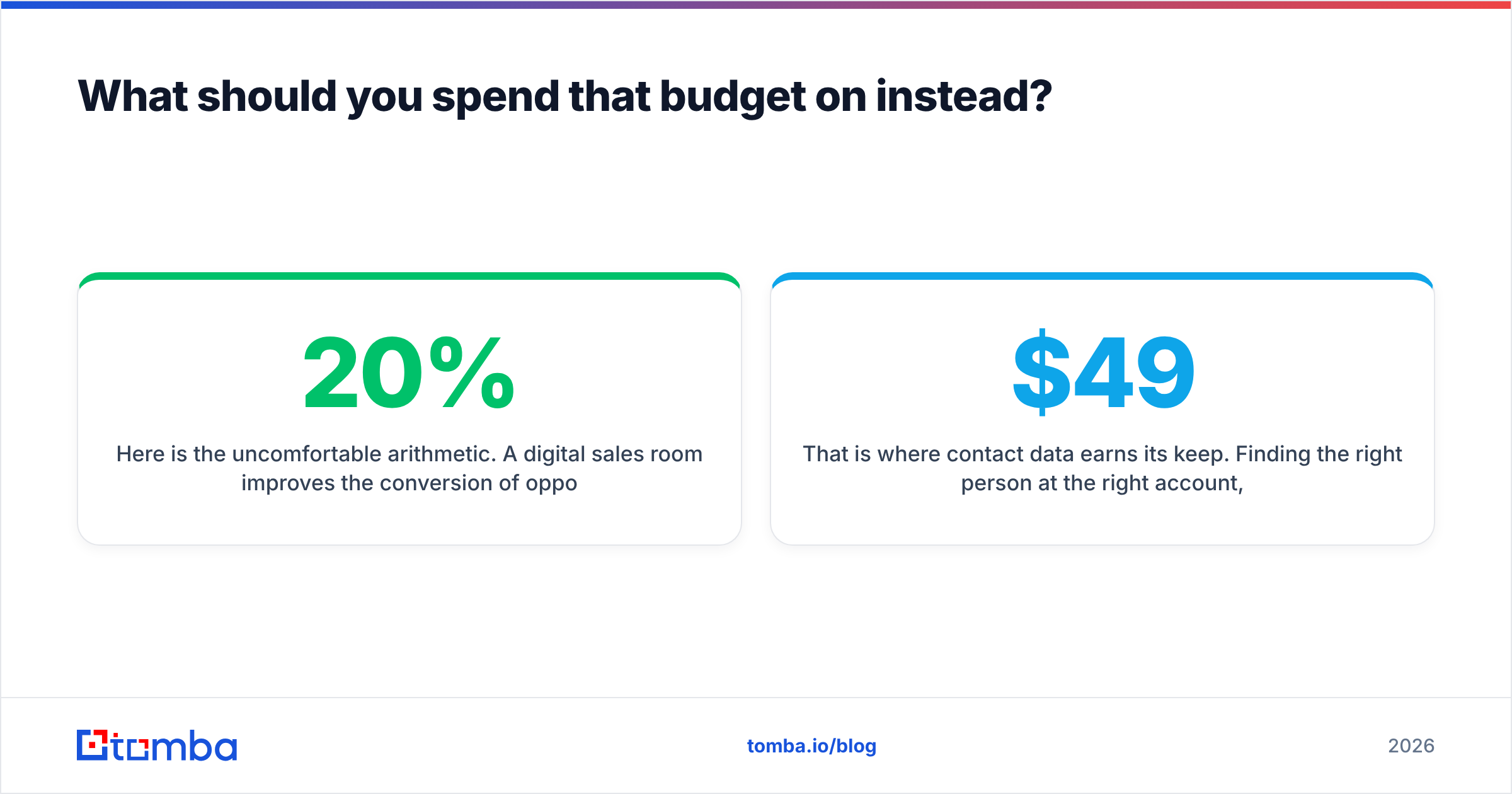
Here is the uncomfortable arithmetic. A digital sales room improves the conversion of opportunities you already have. If you close 20% of 50 opportunities a quarter, a good sales room might move that to 22% — two extra deals. If instead you add 50 more qualified opportunities at the same 20%, you get ten. The leverage is at the top, not the bottom, until your top-of-funnel is genuinely saturated.
Most teams that shop sales rooms are not saturated. They are under-prospected and looking for a tool that makes the few deals they have feel more manageable.
That is where contact data earns its keep. Finding the right person at the right account, confirming the address is deliverable, and enriching it with role and company context is what turns a target list into a pipeline. You can compare Tomba pricing against what you were about to spend on hubs: the Free tier gives you 25 searches a month, Starter is $49/month, Growth is $99/month, and Pro is $249/month. For a ten-rep team, Growth costs less per year than a mid-tier sales room and feeds every downstream tool you own.
Practical sequence: use domain search to map every reachable contact at a target account, run the list through the email verifier so bounces never reach your sending domain, then push enriched records into your CRM with data enrichment so reps open a record that already has title, seniority, and company context on it. Only after those deals exist does packaging them start to matter.
Final verdict on Hubforce#
Do not buy Hubforce — you cannot. The company was dissolved on 1 September 2026, the app is gone, and the archived $30/user pricing is a historical artifact rather than an offer. As a product it was well-built and fairly priced; as a purchase it carried the risk profile of any small, unfunded, thinly-reviewed vendor in a discretionary category, and that risk resolved badly.
The broader lesson costs nothing to apply: verify the vendor before you verify the feature list, and put your first dollar where it creates opportunities rather than where it decorates them.
Start with the pipeline. Tomba's Email Finder locates verified professional addresses by name, domain, or company, so your reps spend the quarter working real accounts instead of comparing microsite templates. Run 25 searches free, and only pay once the pipeline is real.
Related guides#
Ready to find emails that actually work?
Join 150,000+ professionals who stopped guessing and started sending. Free credits on signup — no credit card required.
Get the Tomba newsletter
Practical outbound tactics and product updates — once every two weeks.
About the author