9 Best Humanlinker Alternatives for AI Sales Outreach in 2026
Humanlinker sells AI personalization, but its credit limits and thin email data frustrate teams at scale. Here are 9 alternatives compared on data accuracy, pricing, and what they actually do well.
TL;DR
- Humanlinker is an AI personalization layer — DISC personality analysis, LinkedIn-based icebreakers, multichannel sequences. It is not primarily a contact-data provider, and that is where most teams outgrow it.
- The most common complaints are credit burn on enrichment, shallow verified-email coverage outside Europe, and personalization that reads generic once you send at volume.
- If your bottleneck is data quality, look at Tomba, BookYourData, or Apollo. If it is sequencing, look at Instantly, Smartlead, or lemlist. If it is personality-led selling, Humantic AI is the closest like-for-like swap.
- Cheapest credible starting point for verified B2B emails: a free tier plus a $49/mo paid step — that is roughly a third of what bundled all-in-one suites charge before you send a single email.
- Pick based on which single job you are paying to solve. Bundles look cheaper on the invoice and more expensive in deliverability.
What is Humanlinker and what does it actually do?#
Humanlinker is an AI sales-assistant platform built around personality-driven personalization. You point it at a prospect's LinkedIn profile or a company domain, and it returns a DISC-style personality read, a set of AI-generated icebreakers, and suggested talking points you can drop into an email or a LinkedIn message. It layers multichannel sequences on top so you can run email plus LinkedIn touches from one place.
The pitch is reasonable: generic cold email is dead, so let an AI read the prospect and write the first line for you. Where teams run into friction is the assumption underneath that pitch — that you already have clean, verified contact data to personalize against. Humanlinker enriches, but enrichment is not its core engineering investment, and that shows up in three places:
- Credit mechanics. Enrichment, personality analysis, and sequence sends all draw from overlapping credit pools. A 2,000-contact list can chew through a month's allowance in a single afternoon of testing.
- Email coverage gaps. Coverage is noticeably stronger for European mid-market companies than for US SMBs, APAC, or anything with a catch-all domain. Bounces on catch-all MX records are the most frequent surprise.
- Personalization decay. The first 50 AI icebreakers read sharp. By touch 500, prospects on the same ICP start receiving recognizably similar openers, because the model is drawing from the same narrow LinkedIn signal set.
None of that makes Humanlinker a bad product. It makes it a specific product — and the right alternative depends entirely on which of those three frictions is costing you pipeline.
Why do teams look for Humanlinker alternatives?#
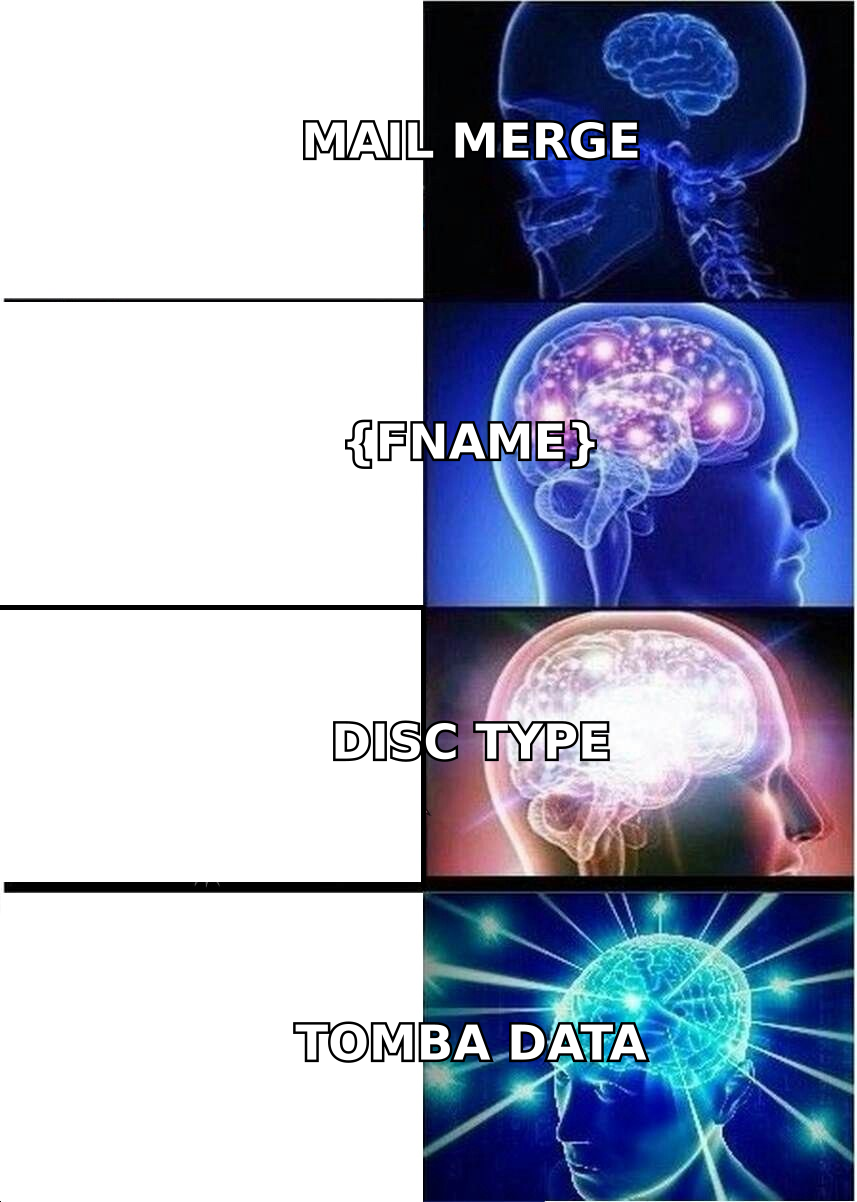
Four triggers show up again and again when teams start shopping:
- Bounce rate crossed 5%. This is the hard stop. Once your bounce rate climbs past the 4–5% band, mailbox providers start throttling, and no amount of clever AI copy recovers a damaged domain. The fix is upstream: a dedicated email verifier and real catch-all verification, not better subject lines.
- Cost per usable contact got opaque. Bundled credit systems make it genuinely hard to answer "what did one verified, deliverable email cost me?" Teams that track this number usually discover they are paying a premium for the AI layer and getting the data as a weak bundled freebie.
- They need an API, not a UI. RevOps teams building enrichment into their own pipeline want a documented endpoint with predictable rate limits. A sequencer-first tool rarely prioritizes that.
- Compliance review. EU buyers in particular want explicit documentation of where contact data originates. "Our AI found it" does not survive a DPA review.
If none of those four describe you, stay on Humanlinker. If two or more do, keep reading.
What should you compare Humanlinker alternatives on?#
Ignore feature-count tables. Five attributes predict whether a tool works for you:
- Verified-email accuracy rate — vendor-claimed numbers are marketing. Test 100 known-good contacts from your own ICP and measure bounces yourself.
- Catch-all handling — does the tool say "unknown" and charge you anyway, or does it run SMTP-level and pattern-based inference and give you a confidence score?
- Credit model honesty — are failed lookups charged? Do credits roll over? Is enrichment billed separately from verification?
- Where the data comes from — public web crawl, user-contributed contributory networks, licensed databases, or a mix. This determines both freshness and compliance posture. Tomba publishes its data sources openly, which is the standard worth holding everyone to.
- Integration surface — native CRM connectors, Google Sheets, Excel, Zapier, REST API, CLI. A tool that only works inside its own dashboard creates a data silo.

Which Humanlinker alternatives are worth evaluating in 2026?#
Nine tools, grouped by the job they actually solve.
Data-first alternatives#
1. Tomba — The straightest swap if your problem is contact data rather than copy. Core product is the email finder, with domain search, verification, phone finder, and data enrichment alongside it. Pricing is transparent: free tier at 25 searches/mo, then $49/mo Starter, $99/mo Growth, $249/mo Pro. The Tomba API and CLI make it viable as infrastructure rather than just a dashboard. Weakness: it does not write your emails or run your sequences — you bring your own sending stack.
2. BookYourData — A strong pick when you want to buy a targeted list rather than enrich one contact at a time. Pay-as-you-go pricing, a large verified B2B database with granular filters (industry, title, geography, tech stack), and a bounce guarantee. Particularly good for well-defined TAMs where you know exactly which 3,000 companies you want. Different philosophy from Humanlinker entirely — list acquisition, not per-prospect AI.
3. Apollo.io — The all-in-one default. Huge contact database, built-in sequencer, Chrome extension, CRM-ish features. Best when you want one vendor and can accept that each individual component is good-not-great. Data freshness on smaller companies is the usual complaint, and the free tier's usable limits shrink over time. See a fuller breakdown of Apollo alternatives if that is your direction.
4. Clearbit (now Breeze Intelligence) — Enterprise-grade firmographic and technographic enrichment, now folded into HubSpot's stack. Excellent if you are already deep in HubSpot and care more about account-level data than individual email discovery. Overkill and overpriced for a five-person outbound team — in which case a Clearbit alternative is the more sensible route.
Personalization-first alternatives#
5. Humantic AI — The closest like-for-like to Humanlinker. DISC and OCEAN personality prediction from LinkedIn and public data, with coaching cues for calls and emails. Choose it over Humanlinker if personality insight is the only thing you valued and you want it deeper, with better CRM embedding. You will still need separate data and sending tools.
6. Lavender — An email coach rather than an email writer. It scores your draft in real time inside Gmail or Outlook, flags spam triggers, suggests cuts, and shows prospect-level context. Pairs well with any data provider. The honest trade: it improves reps' writing rather than removing writing from the workflow, so it is a skills investment, not an automation one.
Sequencing-first alternatives#
7. Instantly — Built for volume cold email: unlimited sending accounts on paid plans, built-in warmup, inbox rotation, a deliverability-obsessed feature set. If your Humanlinker frustration is send-side throttling rather than copy, this is the fix. Compare against Instantly alternatives before committing, since the category moves fast.
8. Smartlead — Similar territory to Instantly, with a stronger master-inbox and sub-sequence logic, plus a whitelabel option agencies like. Slightly steeper learning curve.
9. lemlist — Strongest on multichannel (email + LinkedIn + calls) with image and landing-page personalization baked in. Closest in spirit to Humanlinker's multichannel promise, with a larger ecosystem and more mature integrations.
How do the main Humanlinker alternatives compare on price and capability?#
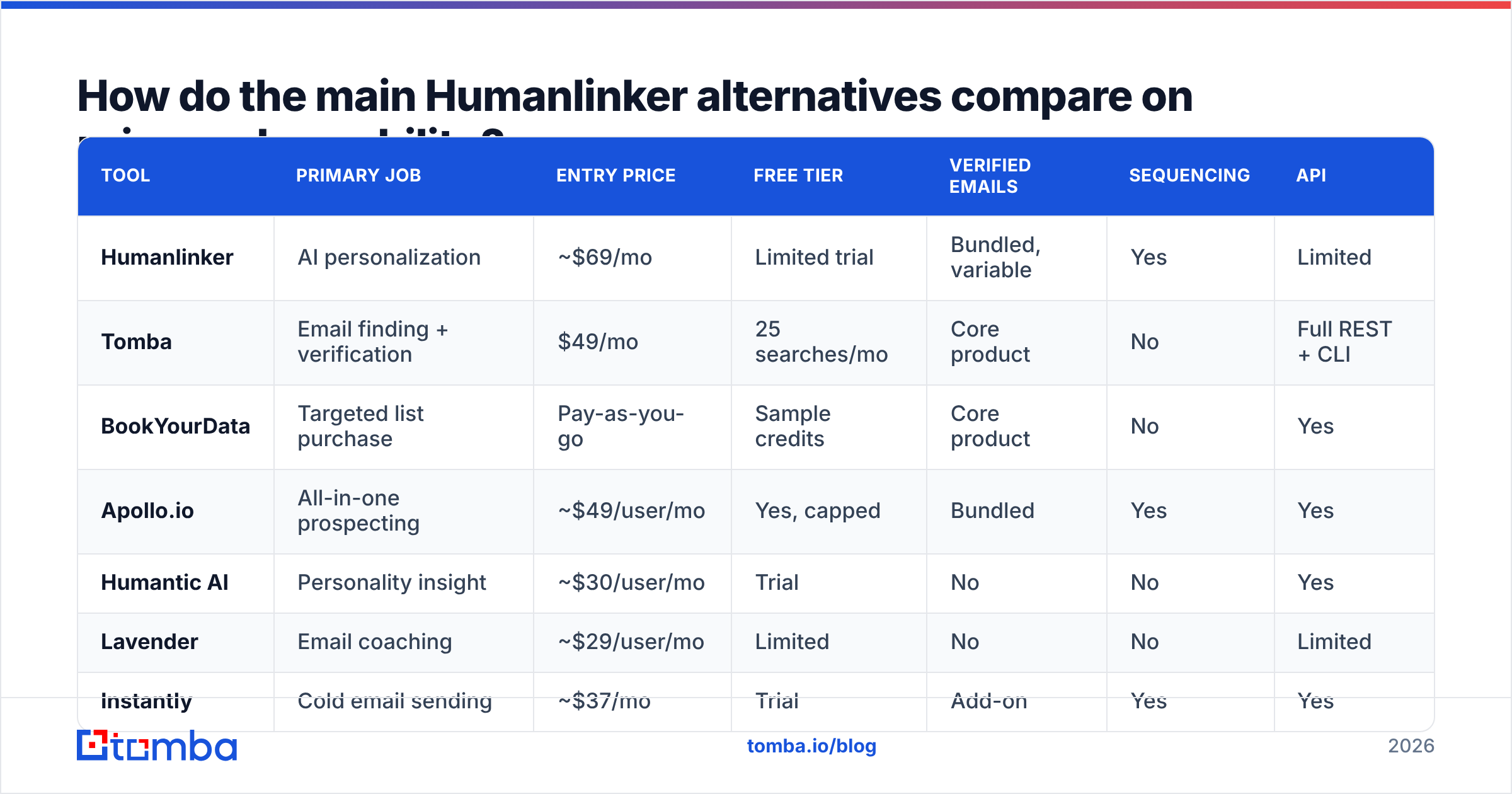
| Tool | Primary job | Entry price | Free tier | Verified emails | Sequencing | API |
|---|---|---|---|---|---|---|
| Humanlinker | AI personalization | ~$69/mo | Limited trial | Bundled, variable | Yes | Limited |
| Tomba | Email finding + verification | $49/mo | 25 searches/mo | Core product | No | Full REST + CLI |
| BookYourData | Targeted list purchase | Pay-as-you-go | Sample credits | Core product | No | Yes |
| Apollo.io | All-in-one prospecting | ~$49/user/mo | Yes, capped | Bundled | Yes | Yes |
| Humantic AI | Personality insight | ~$30/user/mo | Trial | No | No | Yes |
| Lavender | Email coaching | ~$29/user/mo | Limited | No | No | Limited |
| Instantly | Cold email sending | ~$37/mo | Trial | Add-on | Yes | Yes |
| Smartlead | Cold email sending | ~$39/mo | Trial | Add-on | Yes | Yes |
| lemlist | Multichannel sequences | ~$55/user/mo | Trial | Bundled | Yes | Yes |
Prices move; check each vendor's page before you budget. The structural point is more durable than the numbers: per-seat sequencing tools get expensive with headcount, while per-credit data tools get expensive with volume. Model your own shape before you sign annual.


Is an all-in-one platform better than a focused stack?#
Focused stack, for most teams under 50 reps. Here is the reasoning.
All-in-one platforms win on procurement simplicity and lose on component quality. When one vendor owns data, copy, sending, and reporting, every component competes for the same engineering roadmap. The database gets refreshed less often than a database-only company would refresh it. The warmup logic is less aggressive than a deliverability-only company's. You end up paying a bundle premium for the convenience of one invoice.
A focused stack looks like this:
- Data layer — a dedicated finder and verifier, called via bulk jobs or API, feeding your CRM.
- Copy layer — a writing assistant or your own tested cold email templates. Human-reviewed, not fully generated.
- Send layer — a deliverability-first sender with warmup, rotation, and reply detection.
- Measurement layer — your CRM as the source of truth, not the vendor's dashboard.
Four tools, four bills, and each one replaceable without a migration project. Compare that to an all-in-one swap, which means re-onboarding your whole motion.
The counterargument is real: if you have no RevOps function and nobody to wire four tools together, the bundle's operational simplicity genuinely outweighs the quality loss. G2's sales-intelligence category is a useful read for seeing how buyers in each camp actually rate these trade-offs.
Does AI personalization actually lift reply rates?#
Sometimes, and less than vendors claim. Three things are worth separating.
What genuinely works: relevance signals tied to a real trigger — a funding round, a new hire in a relevant role, a tech-stack change, a published article. These are researchable and verifiable, and they explain why a specific person should care right now. Tools like the author finder surface a concrete hook: you read their actual piece.
What works sometimes: personality-matched tone. Adjusting register for a likely-analytical versus likely-expressive reader is defensible. The inference from a LinkedIn profile to a DISC type is noisy, though, and the lift is modest — think a point or two on response rate, not a transformation.
What does not work: AI-generated flattery about someone's career path. Buyers now pattern-match these openers within one sentence. "I was really impressed by your journey from X to Y" is a tell, and the tell costs you credibility.
The unglamorous ranking of what moves reply rates: list quality first, offer relevance second, timing third, copy fourth. HubSpot's sales research consistently lands in the same order. If you are spending on AI personalization while your list still bounces at 6%, you are optimizing the fourth variable and ignoring the first.
How should you run a 30-day evaluation?#
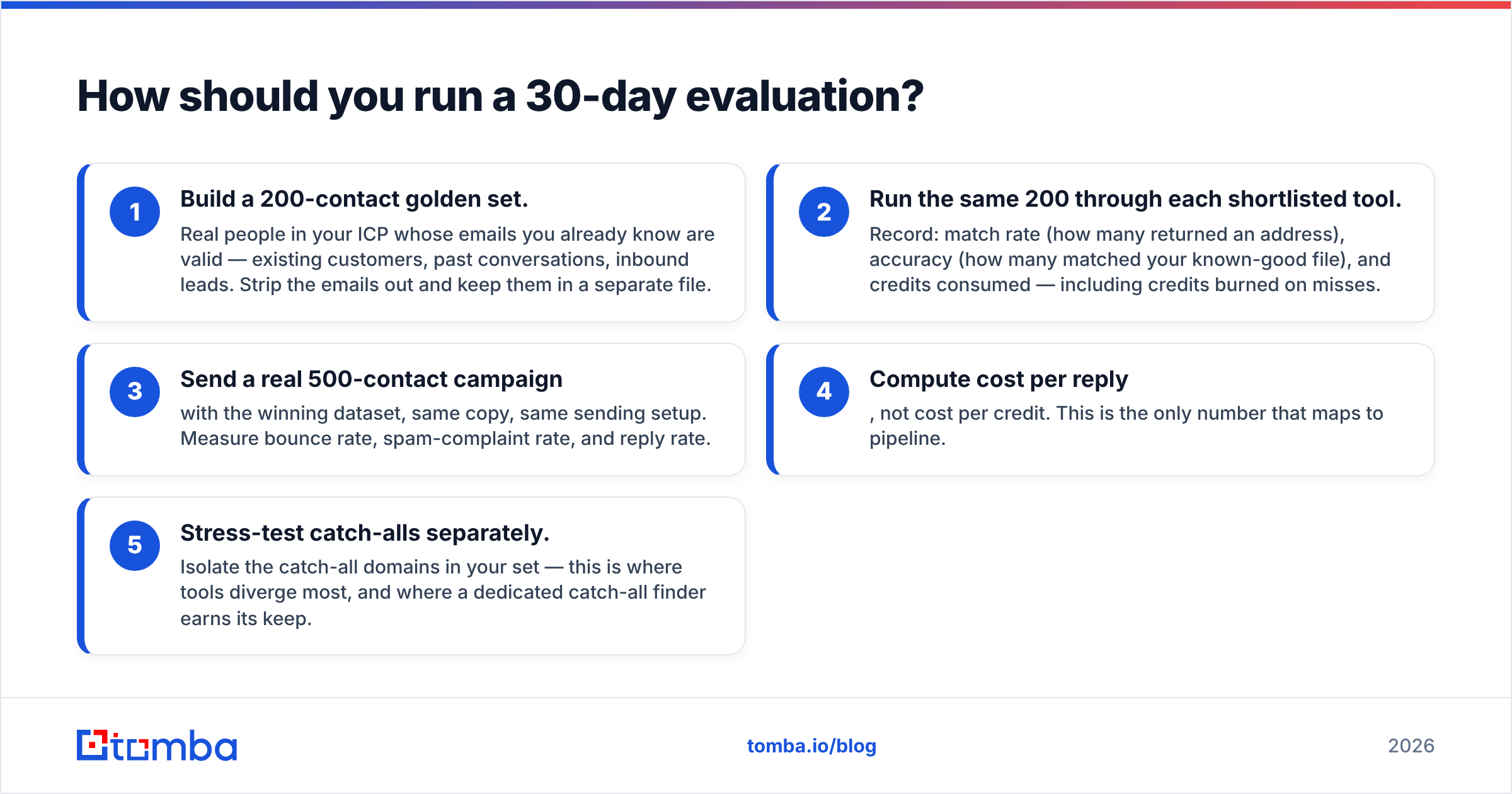
Don't take anyone's accuracy claim, including ours. Run this:
- Build a 200-contact golden set. Real people in your ICP whose emails you already know are valid — existing customers, past conversations, inbound leads. Strip the emails out and keep them in a separate file.
- Run the same 200 through each shortlisted tool. Record: match rate (how many returned an address), accuracy (how many matched your known-good file), and credits consumed — including credits burned on misses.
- Send a real 500-contact campaign with the winning dataset, same copy, same sending setup. Measure bounce rate, spam-complaint rate, and reply rate.
- Compute cost per reply, not cost per credit. This is the only number that maps to pipeline.
- Stress-test catch-alls separately. Isolate the catch-all domains in your set — this is where tools diverge most, and where a dedicated catch-all finder earns its keep.
Two weeks of this beats two months of reading review sites. And check the pricing details of your finalists against your measured volume, not your projected one — projected volume is always wrong in the same direction.
Which alternative is right for you?#
- Your bounce rate is the problem → a dedicated finder plus verifier. Start on a free tier, measure, then upgrade.
- You need 5,000 contacts in a defined TAM, now → BookYourData's list model is faster than enriching one at a time.
- You want one vendor and one invoice → Apollo, accepting component-level compromises.
- You loved only the personality insights → Humantic AI.
- Your reps write badly → Lavender.
- Your sends are throttled → Instantly or Smartlead.
- You need true multichannel → lemlist.
- You are building internal tooling → an API-first data provider; skip the UI entirely.
Ready to fix the data layer first?#
Most Humanlinker frustration traces back to one root cause: clever copy sitting on top of addresses that don't resolve. Fix the foundation and every downstream tool performs better — including Humanlinker, if you decide to keep it.
Start with the Tomba Email Finder. The free tier gives you 25 searches a month, enough to run the golden-set test above on a sample and see real numbers instead of vendor claims. Paid plans start at $49/mo for Starter, $99/mo for Growth, with bulk processing, catch-all verification, and a documented API on every tier. Test it against your own list this week, measure cost per reply, and let the data pick your stack.
Related guides#
// get started
Find, verify and enrich your first contacts today
Start on the free plan with 25 searches a month, then scale when your team is ready.
Free plan · No credit card required · GDPR & CCPA
// about the author