Hunter IO Competitors: 9 Alternatives Tested for 2026
Hunter.io is a solid email finder, but it is not the cheapest or most accurate option for every use case. Here are nine Hunter IO competitors compared on coverage, credits, catch-all handling, and real cost per verified contact.
TL;DR
- Hunter.io is a competent, well-known email finder. Most teams who shop for Hunter IO competitors leave for one of three reasons: credit math that punishes bulk work, weak catch-all handling, or the need for phone numbers and enrichment in one subscription.
- The nine competitors worth testing in 2026: Tomba, Apollo.io, Snov.io, Findymail, RocketReach, ContactOut, Dropcontact, BookYourData, and Anymail Finder.
- Headline "95% accuracy" claims are marketing. The only number that matters is your cost per verified, deliverable contact on your own ICP list.
- Tomba's Starter plan is $49/mo, and the free tier gives you 25 searches a month. It bundles catch-all verification, phone finding, and enrichment under one API.
- Run a 200-contact bake-off across three tools before you commit annually. It takes an afternoon, and it usually changes the decision.
Why are people searching for Hunter IO competitors?#
Hunter.io built the category. It has a clean UI, an honest confidence score, and a Chrome extension that most SDRs can use without training. None of that is in dispute. Check Hunter's own product pages and it does roughly what it says.
The churn comes from three specific frictions.
Credit economics at volume. Hunter's model charges you for searches whether or not the result is usable. On a 5,000-row list, 30% of domains can be catch-all or dead. You still pay full freight for rows you can't email. Teams running 20,000+ finds per quarter feel this right away.
Catch-all domains. A large share of mid-market and enterprise domains accept every address at the SMTP layer. Standard verification then returns "accept-all" and nothing more. Some tools stop there. Others run pattern inference, historical sighting data, and secondary signals to give you a real verdict. This is the single biggest quality gap between email finders in 2026, and it is where most Hunter IO competitors try to stand apart.
Bundle scope. Hunter is deliberately narrow: find and verify email. Say you also need mobile numbers, firmographics, LinkedIn matching, or website visitor identification. Then you end up stacking two or three subscriptions. Tools that bundle those pull budget out of the finder line item.

What should you actually compare between email finders?#
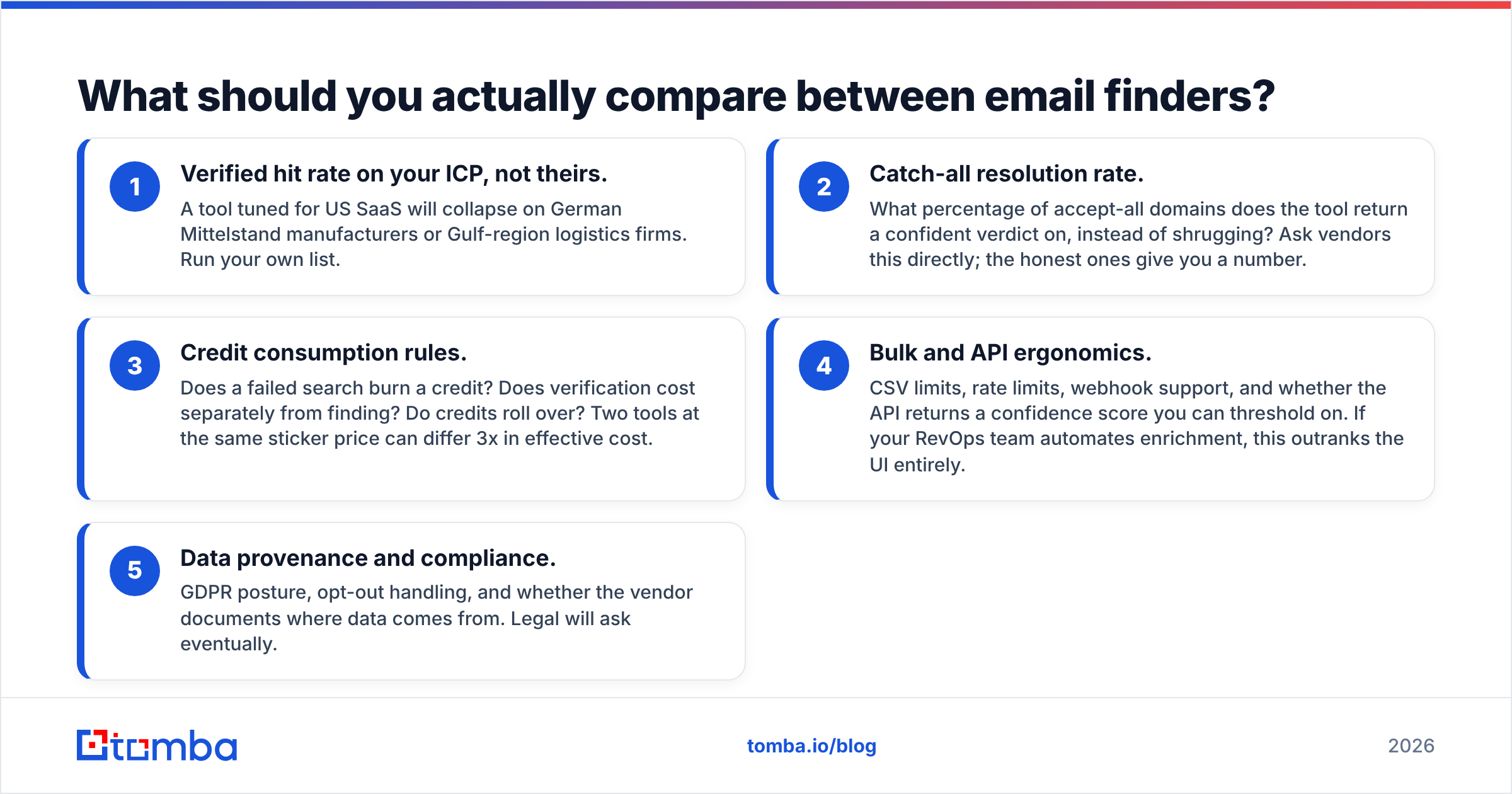
Ignore feature checklists. Five variables decide whether a tool is worth switching to:
- Verified hit rate on your ICP, not theirs. A tool tuned for US SaaS will collapse on German Mittelstand manufacturers or Gulf-region logistics firms. Run your own list.
- Catch-all resolution rate. On what share of accept-all domains does the tool return a confident verdict, instead of shrugging? Ask vendors this directly. The honest ones give you a number.
- Credit consumption rules. Does a failed search burn a credit? Does verification cost separately from finding? Do credits roll over? Two tools at the same sticker price can differ 3x in real cost.
- Bulk and API ergonomics. Check CSV limits, rate limits, webhook support, and whether the API returns a confidence score you can threshold on. If your RevOps team automates enrichment, this outranks the UI entirely.
- Data provenance and compliance. Look at GDPR posture, opt-out handling, and whether the vendor documents where data comes from. Legal will ask eventually.
Anything else — dark mode, Slack alerts, sequence builders — is a tiebreaker, not a decision driver.
Which Hunter IO competitors are worth testing in 2026?#
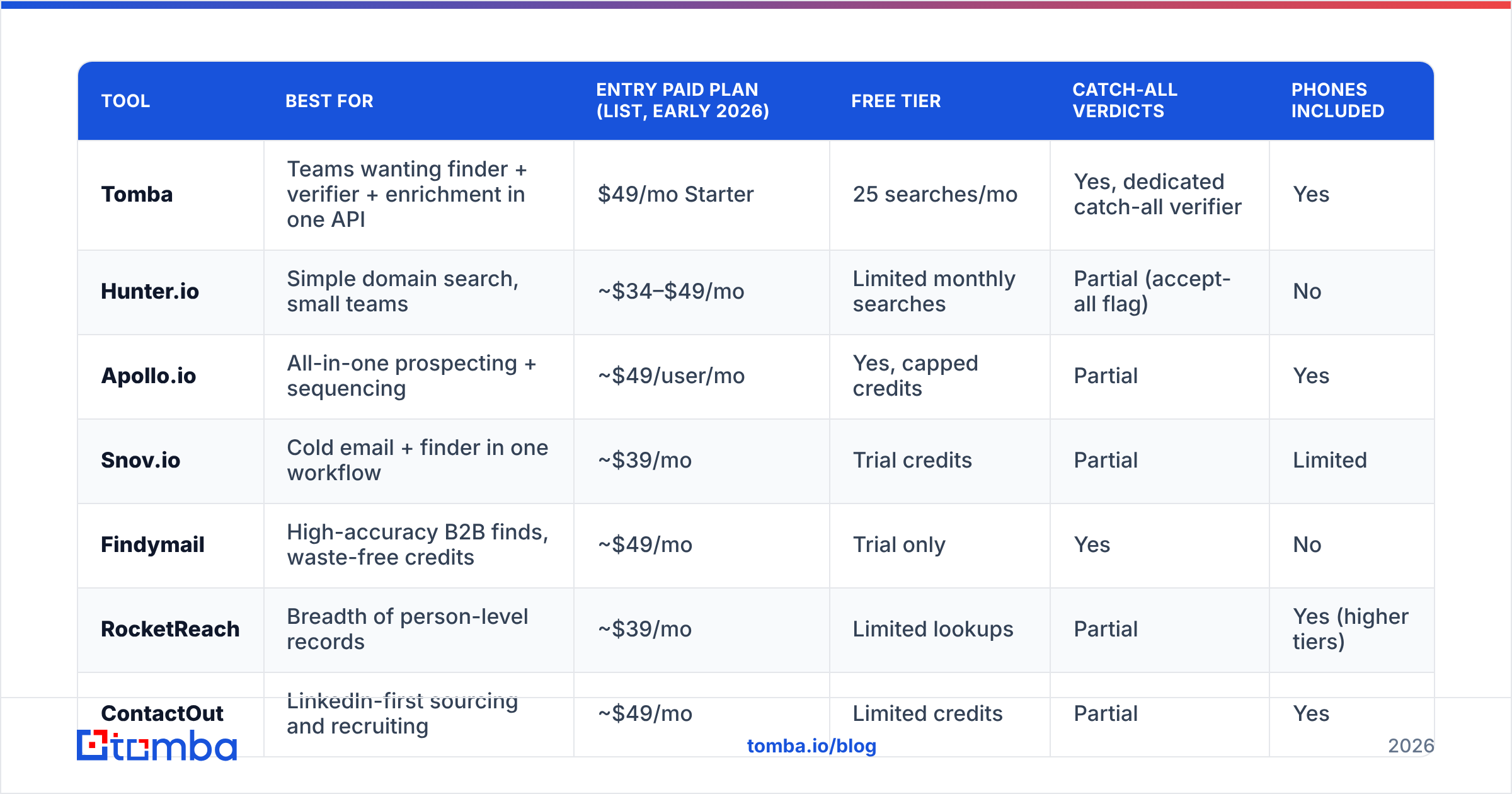
Here is the shortlist, with the honest positioning for each.
| Tool | Best for | Entry paid plan (list, early 2026) | Free tier | Catch-all verdicts | Phones included |
|---|---|---|---|---|---|
| Tomba | Teams wanting finder + verifier + enrichment in one API | $49/mo Starter | 25 searches/mo | Yes, dedicated catch-all verifier | Yes |
| Hunter.io | Simple domain search, small teams | ~$34–$49/mo | Limited monthly searches | Partial (accept-all flag) | No |
| Apollo.io | All-in-one prospecting + sequencing | ~$49/user/mo | Yes, capped credits | Partial | Yes |
| Snov.io | Cold email + finder in one workflow | ~$39/mo | Trial credits | Partial | Limited |
| Findymail | High-accuracy B2B finds, waste-free credits | ~$49/mo | Trial only | Yes | No |
| RocketReach | Breadth of person-level records | ~$39/mo | Limited lookups | Partial | Yes (higher tiers) |
| ContactOut | LinkedIn-first sourcing and recruiting | ~$49/mo | Limited credits | Partial | Yes |
| Dropcontact | GDPR-first European data, no database | ~€24/mo | Trial | Yes (algorithmic) | No |
| BookYourData | Prebuilt, pay-as-you-go verified lists | Pay-as-you-go credits | Sample records | Yes, verified at purchase | Yes |
| Anymail Finder | Pay-only-for-verified-results simplicity | ~$49/mo | Trial credits | Yes | No |
Prices are list rates observed in early 2026, and they change often. Confirm on each vendor's pricing page before you commit. Seat-based tools (Apollo, ContactOut) get expensive fast at 5+ users. Credit-based tools do not.

The short profiles#
Tomba is the closest structural replacement for Hunter: domain search, email finder, verifier, and bulk processing. The difference is that the catch-all verifier is a first-class product rather than a flag. Pricing is flat-rate credits, not per seat — Free (25 searches/mo), Starter $49/mo, Growth $99/mo, Pro $249/mo. The Tomba API covers everything the UI does, which matters if enrichment lives in your warehouse.
Apollo.io is not really an email finder. It's a prospecting platform with a database, sequencer, and dialer attached. If you want one vendor for list building and sending, it's the obvious pick. If you only need find-and-verify, you're paying for a sequencer you won't open. See Apollo's own positioning and compare it against what you actually use.
Snov.io sits between the two: finder, verifier, drip campaigns, and a light CRM. Good value for solo founders. Data depth outside North America and Western Europe is thinner than the enterprise players.
Findymail built its reputation on not charging for bad data. Credits are consumed on verified results only. That model is genuinely better for messy lists, and its LinkedIn export workflow is well-regarded. Scope is narrower than Tomba or Apollo.
RocketReach wins on raw record count for person-level lookups, especially for hard-to-reach titles. Verification quality is inconsistent, so most teams run the output through a second verifier.
ContactOut is a recruiting tool that sales teams adopted. If your workflow starts on a LinkedIn profile rather than a company domain, it's strong. If you work from domain lists, it's the wrong shape.
Dropcontact takes an unusual approach: no contact database at all. It derives and validates addresses algorithmically, which gives it a clean GDPR story for European buyers. Coverage in the US is lower as a result.
BookYourData solves a different problem well. Instead of searching contact by contact, you filter a verified B2B database by industry, title, geography, and company size. Then you buy exactly the records you need, pay-as-you-go, with no subscription. Say you need a clean 3,000-contact list this quarter and nothing next quarter. That's a much better fit than any monthly plan on this table.
Anymail Finder keeps the promise simple: you pay for verified emails only. Small feature surface, predictable bill, no surprises.
How accurate are these tools, really?#
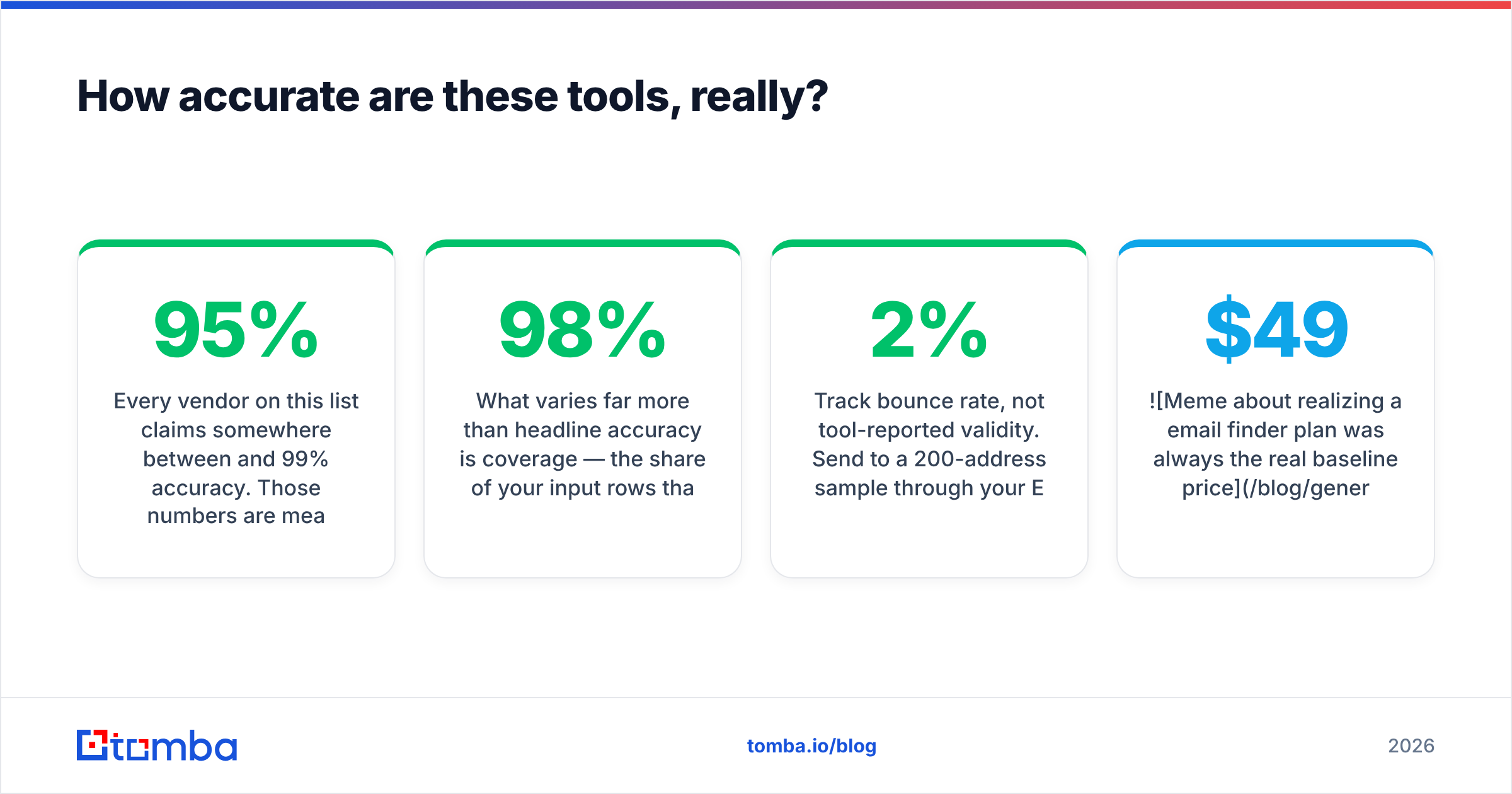
Every vendor on this list claims somewhere between 95% and 99% accuracy. Those numbers come from internal benchmark sets that nobody publishes. Treat them as directionally useful and nothing more.

What varies far more than headline accuracy is coverage — the share of your input rows that return any answer at all. A tool at 98% accuracy on 40% coverage is worse for you than one at 93% accuracy on 75% coverage. The first one leaves 60% of your list unworkable.
Three practical rules:
- Segment your test list by company size. Sub-50-employee companies are where coverage collapses. Enterprise coverage is broadly similar across vendors.
- Track bounce rate, not tool-reported validity. Send to a 200-address sample through your ESP and count hard bounces. Under 2% is healthy. Over 4% will damage your sender reputation.
- Test catch-all domains separately. Pull 50 known accept-all domains and see which tools return a real verdict versus "unknown". The spread here is enormous, and it never shows up in a feature matrix.
Peer review sites help for workflow complaints and support quality, less so for accuracy. Skim recent reviews on G2 filtered to your company size before you shortlist.

What does each option actually cost per verified contact?#
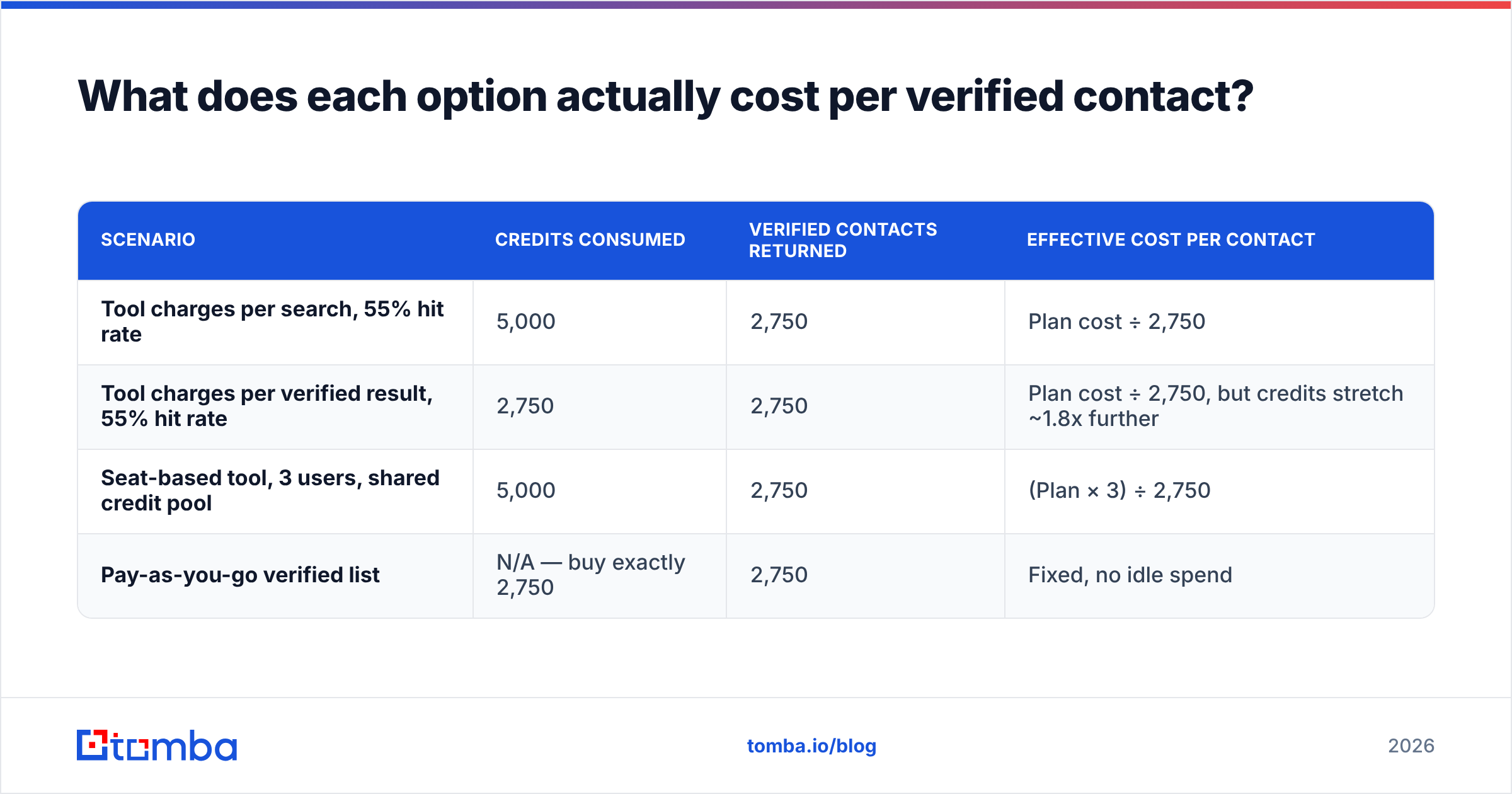
Sticker price is the wrong unit. Here is the calculation that matters, using a realistic 5,000-row prospect list:
| Scenario | Credits consumed | Verified contacts returned | Effective cost per contact |
|---|---|---|---|
| Tool charges per search, 55% hit rate | 5,000 | 2,750 | Plan cost ÷ 2,750 |
| Tool charges per verified result, 55% hit rate | 2,750 | 2,750 | Plan cost ÷ 2,750, but credits stretch ~1.8x further |
| Seat-based tool, 3 users, shared credit pool | 5,000 | 2,750 | (Plan × 3) ÷ 2,750 |
| Pay-as-you-go verified list | N/A — buy exactly 2,750 | 2,750 | Fixed, no idle spend |
Run your own numbers with your own hit rate. Teams routinely find that the "cheaper" $34/mo plan costs more per usable contact than a $49/mo plan with better coverage and no charge for misses. Compare Tomba pricing tier by tier against whatever you're paying now. Use your actual monthly volume, not the volume you imagine.
One more line item people forget: the second verifier. If your primary finder can't resolve catch-alls, you're paying a verification vendor on top. Bundling that removes a whole invoice.
Which Hunter IO competitor fits which team?#
- Solo founder or two-person team, under 1,000 finds/month. Snov.io or Hunter's own free tier. Don't over-buy.
- SDR team of 3–10 running outbound daily. Tomba or Findymail on credits, paired with a separate sending tool. Avoid per-seat pricing at this size, because it scales against you.
- Full-stack GTM team that wants one vendor. Apollo.io, as long as you accept that you're buying a platform, not a finder.
- European company with a strict DPO. Dropcontact or Tomba. Both document their data sources clearly.
- Recruiters and talent sourcers. ContactOut, with a verifier behind it.
- One-off campaign, no ongoing need. BookYourData. Buy the verified list, run the campaign, spend nothing next month.
- Engineering-led enrichment inside a warehouse or CRM. Tomba or Findymail via API. Check rate limits before you architect around either.
How do you run a fair 200-contact bake-off?#
Do this before signing anything annual. It takes about three hours.
- Build one input file. 200 rows: first name, last name, company domain. Mix company sizes (a third under 50 employees, a third 50–500, a third 500+) and mirror your real geographic split.
- Sign up for three tools' free or trial tiers. Same file, same day, no manual cleanup between runs.
- Record four numbers per tool. Rows returned, rows marked confident, rows marked catch-all or unknown, and credits consumed.
- Verify cross-tool. Push all three outputs through one neutral email verifier. That way you grade on a single standard instead of each vendor's self-report.
- Send a real 50-address sample. Same subject line, same domain, spread over two days. Count hard bounces and any spam-folder reports.
- Divide plan cost by confirmed deliverable contacts. That single number decides it.
If you process lists this way often, do it through a bulk email finder workflow rather than the UI. The per-row time savings compound quickly at 5,000+ rows.
The honest verdict#
Hunter.io is not a bad product. If you find under 1,000 emails a month with clean, well-known domains, switching probably isn't worth the migration cost. The case for moving gets strong when any of these are true: you pay for searches that return nothing, catch-all domains eat a third of your list, you need phone numbers in the same tool, or your bill scales by seat instead of by usage.
Among the Hunter IO competitors here, Tomba is the tightest like-for-like swap. Same core job, flat credit pricing, and catch-all verification plus enrichment included rather than bolted on. Apollo wins if you want the whole GTM stack in one login. BookYourData wins if your need is episodic rather than continuous. Dropcontact wins on European compliance posture.
Start with the Tomba Email Finder free tier — 25 searches a month, no card — and run the 200-contact bake-off above against whatever you use today. If Hunter still wins on your data, keep it. If it doesn't, you'll have the numbers to justify the switch to whoever signs the invoice.
Related guides#
// get started
Find, verify and enrich your first contacts today
Start on the free plan with 25 searches a month, then scale when your team is ready.
Free plan · No credit card required · GDPR & CCPA
// about the author