Hunter vs BookYourData: Which B2B Lead Source Wins in 2026?
Hunter finds emails live from a domain. BookYourData sells you a pre-verified list. They solve different problems — and picking wrong costs you either budget or reply rate. Here's the honest breakdown.
TL;DR
- Hunter is a live email-finding engine: you give it a domain or a name, it returns a pattern-derived address with a confidence score. Best when you already know who you want to reach.
- BookYourData is a purchasable B2B contact database: you filter by industry, title, and geography, then buy the records outright with an accuracy guarantee. Best when you need volume fast and don't have a target account list yet.
- They are not really competitors. Hunter answers "what is this person's email?" BookYourData answers "who should I even be emailing?"
- Cost model is the real fork in the road: Hunter charges a monthly subscription for search credits; BookYourData sells credits you own permanently.
- If you want both motions — live lookup and enrichment at a lower monthly floor — Tomba covers the same ground from $49/mo with a free tier to test it first.
What is Hunter and what does it actually do?#
Hunter (formerly Email Hunter) is one of the oldest names in email discovery. Its core mechanic is straightforward: it crawls the public web, indexes every professional email address it finds tied to a company domain, and infers that company's email pattern — first.last@, flast@, first@, and so on. Ask it for "Priya Raman at stripe.com" and it applies the learned pattern, cross-checks against indexed sources, and hands back an address plus a confidence percentage.
That confidence score is the product. Hunter doesn't pretend every result is certain; it tells you how many public sources back the address and when they were last seen. For a domain with thousands of indexed mentions, that signal is strong. For a 12-person agency with no press coverage, it's a guess dressed up as a number.
The domain search workflow is where most teams live: paste a company URL, get back every known address at that domain, filtered by department. Hunter also ships a Chrome extension, a Google Sheets add-on, an API, and a lightweight cold-email sender (Campaigns) so you can send from the same tool you sourced in.
You can see the full product on hunter.io.
What is BookYourData and how is it different?#
BookYourData sits on the other side of the data market. Instead of resolving one contact at a time, it gives you a filterable database of B2B contacts — around 250 million records across roughly 200 countries — and lets you build a list by criteria: job title, seniority, industry, company size, revenue band, technology used, location.
You preview the count, pay for the records, and download a CSV or push it into your CRM. Crucially, the credits you buy are yours — there's no monthly reset that wipes unused balance. BookYourData advertises a 97% accuracy guarantee with credit replacement on hard bounces, which is a meaningfully different risk posture than "here's a confidence score, good luck."
That guarantee matters because list purchasing has an ugly reputation, mostly earned by vendors who scraped once in 2019 and have been reselling the same decayed file ever since. A vendor willing to refund bounces has skin in the game. Details are on bookyourdata.com, and third-party reviews sit on G2.

How do Hunter and BookYourData compare head-to-head?#
Here's the practical split, with Tomba included as a third reference point since it straddles both models:
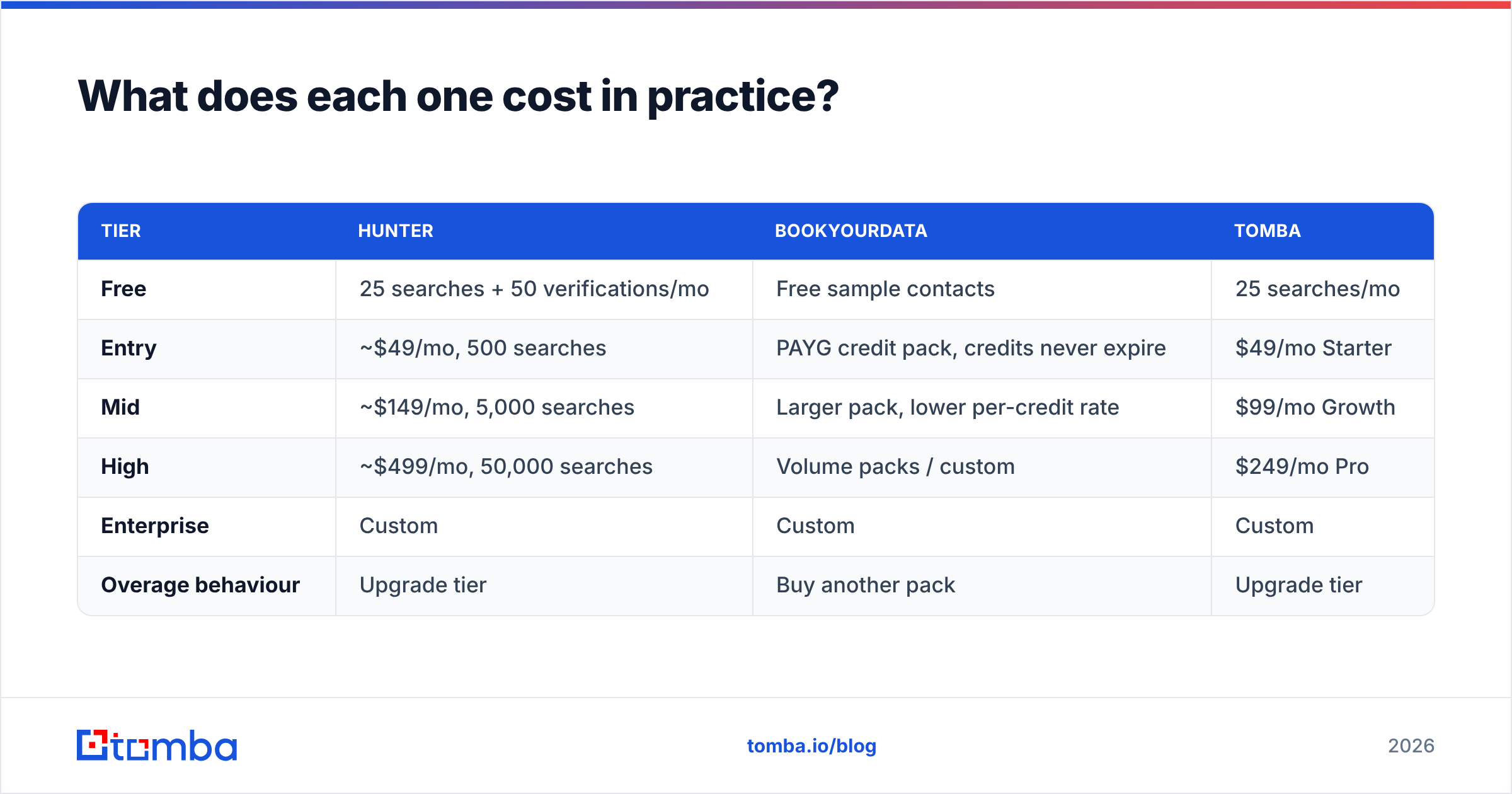
| Attribute | Hunter | BookYourData | Tomba |
|---|---|---|---|
| Primary model | Live domain/name lookup | Prebuilt filterable database | Live lookup + database + enrichment |
| Free tier | 25 searches/mo | Free sample records | 25 searches/mo |
| Entry paid price | ~$49/mo (Starter) | Pay-as-you-go credit packs | $49/mo (Starter) |
| Credit expiry | Resets monthly | Credits do not expire | Resets monthly |
| Built-in verification | Yes | Yes (guaranteed accuracy) | Yes, incl. catch-all handling |
| Bulk processing | Yes (CSV) | Yes (native export) | Yes (bulk email finder) |
| API access | Yes | Yes | Yes (Tomba API) |
| Phone numbers | No | Yes (direct dials on select records) | Yes |
| Built-in sending | Yes (Campaigns) | No | No |
| Best for | ABM, known-account outbound | Volume list building by ICP filter | Mixed: targeted lookup at scale |

The row that decides most purchases is credit expiry. If your outbound is seasonal — three heavy weeks per quarter, then quiet — a subscription that zeroes your balance every 30 days is a bad fit, and non-expiring credits win on pure economics. If you prospect continuously, a subscription is cheaper per contact.
Which one is more accurate?#
Neither number means what the marketing page implies, so read them carefully.
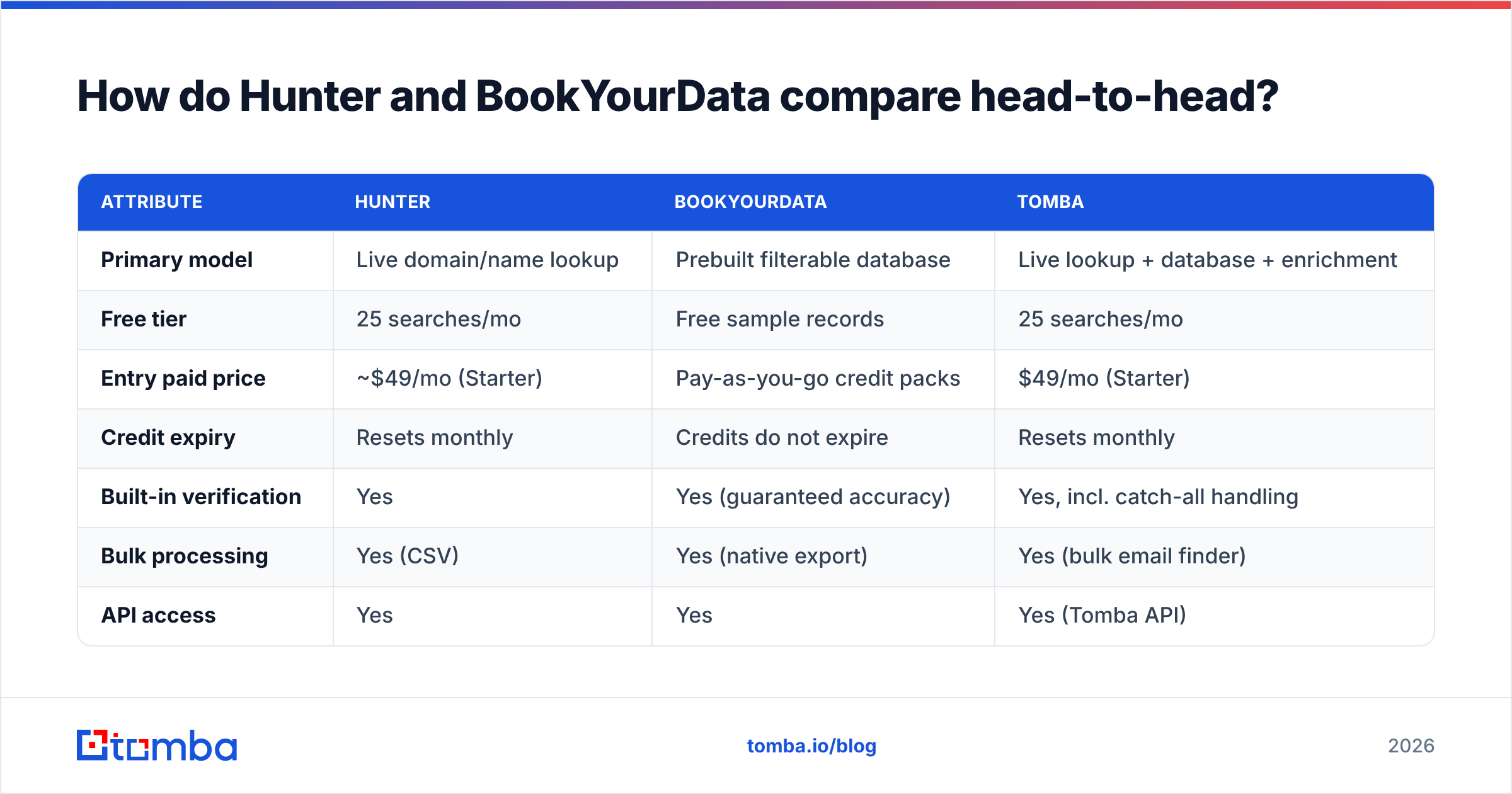
Hunter reports a confidence score per address — a probability, not a guarantee. In practice, results above 90% confidence on well-indexed domains bounce rarely. Results in the 50–70% band are pattern guesses with thin corroboration, and if you mail those without a second verification pass, your bounce rate climbs fast.
BookYourData reports a guaranteed accuracy rate across the delivered file, backed by credit replacement. That's a portfolio-level promise: a small share of records will still be stale, but you're not eating the cost.
Both approaches share the same enemy — data decay. Roughly a quarter to a third of B2B contact data goes stale each year through job changes, domain migrations, and restructures. No vendor beats that with a static file; they beat it with re-verification cadence.

The tactical answer regardless of which tool you buy:
- Never mail straight from a source. Run every list through an independent email verifier before it touches your sending domain, even when the source claims verification.
- Segment by confidence. Mail the 95%+ tier first, warm the domain, then work down. Don't blend a 60%-confidence batch into your first send of the week.
- Handle catch-all domains separately. Catch-all servers accept everything at SMTP, so standard verification returns "valid" for addresses that don't exist. A dedicated catch-all verifier is the only honest way to score them.
- Re-verify anything older than 90 days. A list bought in January is not the list you have in May.
- Track bounces per source, not per campaign. That's how you find out which vendor is actually holding up.
What does each one cost in practice?#
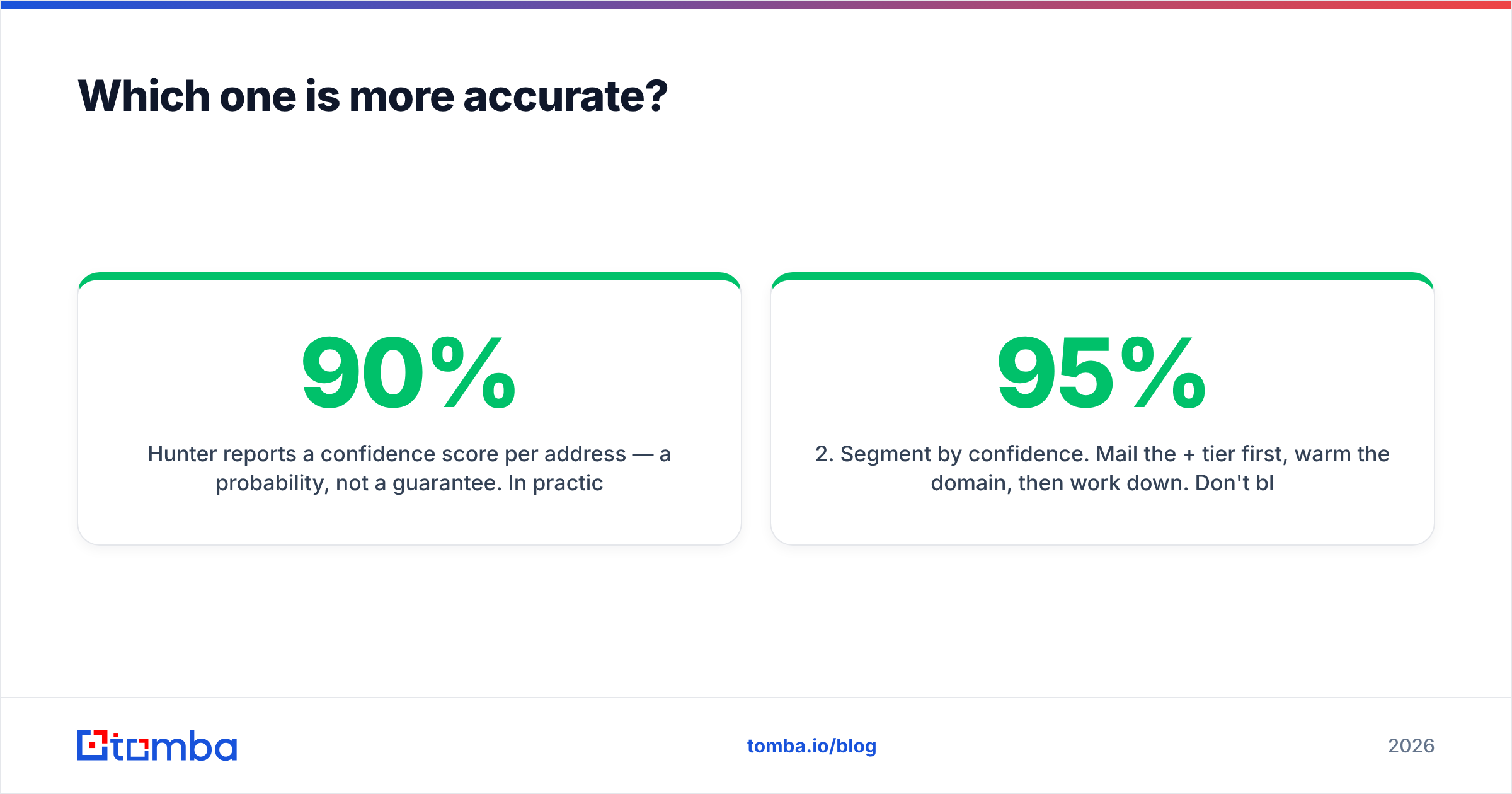
| Tier | Hunter | BookYourData | Tomba |
|---|---|---|---|
| Free | 25 searches + 50 verifications/mo | Free sample contacts | 25 searches/mo |
| Entry | ~$49/mo, 500 searches | PAYG credit pack, credits never expire | $49/mo Starter |
| Mid | ~$149/mo, 5,000 searches | Larger pack, lower per-credit rate | $99/mo Growth |
| High | ~$499/mo, 50,000 searches | Volume packs / custom | $249/mo Pro |
| Enterprise | Custom | Custom | Custom |
| Overage behaviour | Upgrade tier | Buy another pack | Upgrade tier |
Vendor pricing shifts; check each site before you commit. But the shape holds: Hunter's ladder gets steep at volume, BookYourData's per-credit rate improves with pack size and never expires, and Tomba's pricing sits at a lower mid-tier ceiling ($99 vs ~$149) for teams that outgrow a starter plan but aren't ready for a $500/mo line item.
Run the math on cost per usable contact, not cost per credit. A $0.10 credit that bounces 20% of the time costs $0.125 per deliverable contact plus the reputation damage. A $0.18 credit at 97% accuracy costs $0.186 and doesn't hurt your sender reputation. The cheap list is frequently the expensive one.
When should you choose Hunter?#
Pick Hunter when your prospecting starts from named accounts.
- You run account-based marketing and already have a target list of 200 logos from your CRM or a funding-round tracker.
- Your team lives in the browser and wants an extension that surfaces contacts while researching a company site.
- You want sourcing and sending in one tool and don't already own a sequencer.
- Your ICP is well-indexed on the public web — tech, SaaS, agencies, media, anything with a content footprint.
Hunter is weaker when the target company has almost no public presence. Regional manufacturers, family-owned distributors, and clinics generate little indexable text, so the pattern engine has nothing to learn from and confidence scores collapse.
When should you choose BookYourData?#
Pick BookYourData when your prospecting starts from criteria, not names.
- You need 5,000 HR directors at 200–1,000-employee US companies and you don't have a single company name yet.
- You want direct dial numbers alongside email for a multi-channel play.
- Your outbound is bursty and you'd rather own credits than rent them monthly.
- You want a contractual accuracy floor rather than a per-record probability.
Its constraint is the flip side: a database is a snapshot. If you need the email of one specific person who just joined a startup last week, a filterable database is the wrong instrument — that record may not exist yet. That's exactly where live lookup wins.

Where does Tomba fit between them?#
Honestly: as the option that refuses to pick a side.
Tomba runs live pattern-based discovery like Hunter — find email addresses by name and domain, or sweep an entire company with domain search — and it also exposes a searchable B2B database plus data enrichment for records you already own. Same account, same credits.
Where it differs from both:
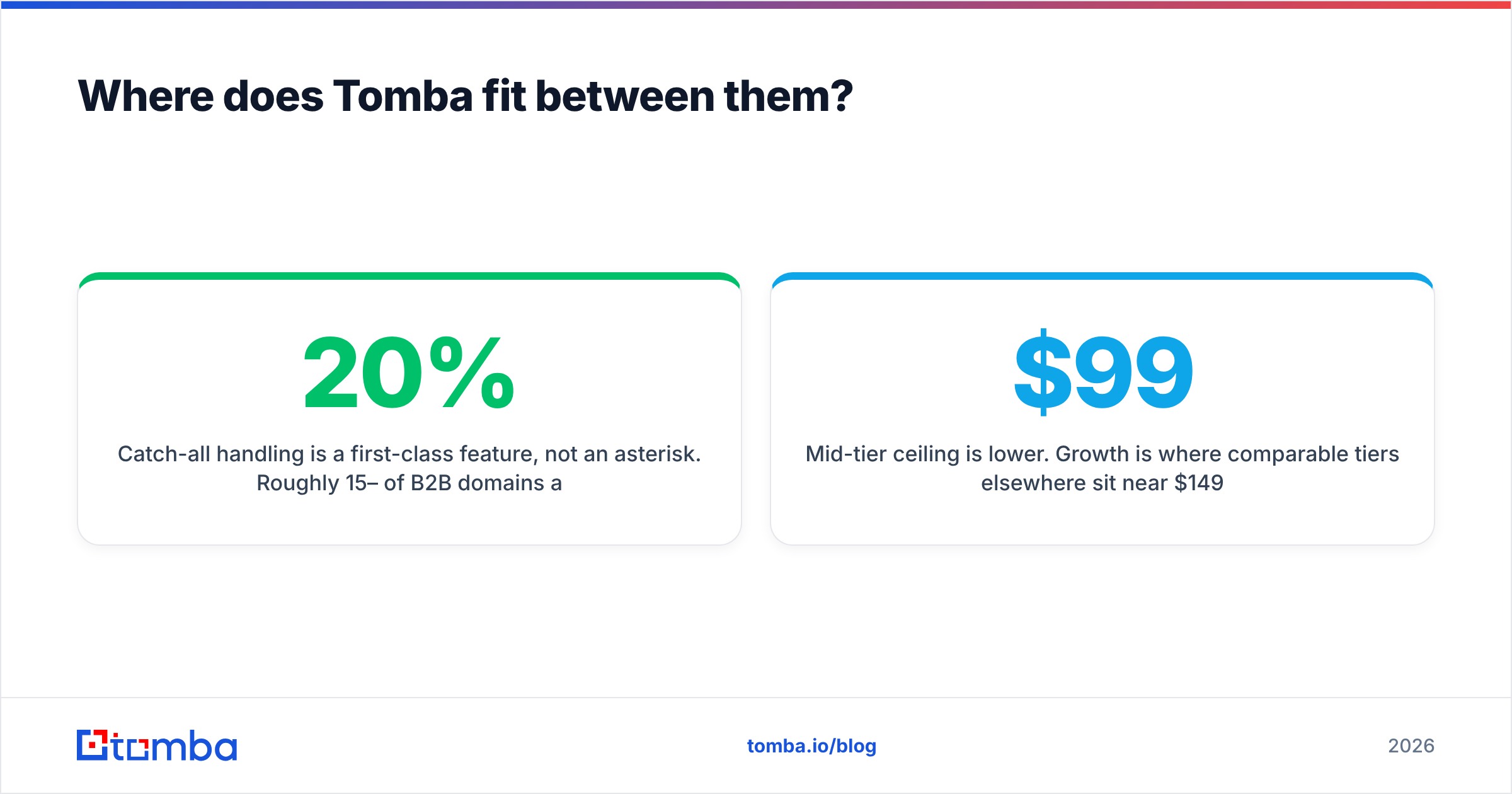
- Catch-all handling is a first-class feature, not an asterisk. Roughly 15–20% of B2B domains are catch-all, and most tools quietly mark them "risky" and move on.
- Developer surface is unusually deep for the price point: REST API, CLI, Chrome extension, Google Sheets, Excel, Airtable, and an MCP server for AI agents.
- Mid-tier ceiling is lower. Growth is $99/mo where comparable tiers elsewhere sit near $149.
- Phone data is included via phone finder, so you're not buying a second vendor for dials.
None of that makes Hunter or BookYourData bad choices. Hunter's browser workflow is genuinely excellent and its Campaigns feature saves a tool for small teams. BookYourData's non-expiring credits and bounce guarantee are the right structure for burst-mode list buying, and its filter depth on firmographics beats most live-lookup tools outright. If either shape matches your motion precisely, buy it.
What should you check before you sign up for any of them?#
Run the same three-step test on every vendor, including Tomba:
- Test on your worst 25 accounts, not your best. Everyone resolves
stripe.com. Feed it the obscure regional companies that make up the boring middle of your pipeline. - Verify the output somewhere else. Push the results through a free email checker or a second verifier and count actual disagreements.
- Read the credit terms. Does a failed search consume a credit? Do unused credits roll over? Is verification billed separately from finding? These three answers change effective cost by 30–50%.
Also confirm compliance posture for your market. GDPR-relevant lists need a documented lawful basis and a working opt-out; check each vendor's data sourcing disclosure rather than assuming.
Verdict: Hunter vs BookYourData in 2026#
Choose Hunter if you know your accounts and want fast, in-browser, per-contact resolution with sending bundled in.
Choose BookYourData if you're building lists from ICP filters, want phone numbers alongside email, and prefer owning non-expiring credits with an accuracy guarantee.
Choose Tomba if you're doing both — targeted lookups and list building — and want one bill, a lower mid-tier price, and an API that your engineers won't complain about.
Start with the free tier of whichever fits, run the 25-account stress test above, and let bounce rates settle the argument. That's a two-hour evaluation that saves a year of bad data.
Ready to test it yourself? Tomba's Email Finder gives you 25 free searches a month — no card required — with built-in verification, catch-all detection, and an API on every plan. Run your hardest 25 accounts through it, compare the results against whatever you're using now, and upgrade only if the numbers justify it.
Related guides#
// get started
Find, verify and enrich your first contacts today
Start on the free plan with 25 searches a month, then scale when your team is ready.
Free plan · No credit card required · GDPR & CCPA
Get the Tomba newsletter
Product and data updates
// about the author