9 Best Icypeas Alternatives in 2026 (Free and Paid Tools)
Icypeas is fast and cheap per credit, but coverage gaps, catch-all handling, and workflow limits push teams to look elsewhere. Here are nine Icypeas alternatives compared on accuracy, credits, and real cost.
TL;DR
- Icypeas wins on price-per-credit and bulk speed, but teams outgrow it on catch-all handling, phone data, and native integrations.
- The best Icypeas alternative depends on your bottleneck: coverage (Tomba, Apollo), French/EU B2B data (Dropcontact), verified-only exports (Findymail), or pre-built list buying (BookYourData).
- Credit math matters more than sticker price. A $29 plan that burns credits on failed lookups costs more than a $49 plan that only charges for hits.
- Tomba's free tier (25 searches/month) plus $49/mo Starter is the cheapest way to A/B test accuracy against your existing Icypeas exports.
- Run any candidate on 200 known-good contacts before you migrate. Vendor-published accuracy numbers are marketing; your bounce rate is data.
What is Icypeas, and why are teams shopping for alternatives?#
Icypeas is a French email-finding and verification platform built around bulk processing. You upload a list of names and domains, it returns emails with a confidence label, and it prices aggressively — often well below the per-credit cost of legacy players. For a solo founder running 2,000 lookups a month, that's a real advantage.
The reasons people start searching for Icypeas alternatives are consistent, and none of them are "the product is bad":
- Coverage on non-EU domains. Icypeas is strong on French and broader European company data. Teams selling into US mid-market or APAC often see hit rates drop enough to matter.
- Catch-all ambiguity. Roughly 20–30% of B2B domains accept every address at the SMTP layer. Any finder that returns "unknown" on those is handing you a judgment call, not a lead.
- No phone or deep enrichment. If your sequence is email plus a call, you're paying a second vendor.
- Integration surface. Native CRM connectors, a Sheets add-on, or an MCP server for AI agents are increasingly table stakes for RevOps teams.
- Support and roadmap velocity for teams above ~10 seats.
If none of those apply to you, stay put. If two or more do, the rest of this guide is the shortlist.
What should you actually compare in an Icypeas alternative?#
Skip the feature matrix on the vendor's own site. Five things determine whether a switch pays for itself:
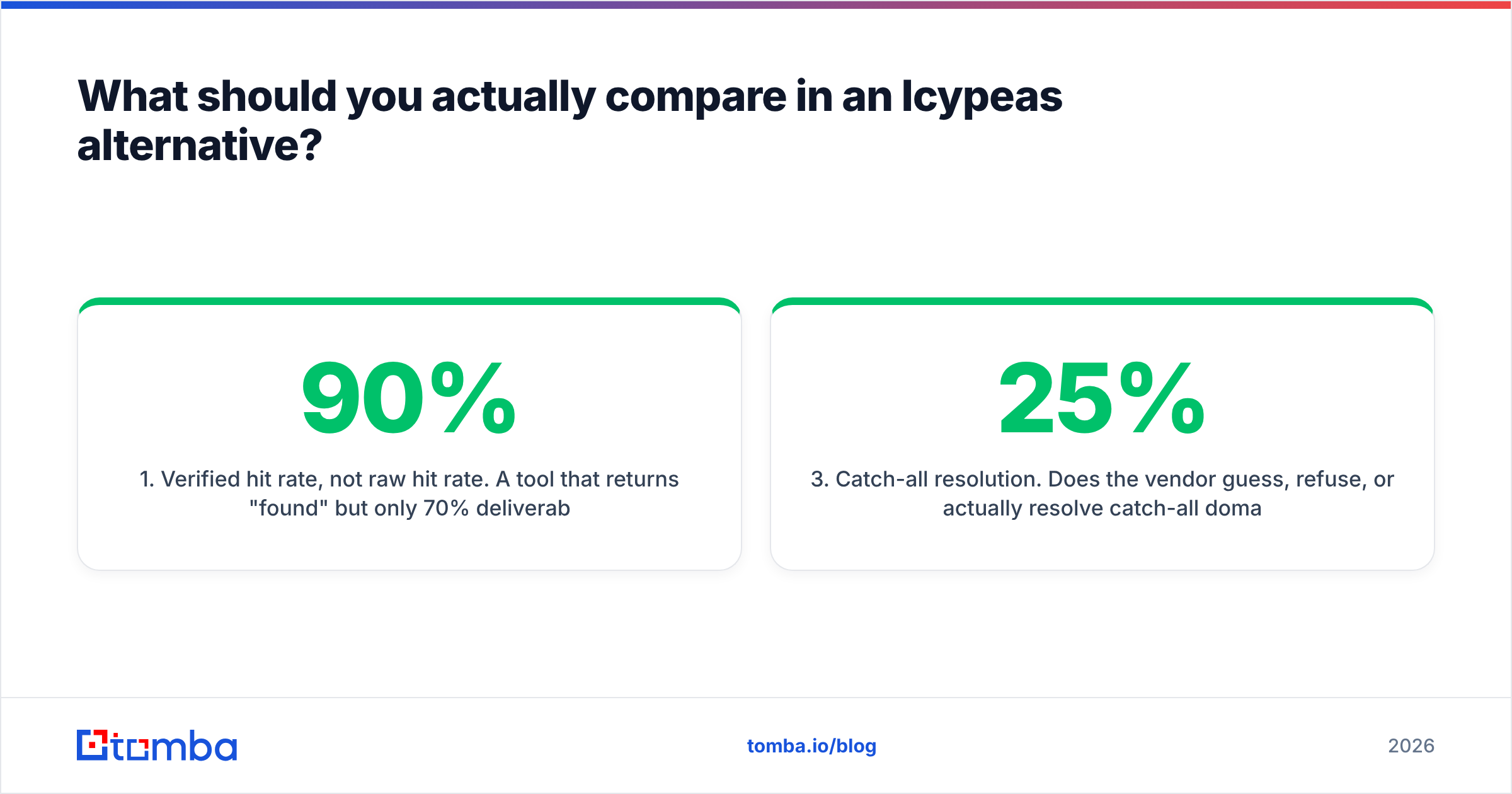
- Verified hit rate, not raw hit rate. A tool that returns 90% "found" but only 70% deliverable is worse than one that returns 75% found and 73% deliverable. Measure bounces, not rows.
- Credit consumption model. Ask whether failed lookups burn credits, whether verification is billed separately, and whether credits roll over. This single answer often swings effective cost by 2–3x.
- Catch-all resolution. Does the vendor guess, refuse, or actually resolve catch-all domains with a separate method? A dedicated catch-all verifier is the difference between a usable 25% of your list and a dead 25%.
- Data provenance. Public web crawl, contributed contact books, partner exchanges, or purchased files? Where the data comes from predicts both accuracy decay and GDPR exposure.
- Workflow fit. API rate limits, bulk file size caps, Sheets/Excel add-ons, CRM sync, and CLI/MCP access. The best data is worthless if a human has to CSV-shuttle it every morning.
- Compliance posture. GDPR/CCPA documentation, opt-out handling, and whether the vendor will sign a DPA. If you sell into the EU, this is a procurement blocker, not a nice-to-have.
Which Icypeas alternatives are worth testing in 2026?#
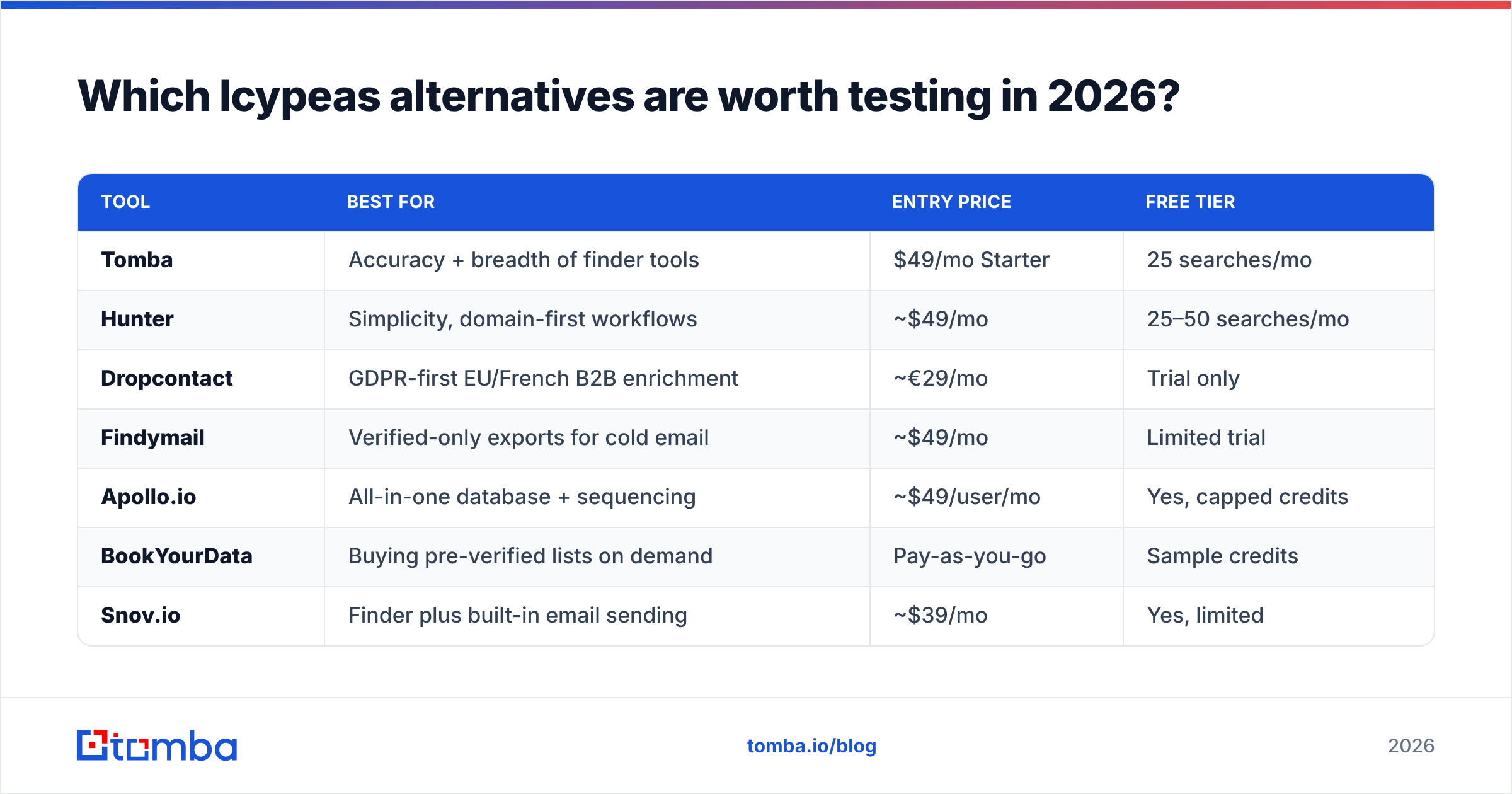
Nine tools, grouped by the job they actually do best. Pricing is entry-level list pricing as observed in early 2026 — vendors change tiers often, so confirm on the vendor page before you budget.
| Tool | Best for | Entry price | Free tier |
|---|---|---|---|
| Tomba | Accuracy + breadth of finder tools | $49/mo Starter | 25 searches/mo |
| Hunter | Simplicity, domain-first workflows | ~$49/mo | 25–50 searches/mo |
| Dropcontact | GDPR-first EU/French B2B enrichment | ~€29/mo | Trial only |
| Findymail | Verified-only exports for cold email | ~$49/mo | Limited trial |
| Apollo.io | All-in-one database + sequencing | ~$49/user/mo | Yes, capped credits |
| BookYourData | Buying pre-verified lists on demand | Pay-as-you-go | Sample credits |
| Snov.io | Finder plus built-in email sending | ~$39/mo | Yes, limited |
| Anymail Finder | Pay-only-for-valid-results billing | ~$49/mo | Trial credits |
| Prospeo | LinkedIn-centric prospecting | ~$39/mo | Small monthly free |

A few notes that the table can't carry:
Tomba is the closest like-for-like replacement if your complaint is coverage rather than price. The email finder is the core product, but domain search, email verification, catch-all resolution, phone lookup, and enrichment sit on the same credit pool — so you're not stacking three subscriptions to replace one. Pricing runs Free (25 searches/mo), Starter $49/mo, Growth $99/mo, Pro $249/mo, Enterprise custom.
Dropcontact deserves a specific mention for EU teams: it does no data storage of personal contact databases, computing results instead, which makes GDPR conversations dramatically shorter. Its trade-off is coverage outside Europe.
Apollo.io is a different category — a 200M+ contact database with sequencing bolted on. If you want one tool and can live with database-style data decay, it's compelling. If you already run Instantly or Smartlead for sending, you're paying for a sequencer twice. Teams comparing the two often land on our breakdown of Apollo alternatives.
BookYourData solves a genuinely different problem: you're not enriching a list you already have, you're buying one. Their pay-as-you-go model with a verified-accuracy guarantee suits teams that need 5,000 CFOs in DACH by Friday and don't have source names. It's a strong complement to a finder rather than a substitute for one — many teams run both.
How accurate are these tools in practice?#
Accuracy claims cluster suspiciously around "98%+" across every vendor site, which should tell you the number is measured differently at each one. What actually varies is the denominator.

Three definitions get used interchangeably:
- Hit rate — percentage of input rows that returned any email. Inflated by pattern guessing.
- Deliverability rate — percentage of returned emails that don't hard bounce. The only one your ESP cares about.
- Verified-accuracy rate — percentage of emails the vendor marked "valid" that actually were. This is the honest metric, and it's the one to demand.
Run this test before you commit to anyone. Take 200 contacts you already have confirmed emails for — closed-won accounts, webinar registrants, people who've replied to you. Strip the emails. Feed names and domains to each candidate tool. Then score three columns: found, matched-your-known-good, and marked-valid-but-wrong. That last column is where tools separate. A vendor that returns fewer results but never mislabels a guess as verified will save you more sender reputation than one with a flashy hit rate.
For the ~25% of your list sitting on catch-all domains, run them through a dedicated catch-all finder rather than accepting an "unknown" verdict. Treating catch-all as undeliverable throws away real pipeline; treating it as deliverable torches your sender reputation. The only correct answer is a second method.

Is Tomba a better fit than Icypeas for your team?#
Honestly: not always. Here's the split.
Stay on Icypeas if your ICP is concentrated in France and Western Europe, your volume is under ~3,000 lookups/month, price-per-credit is your dominant constraint, and you don't need phone numbers. It does that job well and cheaply.
Move to Tomba if any of these are true:
| Situation | Why Tomba fits |
|---|---|
| Selling into US + EU + APAC | Broader crawl-based coverage across non-EU domains |
| Catch-all domains are 20%+ of your list | Dedicated catch-all verifier instead of an "unknown" label |
| You need email and phone | Phone finder shares the same credit pool |
| Your ops run in Sheets or Airtable | Native Google Sheets add-on and Airtable integration |
| You're building an AI agent workflow | Tomba API, CLI, and an MCP server for agent access |
| Budget is genuinely the blocker | Free tier at 25 searches/mo to benchmark before paying |
The MCP point is underrated. If your team is wiring Claude or another agent into prospecting, having a supported MCP server means the agent can look up and verify contacts natively instead of you writing glue code around a REST endpoint.
What about the all-in-one platforms — Apollo, Snov, and Instantly?#
Different trade. All-in-ones bundle data, sequencing, and sometimes a CRM. That bundling is great until one component underperforms and you can't swap it independently.
The practical pattern most outbound teams converge on by 2026 is a two-layer stack: a best-in-class data layer (finder + verifier + enrichment) feeding a best-in-class sending layer (a sequencer with inbox rotation and warmup). The data layer is where accuracy compounds; the sending layer is where deliverability compounds. Coupling them into one vendor means you optimize neither.
Check G2's email-finder category for how buyers actually rate these — the review distribution across data quality versus support quality is more revealing than any feature list, and it's the fastest way to sanity-check a vendor's own claims.
If you're already committed to a sequencer, keep it and just replace the data source. That's a one-afternoon migration. Replacing an all-in-one is a quarter-long project.
How do you migrate off Icypeas without breaking your pipeline?#
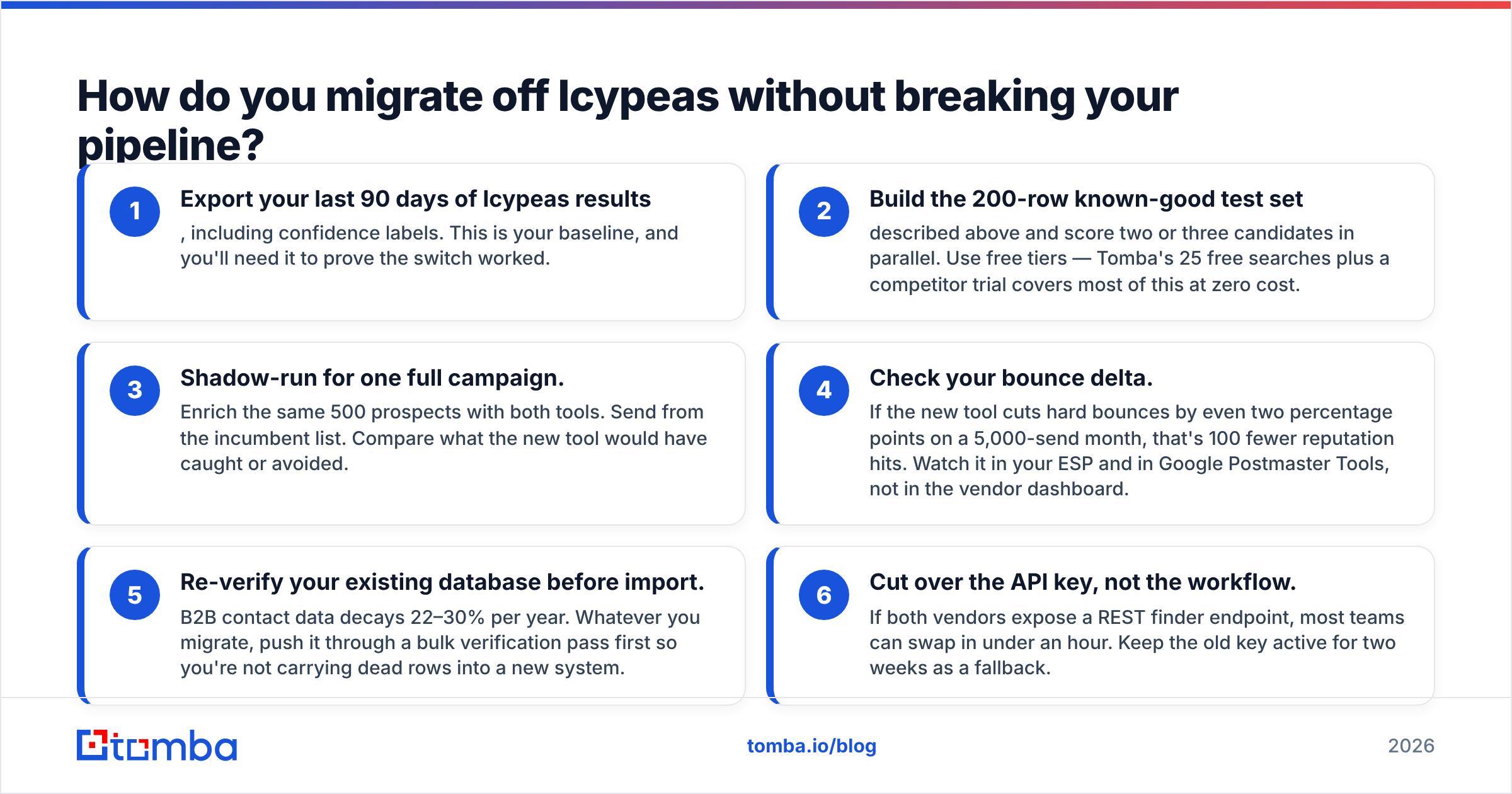
Run this over two weeks, not one weekend:
- Export your last 90 days of Icypeas results, including confidence labels. This is your baseline, and you'll need it to prove the switch worked.
- Build the 200-row known-good test set described above and score two or three candidates in parallel. Use free tiers — Tomba's 25 free searches plus a competitor trial covers most of this at zero cost.
- Shadow-run for one full campaign. Enrich the same 500 prospects with both tools. Send from the incumbent list. Compare what the new tool would have caught or avoided.
- Check your bounce delta. If the new tool cuts hard bounces by even two percentage points on a 5,000-send month, that's 100 fewer reputation hits. Watch it in your ESP and in Google Postmaster Tools, not in the vendor dashboard.
- Re-verify your existing database before import. B2B contact data decays 22–30% per year. Whatever you migrate, push it through a bulk verification pass first so you're not carrying dead rows into a new system.
- Cut over the API key, not the workflow. If both vendors expose a REST finder endpoint, most teams can swap in under an hour. Keep the old key active for two weeks as a fallback.
One thing to resist: migrating and simultaneously changing your sending volume, copy, or domain setup. If bounce rate moves, you want exactly one variable to explain it.
What does this cost over a year?#
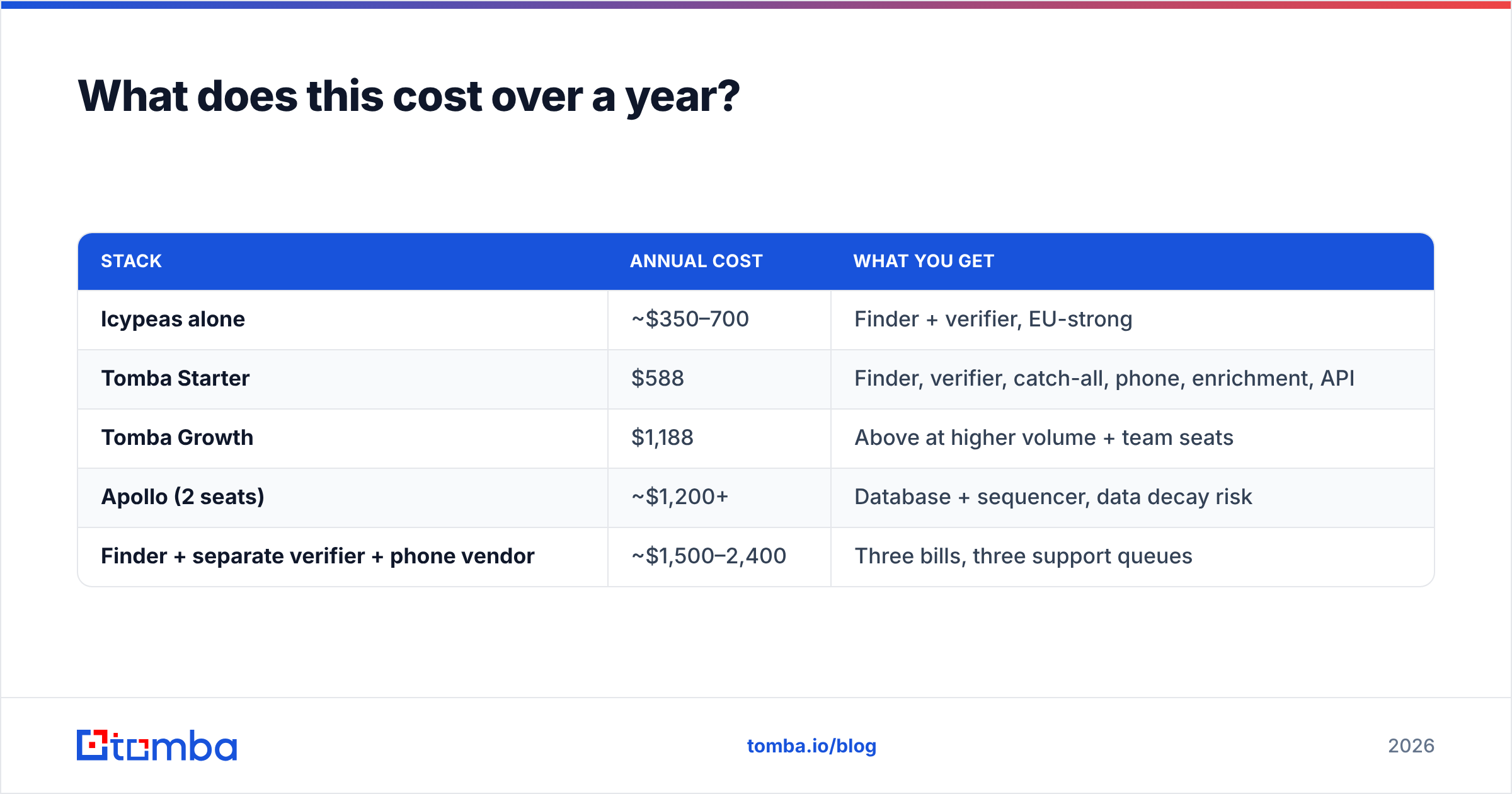
Rough annual math for a two-person outbound team running 5,000 lookups/month:
| Stack | Annual cost | What you get |
|---|---|---|
| Icypeas alone | ~$350–700 | Finder + verifier, EU-strong |
| Tomba Starter | $588 | Finder, verifier, catch-all, phone, enrichment, API |
| Tomba Growth | $1,188 | Above at higher volume + team seats |
| Apollo (2 seats) | ~$1,200+ | Database + sequencer, data decay risk |
| Finder + separate verifier + phone vendor | ~$1,500–2,400 | Three bills, three support queues |
The consolidation argument is the real one. Most teams that "save money" on a cheap finder end up paying a second vendor for verification and a third for phone numbers, landing above where a single consolidated tool would have put them. Compare Tomba pricing against your current stack total, not against your current finder line item.
Try it against your own list#
Pick the two candidates that match your bottleneck, load the same 200 rows into both, and let the bounce data decide. If coverage and catch-all handling are what pushed you off Icypeas, start with the Tomba Email Finder — the free tier gives you 25 searches with no card, which is enough to score a real sample before you spend anything. If the numbers don't beat what you have, you've lost an afternoon and learned something concrete about your data quality. If they do, the $49/mo Starter plan pays for itself the first time it stops a bounce spike.
Related guides#
// get started
Find, verify and enrich your first contacts today
Start on the free plan with 25 searches a month, then scale when your team is ready.
Free plan · No credit card required · GDPR & CCPA
// about the author