Influencers Club vs ReachStream: Which B2B Data Tool Wins?
One sells creator data, the other sells classic B2B contact records. Here is how Influencers Club and ReachStream actually differ on coverage, accuracy, pricing and export limits — and which one belongs in your stack.
TL;DR
- They are not really competitors. Influencers Club is a creator/social-audience database. ReachStream is a traditional B2B contact database of job titles, companies and work emails. Picking between them is mostly a question of who you sell to, not which is better.
- Choose Influencers Club if your ICP is creators, DTC brand owners, affiliates or anyone you would find on Instagram, TikTok or YouTube before you would find them on LinkedIn.
- Choose ReachStream if you sell to job functions inside registered companies and you want cheap, high-volume contact lists you can filter by industry, headcount and title.
- Both are static databases, which means both decay. Independent studies and vendor benchmarks consistently put B2B data decay somewhere between 25% and 30% per year, so verification at send time is not optional with either tool.
- The pragmatic stack for most teams: one database for discovery, plus a real-time email finder and verifier layer so you are not emailing records that were accurate 14 months ago.
What are Influencers Club and ReachStream?#
They solve two different discovery problems with the same shape of product: a searchable index of people plus contact details.
Influencers Club indexes social creators. Its core value is that you can filter by things no B2B database tracks — follower count, engagement rate, audience country, audience gender split, posting frequency, whether the creator has mentioned a competitor brand, whether they have a Shopify store. Then it attaches an email address to that profile. The buyer is usually an influencer-marketing lead, an affiliate manager, or an ecommerce brand hunting for partners.
ReachStream is the classic B2B play. It sells access to a contact and company database — names, titles, work emails, phone numbers, company size, revenue band, industry codes, tech signals — with filters that look familiar to anyone who has used ZoomInfo or Apollo. The buyer is an SDR manager or demand-gen marketer building a territory list.
The confusion comes from the fact that both get bought by "growth" teams and both promise "verified emails." That is where the similarity ends.
How do the two data models actually differ?#
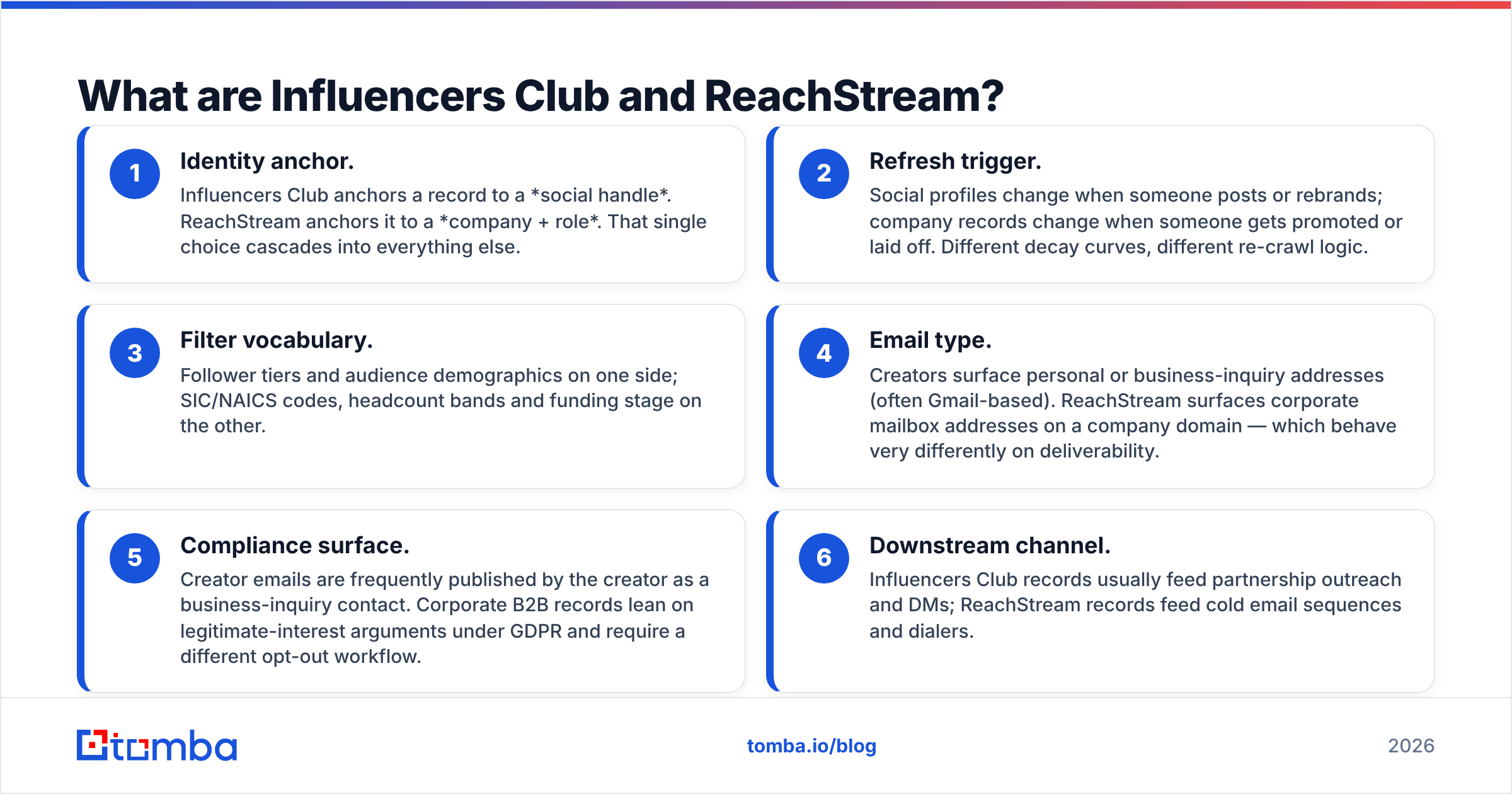
- Identity anchor. Influencers Club anchors a record to a social handle. ReachStream anchors it to a company + role. That single choice cascades into everything else.
- Refresh trigger. Social profiles change when someone posts or rebrands; company records change when someone gets promoted or laid off. Different decay curves, different re-crawl logic.
- Filter vocabulary. Follower tiers and audience demographics on one side; SIC/NAICS codes, headcount bands and funding stage on the other.
- Email type. Creators surface personal or business-inquiry addresses (often Gmail-based). ReachStream surfaces corporate mailbox addresses on a company domain — which behave very differently on deliverability.
- Compliance surface. Creator emails are frequently published by the creator as a business-inquiry contact. Corporate B2B records lean on legitimate-interest arguments under GDPR and require a different opt-out workflow.
- Downstream channel. Influencers Club records usually feed partnership outreach and DMs; ReachStream records feed cold email sequences and dialers.

How do Influencers Club and ReachStream compare head-to-head?#
Here is the practical side-by-side. Where a vendor does not publish a number, we say so rather than inventing one — check the vendor page before you sign anything, because both companies have repriced in the last 18 months.
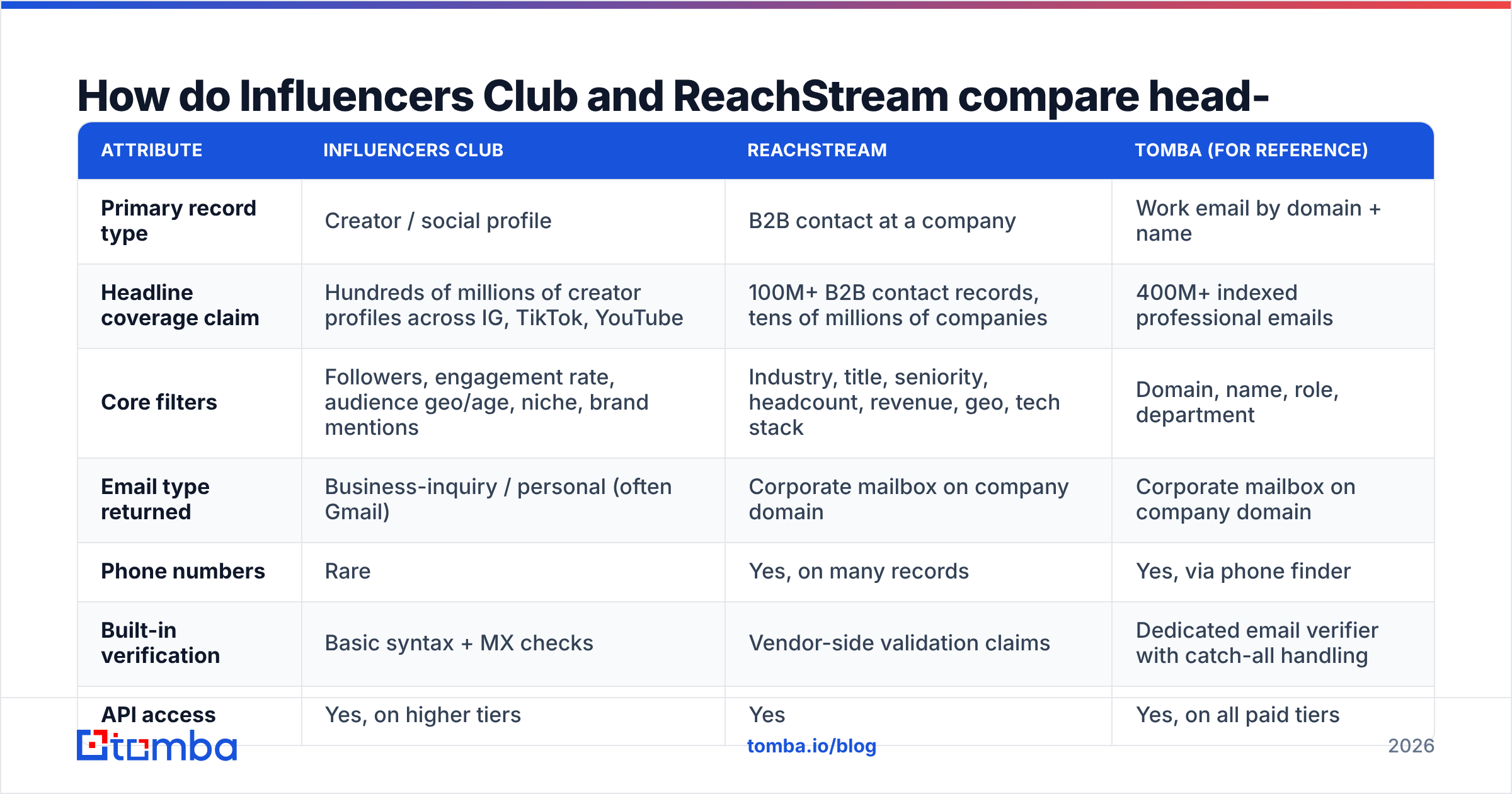
| Attribute | Influencers Club | ReachStream | Tomba (for reference) |
|---|---|---|---|
| Primary record type | Creator / social profile | B2B contact at a company | Work email by domain + name |
| Headline coverage claim | Hundreds of millions of creator profiles across IG, TikTok, YouTube | 100M+ B2B contact records, tens of millions of companies | 400M+ indexed professional emails |
| Core filters | Followers, engagement rate, audience geo/age, niche, brand mentions | Industry, title, seniority, headcount, revenue, geo, tech stack | Domain, name, role, department |
| Email type returned | Business-inquiry / personal (often Gmail) | Corporate mailbox on company domain | Corporate mailbox on company domain |
| Phone numbers | Rare | Yes, on many records | Yes, via phone finder |
| Built-in verification | Basic syntax + MX checks | Vendor-side validation claims | Dedicated email verifier with catch-all handling |
| API access | Yes, on higher tiers | Yes | Yes, on all paid tiers |
| Free entry point | Limited trial / demo-gated | Free plan with a small record allowance | Free tier, 25 searches/mo |
| Entry paid price | Quote-driven; typically low-to-mid three figures monthly | Advertised as budget-tier, low three figures monthly | $49/mo Starter |
| Best for | Influencer, affiliate and DTC partnerships | Volume B2B list building | Accuracy-first email discovery + verification |
| Worst for | Enterprise SaaS ICPs | Creator or personal-brand ICPs | Audience demographics research |

The row that decides most evaluations is the third one. If your filter list starts with "engagement rate above 3% in Germany," ReachStream cannot help you at any price. If it starts with "Heads of RevOps at 200–1,000 employee SaaS companies," Influencers Club cannot help you at any price. Budget arguments come second.
Whose data is more accurate?#
Neither vendor publishes an audited accuracy figure, so treat every "98% accurate" banner — from either of them, or from anyone else — as marketing until you test it on your own ICP.
What you can do is run the same 200-record test both ways:
- Pull 200 records matching your ICP from the tool.
- Run every address through an independent verifier before sending. Do not use the vendor's own validation for this; you are auditing them.
- Record four buckets: valid, invalid, catch-all/accept-all, and unknown.
- Send to the valid bucket only, then compare hard-bounce rate against your usual baseline.
In our experience running this test across creator databases and B2B databases, two patterns hold consistently. Creator databases return a higher share of free-mail addresses (Gmail, Outlook.com), which verify cleanly but convert unpredictably because the inbox is personal and crowded. B2B databases return a higher share of catch-all domains, which verify as "unknown" and quietly inflate your bounce risk unless you run a proper catch-all verifier against them.

The second accuracy trap is age. A database that was built in bulk and refreshed quarterly is, on average, several months stale by the time you query it. With B2B decay running at roughly a quarter of records per year, a list bought in January and sent in September has already lost a meaningful slice of its validity. This is the single biggest reason teams blame "bad data" when what they really have is old data.
Practical rule: databases are for discovery. Real-time lookup and verification are for sending. Do not let one product do both jobs unless it is genuinely re-resolving the address at query time.
What does each one cost?#
Both vendors gate their real numbers behind a demo or a signup, which makes clean comparison hard. Here is the honest shape of it.
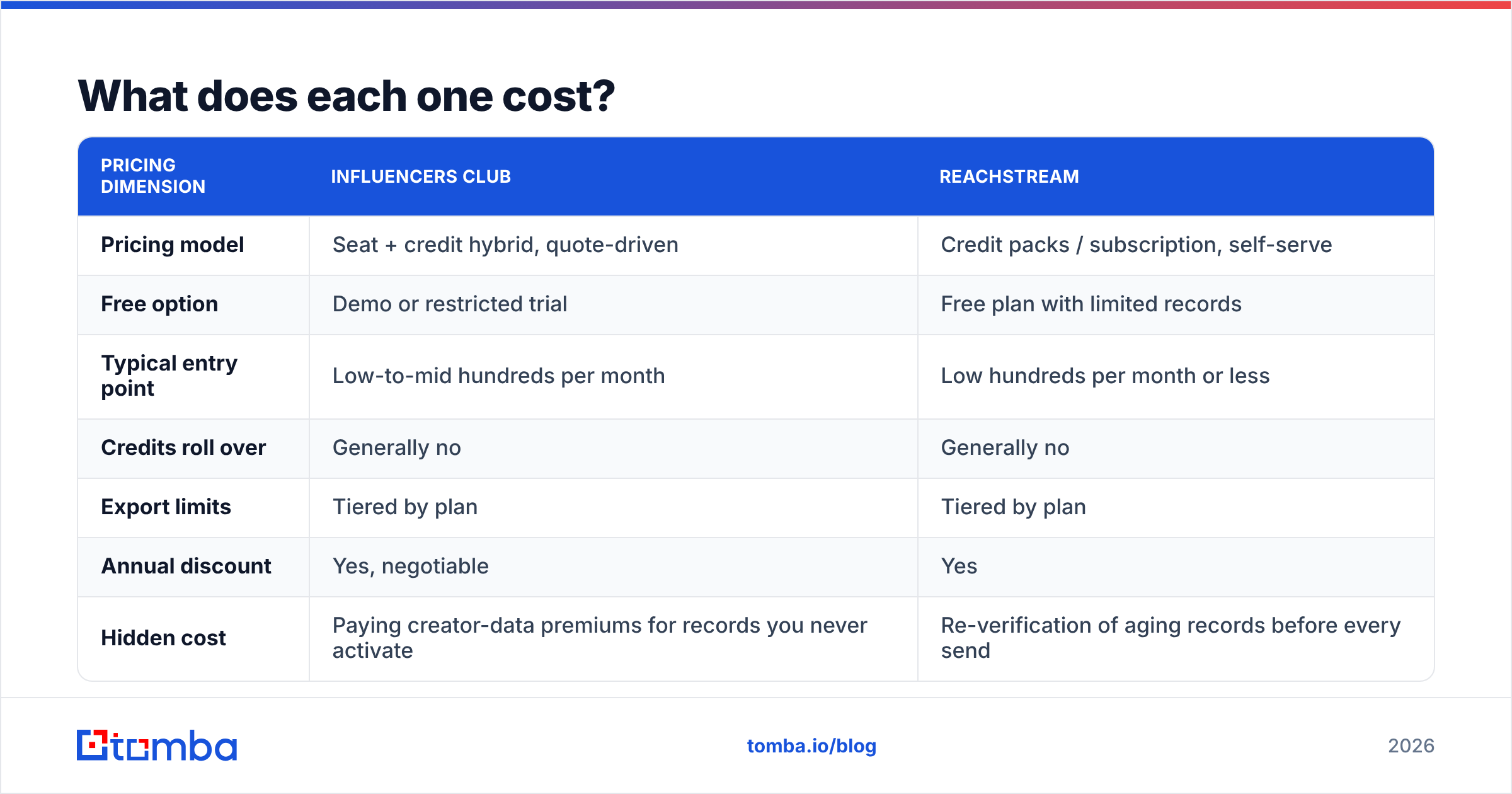
| Pricing dimension | Influencers Club | ReachStream |
|---|---|---|
| Pricing model | Seat + credit hybrid, quote-driven | Credit packs / subscription, self-serve |
| Free option | Demo or restricted trial | Free plan with limited records |
| Typical entry point | Low-to-mid hundreds per month | Low hundreds per month or less |
| Credits roll over | Generally no | Generally no |
| Export limits | Tiered by plan | Tiered by plan |
| Annual discount | Yes, negotiable | Yes |
| Hidden cost | Paying creator-data premiums for records you never activate | Re-verification of aging records before every send |
The hidden-cost row matters more than the headline price. Influencers Club charges a premium for audience intelligence — follower quality, geo splits, brand-affinity signals. That premium is worth it if you are actually running partnership campaigns off those signals. It is pure waste if you bought the tool for email addresses and ignore everything else in the record.
ReachStream's hidden cost runs the other way. Volume-priced records are cheap up front, but every send cycle you should be re-verifying before it hits your ESP. Budget for that. A cheap list that burns your sending domain is the most expensive list you will ever buy.
For calibration, Tomba pricing runs a free tier at 25 searches/month, Starter at $49/mo, Growth at $99/mo and Pro at $249/mo — with verification included rather than sold as a separate line item. That structure exists precisely because discovery and verification are the same workflow, not two products.

Who should use Influencers Club?#
Pick Influencers Club when the person you want to reach is discoverable by audience, not by employer.
Strong fits:
- Influencer and affiliate programs. You need engagement rate, audience geography and past brand collaborations before you decide who is worth an email. No B2B database carries those fields.
- DTC and ecommerce partnerships. Filtering for creators who already run a Shopify store, or who have mentioned a competitor, is a genuinely differentiated capability.
- Agency prospecting into personal brands. Coaches, course creators and solo operators are often invisible to B2B databases because they have no registered company footprint.
- UGC sourcing at scale. When you need 500 micro-creators in a niche rather than 50 enterprise accounts.
Weak fits: enterprise SaaS, industrial, healthcare, financial services — anything where the buying committee sits inside a corporate org chart. You will pay for audience signals you never use and get thin coverage on the records you actually want.
Who should use ReachStream?#
Pick ReachStream when you need volume, standard firmographic filters, and a low cost per record.
Strong fits:
- Early-stage teams doing broad TAM tests. When you do not yet know which segment responds, cheap breadth beats expensive precision.
- Event and webinar list building. Wide title-based pulls where a 10% miss rate is survivable.
- Regional or mid-market ICPs that the expensive incumbents cover poorly.
- Teams already paying enterprise prices elsewhere and looking for a cheaper second source to cross-reference. Running two sources and keeping only records that agree is one of the most reliable accuracy hacks in B2B data.
Weak fits: highly specific technographic targeting, real-time intent, or any workflow that assumes the record was verified this week. Check recent ReachStream reviews on G2 alongside the vendor's own materials before committing to an annual term — user reviews are where coverage gaps for specific regions and industries actually surface.
Do you still need an email finder if you buy a database?#
Yes, and this is the part most evaluations miss.
A database answers "who exists?" An email finder answers "what is this specific person's address, right now?" Those are different queries with different failure modes. When your rep finds a perfect-fit prospect on LinkedIn or in a podcast guest list, no database subscription helps — the record either exists in the index or it does not. A lookup layer resolves the address on demand against live signals.
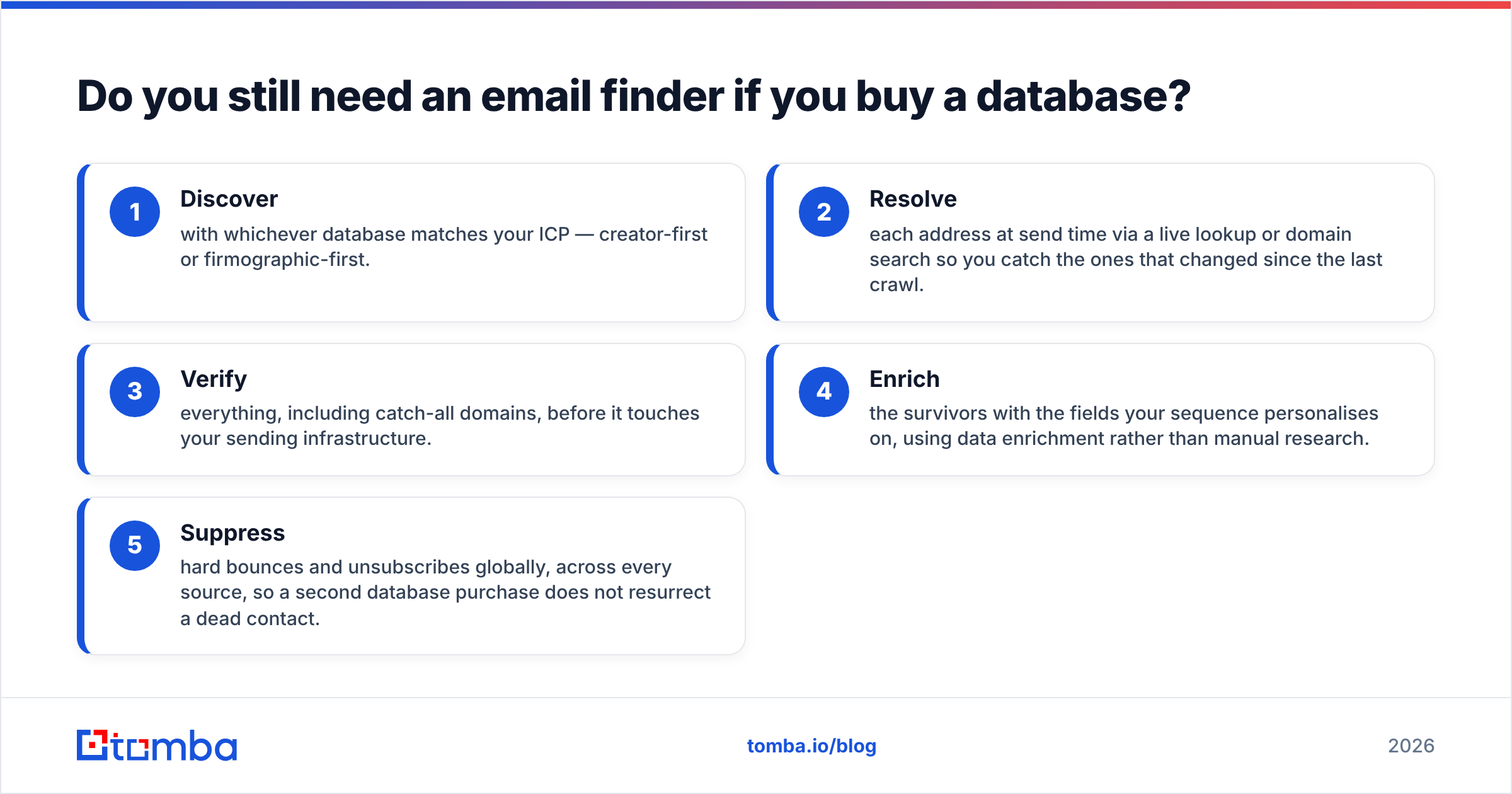
The workflow that actually holds up in 2026 looks like this:
- Discover with whichever database matches your ICP — creator-first or firmographic-first.
- Resolve each address at send time via a live lookup or domain search so you catch the ones that changed since the last crawl.
- Verify everything, including catch-all domains, before it touches your sending infrastructure.
- Enrich the survivors with the fields your sequence personalises on, using data enrichment rather than manual research.
- Suppress hard bounces and unsubscribes globally, across every source, so a second database purchase does not resurrect a dead contact.
Skip step 3 and your sender reputation absorbs the cost of every stale record either vendor hands you. Mailbox providers do not care where the address came from.
What is the verdict on Influencers Club vs ReachStream?#
There is no universal winner, and any post that declares one is not looking at your ICP.
- If you sell to creators or through creators, Influencers Club is the better buy, and it is not close. Its audience filters are the product; the email is a bonus field.
- If you sell to companies, ReachStream is the better buy, and it is a reasonable budget-tier choice against far more expensive incumbents — provided you verify before you send.
- If you are trying to decide because you want accurate work emails at a predictable price, the honest answer is that neither product is optimised for that job. Both are databases with an email column attached.
Run the 200-record test on your own ICP before you sign. Two weeks of testing is cheaper than a twelve-month contract for a dataset that does not cover your market.
Ready to stop guessing on contact data?#
Databases are useful for discovery, but the address you send to should be resolved and verified the day you send it — not the quarter it was crawled. The Tomba Email Finder looks up professional email addresses by name, domain or company in real time, confirms the pattern against live signals, and runs verification in the same call so nothing untested reaches your ESP. Start on the free tier with 25 searches a month, run it head-to-head against whichever database you are evaluating, and let the bounce rate decide.
Related guides#
Ready to find emails that actually work?
Join 150,000+ professionals who stopped guessing and started sending. Free credits on signup — no credit card required.
Get the Tomba newsletter
Practical outbound tactics and product updates — once every two weeks.
About the author