Influno vs SMARTe (2026): Which Sales Tool Actually Fits?
Influno sends the emails. SMARTe supplies the contacts. Here is an honest breakdown of pricing, data quality, deliverability, and which one your outbound team actually needs first.
TL;DR
- Influno and SMARTe are not really competitors. Influno is a cold email sending and sequencing platform; SMARTe is a B2B contact data provider focused on mobile numbers and enriched profiles.
- If your problem is "I have a list but nothing is going out," you need Influno. If your problem is "I have a great pitch but no one to send it to," you need SMARTe.
- SMARTe's differentiator is phone coverage and international (EMEA/APAC) data. Influno's differentiator is a self-serve, sequencer-first workflow at a price point smaller teams can actually approve.
- Neither tool fully solves email accuracy. Data providers ship stale addresses and sequencers happily send to them, which is why a standalone verification layer belongs between the two.
- Realistic setup for most teams: one data source, one sender, one verifier. Tomba covers the data and verification half starting at $49/mo, which is usually cheaper than buying enterprise credits you never burn.
What are Influno and SMARTe, exactly?#
They solve opposite halves of the same problem, and confusing them is the single most expensive mistake in this evaluation.
Influno is an outbound email platform. You connect mailboxes, warm them up, import contacts, build multi-step sequences with conditional branches, and track opens, clicks, and replies. It sits in the same category as Instantly, Smartlead, and Lemlist. Its value shows up after you already know who you want to reach.
SMARTe is a B2B data and go-to-market intelligence platform. It sells access to a contact database — direct dials, mobile numbers, work emails, firmographics, technographics, and buyer-intent signals — plus a Chrome extension that pulls contacts off LinkedIn and company sites into your CRM. It sits in the same category as ZoomInfo, Apollo's data layer, Cognism, and Lusha. Its value shows up before you write a single line of copy.
So "Influno vs SMARTe" is rarely a real either/or decision. It becomes one in exactly two situations: you have a fixed budget and can only fund one line item this quarter, or you are evaluating all-in-one platforms and trying to figure out which one stretches furthest into the other's territory.
This post answers both versions of the question.
How do Influno and SMARTe compare head-to-head?#
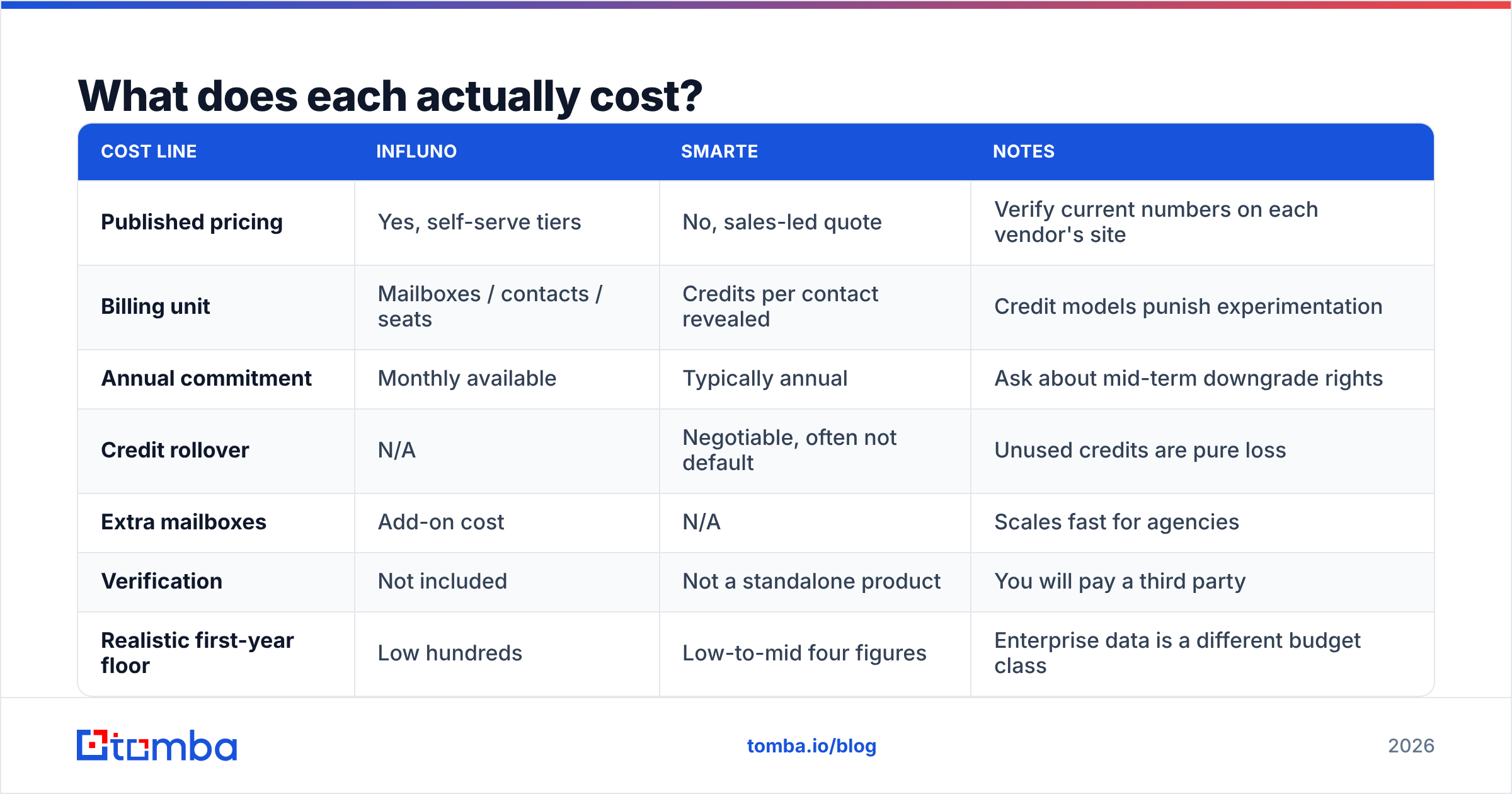
| Dimension | Influno | SMARTe |
|---|---|---|
| Primary job | Send and sequence cold email | Supply contact and company data |
| Core asset | Sending infrastructure + sequencer | Contact database + enrichment API |
| Email addresses | You bring them | Provides them |
| Phone / mobile numbers | Not a focus | Core strength, especially non-US |
| Mailbox warmup | Built in | Not applicable |
| Deliverability tooling | Sending limits, rotation, tracking | Not applicable |
| Intent data | No | Yes, on higher tiers |
| CRM sync | Yes, for sequence activity | Yes, for contact push |
| Pricing model | Public self-serve tiers | Quote-based, credit bundles |
| Typical buyer | Founder, SDR lead, agency | RevOps, demand gen, enterprise SDR team |
| Free entry point | Trial | Limited free credits / demo |
| Fails when | Your list is garbage | You have nowhere to send the list |
Read that table twice. Almost every row where one tool is strong, the other is blank. That is the whole story.
Which one gives you better contact data?#
SMARTe, trivially — because Influno does not sell contact data at all. The more useful question is whether SMARTe's data is good enough to justify a database-tier budget.
SMARTe's reputation is built on phone coverage outside North America. Most US-centric providers fall off a cliff when you ask for a mobile number for a manufacturing ops director in Germany or a fintech VP in Singapore. SMARTe invests there, and buyers on G2 consistently cite international mobile fill rate as the reason they picked it over a bigger-name competitor.
Where it gets less clean is email. Every large B2B database — SMARTe included — carries a tail of addresses that were accurate the day they were ingested and have been quietly dead since a reorg eighteen months ago. Vendors publish accuracy rates measured against their own refresh cycles, not against your send date. That gap is where bounce rates come from.

Three practical habits fix most of it:
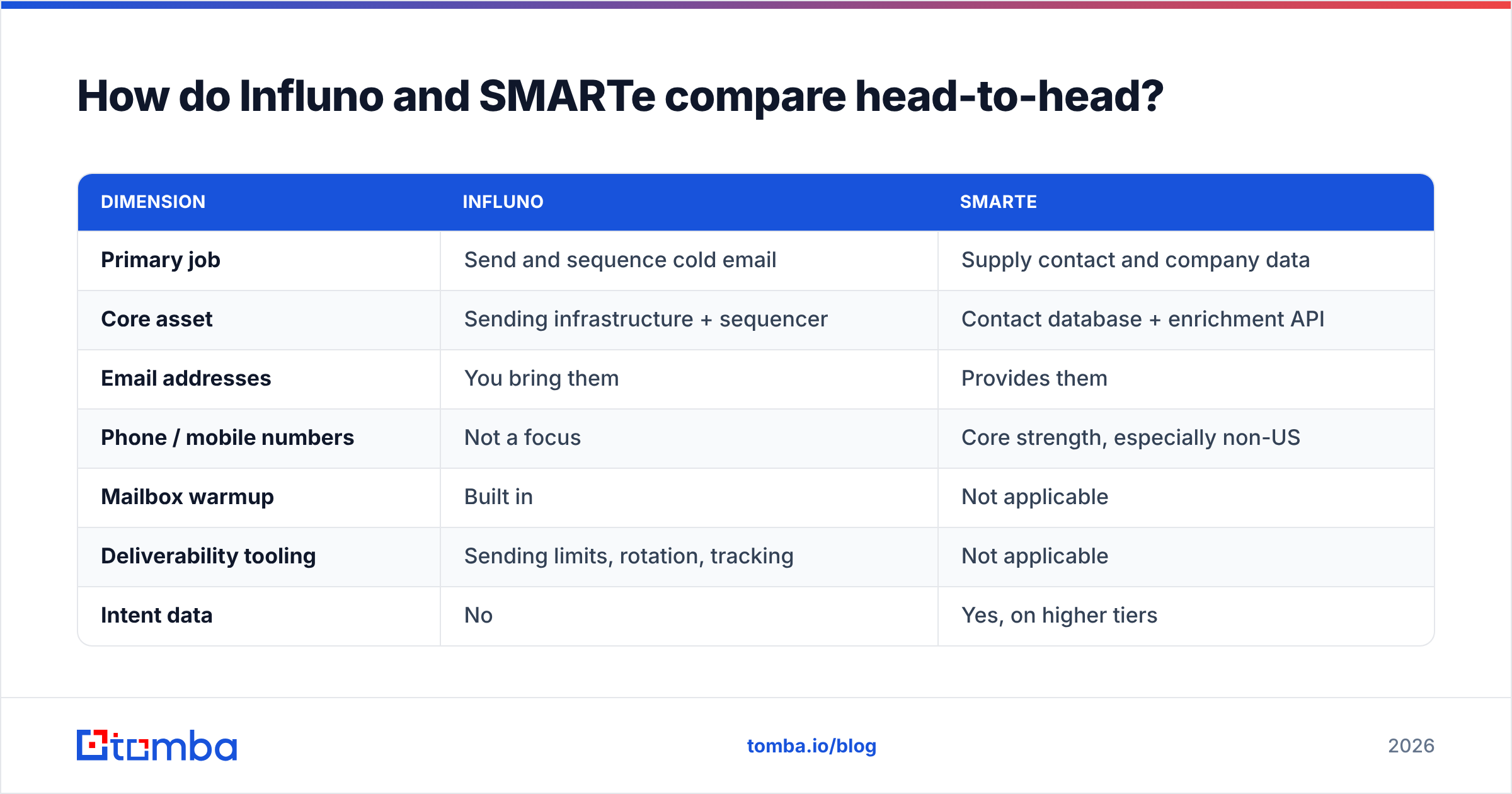
- Never send straight from an export. Run every list through an email verifier the week you send, not the week you bought it. A list verified 60 days ago is an unverified list.
- Treat catch-all domains as their own bucket. A catch-all server accepts everything, so standard SMTP checks return "valid" for addresses that do not exist. Segment them, send to them last, and keep them out of your primary domain's volume until they prove themselves.
- Cross-check the pattern, not just the address. If a database hands you
j.smith@acme.combut every other contact at Acme isjsmith@acme.com, the database is guessing. A domain search tells you the real convention in seconds. - Watch your bounce rate weekly, not per campaign. Google and Microsoft judge your domain on a rolling window. One bad list poisons the next three good ones.
None of that is a knock on SMARTe specifically. It applies to any provider, including the one you are using today.
What does each actually cost?#
Here is where the "hidden costs" live, and they are not in the sticker price.
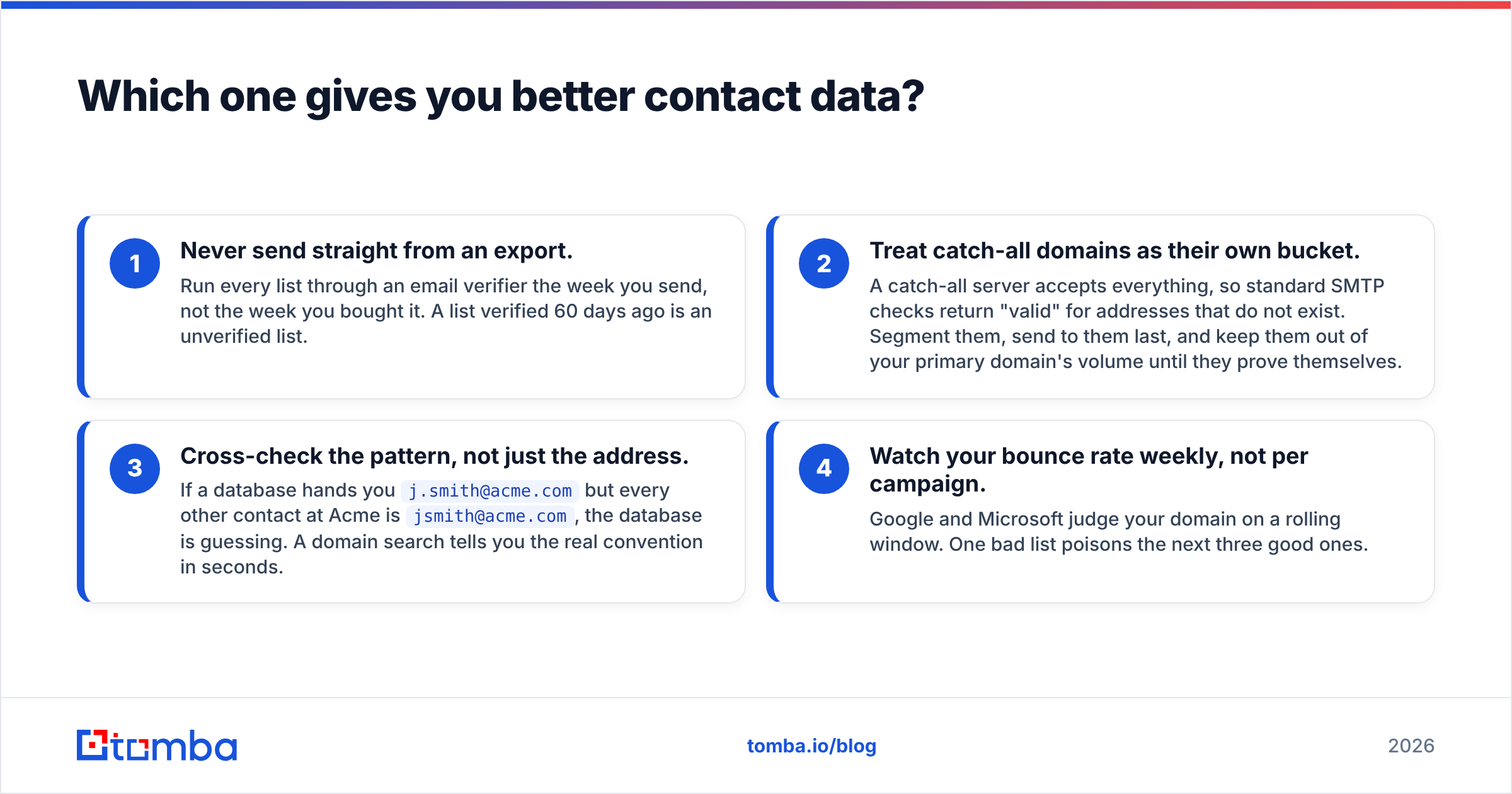
| Cost line | Influno | SMARTe | Notes |
|---|---|---|---|
| Published pricing | Yes, self-serve tiers | No, sales-led quote | Verify current numbers on each vendor's site |
| Billing unit | Mailboxes / contacts / seats | Credits per contact revealed | Credit models punish experimentation |
| Annual commitment | Monthly available | Typically annual | Ask about mid-term downgrade rights |
| Credit rollover | N/A | Negotiable, often not default | Unused credits are pure loss |
| Extra mailboxes | Add-on cost | N/A | Scales fast for agencies |
| Verification | Not included | Not a standalone product | You will pay a third party |
| Realistic first-year floor | Low hundreds | Low-to-mid four figures | Enterprise data is a different budget class |
Two asymmetries matter.
Influno's cost is predictable. You know how many mailboxes you run and roughly how many contacts flow through them. Budget variance is small.
SMARTe's cost is a negotiation. Credit-based data platforms price on volume tiers, contract length, and how badly the rep needs the quarter. The list price you get in October is not the list price you get in December. Push for credit rollover and a mid-contract downgrade clause; both are commonly granted and rarely offered.
For comparison, a pure data-and-verification layer is a much smaller line item. Tomba pricing runs a free tier at 25 searches/mo, Starter at $49/mo, Growth at $99/mo, and Pro at $249/mo, with Enterprise quoted. That will not replace an intent-data platform, but if what you actually need is verified work emails at scale, it is a fraction of a database contract.
Is Influno better than SMARTe for cold email?#
For the sending half, yes — SMARTe does not compete there. But "better for cold email" deserves a harder look, because most cold email failures are data failures wearing a copywriting costume.
Break a campaign into its failure modes:
- Nobody opens. Usually deliverability: bad domain reputation, no warmup, broken authentication. Influno's territory.
- Everything bounces. Data freshness. Neither tool's fault by default, but it is the verifier's job and it lands on your domain reputation regardless.
- Opens, no replies. Copy and targeting. Partly SMARTe's territory — better firmographic and intent filtering means you are writing to people who actually have the problem.
- Replies, no meetings. Offer and follow-up cadence. Influno's sequencer helps; nothing else does.
Notice that only one of those four is purely a sending problem. If you buy Influno and feed it an unverified list scraped last year, you will burn a domain in three weeks and conclude that cold email is dead. If you buy SMARTe and have no sending infrastructure, you will have a beautiful spreadsheet and zero pipeline.
The correct sequencing for a team starting from zero is: fix the domain first, get clean data second, sequence third. Authentication records, a warmed mailbox, and a verified list beat a clever subject line every time. If you are unsure where your domain stands, run a free SPF checker before you spend anything on either platform.
What are the honest pros and cons of each?#
Influno — strengths
- Self-serve. You can be sending in an afternoon without a sales call.
- Warmup, rotation, and sending limits are handled for you, which is genuinely hard to build yourself.
- Priced for founders, small SDR teams, and agencies rather than enterprise procurement.
- Reply detection and sequence branching are table stakes now, and it has them.
Influno — limits
- Zero data. Your results are capped by whatever list you bring.
- Like every sequencer, it will cheerfully send to invalid addresses and let your domain absorb the damage.
- Less mature ecosystem than the largest players in the category, so niche CRM integrations may need Zapier or a middleware layer.
SMARTe — strengths
- Genuinely strong international and mobile coverage, which is the hardest data to source.
- Intent and technographic filters let you narrow a TAM into a workable list instead of blasting a category.
- CRM push and Chrome extension make it usable inside an existing RevOps workflow rather than as a side export.
SMARTe — limits
- Sales-led pricing with credit models, annual terms, and the usual procurement friction.
- Email freshness, like all databases, degrades between refresh cycles — budget for verification separately.
- No sending, no warmup, no sequencing. It hands you a list and stops.

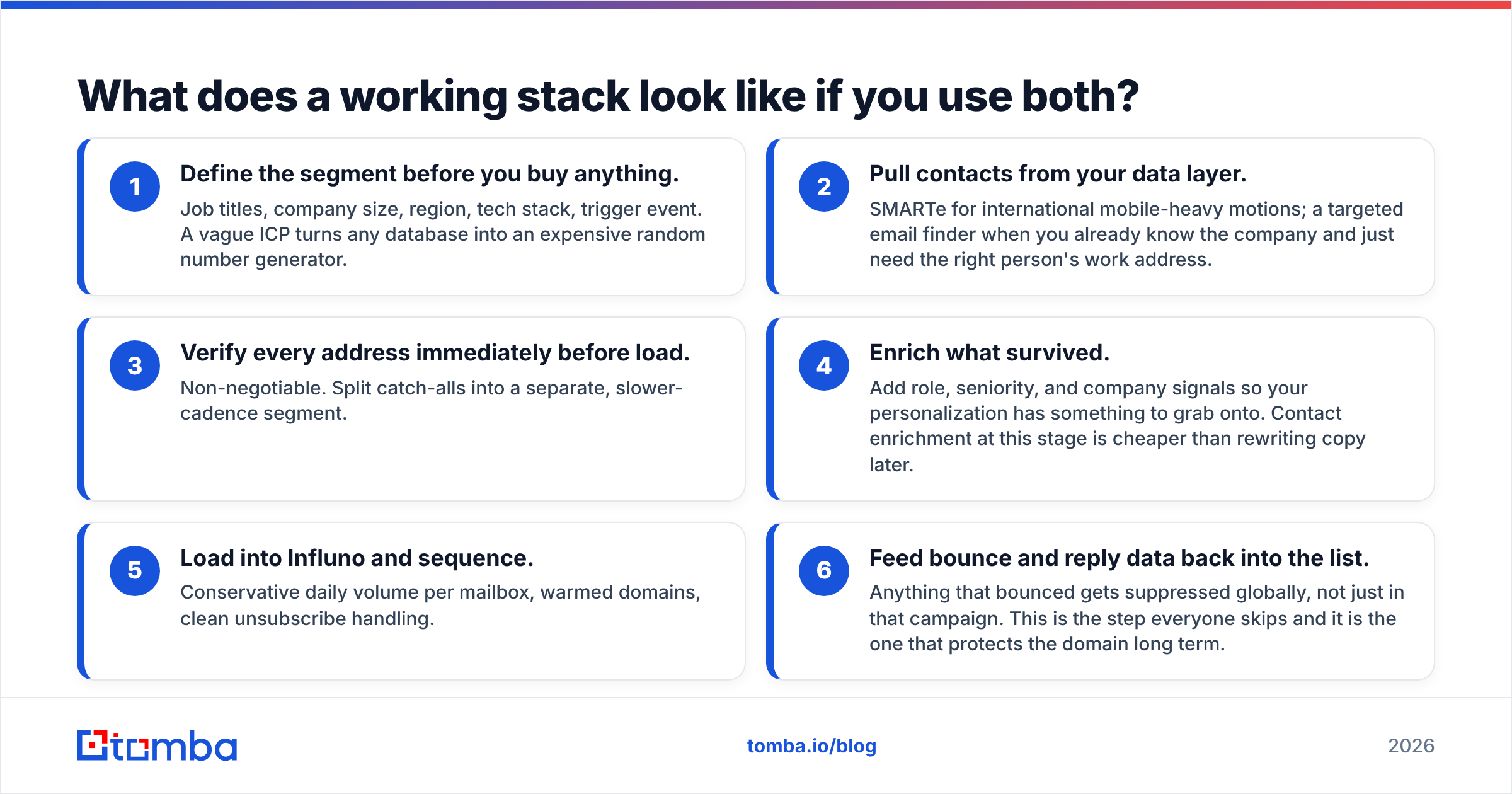
What does a working stack look like if you use both?#
If budget allows, the two compose cleanly. Here is the pipeline that actually holds up under volume:
- Define the segment before you buy anything. Job titles, company size, region, tech stack, trigger event. A vague ICP turns any database into an expensive random number generator.
- Pull contacts from your data layer. SMARTe for international mobile-heavy motions; a targeted email finder when you already know the company and just need the right person's work address.
- Verify every address immediately before load. Non-negotiable. Split catch-alls into a separate, slower-cadence segment.
- Enrich what survived. Add role, seniority, and company signals so your personalization has something to grab onto. Contact enrichment at this stage is cheaper than rewriting copy later.
- Load into Influno and sequence. Conservative daily volume per mailbox, warmed domains, clean unsubscribe handling.
- Feed bounce and reply data back into the list. Anything that bounced gets suppressed globally, not just in that campaign. This is the step everyone skips and it is the one that protects the domain long term.
Teams that run this loop see bounce rates settle in the low single digits. Teams that skip steps three and six spend their second quarter buying new domains.
Which one should you buy?#
Buy Influno if: you already have a source of contacts — inbound signups, an existing CRM, a scraper, a VA, or a cheaper finder tool — and your bottleneck is getting consistent, warmed, sequenced email out the door without babysitting mailboxes.
Buy SMARTe if: you are selling into EMEA or APAC, phone is a real channel for you, and generic US-first databases keep returning blanks. Its international mobile coverage is a specific, defensible reason to pay database prices.
Buy neither yet if: you cannot describe your ICP in one sentence, or your sending domain has no authentication records. Both tools will amplify that problem faster than they solve it.
Buy a lighter data layer if: what you actually need is verified work emails for companies you can already name — not intent scores, not a 200-million-record TAM. That is a $49-to-$99/mo problem, not a four-figure one.
How do you decide in a week instead of a quarter?#
Run a controlled test. Take 200 target accounts you genuinely want. Source contacts for 100 of them through the data vendor you are evaluating and 100 through a cheaper finder. Verify both sets with the same verifier so the comparison is fair. Measure three numbers: fill rate (how many accounts returned a usable contact), verified rate (how many survived verification), and bounce rate (what actually happened when you sent).
That test costs a few hundred dollars and settles arguments that otherwise run for six weeks. It also tends to reveal that the expensive option wins decisively on phones and barely at all on emails — which is exactly the information you need to right-size the contract.
Where does Tomba fit in this comparison?#
Tomba does not compete with Influno at all — it has no sequencer and does not want one. Against SMARTe, it overlaps on one axis only: finding and verifying professional email addresses. It does not sell intent data or a mobile-first database, so if phones drive your motion, SMARTe is the better fit for that half.
What Tomba does is make the email half cheap, accurate, and API-first. Find addresses by name and domain, pull every public contact at a company with domain search, catch and segment catch-all domains, verify in bulk, and push the result straight into whatever sequencer you chose — through the Tomba API, the Chrome extension, or a Google Sheets add-on. Free tier is 25 searches/mo; Starter is $49/mo; Growth is $99/mo.
If your outbound is stalling because the list is wrong rather than because the sender is wrong, start with the Tomba Email Finder. Clean data feeds every sequencer equally well — including Influno.
Related guides#
// get started
Find, verify and enrich your first contacts today
Start on the free plan with 25 searches a month, then scale when your team is ready.
Free plan · No credit card required · GDPR & CCPA
// about the author