Influno vs Warpleads: Which B2B Lead Tool Wins in 2026?
Influno sends the emails. Warpleads supplies the list. Here is an honest breakdown of where each one is strong, where both leave a gap, and which you should actually pay for first.
TL;DR
- Influno and Warpleads are not really competitors. Influno is a cold email sending and sequencing platform; Warpleads is a B2B lead database built around high-volume exports. Comparing them head-to-head only makes sense if you are deciding where the next chunk of budget goes.
- If your problem is "I have leads but my campaigns are messy, manual, or unmeasured," Influno is the higher-leverage buy.
- If your problem is "I run out of prospects by the second week of the month," Warpleads solves the volume side faster.
- Both tools leave the same gap: neither is a dedicated verification layer. Bulk-exported records decay, and sending engines will happily blast a stale list straight into a spam folder.
- The realistic 2026 stack is a source (Warpleads or similar), a verification and enrichment layer (Tomba), and a sender (Influno). Skipping the middle step is what produces 30-40% bounce rates.
What are Influno and Warpleads?#
Influno is an outbound email platform. Its job starts after you have contacts: multi-step sequences, inbox rotation, personalization variables, reply detection, and reporting on opens, clicks, and replies. Think of it as the delivery truck — it does not manufacture the packages, it moves them reliably and tells you which ones arrived.
Warpleads sits one step earlier in the funnel. It is a B2B contact database positioned around unlimited or very high-volume exports: you filter by industry, title, geography, or company size, and pull lists out as CSV. Think of it as the warehouse — plenty of inventory, and the value depends entirely on how well the shelves are labeled.
So the real question behind "Influno vs Warpleads" is rarely "which tool is better." It is: which layer of my outbound machine is currently broken? Answer that honestly and the purchase decision usually makes itself.

How do Influno and Warpleads compare head-to-head?#
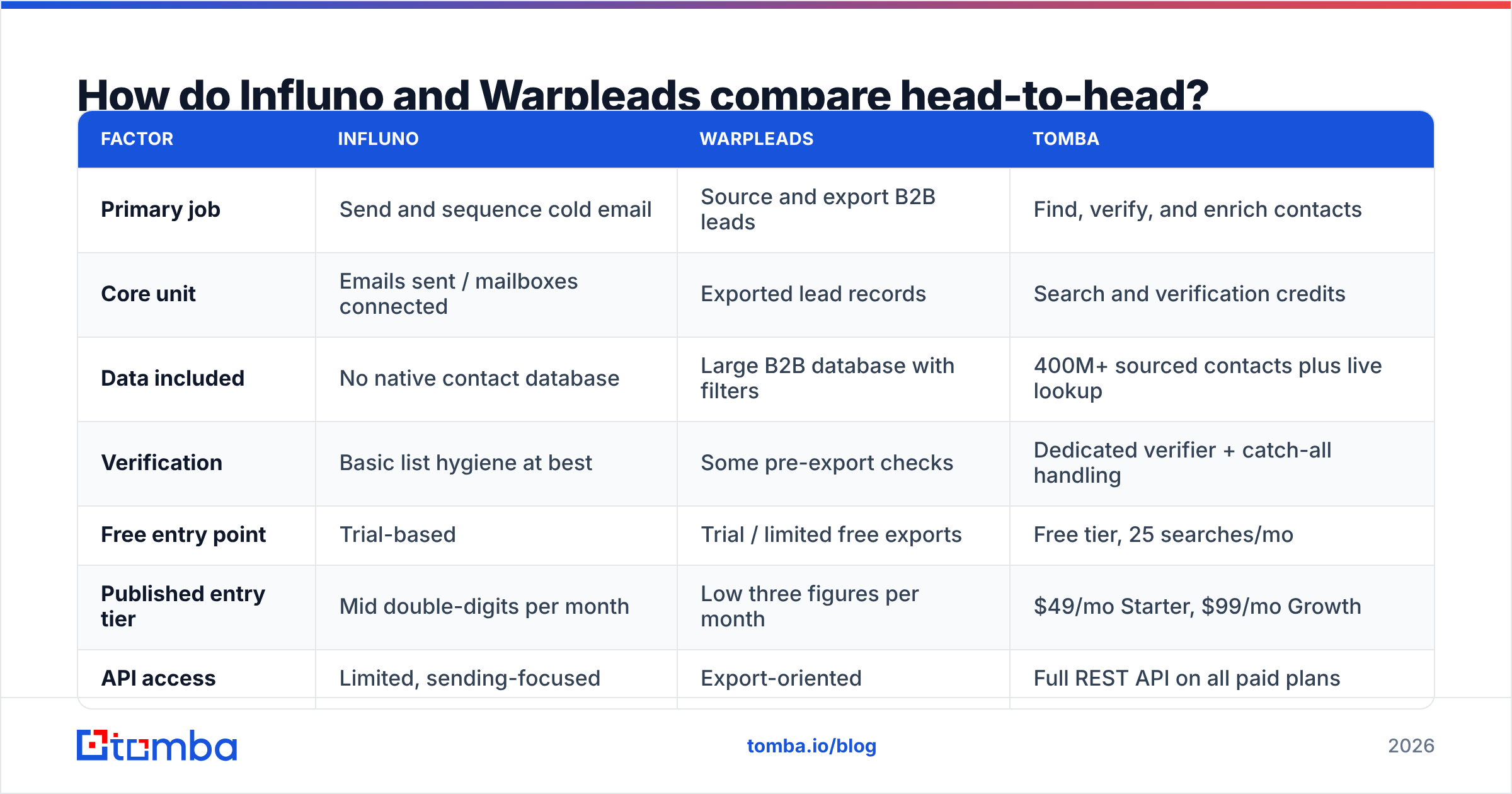
Here is the practical comparison. Pricing moves constantly in this category, so treat the money row as a directional guide and confirm on each vendor's own pricing page before you buy.
| Factor | Influno | Warpleads | Tomba |
|---|---|---|---|
| Primary job | Send and sequence cold email | Source and export B2B leads | Find, verify, and enrich contacts |
| Core unit | Emails sent / mailboxes connected | Exported lead records | Search and verification credits |
| Data included | No native contact database | Large B2B database with filters | 400M+ sourced contacts plus live lookup |
| Verification | Basic list hygiene at best | Some pre-export checks | Dedicated verifier + catch-all handling |
| Free entry point | Trial-based | Trial / limited free exports | Free tier, 25 searches/mo |
| Published entry tier | Mid double-digits per month | Low three figures per month | $49/mo Starter, $99/mo Growth |
| API access | Limited, sending-focused | Export-oriented | Full REST API on all paid plans |
| Best for | SDR teams running sequences at scale | Volume prospecting, agencies | Accuracy-critical outbound and enrichment |
| Biggest weakness | You must bring your own data | Data freshness varies by segment | Not a sending platform |
The last row matters more than anything above it. None of these three tools does the other's job well, and vendors that claim to do all three usually do two of them badly.
What does Influno actually do well?#
Three things, and they are not trivial.
- Sequencing without spreadsheet babysitting. Multi-step cadences with conditional branches mean a rep stops manually tracking who got touch three on Tuesday. This is the single biggest time saver for a two-to-ten person sales team.
- Inbox rotation and sending limits. Spreading volume across multiple mailboxes is now table stakes for staying under provider thresholds. Google and Microsoft both tightened bulk-sender requirements, and Google's published sender guidelines make authentication and low complaint rates non-negotiable.
- Reply-level reporting. Open rates became close to useless after Apple Mail Privacy Protection. Platforms that report replies and positive replies — not just opens — give you a metric you can actually optimize against.
Where Influno gets weak is upstream. It assumes your list is good. If you import 5,000 rows of unverified contacts, the platform will send to all 5,000, and your domain absorbs the damage. That is not a product flaw so much as a category boundary, but buyers regularly mistake "outreach platform" for "outreach platform with reliable data."
What does Warpleads actually do well?#
Warpleads' pitch is volume economics. Instead of paying per credit and rationing lookups, you export large filtered lists at a flat monthly rate. For agencies running outbound for multiple clients, or for teams testing many ICP hypotheses at once, that pricing model is genuinely attractive — per-credit tools punish exactly the exploratory behavior early-stage outbound requires.
The honest caveats:
- Coverage is uneven by segment. Databases are strong where their sources are strong. North American SaaS and tech roles are usually well covered; EU SMBs, non-English markets, and niche verticals thin out fast.
- Freshness is the hidden variable. B2B contact data decays roughly 2-3% per month through job changes alone, which compounds to around a quarter of a database going stale each year. Bulk export volume does nothing to fix that.
- Unlimited export is not unlimited usable records. A 10,000-row CSV where 6,500 addresses still resolve is a 6,500-row list with 3,500 landmines in it.
None of that makes Warpleads a bad product. It makes it a sourcing product, which is exactly what it says it is. The failure mode is treating an export as a send-ready list.
Why does verification sit between them?#
This is the part most Influno vs Warpleads comparisons skip, and it is where campaigns quietly die.
A bounce is not a neutral event. Mailbox providers read hard bounces as a signal that you are sending to addresses you have no relationship with, which is the textbook profile of a spammer. Push past roughly 2-3% bounce rate and your inbox placement degrades for every recipient, including the clean ones. The list you burned last month keeps costing you in the campaigns you run next month.
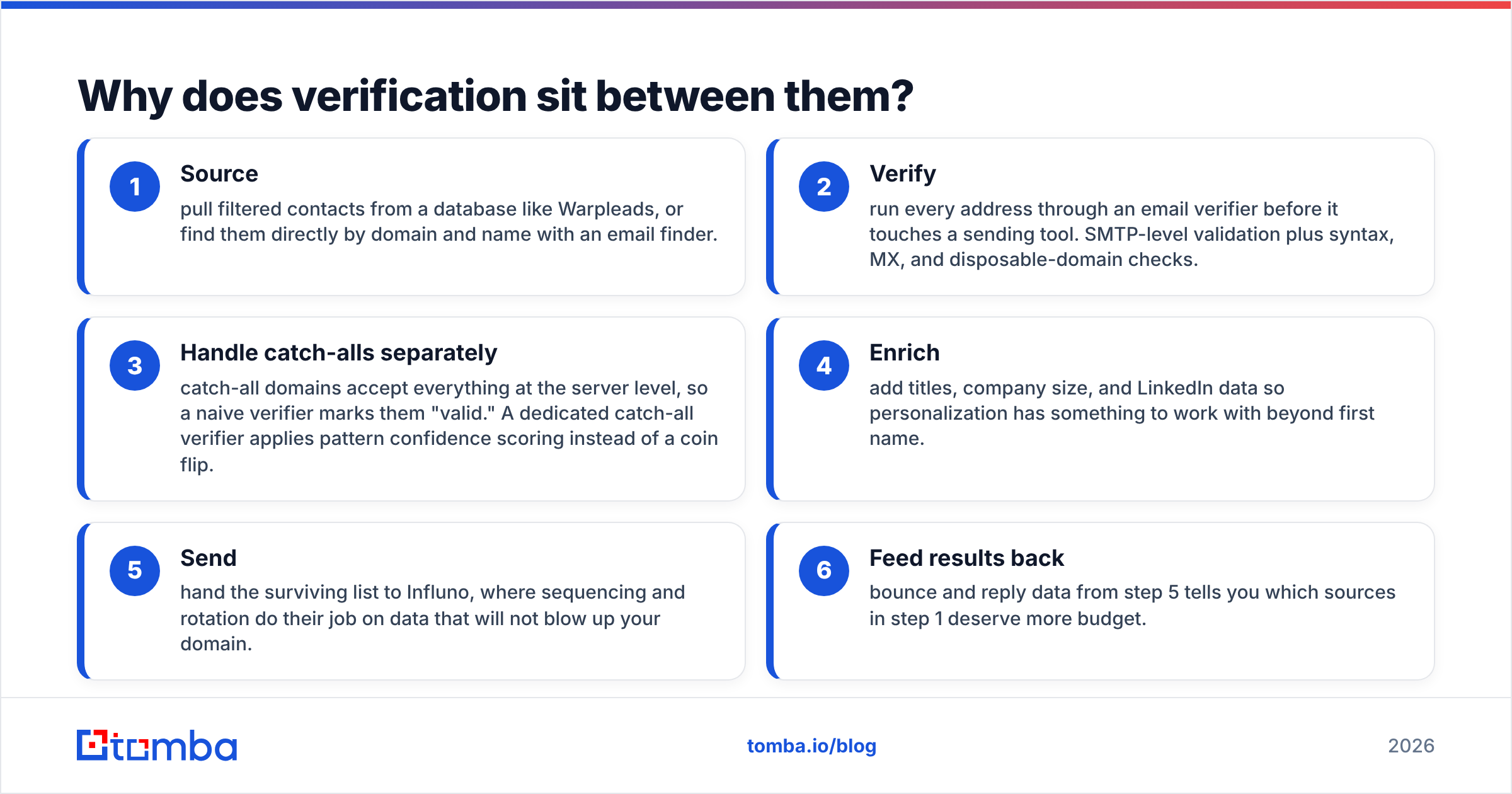
Here is the chain that actually determines whether outreach lands:
- Source — pull filtered contacts from a database like Warpleads, or find them directly by domain and name with an email finder.
- Verify — run every address through an email verifier before it touches a sending tool. SMTP-level validation plus syntax, MX, and disposable-domain checks.
- Handle catch-alls separately — catch-all domains accept everything at the server level, so a naive verifier marks them "valid." A dedicated catch-all verifier applies pattern confidence scoring instead of a coin flip.
- Enrich — add titles, company size, and LinkedIn data so personalization has something to work with beyond first name.
- Send — hand the surviving list to Influno, where sequencing and rotation do their job on data that will not blow up your domain.
- Feed results back — bounce and reply data from step 5 tells you which sources in step 1 deserve more budget.
Skip step two and steps three through six inherit the damage. This is why "which tool wins" is the wrong frame: the weakest link sets your ceiling, not the strongest one.

Is Warpleads' unlimited export worth more than Influno's automation?#
It depends on which number is currently embarrassing you.
Buy the sourcing layer first if:
- Reps spend more than a few hours a week hunting for contacts manually.
- You are testing three or more ICPs and keep running dry mid-test.
- You run outbound for multiple clients and per-credit pricing is capping experiments.
Buy the sending layer first if:
- You already have a list you trust but are sending from spreadsheets and a personal inbox.
- Follow-up is inconsistent — most reply volume lives in touches two through four, and manual cadences lose them.
- You cannot answer "what was our reply rate last month" without an hour of work.
Buy the verification and enrichment layer first if:
- Your bounce rate is above 3%.
- You have a database subscription but no confidence in the addresses coming out of it.
- You send from a domain you cannot afford to burn.
Most teams that ask the Influno vs Warpleads question are actually in the third bucket and do not know it yet. The diagnostic takes ten minutes: pull 200 random rows from your most recent export, verify them, and look at the pass rate. If it is under 85%, no amount of sequencing sophistication will save the campaign.
How do the three layers price out together?#
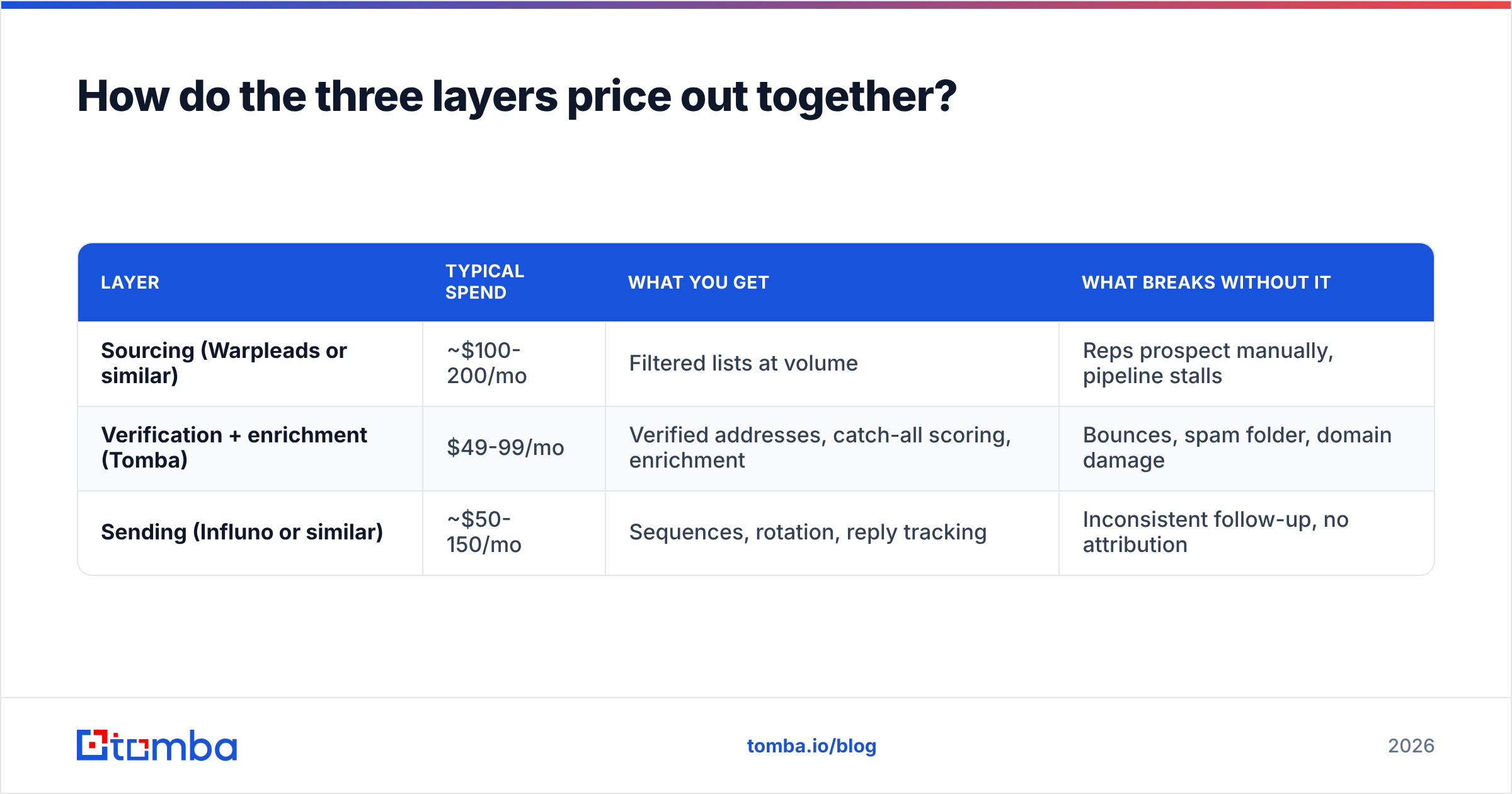
Stack economics matter more than any single line item. A rough monthly picture for a small outbound team:
| Layer | Typical spend | What you get | What breaks without it |
|---|---|---|---|
| Sourcing (Warpleads or similar) | ~$100-200/mo | Filtered lists at volume | Reps prospect manually, pipeline stalls |
| Verification + enrichment (Tomba) | $49-99/mo | Verified addresses, catch-all scoring, enrichment | Bounces, spam folder, domain damage |
| Sending (Influno or similar) | ~$50-150/mo | Sequences, rotation, reply tracking | Inconsistent follow-up, no attribution |
The verification layer is usually the cheapest line and the one teams cut first, which is backwards. Tomba pricing starts at a free tier with 25 searches per month, then $49/mo Starter, $99/mo Growth, and $249/mo Pro, with an Enterprise tier for custom volume. For most teams, adding verification costs less than the sending tool and protects the entire spend above it.
If you already have a database subscription, the fastest integration is a bulk email finder pass over your exports — upload the CSV, get back validated addresses with confidence scores, and only pay attention to the rows that survive. For engineering-led teams, the Tomba API does the same thing inline, so a lead never reaches the sequencer without a verification verdict attached.
Which alternatives should you also consider?#
Neither tool operates in a vacuum. Depending on your bottleneck, these are worth a look, and G2's sales intelligence category is a reasonable place to sanity-check current review volume and scores:
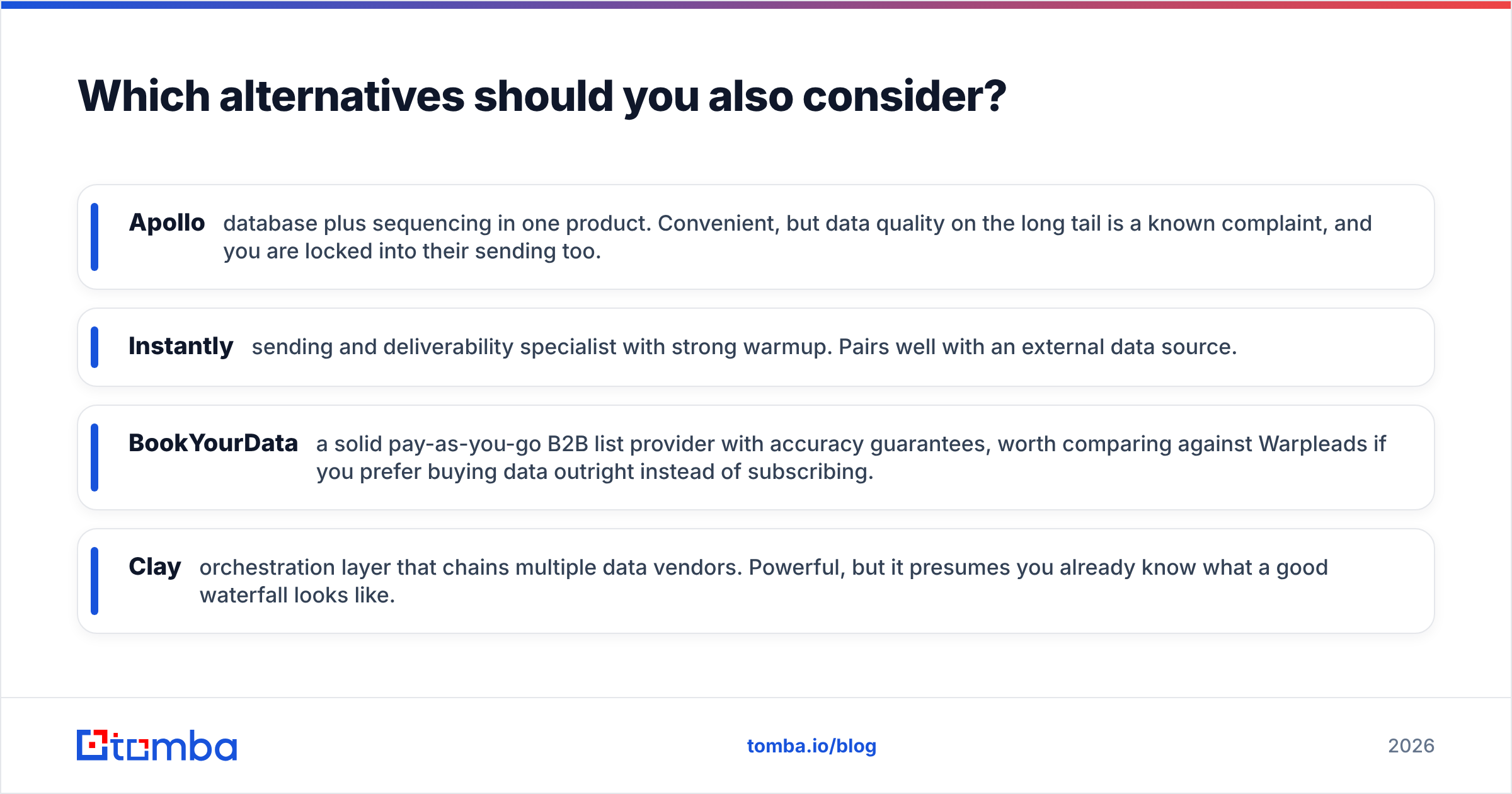
- Apollo — database plus sequencing in one product. Convenient, but data quality on the long tail is a known complaint, and you are locked into their sending too.
- Instantly — sending and deliverability specialist with strong warmup. Pairs well with an external data source.
- BookYourData — a solid pay-as-you-go B2B list provider with accuracy guarantees, worth comparing against Warpleads if you prefer buying data outright instead of subscribing.
- Clay — orchestration layer that chains multiple data vendors. Powerful, but it presumes you already know what a good waterfall looks like.
The pattern across all of them: the tools that try to own every layer compromise on at least one. Best-of-breed still wins in outbound, mostly because you can swap a weak link without rebuilding the machine.
What is the verdict on Influno vs Warpleads?#
Neither one is a complete outbound stack, and picking between them is a sequencing decision, not a quality judgment. Warpleads gets you volume. Influno gets you consistency and measurement. Whichever you buy, the record that travels between them decides whether the campaign works.
If you are starting from zero and can only afford one thing this quarter, buy sourcing — you cannot sequence contacts you do not have. If you already have contacts sitting in a CRM or an old export, buy sending and stop losing follow-ups. And in both cases, budget the verification layer before you scale volume, not after your domain reputation tanks.
The mistake is almost never picking the wrong vendor. It is scaling send volume on data nobody checked.
Start with the data layer. Run your current export through Tomba Email Finder and see how many of your addresses actually resolve before your next campaign goes out. The free tier covers 25 searches a month — enough to audit a sample, quantify your real bounce risk, and decide whether your next dollar belongs in sourcing, sending, or cleaning up what you already have.
Related guides#
// get started
Find, verify and enrich your first contacts today
Start on the free plan with 25 searches a month, then scale when your team is ready.
Free plan · No credit card required · GDPR & CCPA
// about the author