Influno vs ZoomInfo in 2026: Features, Pricing, and Verdict
Influno sends the emails. ZoomInfo supplies the database. Here's an honest breakdown of where each one earns its budget in 2026 — and when neither is the right line item.
Influno vs ZoomInfo looks like a head-to-head, but it isn't one. Influno sends your emails. ZoomInfo sells you the list. Pick by the job you need done, not by the feature grid.
TL;DR
- Influno and ZoomInfo are not real rivals. Influno runs outreach: sequences, sending accounts, replies. ZoomInfo sells B2B data and buying signals. It is a truck versus a warehouse.
- ZoomInfo wins on breadth. You get company data, intent signals, org charts, and deep CRM workflows. You also pay for it. Buyers report five-figure yearly deals with seat minimums.
- Influno wins on cost to first email. You sign up, build a sequence, and send the same day. That suits founders and small teams who already know who to reach.
Two more points matter before you spend anything.
- Most teams search "Influno vs ZoomInfo" when the real question is money. Who finds the emails, and who sends them? A credit-based finder plus a sending tool often beats both on price.
- Need verified work emails and nothing else? A focused tool like Tomba starts at $49/mo and has a free tier. A ZoomInfo quote needs a sales call first.
Influno vs ZoomInfo: what does each tool actually do?#
They solve different halves of one problem. That split drives every other answer here.
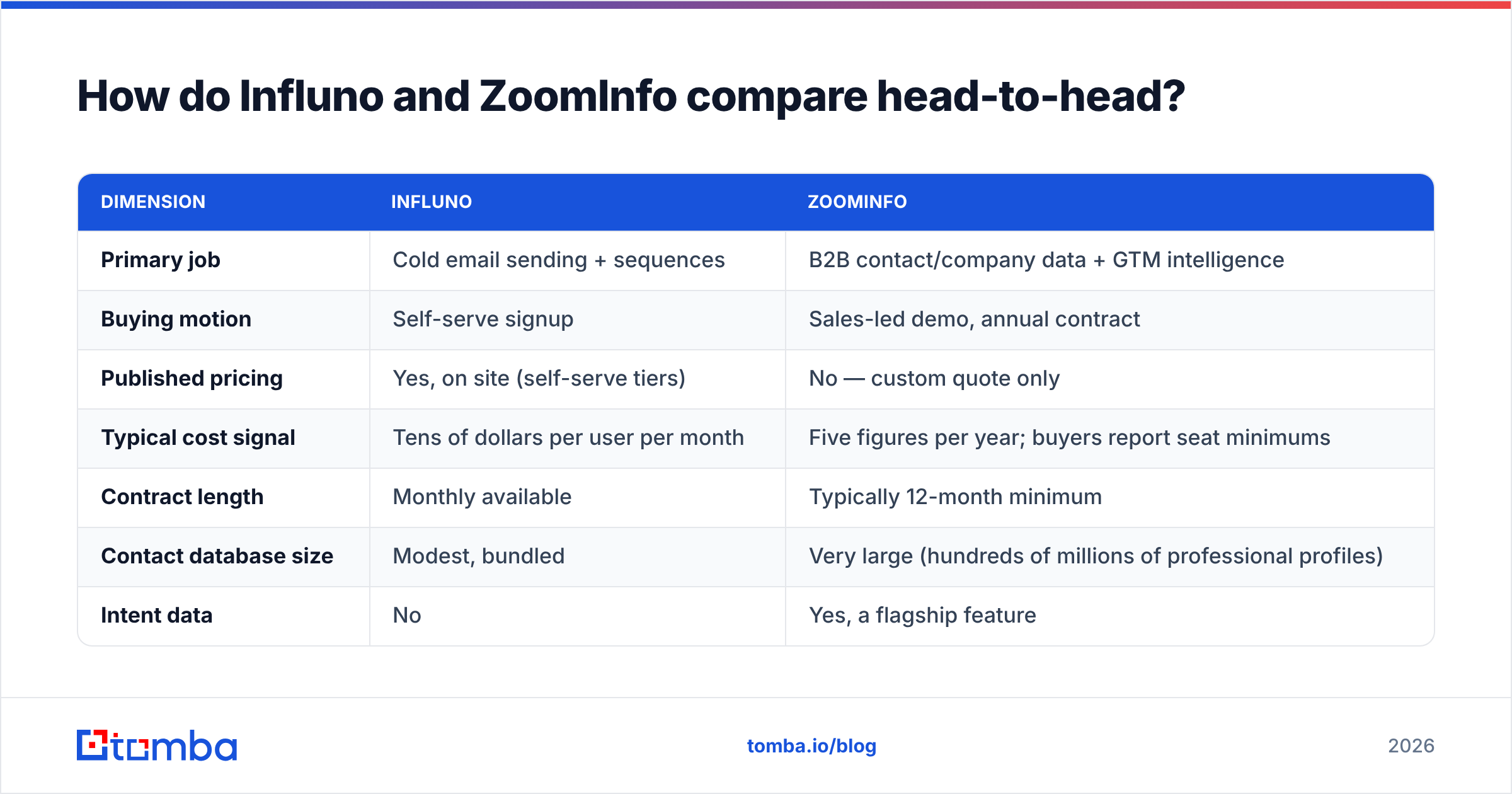
- Influno is the send layer. It takes over once you have a list. You get multi-step sequences, inbox rotation, warmup, reply detection, and campaign stats.
- ZoomInfo is the data layer. It sells you the record: company details, contact details, org charts, tech stacks, and buying signals. Its GTM suite pushes all that into your CRM.
- They overlap at the edges. Influno bundles some contact lookup so you don't start from zero. ZoomInfo's Engage module can send sequences. Neither edge beats the other vendor's core.
The gap shows up in how you buy, too.
- The sales motions are opposite. Influno is self-serve: card, login, first campaign. ZoomInfo is sales-led: call, demo, quote, annual paper, procurement.
- The failure modes are opposite too. Influno teams run out of good contacts. ZoomInfo teams run out of budget. They also waste seats they paid for.
So the Influno vs ZoomInfo call is really about the shape of your spend. It is not a feature checklist.

Influno vs ZoomInfo: the head-to-head table#
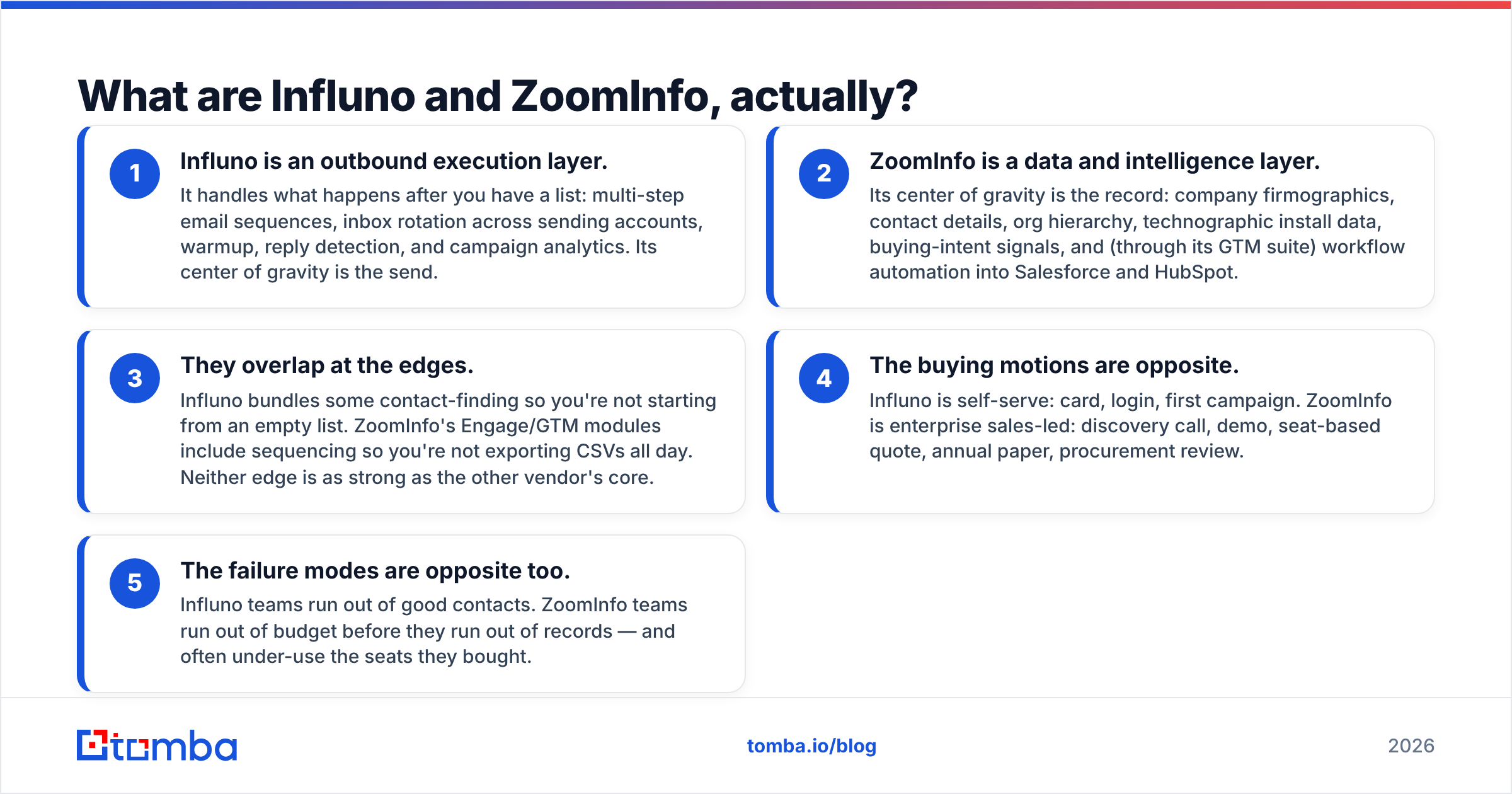
Here is the honest side-by-side. Where a vendor hides a number, the table says so. Check current details on influno.com and zoominfo.com before you sign.
| Dimension | Influno | ZoomInfo |
|---|---|---|
| Primary job | Cold email sending + sequences | B2B contact/company data + GTM intelligence |
| Buying motion | Self-serve signup | Sales-led demo, annual contract |
| Published pricing | Yes, on site (self-serve tiers) | No — custom quote only |
| Typical cost signal | Tens of dollars per user per month | Five figures per year; buyers report seat minimums |
| Contract length | Monthly available | Typically 12-month minimum |
| Contact database size | Modest, bundled | Very large (hundreds of millions of professional profiles) |
| Intent data | No | Yes, a flagship feature |
| Org charts / technographics | No | Yes |
| Email sequencing | Core strength | Available via Engage/GTM modules |
| Inbox rotation & warmup | Yes | Limited / not the focus |
| CRM depth | Basic integrations | Deep Salesforce, HubSpot, Dynamics workflows |
| Best for | Founders, agencies, 1-5 rep outbound teams | Mid-market to enterprise RevOps with budget |
| Worst fit | Teams needing intent + enrichment at scale | Small teams that just need verified emails |
Two things jump out of that grid.
First, neither tool is strong where the other is. Influno's best feature is sending. That is ZoomInfo's weakest spot, and the reverse holds too. So "which one should I buy?" is often the wrong question. For many teams the answer is one of each, or neither plus something cheaper.
Second, hidden pricing is itself a data point. Buyers now expect to see a price. A gated quote adds weeks to the cycle. If you run a five-person team, that call alone may rule ZoomInfo out before you see a single feature.
Is ZoomInfo worth the price in 2026?#
Sometimes. It depends on how much of it you use.
ZoomInfo earns its cost when at least three of these are true:
- You have 10 or more reps who use the data every day.
- You sell to mid-market or enterprise, where org charts change your deal plan.
- Intent signals actually reroute your territory planning.
- Your CRM is the system of record and needs records topped up on their own.
- One person owns the platform. Unowned seats go stale fast.
It gets hard to justify when you buy it as a pricey address book. Many low ZoomInfo reviews on G2 hit the same notes. Contracts are rigid. Renewals surprise people. Credits run dry. Teams pay top rates for plain email lookups. None of that means the data is bad. It means the packaging punishes light users.
Coverage is the counter-argument. Say your ICP is "VP of Engineering at 500-5,000 employee SaaS firms in Germany." A general finder will thin out fast. ZoomInfo will not. Depth is the real thing you buy. For some ICPs it is worth every dollar.
Can Influno run your outbound on its own?#
For a lot of small teams, yes. There is one catch.
Influno folds three line items into one plan: sequencer, sending setup, and warmup. Stitching those together yourself is a chore. Anyone who has tried it knows the drag. Inbox rotation and reply handling are table stakes in 2026. Getting them in one place, at a price you can read, beats a suite that treats sending as an add-on.
The catch is list supply. A sending tool is only as good as the contacts you feed it. Bundled databases inside sending tools tend to be thinner and older than a data vendor's. That is not a knock on Influno. It is structural. Building a contact graph costs far more than building a sequencer.
So use Influno for what it does well. Source contacts from a vendor whose whole job is data accuracy. Then check each address before you send. Bounces are the fastest way to burn a domain you spent weeks warming.
What does the "third path" look like?#
Most people who search "Influno vs ZoomInfo" are asking a budget question in disguise. How do I get good contact data without a five-figure contract?
The unbundled stack answers it:
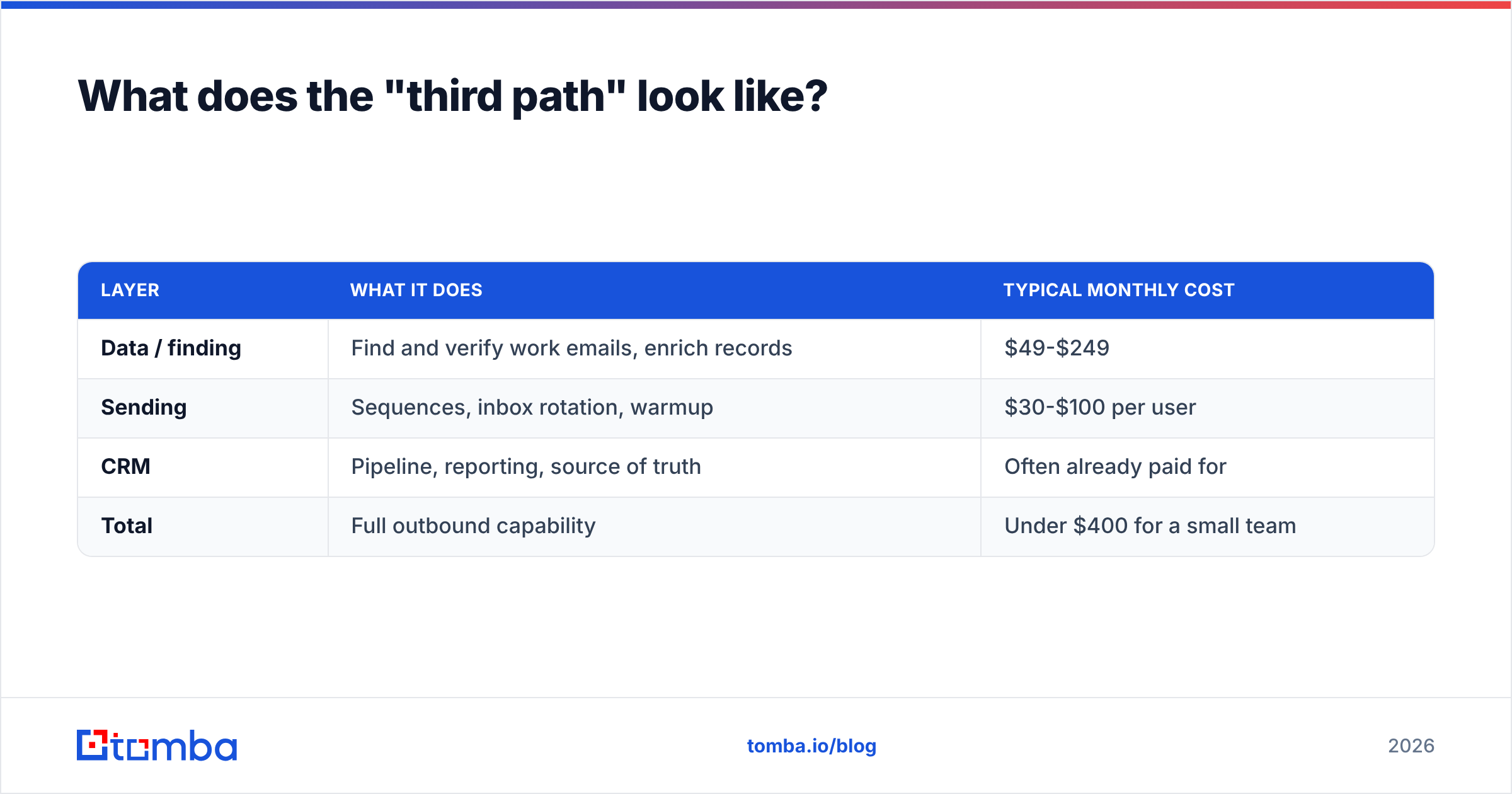
| Layer | What it does | Typical monthly cost |
|---|---|---|
| Data / finding | Find and verify work emails, enrich records | $49-$249 |
| Sending | Sequences, inbox rotation, warmup | $30-$100 per user |
| CRM | Pipeline, reporting, source of truth | Often already paid for |
| Total | Full outbound capability | Under $400 for a small team |
Compare that to one enterprise data contract and the math gets awkward. You do give up intent data and org charts. That matters if you need them. It costs you nothing if you don't.
On the data layer, Tomba pricing is plain to read. A free tier gives 25 searches a month. Starter is $49/mo, Growth $99/mo, Pro $249/mo, plus a custom plan. No demo needed to see the number. Run a domain search to pull every address at a target company. Then push the results through an email verifier before they reach your sequencer.
How do you judge contact data quality without a trial?#
Vendor accuracy claims are marketing. Test them yourself. The whole protocol takes about an hour.
- Build a 100-contact control list from your real ICP. Skip the famous-company list every vendor is tuned for. Add some 20-200 person firms.
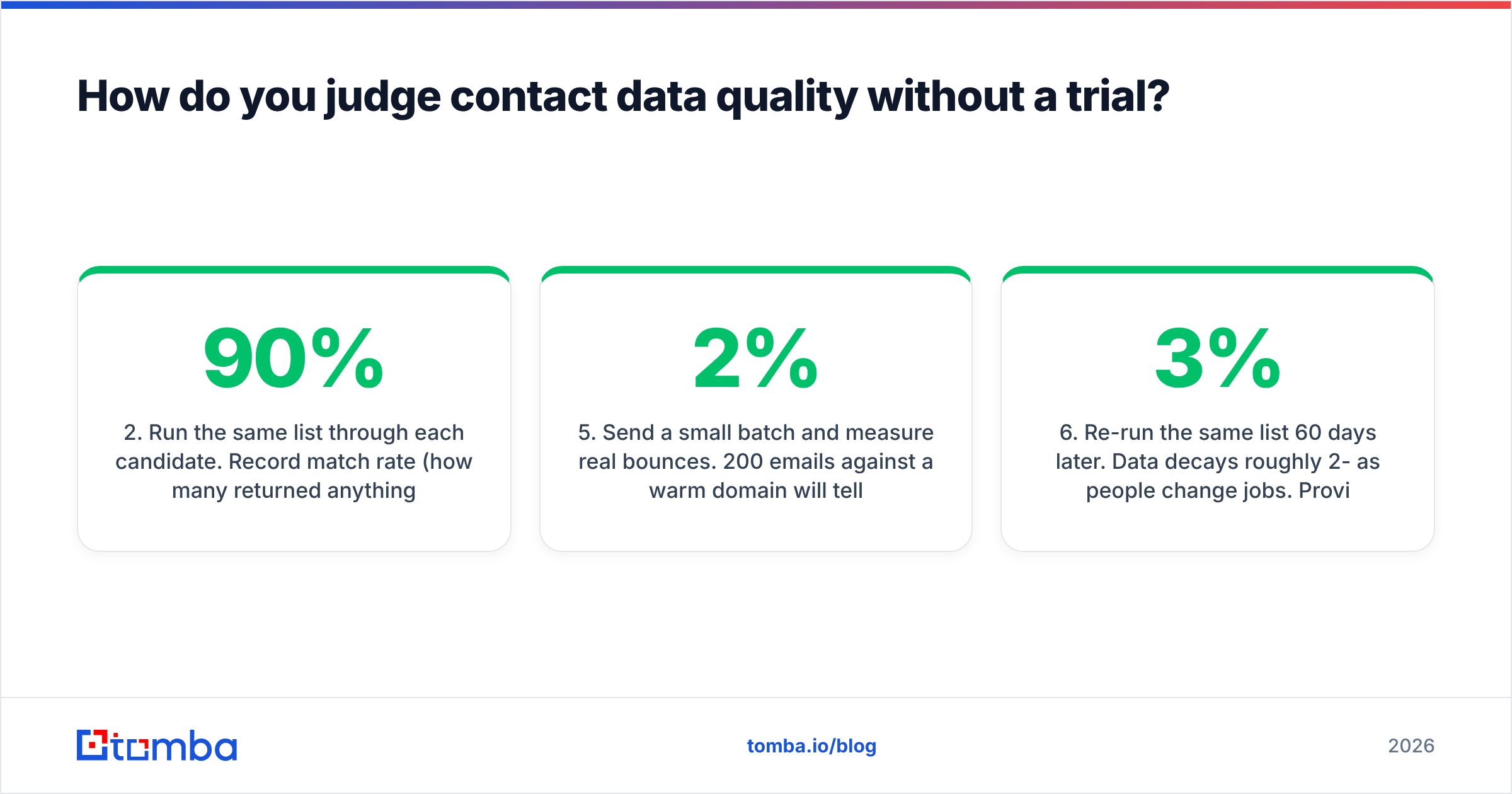
- Run that list through each tool. Log match rate and confidence scores apart from each other. A 90% match rate with 40% weak hits is worse than 60% solid ones.
- Verify on your own. Push every address through a third-party checker. If a vendor's "valid" results fail that check, you have your answer.
Three more steps show how the data holds up over time.
- Check catch-all handling. Catch-all domains accept every address at the gate, so lazy checkers mark them valid. Ask how the vendor scores them. A proper catch-all verifier gives you odds, not a shrug.
- Send a small batch and count bounces. Two hundred emails from a warm domain beat any datasheet. Under 2% hard bounce is healthy. Over 5% and you are hurting your sender reputation.
- Run the same list again 60 days later. Data decays about 2-3% a month as people switch jobs. A vendor that refreshes well will show new results. A stale one will not move.
Nobody does that last step. It is the one that tells a data vendor from a data archive.
Influno vs ZoomInfo: which should you choose?#
Here is the decision tree, stated plainly.
Choose ZoomInfo if you have the budget, an owner for the tool, and 10 or more seats that will use it daily. It also fits when your motion leans on intent signals and org charts. Pick it too if your ICP is narrow and hard to source. Depth is the one thing you cannot cheaply copy.
Choose Influno if your bottleneck is sending, not finding. You know your accounts. You need sequences going out from rotated inboxes with warmup handled. You want a price you can read and cancel. Pair it with a real data source.
Choose neither, and unbundle, if you are a founder, an agency, or a small team. Your real need is verified work emails at a price you can predict. This is the common case. Buy data by the credit and sending by the seat. Keep both cancellable.
Consider a specialist database if you build lists in bursts rather than enrich all year. Vendors like BookYourData sell verified B2B lists pay-as-you-go, with no subscription. That suits campaign-by-campaign buyers. It is a third shape of spend, and it is worth pricing out.
What are the most common mistakes here?#
- Buying data to fix a messaging problem. If your reply rate is 0.3%, better data will not save you. Your copy will. No database ever rescued a weak first line.
- Ignoring credit mechanics. Ask what burns a credit: a search, a record, a field, a check? Ask if credits roll over. Ask what overage costs. Those clauses are where deals get expensive.
- Skipping checks because a vendor says "verified." Run your own anyway. It is cheap cover against a domain hit that takes months to undo.
- Signing a year before a real pilot. Ask for a 60-90 day out. Or pilot on a monthly plan first. A vendor sure of its data will agree to a test.
- Forgetting the API. Per-seat pricing is wrong if you enrich inside your own product. Look for an email finder API that bills per call, not per human.
Frequently asked questions#
Is Influno vs ZoomInfo even the right comparison? Often not. Influno replaces your sequencer and sending setup. ZoomInfo replaces your data source. Teams that leave ZoomInfo on cost usually need a new data vendor plus a sending tool, not one product.
Does ZoomInfo publish pricing? No. Quotes are custom and need a sales call. Buyers report five-figure yearly deals with seat minimums. Your number will depend on seats, modules, and credits.
Can I use both? Yes, and some teams do. ZoomInfo covers account research, and a cheaper tool sends. It is costly but coherent, as long as the research drives real targeting calls.
What is the cheapest way to get verified B2B emails? Credit-based finders with public pricing. Start on a free tier. Test against your real ICP. Scale the plan only when match rates hold. Avoid anything that needs a call to show a price.
How do I keep deliverability healthy on a small budget? Verify every address first. Keep daily volume per inbox low. Set up SPF, DKIM, and DMARC. Check your bounce rate weekly. Most inbox disasters are list disasters in a costume.
Ready to test the data layer yourself?#
Settle the Influno vs ZoomInfo question with your own list, not a demo. The Tomba Email Finder gives you 25 free searches a month. That is enough to score match rate against any quote sitting in your inbox. If it holds up, Starter is $49/mo and you can cancel. If it does not, you spent nothing — and you know what the big contract is really buying.
Related guides#
// get started
Find, verify and enrich your first contacts today
Start on the free plan with 25 searches a month, then scale when your team is ready.
Free plan · No credit card required · GDPR & CCPA
// about the author