Bounceshield vs ZoomInfo 2026: Which Data Tool Wins?
Bounceshield guards deliverability, ZoomInfo sells a data empire. We break down pricing, accuracy, and fit so you pick the right tool in 2026 — without overpaying.
Choosing between Bounceshield and ZoomInfo feels like comparing a smoke detector to a skyscraper. One protects a narrow, critical job — keeping bounced emails from wrecking your sender reputation. The other is a sprawling data platform that wants to own your entire go-to-market motion. Both show up on the same shortlist, and that confuses buyers.
This guide cuts through the confusion. You will see where each tool genuinely wins, where the pricing math turns ugly, and where a leaner option beats both for most teams under 200 reps.
TL;DR — Bounceshield vs ZoomInfo at a glance#
- Bounceshield is a focused email verification and deliverability tool. It is cheap, fast, and narrow — it cleans lists and protects bounce rates, but it does not find new contacts.
- ZoomInfo is a full B2B data and sales-intelligence platform. Huge contact database, intent data, and CRM enrichment — but contracts routinely start near $15,000/year with annual lock-in.
- They solve different problems. If you already have contacts and fear bounces, Bounceshield is enough. If you need net-new prospects at scale, ZoomInfo is the heavyweight.
- Most teams overpay for ZoomInfo. A combined email finder plus email verifier workflow covers 80% of the use case at a fraction of the cost.
- Best value pick: pairing on-demand finding with built-in verification — which is exactly what Tomba bundles from $49/mo.
What is Bounceshield and what does it actually do?#
Bounceshield is an email verification service. Its core job is simple: take a list of email addresses and tell you which ones are safe to send to. Think of it as airport security for your outbound — every address gets screened before it boards your campaign.
It runs the standard verification checks you would expect: syntax validation, MX record lookups, SMTP handshake testing, disposable-domain detection, and catch-all flagging. The output is a clean list sorted into deliverable, risky, and undeliverable buckets. That is genuinely valuable. A high bounce rate signals spam-like behavior to inbox providers, and once your sender reputation tanks, even your good emails land in spam.
What Bounceshield does not do is find contacts. It cannot turn "VP of Marketing at Acme Corp" into an email address. You bring the list; it cleans the list. That single limitation is the whole story of this comparison, because ZoomInfo sits on the opposite end of the spectrum.

What is ZoomInfo and who is it built for?#
ZoomInfo is a B2B data platform — arguably the most recognized name in the category. It maintains a massive database of company and contact records, layered with firmographics, technographics, org charts, intent signals, and direct-dial phone numbers. According to ZoomInfo's own platform pages, the goal is to be the single source of truth for revenue teams.
The pitch is breadth. Sales reps prospect inside the platform, marketers build target-account lists, and RevOps teams pipe enriched data straight into Salesforce or HubSpot. ZoomInfo is designed for organizations that treat data as infrastructure and have the budget to match.
That budget is the catch. ZoomInfo does not publish transparent pricing, and independent reviews on G2 consistently note that entry contracts begin in the five-figure range, billed annually. You are buying a platform and a multi-seat commitment, not a monthly utility you can switch off.
So the honest framing is this: Bounceshield is a scalpel, ZoomInfo is an operating room. Comparing them head-to-head only makes sense once you admit they answer different questions.
Bounceshield vs ZoomInfo: the core comparison table#
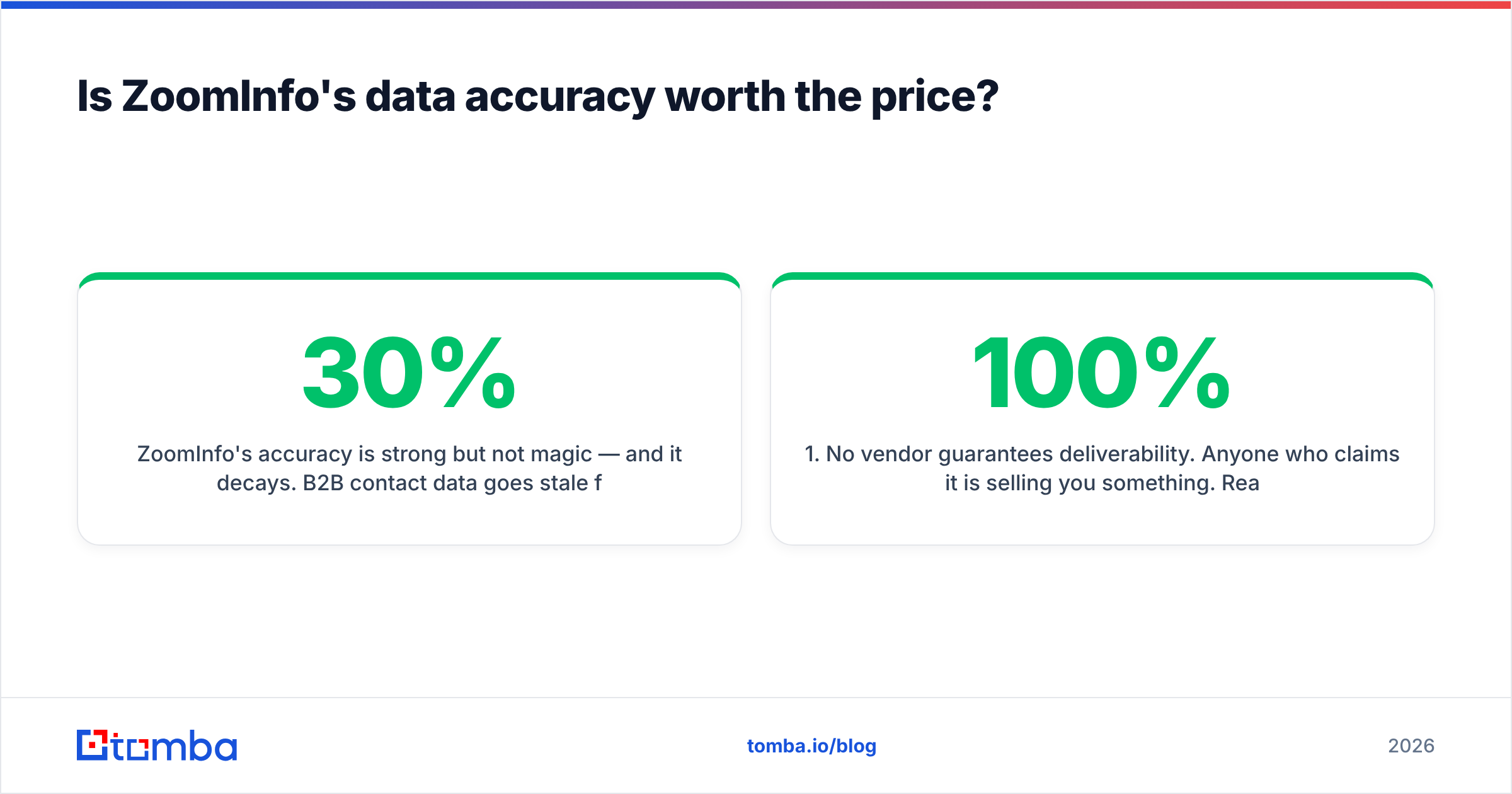
Here is the side-by-side that matters most. Pricing for ZoomInfo is approximate because it is quote-based and varies by seat count and data volume.
| Attribute | Bounceshield | ZoomInfo |
|---|---|---|
| Primary job | Email verification & deliverability | B2B data, prospecting, enrichment |
| Finds new contacts | No | Yes — large database |
| Verifies existing lists | Yes — core feature | Limited / secondary |
| Phone numbers | No | Yes — direct dials |
| Intent data | No | Yes |
| Starting price | ~$15–$50/mo range | ~$15,000/yr typical |
| Billing | Monthly, flexible | Annual contract |
| Best for | List hygiene, low bounce rates | Enterprise GTM at scale |
| Setup complexity | Minimal | High — onboarding required |
| Free tier | Limited trial | No |
The table makes the trade visible. Bounceshield is a low-commitment utility. ZoomInfo is a strategic platform purchase. If your real need is "stop my emails from bouncing," paying ZoomInfo prices is like buying a freight train to move a sofa.
Is ZoomInfo's data accuracy worth the price?#
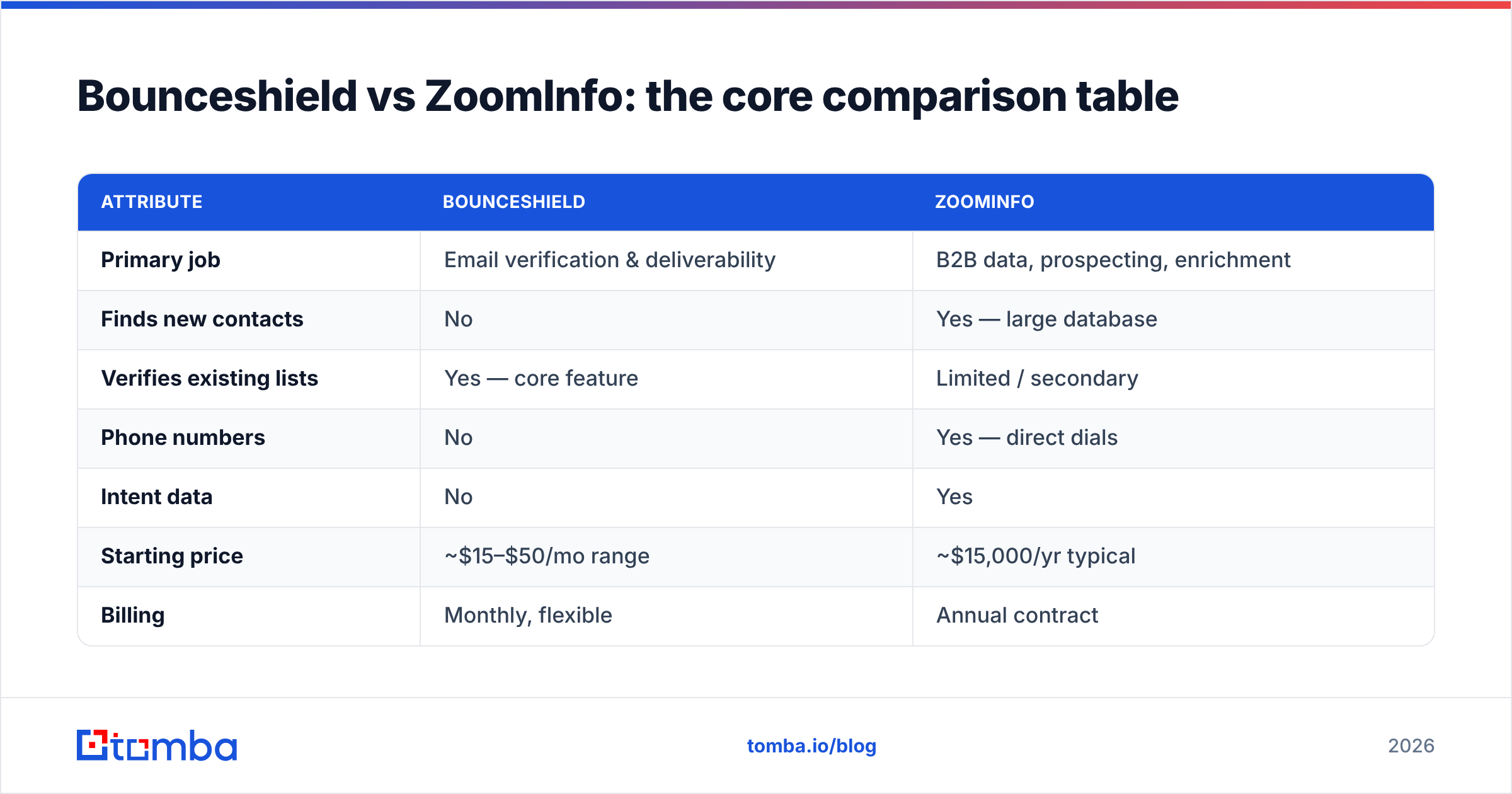
ZoomInfo's accuracy is strong but not magic — and it decays. B2B contact data goes stale fast: people change jobs, companies rebrand, and email formats shift after acquisitions. Industry estimates put B2B data decay at roughly 30% per year. That means even a premium database needs continuous verification, which is the exact gap Bounceshield was built to fill.
This is the irony at the heart of the comparison. ZoomInfo gives you scale; Bounceshield gives you confidence. Teams that run ZoomInfo at scale often still bolt on a verification step before launching campaigns, because sending to unverified ZoomInfo records can quietly inflate bounce rates.
A few accuracy realities worth internalizing:
- No vendor guarantees 100% deliverability. Anyone who claims it is selling you something. Real-world verified-email accuracy in the 95–99% range is excellent.
- Catch-all domains are the gray zone. Many corporate domains accept every address at the SMTP layer, so verification returns "unknown." A dedicated catch-all verifier handles these better than a general database lookup.
- Freshness beats raw size. A smaller database refreshed weekly often outperforms a giant one refreshed quarterly.
- Verification is not optional. Whether your contacts come from ZoomInfo, a scraper, or a finder tool, you verify before you send. Always.
If data quality is your obsession, read how Tomba sources and validates its data — the methodology matters more than the headline record count.
When should you choose Bounceshield over ZoomInfo?#
Choose Bounceshield when your problem is hygiene, not discovery. Specifically:
- You already have lists — from events, signups, a CRM export, or past campaigns — and you need them cleaned before sending.
- Your bounce rate is climbing and inbox placement is slipping. Verification is the fastest fix.
- Budget is tight and a five-figure annual contract is a non-starter.
- You want monthly flexibility instead of a locked annual commitment.
Bounceshield is the right call for solo founders, lean marketing teams, and anyone whose outbound engine is already fed with contacts. It does one job and does it without drama. For deeper context on why this matters, our primer on email deliverability explains how bounce rates cascade into reputation damage.
When does ZoomInfo actually make sense?#
ZoomInfo earns its price when contact discovery at scale is the bottleneck — and when you have the org to absorb it. It fits if:
- You run a large sales org with many reps who prospect daily and need a shared data backbone.
- Account-based marketing is your strategy and you need intent signals plus org charts to prioritize accounts.
- CRM enrichment is mission-critical and you want automated firmographic updates flowing into Salesforce.
- You have budget and procurement that can justify and approve a six-figure data line item.
If that describes you, ZoomInfo is a legitimate platform and a category leader. But be honest about utilization. Many teams buy the full suite and use a sliver of it — the classic shelfware trap. Compare against an Apollo alternative or other lighter platforms before signing, because the gap between "impressive demo" and "daily ROI" is wide.

Is there a better middle ground than either tool?#
Yes — and for most teams, it is the smart default. The hidden assumption in "Bounceshield vs ZoomInfo" is that you must choose between verification only and a giant platform. You do not. A focused finder-plus-verifier stack covers the majority of real outbound needs at a fraction of ZoomInfo's cost, with verification built in so you never need a separate Bounceshield subscription.
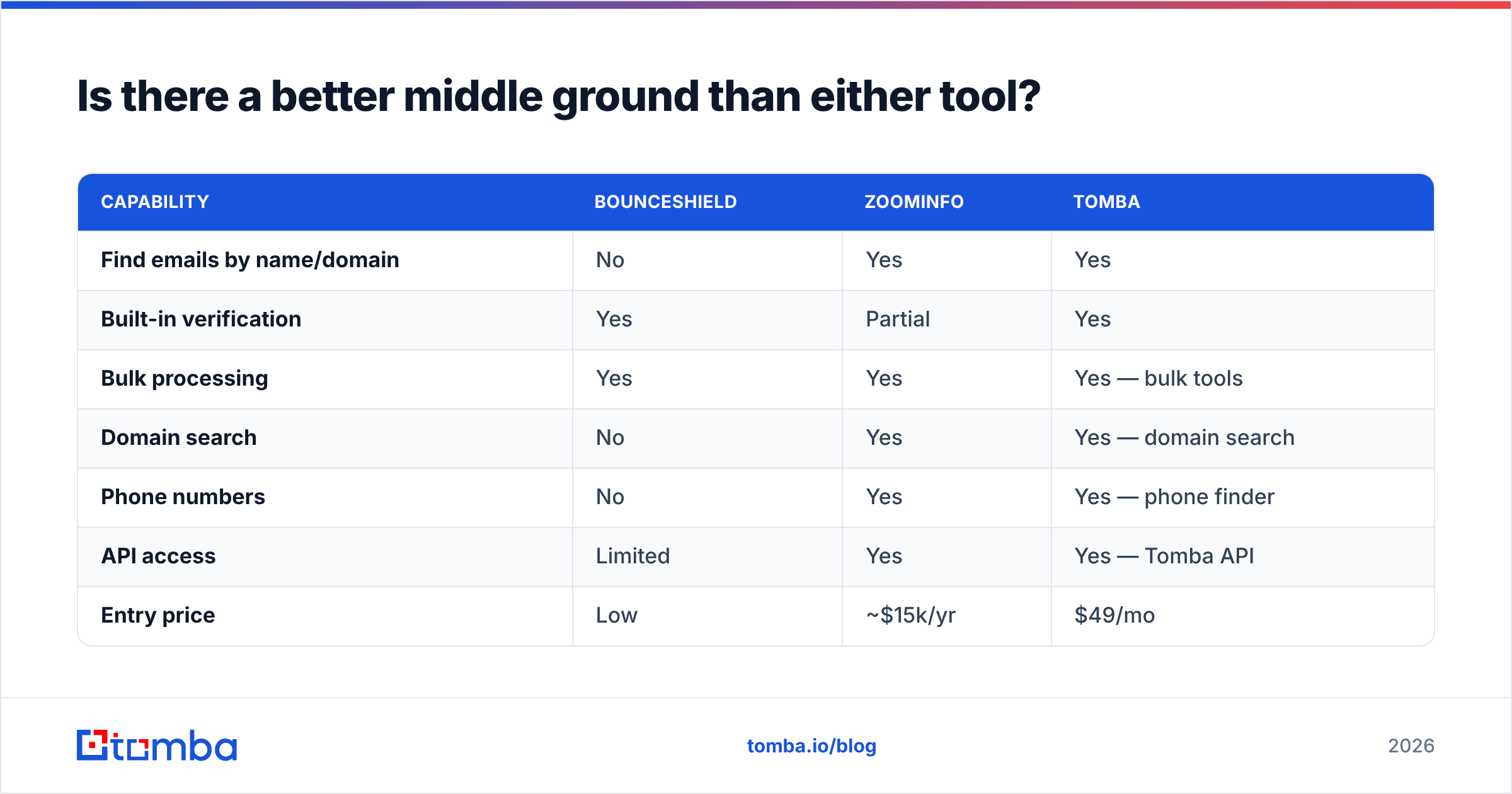
Here is how the three approaches stack up on the dimensions that drive actual outbound results.
| Capability | Bounceshield | ZoomInfo | Tomba |
|---|---|---|---|
| Find emails by name/domain | No | Yes | Yes |
| Built-in verification | Yes | Partial | Yes |
| Bulk processing | Yes | Yes | Yes — bulk tools |
| Domain search | No | Yes | Yes — domain search |
| Phone numbers | No | Yes | Yes — phone finder |
| API access | Limited | Yes | Yes — Tomba API |
| Entry price | Low | ~$15k/yr | $49/mo |
| Free tier | Trial | No | 25 searches/mo |
| Contract | Monthly | Annual | Monthly |
The middle column is the expensive empire. The right column is the pragmatic stack: you find the contact, the tool verifies it on the way out, and you pay a monthly price you can actually predict. You get ZoomInfo-style discovery and Bounceshield-style hygiene in one workflow.
How does pricing really compare over a year?#
Run the annual math, because that is where the decision usually resolves.
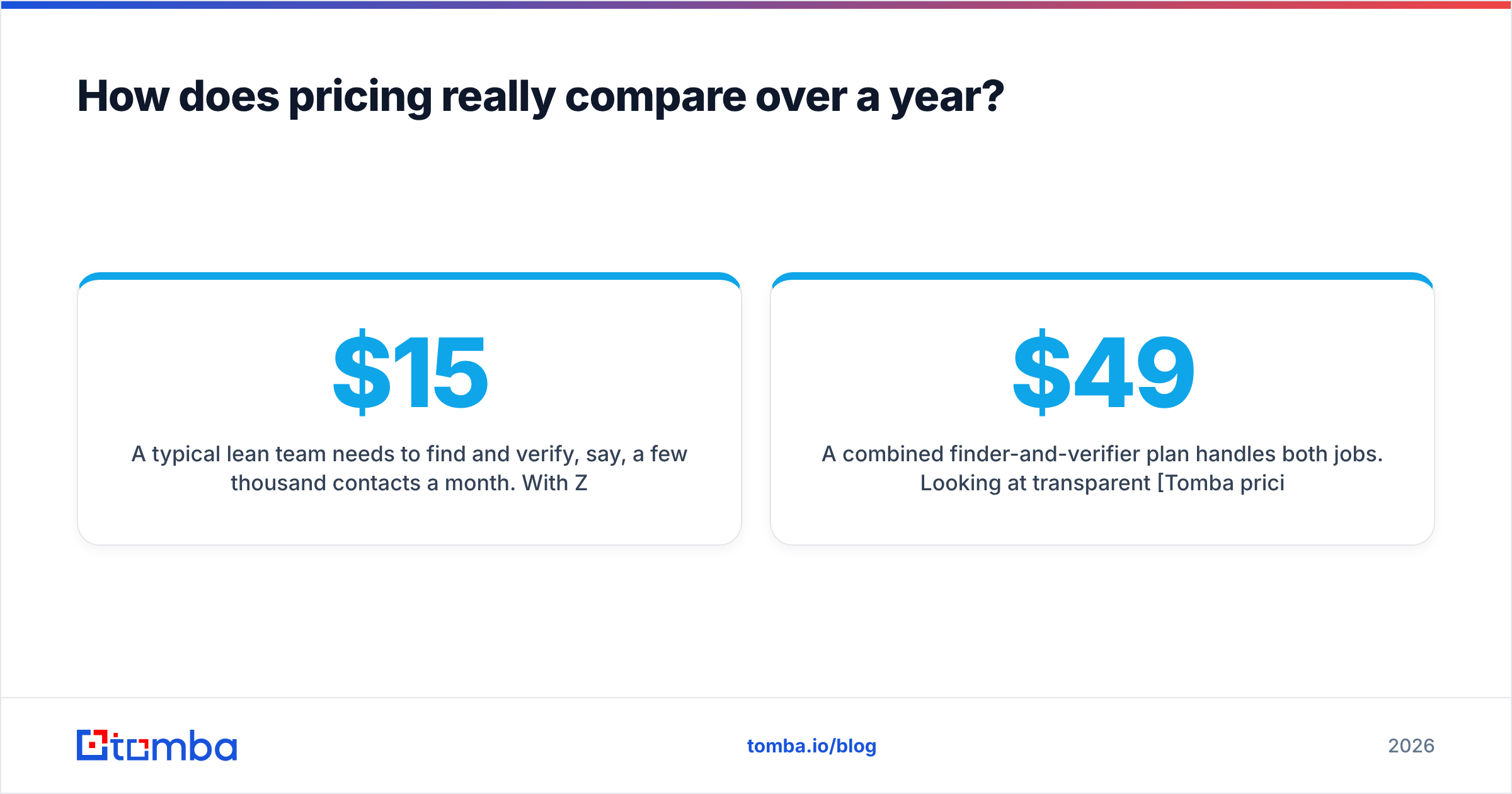
A typical lean team needs to find and verify, say, a few thousand contacts a month. With ZoomInfo, you are committing to a multi-seat annual contract that frequently lands between $15,000 and $40,000 depending on modules and seats. Bounceshield alone might cost a few hundred dollars a year — but remember, it cannot find a single new contact, so you still need a discovery tool on top.
A combined finder-and-verifier plan handles both jobs. Looking at transparent Tomba pricing: the Free tier covers 25 searches/mo, Starter is $49/mo, Growth is $99/mo, Pro is $249/mo, and Enterprise is custom. Even the Pro plan, annualized at roughly $3,000/year, lands well under a typical ZoomInfo entry contract — while still doing discovery and verification.
The takeaway: unless you are an enterprise that will genuinely use ZoomInfo's intent data and org charts every day, the combined-stack route saves five figures a year. That saved budget funds more campaigns, better copy, or simply a healthier margin.
What about deliverability after you have clean data?#
Clean data is step one; protecting it is step two. Even perfectly verified lists bounce if your underlying sending infrastructure is misconfigured. Before you scale outbound, confirm the fundamentals:
- Authentication — set up SPF, DKIM, and DMARC so inbox providers trust you. Run a quick SPF check to confirm your record is valid.
- Warmup — new domains need gradual volume ramp. Estimate your schedule with a warmup calculator.
- List hygiene — re-verify before every major send, not just once. Data decays continuously.
- Reputation monitoring — watch your sender reputation and stay off blacklists.
Neither Bounceshield nor ZoomInfo fully owns this layer — it is on you. But a finder that verifies inline means fewer surprises when you hit send.
Bounceshield vs ZoomInfo: the verdict#
Pick based on the job in front of you, not the brand on the box.
- Need to clean an existing list cheaply? Bounceshield does the narrow job well, and a standalone email verifier does it just as well.
- Need enterprise-scale data, intent, and org charts — and have the budget? ZoomInfo is the category heavyweight.
- Need to find and verify contacts without a five-figure contract? That is the gap a combined stack fills, and it is where most growing teams should land.
The framing "Bounceshield vs ZoomInfo" assumes a binary that does not hold. One tool is too narrow on its own; the other is too heavy for most teams. The practical answer for the majority of sales and marketing teams sits in between.
Get the discovery-plus-verification stack right#
If your real goal is to fill the pipeline with contacts you can actually reach, start with the tool built for exactly that. The Tomba Email Finder turns names, domains, and companies into verified professional email addresses — discovery and verification in one flow, billed monthly with no enterprise contract. Start free with 25 searches a month, scale to Starter at $49/mo when you are ready, and skip both the narrow single-purpose tool and the five-figure platform. Try the Tomba Email Finder and put your budget toward sending, not procurement.
// get started
Find, verify and enrich your first contacts today
Start on the free plan with 25 searches a month, then scale when your team is ready.
Free plan · No credit card required · GDPR & CCPA
// about the author