Infofree vs Leadzen.ai (2026): Which Lead Database Wins?
Infofree sells unlimited US business records on a flat subscription. Leadzen.ai sells AI-scored, credit-based lead discovery. They fail in opposite ways, and the right pick depends on whether you dial or email.
TL;DR
- Infofree is a flat-rate US business and consumer database with a bundled mini-CRM. You pay a fixed monthly fee, pull effectively unlimited records, and accept that a chunk of them are stale.
- Leadzen.ai is a credit-based, AI-assisted lead discovery tool with a LinkedIn extension and real-time enrichment. It is priced in INR, which makes it dramatically cheaper per seat than US-priced competitors.
- If you dial, Infofree's phone-heavy SMB records win. If you email, neither tool ships a serious verification layer, and that is where campaigns die.
- Neither platform is built for developers. Infofree has no meaningful public API; Leadzen.ai's API access sits behind higher tiers and sales conversations.
- The practical stack for most outbound teams: use one of these for discovery, then run every address through a dedicated finder and verifier before it touches a sequence.
What are Infofree and Leadzen.ai?#
They solve the same problem from opposite ends of the market, and the difference matters more than any feature checklist.
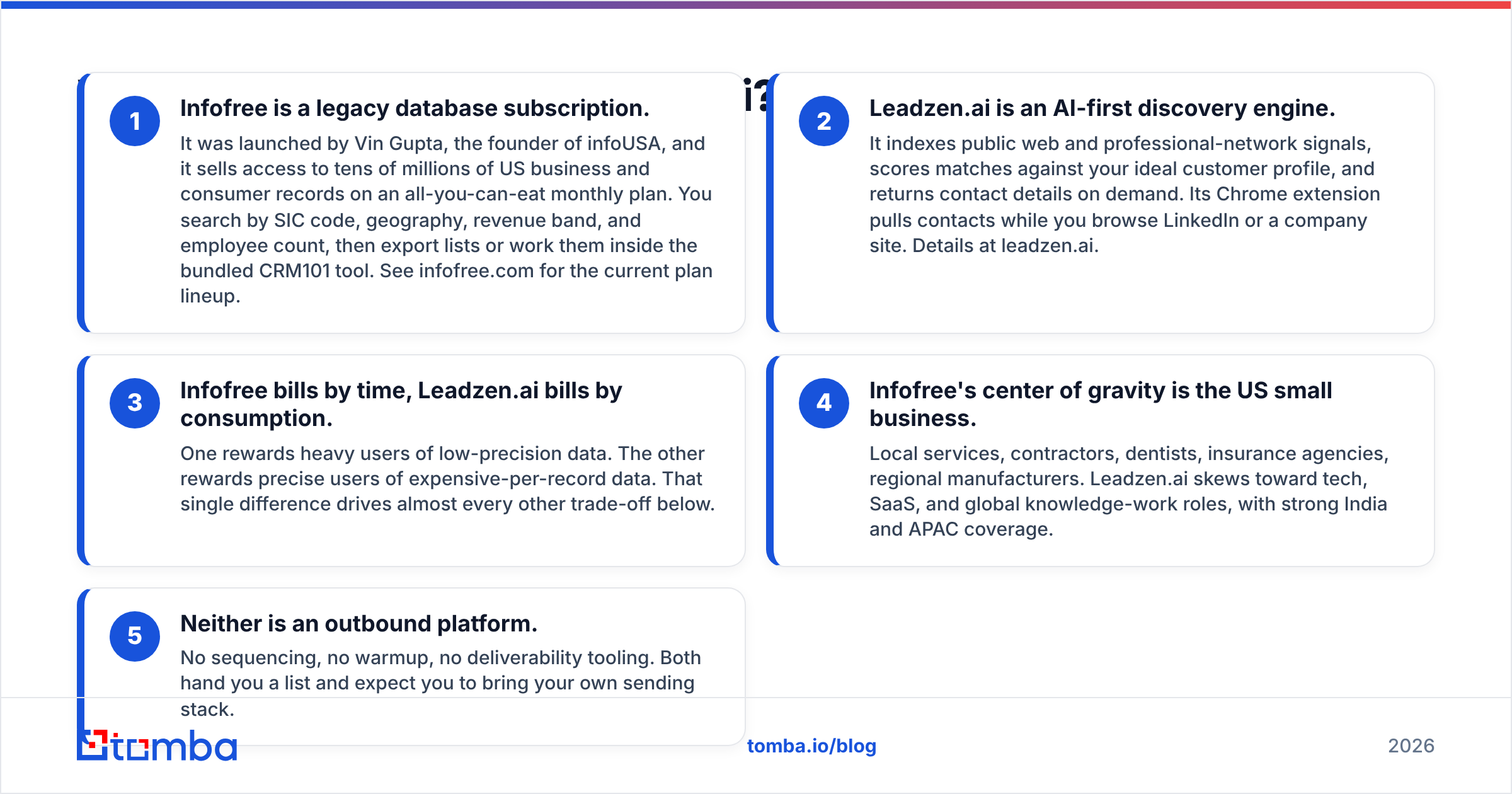
- Infofree is a legacy database subscription. It was launched by Vin Gupta, the founder of infoUSA, and it sells access to tens of millions of US business and consumer records on an all-you-can-eat monthly plan. You search by SIC code, geography, revenue band, and employee count, then export lists or work them inside the bundled CRM101 tool. See infofree.com for the current plan lineup.
- Leadzen.ai is an AI-first discovery engine. It indexes public web and professional-network signals, scores matches against your ideal customer profile, and returns contact details on demand. Its Chrome extension pulls contacts while you browse LinkedIn or a company site. Details at leadzen.ai.
- Infofree bills by time, Leadzen.ai bills by consumption. One rewards heavy users of low-precision data. The other rewards precise users of expensive-per-record data. That single difference drives almost every other trade-off below.
- Infofree's center of gravity is the US small business. Local services, contractors, dentists, insurance agencies, regional manufacturers. Leadzen.ai skews toward tech, SaaS, and global knowledge-work roles, with strong India and APAC coverage.
- Neither is an outbound platform. No sequencing, no warmup, no deliverability tooling. Both hand you a list and expect you to bring your own sending stack.
How do Infofree and Leadzen.ai compare head-to-head?#
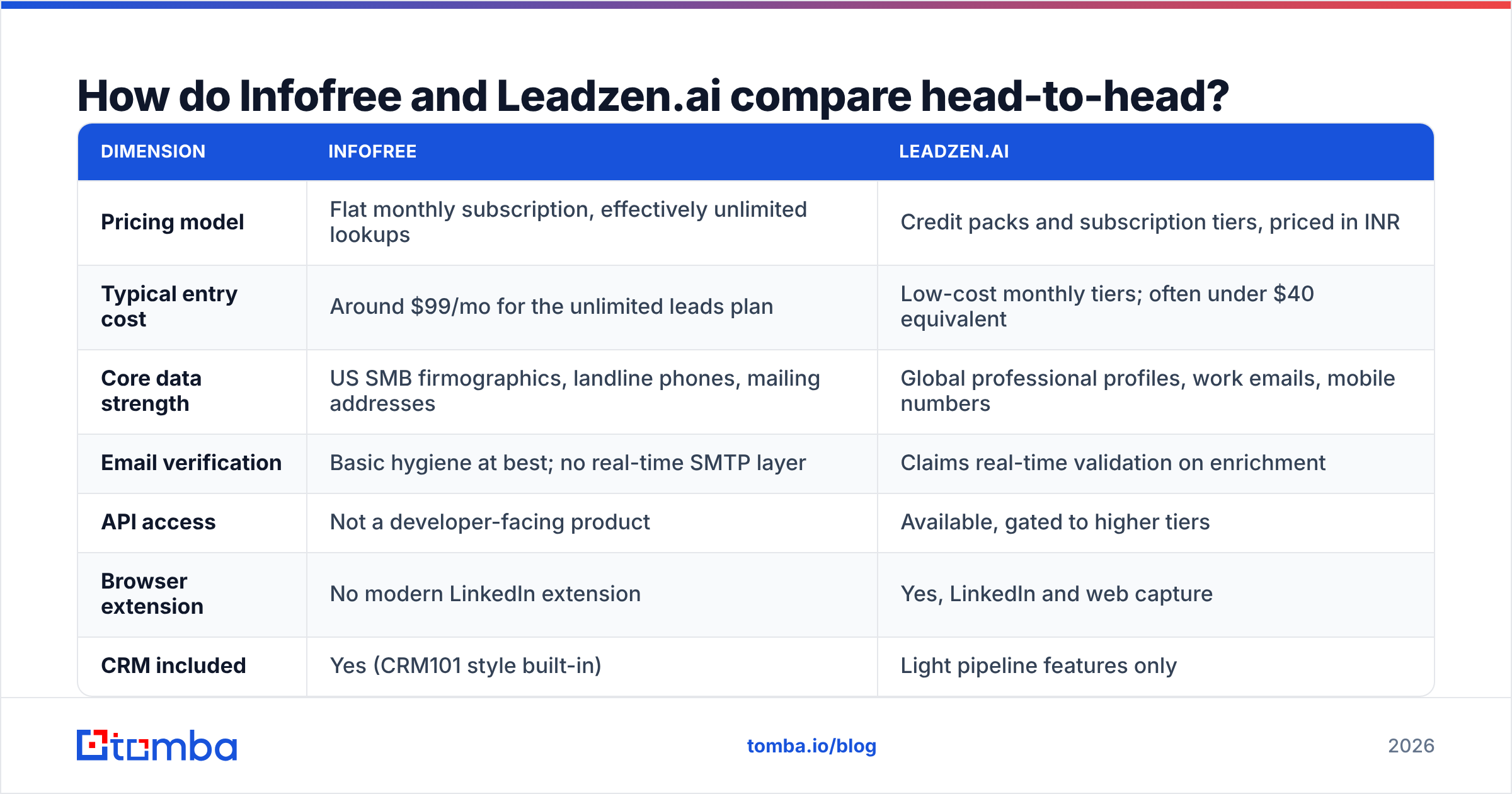
Pricing and limits change often. Treat this as a structural comparison and confirm current numbers on each vendor's site before you buy.
| Dimension | Infofree | Leadzen.ai |
|---|---|---|
| Pricing model | Flat monthly subscription, effectively unlimited lookups | Credit packs and subscription tiers, priced in INR |
| Typical entry cost | Around $99/mo for the unlimited leads plan | Low-cost monthly tiers; often under $40 equivalent |
| Core data strength | US SMB firmographics, landline phones, mailing addresses | Global professional profiles, work emails, mobile numbers |
| Email verification | Basic hygiene at best; no real-time SMTP layer | Claims real-time validation on enrichment |
| API access | Not a developer-facing product | Available, gated to higher tiers |
| Browser extension | No modern LinkedIn extension | Yes, LinkedIn and web capture |
| CRM included | Yes (CRM101 style built-in) | Light pipeline features only |
| Best for | Cold calling SMB territories at volume | Email and LinkedIn prospecting on narrow ICPs |
| Weakest point | Data freshness and email quality | Coverage depth outside tech and APAC |
Which platform has better data accuracy?#
Different failure modes, and you should pick the one whose failures you can absorb.
Infofree's lineage is compiled data: directories, filings, phone listings, public registrations. Compiled sources are broad and shallow. You will find a plumbing company in Tulsa with a valid main line and a verified mailing address. You will much less reliably get the owner's current, working, personal-work email. Compiled B2B files typically decay 25% to 30% a year as people change jobs and businesses close, and flat-rate providers have weak commercial incentive to aggressively prune records, because "unlimited" is the product.
Leadzen.ai's lineage is scraped and inferred: profile pages, pattern-based email construction, and enrichment at query time. Query-time enrichment is a genuine advantage over a static file, because the record is assembled when you ask for it rather than pulled from a snapshot taken last quarter. The weakness is confidence signaling. Pattern-generated addresses look identical to sourced addresses in an export. Without a verification step, you cannot tell which is which, and your sending domain pays for the guess.
Here is the uncomfortable part for both vendors: neither one's built-in validation is a substitute for a dedicated email verifier. Verification is a specialist job involving MX checks, SMTP handshakes, catch-all handling, role-account detection, and disposable-domain filtering. Tools that bolt it on as a checkbox feature usually skip catch-all logic entirely, which is exactly where most B2B domains now sit.
A reasonable expectation, based on how compiled and scraped sources generally behave in the wild:
- Direct dial and main-line phone numbers: Infofree ahead for US SMB, meaningfully behind for enterprise and non-US.
- Work email addresses: Leadzen.ai ahead, especially for tech titles, but with a wider confidence spread.
- Firmographics (revenue, headcount, SIC): Infofree ahead, because compiled files are built around exactly those fields.
- Job-title currency: Leadzen.ai ahead, because profile-derived data updates when the person updates it.
Run your own 100-record bake-off before committing. Any vendor unwilling to let you test a sample is telling you something.
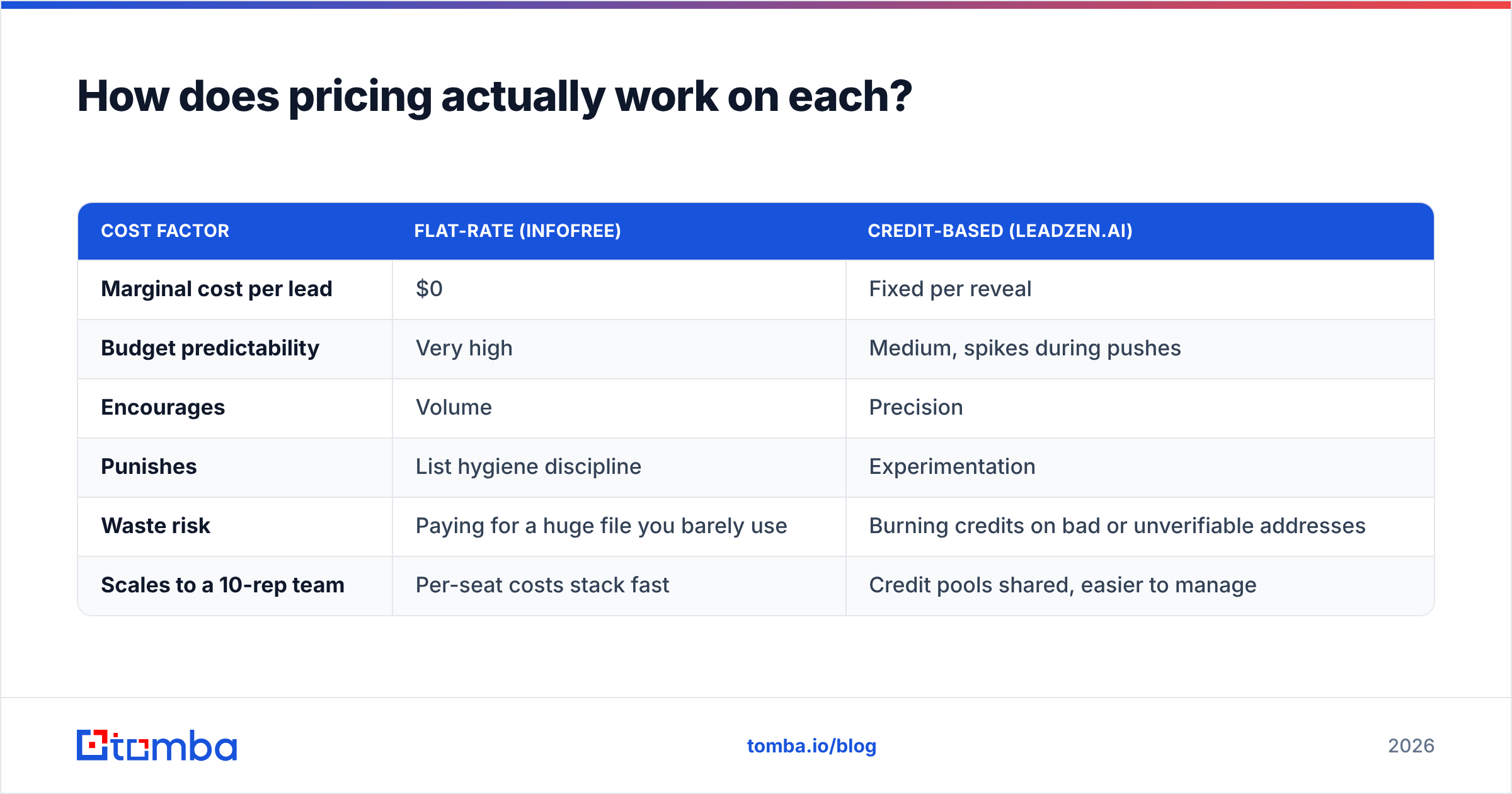
How does pricing actually work on each?#
Flat-rate versus credits is not a pricing detail. It is a behavioral change in how your team prospects.
Under a flat subscription like Infofree's, marginal cost per record is zero. Reps pull 5,000 rows because pulling 5,000 rows costs nothing. That is great for a dialing floor working territories and terrible for list discipline. Volume without filtering is how teams end up blasting a generic pitch at 4,000 unqualified businesses and blaming the copy.
Under a credit model like Leadzen.ai's, every reveal has a price. Reps get stingy, which usually improves targeting, but introduces a second failure: credit anxiety. People stop testing new segments because each experiment burns budget. And credits spent on an invalid address are gone whether or not the email lands.
| Cost factor | Flat-rate (Infofree) | Credit-based (Leadzen.ai) |
|---|---|---|
| Marginal cost per lead | $0 | Fixed per reveal |
| Budget predictability | Very high | Medium, spikes during pushes |
| Encourages | Volume | Precision |
| Punishes | List hygiene discipline | Experimentation |
| Waste risk | Paying for a huge file you barely use | Burning credits on bad or unverifiable addresses |
| Scales to a 10-rep team | Per-seat costs stack fast | Credit pools shared, easier to manage |
For reference, Tomba pricing sits in the middle of these two models: a free tier at 25 searches per month, Starter at $49/mo, Growth at $99/mo, Pro at $249/mo, and custom enterprise plans. It is credit-shaped, but verification is part of the same workflow rather than a separate purchase, which removes the most common source of wasted spend.
Who should choose Infofree?#
Pick Infofree if three things are true at once.
- Your motion is phone-first. You have SDRs dialing lists, not writing sequences. Compiled landline and main-line data is Infofree's genuine strength.
- Your ICP is US small business. Home services, local professional practices, regional distributors, franchises. Under 100 employees, geographically defined territory.
- You want one bill and no metering. Finance likes a fixed line item. Reps like not asking permission to pull a list.
Skip it if you sell to enterprise, sell outside the US, sell to technical buyers, or run cold email as your primary channel. Compiled SMB files are the worst possible input for a modern email sequence, because bounce rates on stale compiled data routinely land in the double digits, and mailbox providers read that as a spam signal long before your prospect reads your subject line.
Who should choose Leadzen.ai?#
Pick Leadzen.ai if you are the inverse case.
- You prospect in the browser. Your reps live on LinkedIn and company sites, and a capture extension fits how they already work.
- You have a narrow, well-defined ICP. Credits reward precision. If you can name the 400 accounts that matter, credit pricing is cheaper than any flat file.
- Budget is tight and INR pricing helps. For teams that can transact in INR, the effective per-seat cost undercuts most US-priced alternatives by a wide margin.
- You need job-title currency more than firmographic depth. Profile-derived data ages better on roles than compiled data does.
Skip it if you need auditable compiled firmographics for territory planning, if your ICP is US main-street SMB, or if procurement requires a US-domiciled data vendor with formal compliance documentation.

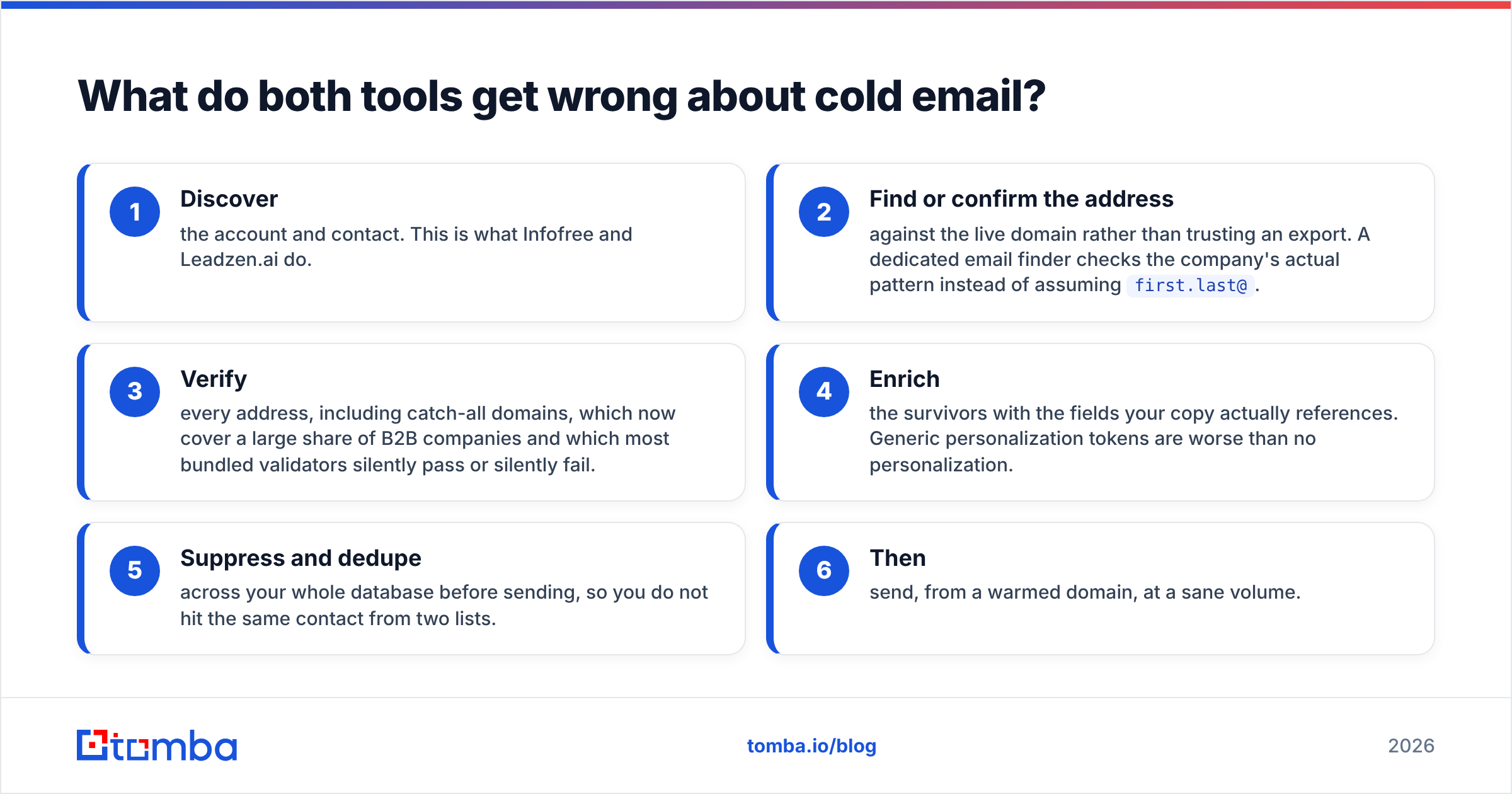
What do both tools get wrong about cold email?#
Both ship you addresses and call the job done. It is not done.
The sequence that actually protects your domain looks like this:
- Discover the account and contact. This is what Infofree and Leadzen.ai do.
- Find or confirm the address against the live domain rather than trusting an export. A dedicated email finder checks the company's actual pattern instead of assuming
first.last@. - Verify every address, including catch-all domains, which now cover a large share of B2B companies and which most bundled validators silently pass or silently fail.
- Enrich the survivors with the fields your copy actually references. Generic personalization tokens are worse than no personalization.
- Suppress and dedupe across your whole database before sending, so you do not hit the same contact from two lists.
- Then send, from a warmed domain, at a sane volume.
Skipping step three is the single most common reason a technically fine campaign produces a 20%+ bounce rate and a burned sending domain. Data providers rarely mention it, because the cost lands on you, not on them. Independent user reviews on G2 for both categories repeat the same complaint: the data looked fine in the export and fell apart in the inbox.
Is there a better setup than picking one?#
For most email-led teams, yes, and it is not a dodge.
Use a discovery tool for what it is good at, then own the contact layer separately. That means your list source is replaceable. If Infofree's file goes stale or Leadzen.ai's coverage misses your next segment, you swap the source without rebuilding your workflow, because finding and verification live in your own pipeline.
That is the case for a contact-data layer with an API. Tomba's approach is deliberately unbundled: domain search to map an entire company's addresses and pattern, bulk email finder for list-scale processing, verification with explicit catch-all handling, and a Tomba API so the whole thing runs inside your CRM sync or enrichment job rather than as a manual CSV ritual. It does not try to be your CRM, your dialer, or your sequencer.
It is also worth naming the honest limitation: Tomba is not a compiled SMB firmographic database. If your requirement is "give me every HVAC company in three counties with revenue between $1M and $5M," a compiled file like Infofree's is the right shape of product and Tomba is not. Use each tool for the job it was built to do.
Other options worth a look depending on your constraint: BookYourData is a strong choice when you want pre-built, pay-as-you-go verified B2B lists with no subscription commitment, and it publishes clear accuracy guarantees. Apollo and similar all-in-one platforms make sense when you want data and sequencing under one login and are willing to accept the data quality that comes with a bundled model.
How should you run the evaluation?#
Do not trust anyone's marketing page, including this one. Run the test.
- Pull the same 100 target accounts from both tools using identical filters.
- Export, then verify every address through an independent verifier. Record valid, invalid, catch-all, and unknown counts per source.
- Dial 20 phone numbers from each. Count connects, wrong numbers, and disconnected lines.
- Check title currency on 20 contacts against their live public profile.
- Divide total cost by the count of usable records, not total records. That number is the only price that matters.
A tool that returns 400 records where 180 are usable is more expensive than a tool that returns 150 records where 140 are usable, regardless of what the invoice says.
The verdict#
Infofree wins for US SMB phone prospecting on a predictable budget. Leadzen.ai wins for browser-based, ICP-narrow email and LinkedIn prospecting at a low per-seat cost. Neither one wins on email deliverability, because neither one treats verification as a first-class product.
If cold email is your primary channel, fix the contact layer before you argue about the list source. Start with the Tomba Email Finder on the free tier, run 25 searches against accounts you already know, and compare the hit rate against whatever your current provider returned. Twenty minutes of testing will tell you more than another week of comparison pages.
Related guides#
// get started
Find, verify and enrich your first contacts today
Start on the free plan with 25 searches a month, then scale when your team is ready.
Free plan · No credit card required · GDPR & CCPA
// about the author