Infofree vs TAMI AI (2026): Which B2B Data Tool Wins?
One sells unlimited US lists for a flat monthly fee. The other sells GDPR-first European intelligence at quote-based pricing. Here's how Infofree and TAMI AI actually compare on coverage, accuracy, and cost per usable contact.
TL;DR
- Infofree is a US-focused, flat-fee list platform: unlimited business and consumer records, a bundled lightweight CRM, and pricing that sits in the low double digits to around $99/month depending on the plan you pick.
- TAMI AI is a European-first B2B intelligence platform: company and contact data with heavy EMEA coverage, technographics, web-presence signals, and GDPR-aligned processing. Pricing is quote-based, not self-serve.
- They are not really competitors. Infofree wins on volume-per-dollar for US SMB and consumer targeting. TAMI wins on European coverage, compliance documentation, and account-level intelligence.
- Neither is an email accuracy tool. Both hand you records that need verification before they touch a sending domain.
- Best real-world setup: pick one as your list source, then run every address through a dedicated finder and verifier before the first send.
If you searched Infofree vs TAMI AI, you probably landed on both from very different directions. Infofree shows up when you search "unlimited sales leads." TAMI shows up when you search "GDPR-compliant B2B data Europe." That gap tells you most of what you need to know, but the details matter when you're the one signing the contract.
What is Infofree?#
Infofree is a US lead-list platform built around a simple promise: pay a flat monthly fee, download as many sales leads as you want. It descends from the same lineage as the classic US compiled-data business, which is why its strength is breadth of small-business and consumer records rather than modern buying signals.
What you get:
- Business records across roughly 14–15 million US companies, with SIC code, employee count, sales volume, and executive names.
- Consumer records in the hundreds of millions, filterable by income, home value, age, and geography. This is unusual — most B2B data tools have no consumer file at all.
- CRM101, a bundled starter CRM so reps can work the list without exporting to a separate tool.
- Mobile access for field reps doing territory or door-to-door work.
Infofree's published pricing has historically sat in the $50–$99/month range per user for unlimited-download plans, which is why it dominates searches for cheap list access. Check infofree.com for current tiers before you budget — flat-fee vendors change terms more often than credit-based ones.
The honest framing: Infofree is a compiled-database product. Compiled data comes from directories, public filings, phone records, and survey sources. It's wide, it's cheap, and it goes stale faster than user-contributed or crawl-refreshed data.
What is TAMI AI?#
TAMI (Total Addressable Market Intelligence) is a Dublin-headquartered sales intelligence platform aimed at teams selling into Europe, the UK, and Ireland. Where Infofree sells you a list, TAMI sells you a view of a market.
What you get:
- Company-level intelligence with a genuine EMEA focus, including markets where US-built databases thin out fast (Ireland, Nordics, Benelux, DACH).
- Technographic data — what software a company runs, which is the backbone of "sell to everyone using X" campaigns.
- Web-presence and hiring signals used to infer growth and buying intent.
- GDPR-oriented processing, with documentation around lawful basis and data subject requests. For EU-headquartered buyers, this is often the deciding factor, not a nice-to-have.
Pricing is not published. You book a demo, you get a quote, and the quote scales with seats and data scope. Expect it to land well above Infofree's flat fee. See tami.ai for the current product breakdown.
How do Infofree and TAMI AI compare head-to-head?#
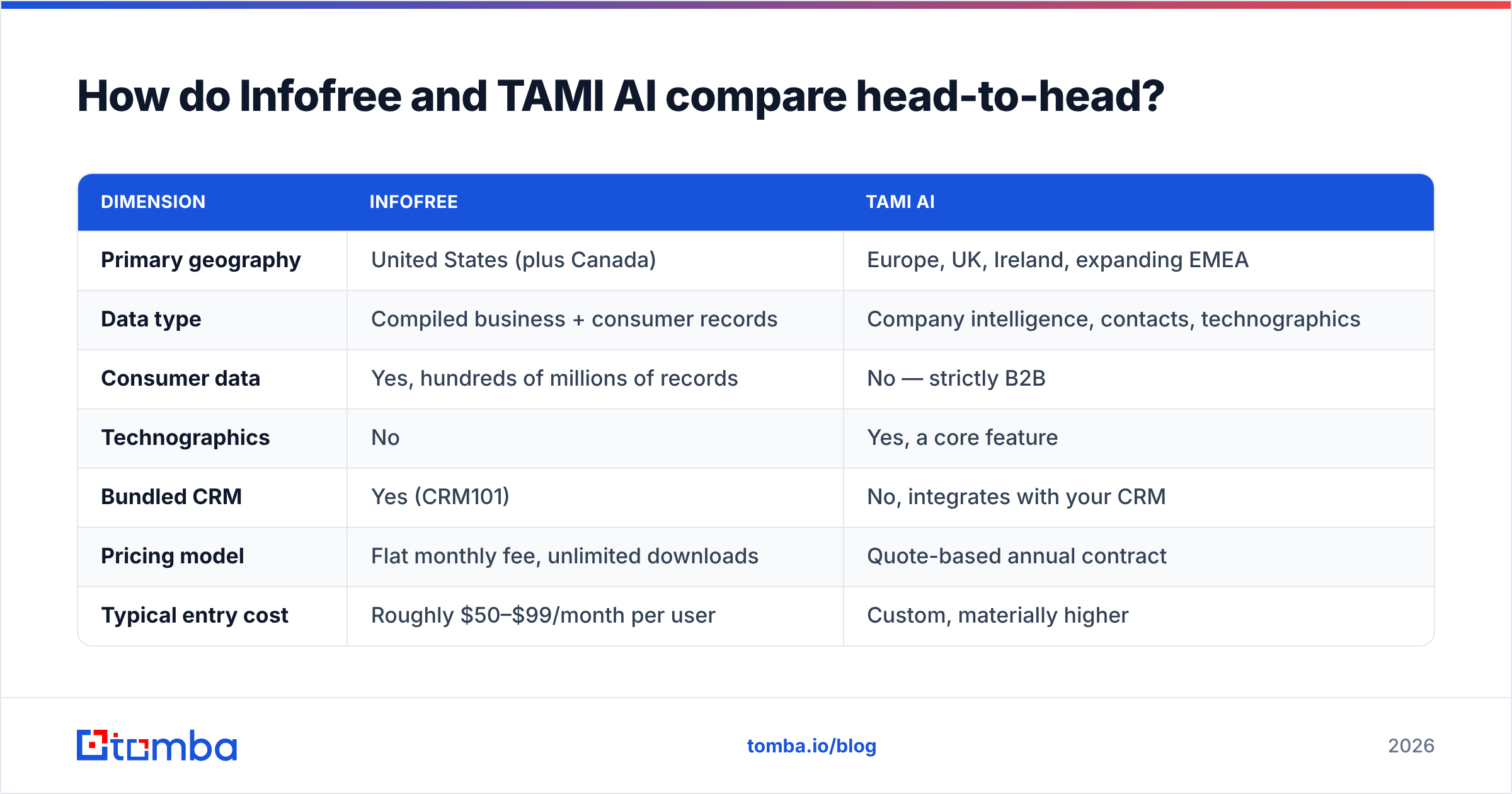
Here is the side-by-side that actually matters when you're evaluating the two.
| Dimension | Infofree | TAMI AI |
|---|---|---|
| Primary geography | United States (plus Canada) | Europe, UK, Ireland, expanding EMEA |
| Data type | Compiled business + consumer records | Company intelligence, contacts, technographics |
| Consumer data | Yes, hundreds of millions of records | No — strictly B2B |
| Technographics | No | Yes, a core feature |
| Bundled CRM | Yes (CRM101) | No, integrates with your CRM |
| Pricing model | Flat monthly fee, unlimited downloads | Quote-based annual contract |
| Typical entry cost | Roughly $50–$99/month per user | Custom, materially higher |
| Free trial | Yes, limited trial historically offered | Demo-gated |
| Email verification | Not a core capability | Not a core capability |
| GDPR posture | US-centric; review before EU use | Built around EU compliance |
| Best fit | US SMB volume outbound, local services, insurance, mortgage | EU enterprise and mid-market ABM |
Read that table once and the decision mostly makes itself. If your ICP is a 12-person HVAC company in Ohio, TAMI has no answer for you. If your ICP is a 400-person SaaS firm in Amsterdam that runs Shopify Plus, Infofree has no answer for you.
Which one has more accurate data?#
Neither vendor publishes an independently audited accuracy figure, so treat any percentage you see in marketing copy as a claim, not a benchmark. What you can reason about is how each dataset is built, because that predicts decay.
Compiled US databases like Infofree's refresh on a batch cadence. A record for a small business might be accurate on company name and phone while the listed "owner" left two years ago. That's fine for direct mail and cold calling. It's risky for email, because a bad address doesn't just fail — it damages your sender reputation on the way down.
TAMI refreshes from web sources and public signals, which tends to age better on the company side. Contact-level email accuracy is the softer spot, as it is for nearly every intelligence platform. Crawled or inferred addresses still need an SMTP-level check.
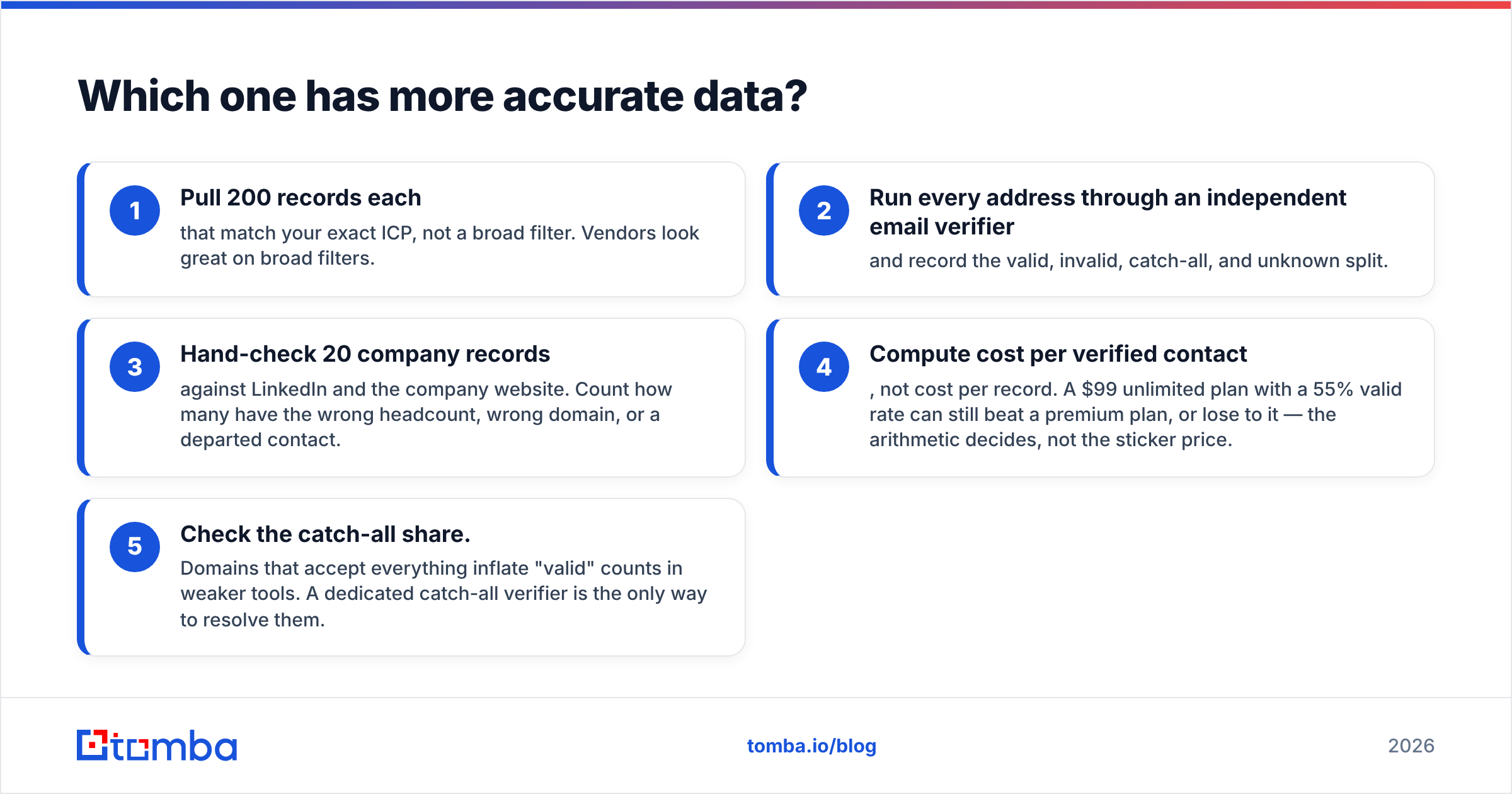
A practical way to test both before committing:
- Pull 200 records each that match your exact ICP, not a broad filter. Vendors look great on broad filters.
- Run every address through an independent email verifier and record the valid, invalid, catch-all, and unknown split.
- Hand-check 20 company records against LinkedIn and the company website. Count how many have the wrong headcount, wrong domain, or a departed contact.
- Compute cost per verified contact, not cost per record. A $99 unlimited plan with a 55% valid rate can still beat a premium plan, or lose to it — the arithmetic decides, not the sticker price.
- Check the catch-all share. Domains that accept everything inflate "valid" counts in weaker tools. A dedicated catch-all verifier is the only way to resolve them.
Do this before the demo call ends and you'll negotiate from data instead of vibes. Buyer reviews on G2 are a useful sanity check on the same points, particularly the recurring complaints about record freshness that both categories attract.
How does the pricing really compare?#
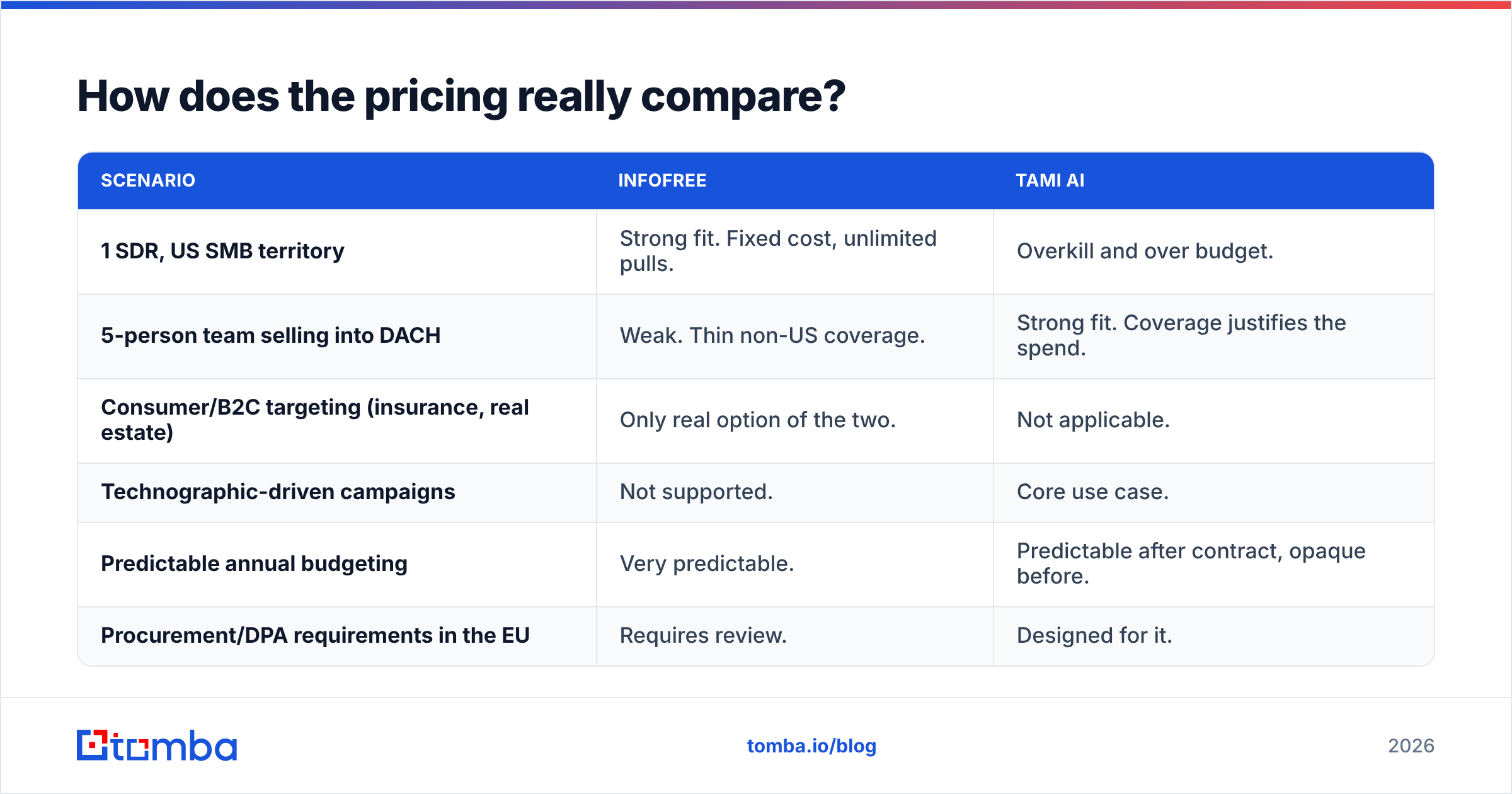
Flat-fee and quote-based pricing can't be compared line by line, so compare them by outcome instead.
| Scenario | Infofree | TAMI AI |
|---|---|---|
| 1 SDR, US SMB territory | Strong fit. Fixed cost, unlimited pulls. | Overkill and over budget. |
| 5-person team selling into DACH | Weak. Thin non-US coverage. | Strong fit. Coverage justifies the spend. |
| Consumer/B2C targeting (insurance, real estate) | Only real option of the two. | Not applicable. |
| Technographic-driven campaigns | Not supported. | Core use case. |
| Predictable annual budgeting | Very predictable. | Predictable after contract, opaque before. |
| Procurement/DPA requirements in the EU | Requires review. | Designed for it. |
The trap with flat-fee unlimited plans is that "unlimited" describes downloads, not quality. You can export 50,000 records on a Tuesday and still only have 9,000 addresses worth emailing. The trap with quote-based platforms is the opposite: you pay a premium for intelligence, then discover that contact-level emails still need a second tool.
For reference on how credit-based contact tooling is normally priced, Tomba pricing runs a free tier at 25 searches per month, Starter at $49/month, Growth at $99/month, and Pro at $249/month. That gives you a yardstick for what verified-contact capacity should cost when it's sold as its own line item rather than bundled into a list subscription.
Who should choose Infofree?#
Choose Infofree if most of these are true:
- Your market is US SMB. Local services, insurance, financial advisory, franchise sales, home improvement.
- You call more than you email. Compiled phone data holds up better than compiled email data, and Infofree's record depth on small businesses is genuinely hard to match at the price.
- You need consumer records. Very few B2B tools carry a consumer file. If you sell to homeowners or individuals, this alone decides it.
- You want one predictable invoice. No credit anxiety, no overage surprises.
- You don't already own a CRM. CRM101 is basic, but a solo rep or two-person shop can genuinely work out of it.
Skip it if your buyers are outside North America, if you sell to venture-backed tech companies, or if your entire motion is email-first.
Who should choose TAMI AI?#
Choose TAMI if most of these are true:
- Europe is your primary market, especially markets where US-compiled databases return sparse or wrong results.
- Compliance is a gate, not a preference. If your legal team needs a defensible lawful basis and a signed DPA before you can prospect, this is the side of the comparison that survives review.
- You run account-based motions. Technographics plus firmographics plus hiring signals is a real segmentation layer, not a list filter.
- You already have a CRM and a sequencer and need intelligence feeding them, not another workspace.
- Your ACV supports the spend. A €25k average deal absorbs a data platform. A €900 deal does not.

What do both platforms miss?#
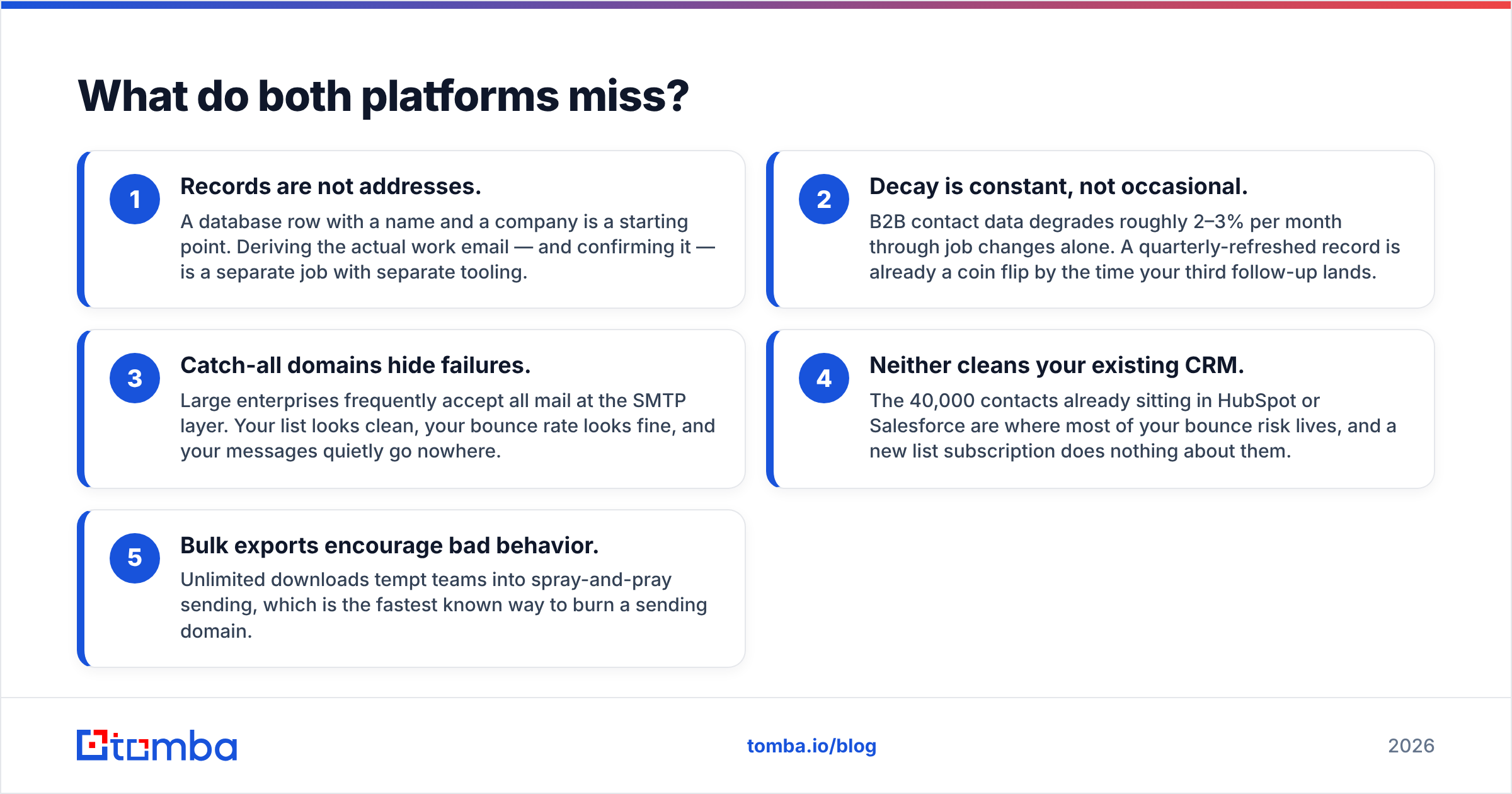
This is where the Infofree vs TAMI AI framing breaks down, because both share the same blind spot: neither is built to guarantee that a specific email address will accept mail today.
- Records are not addresses. A database row with a name and a company is a starting point. Deriving the actual work email — and confirming it — is a separate job with separate tooling.
- Decay is constant, not occasional. B2B contact data degrades roughly 2–3% per month through job changes alone. A quarterly-refreshed record is already a coin flip by the time your third follow-up lands.
- Catch-all domains hide failures. Large enterprises frequently accept all mail at the SMTP layer. Your list looks clean, your bounce rate looks fine, and your messages quietly go nowhere.
- Neither cleans your existing CRM. The 40,000 contacts already sitting in HubSpot or Salesforce are where most of your bounce risk lives, and a new list subscription does nothing about them.
- Bulk exports encourage bad behavior. Unlimited downloads tempt teams into spray-and-pray sending, which is the fastest known way to burn a sending domain.
The fix is boring and it works: treat your list vendor as the source of targets, and use a dedicated contact layer to turn targets into deliverable addresses. A domain search pulls the live email pattern for a company you've already decided to pursue. Bulk verification cleans whatever you exported. Data enrichment fills the gaps your primary vendor left behind.
So which one wins?#
There is no single winner, and any article claiming otherwise is guessing at your ICP.
Infofree wins on cost-per-record for US small business and consumer targeting, and on being the only one of the two a solo rep can afford without a procurement cycle.
TAMI AI wins on European coverage, compliance posture, and the kind of account intelligence that supports real segmentation rather than raw list pulling.
Neither wins on email deliverability, and that's the decision most teams get wrong. The vendor you pick determines who you talk to. The verification layer you add determines whether they ever see the message.
If you're building a US SMB calling motion on a tight budget, start with Infofree and add verification before any email campaign. If you're selling into Europe with a compliance requirement and a deal size that justifies it, run the TAMI demo and pressure-test coverage in your three hardest countries. If you're somewhere in between, buy the cheaper list source and spend the difference on contact accuracy.
Whichever way you go, put a verification step between the export and the send. The Tomba Email Finder resolves names and domains into current, deliverable work emails, with SMTP-level checks and catch-all handling built in — so the list you paid for actually turns into replies instead of bounces. Start on the free tier, run your first 25 searches against records from either platform, and let the valid rate tell you which vendor deserves the contract.
Related guides#
// get started
Find, verify and enrich your first contacts today
Start on the free plan with 25 searches a month, then scale when your team is ready.
Free plan · No credit card required · GDPR & CCPA
// about the author