Infofree vs ZoomInfo: Which B2B Data Tool Wins in 2026?
Infofree sells unlimited lists for pocket change. ZoomInfo sells enterprise intent data for five figures a year. Here is the honest breakdown of accuracy, contracts, and who each one actually fits.
Infofree vs ZoomInfo is an odd match-up. One tool costs less than a team lunch. The other costs more than a used car. This guide shows what you get at each price, and why most small teams need neither.
TL;DR — Infofree vs ZoomInfo on one screen:
- Infofree is a cheap list service built on old business-directory data. You pay tens of dollars a month and pull down a lot of records. Depth and freshness are the trade-off.
- ZoomInfo is a full sales data platform. You get org charts, intent signals, and workflow tools. You also get a yearly contract that often lands in five figures, with seat and credit caps on top.
- Neither one does the job most small B2B teams have: check one person's work email right before you hit send.
- Accuracy is the hidden cost in both. A cheap list with 30% bounces costs more than a small clean one. Bounces hurt your sending domain, not just your open rate.
- Best fit by team: local phone sales, go Infofree. Big-team ABM with a RevOps hire, go ZoomInfo. Tight budget and precise targets, use a pay-per-find tool like Tomba.
Infofree vs ZoomInfo: what are these two tools?#
They are very different products. People lump both under "B2B database" anyway.
Infofree.com is a low-cost service. It gives you a large compiled list of US firms and consumers, plus a simple built-in CRM. The data comes from the old directory world: phone books, public filings, and surveys. The price is low on purpose. It is an impulse buy for a solo rep or a small local team. The pitch is volume, not depth.
ZoomInfo sits at the far end of the market. It blends a shared data network, web crawling, and human research. On top of that you get org charts, tech stacks, buying signals, website visitor IDs, call analysis, and CRM sync. It is a public company. It sells by yearly contract with named seats. The company background on Wikipedia covers the DiscoverOrg merger that shaped the tool.
Here is the short way to frame Infofree vs ZoomInfo:
- Coverage — Infofree lists many firms in a shallow way: name, address, phone, SIC code, revenue guess. ZoomInfo builds deep profiles: job title, direct dial, who reports to whom, tech stack, recent job move.
- Freshness — Old directory data ages in silence. A shared network spots job moves faster, because live users feed it.
- Buyer — Infofree fits a single rep, an agent, or a local shop. ZoomInfo fits VP Sales and RevOps teams with a real data budget.
- Contract — Infofree is month to month and self-serve. ZoomInfo is yearly, priced by deal, and gated behind a demo.
- Next step — Infofree hands you a list to call. ZoomInfo hands you a map to work, then charges you to push it into Salesforce or HubSpot.

How do Infofree and ZoomInfo compare head-to-head?#
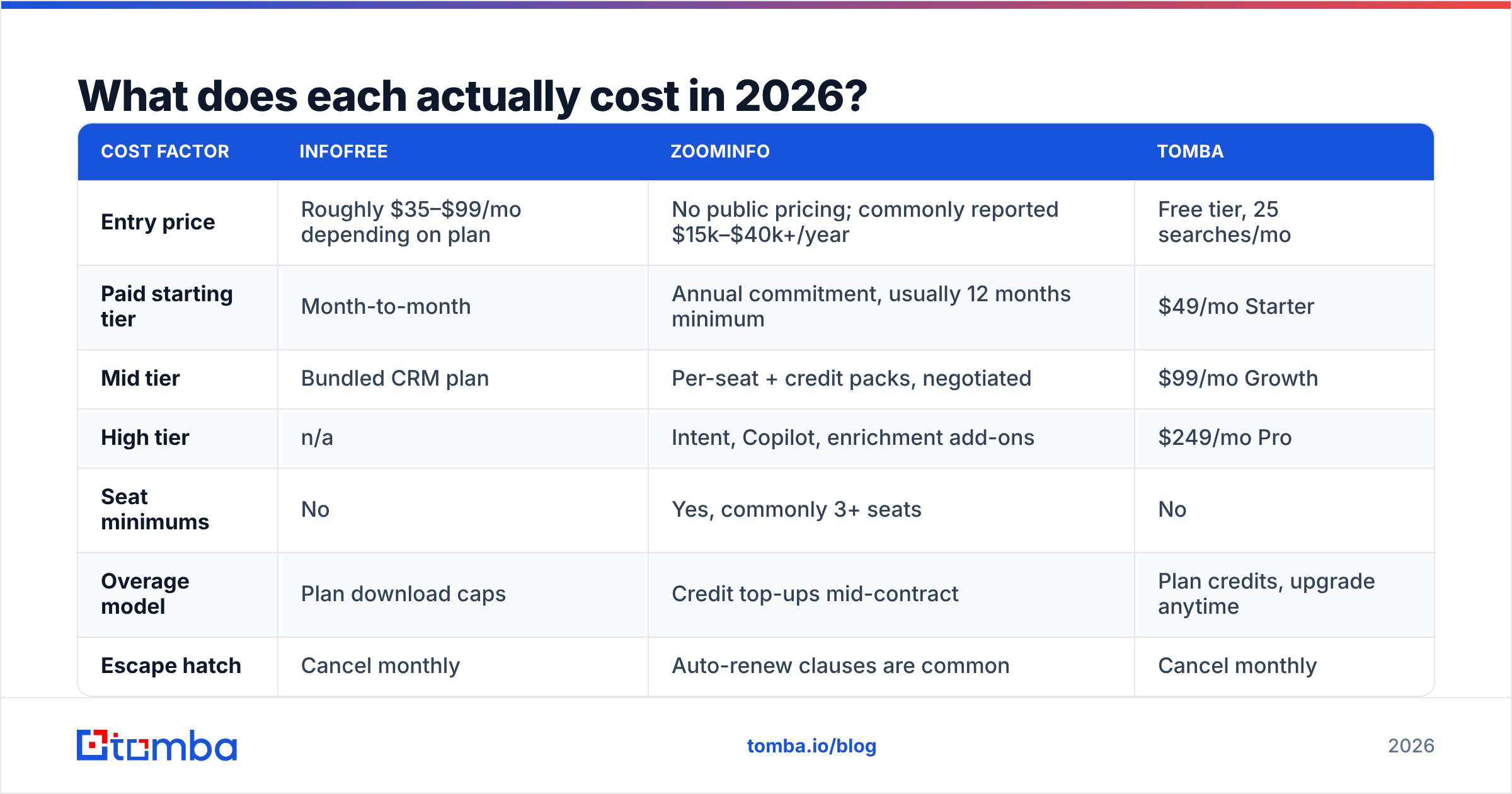
| Attribute | Infofree | ZoomInfo |
|---|---|---|
| Primary use case | Cheap volume lists for calls and mail | Big-team ABM, intent-led outbound |
| Data type | Compiled firm and consumer directory | Shared network, research, intent |
| Verified work emails | Weak; often generic or company-level | Strong, with direct dials on top plans |
| Org charts | No | Yes |
| Buying intent signals | No | Yes, the core edge |
| Contract | Month to month, self-serve | Yearly, sales-led, priced by deal |
| Published pricing | Yes, on site | No |
| Free trial | Short trial | Demo plus a small trial via sales |
| CRM sync | Basic built-in CRM | Salesforce, HubSpot, Dynamics, Outreach |
| API access | Minimal | Yes, on top plans or as an add-on |
| Best for | Solo reps, local B2B and B2C, agents | 20+ seat teams with RevOps support |
The table makes the call clear. These are not two takes on the same thing. One sells you a list. The other sells you a platform. Judge them on price alone and you learn nothing.

Which one has better data accuracy?#
ZoomInfo wins on contact data. Infofree does not really compete here.
That sounds harsh, so here is why. Directory data is great at one job: does this firm exist, and where is it? It is weak at the next job: who runs ops today, and what is her work email? That answer changes every 18 months. Nobody updates a phone book when they switch jobs. ZoomInfo's shared model, where users' own contacts flow back in, is built to catch that churn.
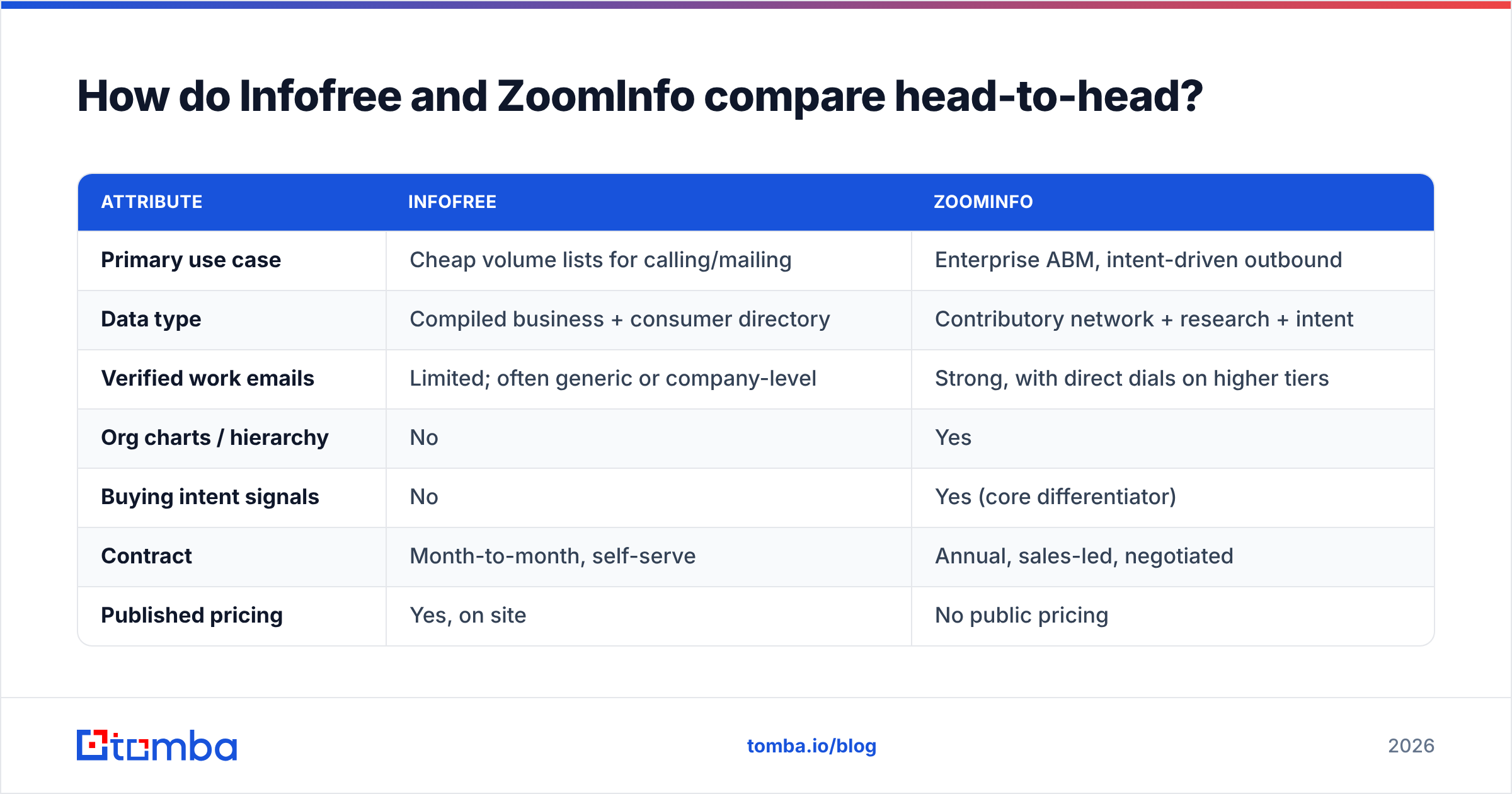
But ZoomInfo is not magic. Reviews in G2's sales intelligence category show one pattern across every vendor. Users praise coverage. They gripe about stale contacts and credit burn. Every big database has dead rows. B2B contact data decays by 25–30% a year from job moves alone. Vendors who claim 95% accuracy tend to measure when they collect the row, not when you press send.
Most Infofree vs ZoomInfo posts skip the next part. Database accuracy and send-time accuracy are two numbers, not one. A row that was 98% right in March can be dead by September. So good teams re-check every address at export time. It does not matter which tool it came from. Run the batch through an email verifier first. It is cheap cover for a domain problem that takes months to fix.

Rule of thumb: treat any export as a guess list. Verify, then send. If a vendor talks you out of verifying, that tells you a lot.
What does each actually cost in 2026?#
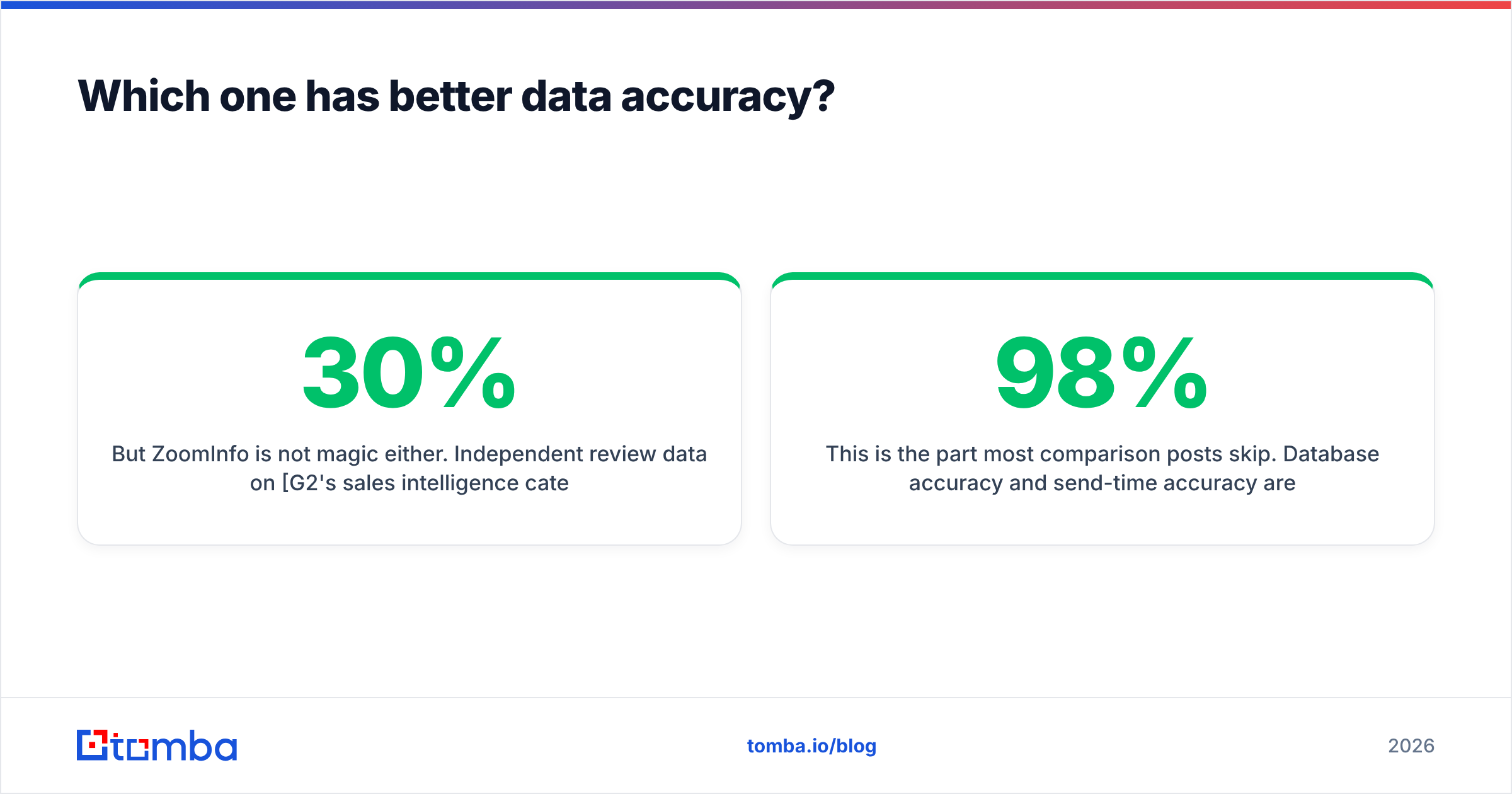
Price is the sharpest split in Infofree vs ZoomInfo. Check both sites before you set a budget. Infofree posts its tiers. ZoomInfo does not.
| Cost factor | Infofree | ZoomInfo | Tomba |
|---|---|---|---|
| Entry price | About $35–$99/mo by plan | No public price; often $15k–$40k+/year | Free tier, 25 searches/mo |
| Paid starting tier | Month to month | Yearly, 12 months at least | $49/mo Starter |
| Mid tier | Bundled CRM plan | Per seat plus credit packs | $99/mo Growth |
| High tier | n/a | Intent, Copilot, and data add-ons | $249/mo Pro |
| Seat minimums | No | Yes, often 3 or more | No |
| Overage model | Plan download caps | Credit top-ups mid-term | Plan credits, upgrade anytime |
| Escape hatch | Cancel monthly | Auto-renew terms are common | Cancel monthly |
Watch two things in a ZoomInfo quote. First, credits are not seats. You can hit a credit wall in month four. The top-up rate is often worse than the one you agreed to. Second, auto-renewal comes up a lot in public reviews. Read the renewal notice window before you sign, not after.
On the Infofree side, watch what "unlimited" means. It tends to cover one record type inside a plan cap. The rows lean toward firm data, not people data. Unlimited access to data you cannot email is not a bargain.
Who should choose Infofree?#
Pick Infofree if you sell by phone, in a set area.
It fits:
- Agents, local services, and field sales who work one ZIP-code radius.
- Sellers with consumer targets who need people records next to firm records. ZoomInfo does not serve that market at all.
- Solo operators who want a $50 tool and a simple CRM, not a platform move.
- Direct mail, where a good postal address beats a good email.
It does not fit cold email at scale. Export 5,000 rows, sequence them, and the bounce rate will choke your domain in a week. That is not a flaw in the tool. You bought a phone book and used it as an email list.
Who should choose ZoomInfo?#
Pick ZoomInfo if three or more of these are true:
- You have 15+ reps on quota and a RevOps hire who owns the data.
- Your deal size covers five figures a year. If one extra win pays for the contract, the math works.
- You need intent signals and visitor IDs to rank accounts, not just contacts.
- You sell to mid-market or large firms, where org charts change your way in.
- You need CRM enrichment on a schedule, not CSV imports.
If fewer than three are true, you will pay for a tool you barely use. The top ZoomInfo regret in public reviews is not "the data was bad." It is "we used 20% of what we bought." Big platforms punish light use. The contract does not shrink when your pipeline does.
Is there a middle option in Infofree vs ZoomInfo?#
Yes. For most teams under 20 reps, it is the right answer.
The gap is huge. Under $100 a month you get shallow list data. Over $15,000 a year you get a full platform. Almost nothing here is built for the team that knows who it wants to reach and just needs 300 correct work emails this quarter.
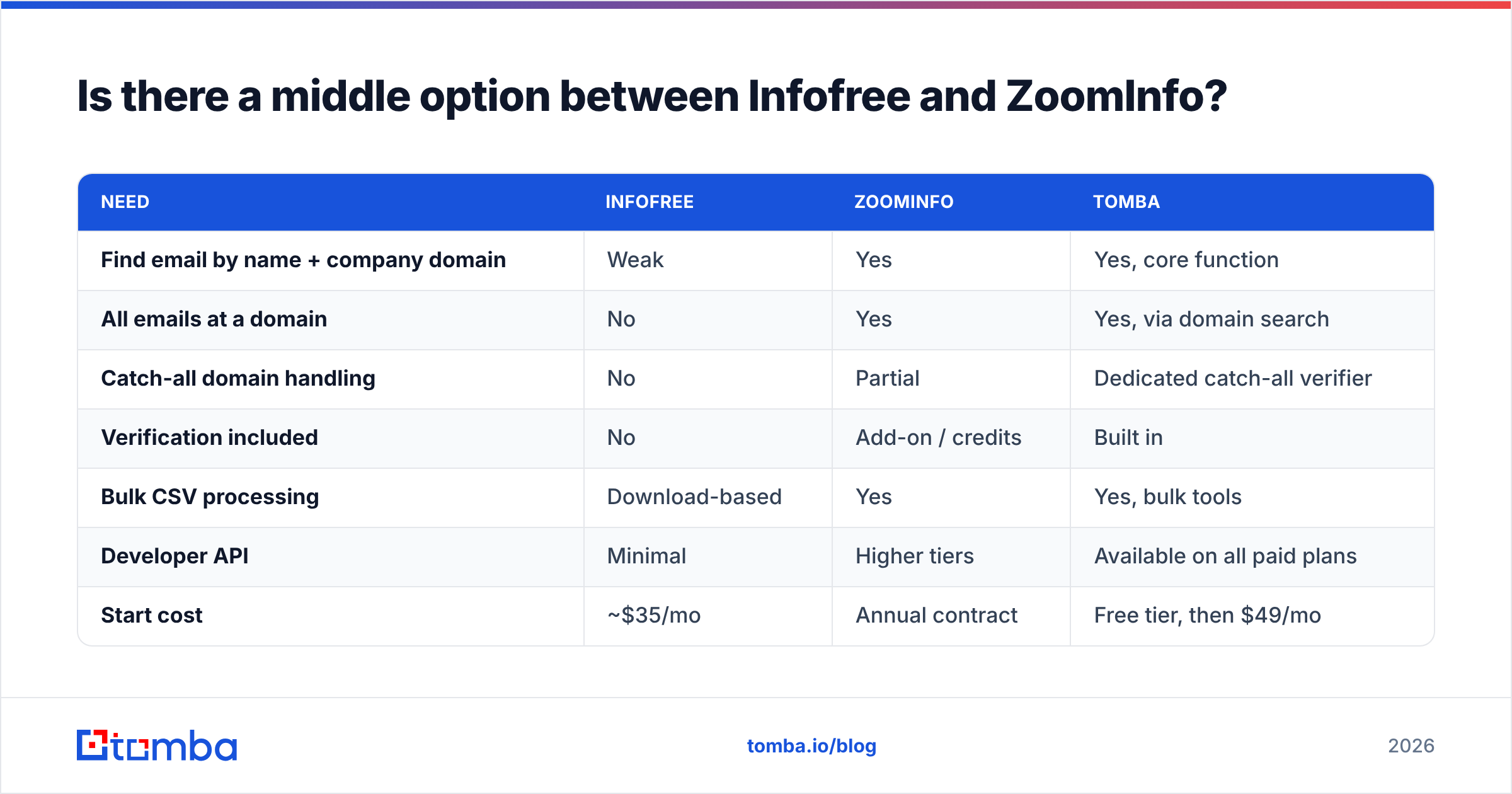
That is the job an email finder does. You do not rent a database. You resolve contacts on demand:
| Need | Infofree | ZoomInfo | Tomba |
|---|---|---|---|
| Find email by name and domain | Weak | Yes | Yes, core job |
| All emails at a domain | No | Yes | Yes, via domain search |
| Catch-all domain handling | No | Partial | Yes, own catch-all check |
| Verification included | No | Add-on or credits | Built in |
| Bulk CSV work | Download-based | Yes | Yes, bulk tools |
| Developer API | Minimal | Top plans | On all paid plans |
| Start cost | ~$35/mo | Yearly contract | Free tier, then $49/mo |
The workflow gap matters more than the price gap. With a database, you start from a list the vendor chose to sell you. With a finder, you start from your own target list. Build it from LinkedIn, an event roster, a funding note, or a lookalike export. Then resolve contacts against it. Your list quality now tracks your targeting, not the vendor's map. If you have a clear ICP, that is a better place to start. You can check plan limits on the Tomba pricing page without booking a call.
The API angle is worth a line too. Say you want to add enrichment to your own signup flow, CRM, or internal tools. The Tomba API makes lookup and checks a step in your code, not a UI export. ZoomInfo has an API too. It just sits at a tier most small dev teams cannot justify.
And if you truly need broad prebuilt lists with human-checked B2B contacts, closer to what Infofree promises but far more accurate, BookYourData is a solid pay-as-you-go pick worth a look next to these two.
How do you test either tool before you commit?#
Run the same 50-record test on every option. It takes an afternoon. It can save you five figures.
- Build a control list. Pick 50 contacts you know are good: clients, partners, people who replied last quarter. Strip out the emails.
- Run each tool blind. Ask each one to resolve those 50 names at their firms. Log found and not found.
- Score accuracy, not coverage. A tool that returns 48 rows with 12 bounces is worse than one that returns 35 clean ones. Count only checked, deliverable hits.
- Measure cost per valid contact. Divide the monthly price by the number of clean hits. That one number settles most Infofree vs ZoomInfo debates faster than any demo.
- Test the odd cases. Add a few catch-all domains and a few recent job movers. That is where a fresh index beats a stale one.
- Check the exit. Before you sign a yearly deal, confirm the renewal notice window and whether credits expire.
Do this before the demo, not after. Sales engineers demo on accounts the tool covers well. Your control list does not care.
What's the verdict on Infofree vs ZoomInfo?#
ZoomInfo is the better product. Infofree is the better deal. Neither is the right default for a small B2B team doing precise email outbound.
Sell to local firms by phone and mail? Infofree's math is hard to argue with. Just know you are buying a directory, not a contact graph. Run big-team ABM with staff to drive the tool? ZoomInfo earns its contract on intent data and org charts. Nothing at the low end matches those. Just push back on the credit pool and the renewal terms.
Sit between those poles, as a startup, an agency, or a team of three to fifteen? Then both tools are the wrong shape. You do not need endless shallow rows. You do not need a five-figure platform. You need correct addresses for the people you already picked, checked at the moment you send.
That is what the Tomba Email Finder is built for. Give it a name and a domain. It finds the work email and checks it in one step. Pull it through an API or a bulk upload when the list grows. Start free with 25 searches a month. Run the 50-record test above against whatever quote sits in your inbox. Then let the cost per valid contact make the call.
Related guides#
// get started
Find, verify and enrich your first contacts today
Start on the free plan with 25 searches a month, then scale when your team is ready.
Free plan · No credit card required · GDPR & CCPA
Get the Tomba newsletter
Product and data updates
// about the author