Intapp Pricing Reviews, Pros and Cons: 2026 Buyer Guide
Intapp doesn't publish a price list. Here's what firms actually pay for DealCloud and the wider Intapp platform in 2026, what reviewers praise, where it frustrates teams, and when a lighter stack wins.
Intapp pricing reviews are hard to pin down for one reason: Intapp does not publish prices. This guide collects what firms actually pay, what reviewers praise, what they criticize, and when a lighter stack wins.
TL;DR
- Intapp does not publish list prices. Every deal is quoted, annual, and seat-based. Module fees stack on top, and so does a one-time implementation charge — the largest year-one line item for most buyers.
- Buyer-reported ranges cluster around $100–$200 per user per month for DealCloud-class seats. Implementation lands between $25,000 and $150,000+, depending on data migration scope. Treat these as directional, not quoted.
- Reviewers consistently praise the depth: relationship intelligence, conflicts/intake workflows, and a data model built for deal teams rather than widget sellers.
- The recurring complaints are equally consistent: slow implementation, admin dependency on Intapp or a partner, dated UI in parts of the suite, and contract inflexibility at renewal.
- Intapp is a platform decision, not a tool purchase. If what you actually need is contact data and outbound volume, a $49/mo email finder plus a CRM you already own will outperform a six-figure platform.
What is Intapp, and who actually buys it?#
Intapp sells software to professional and financial services firms — law firms, accounting and advisory firms, private equity, investment banking, and consulting. The core of the modern platform is DealCloud, the CRM and deal management system Intapp bought in 2020. Around it sits a compliance and operations layer: Intapp Intake, Intapp Conflicts, Intapp Walls, Intapp Time, Intapp Terms, and the Intapp Assist AI features.
The useful mental model: Salesforce is a general-purpose warehouse you fit out yourself. Intapp arrives pre-fitted for one industry — the shelves are already the right size for funds, mandates, matters, and engagement letters. That's the entire value proposition, and it's also why the price tag looks the way it does.
Buyers fall into three groups:
- Private capital firms replacing a spreadsheet-plus-Outlook deal pipeline with something auditable.
- Law and accounting firms that need conflicts checking, ethical walls, and matter intake to be one system rather than four.
- Mid-market advisory firms that tried Salesforce, spent 18 months customizing it, and decided buying the vertical model was cheaper than building it.
If you don't recognize yourself in that list, Intapp is almost certainly over-specified for your problem. You can check the official positioning at intapp.com — note that no plan page exists, which is itself the first pricing fact.
How does Intapp pricing work in 2026?#
Short answer: quote-only, annual, seat-based, module-gated, with a mandatory implementation fee.
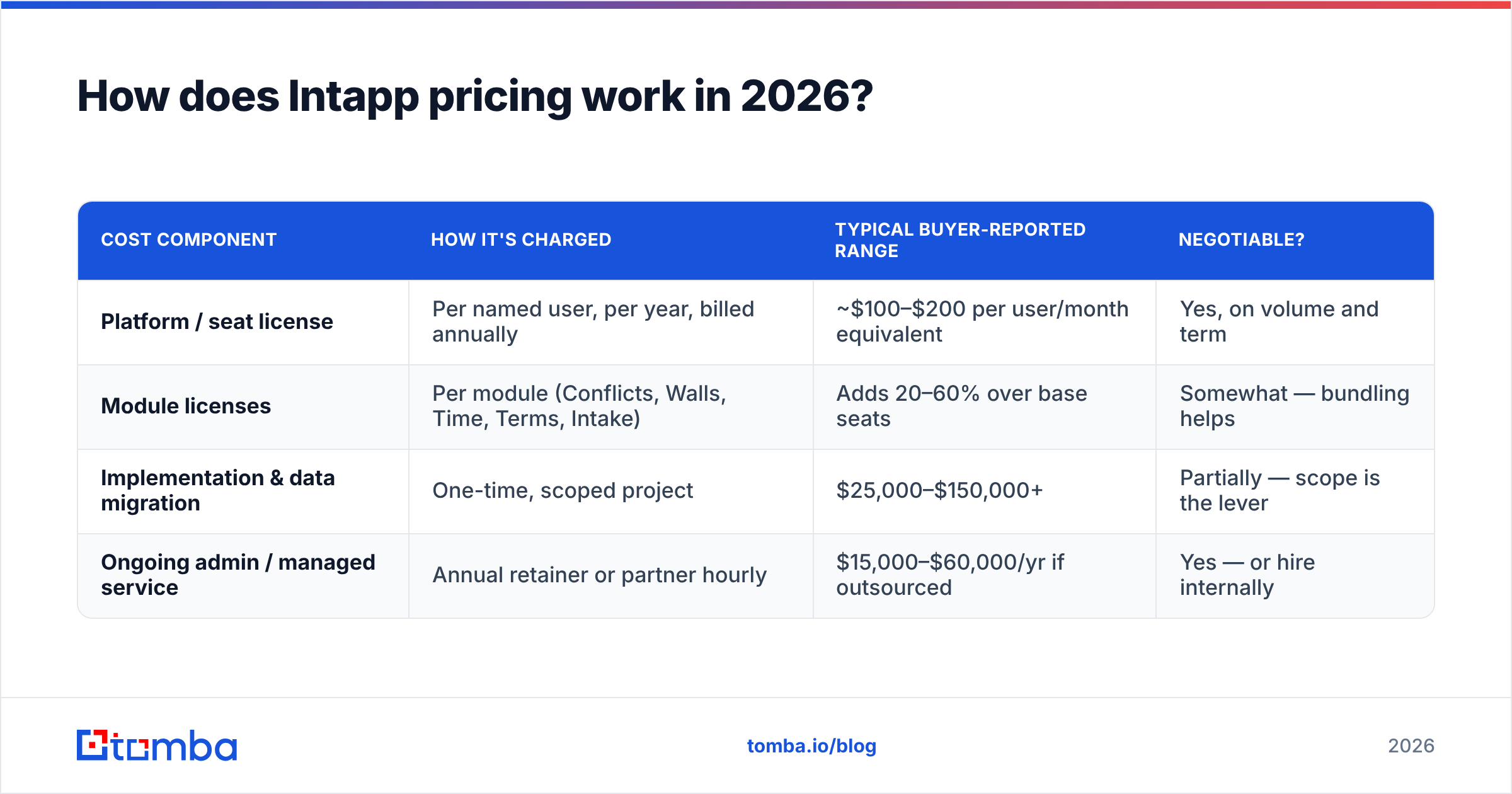
There is no free tier, no self-serve checkout, and no published rate card. You enter through a discovery call, get scoped by a solutions engineer, and receive a proposal built from four components:
| Cost component | How it's charged | Typical buyer-reported range | Negotiable? |
|---|---|---|---|
| Platform / seat license | Per named user, per year, billed annually | ~$100–$200 per user/month equivalent | Yes, on volume and term |
| Module licenses | Per module (Conflicts, Walls, Time, Terms, Intake) | Adds 20–60% over base seats | Somewhat — bundling helps |
| Implementation & data migration | One-time, scoped project | $25,000–$150,000+ | Partially — scope is the lever |
| Ongoing admin / managed service | Annual retainer or partner hourly | $15,000–$60,000/yr if outsourced | Yes — or hire internally |
Those ranges come from buyer reports, peer-review sites, and procurement chatter — not from an Intapp rate card. Most Intapp pricing reviews online repeat the same directional numbers. Anyone quoting you a precise list price is guessing. Your actual number moves on seat count, module mix, contract length, and how ugly your legacy data is.
Three pricing mechanics worth knowing before the first call:
- Multi-year discounts are real but sticky. Three-year terms get meaningfully better per-seat rates. They also remove your leverage at month 13 when you discover you over-bought seats.
- Seat true-ups are one-directional in most contracts. Adding users mid-term is easy. Removing them usually waits for renewal.
- Implementation is where budgets die. Firms that arrive with clean, deduplicated contact data consistently report shorter, cheaper implementations. Firms that arrive with 14 years of Outlook exports do not.

What do Intapp pricing reviews actually say?#
Most Intapp pricing reviews on G2 and Capterra are positive. Intapp and DealCloud sit in the 4.2–4.5 range on most listings. But the reviews split cleanly along one axis: firms that invested in the implementation are happy; firms that treated it as a software install are not.
What reviewers repeatedly praise:
- Relationship intelligence. The system captures who at the firm knows whom, sourced from email and calendar activity. It is the single most-cited win. Partners stop asking "do we have a relationship here?" in meetings.
- Industry-native data model. Funds, LPs, mandates, matters, and intermediaries exist as first-class objects. No custom-object archaeology required.
- Compliance coverage. For law firms, having conflicts, intake, and walls under one vendor removes a category of audit pain that's hard to price.
- Reporting partners will actually open. Dashboards built around origination credit and relationship coverage land better with partnerships than generic pipeline charts.
What reviewers repeatedly criticize:
- Time to value. Six-to-twelve month implementations are normal. Some reviewers describe longer.
- Admin dependency. Changes that would take a Salesforce admin an afternoon often route through Intapp professional services or a certified partner.
- Uneven UI. DealCloud feels modern; parts of the legacy compliance suite do not. Users notice the seam.
- Renewal posture. A recurring theme in mid-market reviews is that pricing flexibility at renewal is narrower than expected.
- Search and data hygiene. The system is only as good as the contact records in it — and Intapp does not meaningfully solve contact acquisition or verification for you.
That last point matters more than it sounds. Intapp is exceptional at telling you what your firm already knows. It is not a prospecting data source.
What are the real pros and cons of Intapp?#
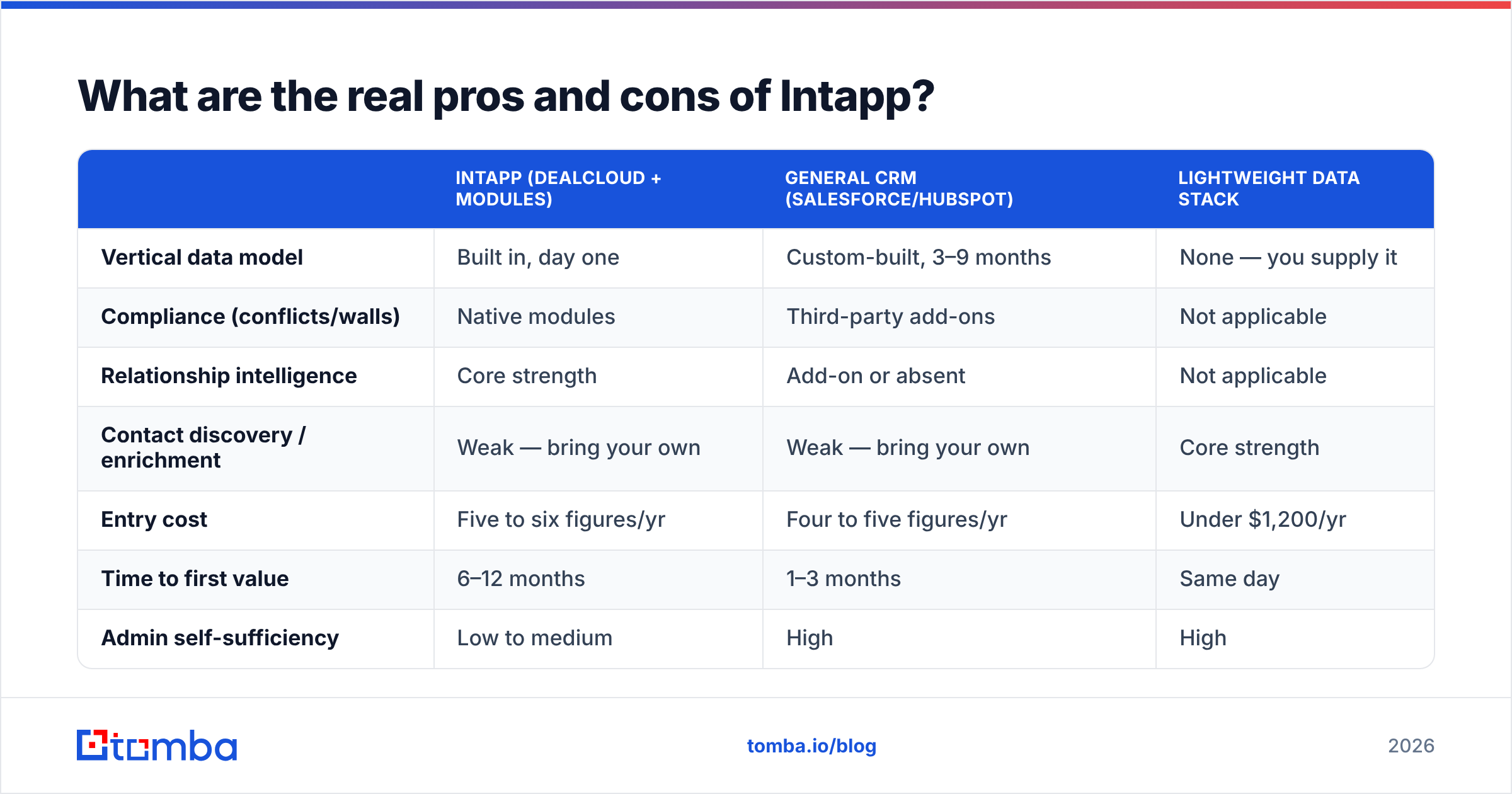
| Intapp (DealCloud + modules) | General CRM (Salesforce/HubSpot) | Lightweight data stack | |
|---|---|---|---|
| Vertical data model | Built in, day one | Custom-built, 3–9 months | None — you supply it |
| Compliance (conflicts/walls) | Native modules | Third-party add-ons | Not applicable |
| Relationship intelligence | Core strength | Add-on or absent | Not applicable |
| Contact discovery / enrichment | Weak — bring your own | Weak — bring your own | Core strength |
| Entry cost | Five to six figures/yr | Four to five figures/yr | Under $1,200/yr |
| Time to first value | 6–12 months | 1–3 months | Same day |
| Admin self-sufficiency | Low to medium | High | High |
| Best fit | Partnerships, funds, law firms | Most B2B sales orgs | Lean outbound teams |
Pros, stated plainly:
- It removes a build project. The industry model, the compliance workflows, and the reporting vocabulary are already correct. For a 200-partner firm, that's worth real money.
- One vendor for regulated workflows. Conflicts plus intake plus walls under a single contract simplifies audits and security reviews.
- It survives partner scrutiny. Systems that partners won't use are worthless. Intapp's relationship-first framing gets adoption in firms where generic CRMs died.
- Roadmap credibility. Intapp is a public company with sustained R&D investment in AI-assisted intake, conflicts, and deal summarization.
Cons, stated equally plainly:
- Opaque pricing wastes buying cycles. You cannot budget without a sales process. For small teams that alone is disqualifying.
- Implementation risk sits with you. Poor data going in produces an expensive, distrusted system coming out.
- Change velocity is slow. If your GTM motion changes quarterly, a partner-dependent admin model will frustrate you.
- It does not generate pipeline. No email finding, no verification, no cold outbound infrastructure. That gap is yours to fill.

Is Intapp worth it for your firm?#
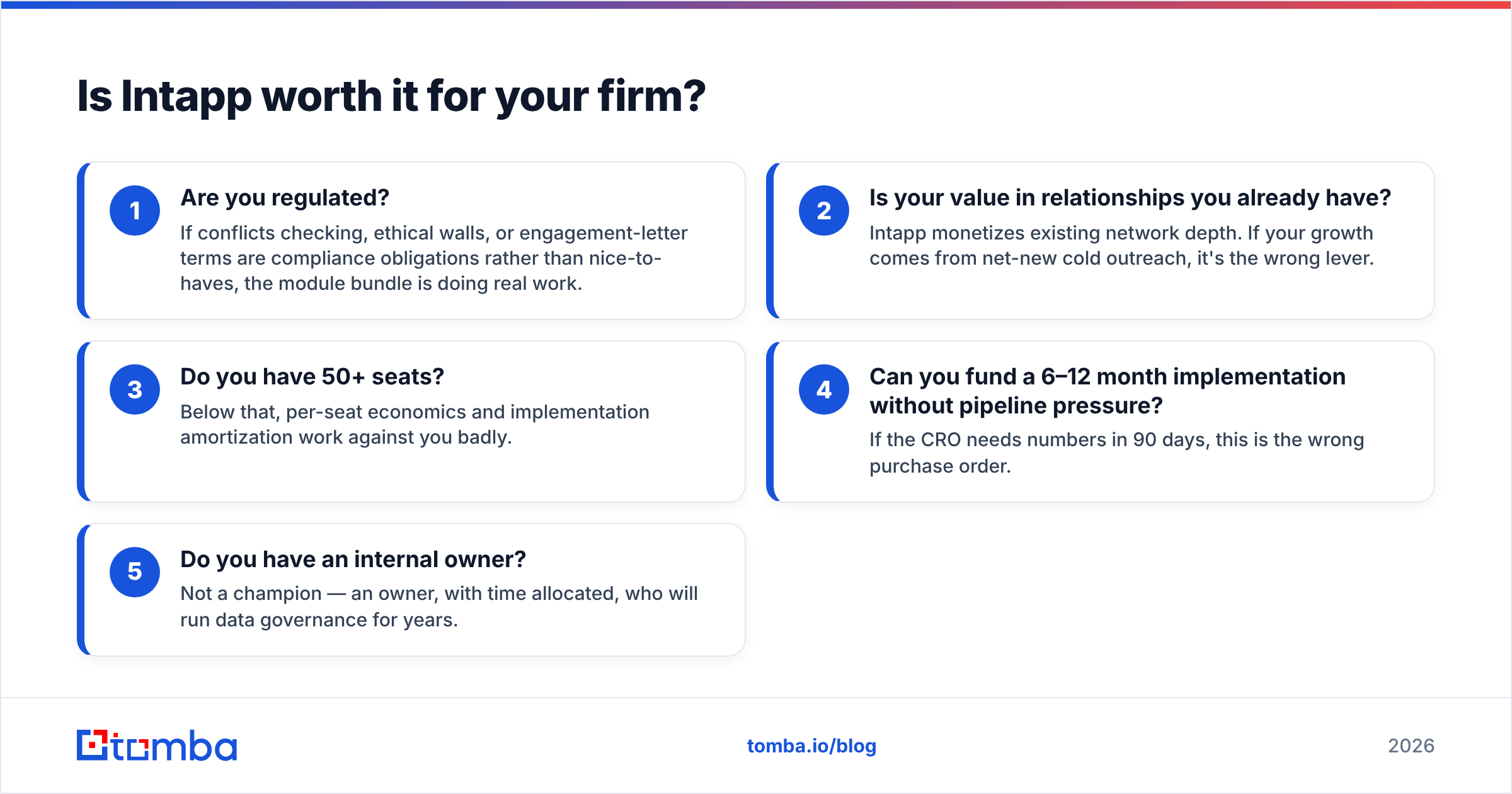
Use these five filters. Three or more "yes" answers means the quote is probably justified.
- Are you regulated? If conflicts checking, ethical walls, or engagement-letter terms are compliance obligations rather than nice-to-haves, the module bundle is doing real work.
- Is your value in relationships you already have? Intapp monetizes existing network depth. If your growth comes from net-new cold outreach, it's the wrong lever.
- Do you have 50+ seats? Below that, per-seat economics and implementation amortization work against you badly.
- Can you fund a 6–12 month implementation without pipeline pressure? If the CRO needs numbers in 90 days, this is the wrong purchase order.
- Do you have an internal owner? Not a champion — an owner, with time allocated, who will run data governance for years.
If you answered "no" to three or more, you're looking at a platform because it's the category leader, not because it solves your bottleneck. The cheaper diagnosis: your problem is probably contact data and outbound volume, not deal management architecture.
What's the cheaper alternative when your gap is data, not deal management?#
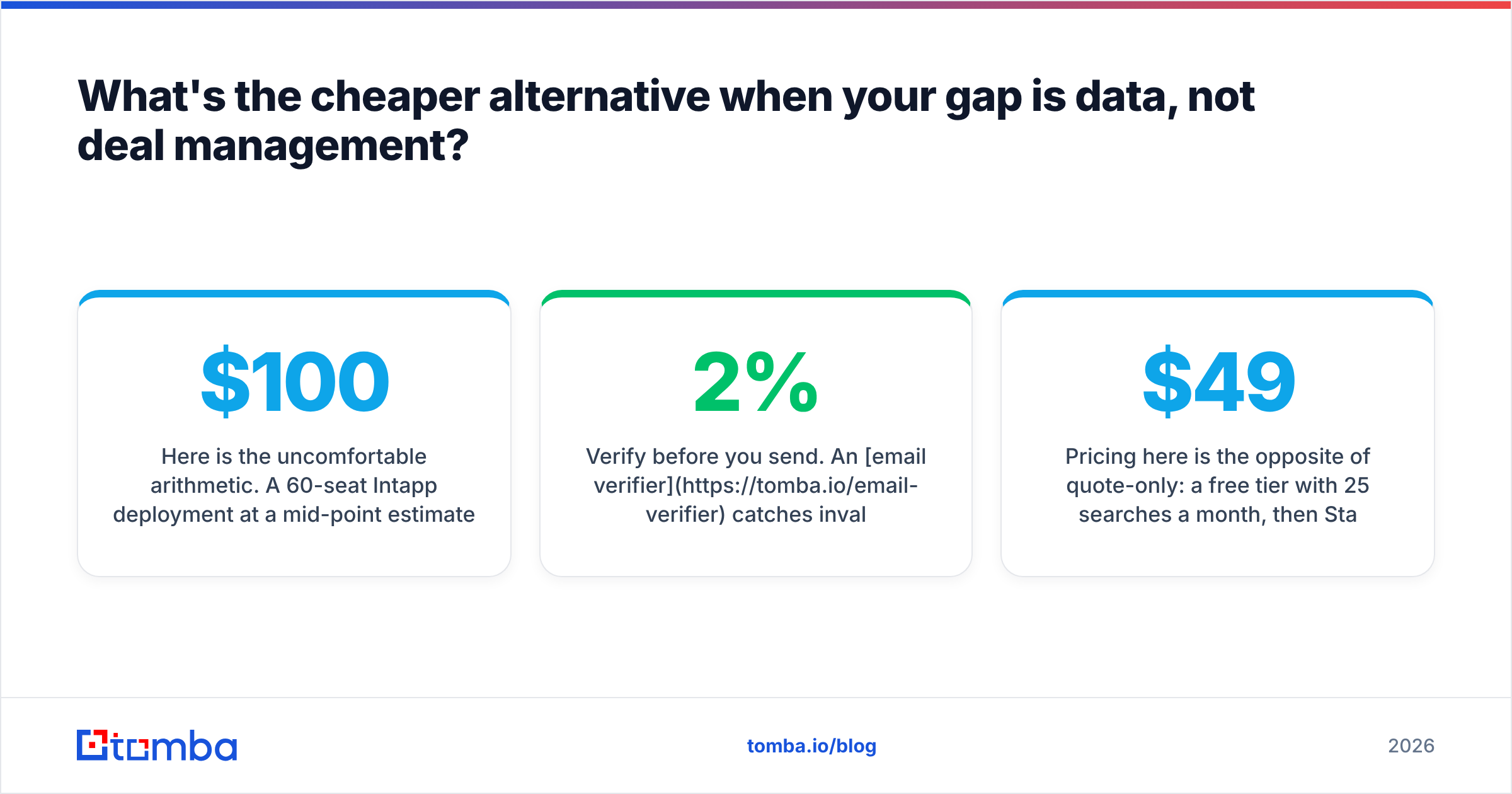
Here is the uncomfortable arithmetic. A 60-seat Intapp deployment at a mid-point estimate lands near $100,000–$150,000 in year one, before implementation. Now price the other path. Six people running outbound with verified contact data, a sequencer, and the CRM they already pay for spend under $6,000. They book meetings in week one.
They solve different problems. But plenty of firms buy the platform hoping it will solve the data problem, and it won't. Intapp enriches and organizes relationships you already have. It does not find the CFO at a target company you've never touched.
That's the job of a dedicated finder-and-verifier layer:
- Find contacts by company. Domain search returns the verified email addresses attached to a company domain, with role and department context. You build a target list without buying a static database.
- Verify before you send. An email verifier catches invalid and risky addresses before they touch your sending domain. Bounce rates below 2% are the difference between a working channel and a burned one.
- Enrich what the CRM already holds. Data enrichment fills the gaps in records you imported from a legacy system — the exact cleanup work that inflates Intapp implementation quotes.
- Automate it. The Tomba API plugs find-and-verify into whatever workflow you're running, whether that's DealCloud, Salesforce, or a spreadsheet.
Pricing here is the opposite of quote-only: a free tier with 25 searches a month, then $49/mo Starter, $99/mo Growth, $249/mo Pro, with Enterprise custom. You can see the full breakdown on the Tomba pricing page and calculate your cost before anyone calls you.
The honest framing: these are complements, not substitutes. Firms running Intapp well still need a contact discovery layer feeding it. Firms considering Intapp should build the data layer first. It's cheap, and clean data measurably cuts what the platform implementation costs.
How should you run the Intapp buying process?#
No set of Intapp pricing reviews will hand you your number. You get it from the process. If you proceed, four moves protect you:
- Get the quote broken out. Seats, modules, implementation, and support as separate lines. Bundled totals hide where the negotiation room actually is.
- Scope implementation against clean data. Deduplicate and verify your contact file before the migration scoping call. It shortens the project and gives you a factual basis to push back on the estimate.
- Negotiate seat flexibility, not just price. The right to reduce seats at renewal is worth more than a 5% discount you'll pay for in unused licenses.
- Pilot with one practice group. A 12-week pilot with real users beats a 12-month firm-wide rollout that nobody tested.
And ask the vendor one direct question: what does this product do about contacts we don't already have a relationship with? The honest answer is "not much" — which tells you exactly which budget line the rest of your stack belongs on.
The bottom line#
Intapp is a serious, well-reviewed platform priced like enterprise infrastructure, because that's what it is. For regulated firms with deep existing networks and 50+ seats, the quote is defensible. For everyone else, it's an expensive answer to a question you probably didn't ask.
If your actual constraint is finding and verifying the people you want to reach, start there and spend a fraction of the money. Tomba Email Finder returns verified professional email addresses by domain, name, or company. Your first 25 searches a month are free, and paid plans start at $49/mo. Build the contact layer first. Decide on the platform when you have the data to justify it.
Related guides#
// get started
Find, verify and enrich your first contacts today
Start on the free plan with 25 searches a month, then scale when your team is ready.
Free plan · No credit card required · GDPR & CCPA
// about the author