Interseller vs Kipplo: Which Outreach Tool Wins in 2026?
Interseller is recruiting-native sourcing plus sequencing; Kipplo is lean, credit-priced outbound. We break down data quality, sending limits, CRM sync and real cost — and name the setup that beats both.
Interseller vs Kipplo is a choice between depth and price. One tool is built for recruiters. The other is built for cheap cold email. Here is the short answer first.
TL;DR
- Interseller is the recruiting-native pick. You get Chrome-extension sourcing, contact lookup, email sequences, and deep ATS sync. Greenhouse bought it. Pricing sits in the premium per-seat bracket.
- Kipplo is the lean, credit-priced pick. It costs less to start, keeps sequencing simple, and aims at general B2B sales rather than staffing.
- The real gap is not features. It is who owns your data. Both bundle contact finding into the sending tool. So your list quality is capped by the vendor you pay for sequences.
The short verdict:
- Send under ~2,000 emails a month and recruit? Interseller's ATS sync earns the seat price.
- Run general B2B outbound on a budget? Kipplo costs less.
- Most teams do better on a third path. Pair a dedicated data provider with the sender you already like. That split is where accuracy and margin live.
Interseller vs Kipplo: what are these tools?#
Short version: both do the same job. Find a person. Get their email. Send a sequence. But they were built for different buyers.
Interseller began as a sourcing and outreach tool for recruiting agencies. You browse LinkedIn, GitHub, or a job board and click the extension. Interseller finds a work or personal email, drops the person into a sequence, and writes the activity back to your ATS. Greenhouse later acquired it. That pulled the product further toward talent teams. The roadmap, the integrations, and the docs all assume you are filling roles, not closing deals.
Kipplo comes from the general outbound side. It sells itself as a low-cost cold email and lead sourcing tool. The buyers are small sales teams, agencies, and founders who prospect for themselves. Less ATS plumbing. Lower price. Credits instead of premium seats.
Here is the honest framing before you read another comparison table:
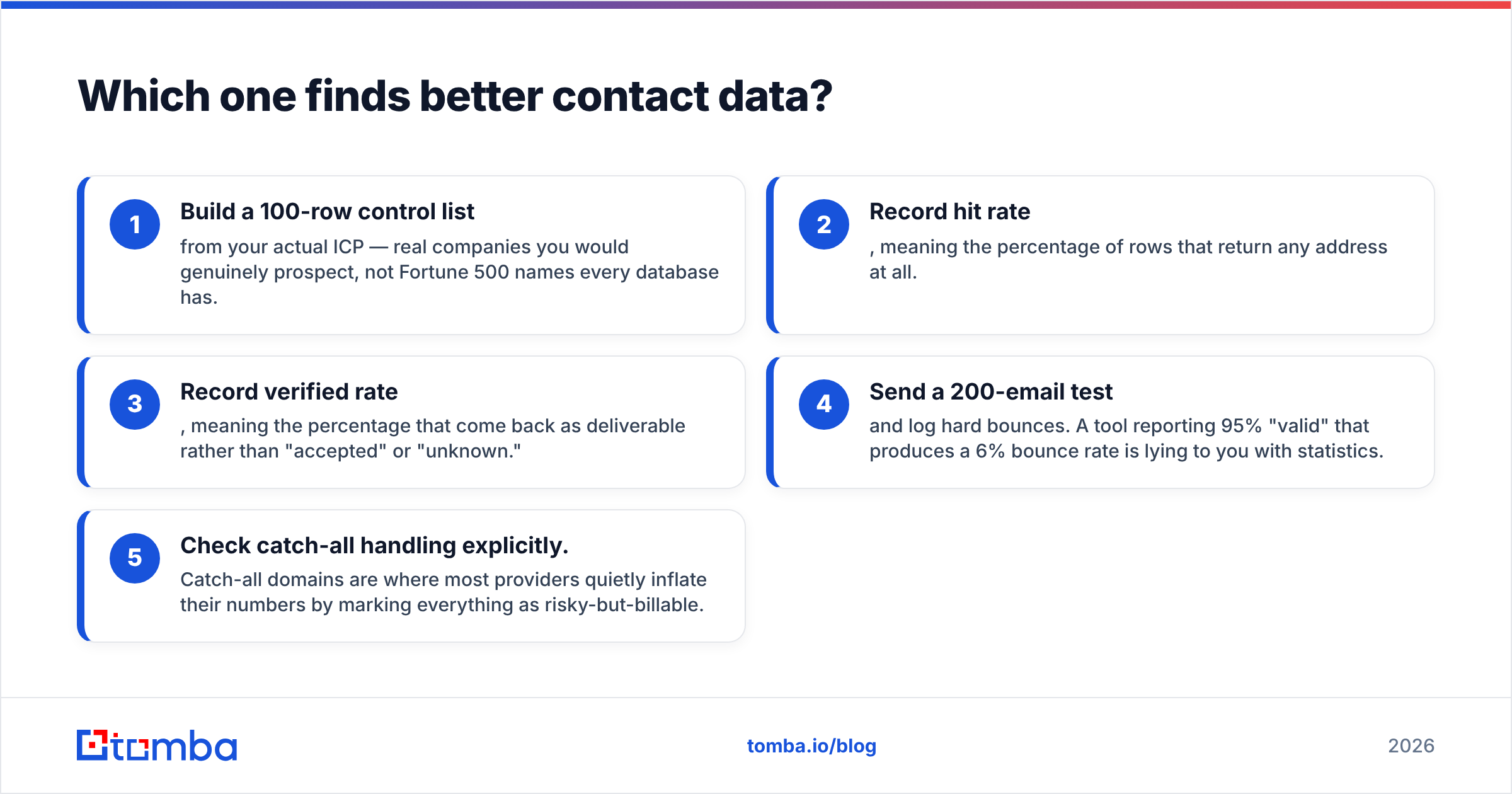
- Both are bundles. Contact data, verification, and sending sit in one subscription. That is handy. But you inherit one vendor's database, strong in your market or not.
- Interseller is built for workflow depth. The value is the round trip: source, sequence, ATS record, reply. It also flags people your team already contacted.
- Kipplo is built for low unit cost. The value is getting a small team sending without a four-figure yearly deal.
Three more caveats:
- Neither is a deliverability tool. Warmup, inbox rotation, and domain reputation are still your job.
- Neither replaces a CRM. They push data into one. Your pipeline reporting still lives in HubSpot, Salesforce, or your ATS.
- Data claims are self-reported. Ask both vendors to run a live test on 100 of your target domains. Published hit rates are marketing until you repeat them.

Interseller vs Kipplo: how do they compare head-to-head?#
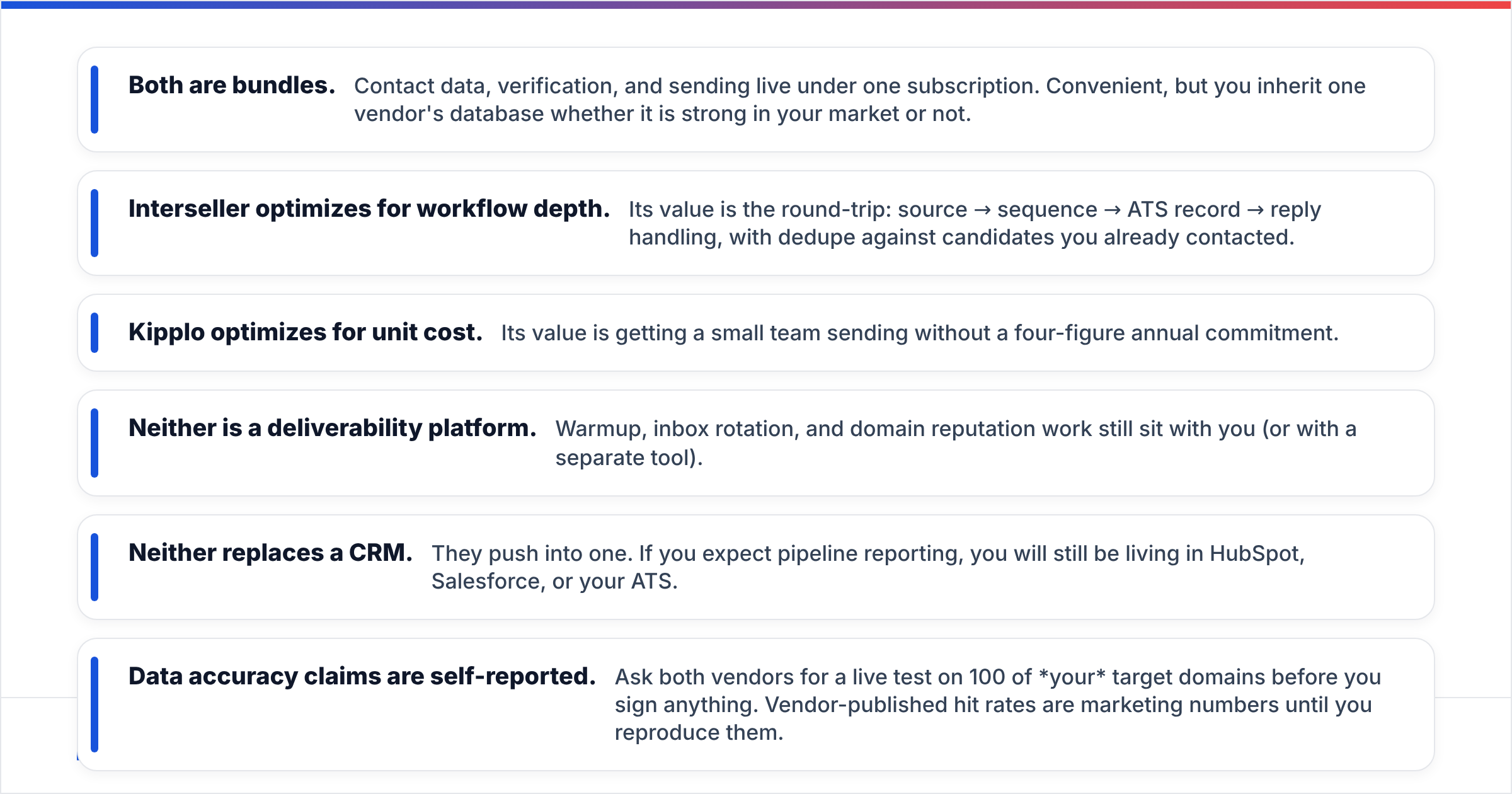
| Dimension | Interseller | Kipplo |
|---|---|---|
| Primary audience | Recruiting agencies, in-house talent teams | SMB sales teams, agencies, founders |
| Contact sourcing | Chrome extension + built-in lookup from LinkedIn/web profiles | Built-in lead search + list upload |
| Email finding | Bundled, includes personal-email attempts | Bundled, work-email focused |
| Verification | Included, not separately configurable | Included, basic validity checks |
| Sequencing | Multi-step email sequences with auto follow-up stop on reply | Multi-step email sequences, simpler branching |
| ATS integration | Deep (Greenhouse, Bullhorn, Lever and similar) | Limited or none |
| CRM integration | HubSpot, Salesforce, Pipedrive | Common CRMs via native or Zapier-style connectors |
| Pricing model | Premium per seat, annual-friendly | Credit/tier based, lower entry point |
| API access | Available on higher tiers | Limited |
| Best for | Filling roles with candidate-level tracking | Cheap, fast generalist cold outreach |
Two caveats on that table. First, prices and tiers change. Check both vendors' current pages before you budget. Treat list prices as a starting point, not a fixed fact. Second, the ATS row is the one most likely to decide this for you. If you run a staffing firm, it is worth more than every other row combined. If you sell software, it is worth nothing.
Which one finds better contact data?#
Neither one wins outright. That is the most useful thing anyone can tell you about this matchup.
Interseller leans toward people-level coverage. It is built to find a software engineer with no public work email. That is why it tries personal addresses. Useful in recruiting. Risky in B2B sales, where a pitch to a personal Gmail earns a spam complaint fast.
Kipplo leans toward company-level coverage. Work emails on known domains. That is the core case for cold sales. Budget tools thin out on long-tail domains, non-US regions, and firms under 20 people. So test them there.
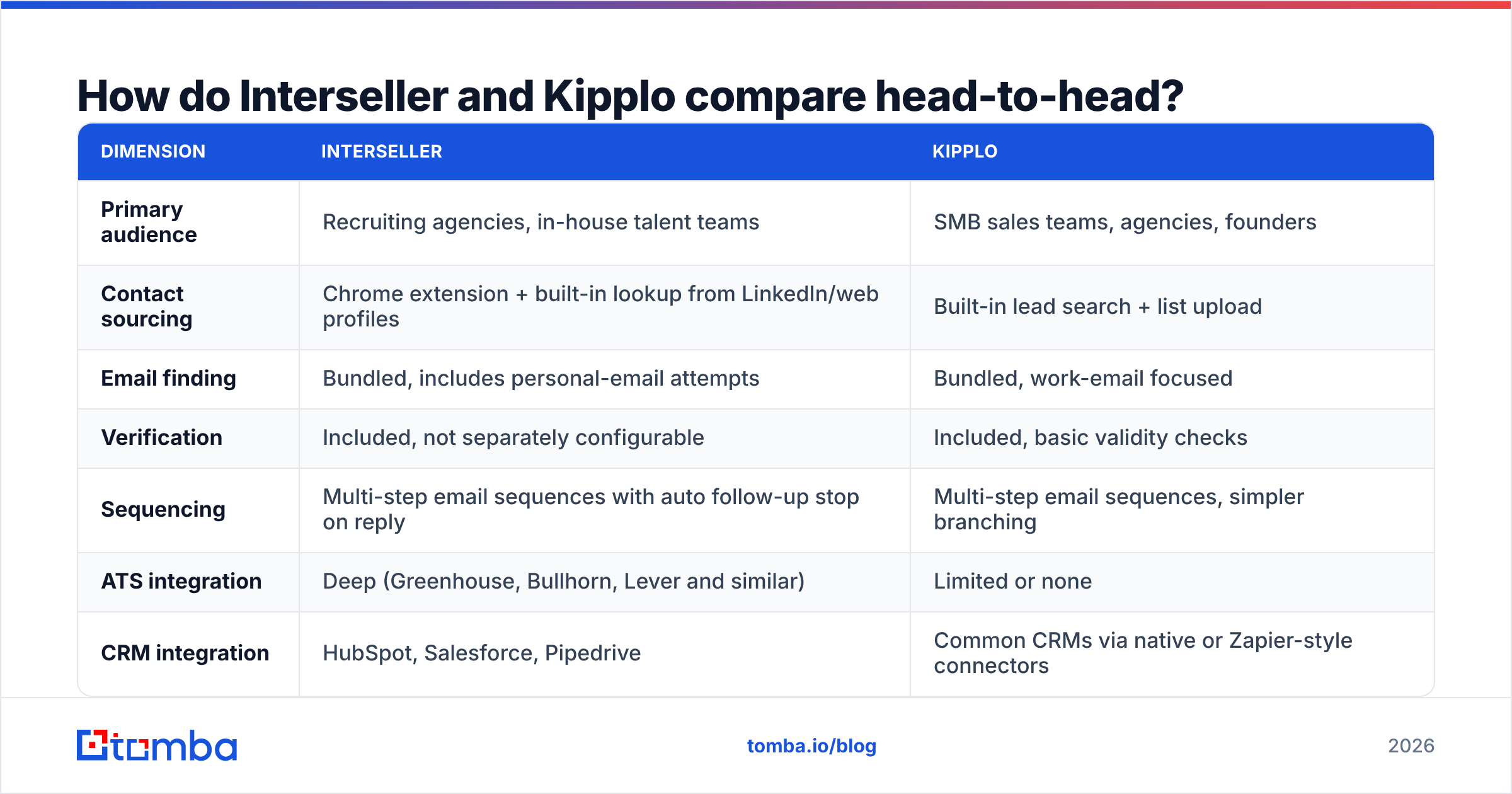
Run this test on both tools, and on any third option you are weighing:
- Build a 100-row control list from your real ICP. Use companies you would actually prospect, not the big names every database has.
- Record hit rate. That is the share of rows that return any address at all.
- Record verified rate. That is the share that come back as safe to send, not "accepted" or "unknown."
- Send a 200-email test and log hard bounces. A tool that claims 95% valid but bounces 6% is lying to you with statistics.
- Check catch-all handling. Catch-all domains are where most providers quietly pad their numbers.
Want a neutral second opinion? Run the same list through an email verifier and compare the bounce forecasts. Catch-all domains are a big slice of some markets, such as enterprise and EU mid-market. If that is you, a catch-all verifier teaches you more in an afternoon than a month of vendor demos.
What do Interseller and Kipplo actually cost?#
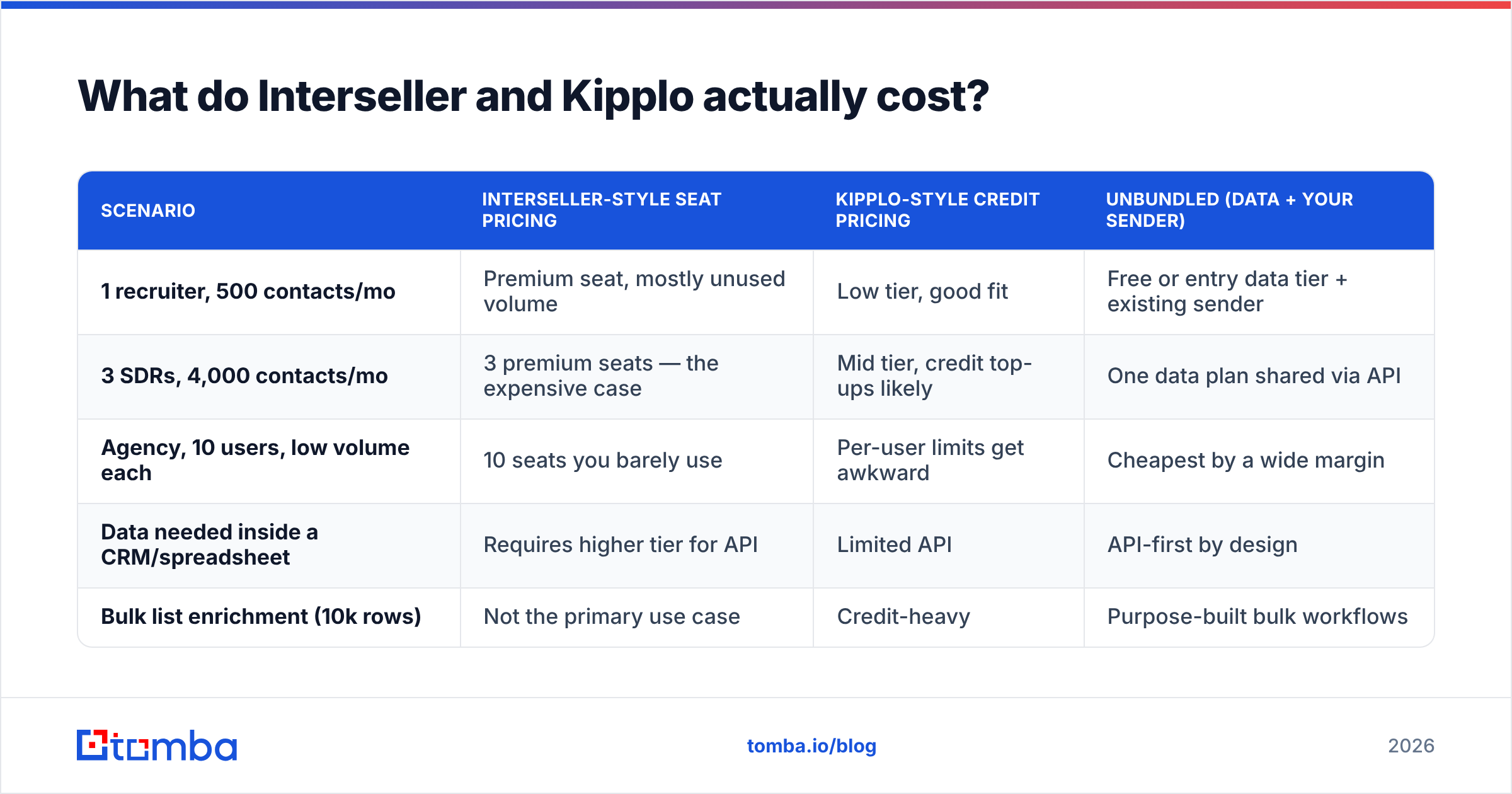
Bundled tools hide cost in two places: seats and credits. Interseller puts the cost in seats. Kipplo puts it in credits. Which one is cheaper depends on your team shape.
| Scenario | Interseller-style seat pricing | Kipplo-style credit pricing | Unbundled (data + your sender) |
|---|---|---|---|
| 1 recruiter, 500 contacts/mo | Premium seat, mostly unused volume | Low tier, good fit | Free or entry data tier + existing sender |
| 3 SDRs, 4,000 contacts/mo | 3 premium seats — the expensive case | Mid tier, credit top-ups likely | One data plan shared via API |
| Agency, 10 users, low volume each | 10 seats you barely use | Per-user limits get awkward | Cheapest by a wide margin |
| Data needed inside a CRM/spreadsheet | Requires higher tier for API | Limited API | API-first by design |
| Bulk list enrichment (10k rows) | Not the primary use case | Credit-heavy | Purpose-built bulk workflows |
The pattern holds. Seat bundles punish teams with many light users. Credit bundles punish teams with a few heavy users. Unbundling dodges both. Data is priced by volume. Sending is priced by mailbox.
On the unbundled side, Tomba pricing starts free at 25 searches a month. Starter is $49/mo, Growth is $99/mo, and Pro is $249/mo, with custom Enterprise plans. Access comes by API, not per seat. Your sending tool then costs what it costs, no matter how many contacts you look up.

How do the sequencing engines differ?#
Interseller's sequencer is deliberately plain. It sends from your own mailbox. It stops follow-ups on reply. It keeps two recruiters from emailing the same candidate. It logs every step back to the ATS. You will not find the branching logic of a dedicated sales platform here. In recruiting, the guardrails are the point. Double-contacting a candidate is an embarrassment, not a metric.
Kipplo's sequencer is simpler and familiar. You get steps, delays, rules on open or reply, and basic A/B tests on subject lines. It does the job for plain outbound. At this price you rarely get inbox rotation, per-mailbox throttling, or detailed reputation reports.
That gap matters less than you think. Sequencing quality is rarely what kills a campaign. Email deliverability does. A perfect five-step sequence sent to a list that bounces 8% will lose to a clumsy three-step sequence sent to a clean list from a warm domain. Every time. Fix list hygiene and sender reputation first, then argue about branching logic.
Which one integrates better with your stack?#
This is the clearest section in the comparison.
- If you run an ATS — Greenhouse, Bullhorn, Lever — Interseller wins, and it is not close. Two-way, candidate-aware sync is the whole point of the product.
- If you run a sales CRM only, both connect to HubSpot, Salesforce, or Pipedrive. Interseller's sync is more mature. Kipplo's is cheaper.
- If you want data in a spreadsheet or your own app, both are weak. Use an API-first provider instead. See the Tomba API, or the Google Sheets add-on for the no-code version.
- If you need bulk enrichment, neither bundle suits 10,000-row jobs. A bulk email finder handles it without burning sequence credits.
- If you shop by reviews, read the low-star reviews on G2 before the marketing pages. Complaint patterns tell you more than feature lists do.
Who should choose Interseller, and who should choose Kipplo?#
Choose Interseller if you are a recruiting agency or talent team. Your ATS sits at the center of your work. You need candidate dedupe across users. And your seat count is small enough that premium per-user pricing still makes sense. The ATS round trip can save a recruiter hours each week. That is the real ROI math, not cost per contact.
Choose Kipplo if you are a small sales team or a solo founder running general B2B outbound. Budget is your binding constraint. You do not need ATS plumbing. And you would rather spend the difference on a second sending domain or a warmup tool.
Choose neither — unbundle instead — if you have more than a couple of users, your volume is lumpy, or you want your contact data to move with you. The same goes if you already like your sending tool and only need better addresses flowing into it. This is the common case. Most comparison posts skip it because it does not fit a two-column format.
What does the unbundled setup actually look like?#
Three parts, each picked on its own merits:
- A data layer. Find and verify addresses with an email finder. Search a whole domain when you need a full company. Verify before anything enters a sequence.
- A sending layer. Whatever you use now — Instantly, Smartlead, Lemlist, a sales-engagement platform, or your CRM's own sequencer. Keep it.
- A routing layer. Zapier, Make, or a direct API call moves verified contacts from step one into step two.
The payoff is not only cost. When your data source weakens in a new market, you swap it without rebuilding a single sequence. And when you outgrow your sender, your contact database comes with you.
Frequently asked questions#
Is Interseller still available after the Greenhouse acquisition? Yes. It still runs, and it keeps moving closer to Greenhouse's talent stack. Confirm the current plans with the vendor before you budget.
Interseller vs Kipplo: which one is cheaper? Kipplo, at the entry level. Interseller costs more per seat but bundles ATS sync. Count your seats and your monthly volume before you decide.
Does Kipplo verify emails before sending? It runs basic validity checks. For catch-all domains and role accounts, a separate verification pass still cuts bounces a lot.
Can I use both? Rarely worth it. The overlap is near total. Pick one sender and add a stronger data source instead.
Which has better deliverability? Neither controls it. Deliverability comes from domain age, SPF, DKIM, DMARC, warmup, list hygiene, and copy. Not from the vendor's logo.
The setup we'd actually recommend#
Decide the sequencing question on workflow fit. ATS depth for recruiting. Budget for general outbound. Then fix the input, because that is where most campaigns are won or lost. Feed your sender verified, portable contact data instead of whatever the bundle hands you.
Start with the Tomba Email Finder. You get 25 free searches a month to test against your own target list. Starter is $49/mo once you scale. The API plugs into Interseller, Kipplo, or any other tool, with no per-seat penalty. Run your 100-row control test this week. The bounce numbers will settle the Interseller vs Kipplo debate for you.
Related guides#
// get started
Find, verify and enrich your first contacts today
Start on the free plan with 25 searches a month, then scale when your team is ready.
Free plan · No credit card required · GDPR & CCPA
// about the author