Interseller vs Salesbot: Honest 2026 Comparison for Outbound Teams
Interseller automates recruiter-style sourcing and email sequences. Salesbot automates conversations inside a CRM. They solve different problems — here is how to tell which one your pipeline actually needs.
TL;DR
- Interseller and Salesbot are not really competitors. Interseller is outbound sourcing plus email sequencing (built for recruiters, owned by Greenhouse since 2021). Salesbot is a conversational automation layer inside a CRM — most commonly Kommo's no-code chatbot.
- Pick Interseller if your bottleneck is "I need to find 500 qualified people and email them without touching a spreadsheet."
- Pick Salesbot if your bottleneck is "leads message us on WhatsApp/Instagram at 11pm and nobody replies until Tuesday."
- Neither tool fixes bad contact data. Interseller's enrichment is bundled and opaque; Salesbot does not source contacts at all.
- The cheapest way to run either one well is to feed it verified emails from a dedicated finder and keep the sequencing/chat tool focused on what it's good at.
Which "Salesbot" are you actually comparing?#
Start here, because the name collides. If you search "Interseller vs Salesbot" you will land on at least three different things:
- Salesbot by Kommo (formerly amoCRM) — a no-code chatbot builder that lives inside the CRM, answers inbound messages across WhatsApp, Instagram, Telegram and web chat, qualifies the lead, and moves the deal card down the pipeline. This is what most people mean. See Kommo's own product pages for the current feature set.
- "Sales bot" as a category — the generic AI SDR wave: bots that draft replies, book meetings, and nudge stalled deals. Dozens of vendors use the word.
- Internal Slack/Teams bots some RevOps teams build and name "salesbot."
This post compares option 1 against Interseller, because that is the only apples-to-something comparison with a real product behind it. Where the generic AI-SDR category matters, I'll flag it.
And on the other side: Interseller launched in 2016 as a recruiter outreach tool, was acquired by Greenhouse in 2021, and now sits inside Greenhouse's sourcing automation story. That acquisition matters more than any feature bullet — it shaped the pricing, the roadmap, and who the product is sold to.
What does Interseller actually do?#
Interseller compresses three jobs into one workflow:
- Source — a Chrome extension pulls candidate or prospect profiles from LinkedIn, GitHub, and similar sites into a project list.
- Enrich — it attempts to resolve a personal or work email for each profile from bundled data sources.
- Sequence — multi-step email cadences send from your own mailbox, with auto-stop on reply, plus two-way sync to your ATS or CRM (Greenhouse, Lever, Bullhorn, Salesforce, HubSpot and friends).
The sync is the part long-time users rave about. Interseller was one of the first tools to treat "did this person already exist in our ATS?" as a first-class question rather than an afterthought, which is why agency recruiters stuck with it through the acquisition.
The weak point is the same weak point every bundled-enrichment tool has: you cannot see where a given email came from, you cannot independently score it, and when the match rate on a niche domain drops to 40% your only recourse is a support ticket. That's fine when you're sourcing software engineers at well-indexed companies. It hurts when you're targeting a 30-person manufacturer in Ohio.
What does Salesbot actually do?#
Salesbot is the opposite shape. It does not go find anyone. It sits inside Kommo and reacts to people who already raised their hand:
- Greets an inbound message within seconds, on whichever channel it arrived.
- Asks qualifying questions from a visual flow builder (no code, drag-and-drop branches).
- Writes the answers onto the lead card as custom fields.
- Routes to a human, books a slot, or moves the deal stage automatically.
- Runs follow-up nudges when a conversation goes quiet.
If your business gets inbound DMs — agencies, real estate, education, e-commerce, local services — this is genuinely high leverage. Response time is the single strongest predictor of conversion on inbound, and a bot that replies in four seconds beats a human who replies in four hours every time.
If your business is pure cold outbound, Salesbot has nothing to chew on. There is no list to work.
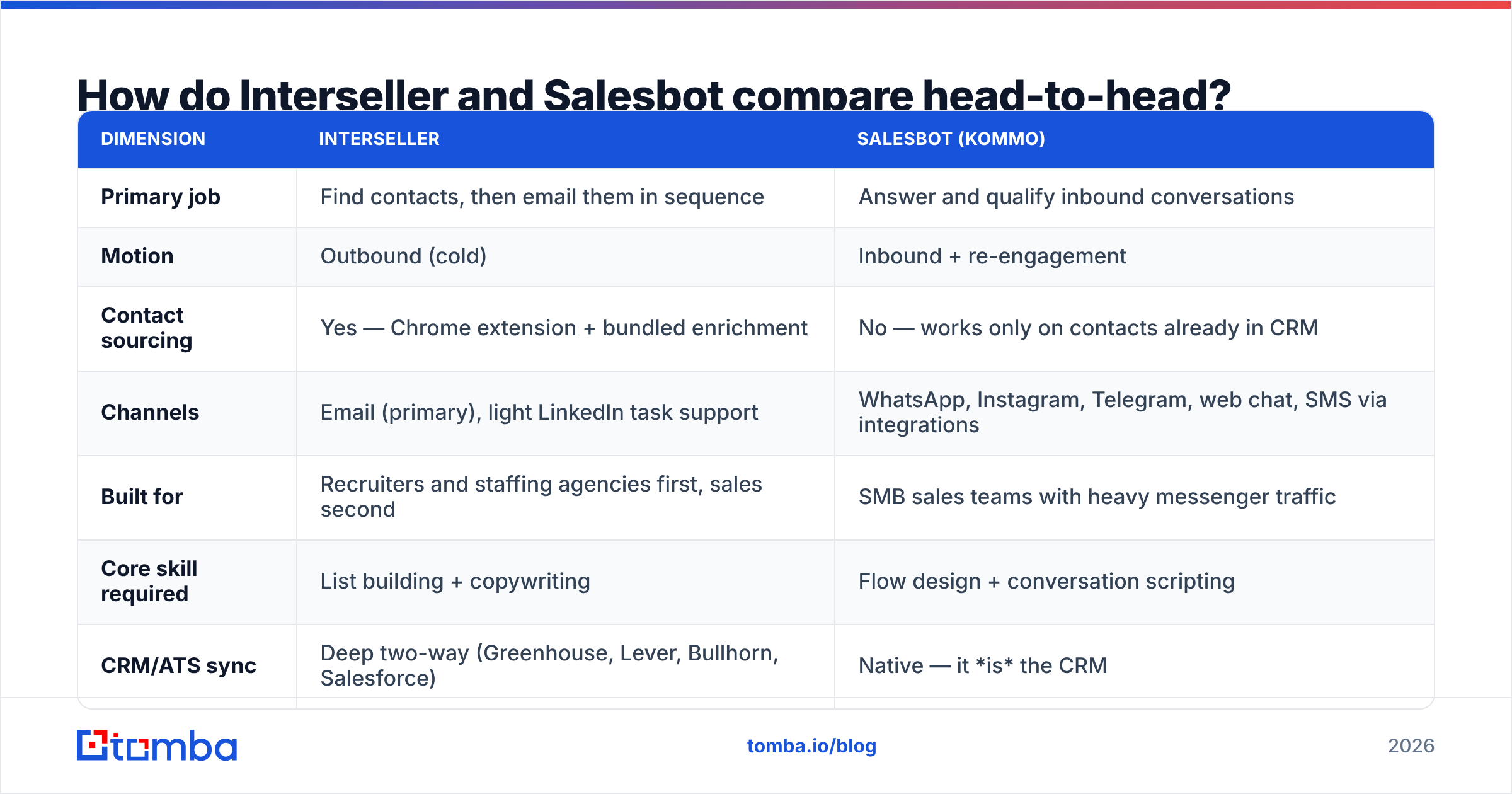
How do Interseller and Salesbot compare head-to-head?#
| Dimension | Interseller | Salesbot (Kommo) |
|---|---|---|
| Primary job | Find contacts, then email them in sequence | Answer and qualify inbound conversations |
| Motion | Outbound (cold) | Inbound + re-engagement |
| Contact sourcing | Yes — Chrome extension + bundled enrichment | No — works only on contacts already in CRM |
| Channels | Email (primary), light LinkedIn task support | WhatsApp, Instagram, Telegram, web chat, SMS via integrations |
| Built for | Recruiters and staffing agencies first, sales second | SMB sales teams with heavy messenger traffic |
| Core skill required | List building + copywriting | Flow design + conversation scripting |
| CRM/ATS sync | Deep two-way (Greenhouse, Lever, Bullhorn, Salesforce) | Native — it is the CRM |
| Data quality control | Opaque, bundled, no per-record confidence | Not applicable (no sourcing) |
| Where it breaks | Niche domains, low match rate, no source transparency | Zero value without inbound volume |
Read that table as a routing decision, not a scorecard. Almost nobody is genuinely torn between these two once they write down which motion pays their rent.
How does pricing compare in 2026?#
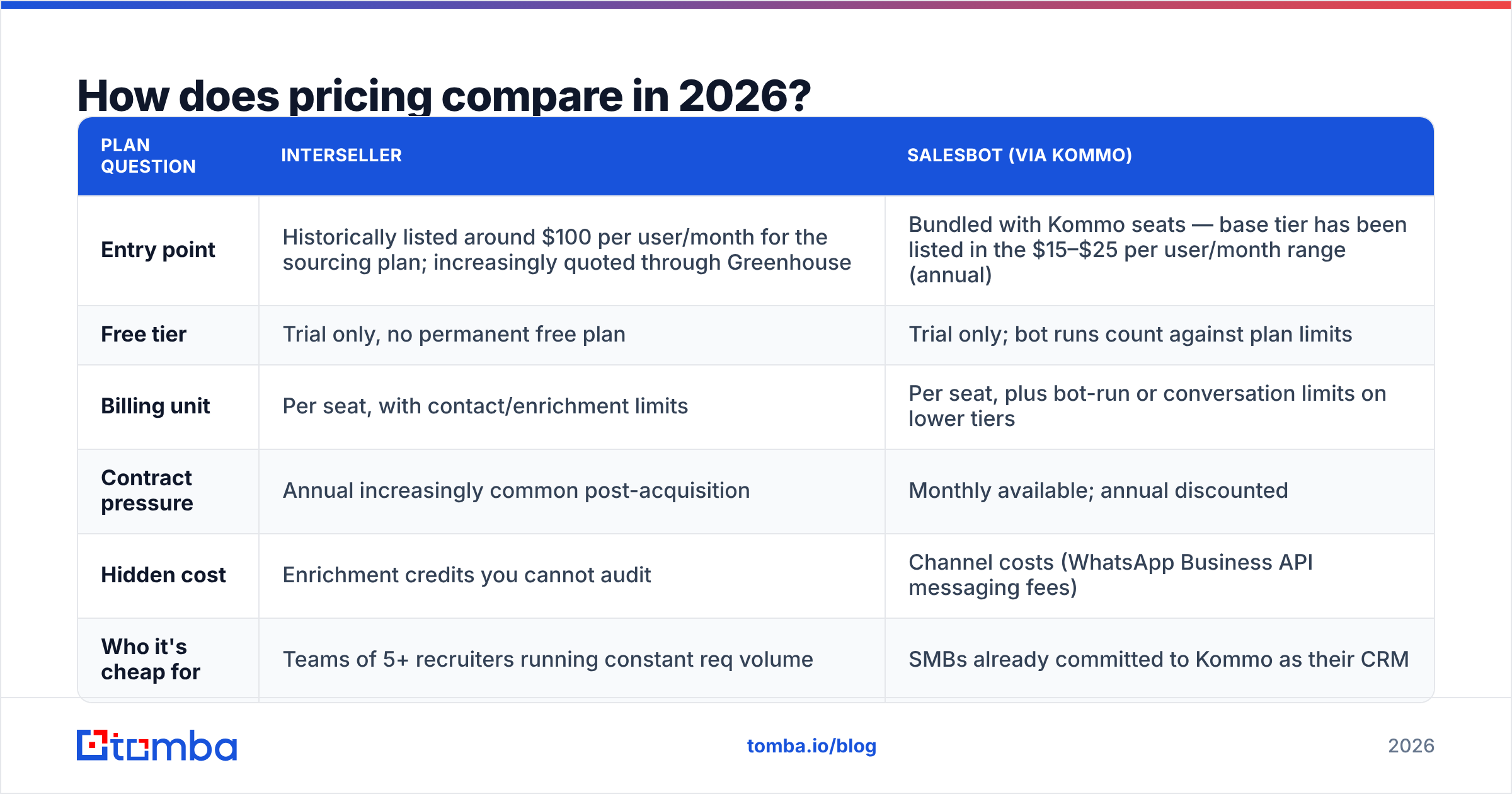
Both vendors have moved toward "talk to us" for anything above the entry tier, so treat the figures below as directional and confirm on the vendor's own page before you budget.
| Plan question | Interseller | Salesbot (via Kommo) |
|---|---|---|
| Entry point | Historically listed around $100 per user/month for the sourcing plan; increasingly quoted through Greenhouse | Bundled with Kommo seats — base tier has been listed in the $15–$25 per user/month range (annual) |
| Free tier | Trial only, no permanent free plan | Trial only; bot runs count against plan limits |
| Billing unit | Per seat, with contact/enrichment limits | Per seat, plus bot-run or conversation limits on lower tiers |
| Contract pressure | Annual increasingly common post-acquisition | Monthly available; annual discounted |
| Hidden cost | Enrichment credits you cannot audit | Channel costs (WhatsApp Business API messaging fees) |
| Who it's cheap for | Teams of 5+ recruiters running constant req volume | SMBs already committed to Kommo as their CRM |
The hidden-cost row is the one people underestimate. Interseller's cost per usable contact is not the sticker price divided by credits — it's the sticker price divided by credits that actually deliver. If 18% of the addresses bounce, your real cost per usable contact just jumped 22%. On the Salesbot side, WhatsApp Business API conversation pricing is a separate meter that has nothing to do with your CRM seat count, and it scales with volume.
Do either of them solve your data problem?#
No — and this is the part most comparison posts skip.
Think of it like a restaurant. Interseller is the kitchen line: fast, repeatable, sends plates out on schedule. Salesbot is the host stand: greets everyone who walks in, seats them properly. Neither one is the supplier. If the produce arriving at the back door is three weeks old, both stations produce garbage very efficiently.
Contact data is the produce. Here's what goes wrong when you let a sequencing tool double as your data supplier:
- No confidence score per record. Bundled enrichment returns "an email." It does not tell you whether it's a verified SMTP hit, a pattern guess, or a catch-all domain that will accept anything and deliver nothing. You need that distinction before you send, not after.
- Catch-all domains get treated as valid. A large share of mid-market companies run catch-all MX configurations. Naive verification marks those addresses "accepted." They then bounce silently or land in a black hole. A dedicated catch-all verifier is the only way to separate real mailboxes from accept-everything domains.
- Bounces are charged to your domain, not the vendor's. Every hard bounce degrades your sender reputation. Interseller sends from your mailbox. The vendor's match-rate marketing number costs them nothing; your deliverability pays for it.
- You can't reuse the data. Contacts enriched inside a sequencing tool are usually locked to that tool's export rules. Contacts pulled through an email finder API belong to you and can feed the CRM, the ad platform, and the enrichment job on the same pull.
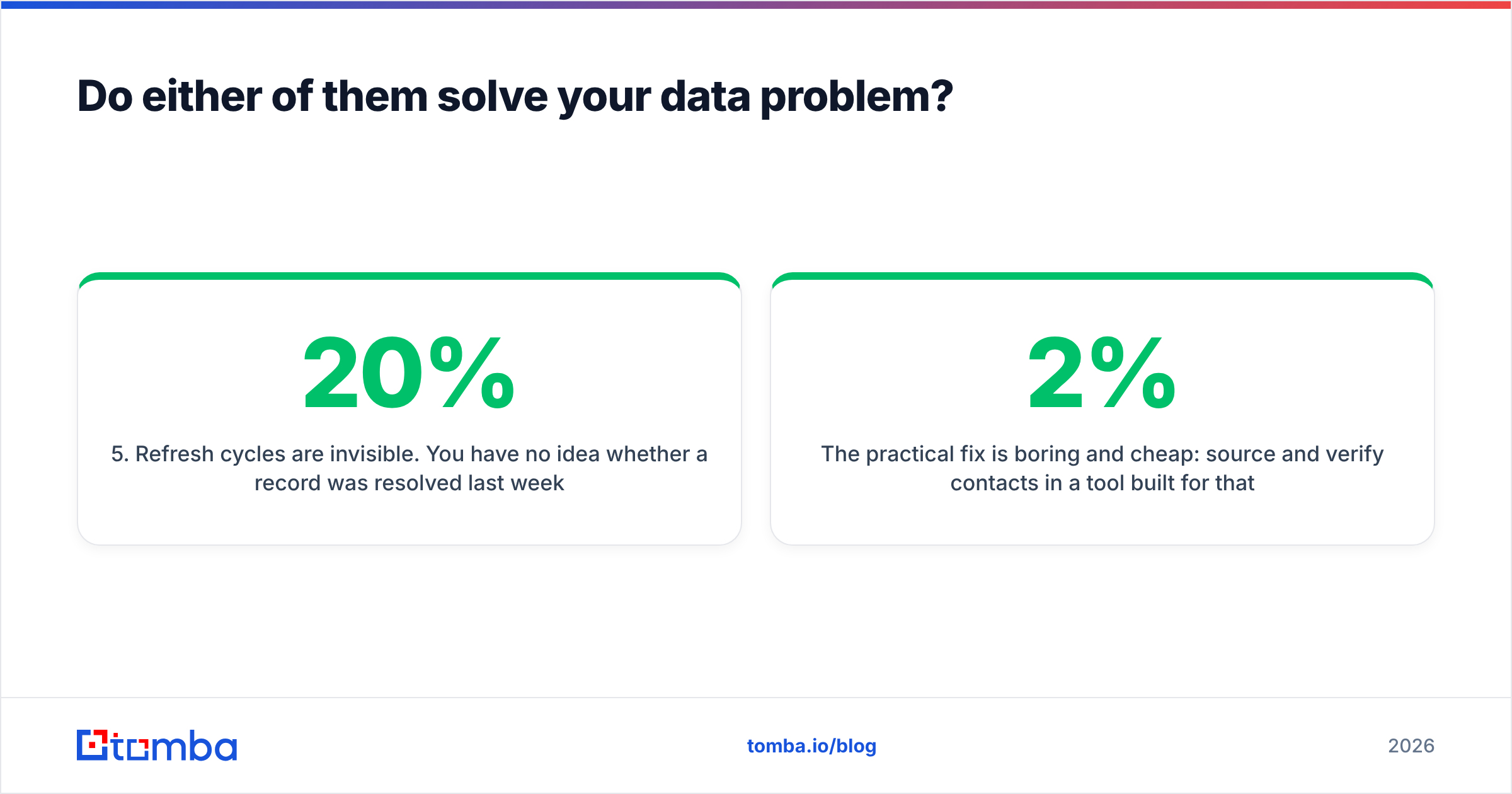
- Refresh cycles are invisible. You have no idea whether a record was resolved last week or cached in 2023. People change jobs roughly every two to three years; a stale B2B contact database decays at somewhere between 20% and 30% annually depending on seniority and sector.
The practical fix is boring and cheap: source and verify contacts in a tool built for that job, then push the clean list into whichever execution layer you chose. Run the list through an email verifier before it ever touches a sequence, and keep the bounce rate under 2% so your domain stays healthy.
Which should you pick for your use case?#
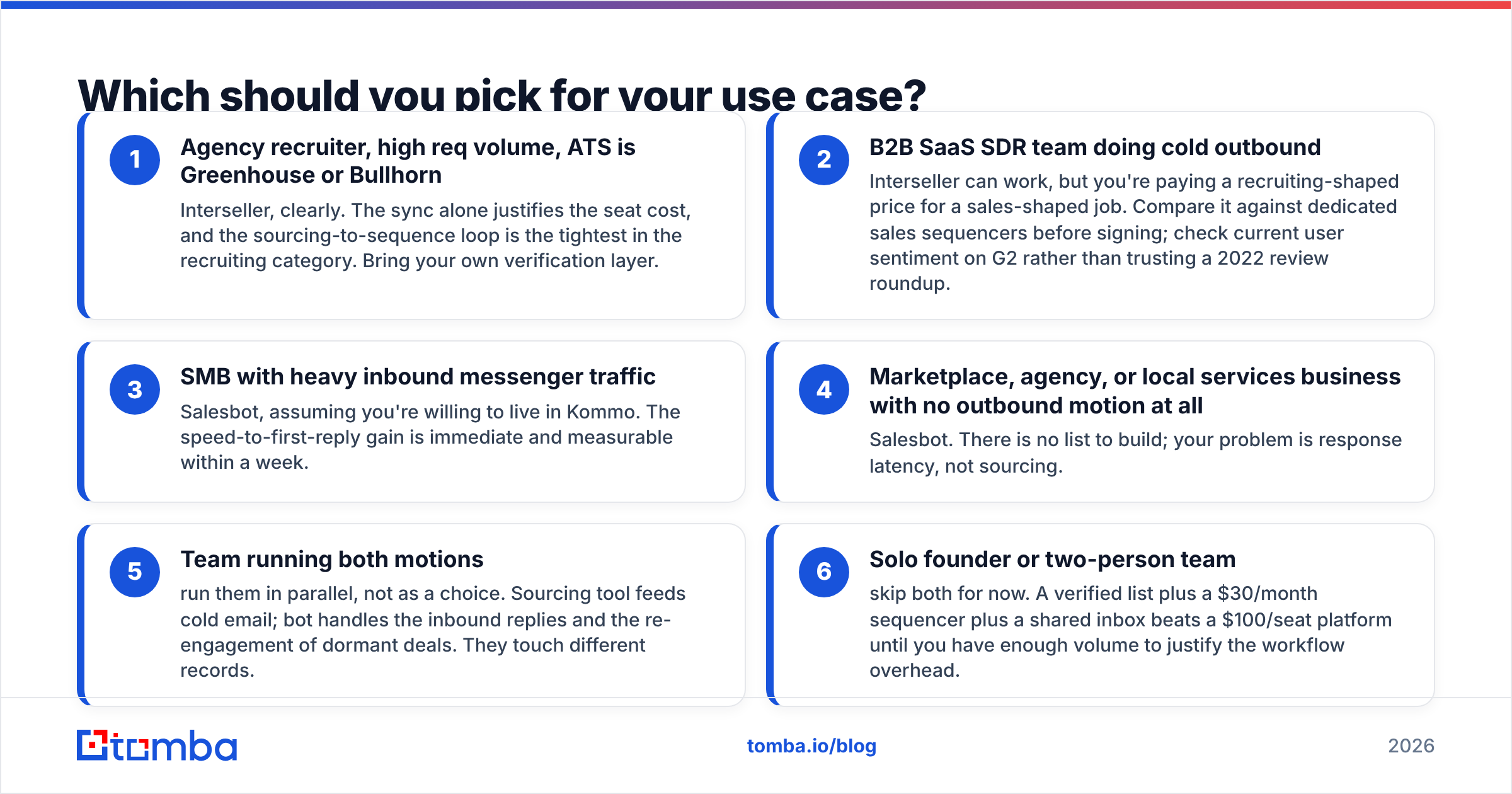
- Agency recruiter, high req volume, ATS is Greenhouse or Bullhorn — Interseller, clearly. The sync alone justifies the seat cost, and the sourcing-to-sequence loop is the tightest in the recruiting category. Bring your own verification layer.
- B2B SaaS SDR team doing cold outbound — Interseller can work, but you're paying a recruiting-shaped price for a sales-shaped job. Compare it against dedicated sales sequencers before signing; check current user sentiment on G2 rather than trusting a 2022 review roundup.
- SMB with heavy inbound messenger traffic — Salesbot, assuming you're willing to live in Kommo. The speed-to-first-reply gain is immediate and measurable within a week.
- Marketplace, agency, or local services business with no outbound motion at all — Salesbot. There is no list to build; your problem is response latency, not sourcing.
- Team running both motions — run them in parallel, not as a choice. Sourcing tool feeds cold email; bot handles the inbound replies and the re-engagement of dormant deals. They touch different records.
- Solo founder or two-person team — skip both for now. A verified list plus a $30/month sequencer plus a shared inbox beats a $100/seat platform until you have enough volume to justify the workflow overhead.
What does a sane combined stack look like?#
Three layers, cleanly separated:
Layer 1 — Data. Build the target list from firmographic criteria, resolve emails by domain and name, verify every record, and drop catch-alls into a separate "risky" bucket you send to last. Tools like Tomba's domain search handle the company-wide sweep; a bulk email finder handles the named-prospect list you already scraped from LinkedIn.
Layer 2 — Execution. Interseller (or your sequencer of choice) sends the cold cadence. Salesbot handles anyone who replies on a messenger channel or comes in through the site.
Layer 3 — System of record. Your CRM or ATS. Both execution tools write to it; neither owns it.
The failure mode almost every team hits is collapsing layers 1 and 2 into one vendor because it's convenient. It is convenient — right up until match rates slip, bounces climb, and you cannot diagnose the problem because the data layer is a black box you don't control.
Frequently asked questions#
Is Interseller still a standalone product after the Greenhouse acquisition? Yes, interseller.io still operates and existing customers continue to be served, but the roadmap and packaging are increasingly tied to Greenhouse's broader sourcing suite. If you are not a Greenhouse customer, ask directly about long-term standalone support before you sign an annual deal.
Can Salesbot do cold outreach? Not meaningfully. It reacts to conversations; it does not start them with strangers, and cold-messaging people on WhatsApp or Instagram is a fast route to account restrictions. Keep cold on email.
Do I need both? Only if you genuinely run both motions. Most teams under 20 people run one hard and the other barely at all — buy for the one that pays.
Will either tool improve my deliverability? No. Both send through infrastructure you're responsible for. Warmup, SPF/DKIM/DMARC alignment, and list hygiene are your job regardless of which platform sits on top.
The bottom line#
Interseller vs Salesbot is a category mismatch dressed up as a rivalry. Interseller wins the sourcing-and-sequencing job, especially for recruiters inside the Greenhouse ecosystem. Salesbot wins the inbound-conversation job for SMBs already living in Kommo. Neither one wins on data, because neither one was built to.
Fix the supply line first. Pull verified, source-attributed contacts with the Tomba Email Finder — free tier gives you 25 searches a month to sanity-check match rates on your own target domains before you commit, and paid plans start at $49/month with per-record confidence scoring and source URLs you can actually audit. Check the full Tomba pricing breakdown, run 100 of your own prospects through it, and compare the bounce rate against whatever your current tool hands you. That one test will tell you more than any comparison table — including this one.
Related guides#
// get started
Find, verify and enrich your first contacts today
Start on the free plan with 25 searches a month, then scale when your team is ready.
Free plan · No credit card required · GDPR & CCPA
// about the author