Interseller vs SignalHire (2026): Which Sourcing Tool Wins?
Interseller sells sequences. SignalHire sells contacts. One is a recruiting outreach engine, the other a credit-based contact finder, and picking the wrong one can cost you a full quarter of sourcing output.
TL;DR
- Interseller (now part of Greenhouse) is a recruiting outreach platform: it finds a candidate's personal or work email, drops them into an automated multi-step sequence, and syncs activity back to your ATS. Sourcing is the feature; sequencing is the product.
- SignalHire is a contact-data tool: a browser extension and bulk search that returns work emails, personal emails, and mobile numbers on a credit model. It has a light ATS and basic outreach bolted on, but data is the product.
- Pricing models are not comparable. Interseller is sold per seat (historically around $100/user/month, now quoted through Greenhouse). SignalHire is credit-based and starts near $49/month, so cost scales with volume, not headcount.
- If you need phone numbers, SignalHire wins outright. If you need ATS-native sequencing for a recruiting team, Interseller wins outright.
- If you mainly need accurate B2B email data at API scale — for sales, not just recruiting — a dedicated finder like Tomba ($49/mo Starter, free tier included) usually beats paying platform prices for a data layer you'll pipe elsewhere anyway.
What is Interseller and who actually uses it?#
Interseller started as a sourcing-and-outreach tool built specifically for agency recruiters. You paste a LinkedIn profile or upload a list, Interseller resolves the contact's email, and then runs an automated email sequence with follow-ups, reply detection, and two-way sync into your ATS or CRM. Greenhouse acquired it in 2021, and it now sits inside the Greenhouse ecosystem as sourcing automation — you can still read the product's own positioning at interseller.io.
The people who love Interseller are almost always recruiters at staffing agencies or in-house talent teams running high-volume passive candidate outreach. The workflow is opinionated in a good way: source, enrich, sequence, sync, repeat. Contacts that bounce are suppressed. Contacts already in your ATS are deduplicated automatically. Nobody on your team accidentally emails the same senior engineer twice in the same month.
What Interseller is not: a general-purpose B2B data provider. You won't export a 50,000-row prospect list, you won't hit a public API for enrichment at scale, and you won't get much phone coverage. It's a closed loop, and the loop is recruiting.
What is SignalHire and how is it different?#
SignalHire attacks the same problem from the opposite end. It is fundamentally a contact-finding engine with a Chrome extension that reveals emails and phone numbers on LinkedIn, GitHub, and other profile pages, plus a bulk search across its own database. You can read its feature list at signalhire.com.
The two things SignalHire is genuinely known for:
- Personal contact coverage. It returns personal emails and mobile numbers more often than most email-only tools, which matters enormously in recruiting where a work inbox is a terrible channel for a passive candidate.
- Credit-based access. You buy reveals, not seats. A one-person sourcing shop can run SignalHire for the price of a few lunches; a ten-person team pays for what it actually consumes.
SignalHire has since added an ATS-ish pipeline view and simple email campaigns, but those are secondary. If you judge SignalHire as an outreach platform against Interseller, it loses. If you judge Interseller as a data provider against SignalHire, it loses. That asymmetry is the whole comparison.

Interseller vs SignalHire: how do they compare head to head?#
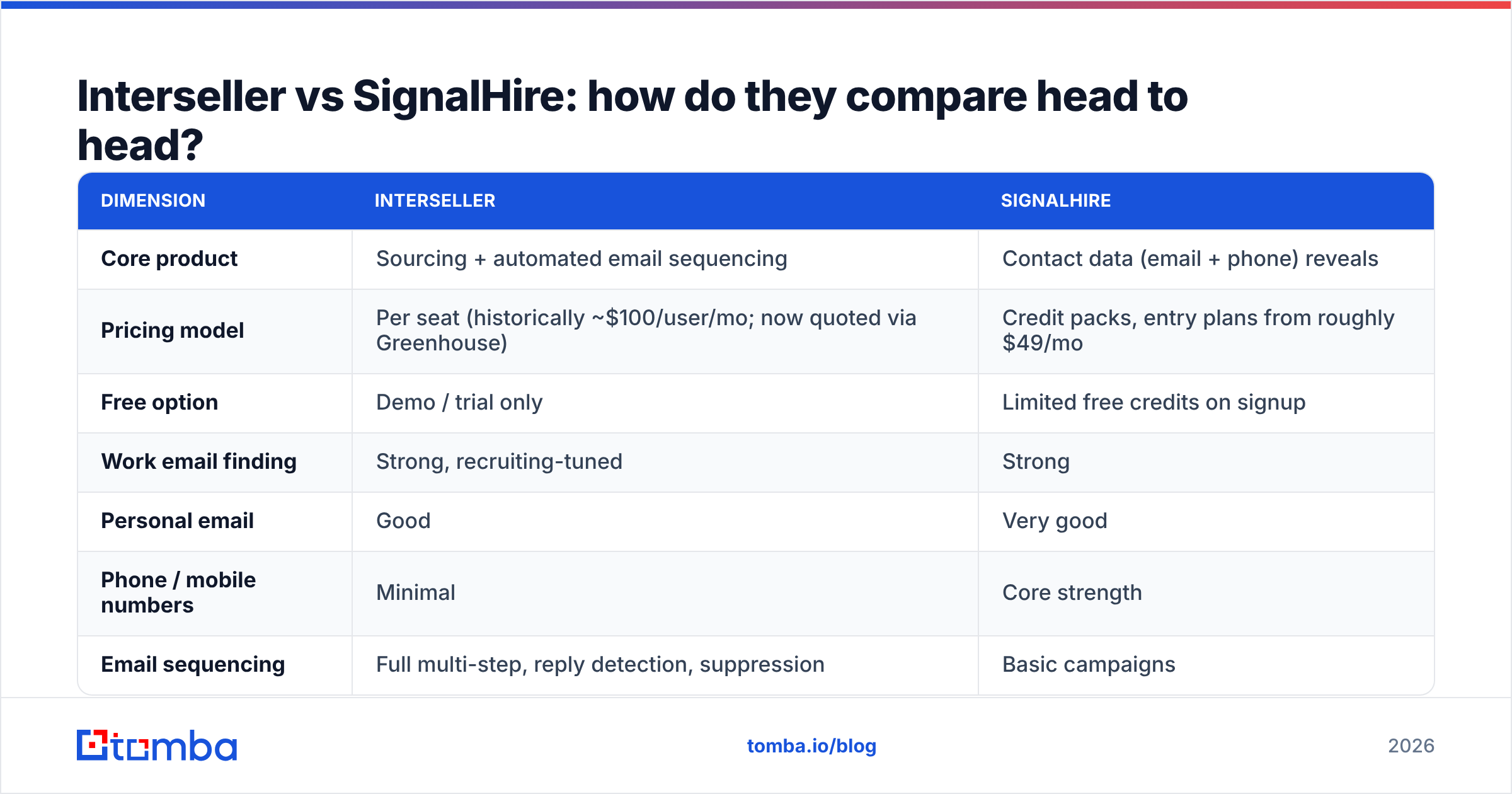
| Dimension | Interseller | SignalHire |
|---|---|---|
| Core product | Sourcing + automated email sequencing | Contact data (email + phone) reveals |
| Pricing model | Per seat (historically ~$100/user/mo; now quoted via Greenhouse) | Credit packs, entry plans from roughly $49/mo |
| Free option | Demo / trial only | Limited free credits on signup |
| Work email finding | Strong, recruiting-tuned | Strong |
| Personal email | Good | Very good |
| Phone / mobile numbers | Minimal | Core strength |
| Email sequencing | Full multi-step, reply detection, suppression | Basic campaigns |
| ATS / CRM sync | Deep (Greenhouse, Bullhorn, Lever, Greenhouse-adjacent tools) | Light integrations, CSV, Zapier |
| Bulk list export | Restricted by design | Yes, credit-limited |
| Public API | Limited | Yes |
| Best for | Agency + in-house recruiting teams | Sourcers, researchers, lean sales teams |
Pricing above reflects publicly listed figures at the time of writing. Both vendors move their packaging around — Interseller in particular is now bundled and quoted rather than self-serve — so confirm on their sites before you budget. Cross-check user sentiment on G2 too; the review gap between "great data, clunky sending" and "great sending, thin data" is remarkably consistent for these two.
Which tool gives you more accurate contact data?#
Accuracy is where most head-to-heads get lazy. "95% accurate" is a meaningless claim unless you know what was measured: the share of returned emails that were valid, or the share of requested contacts for which anything was returned at all. Those are different numbers, and vendors love to quote the first while you care about both.

Here's how to run a fair test between the two in about an hour:
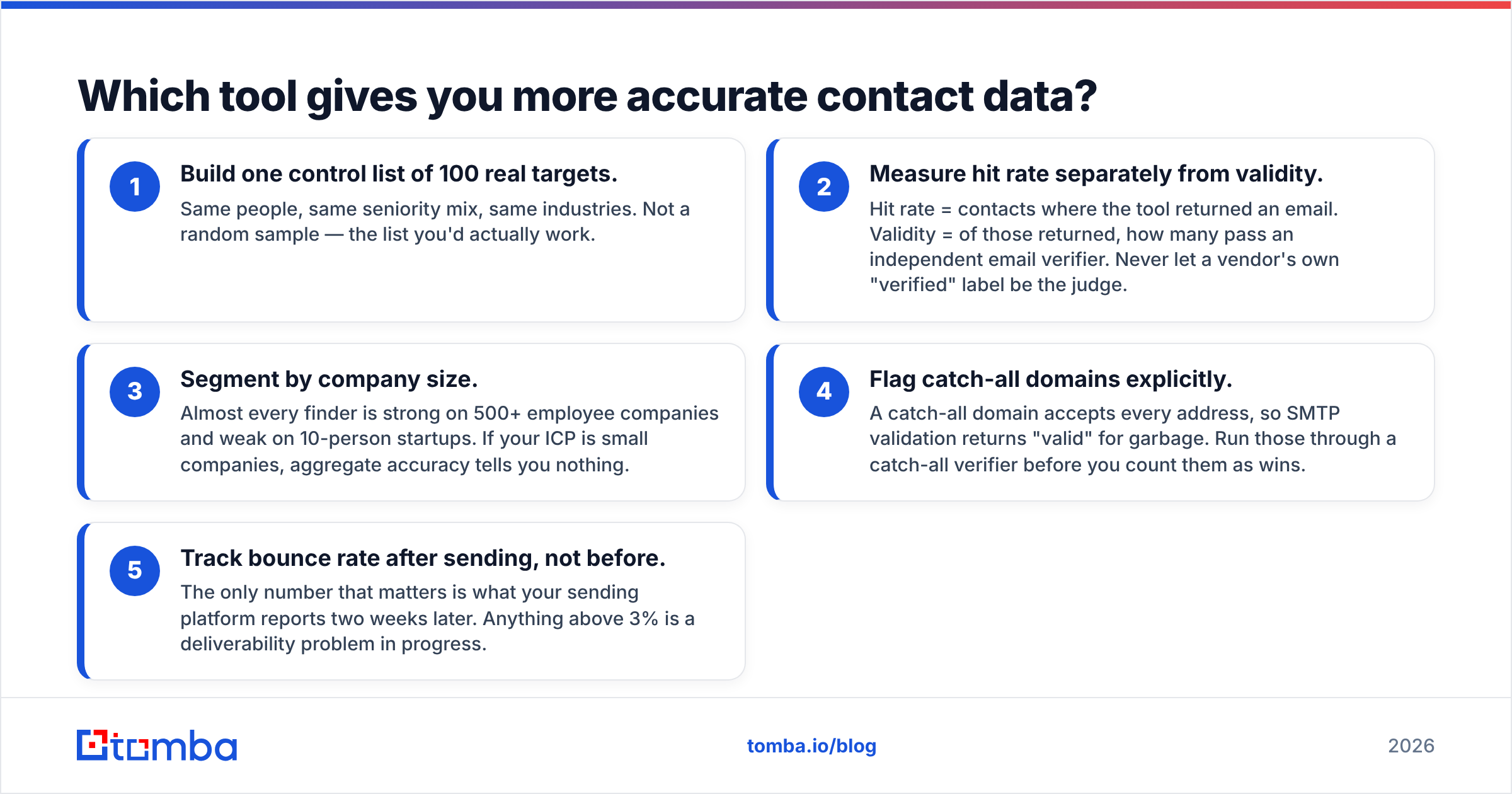
- Build one control list of 100 real targets. Same people, same seniority mix, same industries. Not a random sample — the list you'd actually work.
- Measure hit rate separately from validity. Hit rate = contacts where the tool returned an email. Validity = of those returned, how many pass an independent email verifier. Never let a vendor's own "verified" label be the judge.
- Segment by company size. Almost every finder is strong on 500+ employee companies and weak on 10-person startups. If your ICP is small companies, aggregate accuracy tells you nothing.
- Flag catch-all domains explicitly. A catch-all domain accepts every address, so SMTP validation returns "valid" for garbage. Run those through a catch-all verifier before you count them as wins.
- Track bounce rate after sending, not before. The only number that matters is what your sending platform reports two weeks later. Anything above 3% is a deliverability problem in progress.
In practice, sourcers report that SignalHire returns something for more profiles — largely because it counts personal emails and mobiles as hits — while Interseller's returns skew toward verified work emails suitable for sequencing. Neither is universally "more accurate." They're optimizing for different definitions of a win.
Do you need phone numbers, or do you need sequences?#
This is the actual decision, and you can usually answer it in one sentence about your workflow.
Choose phone-first (SignalHire) if: you're recruiting engineers or executives who ignore email, your team calls or texts, you do research and hand lists to someone else, or your volume is spiky and you'd rather buy credits than seats.
Choose sequence-first (Interseller) if: your team lives in an ATS, you run structured multi-touch campaigns, you need suppression and dedupe across recruiters, and compliance wants every touch logged against a candidate record.
Teams that need both usually end up with a stack rather than a single tool: a data source, a verifier, and a sender. That's not a failure of either product; it's how most mature sourcing operations actually run. If you go that route, a standalone phone finder plus an email finder often costs less than one all-in-one seat and gives you cleaner data ownership.
How does pricing really compare at team scale?#
Per-seat and per-credit pricing diverge violently as you grow, and the crossover point catches people off guard.
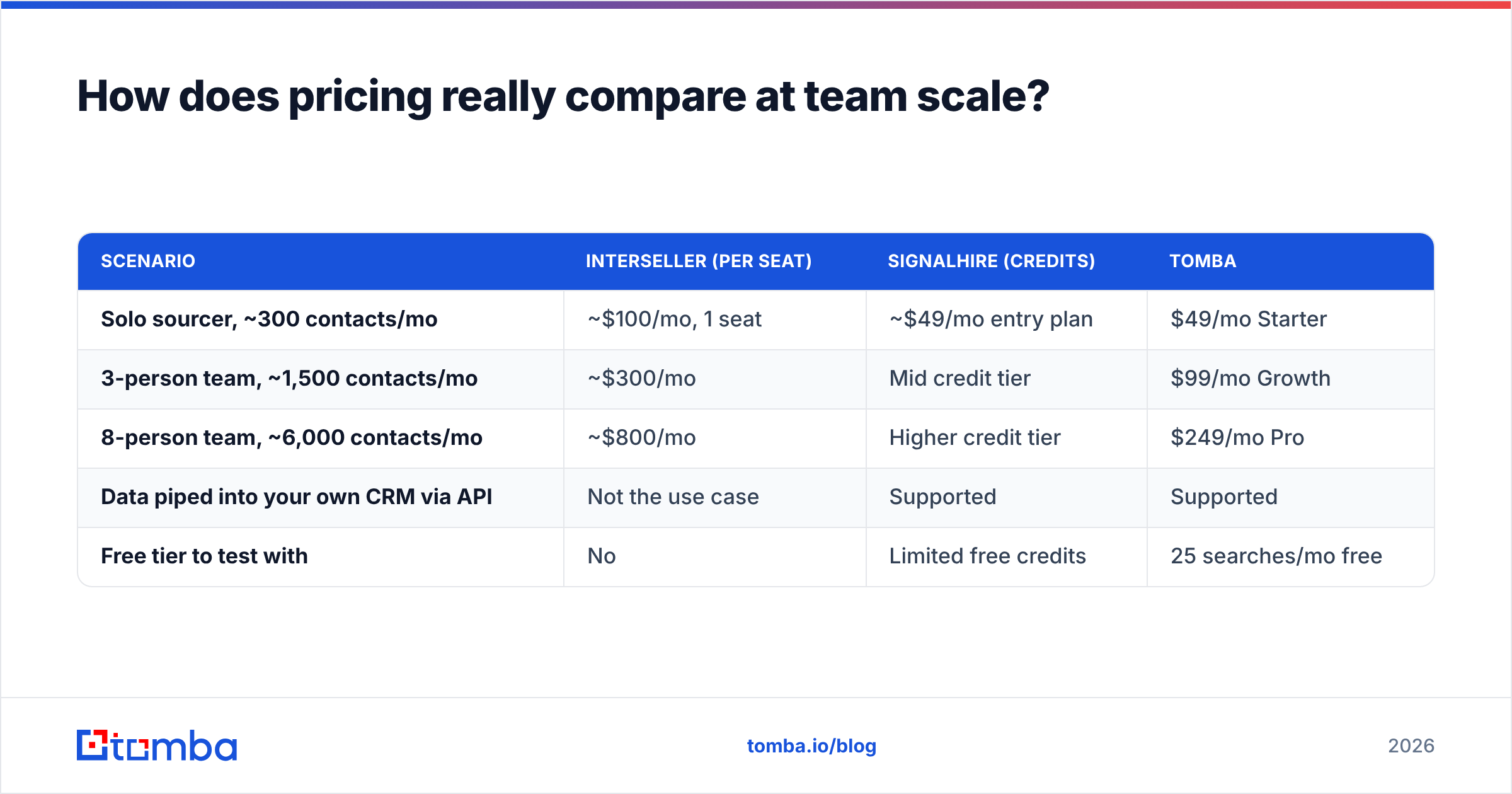
| Scenario | Interseller (per seat) | SignalHire (credits) | Tomba |
|---|---|---|---|
| Solo sourcer, ~300 contacts/mo | ~$100/mo, 1 seat | ~$49/mo entry plan | $49/mo Starter |
| 3-person team, ~1,500 contacts/mo | ~$300/mo | Mid credit tier | $99/mo Growth |
| 8-person team, ~6,000 contacts/mo | ~$800/mo | Higher credit tier | $249/mo Pro |
| Data piped into your own CRM via API | Not the use case | Supported | Supported |
| Free tier to test with | No | Limited free credits | 25 searches/mo free |
Figures are indicative, based on publicly listed pricing at the time of writing, and exclude annual discounts or negotiated Greenhouse bundles. The pattern, not the exact dollar, is the point: seat pricing punishes team growth, credit pricing punishes volume growth. A ten-person team that each reveals 50 contacts a month is wildly overpaying for seats. A two-person team burning 20,000 credits is wildly overpaying for credits.

The third column exists because a large share of teams evaluating Interseller vs SignalHire don't actually want a platform. They want reliable contact data flowing into the CRM, sequencer, or spreadsheet they already trust. If that's you, paying platform prices for the data layer is the expensive mistake. Tomba pricing starts free at 25 searches/month, then $49/mo Starter, $99/mo Growth, and $249/mo Pro, with the same email finder API behind every tier so you're not gated out of automation on the entry plan.
What are the best Interseller and SignalHire alternatives in 2026?#

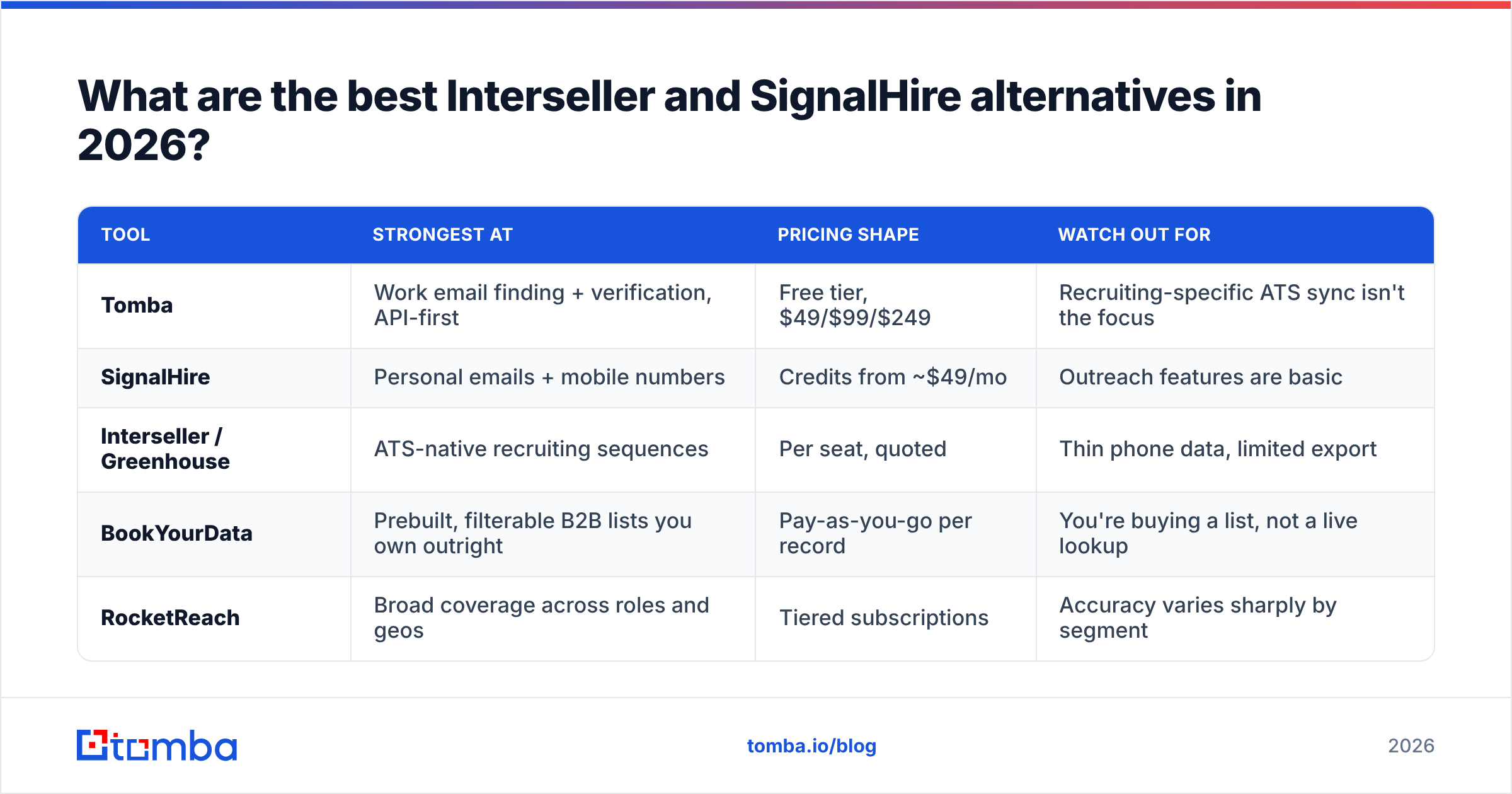
| Tool | Strongest at | Pricing shape | Watch out for |
|---|---|---|---|
| Tomba | Work email finding + verification, API-first | Free tier, $49/$99/$249 | Recruiting-specific ATS sync isn't the focus |
| SignalHire | Personal emails + mobile numbers | Credits from ~$49/mo | Outreach features are basic |
| Interseller / Greenhouse | ATS-native recruiting sequences | Per seat, quoted | Thin phone data, limited export |
| BookYourData | Prebuilt, filterable B2B lists you own outright | Pay-as-you-go per record | You're buying a list, not a live lookup |
| RocketReach | Broad coverage across roles and geos | Tiered subscriptions | Accuracy varies sharply by segment |
BookYourData deserves a note because it solves a different job well: if you want a clean, filterable list delivered up front rather than a per-profile reveal workflow, buying records directly is faster and the per-record math often beats credit subscriptions. It's a genuinely good fit for one-off campaign builds and territory launches.
For teams replacing a per-seat platform, the practical move is usually to unbundle: a data layer, a verification layer, and a sending layer you already own. Tomba's domain search covers the "find everyone at this company" job that both Interseller and SignalHire handle one profile at a time, and bulk email finder handles the list-level work without burning a seat license per researcher.
Which should you pick: Interseller or SignalHire?#
Pick Interseller if you are a recruiting team whose center of gravity is an ATS, you run structured sequences, and you need every touch attributed to a candidate record. The per-seat cost buys you workflow discipline that a data tool simply cannot provide. It's the right answer for agency recruiters and in-house talent teams already in the Greenhouse orbit.
Pick SignalHire if your bottleneck is reaching people, not organizing outreach. Mobile numbers and personal emails change candidate response rates in a way no amount of sequence tuning will match, and credit pricing means a small team can start cheap and scale honestly.
Pick neither if what you actually needed was a reliable B2B email layer for a sales motion. Both tools are built around recruiting workflows, and you'll pay for a lot of surface area you never touch.
Run the 100-contact test described above before you commit to an annual plan. It takes an afternoon, it costs almost nothing on free tiers, and it will tell you more than any comparison post — including this one.
Want to test the data layer first, before committing to a platform? Start with the Tomba Email Finder. Find verified work emails by domain, name, or company, check them against the built-in verifier, and pipe results straight into your CRM or sequencer through the API. The free tier gives you 25 searches a month with no card required — enough to benchmark it against Interseller and SignalHire on your own list, with your own ICP, and decide with data instead of a sales call.
Related guides#
// get started
Find, verify and enrich your first contacts today
Start on the free plan with 25 searches a month, then scale when your team is ready.
Free plan · No credit card required · GDPR & CCPA
// about the author