Interseller vs Tami AI: Which Outreach Tool Wins in 2026?
Interseller is a recruiter-first sourcing sequencer. Tami AI is an AI agent that researches and writes outbound. Here's how they actually differ on data, sequencing, pricing and fit — and when neither is the right buy.
Interseller vs Tami AI is a choice between two different jobs. One sources contacts and sequences them for recruiters. The other is an AI agent that researches accounts and writes your outbound for you.
TL;DR
- Interseller is a recruiter's tool. It sources contacts, runs email sequences and syncs to your ATS in one window. Greenhouse acquired it, and the roadmap shows it.
- Tami AI is an AI outbound agent. It researches an account, drafts the message, then runs the cadence.
- Neither one is a data vendor. Both resell contact data. Both will hand you addresses that bounce.
- Pick Interseller for staffing and recruiting. Pick Tami AI if you are a small GTM team that needs personalized drafts at volume.
- Budget for a separate data layer. An email finder plus email verification usually costs less than credit overages inside an all-in-one.
What are Interseller and Tami AI?#
They solve overlapping problems from opposite ends.
Interseller started as a sourcing and outreach product for recruiters. You paste a LinkedIn profile or a list. Interseller looks up a work or personal email. The contact drops into a multi-step sequence, and activity syncs back to your ATS or CRM. It was acquired by Greenhouse and now sits in the recruiting stack. The promise is fewer tabs: source, enrich, send, log. No CSV export needed.
Tami AI comes from the newer "AI SDR" category. You describe your ideal customer profile. The agent researches matching accounts and people. It drafts messages from what it found, then runs the follow-up. Your job shifts from writing to approving. That is a different workflow from Interseller's template-and-merge-field model.
One caveat first. This category moves fast, and vendors repackage every quarter. Check current limits and prices on the vendor's own site before you sign. Everything below describes how each product works, not a spec sheet that expires in ninety days.
Interseller vs Tami AI: the head-to-head comparison#
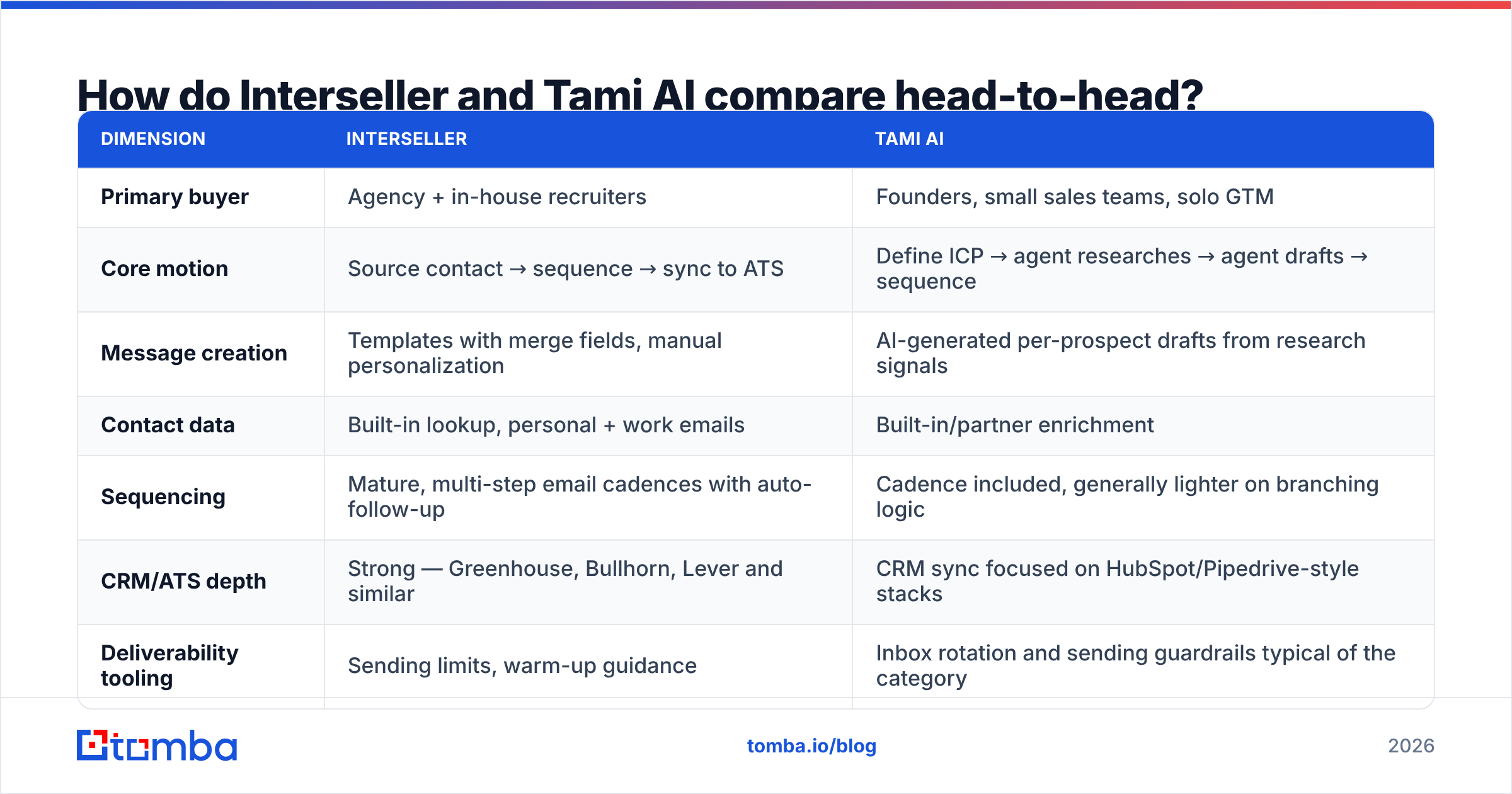
| Dimension | Interseller | Tami AI |
|---|---|---|
| Primary buyer | Agency + in-house recruiters | Founders, small sales teams, solo GTM |
| Core motion | Source contact → sequence → sync to ATS | Define ICP → agent researches → agent drafts → sequence |
| Message creation | Templates with merge fields, manual personalization | AI-generated per-prospect drafts from research signals |
| Contact data | Built-in lookup, personal + work emails | Built-in/partner enrichment |
| Sequencing | Mature, multi-step email cadences with auto-follow-up | Cadence included, generally lighter on branching logic |
| CRM/ATS depth | Strong — Greenhouse, Bullhorn, Lever and similar | CRM sync focused on HubSpot/Pipedrive-style stacks |
| Deliverability tooling | Sending limits, warm-up guidance | Inbox rotation and sending guardrails typical of the category |
| Best-fit team size | 1–50 recruiters | 1–20 reps |
| Weakest point | Not built for complex B2B sales plays | Output quality depends entirely on input data quality |
The table hides the real split, so here it is plainly. Interseller optimizes for workflow. Tami AI optimizes for content. If your recruiters lose 90 minutes a day copying between tabs, consolidation wins. If nobody on the team has time to write 200 opening lines, generation wins.
Which one finds better contact data?#
Most head-to-head reviews get lazy here. "Better data" means four things, in this order:
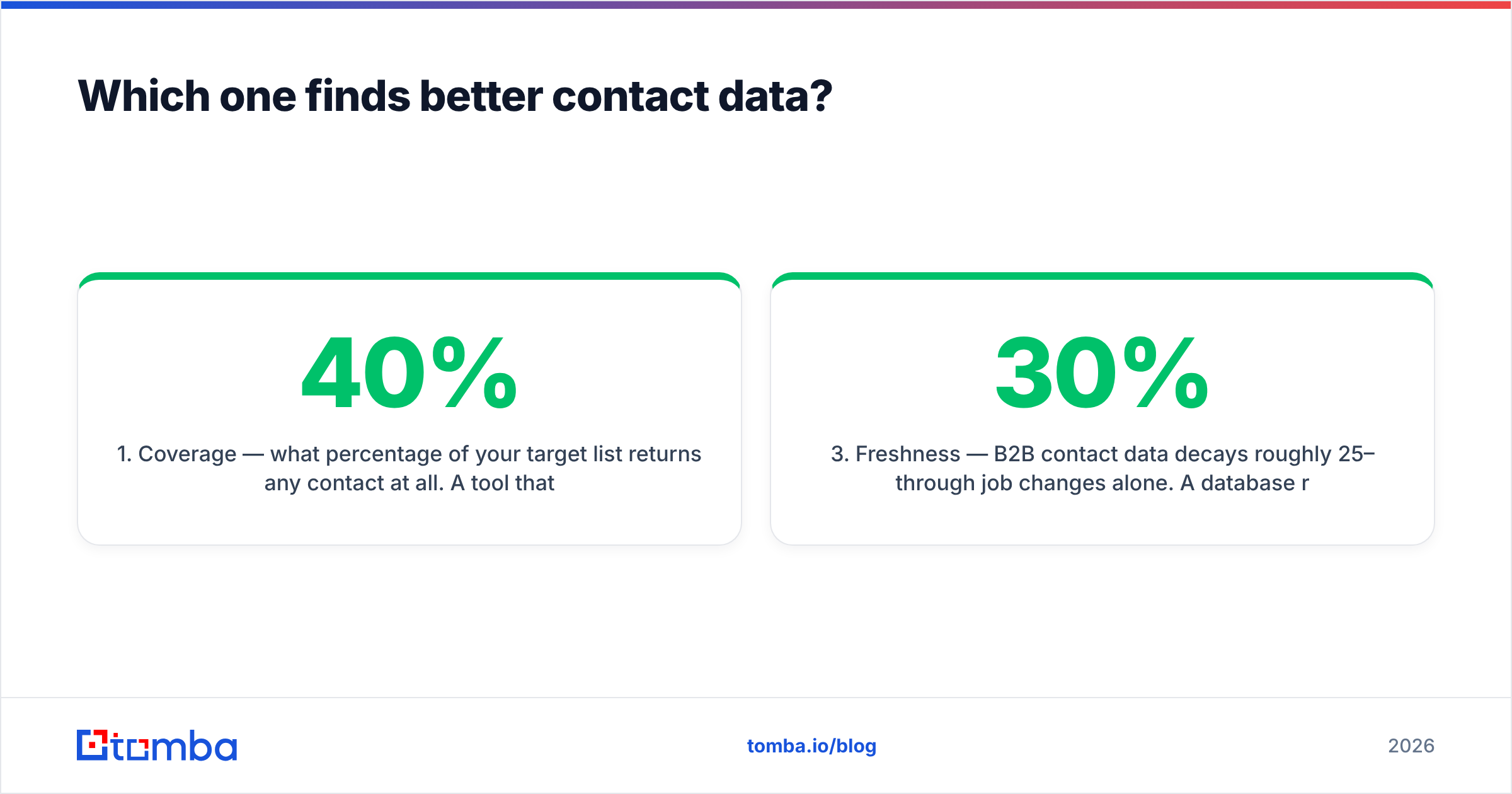
- Coverage — how much of your list returns a contact at all. A tool that finds 40% of a niche vertical is useless, even if those 40% are perfect.
- Accuracy — how many returned addresses actually accept mail. Vendors quote accuracy on the subset they return, which inflates the number.
- Freshness — B2B contact data decays 25–30% a year from job changes alone. A quarterly refresh is a different product from a continuous one.
- Catch-all handling — many corporate domains accept every address at the SMTP layer. Tools that call those "valid" are guessing. Tools that drop them throw away real prospects. You need catch-all verification to settle it.
One more axis matters for recruiters: personal versus work addresses. Interseller surfaces personal emails more readily. That helps candidate outreach, and in some places it changes what you may legally send.
On these axes, Interseller has the stronger record for candidate coverage. Engineers and personal Gmail addresses are its home turf. Tami AI's enrichment points at business contacts inside target accounts. That shape fits B2B sales. It also means you depend on whichever provider sits behind the agent.
Here is the uncomfortable part for both. An all-in-one has no reason to tell you a contact is unreachable. Bad contacts still burn credits and still look like activity. Only independent verification separates "we found something" from "this will land." Run both exports through a standalone checker and compare bounce rates over 500 sends. The gap is usually 8–15 points, and it decides your sender reputation.
Is Interseller better for recruiters?#
Yes, and it is not close.
Recruiting outreach has constraints that sales tools ignore. You work a requisition, not a territory. The same candidate sits in five pipelines. Your rules around personal data are different. Your ATS is the system of record, not your CRM. If outreach does not log there, your team duplicates work within a week.
Interseller was designed around all of that:
- ATS-native sync. Activity lands where recruiters already work, and the Greenhouse tie deepens that.
- Personal email emphasis. Candidates ignore work inboxes for job conversations. The lookup reflects that.
- Duplicate protection across projects. Double-outreach to one candidate is a real risk, not an edge case.
- Simple template cadences. Recruiters want three touches and a clean stop-on-reply, not a nine-branch tree.
The flip side is easy to hit. Run a complex enterprise sales motion through Interseller and you meet walls. Branching logic, multichannel steps and account grouping are all thin. It is a focused product, and the focus is the point.
Is Tami AI better for sales teams?#
For small, fast teams, usually yes. For anything complex, test it hard.
The agent model earns its keep in one case. You have more good-fit accounts than writing hours. A two-person team with 3,000 target accounts cannot write 3,000 first lines. An agent can. That is the trade Tami AI makes.
Where the model gets brittle:
- Garbage in, confident garbage out. Give an agent a stale record and it writes a lovely email to someone who left in March. Fluent is not correct.
- Research depth is uneven. Agents do well on companies with public news, funding rounds and job posts. They do poorly on the quiet mid-market maker that often converts best.
- Review still costs time. Approve every draft and the savings shrink. Stop reviewing and you learn why review existed.
- Deliverability risk grows with volume. Sending 500 messages a day is easy. Landing 500 in a primary inbox is not. That is a sender reputation problem, and better copy cannot fix it.
If your process is solid and copy is the bottleneck, an agent delivers. If targeting or data is the bottleneck, an agent makes it worse.
Interseller vs Tami AI: what do they cost in 2026?#
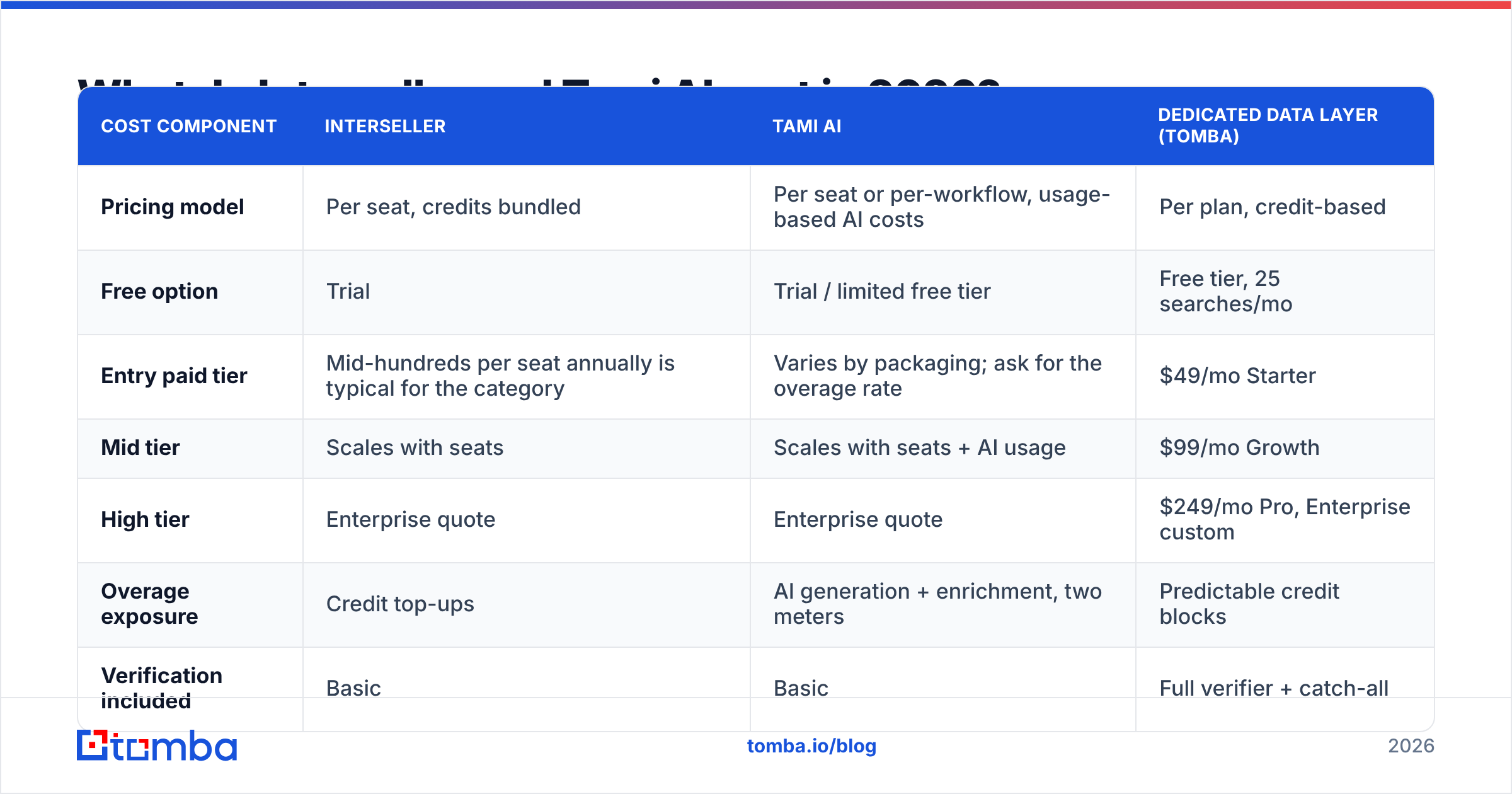
Both vendors move their pricing. Both meter contact credits apart from seats. So here is the cost structure to question, plus a dedicated data vendor as a reference point.
| Cost component | Interseller | Tami AI | Dedicated data layer (Tomba) |
|---|---|---|---|
| Pricing model | Per seat, credits bundled | Per seat or per-workflow, usage-based AI costs | Per plan, credit-based |
| Free option | Trial | Trial / limited free tier | Free tier, 25 searches/mo |
| Entry paid tier | Mid-hundreds per seat annually is typical for the category | Varies by packaging; ask for the overage rate | $49/mo Starter |
| Mid tier | Scales with seats | Scales with seats + AI usage | $99/mo Growth |
| High tier | Enterprise quote | Enterprise quote | $249/mo Pro, Enterprise custom |
| Overage exposure | Credit top-ups | AI generation + enrichment, two meters | Predictable credit blocks |
| Verification included | Basic | Basic | Full verifier + catch-all |
Full Tomba pricing is public. That is why it is here: you can do the math before a sales call. For both other tools, get the overage rate in writing. In an all-in-one, the sticker price is rarely the bill. Credit burn is. Run 20,000 lookups on a plan sized for 5,000 and overages will beat your subscription.
Also read G2 reviews for renewal-time complaints. Feature reviews get written in month one. Billing reviews get written in month thirteen, and they tell you more.
Where do both tools leave the same gap?#
The Interseller vs Tami AI gap is the same gap: the data layer. Both treat contact data as a feature that props up the real product. For Interseller that product is workflow. For Tami AI it is generation. Neither is built as a data company, and it shows in three places.
Verification rigor. Bundled verification is usually a syntax check, an MX check and a light SMTP probe. It cannot resolve catch-all domains, and catch-alls cover a large slice of corporate email. Use a proper catch-all finder so you neither burn sends nor drop good prospects.
Bulk operations. Say you pull a 40,000-row list from a conference or a partner. Pushing it through a seat-priced outreach tool is the expensive route. A bulk email finder handles that volume at data-layer prices, and you import only the verified rows.
Programmatic access. Automate any part of the pipeline and you need a documented email finder API, not an export button. Outreach platforms expose APIs for their own workflows, not for enrichment at scale.
Effective teams land on the same shape. One source of contact truth feeds whichever engagement tool fits the motion. Data and sending are different problems with different cost curves. Coupling them because one vendor sells both is how teams pay premium rates for commodity lookups.
Which should you choose?#
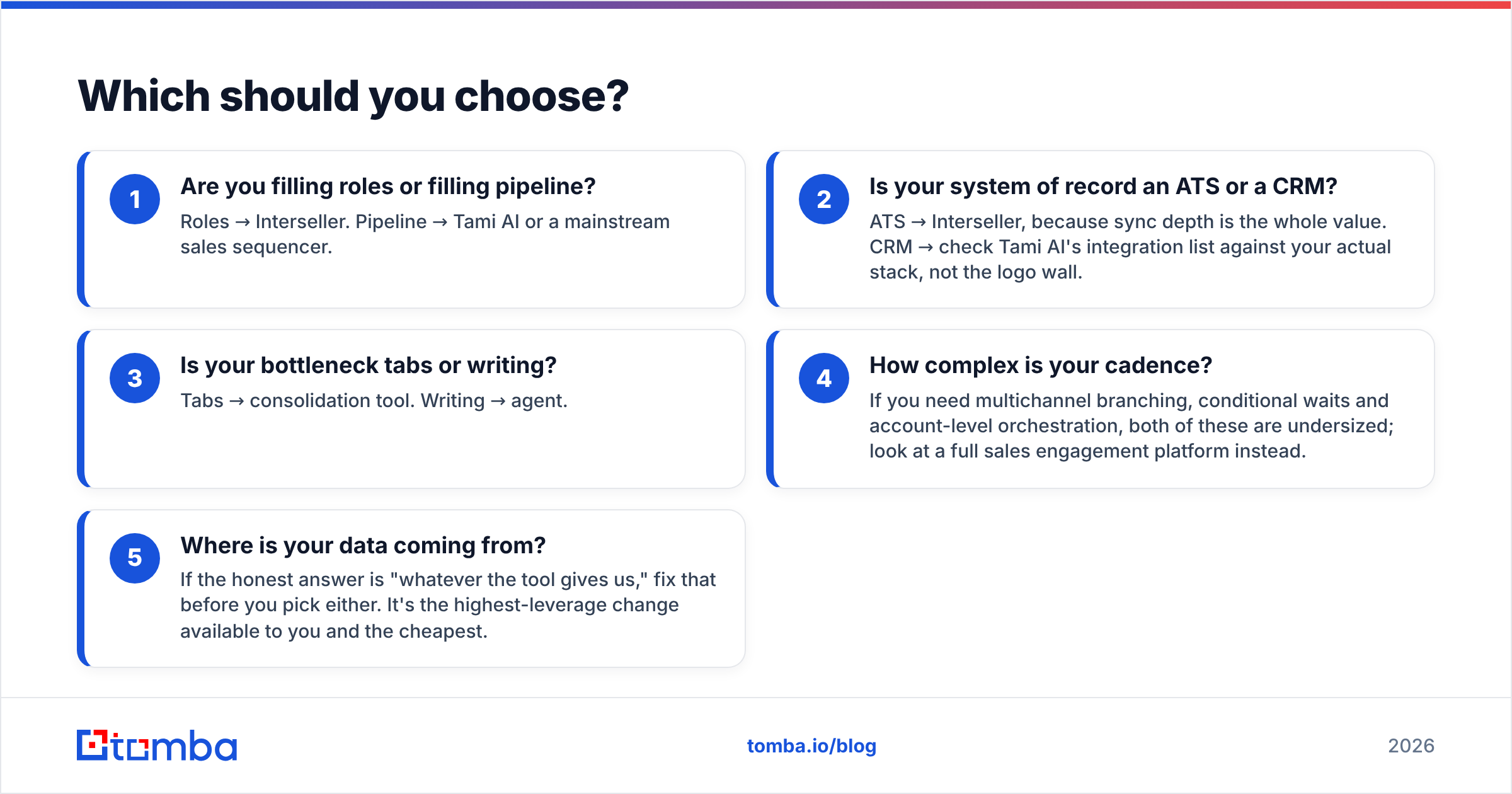
The Interseller vs Tami AI decision comes down to five questions. Answer them in order:
- Are you filling roles or pipeline? Roles → Interseller. Pipeline → Tami AI or a mainstream sales sequencer.
- Is your system of record an ATS or a CRM? ATS → Interseller, because sync depth is the whole value. CRM → check Tami AI's integrations against your real stack, not the logo wall.
- Is your bottleneck tabs or writing? Tabs → a consolidation tool. Writing → an agent.
- How complex is your cadence? If you need branching, conditional waits and account orchestration, both are undersized. Look at a full sales engagement platform.
- Where does your data come from? If the honest answer is "whatever the tool gives us," fix that first. It is the cheapest big win you have.
Hybrid teams can run both. Use Interseller for candidate outreach and an agent for account outreach. Just put one verified contact source under both. Two sequencers with two data qualities give you two bounce rates and one burned domain.
Start with the layer that decides everything else#
Your data sets the deliverability ceiling, not your copy. Run your target list through the Tomba Email Finder. The free tier gives you 25 searches a month, no card needed. Compare the verified output with what Interseller or Tami AI returns for the same accounts. If the bounce gap looks like it usually does, you just found the cheapest win in your stack. Then pick your outreach tool on workflow fit alone. That is how the decision should have been made in the first place.
Related guides#
// get started
Find, verify and enrich your first contacts today
Start on the free plan with 25 searches a month, then scale when your team is ready.
Free plan · No credit card required · GDPR & CCPA
// about the author