Interseller vs Tomba: Which Email Finder Wins in 2026?
Interseller bundles contact finding with recruiting sequences. Tomba sells finding and verification as an API-first layer. Here's the honest breakdown of coverage, pricing, and which one belongs in your stack.
Interseller vs Tomba looks like a head-to-head, but the two tools do different jobs. Interseller finds candidates and sequences them. Tomba finds and verifies work emails, then hands them to the stack you already run. Here is the honest Interseller vs Tomba breakdown.
TL;DR
- Interseller is a sourcing and sequencing suite for recruiters. Tomba is an API-first email finder and verifier for anyone who needs contact data inside their own workflow.
- Greenhouse bought Interseller in late 2021. That matters a lot if you are not a Greenhouse customer.
- The pricing models barely overlap. Interseller sells seats, quoted near $100 per user each month. Tomba sells credits: 25 free searches a month, then $49, $99, or $249.
- Need sequencing, ATS sync, and candidate pipelines in one window? Interseller is the stronger single purchase. Need clean, verified emails in a CRM or your own product? Tomba costs less and plugs in deeper.
- For most teams the two are not direct substitutes. Read the fit section before you pick.
What are Interseller and Tomba?#
Interseller began as a recruiting outreach tool. The pitch was simple. Find a candidate's personal or work email. Drop them into a multi-step sequence. Sync the whole thing back to your applicant tracking system so nobody touches the same person twice. Agency recruiters loved it, because they could work all day in one tab.
In November 2021, Greenhouse acquired Interseller. The product kept running, but its center of gravity moved toward Greenhouse's recruiting world. That deal is the most important fact in this comparison. Interseller is no longer a scrappy independent tool chasing every buyer. It is part of a recruiting platform, and its roadmap follows recruiting priorities.
Tomba came at the same question — who is this person and how do I reach them? — from the data side. Its core product is an email finder that turns a name plus a domain into a working address. Around it sit an email verifier, domain search, catch-all handling, phone lookup, and enrichment. There is a web app, but the heart of the product is the Tomba API and its integrations.
So one tool wants to be your outreach workspace. The other wants to be the data layer behind the workspace you already use.
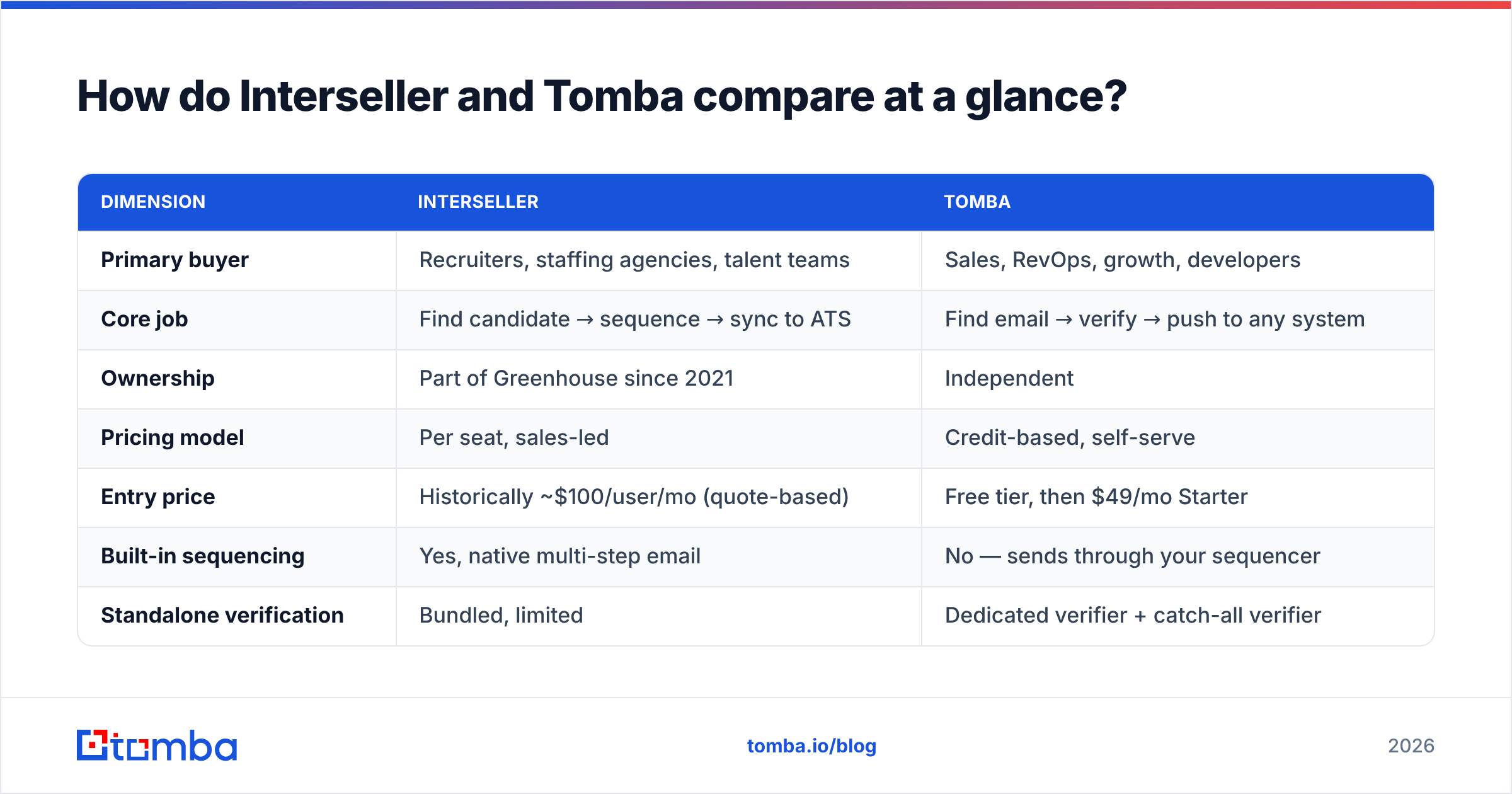
Interseller vs Tomba: how do they compare at a glance?#
| Dimension | Interseller | Tomba |
|---|---|---|
| Primary buyer | Recruiters, staffing agencies, talent teams | Sales, RevOps, growth, developers |
| Core job | Find candidate → sequence → sync to ATS | Find email → verify → push to any system |
| Ownership | Part of Greenhouse since 2021 | Independent |
| Pricing model | Per seat, sales-led | Credit-based, self-serve |
| Entry price | Historically ~$100/user/mo (quote-based) | Free tier, then $49/mo Starter |
| Built-in sequencing | Yes, native multi-step email | No — sends through your sequencer |
| Standalone verification | Bundled, limited | Dedicated verifier + catch-all verifier |
| Public API | Limited | Full REST API, CLI, MCP server |
| Personal email discovery | A core strength | Work email focus |
| Free trial path | Demo-gated | Free tier, no card |
The table makes the split obvious. Interseller wins on workflow depth for one specific job. Tomba wins on flexibility, price transparency, and machine access.
Is Interseller still a good buy after the Greenhouse acquisition?#
It depends on one thing. Are you already inside the Greenhouse ecosystem?
If you are, the acquisition is a feature. Sourcing, sequencing, and candidate records live with one vendor, one contract, one support queue. Dedup against existing candidates works, because the systems are not stitched together with a Zapier scenario. They are the same platform.
If you are not, you are buying a recruiting tool with a recruiting roadmap. Sales teams who picked Interseller for B2B prospecting report the same friction. The features they want — deeper CRM sync, non-recruiting fields, flexible credit pooling — sit behind what talent teams ask for. That is not a knock on the product. It is a note about fit. Check current sentiment on G2's lead intelligence category before you sign anything. Reviews written before and after an acquisition often read like two different products.

How accurate is the contact data on each side?#
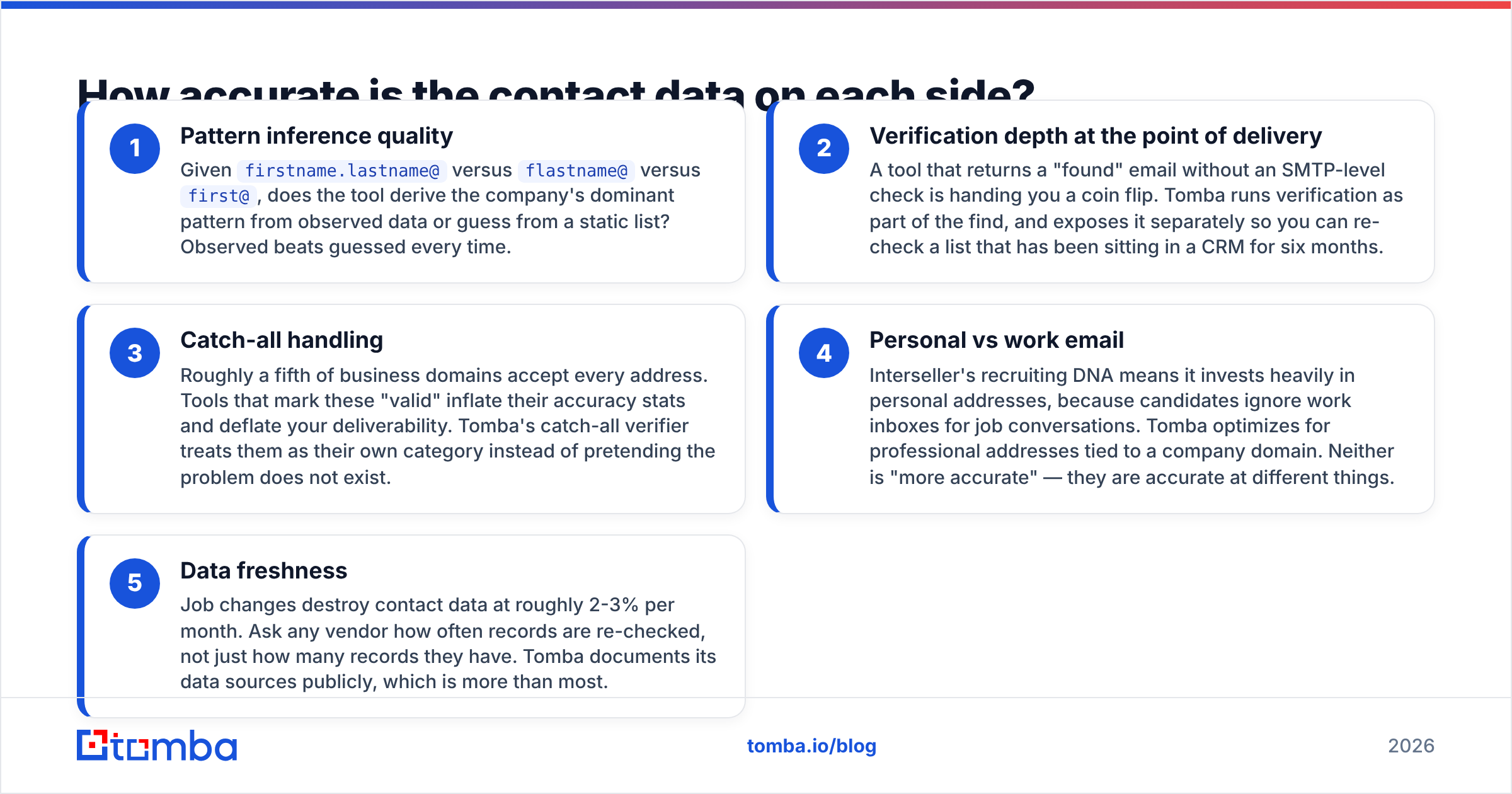
Accuracy is where email finders live or die. It is also where the marketing copy gets loosest. Every vendor claims 95% accuracy. That number means something different each time.
Three things drive your real-world hit rate:
- Pattern inference quality — Take
firstname.lastname@versusflastname@versusfirst@. Does the tool read the company's dominant pattern from observed data, or guess from a static list? Observed beats guessed every time. - Verification depth on delivery — A tool that returns a "found" email with no SMTP check is handing you a coin flip. Tomba verifies as part of the find. It also exposes that check on its own, so you can re-test an old list.
- Catch-all handling — Roughly a fifth of business domains accept every address. Tools that mark these "valid" inflate their accuracy stats and sink your deliverability. Tomba's catch-all verifier treats them as their own category.
Two more factors decide the Interseller vs Tomba result:
- Personal vs work email — Interseller's recruiting DNA means it invests heavily in personal addresses, because candidates ignore work inboxes for job talk. Tomba tunes for professional addresses tied to a company domain. Neither is "more accurate". They are accurate at different things.
- Data freshness — Job changes wreck contact data at roughly 2-3% per month. Ask any vendor how often records get re-checked, not just how many records they hold. Tomba documents its data sources in public, which is more than most.

The practical takeaway: run your own test. Take 50 contacts whose emails you already trust. Run them through both tools and measure. A benchmark on your real ICP beats any vendor chart, including this one.
Interseller vs Tomba pricing: what does each one cost?#
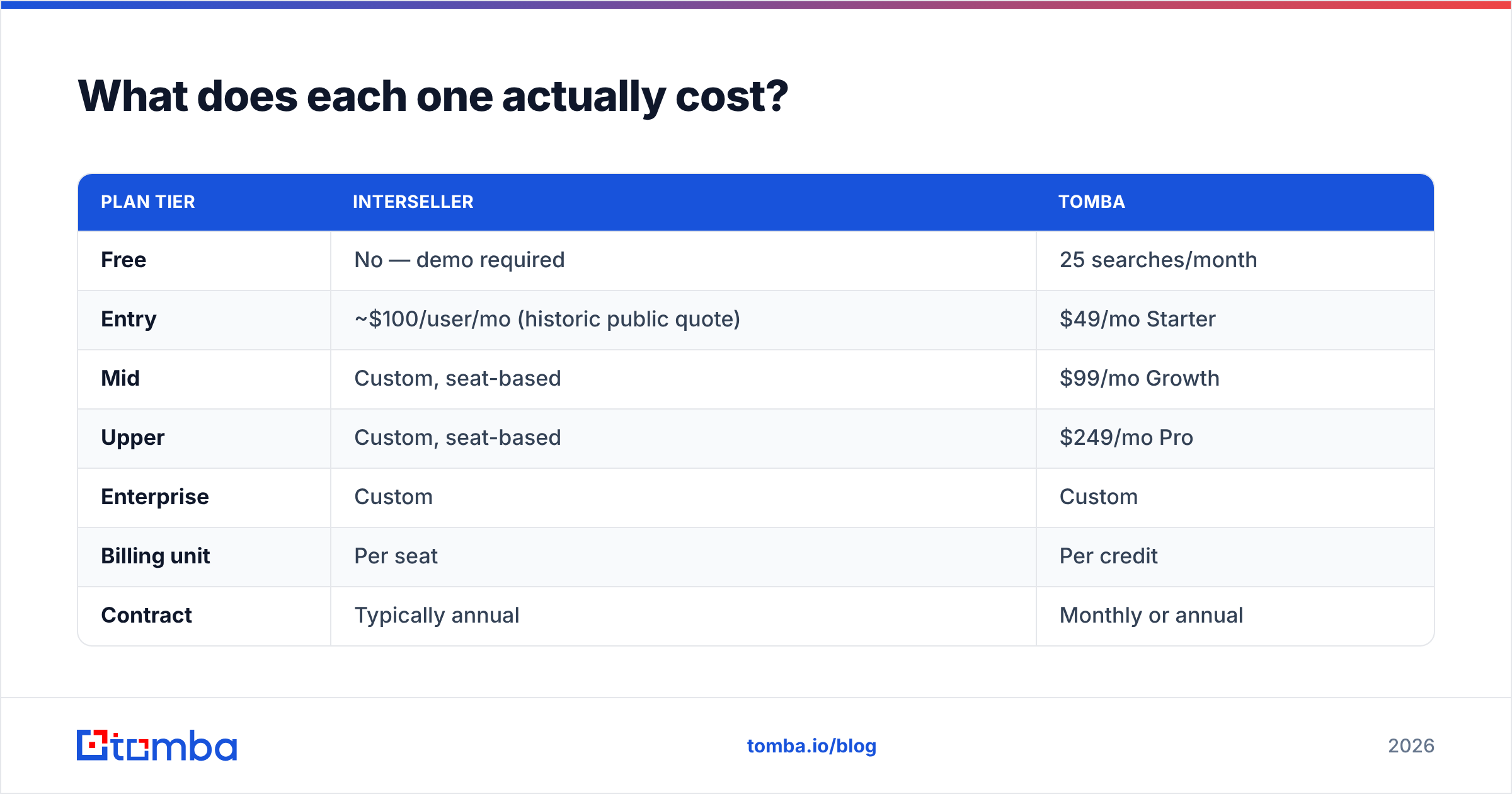
This is the cleanest split in the whole comparison. The two pricing models barely overlap.
| Plan tier | Interseller | Tomba |
|---|---|---|
| Free | No — demo required | 25 searches/month |
| Entry | ~$100/user/mo (historic public quote) | $49/mo Starter |
| Mid | Custom, seat-based | $99/mo Growth |
| Upper | Custom, seat-based | $249/mo Pro |
| Enterprise | Custom | Custom |
| Billing unit | Per seat | Per credit |
| Contract | Typically annual | Monthly or annual |
| Card required to test | Yes | No |
Per-seat pricing punishes the shape of most teams. Say you have four SDRs, two marketers, and one ops person. All of them need a contact now and then. Seats cost you seven licenses for maybe 2,000 lookups a month. Credit pricing lets one API key serve the whole company. Full Tomba pricing sits on the site, and no call is required.
The flip side is real. A seat bundles the sequencer. If Interseller replaces both your data tool and your outreach tool, comparing its seat cost to a credit plan alone is unfair arithmetic. Add your sequencer's cost to Tomba's column before you decide.

Which one fits your team?#
Skip the feature matrix. Answer four questions and Interseller vs Tomba mostly sorts itself out.
- Are you hiring or selling? Recruiting work needs personal emails, candidate dedup, and ATS write-back. Interseller is built for that. Sales work needs company-domain accuracy, CRM enrichment, and volume. Tomba is built for that.
- Do you already own a sequencer? If Instantly, Smartlead, Outreach, or Salesloft is in your stack and working, a second sequencer inside a data tool is waste. Buy data only.
- Does anyone on your team write code or automations? If yes, an API-first tool pays off fast. Tomba ships a CLI, an MCP server, and native integrations with HubSpot, Salesforce, Pipedrive, Zapier, and Google Sheets.
- How many seats need access? Under three, seat pricing can be fine. Above five, credit pooling usually wins on cost and on adoption. Nobody has to ask ops for a license.

Can you use both together?#
Yes. Interseller vs Tomba is not always either/or. For some teams, running both is the right call.
Picture a staffing agency running Greenhouse. It keeps Interseller for candidate sourcing and sequencing. It uses Tomba for the business development side: finding hiring managers at target accounts, enriching inbound leads, verifying lists before an outbound push. The two workflows touch different databases and different KPIs. Force them into one tool and one of them gets served badly.
A practical split looks like this:
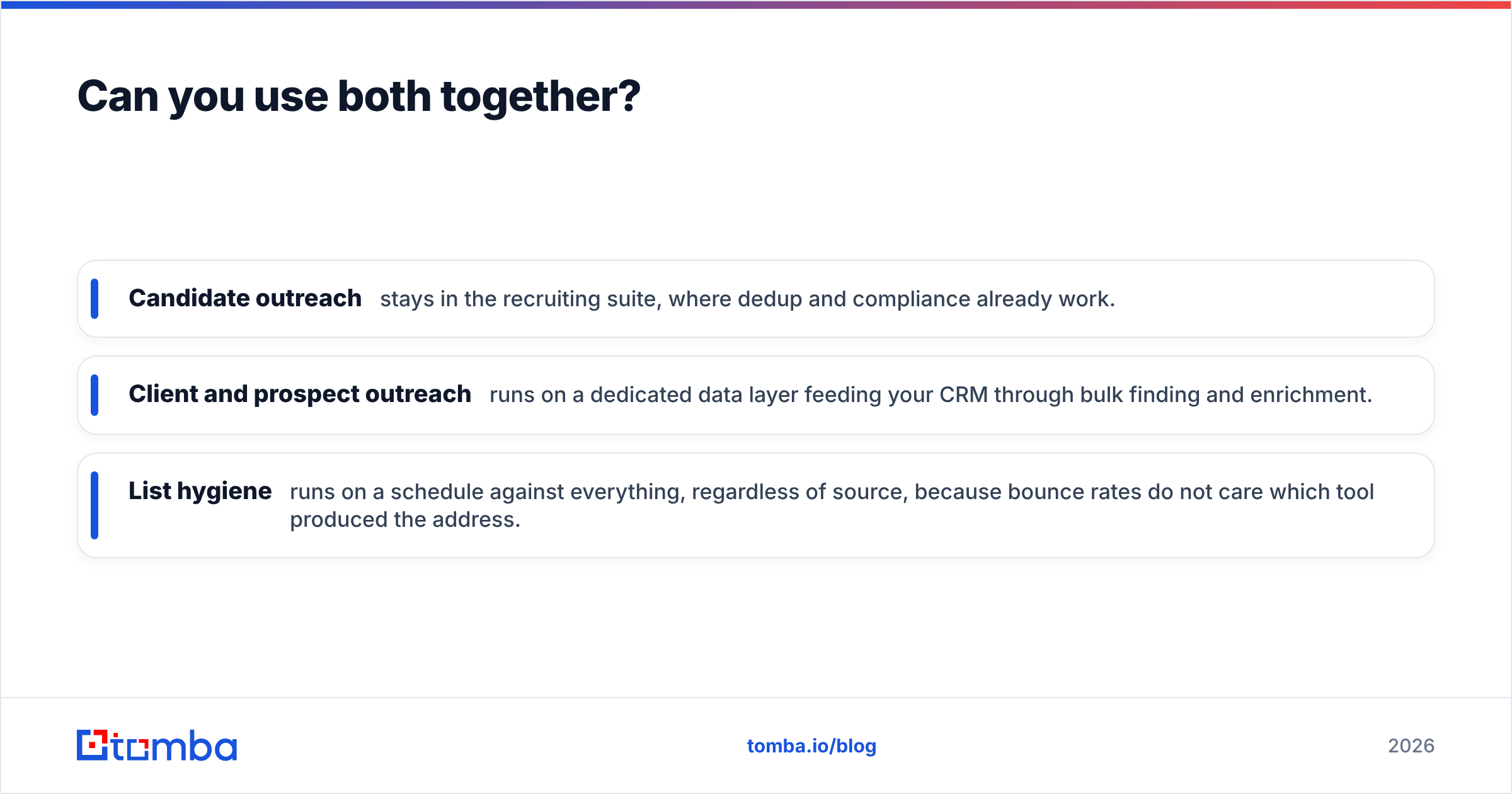
- Candidate outreach stays in the recruiting suite, where dedup and compliance already work.
- Client and prospect outreach runs on a dedicated data layer that feeds your CRM through bulk finding and enrichment.
- List hygiene runs on a schedule against everything, whatever the source, because bounce rates do not care which tool produced the address.
That last point deserves emphasis. Whichever tool you buy, verify before you send. A 5% bounce rate is enough to damage sender reputation at most mailbox providers. Repairing that costs far more than verification credits do.
What are the honest downsides of each?#
Interseller's weak spots: Pricing is not public, so every evaluation starts with a sales call. The API surface is thin next to data-first vendors. Non-recruiting use cases work, but they are not the priority. And off Greenhouse, you are a secondary audience on someone else's roadmap.
Tomba's weak spots: There is no native sequencer, so you need a sending tool. The free tier of 25 searches per month is enough to test quality, but not to run a campaign. Credits also need a little forecasting. Burn through a plan mid-month and you upgrade or wait, where a seat license would have kept working.
Neither list is a deal-breaker. Each one is a trade-off from a different plan: bundle everything for one job, or do one thing well for everyone.
What's the verdict on Interseller vs Tomba?#
Pick Interseller if you are a recruiting team already inside Greenhouse. It fits when you want sourcing and sequencing in one window. It fits when seat pricing matches your headcount, and when personal emails are central to the work.
Pick Tomba if you are a sales, marketing, or ops team that needs verified work emails at a steady cost. It fits when you already own your outreach stack. It fits when you want API and spreadsheet access without a sales call, or when one data source has to serve several tools and several people.
Pick both if you run recruiting and business development under one roof and refuse to compromise either workflow.
One framing leads people wrong. Interseller vs Tomba is not a fight for the same dollar. The two compete for a slot in your stack, not for the same job. Decide which job you are hiring for, and the choice takes about ten minutes.
Ready to test the data side without a demo call? Start with the Tomba Email Finder — 25 free searches a month, no card required, every result verified before it reaches you. Run your own 50-contact benchmark against whatever you use today, and let the hit rate settle the Interseller vs Tomba question for you.
Related guides#
// get started
Find, verify and enrich your first contacts today
Start on the free plan with 25 searches a month, then scale when your team is ready.
Free plan · No credit card required · GDPR & CCPA
// about the author