Introdex Pricing 2026: Reviews, Pros and Cons, Real Costs
Introdex doesn't publish a price. Here's how its warm-intro model is actually billed, what reviewers say, where it wins, where it breaks, and when a $49/mo data stack beats paying for introductions.
TL;DR
- Introdex publishes no public pricing. As of 2026, there is no pricing page, and third-party directories including G2 list pricing as unavailable. Every number you get comes from a sales conversation.
- It is not a data tool — it is an introduction marketplace. Introdex connects B2B vendors to human "connectors" who broker warm intros to decision-makers, with a strong focus on Asian enterprise markets.
- The pros are real: warm intros convert far better than cold touches, and the model is attractive when you are entering a market where your brand means nothing.
- The cons are structural: opaque pricing, supply-dependent coverage, small company (founded 2023, seed-stage, single-digit headcount), and volume that cannot scale like a database.
- The honest verdict: run Introdex as a targeted top-of-funnel experiment for 20–50 named enterprise accounts, not as your pipeline engine. Your repeatable volume still needs verified contact data underneath it.
What is Introdex, exactly?#
Introdex is a go-to-market platform built around warm introductions rather than contact records. Think of it less like a phone book and more like a real-estate agent for relationships: you do not buy the house directly from the owner, you pay someone who already has the owner's trust to walk you through the front door.
Two sides make up the marketplace:
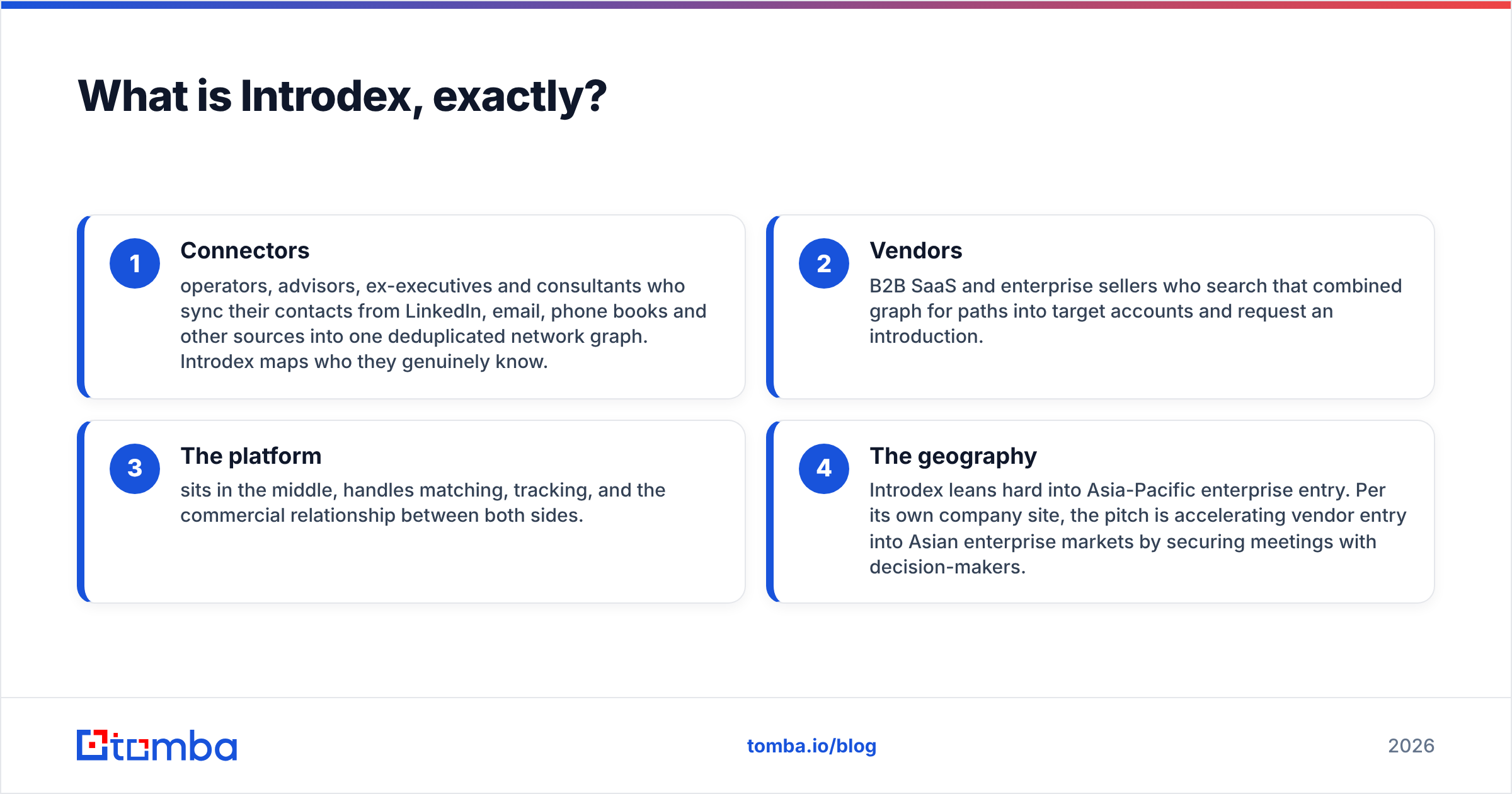
- Connectors — operators, advisors, ex-executives and consultants who sync their contacts from LinkedIn, email, phone books and other sources into one deduplicated network graph. Introdex maps who they genuinely know.
- Vendors — B2B SaaS and enterprise sellers who search that combined graph for paths into target accounts and request an introduction.
- The platform — sits in the middle, handles matching, tracking, and the commercial relationship between both sides.
- The geography — Introdex leans hard into Asia-Pacific enterprise entry. Per its own company site, the pitch is accelerating vendor entry into Asian enterprise markets by securing meetings with decision-makers.
The company was founded in 2023, is headquartered in Singapore, and per Crunchbase is seed-stage with a small team. That context matters for a pricing review: early-stage marketplaces almost always price by negotiation because they are still discovering what the market will bear.

How does Introdex pricing actually work?#
Short answer: nobody outside a sales call knows the list price, because there isn't one published.
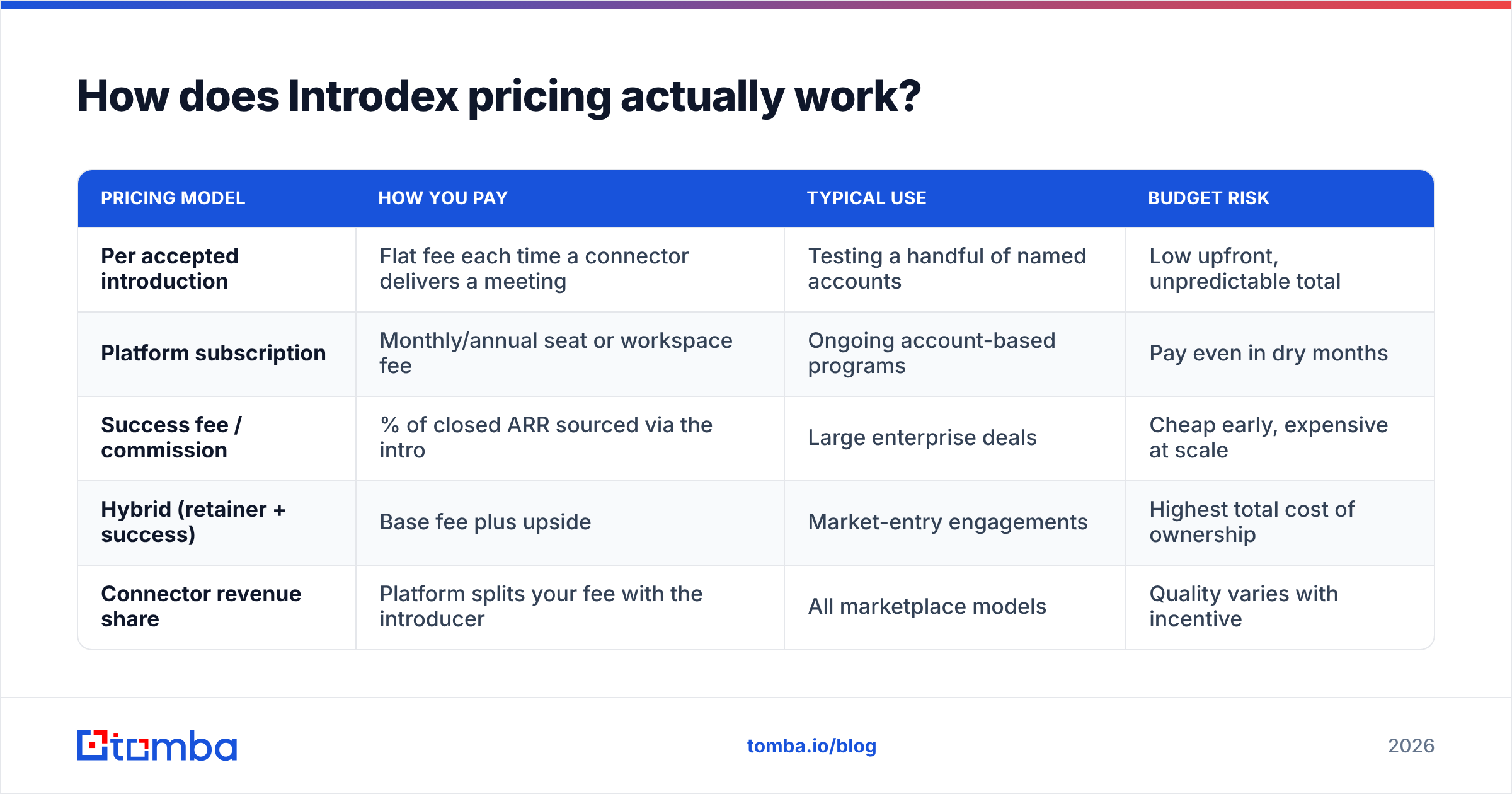
That is not automatically a red flag — plenty of marketplaces price per deal — but it does mean you cannot budget from a webpage. Here is what you are realistically negotiating against when you talk to a warm-intro platform, and what each structure does to your CAC.
| Pricing model | How you pay | Typical use | Budget risk |
|---|---|---|---|
| Per accepted introduction | Flat fee each time a connector delivers a meeting | Testing a handful of named accounts | Low upfront, unpredictable total |
| Platform subscription | Monthly/annual seat or workspace fee | Ongoing account-based programs | Pay even in dry months |
| Success fee / commission | % of closed ARR sourced via the intro | Large enterprise deals | Cheap early, expensive at scale |
| Hybrid (retainer + success) | Base fee plus upside | Market-entry engagements | Highest total cost of ownership |
| Connector revenue share | Platform splits your fee with the introducer | All marketplace models | Quality varies with incentive |
Ask which of these applies before anything else. The same "warm intro" can cost $150 as a flat referral fee or five figures as a 5% commission on a $400K enterprise contract. A marketplace that will not tell you which model it uses until the second call is telling you something.
Four questions to force a straight answer on Introdex pricing:
- Is there a floor? Minimum commitment, minimum number of intros, or minimum contract length.
- What counts as a delivered intro? An email CC? A scheduled meeting? A meeting that actually happened? The definition is the whole deal.
- Who eats a no-show? If the decision-maker ghosts, is that billable?
- Is there exclusivity or a tail? Many intro agreements claim commission on any deal with that account for 12–24 months, even if you sourced it elsewhere later.
What do Introdex reviews say?#
Thin, and you should treat that honestly rather than pretending otherwise. The G2 listing for Introdex exists but carries little review volume and no pricing detail. Directory profiles on Crunchbase, PitchBook and Tracxn confirm the company's existence, funding stage and headcount — not customer satisfaction.
What that means practically:
- You cannot triangulate quality from crowd data the way you can with a mature category leader.
- Reference calls become non-optional. Ask for two customers in your exact segment and region.
- Weight the pilot heavily. With a young marketplace, your own 60-day test is better evidence than any review site.
This is a pattern across warm-intro startups, not a knock specific to Introdex. The category is young, the customer counts are small, and buyers rarely write public reviews about relationship brokerage — it feels like publishing your poker hand.
What are the pros of Introdex?#
1. Warm intros genuinely outperform cold. Nobody serious disputes this. A referred meeting starts with borrowed trust, skips the credibility phase, and typically compresses the early stages of the cycle. If your response rate on cold outbound into enterprise APAC is under 2%, a handful of brokered meetings can look dramatic by comparison.
2. It solves a problem money alone can't. You can buy a list of every CIO in Singapore. You cannot buy the reason one of them takes your call. For a foreign vendor with zero regional brand, that gap is the actual bottleneck.
3. Market-entry speed. Hiring a regional AE, waiting six months for them to build a network, and eating the risk if they miss is expensive. Renting someone's existing network is a legitimate arbitrage on that timeline.
4. Aligned incentives (when success-based). If the platform only wins when meetings happen, you are not paying for shelfware. That is structurally friendlier than a seat-based tool you forget to cancel.
5. Small vendor, high attention. An eight-person company will answer your Slack message. Enterprise data vendors will route you to a ticket queue. Do not undervalue this during a pilot.
What are the cons of Introdex?#
1. Opaque pricing is a planning problem. You cannot model CAC on a number you have to negotiate every quarter. Finance hates it, and so should you.
2. Coverage is supply-constrained. A database's coverage is a function of crawling; a marketplace's coverage is a function of who happened to sign up as a connector. If nobody in the network knows your 40 target accounts, the platform cannot manufacture a path.
3. It doesn't scale linearly. Human introductions have a ceiling. Ten a month is plausible. A thousand a month is not. Any GTM motion that needs volume must be fed by something else.
4. Attribution gets contentious. When a connector claims an intro triggered a deal your SDR had already worked for three months, you are in a commercial dispute with no clean referee.
5. Vendor risk is real. Seed-stage, founded 2023, small team. That is not an accusation — it is a probability statement about roadmap continuity and support depth. Structure contracts accordingly: short terms, data portability, no giant prepayments.

How does Introdex compare to other ways to reach decision-makers?#
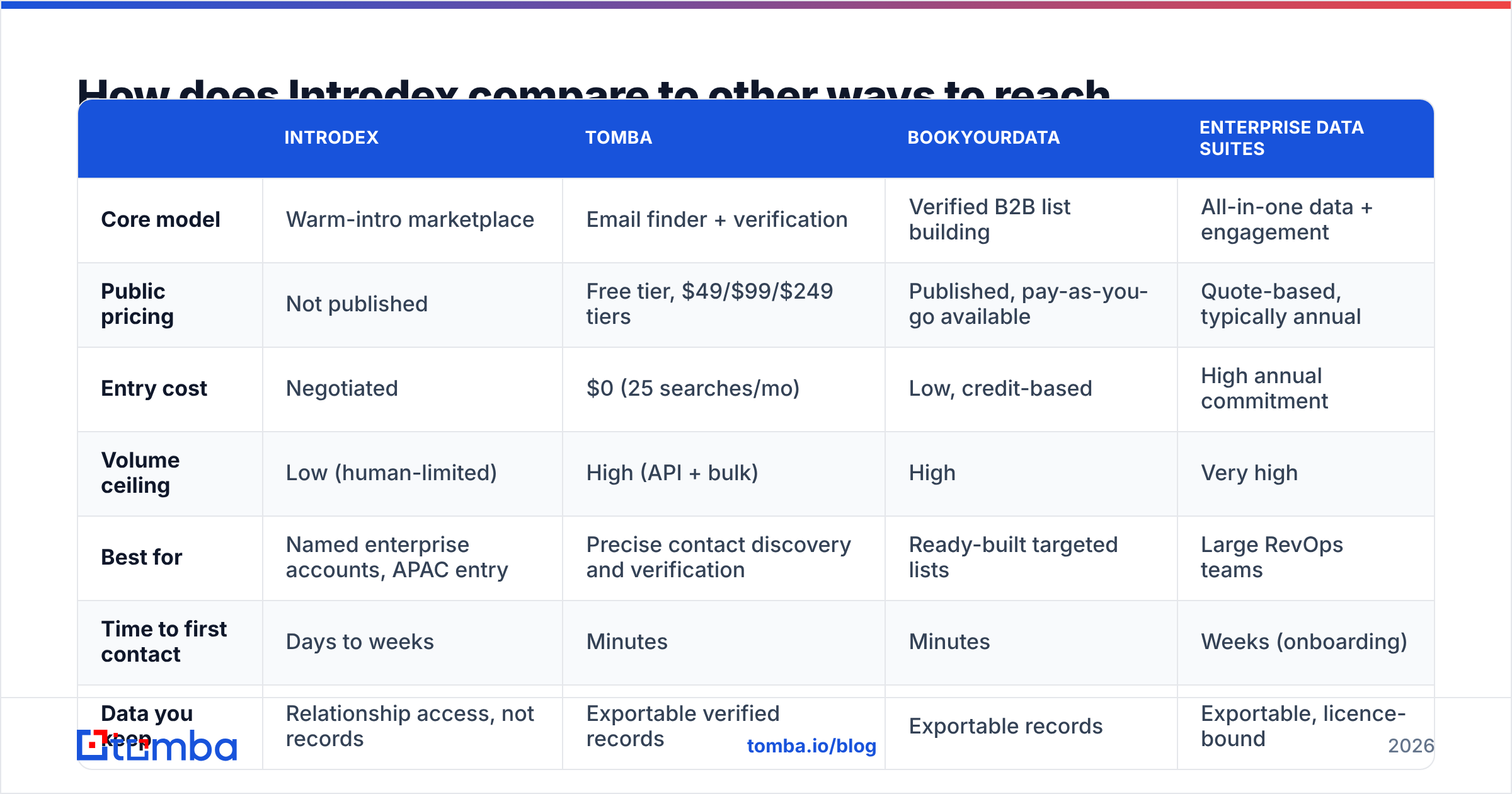
The honest comparison is not "Introdex vs. another intro platform." It is "brokered relationships vs. owned data vs. rented lists." These solve different parts of the same funnel, and most teams need two of the three.
| Introdex | Tomba | BookYourData | Enterprise data suites | |
|---|---|---|---|---|
| Core model | Warm-intro marketplace | Email finder + verification | Verified B2B list building | All-in-one data + engagement |
| Public pricing | Not published | Free tier, $49/$99/$249 tiers | Published, pay-as-you-go available | Quote-based, typically annual |
| Entry cost | Negotiated | $0 (25 searches/mo) | Low, credit-based | High annual commitment |
| Volume ceiling | Low (human-limited) | High (API + bulk) | High | Very high |
| Best for | Named enterprise accounts, APAC entry | Precise contact discovery and verification | Ready-built targeted lists | Large RevOps teams |
| Time to first contact | Days to weeks | Minutes | Minutes | Weeks (onboarding) |
| Data you keep | Relationship access, not records | Exportable verified records | Exportable records | Exportable, licence-bound |
| Main risk | Coverage gaps, attribution | Requires your own targeting | List fit depends on filters | Cost and contract lock-in |
BookYourData sits in a genuinely strong position here for teams who want a clean, pre-built targeted list without assembling one themselves — it is a different job than either Introdex or a search-and-verify workflow, and it does that job well.
The complementary stack most teams land on looks like this: use a warm-intro platform for the 20–50 accounts where a referral changes the outcome, and use verified contact data for everything else. You can find and validate the rest of your target market with an email finder and an email verifier for a fraction of what a single brokered enterprise intro costs.
Is Introdex worth it for your team?#
It depends almost entirely on your deal size and your geography.
Introdex is likely worth a pilot if:
- Your ACV is above roughly $30K, so one closed deal pays for a lot of introductions.
- You are entering APAC — especially Singapore, Indonesia, Vietnam, Malaysia — without a local brand or local team.
- Your target list is short and named. Forty accounts you can recite from memory, not four thousand you filtered into existence.
- You already have outbound running and it is stalling specifically at the "nobody knows us" stage, not at the "our message is bad" stage.
Introdex is probably not worth it if:
- Your ACV is under $10K. The math on brokered relationships rarely survives small contracts.
- You sell to SMBs at volume. You need thousands of touches, not dozens of doors.
- Your problem is targeting or deliverability, not trust. No introduction fixes a domain that lands in spam — that is a sender reputation and list-hygiene problem.
- You need forecastable unit economics this quarter. Quote-only pricing and forecasting are natural enemies.
How should you run an Introdex pilot without overpaying?#
Treat it like a paid experiment with a kill switch, not a procurement event.
- Cap the spend before the first call. Decide your maximum pilot budget internally — say, the fully loaded cost of one month of an SDR — and do not exceed it regardless of what the proposal looks like.
- Define the deliverable precisely. "Meeting held with a named director-or-above at one of these 30 accounts" is a deliverable. "An introduction" is not.
- Pre-check coverage. Give them your target list before signing and ask how many accounts they currently have a viable path into. If the answer is vague, that is your answer.
- Cap the attribution tail. Push the commission window down to 6 months and exclude accounts already in your CRM as of the signature date.
- Instrument everything. Track meetings held, opportunities created, and pipeline dollars per introduction. Compare against your existing outbound cost per meeting. One number versus one number.
- Keep the fallback running. Do not pause outbound during the pilot. If the intro channel underdelivers, you will not have burned a quarter finding out.
What should you do with the rest of your pipeline?#
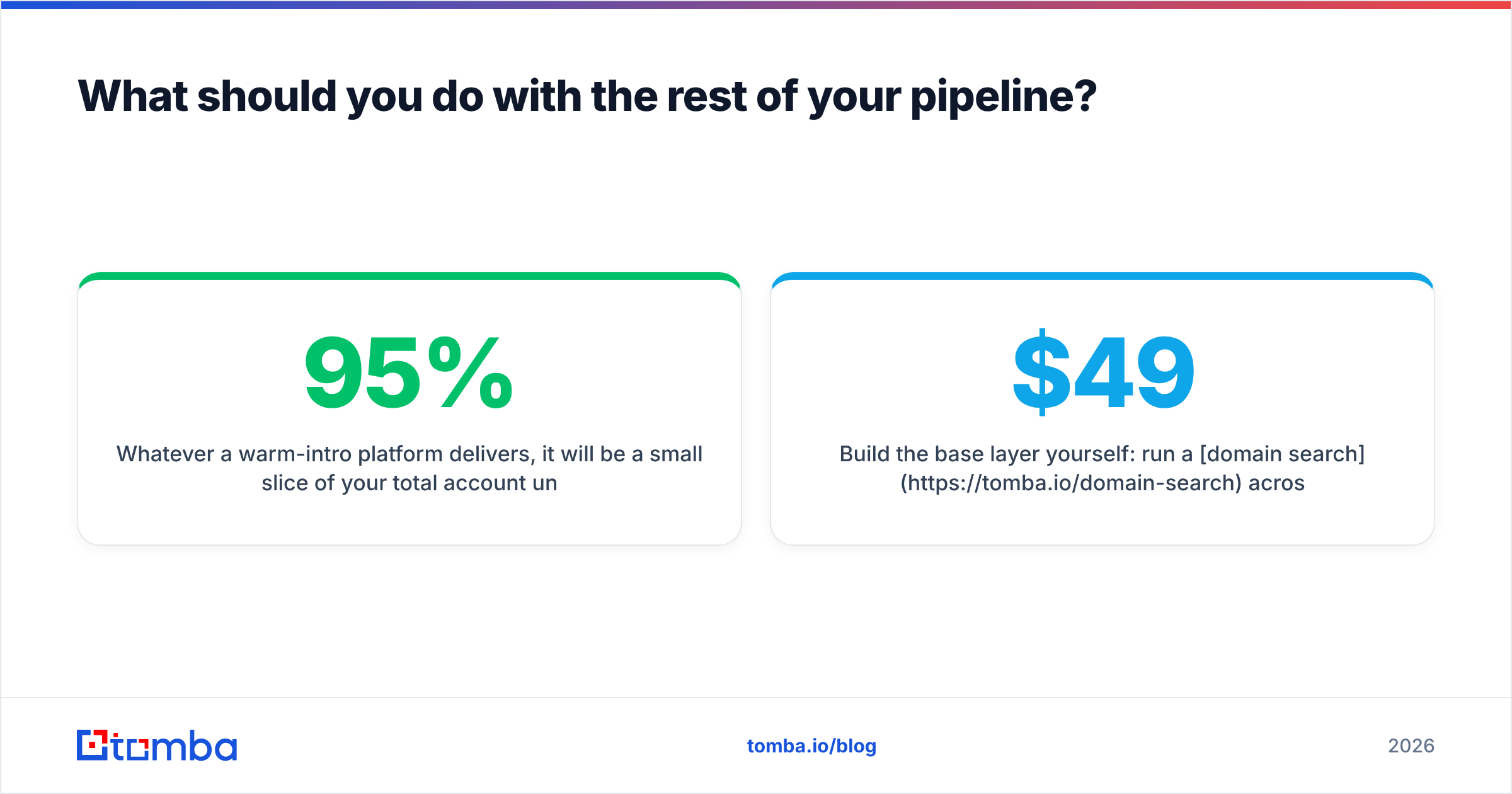
Whatever a warm-intro platform delivers, it will be a small slice of your total account universe. The other 95% still needs contacts, and that is a solvable, cheap, transparent problem.
Build the base layer yourself: run a domain search across your ICP account list to pull the people who actually hold the budget, verify before you send so your email deliverability does not decay, and enrich the survivors into your CRM. The pricing is on a page you can read without a sales call — free for 25 searches a month, $49/mo Starter, $99/mo Growth, $249/mo Pro, with full details on Tomba pricing.
That combination — brokered intros where trust is the blocker, verified data everywhere else — is the configuration that actually survives a budget review.
The verdict on Introdex pricing, reviews, pros and cons#
Introdex is a credible bet on a real insight: in enterprise APAC, a relationship beats a cold email nine times out of ten. The product is young, the review base is thin, and the pricing is invisible until you are in a sales conversation — so go in with a capped budget, a precise deliverable definition, and a short contract. Judged as a targeted market-entry experiment, it can absolutely pay for itself. Judged as a pipeline engine, it cannot carry the load, and no marketplace of human introductions ever will.
Build the layer underneath it first. Before you pay anyone to open a door, know exactly which doors are worth opening and who is standing behind them. Start with the Tomba Email Finder — free for your first 25 searches — map every decision-maker in your target accounts, verify the addresses, and then decide which handful of relationships are genuinely worth paying a connector for.
Related guides#
// get started
Find, verify and enrich your first contacts today
Start on the free plan with 25 searches a month, then scale when your team is ready.
Free plan · No credit card required · GDPR & CCPA
// about the author