Introhive Pricing, Reviews, Pros and Cons: 2026 Analysis
Introhive hides its price behind a sales call. Here is what buyers actually report paying, where the platform earns its keep, and where cheaper tooling covers the same job.
Introhive pricing is not on the website. You have to ask for a quote. This guide collects what real buyers report paying, what the reviews say, and when a cheaper tool does the same job.
TL;DR
- Introhive pricing is quote-only. Every deal runs through a sales call. Contracts are annual. Most buyers also pay a one-time setup fee.
- Buyers on review sites and procurement forums report $30–$60 per user per month, billed yearly. Seat minimums push first-year spend to $25,000–$60,000+ at a mid-size firm.
- You are paying for relationship intelligence. The tool captures contacts from email and calendar, cleans the CRM, and maps who knows whom. That is hard to build yourself.
- You are not paying for new contact discovery. Introhive maps people you already email. It will not find the CFO at a company nobody at your firm has contacted.
- If your real problem is missing emails, phones, and job titles in the CRM, a $49/mo enrichment stack fixes it for about 1% of the cost.
What is Introhive, exactly?#
Introhive is a relationship intelligence platform. It sits between your email, your calendar, and your CRM. It runs three jobs on a loop:
- Contact capture. It reads email headers and calendar invites across the firm. It pulls out every person your team talks to. It also grabs signature details like title, phone, and company.
- Relationship scoring. It rates how strong each connection is, based on how often you talk, how recently, and who replies. Then it shows the warmest path into a target account.
- CRM hygiene. It writes clean, de-duplicated records back to Salesforce, Dynamics, HubSpot, or a services CRM like Intapp. It also flags stale data.
The company started in 2012 and is based in Fredericton, Canada. It sells mostly to professional services: law firms, accounting practices, consultancies, and AEC firms. In those firms, one question can be worth millions: who here knows this general counsel? You can read the official pitch at introhive.com, and roughly 500 verified user reviews sit on G2.
That focus shapes Introhive pricing. Professional-services software is sold the way the services are sold: by quote, by seat block, by annual deal.
How much does Introhive pricing cost in 2026?#
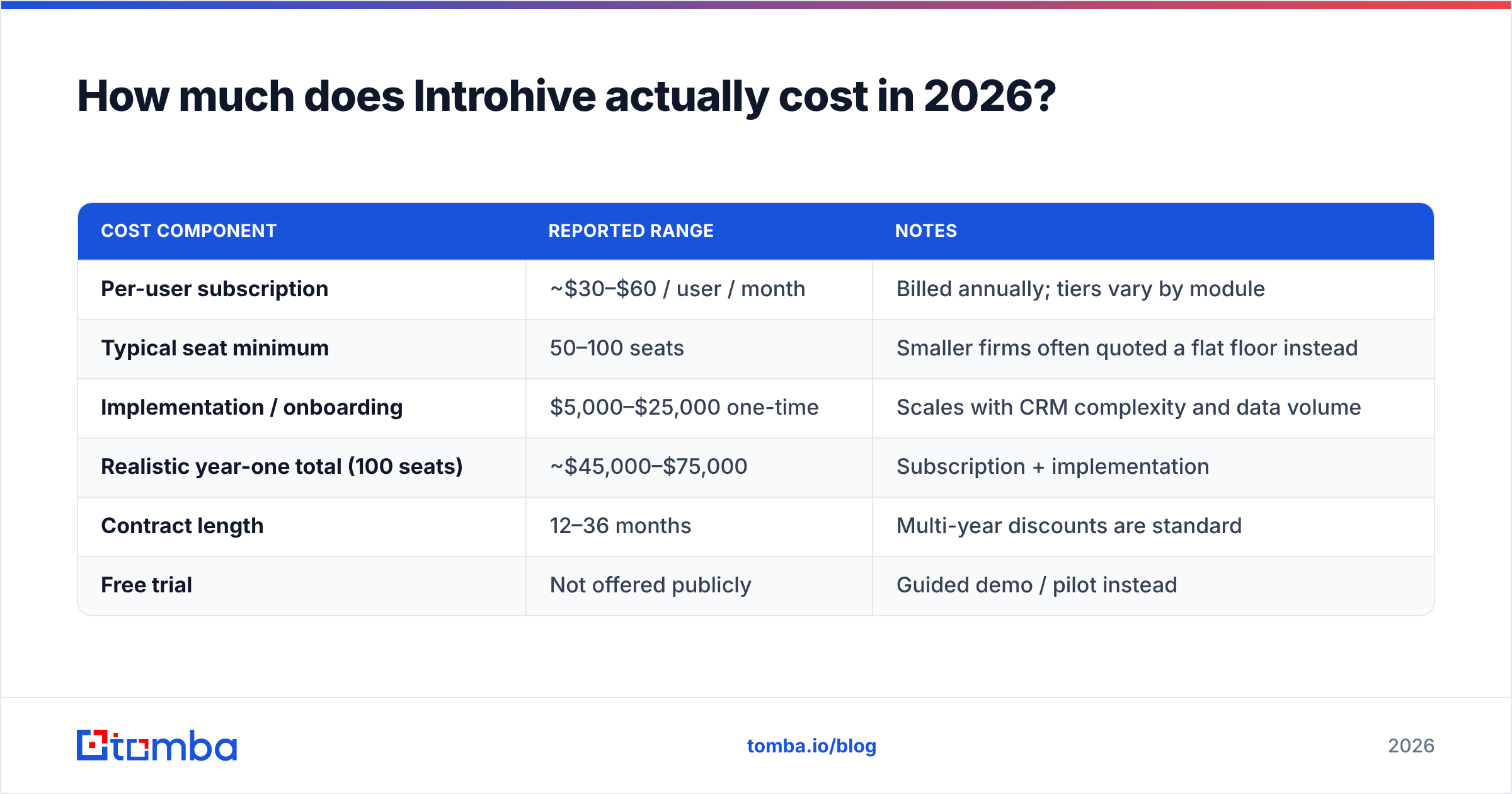
Introhive publishes no price list. There is no self-serve signup, no free tier, and no public rate card. Every number below comes from buyers. The sources are review sites, procurement forums, and public-sector contract records. Treat the ranges as a guide, not a quote.
| Cost component | Reported range | Notes |
|---|---|---|
| Per-user subscription | ~$30–$60 / user / month | Billed annually; tiers vary by module |
| Typical seat minimum | 50–100 seats | Smaller firms often quoted a flat floor instead |
| Implementation / onboarding | $5,000–$25,000 one-time | Scales with CRM complexity and data volume |
| Realistic year-one total (100 seats) | ~$45,000–$75,000 | Subscription + implementation |
| Contract length | 12–36 months | Multi-year discounts are standard |
| Free trial | Not offered publicly | Guided demo / pilot instead |
Three things move Introhive pricing more than anything else:
- Which modules you buy. Contact and relationship sync is the entry point. Pre-meeting digests, business-development dashboards, data-quality scoring, and the marketing-list module cost extra.
- CRM complexity. A clean, single Salesforce org goes live fast. Three merged legacy CRMs with 400,000 duplicate accounts do not. The services team bills for that work.
- When you negotiate. Quarter-end and year-end quotes are softer. Buyers often report 15–25% off the first number.

The short version: this is enterprise software at an enterprise price. If your first question is the monthly cost, you are probably not the target buyer. That is fine. The tool is built for firms where one extra cross-sell pays for the year.
What do Introhive reviews say?#
Scores on G2 and Capterra sit between 4.3 and 4.5. That is strong for a data product. But the average hides a split. Sentiment tracks firm type, and whether the customer had a dedicated admin.
What reviewers praise:
- Contact capture just works. This is the most repeated compliment. Reps stop typing contacts in by hand. The CRM fills itself.
- Relationship mapping finds real introductions. Partners report that a colleague three offices away has known a target prospect for years.
- People read the pre-meeting digest. The email brief before a client meeting covers recent contact, open work, and news. Users say they would miss it most.
- Support scores well. Buyers call the rollout team responsive and hands-on. That softens the setup fee.
What reviewers criticize:
- Price versus adoption. The top one-star theme is not a broken product. It is that only 30% of paid seats ever logged in. Shelfware at $50 a seat hurts.
- Rollout length. Eight to sixteen weeks is normal. Some firms describe six months when data cleanup was underestimated.
- Privacy friction. Scanning firm-wide email metadata raises fair questions, above all under GDPR. There are controls for it. Still, expect a talk with legal and works councils.
- Rigid reporting. Custom dashboards and exports come up often as the weak spot.
- It does not find new contacts. This is the misread that drives the angriest reviews. Introhive maps the network you have. It is not a prospecting database.
That last point earns its own section. It is where most bad purchases start.
Is Introhive a lead generation tool?#
No. Mixing up the two is the costliest mistake in this category.
Introhive is a first-party system. It feeds on your firm's own email and calendar traffic. If nobody at your company has ever emailed an account, Introhive knows nothing about it.
An email finder is a third-party system. It feeds on public web data, verified patterns, and crawled sources. It answers a different question: what is the email of the VP of Engineering at a company you have never touched?
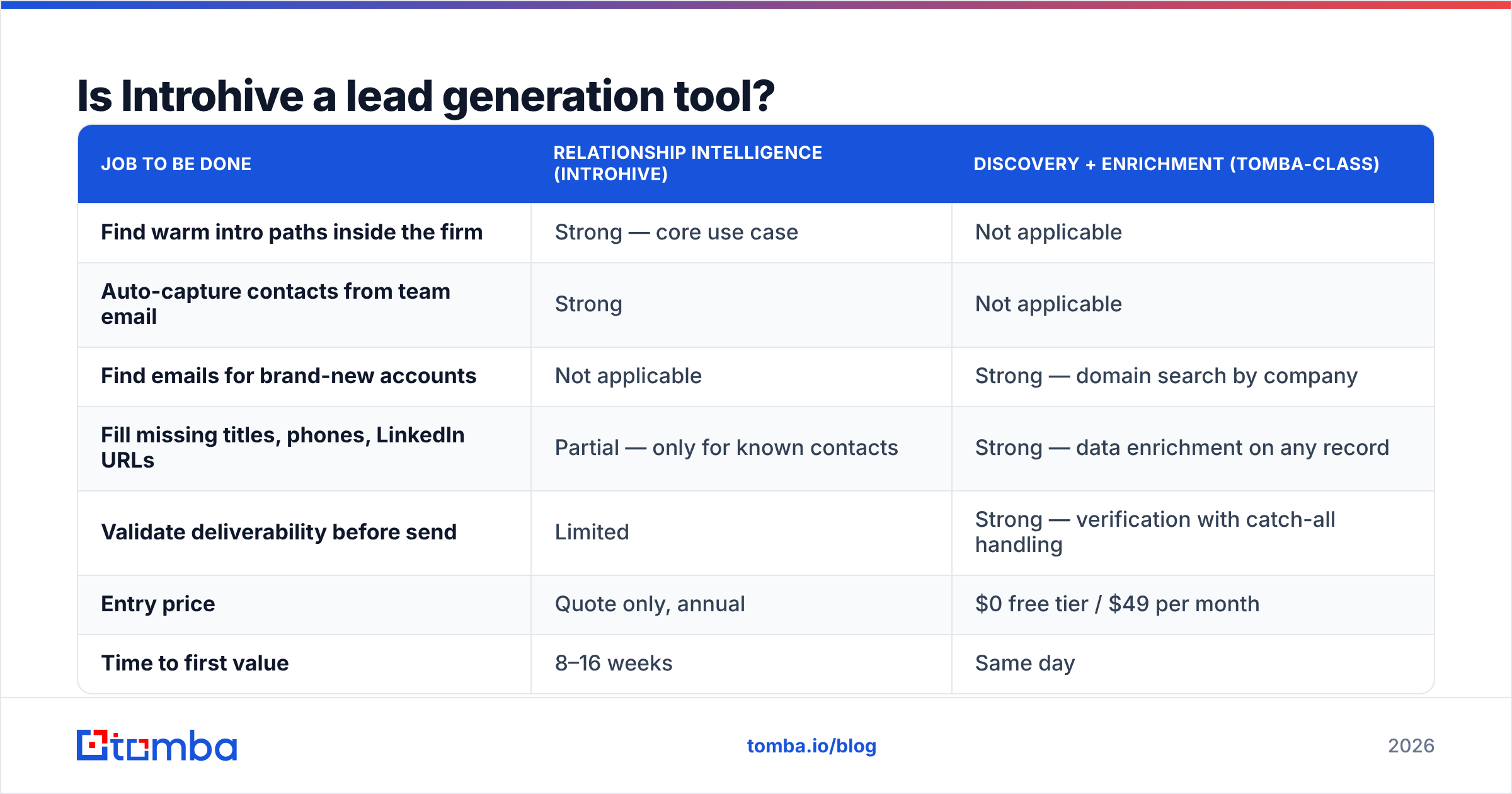
Those are two jobs that sit side by side. Here is the split:
| Job to be done | Relationship intelligence (Introhive) | Discovery + enrichment (Tomba-class) |
|---|---|---|
| Find warm intro paths inside the firm | Strong — core use case | Not applicable |
| Auto-capture contacts from team email | Strong | Not applicable |
| Find emails for brand-new accounts | Not applicable | Strong — domain search by company |
| Fill missing titles, phones, LinkedIn URLs | Partial — only for known contacts | Strong — data enrichment on any record |
| Validate deliverability before send | Limited | Strong — verification with catch-all handling |
| Entry price | Quote only, annual | $0 free tier / $49 per month |
| Time to first value | 8–16 weeks | Same day |
Firms that buy Introhive for column three end up unhappy. Firms that buy it for column two, then add a cheap discovery tool, write the good reviews.

What are the real pros and cons?#
Here is each side with the marketing stripped off.
Pros
- Best-in-class passive capture. Reps do not change how they work. That is the only kind of CRM hygiene that survives a sales floor.
- Network effects in big firms. More seats means a richer relationship graph. Seat-based Introhive pricing lines up with the value you get.
- Built for professional services. Matter and engagement workflows are native, not bolted on. Law and accounting firms hit less friction here than in a generic sales tool.
- A measurable drop in CRM decay. Firms report double-digit gains in record completeness in year one. That is the metric revenue operations is judged on.
- Mature CRM links. The Salesforce and Dynamics connectors run both ways.
Cons
- Opaque, high floor. Introhive pricing comes with no trial, no public tier, and no way to test ten seats before you commit budget.
- Adoption is the whole risk. Value depends on a wide rollout. A wide rollout is also what drives the cost. Unused seats are pure waste.
- Slow rollout. Plan a quarter, not a sprint. Name an internal owner or the project stalls.
- Privacy work. Firm-wide email scanning needs policy, staff comms, and in the EU, likely a DPIA.
- No new contacts. You still need a second tool for cold outbound.
- Overkill under ~50 people. At that size the internal network is small. A shared sheet and some CRM discipline get you most of the way.
Who should buy Introhive — and who should not?#
Buy it if:
- You run a professional-services firm with 100+ client-facing staff, and cross-selling is a stated priority.
- Most revenue comes from growing existing relationships, not from cold deals.
- You have a CRM admin or RevOps owner who can drive a multi-month rollout.
- Your deal size is big enough that one sourced introduction pays back a chunk of the annual fee.
Skip it if:
- You are a startup or SMB team selling mostly to new accounts.
- Your CRM problem is missing emails and phone numbers, not missing context.
- You cannot sign a 12-month deal or roll the tool out firm-wide.
- Your team is under 50 people.
For that second group, and it is a big group, the cheaper stack is not a downgrade. It is a different tool for a different job.
What are the cheaper alternatives for filling CRM gaps?#
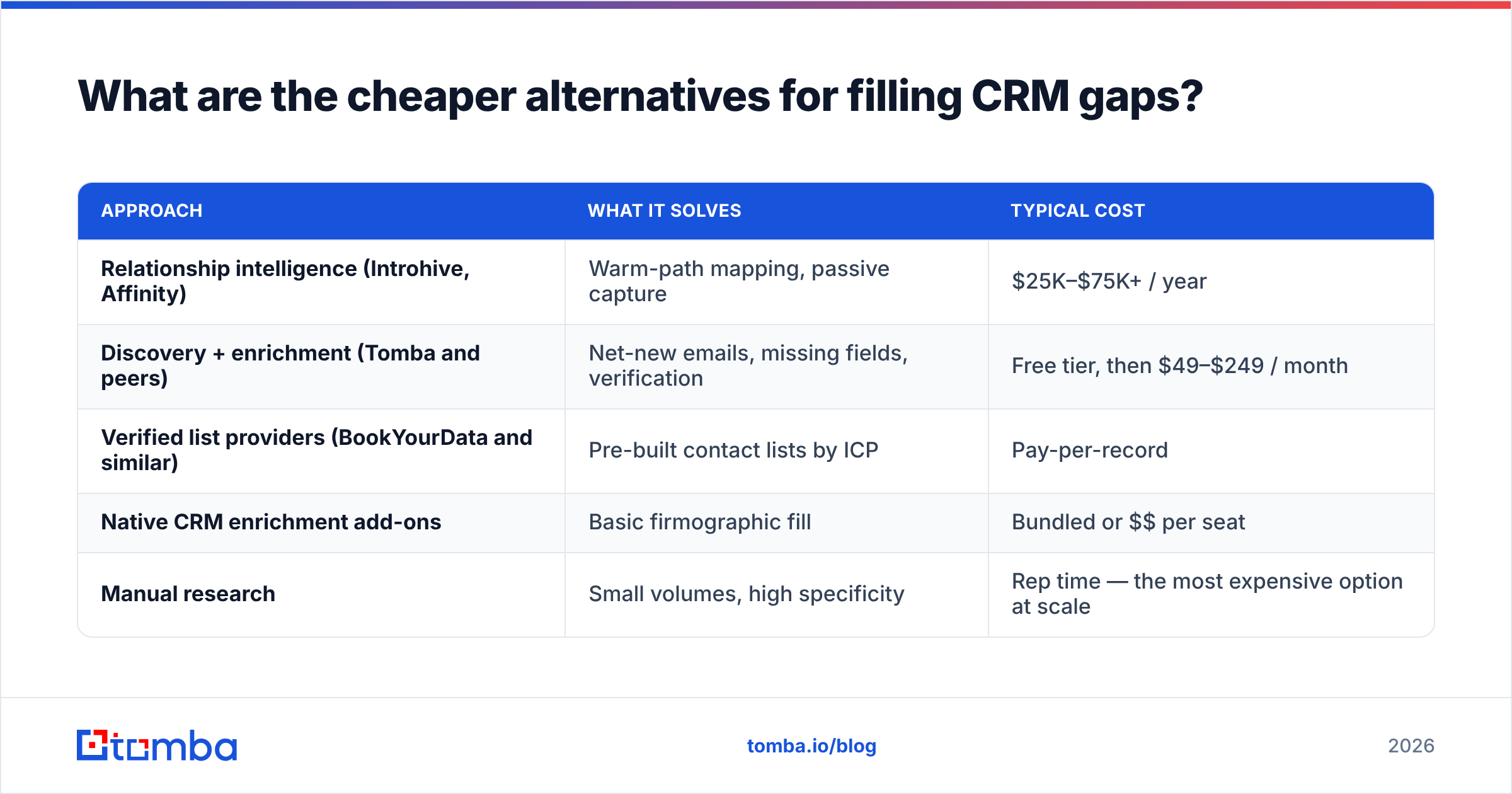
Say the real pain is thin contact records and cold accounts you cannot reach. Then Introhive pricing buys a fix for the wrong problem. Here is what the cheaper stack looks like:
| Approach | What it solves | Typical cost |
|---|---|---|
| Relationship intelligence (Introhive, Affinity) | Warm-path mapping, passive capture | $25K–$75K+ / year |
| Discovery + enrichment (Tomba and peers) | Net-new emails, missing fields, verification | Free tier, then $49–$249 / month |
| Verified list providers (BookYourData and similar) | Pre-built contact lists by ICP | Pay-per-record |
| Native CRM enrichment add-ons | Basic firmographic fill | Bundled or $$ per seat |
| Manual research | Small volumes, high specificity | Rep time — the most expensive option at scale |
Most teams need the second row long before the first. Tomba pricing opens with a free tier at 25 searches a month. Starter is $49/mo, Growth is $99/mo, and Pro is $249/mo. It is all self-serve, and you can cancel. There is no implementation project. The Tomba API does the same CRM-fill job as Introhive's hygiene module. It also works on records where you have no prior relationship at all.
You can run both. A large firm can map its internal network with Introhive and enrich cold accounts through a discovery API. Next to the Introhive pricing line item, the discovery layer is a rounding error.
How should you negotiate Introhive pricing?#
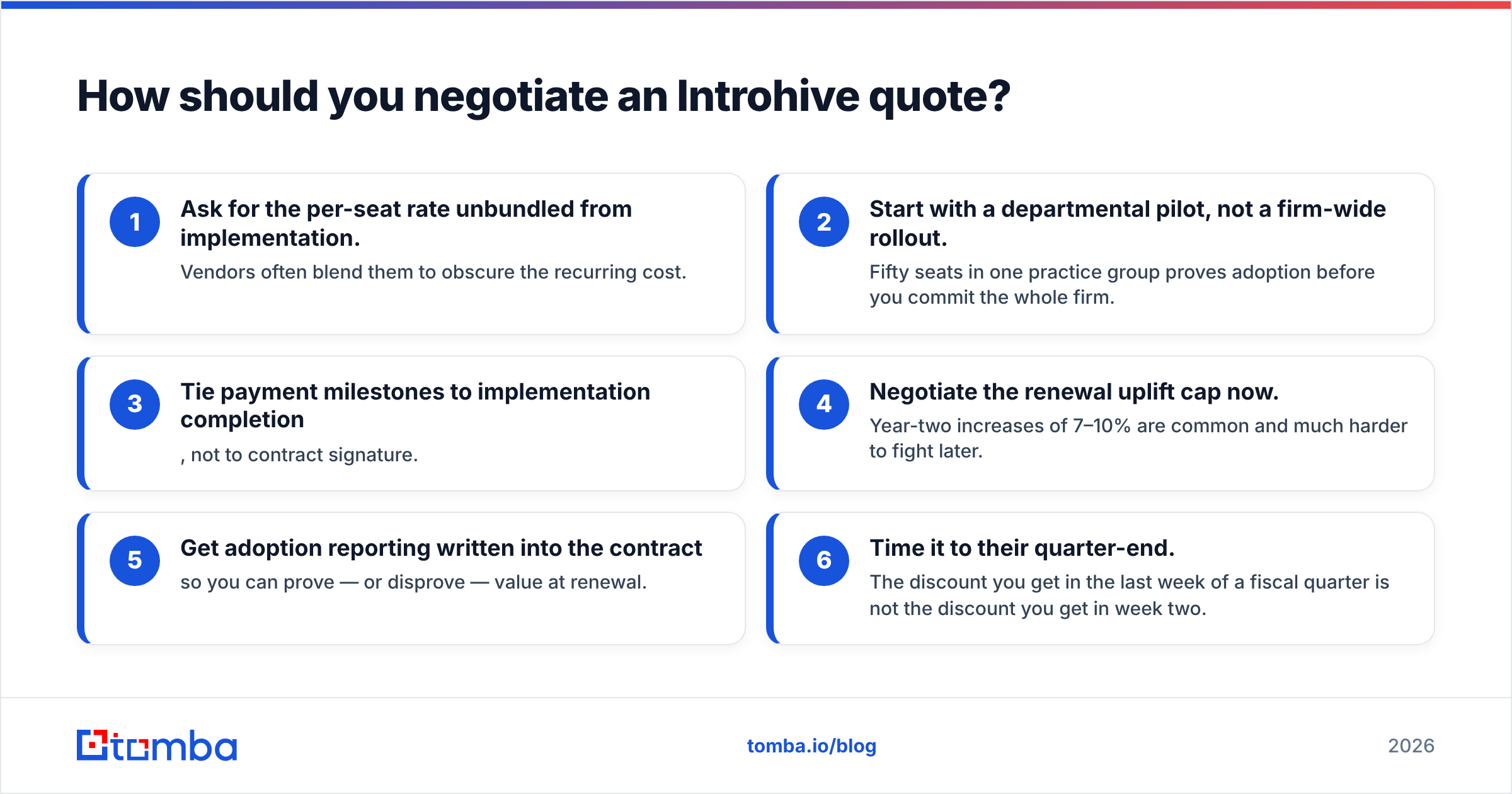
If the platform fits, treat the first quote as an opening bid:
- Split the seat rate from the setup fee. Vendors blend them to hide the recurring cost.
- Start with one department, not the whole firm. Fifty seats in one practice group proves adoption first.
- Tie payments to rollout milestones, not to the signature date.
- Cap the renewal uplift now. Year-two jumps of 7–10% are common, and much harder to fight later.
- Put adoption reporting in the contract. Then you can prove value at renewal, or disprove it.
- Time it to their quarter-end. The discount in the last week of a quarter beats the one in week two.
The bottom line on Introhive pricing#
Introhive is a strong product at an enterprise price. It is sold to one kind of buyer: a large, relationship-driven professional-services firm with the discipline to deploy it widely. For that buyer, the relationship graph is hard to get any other way. The reviews back that up.
For everyone else, Introhive pricing pays for a problem you do not have. That includes outbound sales teams, growth-stage companies, and agencies whose CRM gaps are missing emails rather than missing context.
If your real blocker is reaching people you have never met, start with discovery. The Tomba Email Finder finds verified work email addresses by name, domain, or company. The free tier lets you test accuracy on your own target accounts first. Run 25 searches against a list you already know. Check the hit rate. Let the data decide. That is a much faster process than a three-month enterprise evaluation. And if you still need relationship intelligence afterward, at least you will buy it for the right reason.
Related guides#
// get started
Find, verify and enrich your first contacts today
Start on the free plan with 25 searches a month, then scale when your team is ready.
Free plan · No credit card required · GDPR & CCPA
// about the author