InvestGlass Pricing Review 2026: Real Costs, Pros and Cons
A neutral breakdown of InvestGlass pricing in 2026: what each tier actually includes, the setup and hosting costs reviewers keep flagging, and who should pick something else.
Short answer: InvestGlass is worth it if you run a regulated European finance firm. This InvestGlass pricing review breaks down the real per-seat cost, the fees that show up later, and the pros and cons buyers report. Read it before you sign anything.
TL;DR
- InvestGlass is a Swiss-hosted CRM and client-portal platform. It is built for banks, wealth managers, independent asset managers, and other regulated financial firms — not for generalist B2B sales teams.
- Entry pricing looks cheap on paper: low double-digit dollars per user per month. The invoice you sign is bigger. Onboarding, data migration, hosting choice, and module add-ons all push it up.
- The strongest reviews praise compliance features, Swiss data residency, and a no-code automation builder. The most common complaints are a dated UI, thin third-party integrations, and documentation gaps.
- InvestGlass does not sell prospect data. You still need a separate source for verified work emails, phones, and firmographics before the CRM has anything useful in it.
- Verdict: worth it if you are a regulated European financial firm that needs data sovereignty. It is a poor fit for a SaaS or agency team running normal outbound.
What is InvestGlass and who is it actually for?#
InvestGlass is a Swiss CRM and digital-onboarding platform for financial services. Think of it less as a Salesforce rival and more as a compliance-first work system for advisors. You get client records, KYC and onboarding forms, e-signature, secure client portals, and a no-code automation layer on top.
Hosting is the pitch that sets it apart. InvestGlass runs on Swiss infrastructure, and it offers on-premise or private-cloud deployment. That matters a lot under FINMA rules, GDPR scrutiny, or an internal policy that bars US-controlled cloud providers. That one trait shapes most of the product — and most of its price.
Who it fits:
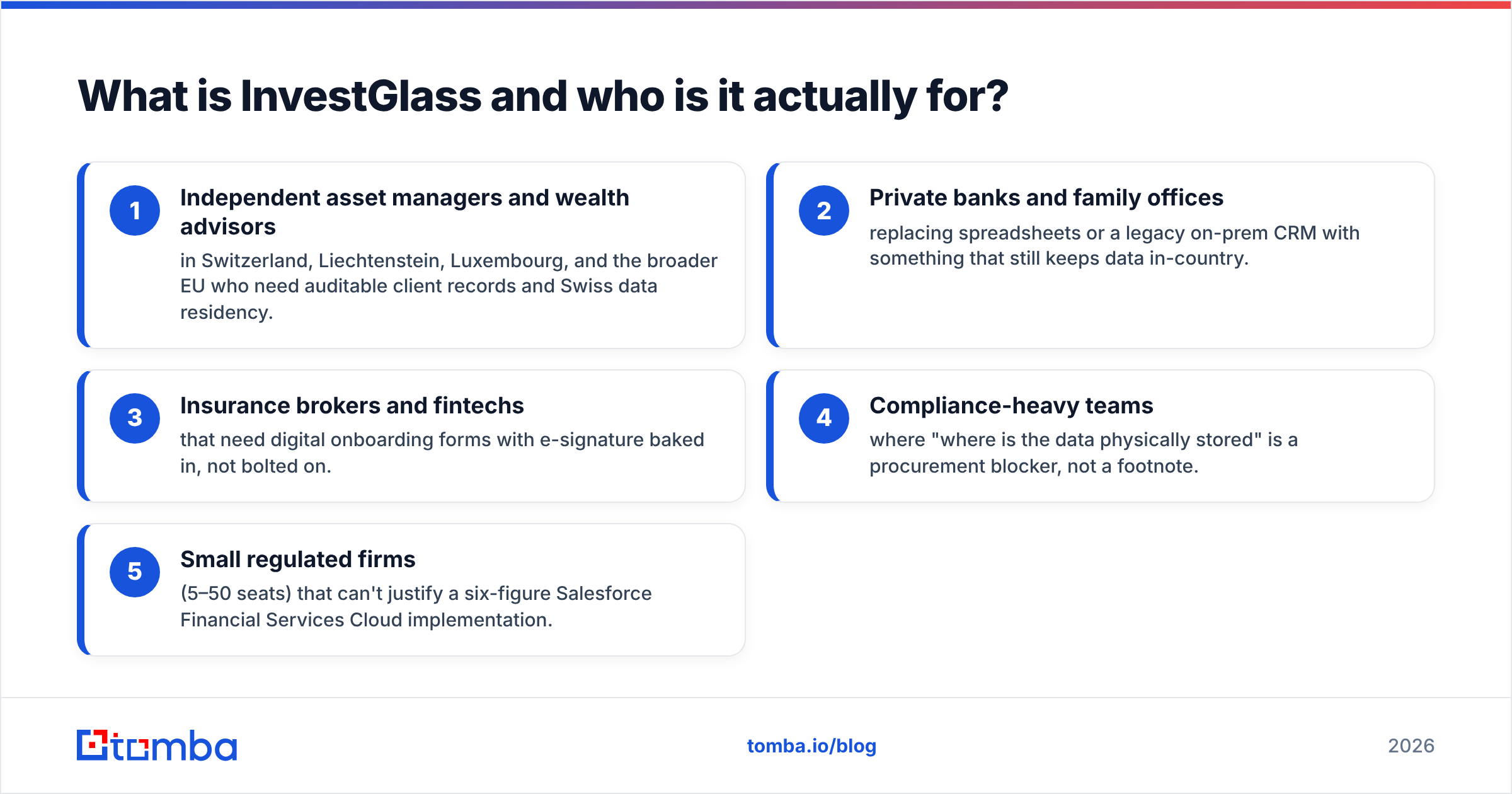
- Independent asset managers and wealth advisors in Switzerland, Liechtenstein, Luxembourg, and the wider EU who need auditable client records and Swiss data residency.
- Private banks and family offices moving off spreadsheets or a legacy on-prem CRM, but keeping data in-country.
- Insurance brokers and fintechs that need digital onboarding forms with e-signature built in, not bolted on.
- Compliance-heavy teams where "where is the data stored" is a procurement blocker, not a footnote.
- Small regulated firms (5–50 seats) that cannot justify a six-figure Salesforce Financial Services Cloud build.
Who it does not fit: standard B2B SaaS sales teams, agencies, and outbound teams. If your buying committee has never said the word "regulator," you are paying for architecture you do not need. You also give up the sales tooling you do need.
InvestGlass pricing review: what does it really cost in 2026?#
Here is the honest framing. The published per-user price is real, and it is far cheaper than the enterprise CRM field. It is also only part of the bill.
Published entry pricing has sat in the low-$20s per user per month. The vendor quotes in Swiss francs, so the dollar figure moves with the exchange rate. Mid-tier plans cost several times that. Sovereign and on-premise deployments are quoted case by case. Before you budget, pull the current numbers from InvestGlass's own pricing page. Swiss vendors reprice in francs more often than US vendors reprice in dollars, so any number in a blog post is a snapshot.
What a realistic total cost of ownership looks like:
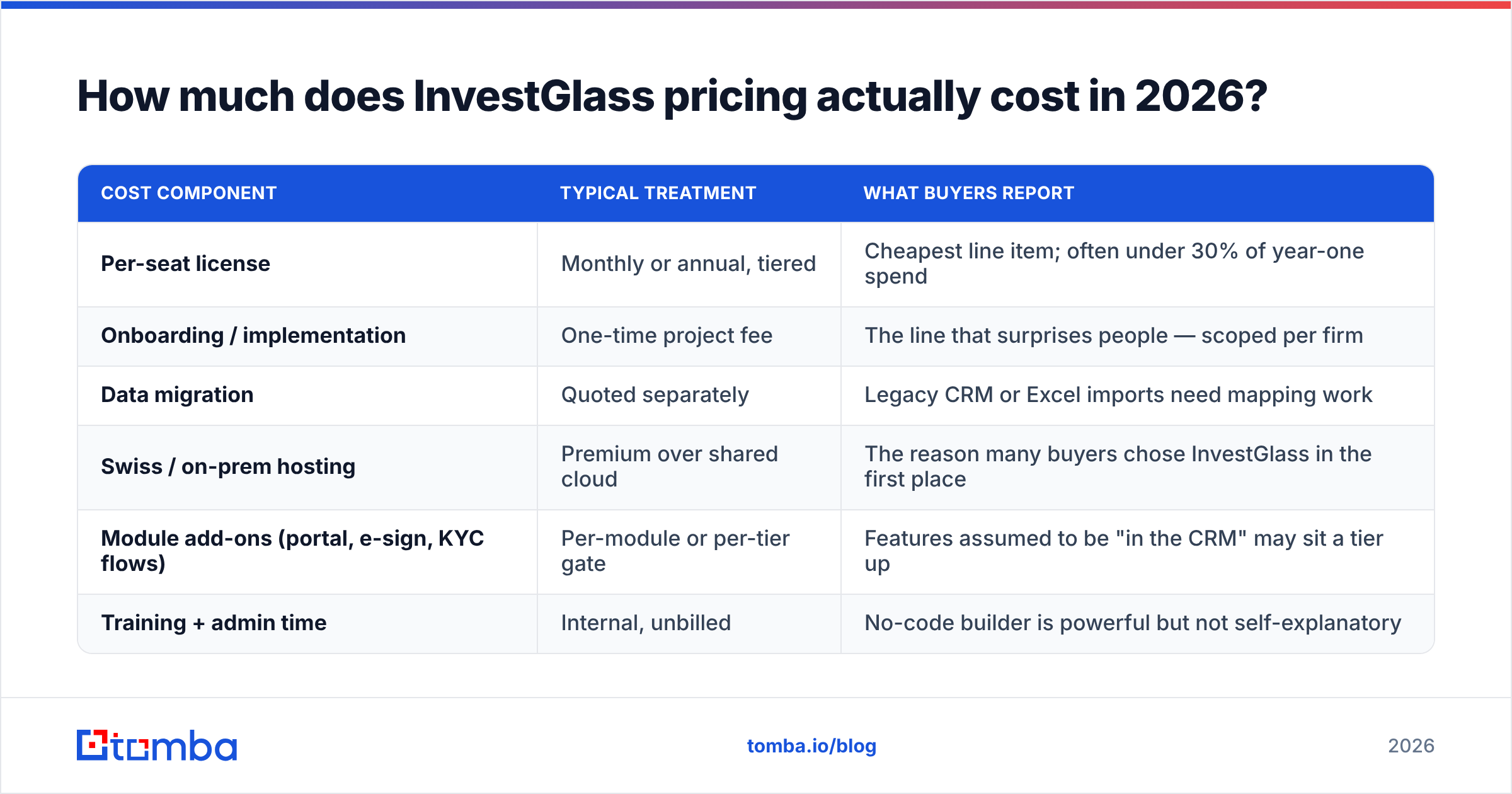
| Cost component | Typical treatment | What buyers report |
|---|---|---|
| Per-seat license | Monthly or annual, tiered | Cheapest line item; often under 30% of year-one spend |
| Onboarding / implementation | One-time project fee | The line that surprises people — scoped per firm |
| Data migration | Quoted separately | Legacy CRM or Excel imports need mapping work |
| Swiss / on-prem hosting | Premium over shared cloud | The reason many buyers chose InvestGlass in the first place |
| Module add-ons (portal, e-sign, KYC flows) | Per-module or per-tier gate | Features assumed to be "in the CRM" may sit a tier up |
| Training + admin time | Internal, unbilled | No-code builder is powerful but not self-explanatory |
The pattern holds across mid-market European CRM buys. The license is the advertised number. The implementation is the real number. Gartner and Forrester both report that CRM implementation costs often match or beat first-year subscription spend. Nothing about InvestGlass escapes that gravity.
What do InvestGlass reviews say?#
Review volume is modest next to Salesforce or HubSpot. That is normal for a vertical Swiss vendor, so read the sample size, not just the star rating. Any InvestGlass pricing review is only as good as its sources. Check the current listings on G2 and Capterra yourself, rather than trusting an aggregate figure quoted in a post. That includes this one.
The recurring themes in published reviews:
What reviewers consistently praise
- Data sovereignty. Swiss hosting and on-prem options close compliance objections that no US vendor can answer.
- Responsive support. Small-vendor advantage — buyers repeatedly mention talking to people who know the product.
- No-code automation. Teams build approval flows, onboarding sequences, and client forms without engineers. It is the most-cited win.
- Price versus incumbents. Next to Salesforce Financial Services Cloud or a private-banking core system, InvestGlass looks cheap.
- Digital onboarding. KYC forms plus e-signature in one flow saves real cycle time for advisors.
What reviewers consistently criticize
- Interface age. The UI works, but it does not look modern. Teams coming from HubSpot or Pipedrive notice at once.
- Integration depth. The connector list is thin next to mainstream CRMs. Expect API work or middleware for anything unusual.
- Documentation gaps. Self-serve learning is harder than it should be, so onboarding help is often a must.
- Configuration overhead. Flexibility cuts both ways. A powerful builder means someone has to own the build.
- Reporting. Fine for advisor workflows. Weaker if you want pipeline analytics a sales leader would recognize.
How does InvestGlass compare to other CRM options?#
The right comparison set depends on what you are optimizing for: regulatory fit, sales speed, or price.
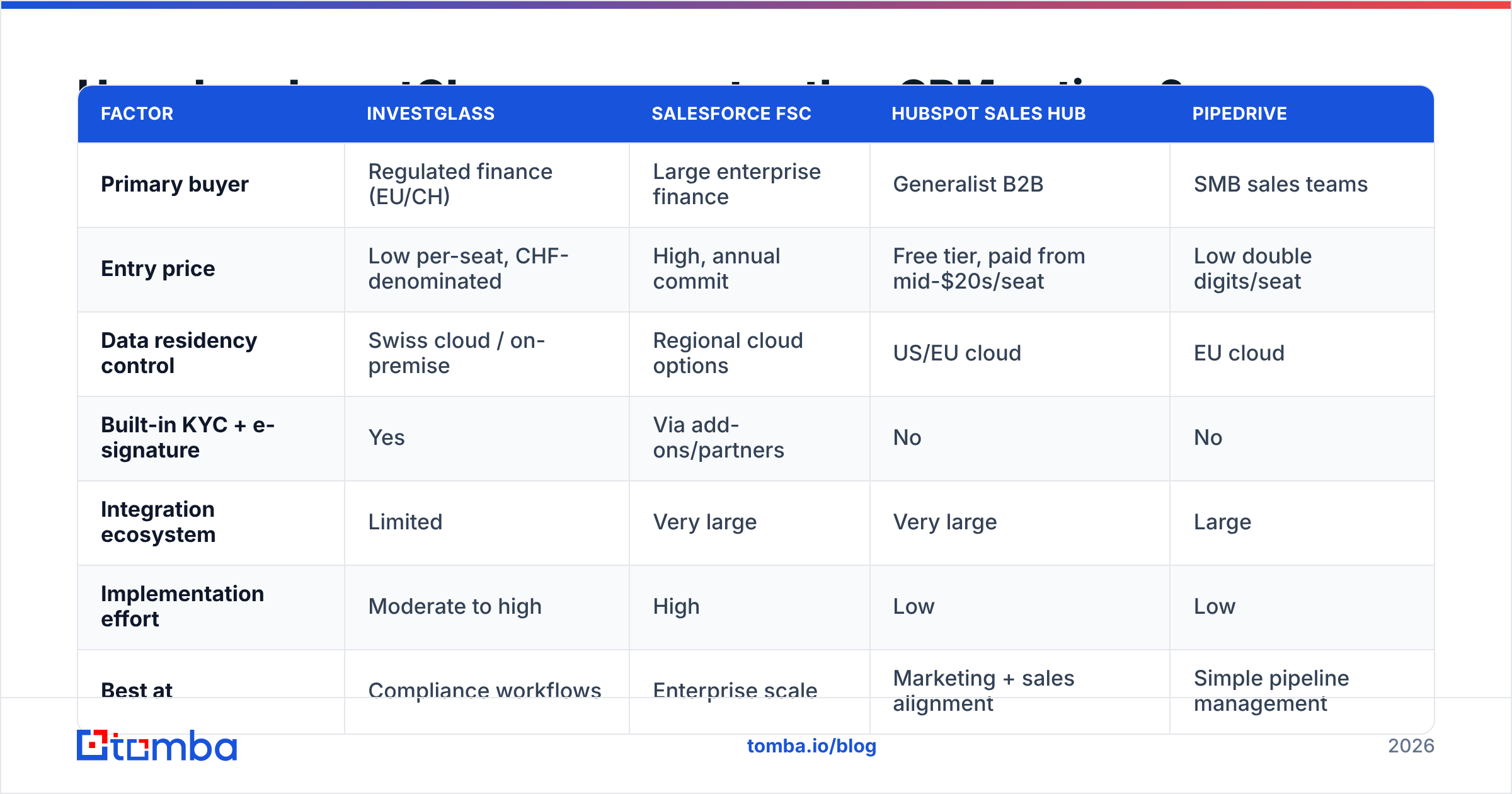
| Factor | InvestGlass | Salesforce FSC | HubSpot Sales Hub | Pipedrive |
|---|---|---|---|---|
| Primary buyer | Regulated finance (EU/CH) | Large enterprise finance | Generalist B2B | SMB sales teams |
| Entry price | Low per-seat, CHF-denominated | High, annual commit | Free tier, paid from mid-$20s/seat | Low double digits/seat |
| Data residency control | Swiss cloud / on-premise | Regional cloud options | US/EU cloud | EU cloud |
| Built-in KYC + e-signature | Yes | Via add-ons/partners | No | No |
| Integration ecosystem | Limited | Very large | Very large | Large |
| Implementation effort | Moderate to high | High | Low | Low |
| Best at | Compliance workflows | Enterprise scale | Marketing + sales alignment | Simple pipeline management |
The takeaway: InvestGlass does not compete on sales features, so do not score it as if it did. It competes on where the data lives and how defensible the audit trail is. Score it on integration count or pipeline dashboards and it loses to tools that cost more but solve a different problem. Score it on "can I keep client data in Switzerland without a six-figure project," and it wins its bracket.
Is your real constraint outbound volume rather than compliance? Then a lighter CRM plus a dedicated prospecting stack usually beats a vertical platform on both cost and speed.
What are the hidden costs in InvestGlass pricing?#
Four line items decide whether the cheap headline price survives contact with reality.
- Implementation scope creep. Every regulated firm thinks its onboarding flow is standard. It never is. Budget for a scoping call before you sign, and get the implementation fee fixed in writing.
- Hosting tier. Shared Swiss cloud and dedicated or on-prem hosting are very different price points. If your compliance team insists on the latter, the per-seat comparison against HubSpot stops meaning much.
- Module gating. Confirm in writing which tier includes the client portal, e-signature volume, and document storage limits. "Available" and "included in your plan" are different words.
- Seat math. Per-user pricing punishes firms that want read-only access for compliance officers, auditors, or part-time advisors. Ask whether limited-access seats exist and what they cost.
- Your own admin time. A no-code builder is a real cost center until someone owns it. One person has to become the InvestGlass admin, and that is 10–20% of a role in year one.
What does InvestGlass not give you?#
Prospect data. Nobody flags this gap in a feature grid, and it is the one that stalls pipelines.
InvestGlass manages relationships you already have. It does not hand you the verified work email of the CFO at a family office you want to court. It does not append firmographics to a list of target firms. It does not clean the dead contacts you migrated in from your old system. Every CRM has this same blind spot, vertical or generalist. Every CRM rollout hits it in month two, when someone notices that half the imported records bounce.
That is a separate layer of the stack, and it is worth budgeting for on its own:
- Finding contacts. An email finder turns names and domains into deliverable addresses, so your advisors are not guessing at
firstname.lastname@patterns. - Cleaning what you migrate. Run your legacy list through an email verifier before import. You stop paying to store dead records, and you protect your sending reputation from day one.
- Filling gaps in existing records. Data enrichment adds company size, industry, and role data to thin rows, so segmentation actually works.
- Mapping a target firm. Domain search returns the contactable people at a company. It is the fastest way to build a coverage map of an account.
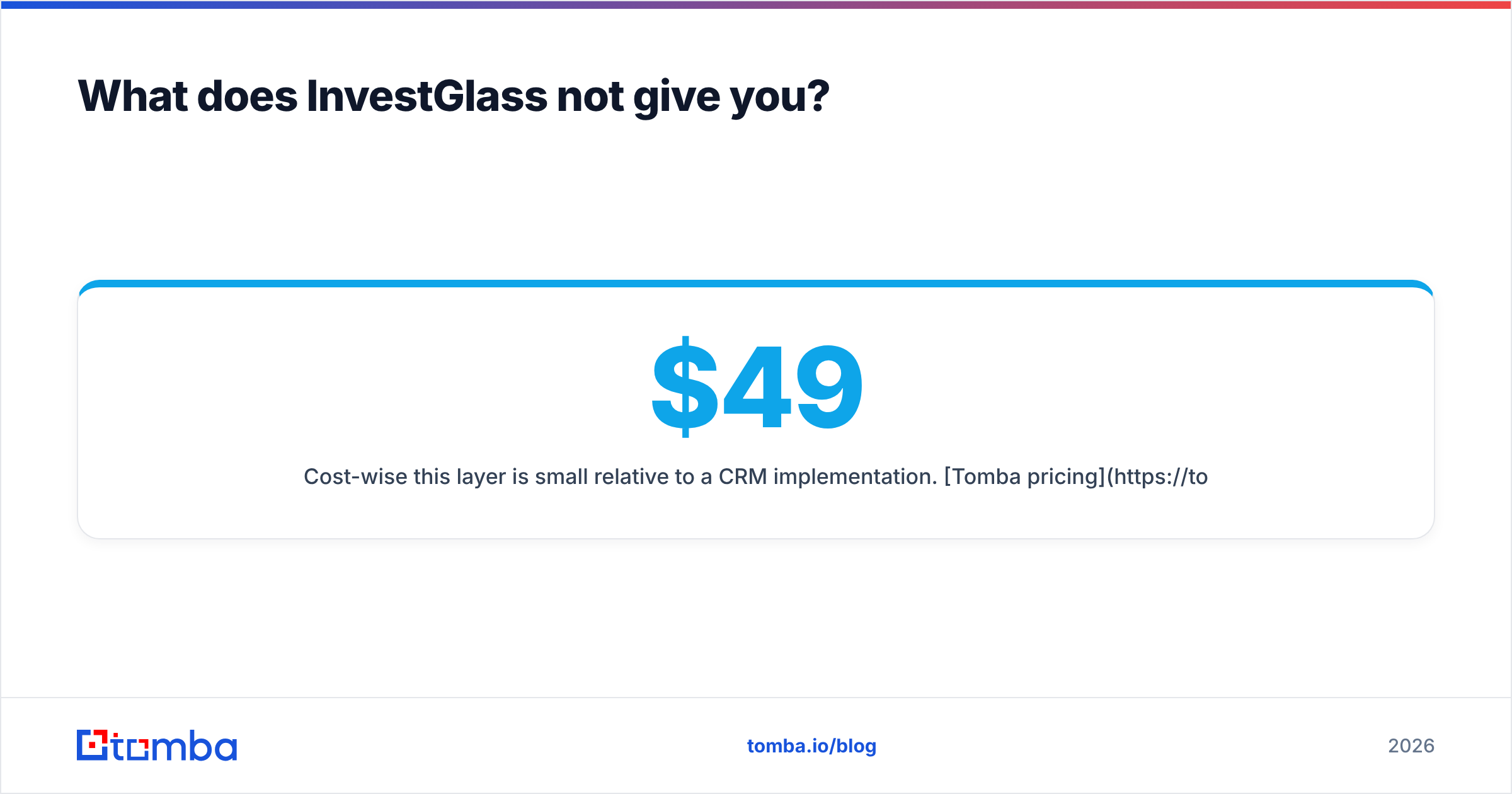
This layer is cheap next to a CRM implementation. Tomba pricing runs a free tier at 25 searches per month, then $49/mo for Starter, $99/mo for Growth, and $249/mo for Pro. Enterprise is quoted case by case. On a regulated-CRM contract, that is a rounding error next to the onboarding fee.
Is InvestGlass worth it in 2026?#
Yes, with conditions. Here is the decision test that closes this InvestGlass pricing review.
Buy InvestGlass if you run a European regulated financial firm of roughly 5 to 100 seats. Data residency has to be a hard procurement requirement. You need KYC and e-signature inside the same system as your client records. And you need one person who can own the setup. In that profile, nothing else at this price clears the compliance bar.
Skip it if your team does volume outbound, you live inside a marketing-plus-sales motion, you need dozens of native integrations, or your criteria include "does it look modern." You will fight the product. The savings versus HubSpot or Pipedrive will vanish into workaround time.
Negotiate hard if you are on the fence. Ask for the implementation fee as a fixed quote. Request a sandbox loaded with your own migrated sample data. Get module inclusions written into the order form. Swiss vendors in this segment negotiate readily, because small vendors want logos in your vertical, and a multi-year commitment is real leverage.
One last practical note: run a pilot with ten real client records, not demo data. Migration friction is the best predictor of whether a CRM rollout succeeds, and a sales demo hides it completely.
Ready to fill your CRM with contacts that actually exist?#
Whatever CRM you land on — InvestGlass, HubSpot, or the spreadsheet you are still secretly using — it is only as valuable as the contact data inside it. Start with the Tomba Email Finder to turn target companies and names into verified, deliverable work emails before you import a single row. The free tier gives you 25 searches a month, so you can test accuracy against accounts you already know. Paid plans start at $49/mo when you are ready to scale. Clean the data first, then worry about which CRM holds it.
Related guides#
// get started
Find, verify and enrich your first contacts today
Start on the free plan with 25 searches a month, then scale when your team is ready.
Free plan · No credit card required · GDPR & CCPA
Get the Tomba newsletter
Product and data updates
// about the author