7 Best iPlum Alternatives in 2026: Compared and Ranked
iPlum gives you a cheap second business line, but it was never built for outbound sales teams. Here are seven alternatives compared on price, HIPAA support, call volume and CRM integrations.
TL;DR
- iPlum is a second-line app: cheap, mobile-first, HIPAA-capable, and aimed at solo professionals — not at sales teams running hundreds of dials a day.
- Most people searching for iPlum alternatives want one of three things: a real team dialer, deeper CRM integration, or a cheaper per-seat price at scale.
- OpenPhone and Dialpad are the strongest all-round replacements; Google Voice wins on price; JustCall and Aircall win on outbound call volume; Grasshopper stays closest to iPlum's "one number, no complexity" spirit.
- If HIPAA matters to you, verify the BAA in writing — several popular alternatives will not sign one on entry-level plans.
- No phone system fixes a bad list. Bad numbers and stale contacts kill connect rates faster than any dialer feature can save them.
What is iPlum, and who is it actually built for?#
iPlum is a second phone line that runs as an app on the phone you already own. You get a separate business number with its own voicemail, auto-attendant, business hours, call recording, and text messaging — without carrying a second device or buying a second SIM.
Its sweet spot is the independent professional. Therapists, real-estate agents, consultants, small clinics, attorneys, contractors. People who need to keep their personal number private, want a professional greeting, and in many cases need HIPAA-compliant texting and voicemail. iPlum sells a Business Associate Agreement on its higher tiers, which is genuinely rare in the sub-$20 segment and a big part of why it ranks for healthcare-adjacent searches.
What it is not: a sales phone system. There is no power dialer, no call cadence, no conversation intelligence, no native two-way sync with Salesforce or HubSpot. That is a design choice, not a flaw. It just means the moment you hire a second SDR, the tool stops matching the job.
Why do teams start looking for iPlum alternatives?#
Four patterns show up over and over in review threads on G2 and in migration conversations:
You added people. iPlum is priced and built per-line, not per-team. Shared inboxes, round-robin routing, ring groups, and call queues are where multi-person teams live, and that is not iPlum's centre of gravity.
You need CRM depth. Logging a call manually is fine at 10 calls a week. At 80 calls a day it is a data-quality disaster. Teams switch when they need every call, recording, and disposition to land in the CRM automatically.
Call quality on cellular. Any app-based line inherits the network it runs on. When reps work from spotty LTE, a desktop-first VoIP platform with a wired or Wi-Fi path tends to be more consistent.
Volume ceilings. Carriers and app vendors alike throttle aggressive outbound. If you are dialling hundreds of numbers a day from one line, you will hit spam labelling and rate limits long before you hit your quota.
What should you compare before switching?#
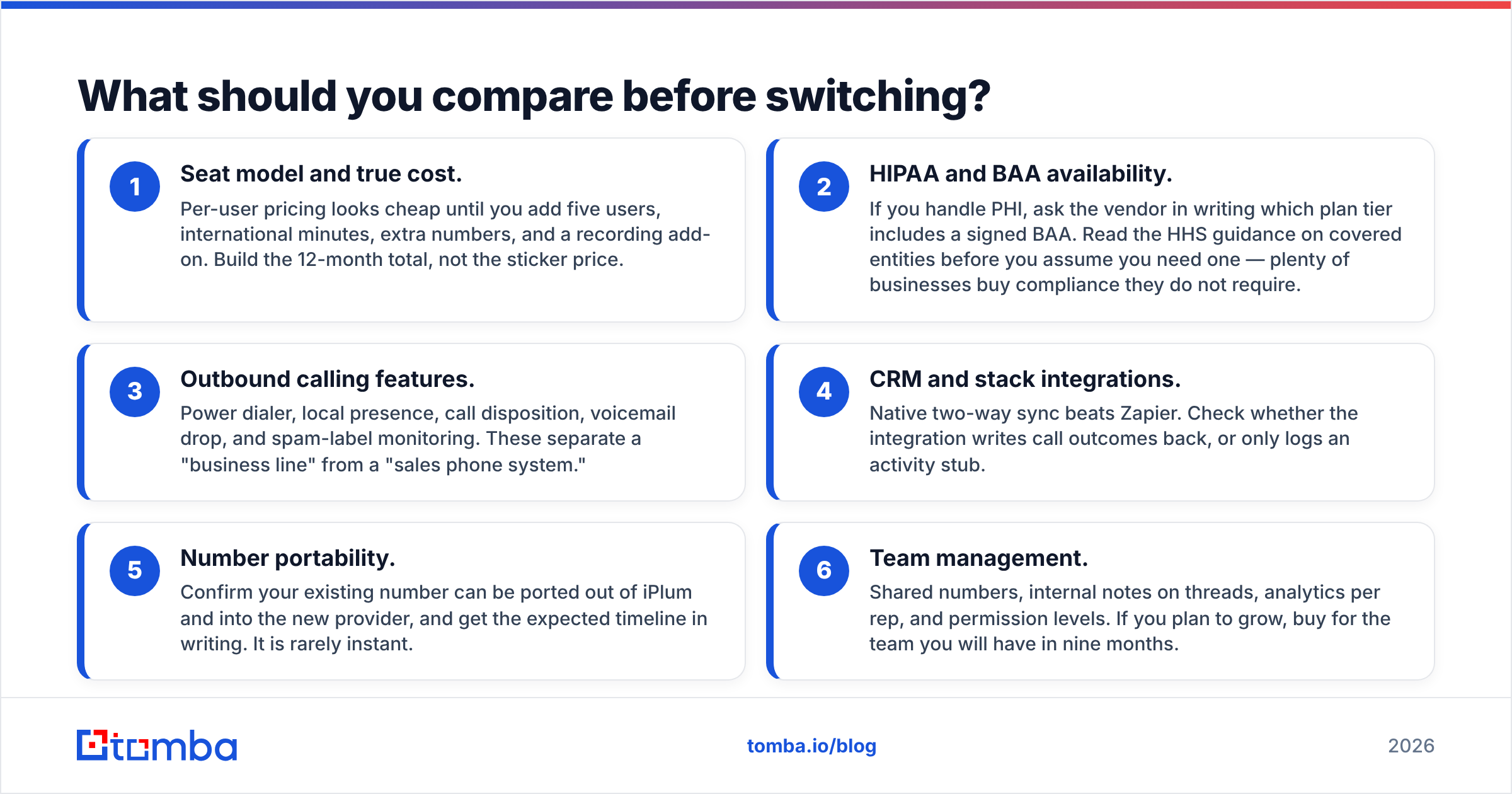
Run every candidate through the same six filters. Price is the last one, not the first.
- Seat model and true cost. Per-user pricing looks cheap until you add five users, international minutes, extra numbers, and a recording add-on. Build the 12-month total, not the sticker price.
- HIPAA and BAA availability. If you handle PHI, ask the vendor in writing which plan tier includes a signed BAA. Read the HHS guidance on covered entities before you assume you need one — plenty of businesses buy compliance they do not require.
- Outbound calling features. Power dialer, local presence, call disposition, voicemail drop, and spam-label monitoring. These separate a "business line" from a "sales phone system."
- CRM and stack integrations. Native two-way sync beats Zapier. Check whether the integration writes call outcomes back, or only logs an activity stub.
- Number portability. Confirm your existing number can be ported out of iPlum and into the new provider, and get the expected timeline in writing. It is rarely instant.
- Team management. Shared numbers, internal notes on threads, analytics per rep, and permission levels. If you plan to grow, buy for the team you will have in nine months.
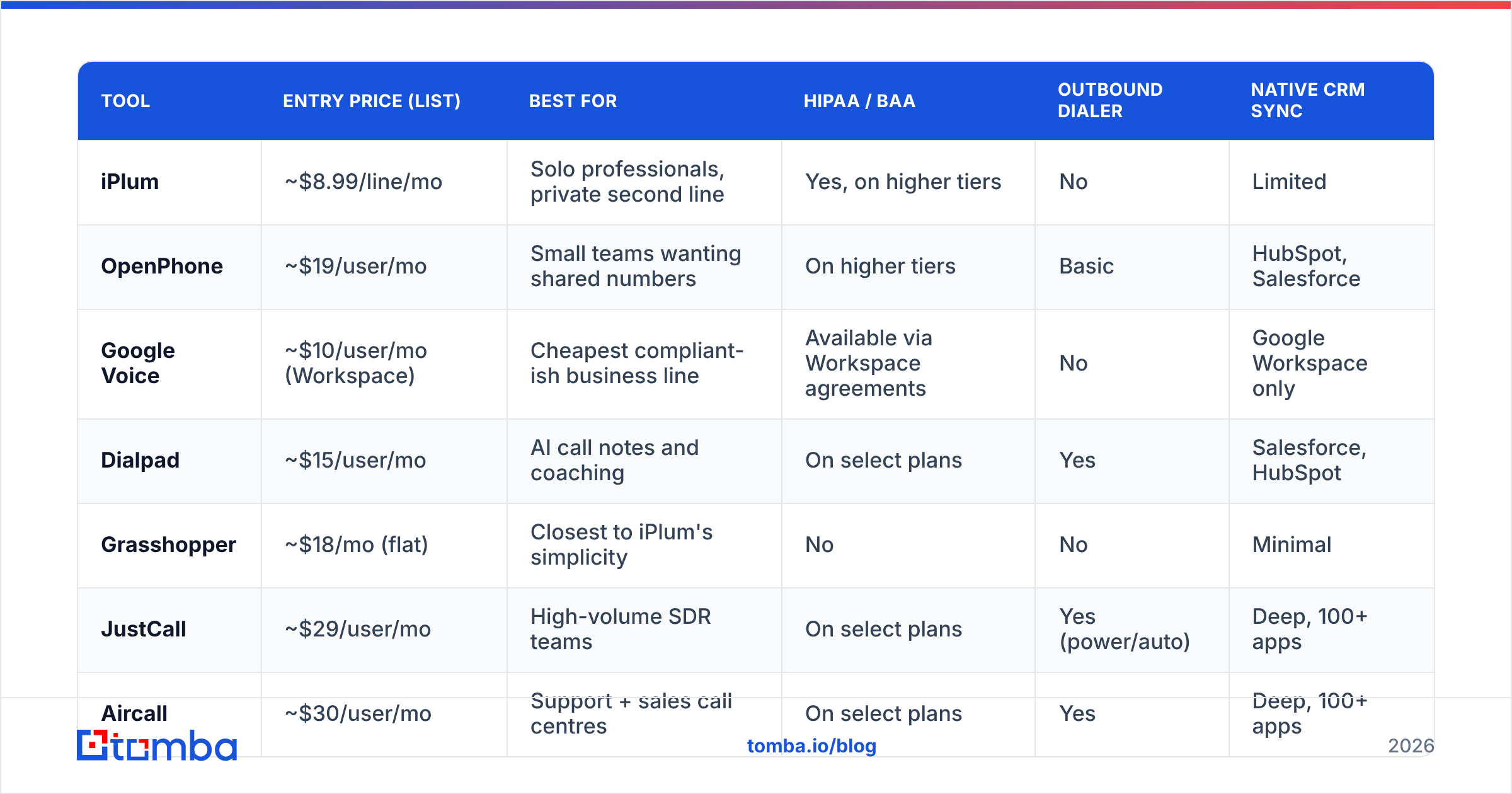
Which are the best iPlum alternatives in 2026?#
| Tool | Entry price (list) | Best for | HIPAA / BAA | Outbound dialer | Native CRM sync |
|---|---|---|---|---|---|
| iPlum | ~$8.99/line/mo | Solo professionals, private second line | Yes, on higher tiers | No | Limited |
| OpenPhone | ~$19/user/mo | Small teams wanting shared numbers | On higher tiers | Basic | HubSpot, Salesforce |
| Google Voice | ~$10/user/mo (Workspace) | Cheapest compliant-ish business line | Available via Workspace agreements | No | Google Workspace only |
| Dialpad | ~$15/user/mo | AI call notes and coaching | On select plans | Yes | Salesforce, HubSpot |
| Grasshopper | ~$18/mo (flat) | Closest to iPlum's simplicity | No | No | Minimal |
| JustCall | ~$29/user/mo | High-volume SDR teams | On select plans | Yes (power/auto) | Deep, 100+ apps |
| Aircall | ~$30/user/mo | Support + sales call centres | On select plans | Yes | Deep, 100+ apps |
| RingCentral | ~$20/user/mo | Full UCaaS replacement (voice + video) | Yes, on eligible plans | Add-on | Salesforce, MS Teams |
List prices are what vendors publish at the time of writing and change often. Annual billing, seat minimums, and regional pricing all shift the real number — confirm on the vendor's own pricing page before you commit.
Is OpenPhone the best all-round iPlum replacement?#
For most teams of two to twenty, yes. OpenPhone keeps the thing people like about iPlum — a clean mobile app with a separate business number — and adds the thing iPlum lacks: shared numbers with a team inbox. Multiple reps can see and reply to the same SMS thread, leave internal comments, and hand off conversations.
Where it falls short: it is not a heavy outbound dialer. If your motion is 200 dials a day per rep, OpenPhone will feel slow. And the entry plan is roughly double iPlum's per-line cost, which stings if you were paying for simplicity.
Is Google Voice good enough?#
If your requirement is "a professional number that is not my cell," Google Voice through Workspace is hard to beat on price. It rings your phone, transcribes voicemail, and lives inside an ecosystem you probably already pay for.
The trade-offs are real. Number porting is restricted in ways that surprise people, international support is uneven, and the feature set has barely moved in years. There is no dialer, no call disposition, and no meaningful sales analytics. Treat it as a phone line, not a phone system.
When does Dialpad make more sense?#
Dialpad's pitch is AI on every call: live transcription, automatic summaries, and coaching signals for managers. If your problem is "my reps do not log calls and I have no idea what is said on them," that is a direct fix.
It is also a fuller unified-communications product — voice, video, and messaging in one place — which makes it a plausible replacement for both iPlum and whatever meeting tool you are paying for separately. The catch is complexity. Teams who wanted a second line sometimes find themselves administering a phone system.
What about JustCall and Aircall for outbound teams?#
These are the two most common landing spots for teams that outgrew iPlum because of volume, not features. Both give you power or predictive dialing, local presence, call queues, real-time coaching, and integrations that actually write back to the CRM.
Both are also roughly three times iPlum's price per seat and expect a minimum number of users. That is the honest trade: you are no longer buying a phone line, you are buying an outbound operations platform. If your reps are not making at least 50 calls a day, the math does not work.
Does Grasshopper still deserve a spot?#
Yes, for one specific buyer: the business that wants a main number with extensions and nothing else. Flat pricing regardless of user count is genuinely differentiated — three people on one plan costs the same as one person. It will never be a sales tool, and it has no HIPAA story, but as a "company front door" it is clean and cheap to run.
Do you still need HIPAA compliance after switching?#
Ask this before you shortlist, because it eliminates half the market instantly.
iPlum's HIPAA support is a real differentiator in its price band. Most of the alternatives above offer a BAA only on mid or upper tiers, and some — Grasshopper, and Google Voice on personal accounts — do not offer one at all. If you are a covered entity or a business associate, a vendor saying "we're secure" is not the same as a vendor signing a BAA.
Three practical checks:
- Get the BAA in writing before you pay. Sales reps are optimistic; contracts are not.
- Confirm which features are in scope. Some vendors cover voice and voicemail but exclude SMS or third-party integrations.
- Check where recordings live. Call recording is often the part that breaks compliance, especially when it syncs to a CRM outside the agreement.
If you are not handling PHI, do not pay for HIPAA tiers. It is one of the most common overspends in this category.
How do you migrate off iPlum without losing your number?#
Porting is the step people underestimate. A rough sequence that works:
- Do not cancel iPlum first. Cancelling releases the number and you may lose it permanently. Port first, cancel second.
- Request your account and PIN details from iPlum support, plus a recent invoice showing the billing address exactly as it appears on the account.
- Submit the port request with the new provider and expect anywhere from a few business days to several weeks, depending on the underlying carrier.
- Run both lines in parallel during the transition window. Forward the old line to the new one so nothing drops.
- Update everything downstream — email signatures, Google Business Profile, invoices, website footer, CRM records, and any voicemail greeting that states the old number.
- Re-check spam labelling two weeks after the switch. New numbers frequently start out unlabelled and then get flagged once volume ramps.
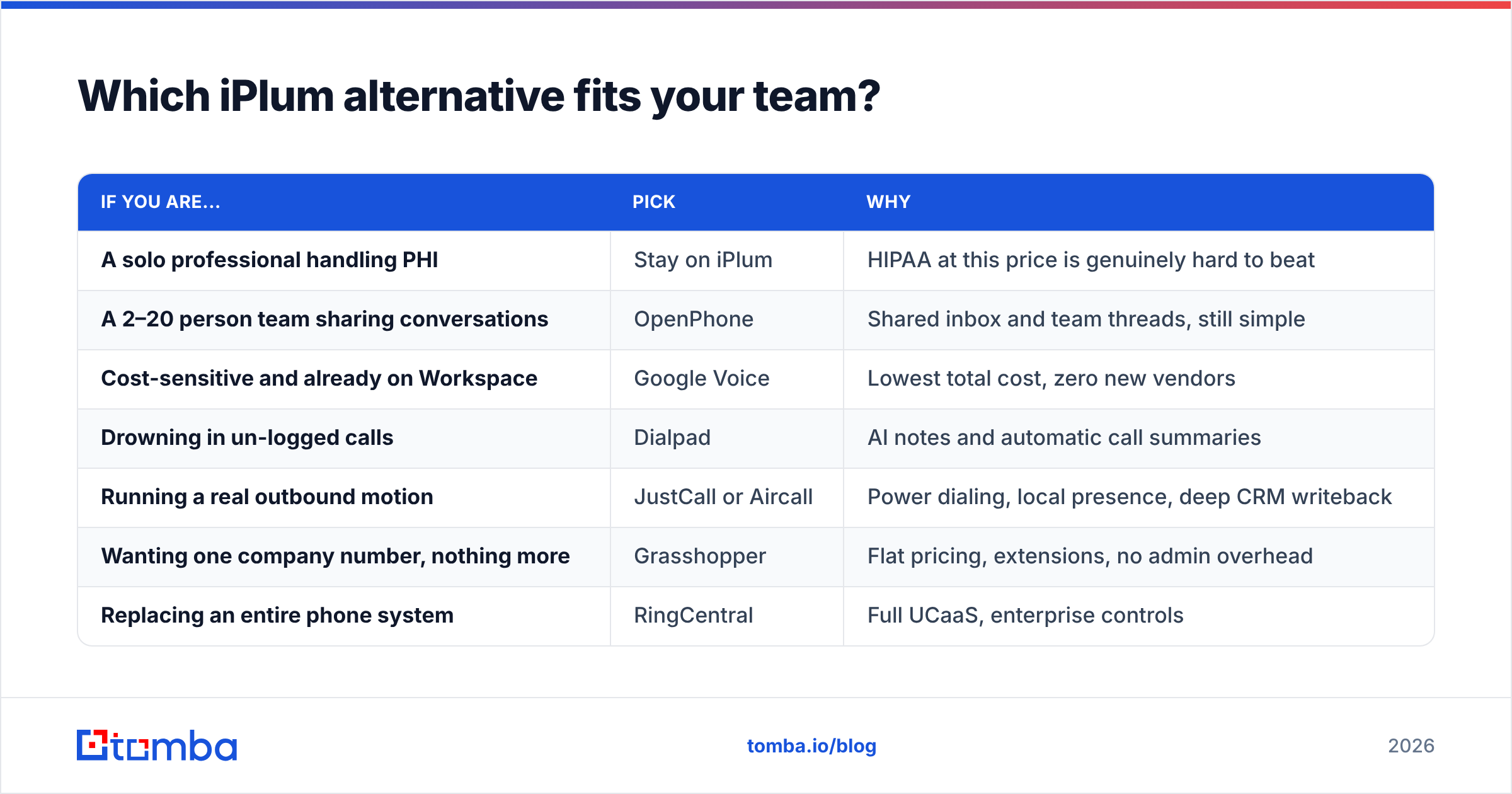
Which iPlum alternative fits your team?#
| If you are... | Pick | Why |
|---|---|---|
| A solo professional handling PHI | Stay on iPlum | HIPAA at this price is genuinely hard to beat |
| A 2–20 person team sharing conversations | OpenPhone | Shared inbox and team threads, still simple |
| Cost-sensitive and already on Workspace | Google Voice | Lowest total cost, zero new vendors |
| Drowning in un-logged calls | Dialpad | AI notes and automatic call summaries |
| Running a real outbound motion | JustCall or Aircall | Power dialing, local presence, deep CRM writeback |
| Wanting one company number, nothing more | Grasshopper | Flat pricing, extensions, no admin overhead |
| Replacing an entire phone system | RingCentral | Full UCaaS, enterprise controls |
What does a phone system never fix?#
The list.
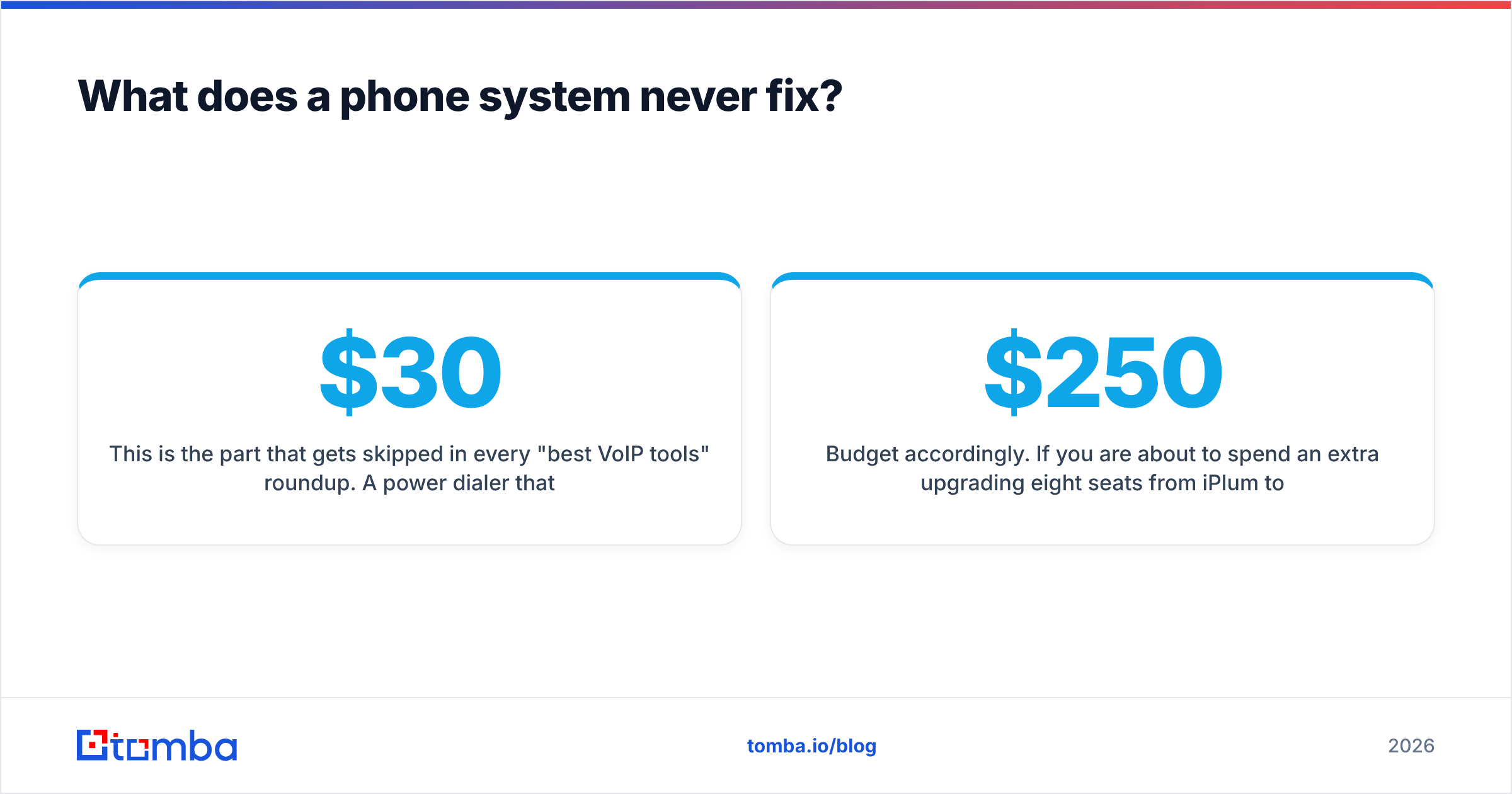
This is the part that gets skipped in every "best VoIP tools" roundup. A power dialer that dials wrong numbers just gets you to failure faster. Teams switch from iPlum to a $30/seat platform, connect rates stay flat, and everyone blames the dialer — when the actual problem is that 30% of the direct dials in the CRM were scraped two years ago and belong to someone who has since changed jobs.
Two things move connect rate more than any feature comparison in this post:
Number accuracy. Direct dials decay fast — people change roles, companies change providers, mobile numbers get reassigned. Running your list through a phone validator before a calling sprint removes the dead weight, and a phone finder fills the gaps where you only have a name and a company.
Multichannel follow-up. Very few B2B deals close on a cold call alone. The call gets the attention; the email gets the reply. Pairing dials with a verified email sequence typically lifts overall response rate more than either channel does alone — and it means a missed call is not a wasted touch. Keeping both contact fields current through ongoing data enrichment is cheaper than replacing the leads.
Budget accordingly. If you are about to spend an extra $250/month upgrading eight seats from iPlum to a sales platform, spend a fraction of that on data hygiene first and measure what changes. Often the data fix alone explains most of the improvement people credit to the new dialer.
Ready to give your new phone system something worth dialling?#
Pick the phone tool that matches your call volume, then make sure the contacts flowing into it are real. Tomba's Email Finder pulls verified business email addresses by name and domain, so every prospect your reps call also has a working email for the follow-up — the touch that actually gets replies. Start on the free tier with 25 searches a month, or check Tomba pricing if you are building lists at volume: Starter runs $49/mo and Growth $99/mo, with bulk and API access for teams wiring this into an existing workflow.
Better dialer, same bad list, same results. Fix the list first.
Related guides#
// get started
Find, verify and enrich your first contacts today
Start on the free plan with 25 searches a month, then scale when your team is ready.
Free plan · No credit card required · GDPR & CCPA
// about the author