iPlum Pricing Reviews Pros and Cons: 2026 Buyer's Guide
A neutral breakdown of iPlum pricing, reviews, pros and cons — what each tier really includes, where the hidden costs sit, how it stacks up against OpenPhone and Google Voice, and who should skip it.
TL;DR — iPlum pricing reviews pros and cons at a glance
iPlum is a second-line business phone app with one big differentiator: HIPAA-ready calling, texting and voicemail with a signed BAA. It sells at per-user prices most VoIP vendors reserve for their entry tier.
Entry plans land in the $5–$9 per user per month range. The compliance-heavy tiers sit closer to $15 per user per month. Almost every plan is quoted on annual billing, so the monthly number you see is not the number you pay month-to-month.
Reviews are consistently strong on reliability, call quality and support. They are consistently weak on the dated interface, thin CRM integrations and per-minute charges on international and toll-free traffic.
It is a great fit for solo clinicians, therapists, small medical practices, insurance agents and consultants. It is a poor fit for sales teams that need dialer speed, sequence automation and native CRM sync.
A phone system does not generate pipeline. Whatever line you buy, the real constraint is contact data quality: verified numbers and emails tied to the right person.
What is iPlum, and who actually uses it?#
iPlum is a second phone number service. It runs as a mobile app and a desktop client on top of your existing carrier connection. You keep your personal number and your personal handset. iPlum layers a separate business identity on it — its own number, its own voicemail, its own texting thread, its own business hours.
That description also fits Google Voice, OpenPhone, Grasshopper and a dozen others. What separates iPlum is the compliance posture. The company sells HIPAA-compliant communication as the headline feature: a Business Associate Agreement, encrypted secure texting, password-protected voicemail and audit-friendly call logs. If you are a covered entity under HIPAA, a plain consumer calling app is a liability. iPlum's core pitch is that you can close that gap for the price of a couple of coffees per month.
The buyer profile that shows up repeatedly in reviews:
- Solo and small-practice clinicians — therapists, dentists, chiropractors, nurse practitioners who need patient texting without exposing a personal cell.
- Insurance and financial advisors — regulated conversations that need call recording and retention.
- Consultants and attorneys — a professional line plus a paper trail, without a full PBX.
- International teams and diaspora businesses — iPlum sells numbers in the US, Canada and several other countries, and is popular for cheap international dialing.
- Field and home-service operators — plumbers, contractors, real-estate agents who live on a mobile handset.
Notably absent from that list: outbound sales teams. That is not an accident, and we will come back to it.
How much does iPlum cost in 2026?#
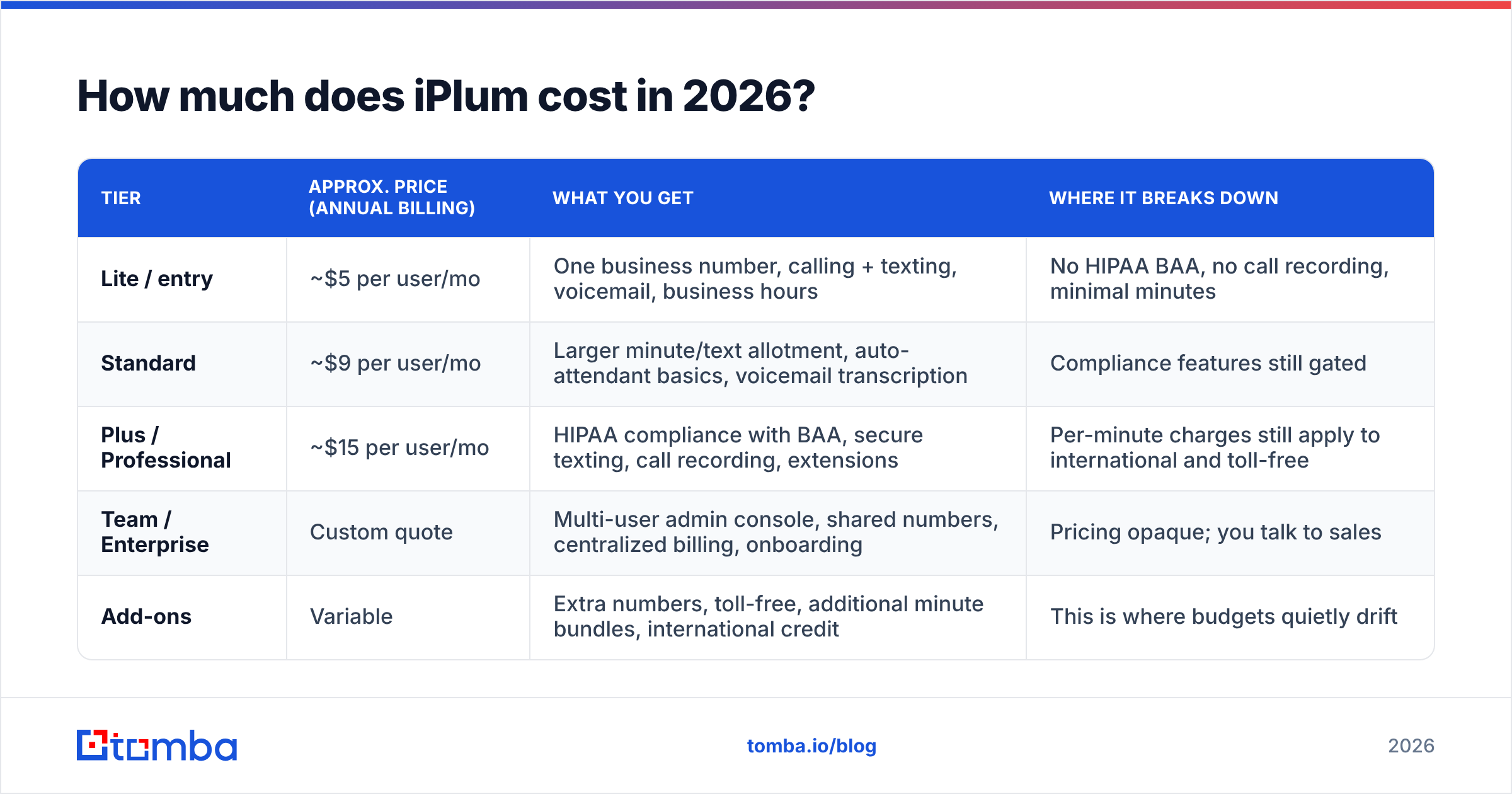
Here is the shape of iPlum pricing, based on published list rates. Treat these as a planning baseline, not a quote. The vendor adjusts tiers and packaging regularly, so confirm current numbers on iplum.com before you commit.
| Tier | Approx. price (annual billing) | What you get | Where it breaks down |
|---|---|---|---|
| Lite / entry | ~$5 per user/mo | One business number, calling + texting, voicemail, business hours | No HIPAA BAA, no call recording, minimal minutes |
| Standard | ~$9 per user/mo | Larger minute/text allotment, auto-attendant basics, voicemail transcription | Compliance features still gated |
| Plus / Professional | ~$15 per user/mo | HIPAA compliance with BAA, secure texting, call recording, extensions | Per-minute charges still apply to international and toll-free |
| Team / Enterprise | Custom quote | Multi-user admin console, shared numbers, centralized billing, onboarding | Pricing opaque; you talk to sales |
| Add-ons | Variable | Extra numbers, toll-free, additional minute bundles, international credit | This is where budgets quietly drift |
Three things to internalise before you compare that table to anything else.
Annual billing is the default framing. The headline per-month price generally assumes a year paid up front. Month-to-month costs meaningfully more. If you are testing the product, budget for the higher monthly rate and treat the annual figure as the steady-state number.
Minutes are metered, not unlimited. Most plans bundle an allotment of minutes and texts rather than true unlimited domestic calling. Go over and you pay per minute. For a therapist doing eight 5-minute confirmation calls a day, that is irrelevant. For someone running 90-minute consultations or heavy international dialing, it is the single biggest variable in your real cost.
HIPAA sits in the upper tier. If compliance is why you are here — and for most iPlum buyers it is — the entry price is not your price. Model the Plus tier.

What do iPlum reviews actually say?#
Aggregate sentiment on G2 and comparable review sites is positive. The pattern is unusually consistent across sources, which is itself a signal. Reviewers rarely disagree about what iPlum is good at and what it is not.
What reviewers praise, repeatedly:
- Call quality and reliability. iPlum can route over your cellular voice channel instead of depending purely on data. Calls hold up in weak-Wi-Fi conditions where pure-VoIP apps stutter. This comes up more than any other positive.
- Support that answers. Small-vendor support is a coin flip. iPlum's is repeatedly described as fast and human, including help with number porting — historically the worst part of switching phone systems.
- Price-to-compliance ratio. Getting a BAA and secure texting at roughly $15 per user per month is genuinely cheap. Comparable healthcare-communication platforms charge multiples of that.
- Number portability and international coverage. Users moving from a landline or an old practice number report smooth ports.
What reviewers criticise, repeatedly:
- The interface looks its age. Functional, dense, not delightful. Several reviews use the word "clunky." If your team's tolerance for dated UI is low, demo it before buying.
- Thin integration surface. This is the big one. iPlum is not deeply wired into HubSpot, Salesforce or most modern CRM stacks the way a sales-first phone tool is. Call data tends to live in iPlum.
- Overage surprises. The metered-minutes model catches people who assumed unlimited.
- Feature gaps at the low tiers. Reviewers sometimes buy the cheap plan, find the feature they needed two tiers up, and call it a bait-and-switch. It is not — it is normal SaaS tiering — but you should still read the feature matrix line by line.
iPlum pricing reviews pros and cons: the short list#
Compressed into a decision-grade list:
Pro — compliance at a small-business price. A BAA, encrypted texting and retention controls cost about as much as a streaming subscription. That is the whole reason iPlum exists, and it delivers.
Pro — works on the hardware you already own. No desk phones, no PBX, no IT project. Install, port, done.
Pro — separation of work and personal life. Business hours routing means the line goes quiet at 6pm without you turning off your phone.
Con — not built for outbound sales. No power dialer, no cadence engine, no native sequence tooling. Cold calling means manual dialing and manual logging.
Con — metered usage model. Your bill tracks talk time, so forecasting is harder than with a flat-rate competitor.
Con — reporting and analytics are basic. You get logs. You do not get the connect-rate, talk-time and disposition dashboards a sales manager expects.
How does iPlum compare to other business phone apps?#
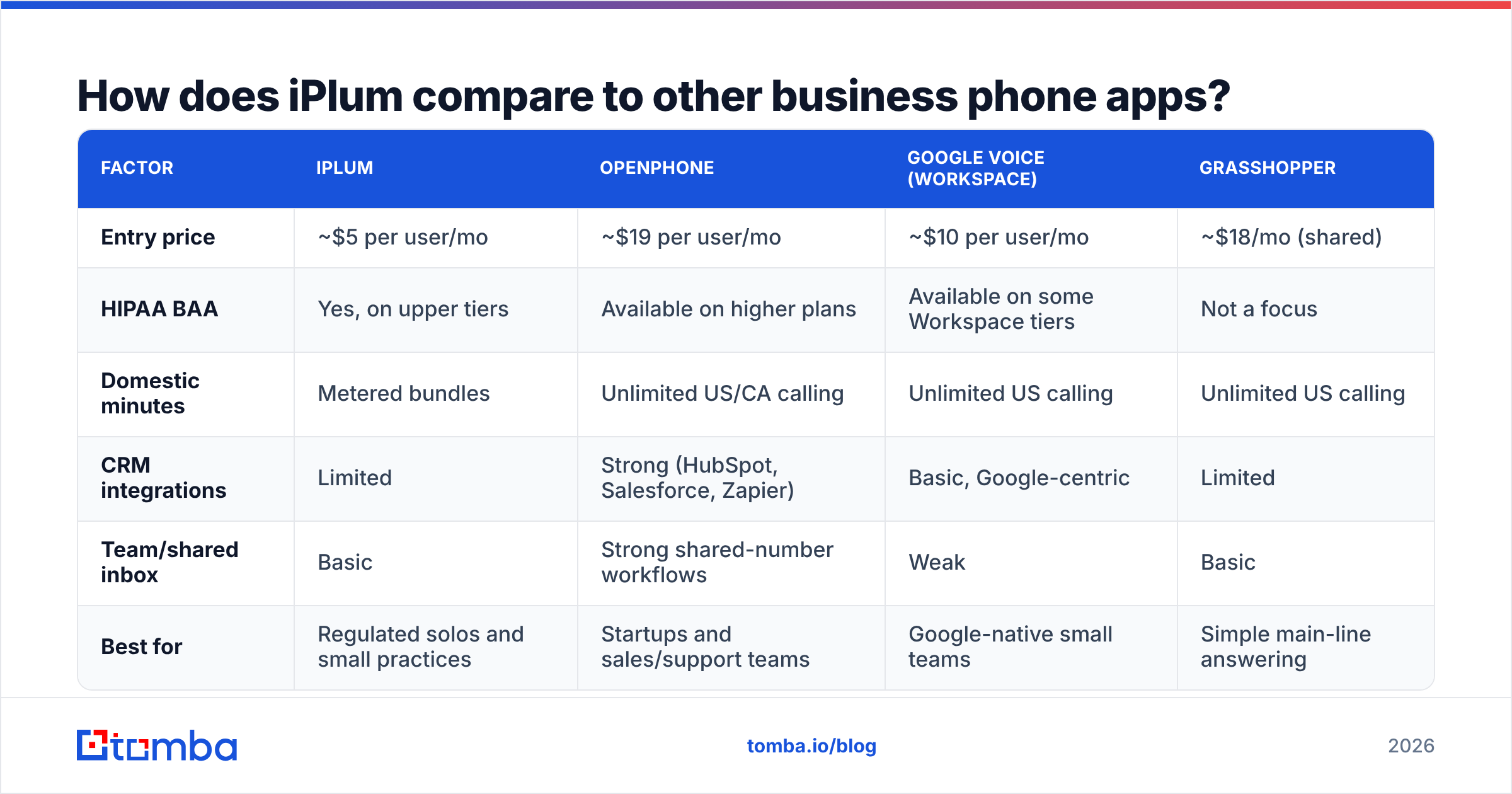
The honest comparison depends entirely on whether compliance is a requirement or a nice-to-have.
| Factor | iPlum | OpenPhone | Google Voice (Workspace) | Grasshopper |
|---|---|---|---|---|
| Entry price | ~$5 per user/mo | ~$19 per user/mo | ~$10 per user/mo | ~$18/mo (shared) |
| HIPAA BAA | Yes, on upper tiers | Available on higher plans | Available on some Workspace tiers | Not a focus |
| Domestic minutes | Metered bundles | Unlimited US/CA calling | Unlimited US calling | Unlimited US calling |
| CRM integrations | Limited | Strong (HubSpot, Salesforce, Zapier) | Basic, Google-centric | Limited |
| Team/shared inbox | Basic | Strong shared-number workflows | Weak | Basic |
| Best for | Regulated solos and small practices | Startups and sales/support teams | Google-native small teams | Simple main-line answering |
Read it this way. If you need a compliant line and your call volume is modest, iPlum is the cheapest credible option on the board. If you need shared inboxes, CRM logging and unlimited talk time, OpenPhone is worth the extra spend. If you are already deep in Google Workspace and compliance is not binding, Google Voice is the path of least resistance.
Who should buy iPlum, and who should skip it?#
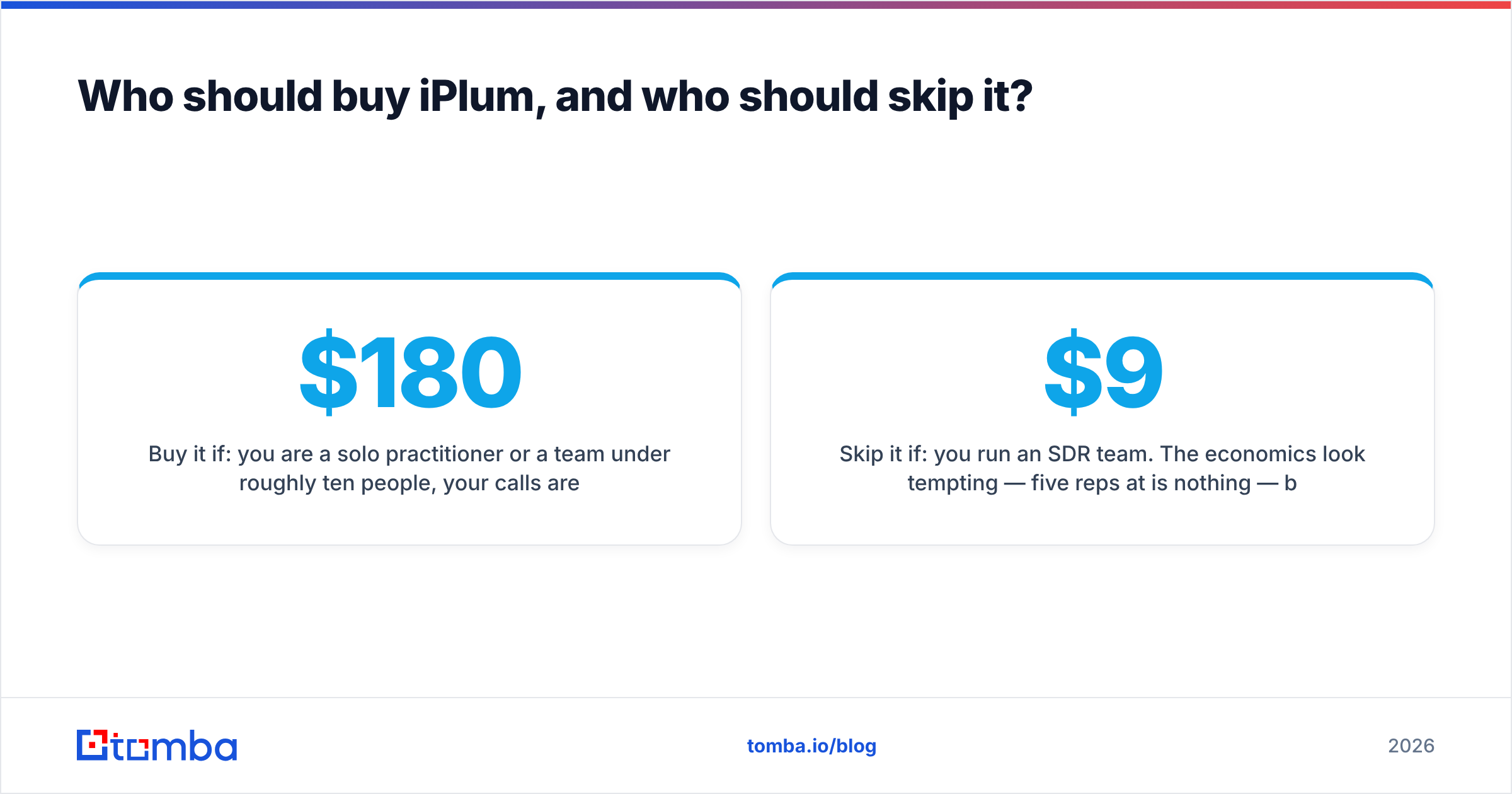
Buy it if: you are a solo practitioner or a team under roughly ten people, your calls are short and mostly domestic, you need a BAA, and you would rather spend $180 a year than $1,800.
Skip it if: you run an SDR team. The economics look tempting — five reps at $9 is nothing. But you lose the savings straight back in manual data entry, missing call analytics and the absence of dialer speed. Sales teams need call logging into the CRM, disposition tracking and sequence integration. iPlum does not pretend to be that product, and you should not force it to be.
Also skip it if: international minutes dominate your usage and you have not modeled the per-minute rates. Run your actual talk-time numbers through the rate card first. A "cheap" plan that meters your heaviest use case is not cheap.
Where does a business phone line fit in an outbound stack?#
Here is the part the pricing-page comparison never covers: the phone tool is rarely the bottleneck.
Teams switch phone providers hunting for a better connect rate, then discover the problem was never the carrier. It was the list. Wrong numbers, disconnected lines, gatekeeper switchboards logged as direct dials, contacts who left the company two years ago. No app fixes bad data — it just dials it faster.

The sequence that actually moves connect rates:
- Start from verified contact data. Use a phone finder to source direct dials tied to a named person at a named company, rather than scraping a main switchboard number off a contact page.
- Validate before you dial. A phone validator filters disconnected and invalid numbers out of the list before a rep wastes a day on them.
- Pair the call with email. Multi-channel beats single-channel by a wide margin. An email finder pulls the verified work address for the same contact, so you can follow a voicemail with a two-line email that references it. That is where most replies actually come from.
- Enrich the record, not just the row. Contact enrichment adds title, seniority and company context so the opener is relevant instead of generic.
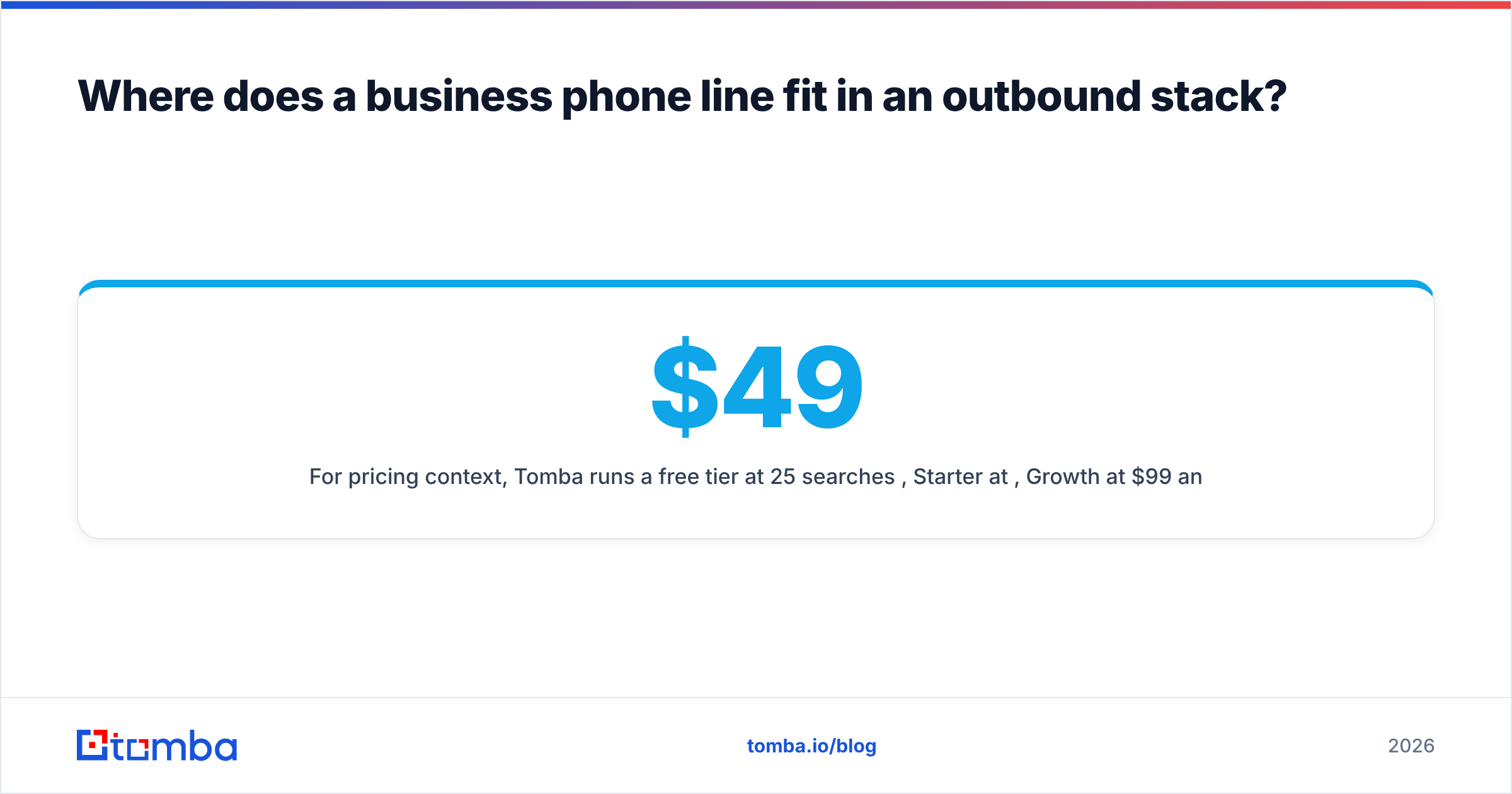
For pricing context, Tomba runs a free tier at 25 searches per month, Starter at $49/mo, Growth at $99/mo and Pro at $249/mo — full details on the Tomba pricing page. That is a different budget line from a phone app, and the two are complementary rather than competitive. iPlum handles the conversation; the data layer decides whether the conversation happens at all.
Is iPlum worth it in 2026?#
Verdict: yes, for the buyer it was designed for. If you are a regulated solo professional or a small practice that needs a compliant second line on a phone you already own, iPlum is one of the best value propositions in the category. The compliance features are real, call quality complaints are rare, and support has a genuinely good reputation.
No, if you are a sales org. The interface, the integration gaps and the metered minutes will fight you. Buy a sales-native phone tool and spend the difference on better data.
The fairest summary of iPlum pricing reviews pros and cons is simple. This is a focused product that knows exactly who it serves and prices accordingly. It does not try to be a revenue platform. That discipline is why it is cheap — and why it is the wrong tool if what you actually need is pipeline.
Before you sign an annual contract, do three things. Pull your last three months of actual talk-time minutes. Price them against the rate card at the tier that includes the features you need. Then run a two-week trial on month-to-month billing. Compliance software is not a place to guess.
Fix the input, not just the dialer. If your connect rates are flat, the list is usually the reason. Tomba's Email Finder pulls verified business email addresses by name, domain or company — so every call you make has a follow-up that lands, and every contact in your CRM is a real person who still works there. Start free with 25 searches a month and see what a clean list does to your reply rate.
Related guides#
// get started
Find, verify and enrich your first contacts today
Start on the free plan with 25 searches a month, then scale when your team is ready.
Free plan · No credit card required · GDPR & CCPA
// about the author