Istari AI Pricing, Reviews, Pros and Cons: A 2026 Breakdown
Istari AI sells web-mined company intelligence — but it never publishes a price. Here's how its quote-based model works, what reviewers praise and complain about, and when a cheaper contact-data stack does the same job.
Istari AI pricing is quote-only — there is no public price list. Below is what buyers actually pay, what the thin review record says, and when a cheaper contact-data stack does the same job.
TL;DR
- Istari AI pricing is quote-based. Cost tracks data scope, refresh rate, seats, and contract length. You cannot compare tiers on a page.
- It is a company intelligence tool, not a contact database. It scans company websites at scale and scores tech use, industry, and innovation signals. It will not give you a work email.
- Buyer-reported Istari AI pricing sits in the four- to five-figure annual range. Pilots are often paid. Treat any number online — including here — as an estimate.
- Reviews are thin. There is no deep G2 or Capterra corpus for Istari AI the way there is for Apollo or Clearbit. Most evidence is academic papers, case studies, and vendor material.
- Need contacts you can email? A $49/mo tool like Tomba does that for about 1% of an enterprise data contract.
What is Istari AI, and is it the company you think it is?#
Start with the name confusion. It costs buyers real time. Two unrelated vendors share a near-identical name:
- Istari AI (istari.ai) — based in Mannheim, Germany. It uses AI and web mining to read corporate websites. The output is structured "smart data" about firms: what they do, what tech they use, how digital they are. Its roots are in economic research at ZEW. Its indicators have been used in public-sector innovation studies.
- Istari Digital (istari.digital) — a US company in digital engineering for aerospace and defense. Different category. Different buyer.
This post is about the first one. If you came looking for simulation software, you want the other domain.
Istari AI's pitch is simple. The open web is an underused data source. Instead of buying a static firm list compiled last quarter, you point a crawler and a classifier at millions of company sites. Then you pull current signals: which firms mention robotics, which have started hiring for AI roles, which run e-commerce, which call themselves a supplier to car makers. That output feeds market sizing, ICP work, territory planning, and economic research.
That framing matters for Istari AI pricing. You are not buying rows in a list. You are buying a derived dataset plus the method behind it. It is priced more like a Gartner subscription than a self-serve SaaS tool.
How does Istari AI pricing actually work in 2026?#
There is no public price page. As of 2026, istari.ai sends you to a contact or demo form instead of a checkout. That is a deliberate choice, not an oversight.

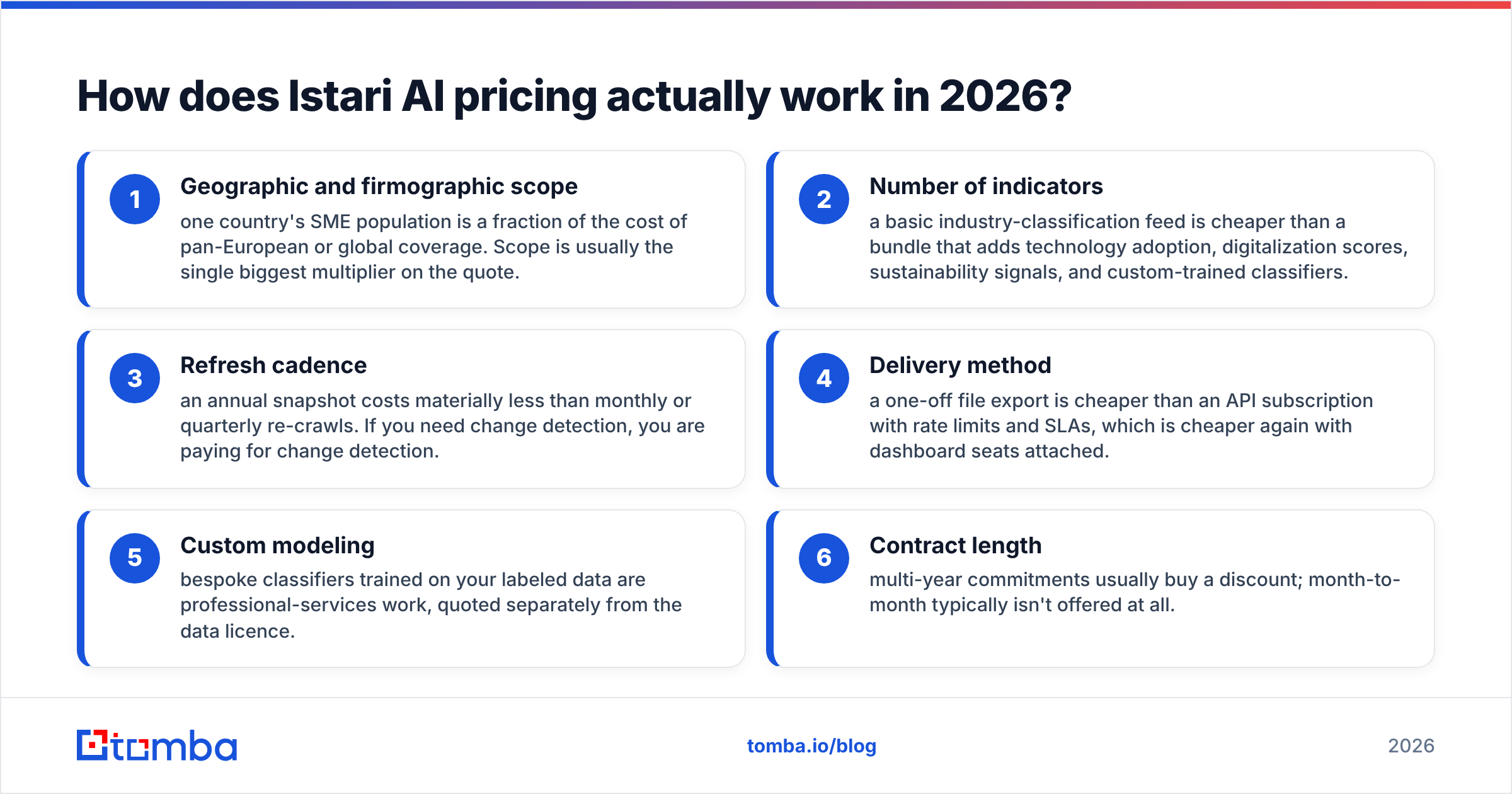
Quote-based vendors price on the same few levers. These three move Istari AI pricing the most:
- Geographic and firmographic scope — one country's SME base costs a fraction of pan-European or global coverage. Scope is the single biggest multiplier on the quote.
- Number of indicators — a basic industry feed is cheaper than a bundle with tech adoption, digital scores, sustainability signals, and custom classifiers.
- Refresh cadence — an annual snapshot costs much less than monthly re-crawls. If you need change detection, you pay for change detection.
Three more levers shape the final Istari AI pricing number:
- Delivery method — a one-off file export is cheaper than an API subscription with rate limits and SLAs. Add dashboard seats and the price climbs again.
- Custom modeling — classifiers trained on your labeled data are services work. They are quoted apart from the data licence.
- Contract length — multi-year deals usually buy a discount. Month-to-month is rarely offered at all.
Buyers in nearby web-intelligence categories report similar bands. Entry deals land in the low five figures per year. Narrow single-country pilots sometimes land in the four figures. Multi-market, multi-indicator programmes run well past six figures. Istari AI pricing appears to sit inside that same band. To be explicit: those are category norms and buyer estimates, not published Istari AI rates. Get the number in writing before you budget against it.
So Istari AI is not a tool you can try on a Tuesday afternoon. Expect a discovery call, a scoping document, and often a paid pilot before you see production data.
How does Istari AI pricing compare to contact-data tools?#
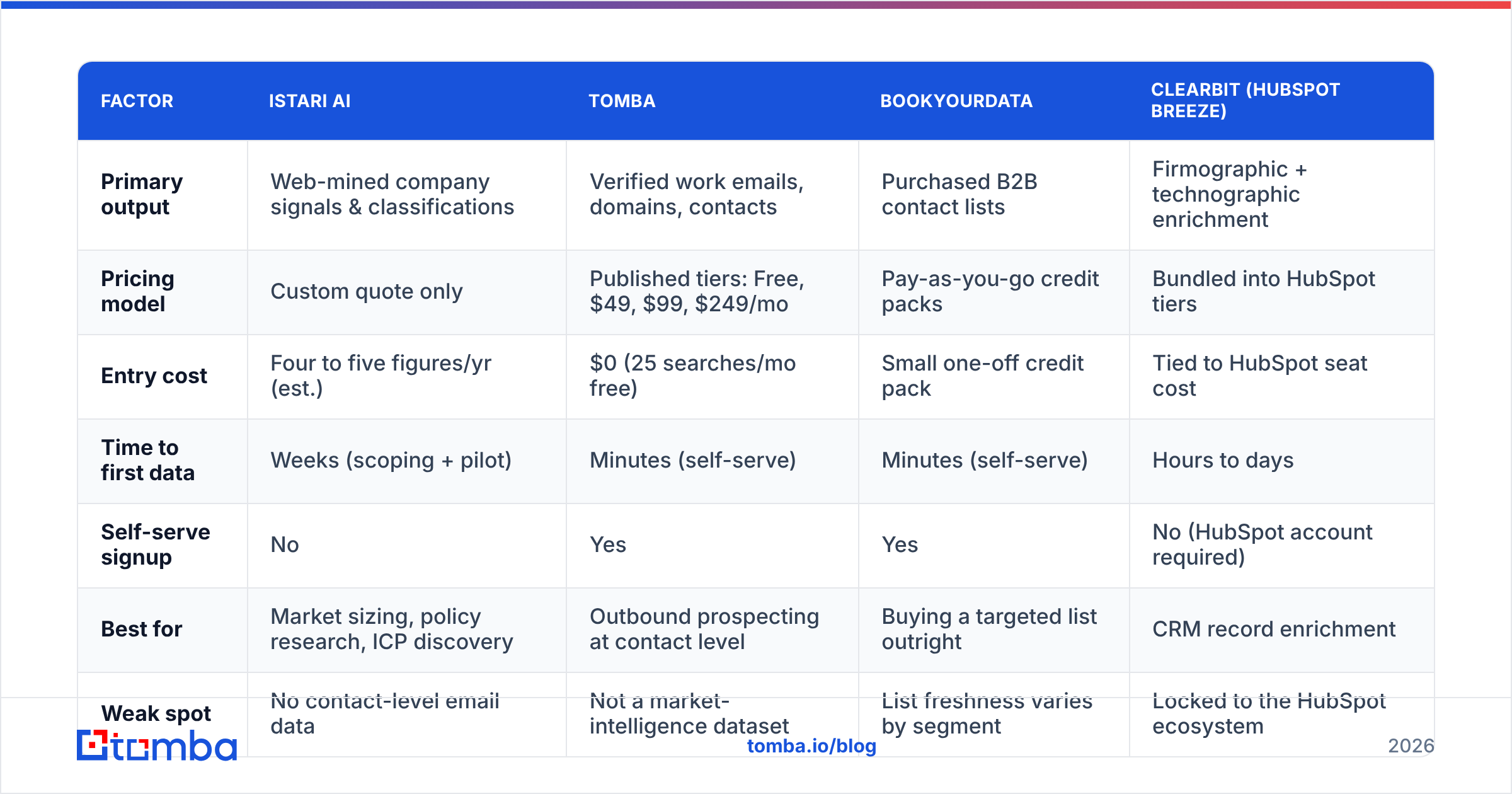
This is where comparison shopping goes wrong. Teams line up Istari AI against Apollo or Clearbit, see the price gap, and call Istari expensive. But these are different products. They solve different halves of a go-to-market problem.
| Factor | Istari AI | Tomba | BookYourData | Clearbit (HubSpot Breeze) |
|---|---|---|---|---|
| Primary output | Web-mined company signals & classifications | Verified work emails, domains, contacts | Purchased B2B contact lists | Firmographic + technographic enrichment |
| Pricing model | Custom quote only | Published tiers: Free, $49, $99, $249/mo | Pay-as-you-go credit packs | Bundled into HubSpot tiers |
| Entry cost | Four to five figures/yr (est.) | $0 (25 searches/mo free) | Small one-off credit pack | Tied to HubSpot seat cost |
| Time to first data | Weeks (scoping + pilot) | Minutes (self-serve) | Minutes (self-serve) | Hours to days |
| Self-serve signup | No | Yes | Yes | No (HubSpot account required) |
| Best for | Market sizing, policy research, ICP discovery | Outbound prospecting at contact level | Buying a targeted list outright | CRM record enrichment |
| Weak spot | No contact-level email data | Not a market-intelligence dataset | List freshness varies by segment | Locked to the HubSpot ecosystem |
Read that table as a stack, not a bake-off. Istari AI tells you which companies matter. A tool like Tomba's email finder or a curated list from BookYourData tells you who to contact inside them. A CRM enrichment layer keeps those records fresh. Many mature RevOps teams run all three. The budget talk gets much easier once you stop treating them as substitutes.
What do Istari AI reviews say?#
Honestly, there is not much of a review corpus. Factor that into your risk assessment.
Search G2 or Capterra for Istari AI. You will not find the hundreds of verified reviews that surround mainstream sales-intelligence tools. That is normal for a European B2B data vendor selling to enterprise and public-sector buyers. Those buyers sign NDAs, not review forms. Still, it means your usual shortcut for diligence is gone.
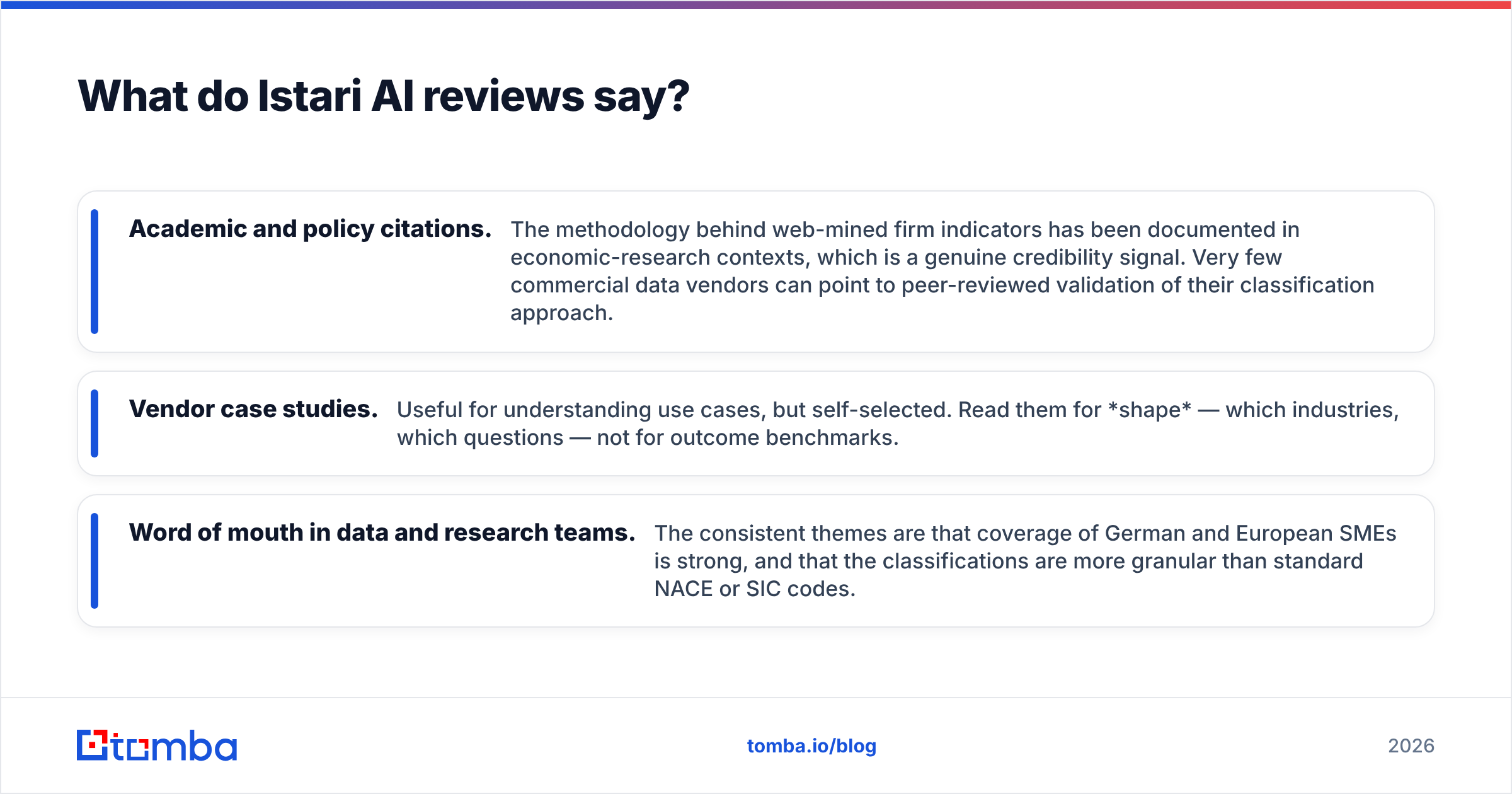
The evidence that does exist falls into three buckets:
- Academic and policy citations. The method behind web-mined firm indicators has been documented in economic research. That is a real credibility signal. Few data vendors can point to peer-reviewed proof of their approach.
- Vendor case studies. Good for understanding use cases, but self-selected. Read them for shape — which industries, which questions — not for outcome benchmarks.
- Word of mouth in data and research teams. The themes are consistent. Coverage of German and European SMEs is strong. The classifications are finer than standard NACE or SIC codes.
The common criticisms are easy to guess for this category. Coverage thins out for firms with weak or dated websites. Classification confidence varies by industry. Non-technical users find raw datasets harder to act on than a dashboard-first tool. None of these are deal-breakers. All of them deserve a direct question on the call.
Want a yardstick? Judge any web scraping-derived data product the same way: coverage rate, freshness, precision on a labeled sample, and repeatability. Ask Istari AI for all four on your own test set.
What are the pros and cons of Istari AI?#
Pros
- Signals you cannot buy elsewhere. Tech mentions, self-described capabilities, and digital scores pulled from real website text beat recycled firmographic files.
- Strong European SME coverage. Most US-centric data vendors are thin below the enterprise tier in Germany, Austria, and Switzerland. This is where Istari AI is strongest.
- An open method. A research lineage means you can ask how a classification was made. That is rare in a market full of black boxes.
- Custom classifiers. If your ICP is "makes precision parts for medical devices," a trained model beats filtering on industry codes.
- API and file delivery. The data drops into your warehouse or enrichment pipeline instead of trapping you in a UI.
Cons
- No public pricing and no self-serve trial. You cannot test value before you enter a sales cycle. For small teams, that is a real cost.
- No contact-level data. No emails. No direct dials. You still need a separate layer, which raises the total cost of your stack.
- Thin third-party review evidence. Less peer validation means you carry more of the diligence load yourself.
- Coverage depends on web presence. A one-page brochure site yields weak signals. Those are often the exact SMEs you wanted to profile.
- Slow time to value. Scoping, pilot, integration. Weeks, not minutes.
Is Istari AI worth it for your team?#
Use a simple rule: Istari AI pricing is worth it when the dataset changes a decision bigger than the quote.
Istari AI fits when you are:
- Sizing a market or a territory where no off-the-shelf cut is precise enough.
- Running innovation or supply-chain research where method matters more than speed.
- Building an ICP model based on capability signals, not headcount and revenue bands.
- Working in DACH or wider Europe, where US-first data vendors fall short.
It does not fit when you are:
- A startup or SMB sales team that needs contacts this quarter. The ROI math will not survive a five-figure yearly commitment.
- Looking for verified emails or phone numbers. That is a different category — see data enrichment and contact-finding tools instead.
- Unable to wait weeks for procurement before your first campaign.
- Without an analyst or data engineer who can turn a raw dataset into something sales can act on.
How do you pressure-test Istari AI pricing before you sign?#
Run this checklist on the demo call. It works for Istari AI and for any quote-based data vendor. Start with the data itself:
- Ask for coverage on your list, not theirs. Hand over 200 companies you care about. Ask what share return a usable classification. Coverage on a vendor-picked sample is marketing.
- Request a precision test. Have the vendor classify 100 firms you already know the answers for. Count the errors yourself.
- Pin down refresh frequency in the contract. "Regularly updated" is not a term you can enforce. A named cadence is.
Then push on the commercial terms, because that is where Istari AI pricing quietly grows:
- Get overage and scope-change terms in writing. Adding a country mid-contract is where surprise invoices start.
- Confirm the exit path. Do you keep the delivered data if you do not renew? For derived datasets, the answer is often no. Check before you build a workflow on it.
- Price the whole stack, not one line item. Add the contact layer, the verification layer, and the engineering hours. A cheap dataset with costly integration is not cheap.
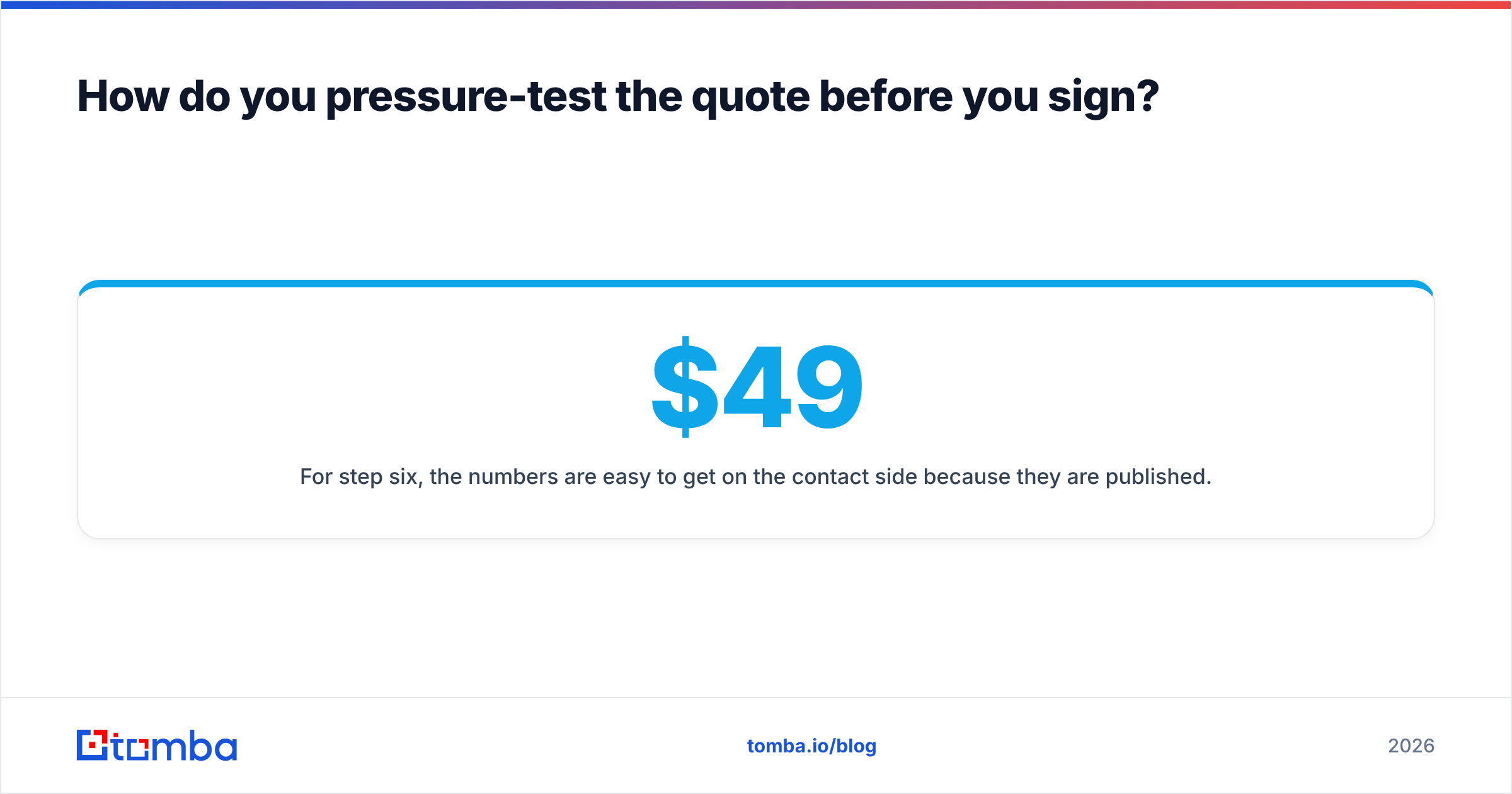
For step six, the contact side is easy to price because it is published. Tomba's pricing runs Free (25 searches/mo), Starter at $49/mo, Growth at $99/mo, Pro at $249/mo, and custom Enterprise. The same credits cover email finding, verification, domain search, and the Tomba API. That predictability balances a quote-based line item in the same budget.
What should you do next?#
If your problem is "which companies should we be selling to," an Istari AI conversation is worth having. Walk in with a coverage test, a precision test, and a scope document. Then the quote is grounded in something real.
If your problem is "we already know the accounts and we need the people inside them," you do not need an enterprise data contract. Start with the Tomba Email Finder. Search by domain, name, or company. Get verified work emails with confidence scores and sources. Test it on the free tier before you spend anything. Twenty-five searches will tell you more about fit than any demo deck. If it works, $49/mo gets your outbound running while the bigger data decision is still in procurement.
Related guides#
// get started
Find, verify and enrich your first contacts today
Start on the free plan with 25 searches a month, then scale when your team is ready.
Free plan · No credit card required · GDPR & CCPA
// about the author