Istari AI vs Kaspr (2026): Which B2B Data Tool Wins?
Istari AI maps entire markets from web data. Kaspr hands you the mobile number. Here is how the two actually compare in 2026 — and which one belongs in your stack first.
Istari AI vs Kaspr is an odd matchup. One tool finds markets. The other finds phone numbers. Here is what each does, what they cost in 2026, and which one to buy first.
TL;DR
- They are not really competitors. Istari AI mines the open web for market intelligence. It reads company sites at scale and turns them into structured signals. Kaspr pulls phone numbers and emails from LinkedIn.
- Buy Istari AI if your bottleneck is which companies to target — market sizing, sector classification, tech-adoption scoring, TAM discovery in Europe.
- Buy Kaspr if your bottleneck is reaching a named person — above all, mobile numbers for EMEA prospects, pulled live from LinkedIn.
- Neither is a full outbound stack. Istari AI gives you accounts with no contacts. Kaspr gives you contacts one seat at a time, with no market-level targeting.
- The cheapest gap-filler is a finder plus verifier layer. A per-credit email finder and email verifier sit under either tool, so you stop paying seat prices for volume work.
What is Istari AI, exactly?#
Istari AI is a German data company. It builds company intelligence by mining the open web. Instead of licensing a static firmographic database, it crawls and reads company websites — the text, the product pages, the job ads, the tech signals. It turns that messy input into structured attributes you can query.
Think of it like a satellite survey of a country versus a phone book. The phone book tells you who lives at an address. The satellite tells you which regions are growing, which are industrial, and which just built a factory. Istari AI is the satellite.
In practice, that means outputs such as:
- Sector and activity classification based on what a company says it does today, not the NACE or SIC code it filed a decade ago.
- Technology and AI adoption signals — whether a firm publicly shows use of a given technology.
- Market mapping and TAM sizing across large sets of companies. Coverage of European SMEs is strong, and those firms are often thin in US-built databases.
- API and data delivery for teams that push signals into a warehouse or CRM instead of clicking around a UI.
The honest caveat: Istari AI is a research and strategy data product, not a sales tool. You can read their own framing on istari.ai. It does not hand you a decision-maker's mobile number. It is not sold as a prospecting extension for reps.
What is Kaspr, exactly?#
Kaspr is the opposite shape. It is a contact-data tool built around a Chrome extension for LinkedIn. Open a profile, a Sales Navigator list, or a group, and Kaspr reveals phone numbers and email addresses for the people on screen. Cognism acquired it in 2022. It is the self-serve, SMB-friendly way into that ecosystem, and it has a good name for European mobile coverage.
What it does well:
- Live LinkedIn enrichment — no CSV round-trip, no batch job to wait for.
- Mobile numbers — the reason most teams buy it. Direct dials are the scarce good in B2B data, and Kaspr's EMEA reviews on G2 are strong here.
- Bulk enrichment from LinkedIn lists on higher tiers, plus CRM integrations.
- A usable free tier, which is rare in phone data and makes a trial cheap.
The honest caveat: Kaspr is priced per user. That works well for a few reps on named accounts. It works badly for high-volume or engineering-led workflows.

Istari AI vs Kaspr: how do they compare head-to-head?#
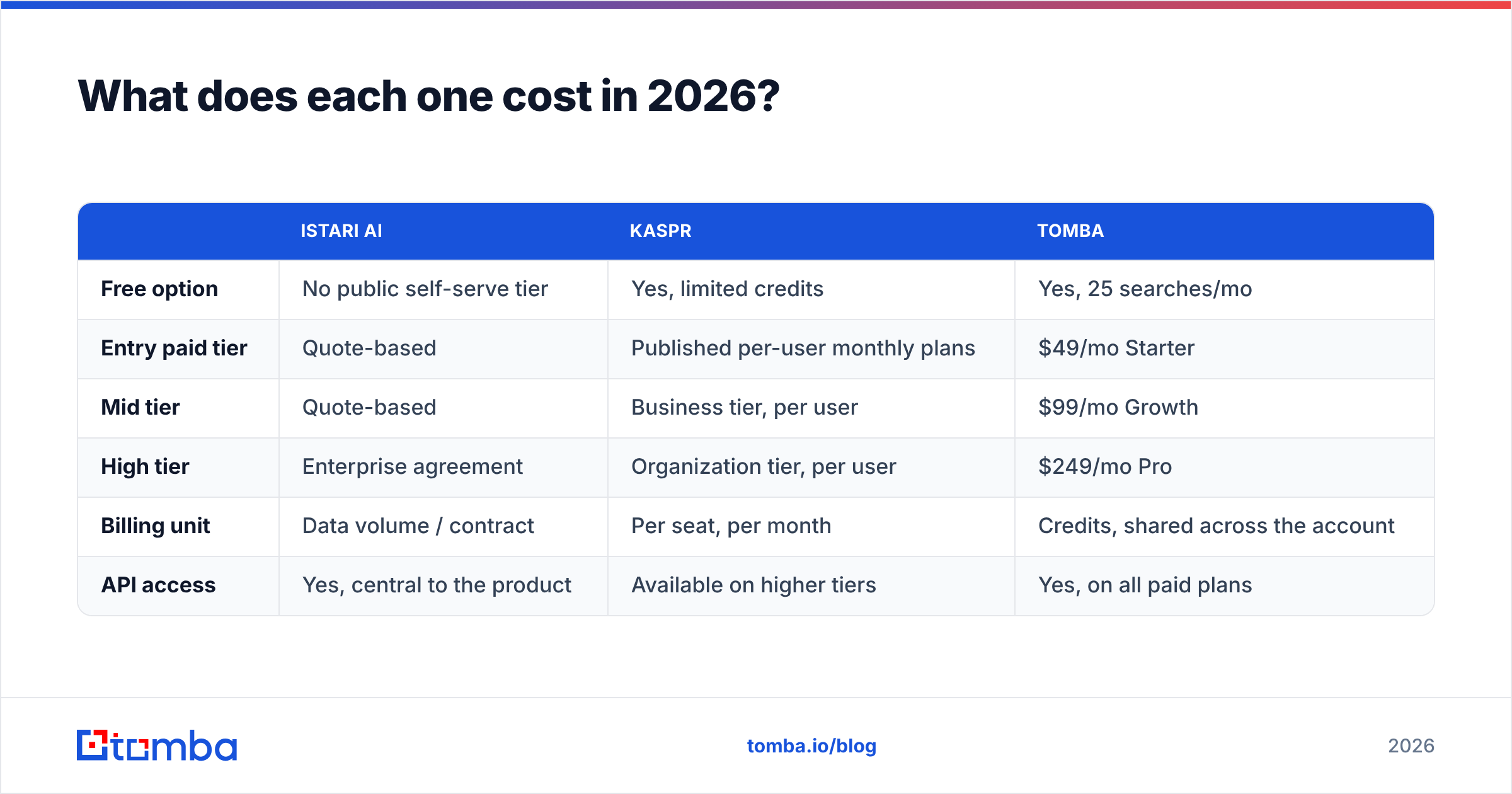
| Dimension | Istari AI | Kaspr |
|---|---|---|
| Core job | Market intelligence from web mining | Contact data from LinkedIn |
| Primary output | Company-level attributes, classifications, scores | Person-level emails and phone numbers |
| Phone numbers | Not the product | Core strength, strong EMEA mobile coverage |
| Email addresses | Not the product | Yes, alongside phones |
| Data method | Crawls and analyses public company websites | Community/contributed data + partner sources |
| Geographic sweet spot | Europe, especially German-speaking markets and SMEs | Europe-heavy, with global coverage |
| Typical buyer | Strategy, research, RevOps, market analysts, investors | SDRs, recruiters, founders doing outbound |
| Delivery | API, data feeds, platform access | Chrome extension, web app, CRM integrations |
| Pricing model | Quote-based / enterprise | Published per-user tiers plus a free plan |
| Where it breaks down | No contacts, no execution layer | Per-seat cost scales badly with volume |
The table makes the point. The overlap between these two products is close to zero. Maybe a vendor list lumped them together under "B2B data." If that is why you are comparing them, you are asking the wrong question. The real question in any Istari AI vs Kaspr decision is simpler: which half of the prospecting problem is costing you pipeline right now?
Which problem are you actually trying to solve?#
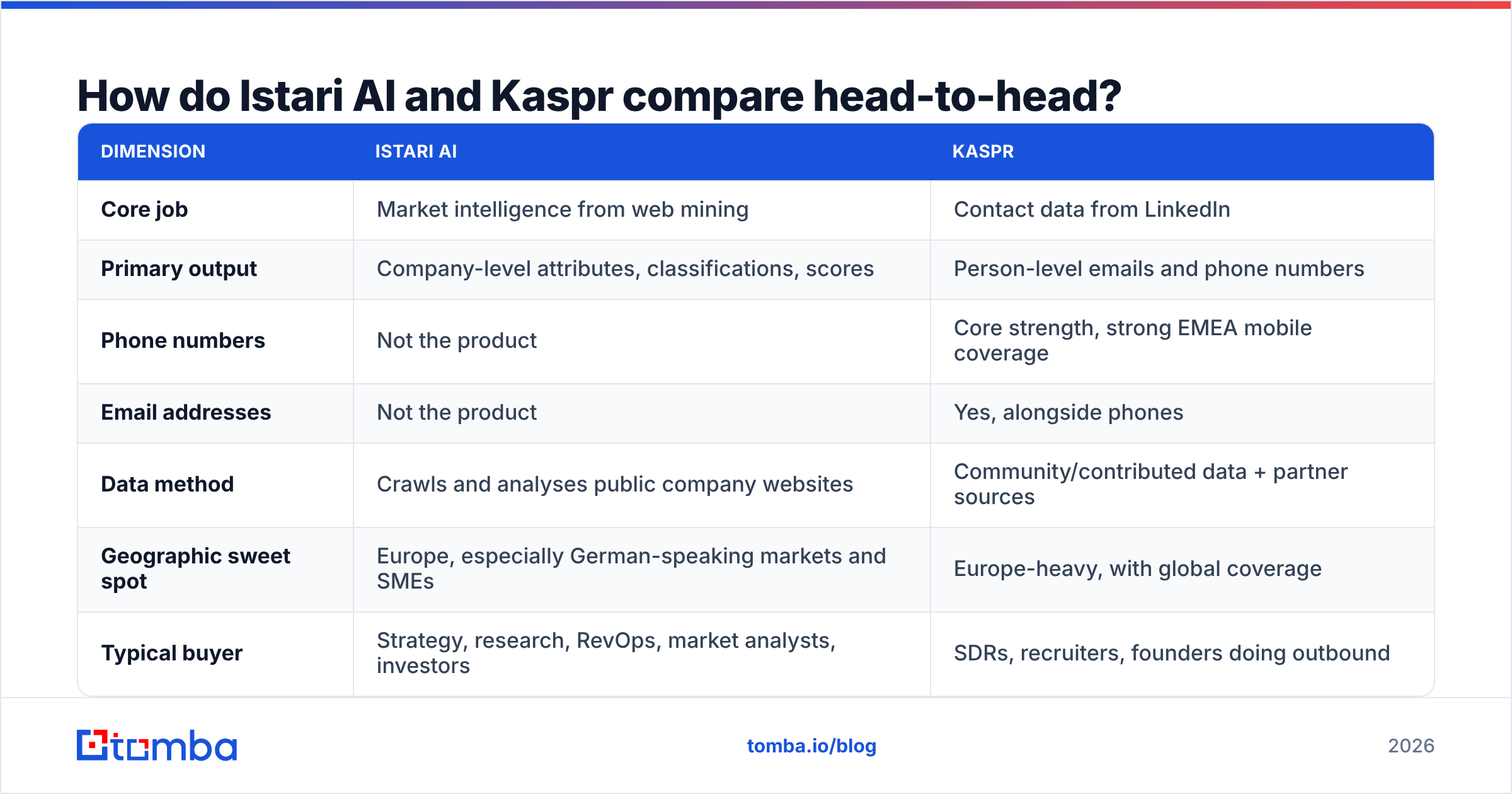
Run through these four checks before you book either demo.
- Do you know who to sell to? If your ICP is still a guess — "manufacturers adopting automation," "firms that just started hiring data engineers" — you have a targeting problem. That is Istari AI's ground. Kaspr will happily sell you numbers for the wrong accounts.
- Do you have a list but no way to reach it? Maybe you can name 400 target companies but hold only generic info@ addresses. That is a contact problem. Kaspr fits, or a domain search plus a finder workflow.
- Is your channel phone or email? Cold calling makes mobile numbers non-negotiable, which points to Kaspr or a dedicated phone finder. Email-first teams care far more about deliverability than about direct dials.
- Is the work manual or programmatic? Two reps clicking through Sales Navigator is a seat-based workflow. Ten thousand rows a month through a pipeline is an API workflow. Per-seat tools get expensive fast at that shape.
Most teams find they have problem 2 and problem 4 at once: a list they cannot reach, at a volume no seat-based tool prices well.
What does each one cost in 2026?#
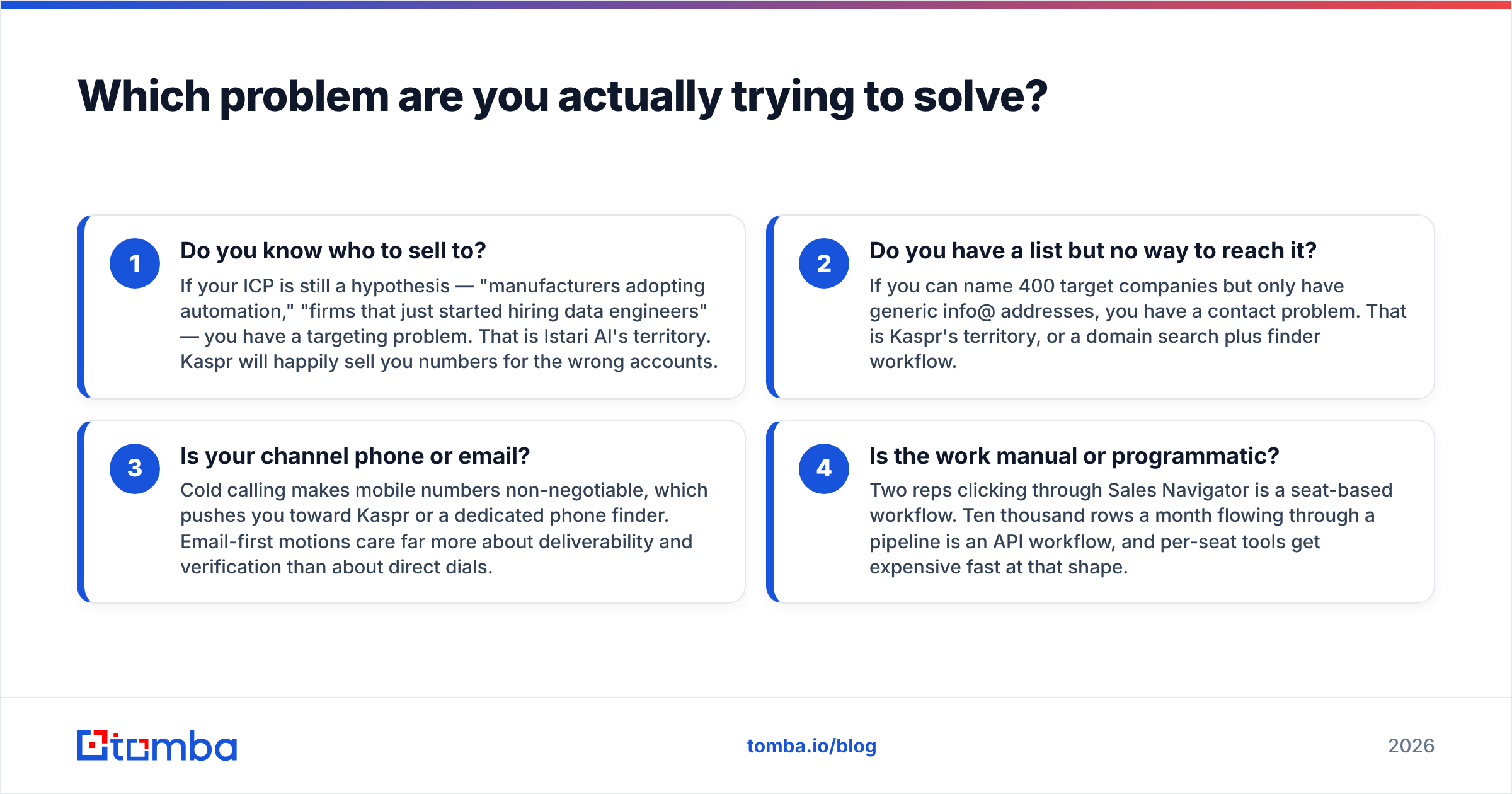
Pricing moves, and the two vendors do not even publish on the same terms. Treat this as a shape comparison, not a quote.
| Istari AI | Kaspr | Tomba | |
|---|---|---|---|
| Free option | No public self-serve tier | Yes, limited credits | Yes, 25 searches/mo |
| Entry paid tier | Quote-based | Published per-user monthly plans | $49/mo Starter |
| Mid tier | Quote-based | Business tier, per user | $99/mo Growth |
| High tier | Enterprise agreement | Organization tier, per user | $249/mo Pro |
| Billing unit | Data volume / contract | Per seat, per month | Credits, shared across the account |
| API access | Yes, central to the product | Available on higher tiers | Yes, on all paid plans |
Two things matter more than the headline numbers.
First, the billing unit. Kaspr charges per user. That is fine for three SDRs. It hurts when marketing, RevOps, and a data engineer each need access for the odd lookup. Credit-pooled models — see the current Tomba pricing for the shape — let one budget serve several teams.
Second, quote-based pricing is a filter. Istari AI sells through an enterprise motion, so you will not run a $200 pilot next Tuesday. If you must prove value inside a quarter on a small budget, that alone may decide it.
Is Istari AI better than Kaspr for outbound prospecting?#
No — and it is not trying to be. For pure outbound, Kaspr is the more useful of the two. Outbound dies at the contact layer, not the targeting layer.
There is one case where Istari AI wins outright: when your outbound fails because you are working the wrong market. Teams burning 5,000 contacts a month at a 0.4% reply rate rarely have a data-quantity problem. They have a targeting problem, and more mobile numbers only make it worse and more costly. Web-mined signals fix a bad ICP. A new capability on a company site, a shift in stated focus, a technology it just started advertising — those are the inputs you want.
If your reply rates are fine and you simply cannot get enough reachable contacts, skip the market intelligence layer for now.

Where do both tools leave a gap?#
Three gaps show up again and again in real deployments.
Verification is still your job. Neither platform is built as a validation engine. Contact data decays by roughly 25–30% a year as people change roles. A number that was right in March may be dead in October. Run everything through a verification step before it enters a sequencer. Bounce rates above 3% start to damage sender reputation, and then your whole domain's email deliverability.
Catch-all domains eat your list. Many enterprise domains accept every address at the SMTP layer. A naive check returns "valid" for addresses that will never reach a human. This is where a dedicated catch-all verifier earns its keep. Neither a market intelligence platform nor a LinkedIn extension is built to resolve those.
Bulk and API work is under-served on the seat model. Once your workflow becomes "enrich every new row in this table," you want per-credit, programmatic access. A bulk email finder or a straight Tomba API call beats a person clicking a browser extension. Kaspr does offer bulk features on higher tiers, but you still pay for humans who may not need seats.
How should you stack these tools together?#
Most mid-market teams land on the same architecture.
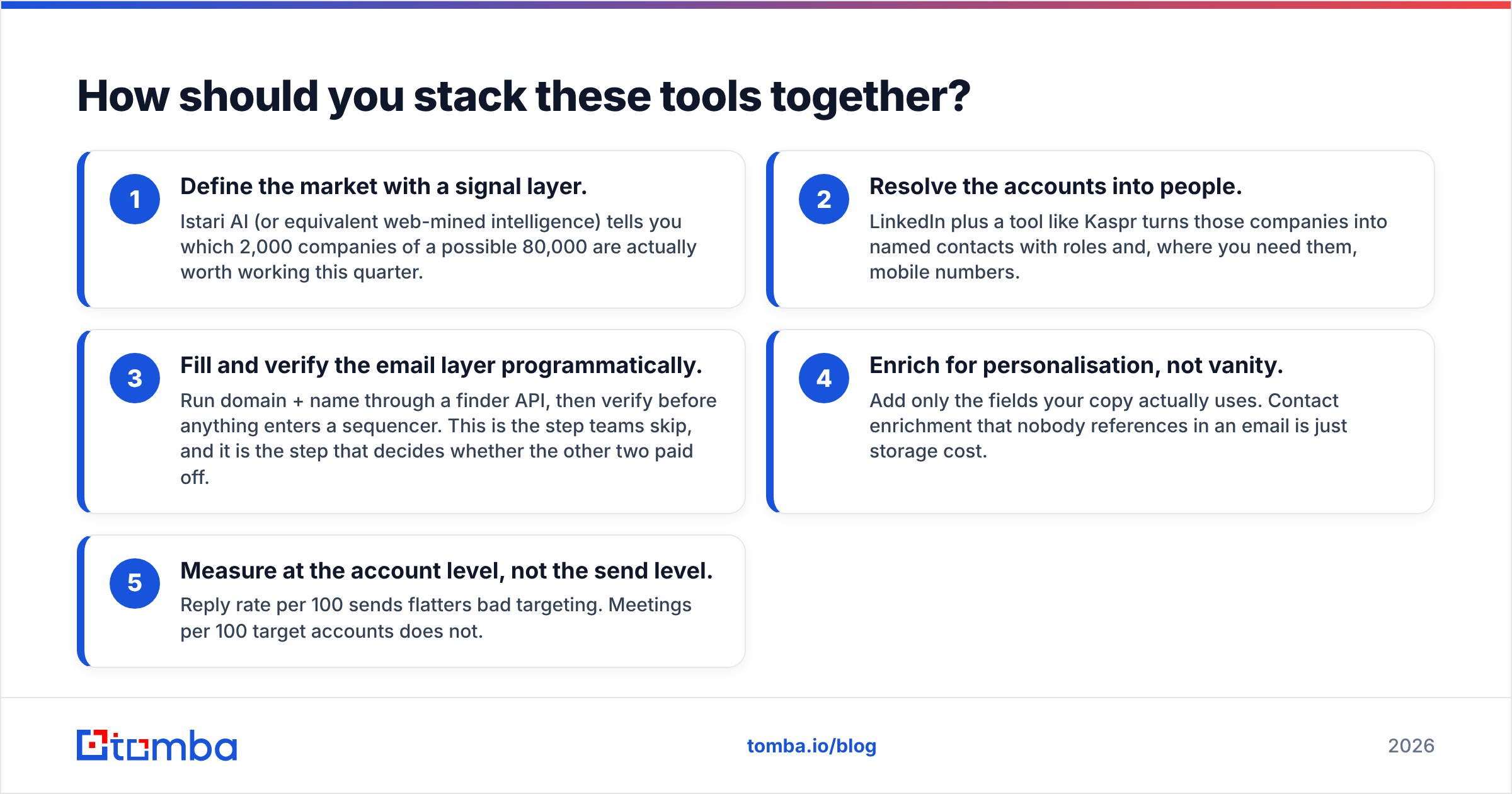
- Define the market with a signal layer. Istari AI, or similar web-mined intelligence, tells you which 2,000 companies out of 80,000 are worth working this quarter.
- Resolve the accounts into people. LinkedIn plus a tool like Kaspr turns those companies into named contacts with roles and, where you need them, mobile numbers.
- Fill and verify the email layer programmatically. Run domain and name through a finder API, then verify before anything enters a sequencer. Teams skip this step, and it decides whether the other two paid off.
- Enrich for personalisation, not vanity. Add only the fields your copy uses. Contact enrichment that no email references is just storage cost.
- Measure at the account level, not the send level. Reply rate per 100 sends flatters bad targeting. Meetings per 100 target accounts does not.
Steps 1 and 2 are where Istari AI and Kaspr fit. Step 3 is where most stacks quietly leak money, because it gets bolted onto a per-seat tool that was never priced for it.
Istari AI vs Kaspr: which one should you choose?#
Choose Istari AI if: you sit in strategy, research, RevOps, or investment; your questions are about markets rather than individuals; you work in European markets where US-built databases thin out; and you have the budget and time for an enterprise data contract.
Choose Kaspr if: you run a small or mid-size sales or recruiting team on LinkedIn every day; you need direct dials more than market maps; you want a free tier to test with; and your headcount on the tool is genuinely small.
Choose neither, yet, if: your real problem is that half the emails you already hold bounce. Fix the data-quality layer first. It is the cheapest fix available, and it makes every downstream tool look better.
For teams in that third bucket, start with the Tomba Email Finder. The same goes for anyone who needs contact discovery at volume without buying another seat.
The free tier gives you 25 searches a month, enough to check coverage against your own known-good list. Starter runs $49/mo, and credits are pooled across the account rather than per user. Every paid plan includes API access, so the same workflow runs from a spreadsheet, a CRM, or a cron job. Pair it with the verifier before your next send. You will learn more about your data quality in an afternoon than a quarter of demos will tell you.
Related guides#
// get started
Find, verify and enrich your first contacts today
Start on the free plan with 25 searches a month, then scale when your team is ready.
Free plan · No credit card required · GDPR & CCPA
// about the author