Istari AI vs ListKit: Which B2B Data Tool Wins in 2026?
Istari AI sells web-derived company intelligence. ListKit sells verified contact lists for cold outbound. They are not the same product — and picking the wrong one wastes a quarter. Here is the honest breakdown.
TL;DR
- Istari AI vs ListKit is not one market. The two tools solve different jobs.
- Istari AI turns company websites into data. ListKit sells verified emails and phone numbers.
- Pick by bottleneck. Stuck on "who should we target?" go with Istari AI. Stuck on "who do I email there?" go with ListKit.
- Pricing runs the opposite way. Istari AI quotes a contract. ListKit sells credits on a card.
- Neither is a safety net. Check every list before it hits your sending domain.
- Most teams overpay. An email finder plus a verifier does the same job for far less.
You typed "Istari AI vs ListKit" into a search box. That usually means one of two things. Either someone sent you a pricing page and you want to know if it replaces your stack. Or you are drafting next year's data budget and both names came up.
Here is the catch. The Istari AI vs ListKit matchup is not a normal head-to-head. The two products do not compete for the same line item. Let's fix that first.
What does each tool actually do?#
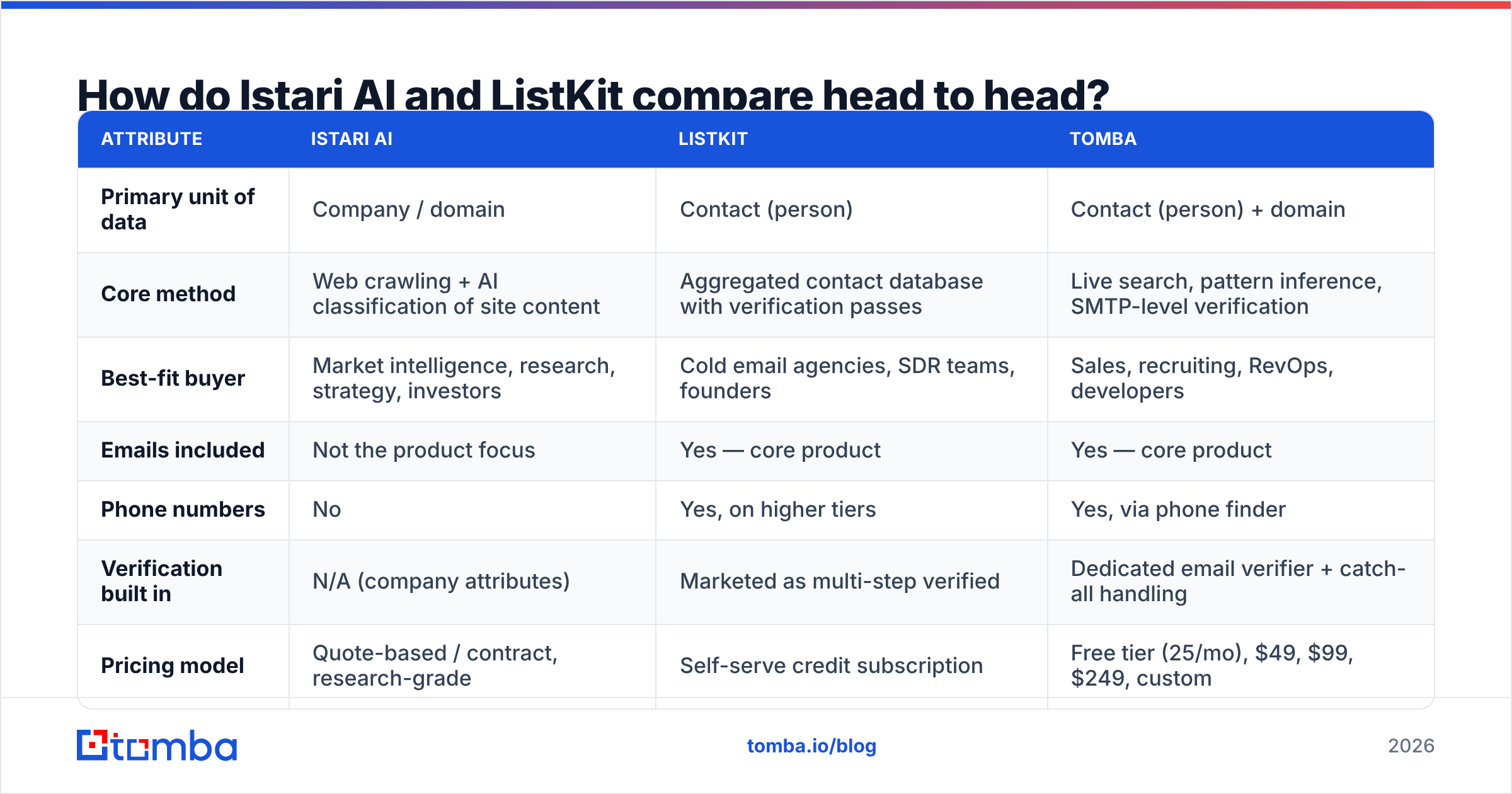
Istari AI (istari.ai) mines the web for company data. It crawls company websites at scale. Then it turns that raw text into clean fields: industry, tech stack, AI use, growth signals. The output describes a company, not a person.
The typical buyer is an analyst, not an SDR. Think market research teams, strategy firms, and investors. They need solid company data across a whole market. Often with an EU-first, GDPR-safe stance.
ListKit (listkit.io) is a B2B contact database built for cold email. It sells verified work emails and mobile numbers. You filter by title, headcount, industry, region, or tech. Each export burns credits.
The typical buyer here is an agency or an outbound team. The design comes straight from the cold email world. Build a list, export it, load a sequencer, send. Bounce rate kills that motion, so verified claims sit front and centre.
Where do they overlap? Both can tell you which companies fit a profile. Only ListKit tries to tell you who to email. Only Istari AI tries to explain what is going on inside a company's website.
That split drives the rest of this guide. Score them on one feature list and each will look half broken. That result is true and useless.
Istari AI vs ListKit: the head-to-head table#
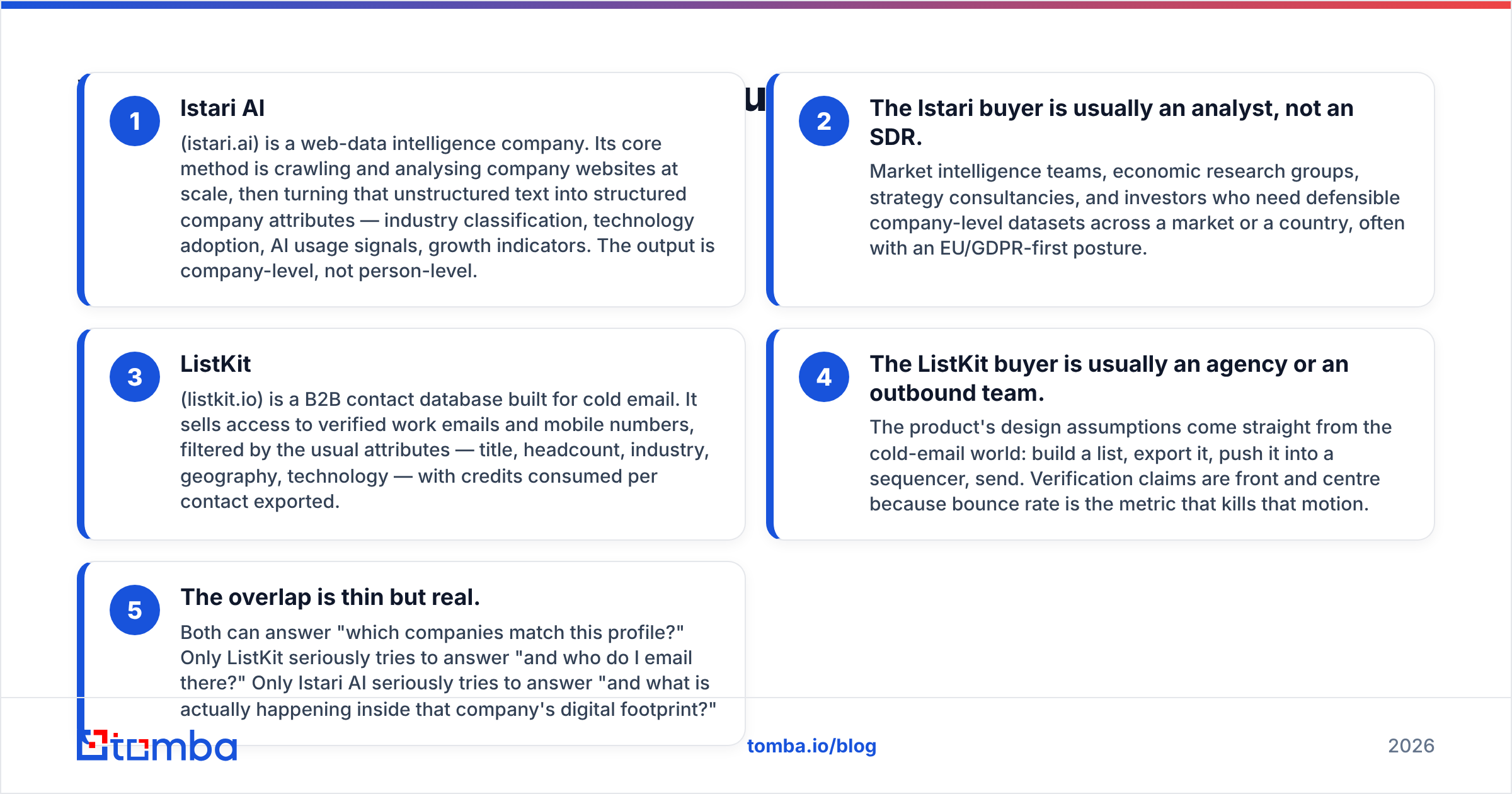
The table stays conservative on purpose. Prices and credit limits move often. Treat the tiers as a starting point. Check the vendor page before you sign. Tomba sits here as a yardstick for the contact column only.
| Attribute | Istari AI | ListKit | Tomba |
|---|---|---|---|
| Primary data unit | Company / domain | Contact (person) | Contact + domain |
| Core method | Web crawl + AI labels | Aggregated database, verified | Live search + SMTP checks |
| Best-fit buyer | Research, strategy, investors | Cold email agencies, SDR teams | Sales, recruiting, RevOps, devs |
| Emails | Not the focus | Yes, core product | Yes, core product |
| Phone numbers | No | Yes, higher tiers | Yes, via phone finder |
| Verification | N/A | Multi-step, as marketed | Email verifier + catch-all |
| Pricing | Quote / contract | Self-serve credits | Free (25/mo), $49, $99, $249 |
| API | Yes | Limited by plan | Yes — Tomba API, CLI, MCP |
| Bulk workflow | Dataset delivery | CSV to sequencer | Bulk finder, Sheets, Excel |
| Geography | Strong EU/DACH | Strong US/English | Global, 100+ regions |
Two rows deserve a second look.
Pricing model. Istari AI sells like a data licence. Scoped, negotiated, usually annual. That is normal for research-grade data. It also explains the missing public price. ListKit posts self-serve tiers because its buyer wants to pay by card on a Tuesday. Neither way is wrong. They just imply very different timelines.
Need data in the building this week? Skip the quote-based vendor.
Geographic strength. This factor gets ignored the most. A dataset that shines in Germany and thins out in Brazil will quietly sink a LATAM push. Ask both vendors for a sample in your real target region. A generic sample deck proves nothing.
Which one fits your go-to-market motion?#
The Istari AI vs ListKit choice comes down to the bottleneck you actually have.
Pick Istari AI if:
- You are sizing a market, not working a list.
- You need company counts, segment sizes, or tech adoption rates.
- You need European coverage and a GDPR story your legal team will accept.
- Your output is a report, a model, or a score in your CRM.
- You can absorb a buying cycle measured in weeks.
Pick ListKit if:
- You already know the ICP and the job titles.
- You need emails and mobiles today, in a CSV.
- It has to drop straight into Instantly, Smartlead, or your sequencer.
- Cost per contact matters more than data depth.
- You want self-serve billing and no sales call.
Pick neither if you only need a few hundred good contacts a month.
Buying a database for that is like leasing a warehouse to store a bike. A finder plus a verifier costs less. For small lists it is often more accurate too. It resolves the address when you ask, not from a record cached months ago.
That is where the money leaks. Database plans assume you will burn most of your credits. Most teams use 30–50% and renew anyway.
Why accuracy differs in Istari AI vs ListKit#
The two tools measure different things. So "accurate" means two different things.
For Istari AI, accuracy is about labels. Did the model spot that this firm is a mid-size industrial supplier running a given tech? You test that by sampling records and checking them by hand. There is no bounce rate to read.
For ListKit, accuracy is about delivery. Does the mailbox exist? Will it accept mail? Is the person still in the job? Every contact database decays. Industry estimates put B2B decay near 2–3% per month. Over a year, a quarter to a third of a list goes stale.
Gartner has flagged weak data quality as a real cost for years. It is not one vendor's flaw.
So "triple-verified" needs a follow-up question: verified when? A record checked at intake eight months ago is not the same as one checked at export. Same label, different product. Ask which one you are buying.
Three defences, whichever vendor wins:
- Re-verify at export. Run the list again right before it enters a sequencer. The cost is a rounding error next to a burned domain.
- Handle catch-all domains. Many large domains accept any address at the SMTP layer. A catch-all verifier that scores confidence beats a shrug.
- Track bounce rate by source. Tag the vendor in your CRM. One quarter later you will know which contract to renew.

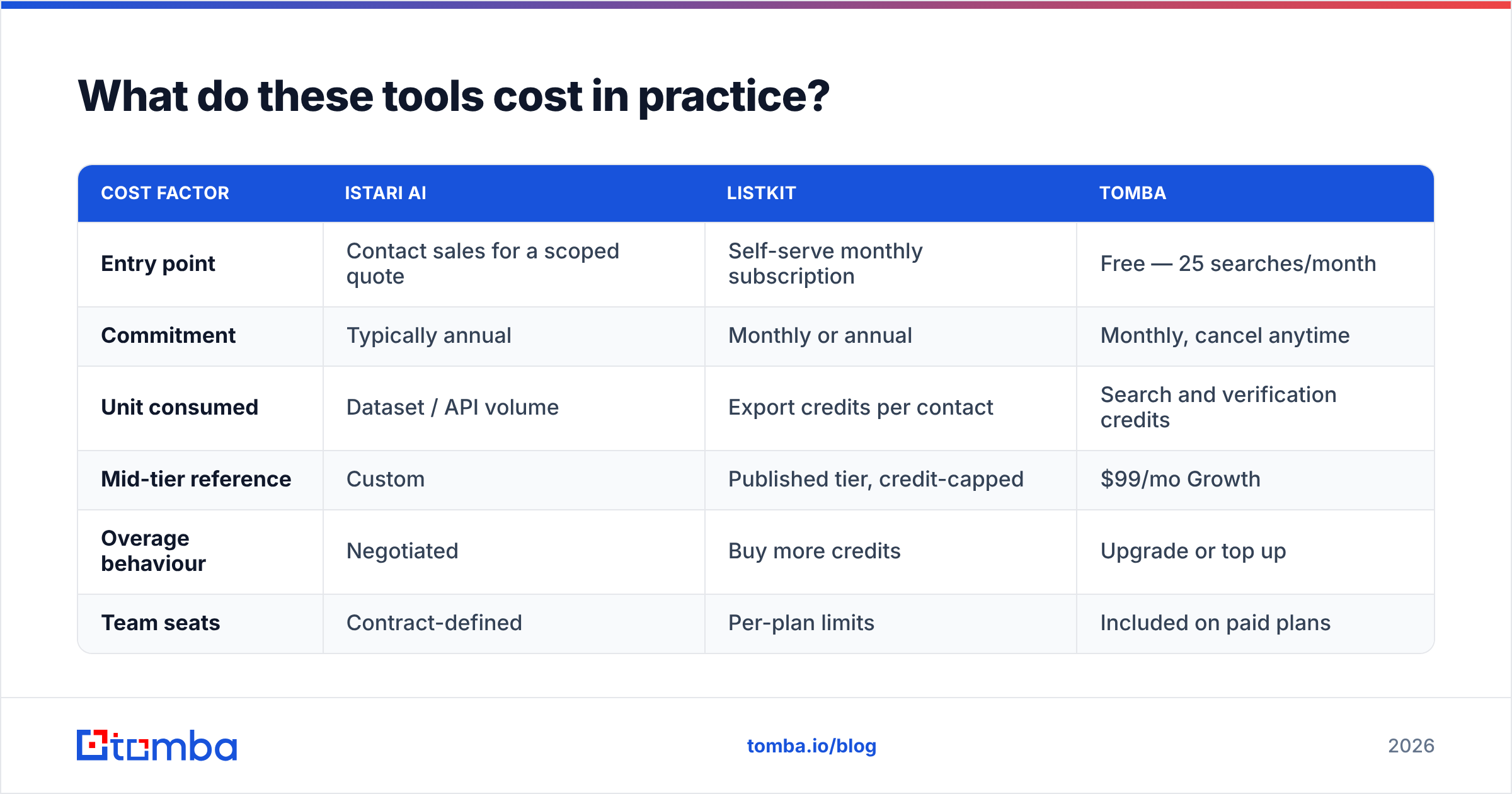
What does each tool cost?#
Published prices move. So here is the shape of the cost, not a number that ages badly.
| Cost factor | Istari AI | ListKit | Tomba |
|---|---|---|---|
| Entry point | Contact sales for a quote | Self-serve monthly plan | Free — 25 searches/month |
| Commitment | Usually annual | Monthly or annual | Monthly, cancel anytime |
| Unit consumed | Dataset / API volume | Export credits per contact | Search and verify credits |
| Mid-tier | Custom | Published, credit-capped | $99/mo Growth |
| Overage | Negotiated | Buy more credits | Upgrade or top up |
| Team seats | Set by contract | Per-plan limits | Included on paid plans |
For scale, Tomba pricing runs Free at 25 searches a month, Starter at $49, Growth at $99, Pro at $249, plus custom plans. The point is not that it beats a research dataset. It is not one. The point is that the contact job has a sub-$100 answer, and many teams walk past it on the way to a $12k contract.
Do the math before the demo. Take your real monthly contact need. Multiply by twelve. Compare that to the credits on offer. Need 2,000 a month and the plan gives 30,000? You are paying for someone else's usage.
Where each tool breaks down#
Both sides of the Istari AI vs ListKit matchup have real gaps. Here they are.
Istari AI, honestly. It will not hand your reps a send-ready list. Person-level contacts are not the product. You still need a finder or a database next to it. Quote pricing also rules out a quick pilot. And web-based labels are only as fresh as the last crawl. Firms with thin websites get described poorly by any web-mining method.
ListKit, honestly. It is tuned for one motion: high-volume cold email into US-heavy targets. Push it outside that lane and coverage thins. Credit plans also create an odd pull. You export more than you need to "use the plan". Lists grow, reply rates drop. And like any aggregated database, you buy a snapshot.
Both, honestly. Neither one fixes your targeting judgement. Better data makes a good ICP faster to work. It will not save a bad one. Reply rates under 1%? A new vendor is rarely the fix. Response rate problems are usually message and list problems in a data costume.
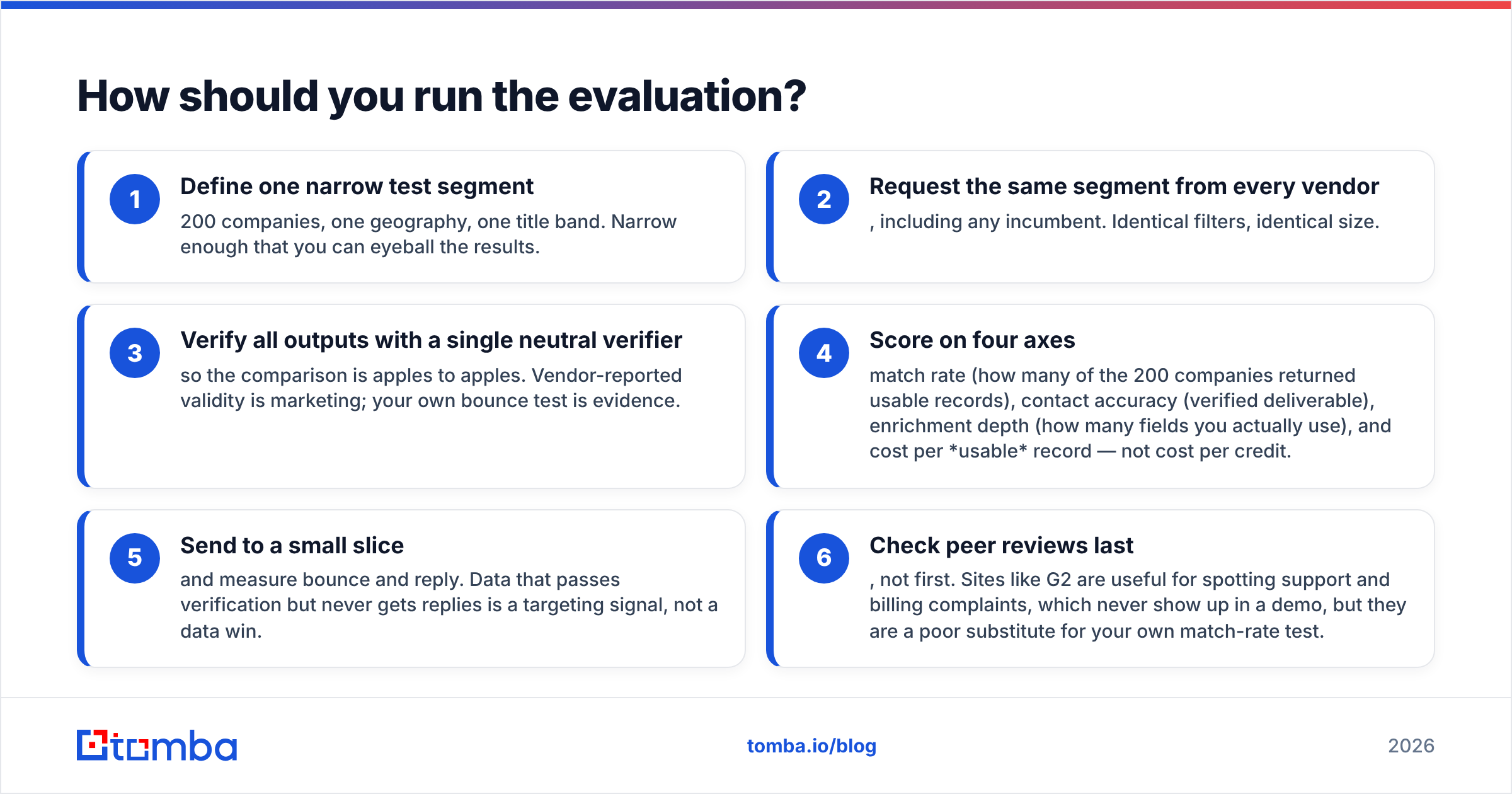
How to run the Istari AI vs ListKit test#
Do this in a week, not a quarter.
- Pick one narrow segment. 200 companies, one region, one title band. Small enough to eyeball.
- Ask every vendor for that same segment. Same filters, same size. Include your current tool.
- Verify all outputs with one neutral verifier. Vendor stats are marketing. Your bounce test is evidence.
- Score four things. Match rate, contact accuracy, depth of useful fields, and cost per usable record.
- Send to a small slice. Watch bounces and replies. Clean data that gets no replies is a targeting problem.
- Read peer reviews last. Sites like G2 expose support and billing gripes you never see in a demo.
Most teams skip step 3. Then they argue about vendor numbers for a month. Don't.
Istari AI vs ListKit: which should you choose in 2026?#
Need to understand a market? Choose Istari AI. Need to email people? Choose ListKit. Need to email people at modest volume? Buy neither. Use a finder and a verifier.
That third path is where most Istari AI vs ListKit searches should land. The search itself signals a team that has not yet split the research problem from the contact problem. Split them and the budget shrinks. Company research becomes a quarterly dataset buy. Contact data becomes a per-lead cost that tracks real sending volume.
A sane 2026 stack for a mid-market outbound team looks like this. One solid account list, built in-house or bought. One finder that resolves decision-maker addresses on demand. One verifier that runs right before send. Enrichment for the fields your sequencer needs. No annual lock-in at the contact layer.
Want that shape? Start with the Tomba Email Finder. The free tier gives you 25 searches a month. Test match rate against your own list before you spend a cent. Starter is $49/mo when you scale. Verification, domain search, and data enrichment sit in the same account. No stitching three tools together to answer one question: who do I email, and will it land?
Related guides#
Ready to find emails that actually work?
Join 150,000+ professionals who stopped guessing and started sending. Free credits on signup — no credit card required.
Get the Tomba newsletter
Practical outbound tactics and product updates — once every two weeks.
About the author