Istari.ai vs ReachStream: Which B2B Data Tool Wins in 2026?
One sells AI-generated market signals from company websites. The other sells contact records by the thousand. They barely compete — and picking the wrong one costs you a quarter of pipeline.
Istari.ai vs ReachStream is a common shortlist. It is also the wrong fight. One tool tells you which firms to chase. The other hands you names to email.
TL;DR
- These two tools barely compete. Istari.ai scores companies from their web presence. ReachStream sells names, emails, and phone numbers in bulk.
- Pick Istari.ai if your problem is which accounts to target. It shines in Europe and in industrial niches, where SIC and NAICS codes fall apart.
- Pick ReachStream if your problem is volume of contacts on a tight budget, and your ICP is already set.
- Neither one fixes bounce rates. Istari.ai gives you firms, not live inboxes. ReachStream gives you rows that age fast.
- The cheapest stack that works splits the job. Pick accounts with Istari.ai. Then find and check each address at send time with Tomba, from $49/mo.
What are Istari.ai and ReachStream?#
They solve two halves of one problem. Most comparison posts blur that line.
Istari.ai mines company websites at scale. It reads the text, then works out what the firm really does. You get its trade, its tech, and its output. Not a stale code from a registry form. The company grew out of research in Germany. Its strength is European coverage, plus heavy industry. Teams use it to size markets and score accounts. You get a map of a market, not a call list.
ReachStream sits at the other end. It is a contact list. You filter by trade, job title, place, head count, and revenue. Then you export rows with work emails. Some plans add phone numbers. It claims tens of millions of contacts across B2B and health care. It sells credit packs, not seats. It aims to undercut ZoomInfo and Apollo. You get a list, fast.
So the honest way to frame Istari.ai vs ReachStream is not "which is better." Ask this instead: is your gap in targeting, or in reach?
Istari.ai vs ReachStream: how do they compare head to head?#
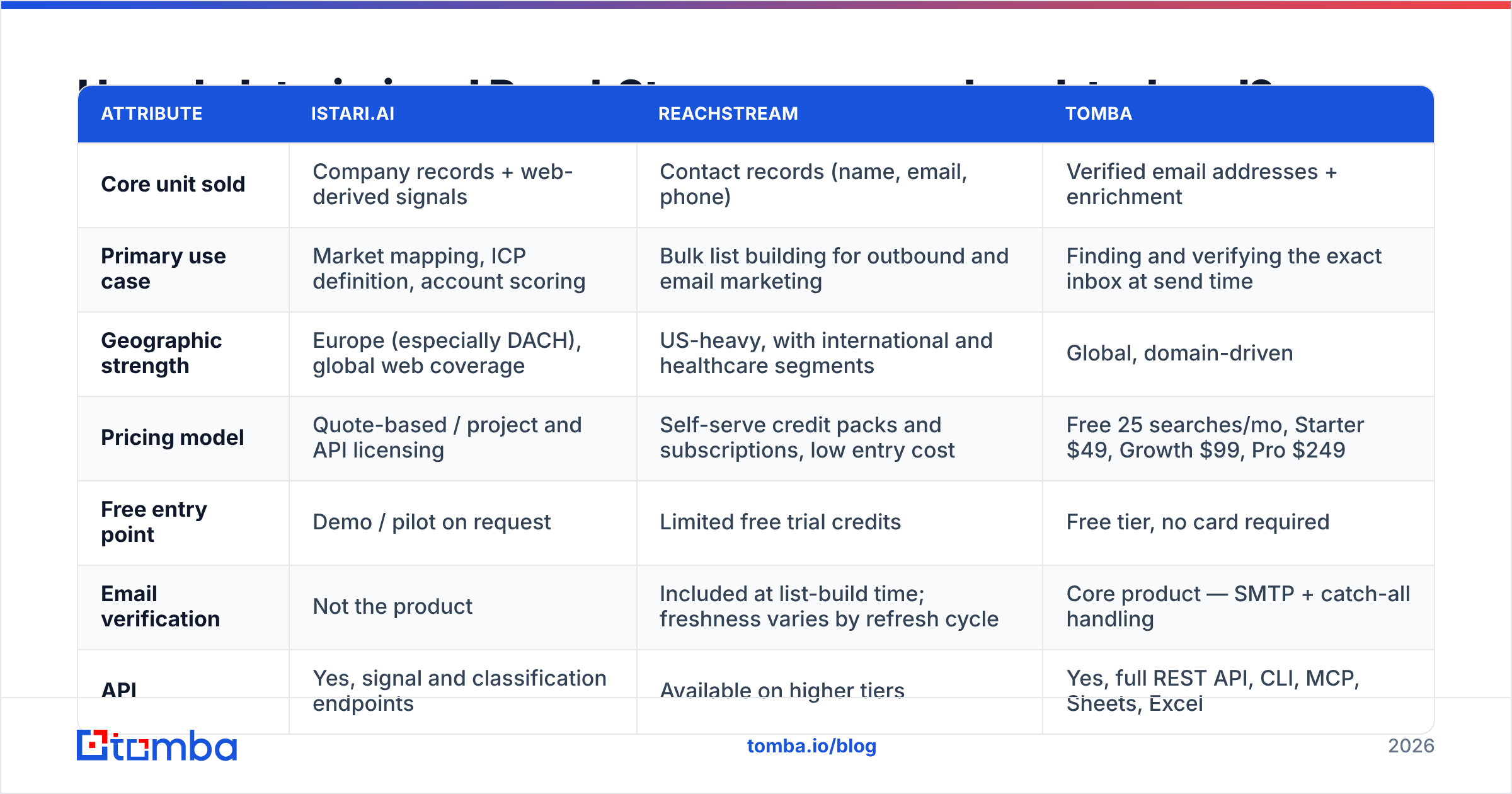
Here is the side by side. Tomba sits in the table as the contact layer most teams bolt on to either one. The vendor figures match their public pages at the time of writing. Check current numbers before you buy.
| Attribute | Istari.ai | ReachStream | Tomba |
|---|---|---|---|
| Core unit sold | Company records + web-derived signals | Contact records (name, email, phone) | Verified email addresses + enrichment |
| Primary use case | Market mapping, ICP definition, account scoring | Bulk list building for outbound and email marketing | Finding and verifying the exact inbox at send time |
| Geographic strength | Europe (especially DACH), global web coverage | US-heavy, with international and healthcare segments | Global, domain-driven |
| Pricing model | Quote-based / project and API licensing | Self-serve credit packs and subscriptions, low entry cost | Free 25 searches/mo, Starter $49, Growth $99, Pro $249 |
| Free entry point | Demo / pilot on request | Limited free trial credits | Free tier, no card required |
| Email verification | Not the product | Included at list-build time; freshness varies by refresh cycle | Core product — SMTP + catch-all handling |
| API | Yes, signal and classification endpoints | Available on higher tiers | Yes, full REST API, CLI, MCP, Sheets, Excel |
| Best for | RevOps and strategy teams defining a market | SDR teams that need contacts this week | Any team that needs the email to actually land |
| Weak spot | Does not hand you a person to email | Data decay between refreshes; limited signal depth | Not a market-mapping tool |
The table shows the real choice. Can you name the 400 accounts that matter this quarter? If not, ReachStream will gladly sell you 40,000 contacts you should never email. If you can, Istari.ai is costly overkill.
Which one has better data quality?#
They chase two kinds of quality. That gap matters more than any vendor stat.
Istari.ai bets on labels. Does this firm truly belong in your segment? Its signal comes from live site text, not a filing from 2019. So it catches the pivot. The machine shop that now sells IoT kits. The agency that became a SaaS. That is hard to get anywhere else, and it is the best case for the tool. The catch: a thin website yields a thin profile. Web mining cannot see what nobody publishes.
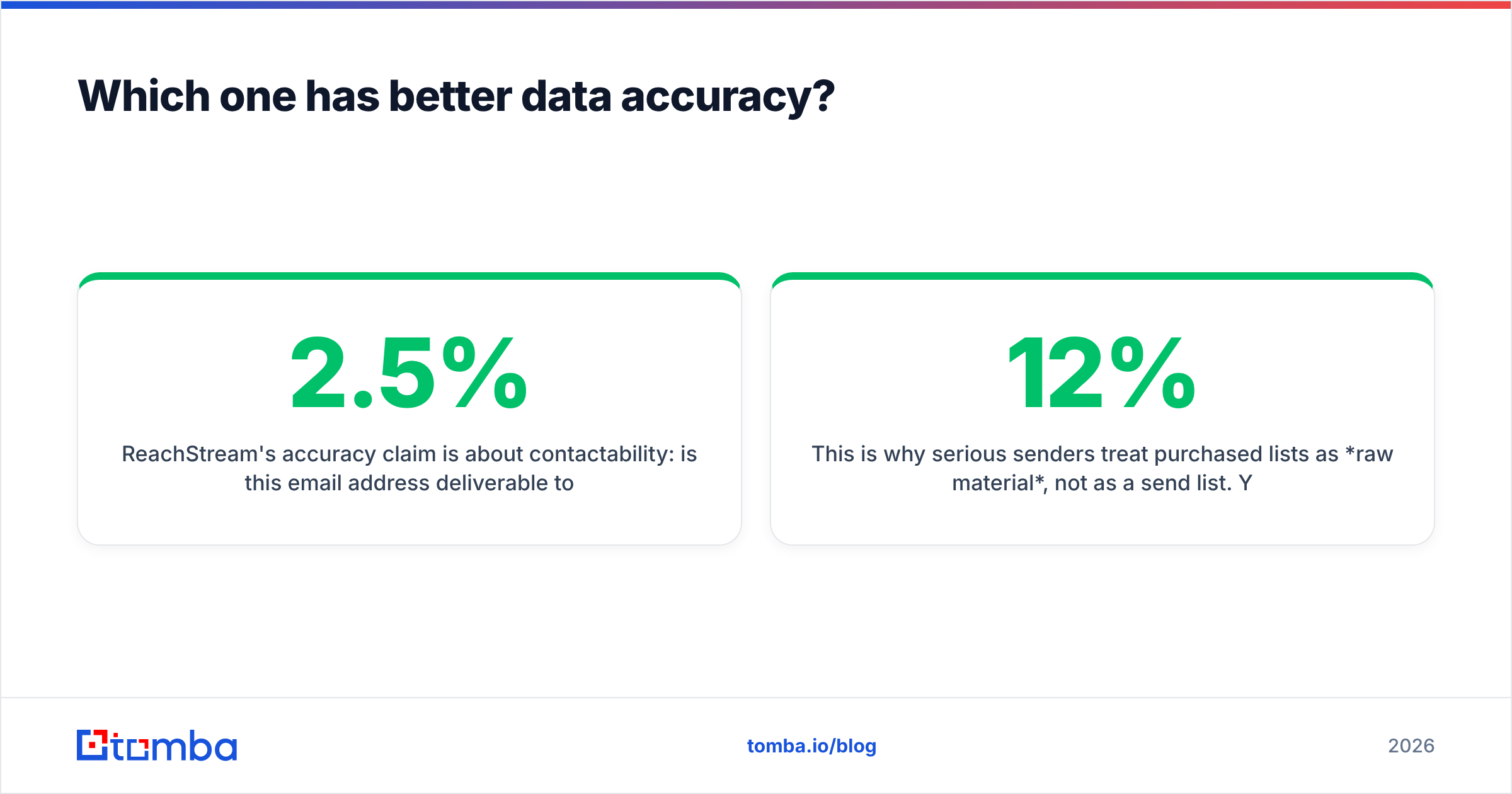
ReachStream bets on reach. Will this address take mail today? Budget databases share one flaw. Rows get checked in batches. The gap between your export and the last check is where bounces hide. B2B contact data rots at roughly 2% to 2.5% a month as people switch jobs. A list that was 95% clean at refresh is much worse ninety days on. That is not a ReachStream quirk. It hits every static database, even the pricey ones. Read the user reviews on G2 for any tool in this band. The story repeats: great value, patchy freshness.
That is why good senders treat a bought list as raw stock. Run the export through an email verifier right before the send. Drop the unknowns. Park catch-all domains in a side track. A 12% bounce rate burns more than credits. It also dents sender reputation on every domain you send from.
How should you choose between them?#
Five questions settle Istari.ai vs ReachStream. Most teams have their answer by question three.
- Is your gap "who" or "how many"? Still arguing over verticals? Buy signals. ICP settled and reps idle? Buy contacts.
- Where are your buyers? Istari.ai owns Europe and heavy industry. Most US-built lists are thin on the German Mittelstand. If your market is US SaaS, that edge fades, and ReachStream wins on cost per contact.
- What is your send volume? Under 5,000 a month, a bulk database is wasted spend. Look up by domain instead. Over 20,000, you need a database and a check step.
- Who keeps the data fresh? A one-time export with no refresh path rots in a quarter. Ask each vendor how rows get re-checked, and whether you pay again for fresh ones.
- Does it fit your stack? A list that needs hand-cut CSVs before it hits your CRM eats more SDR hours than it saves in fees. Check the integrations on both sides first.
Run that list honestly and most teams land on a mix. One layer picks accounts. One layer finds people. One step checks each address before it enters a sequence.
What do Istari.ai and ReachStream cost?#
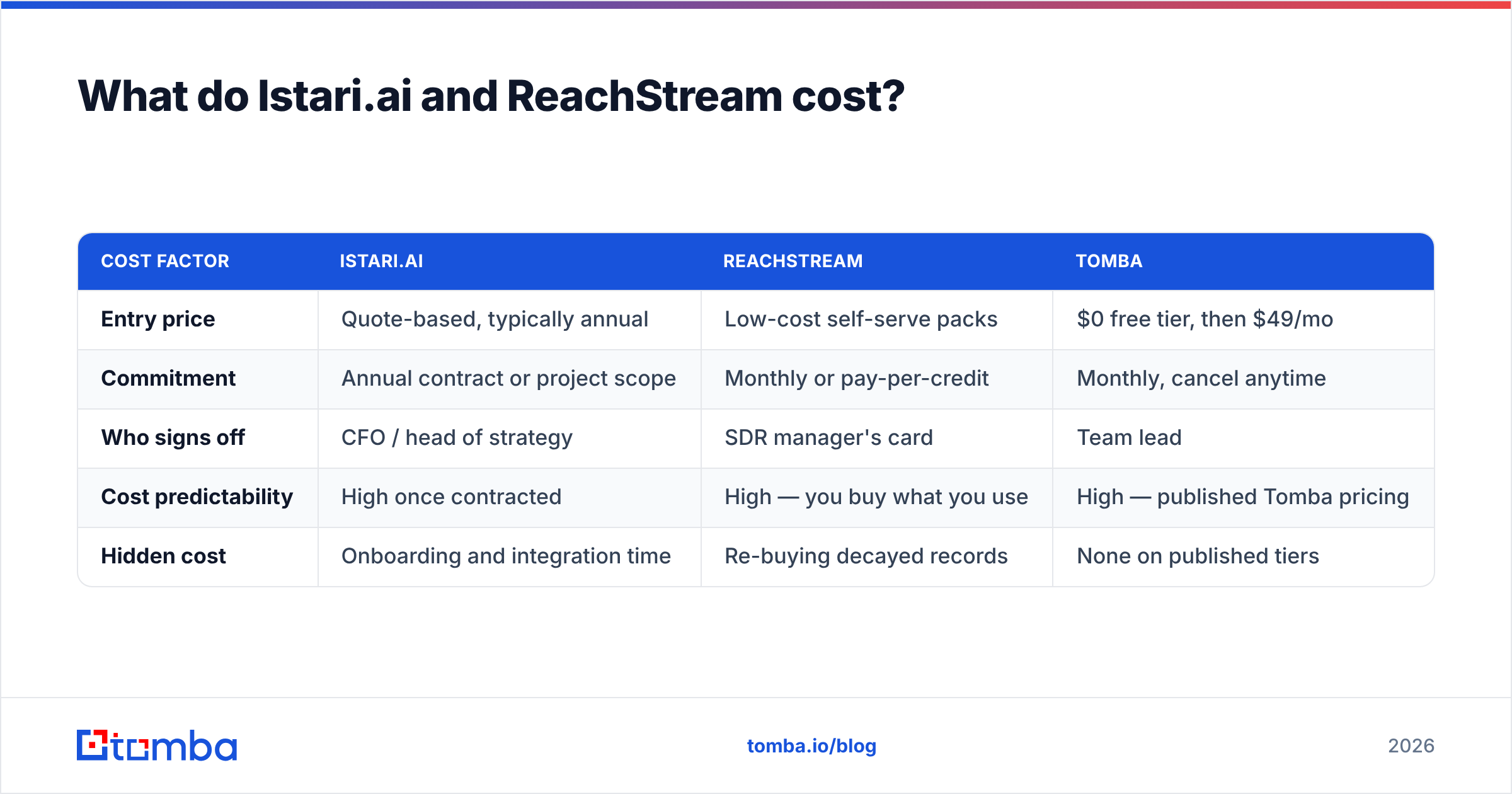
Price is where Istari.ai vs ReachStream splits hardest. It also tells you who each product is for.
| Cost factor | Istari.ai | ReachStream | Tomba |
|---|---|---|---|
| Entry price | Quote-based, typically annual | Low-cost self-serve packs | $0 free tier, then $49/mo |
| Commitment | Annual contract or project scope | Monthly or pay-per-credit | Monthly, cancel anytime |
| Who signs off | CFO / head of strategy | SDR manager's card | Team lead |
| Cost predictability | High once contracted | High — you buy what you use | High — published Tomba pricing |
| Hidden cost | Onboarding and integration time | Re-buying decayed records | None on published tiers |
Istari.ai sells like data plumbing. Scoped, signed, wired in. That fits its buyer: a strategy or research team that needs solid market data. But you cannot test it on a Tuesday afternoon.
ReachStream sells like a consumable. Buy credits, export, send. The risk is the one every credit model carries. A row does not cost what you paid. It costs what you paid divided by the share that still works. A $0.03 contact with a 25% bounce rate really costs $0.04. It drags your domain down too.
This mid-market band is crowded, and that is good for you. BookYourData is a strong pick in the same bracket. You pay as you go, and the data carries a bounce guarantee. That removes the freshness worry above. If cost per working contact is your metric, put it on the shortlist.
Where do both tools leave a gap?#
Both sides of the Istari.ai vs ReachStream choice leave the same three gaps.
Neither hands you a live inbox at send time. Istari.ai stays out of contact data by design. ReachStream ships a snapshot. Neither one checks an address in the moment you use it. That check is cheap and fast. It is the best return in outbound. A domain search plus a live check turns an aging list into a current one.
Catch-all domains stay unsolved. Many large domains accept all mail at the SMTP layer. So a standard check returns "unknown." Databases ship those rows as valid. Verifiers drop them. Both calls are wrong. You need a path that scores the pattern instead of guessing. Otherwise you burn good leads or bounce on them.
Enrichment stops at the row. You get a title, a firm, maybe a LinkedIn URL. You do not get the data enrichment that keeps the row true after export. Job moves. Domain swaps. Rebrands. A contact row is fresh food, and both vendors sell it as canned.
Is there a better setup than picking one?#
Yes. It often costs less than either mid-tier plan.
Treat the work as three jobs you can split. Job one: pick who. That is Istari.ai's turf, or your own signal layer, or a well-built spreadsheet if you are early. Job two: find the people. Match real names to those firms by domain and role. Job three: check the address. Do it right before the send, not last quarter.
Split the jobs and you never overpay for slack. Teams that buy a suite for job two use about 15% of it. Teams that buy signals for job three learn it does not do job three at all. A bulk email finder aimed at your account list costs a slice of a seat plan. It yields cleaner data too, since it resolves addresses now instead of replaying an old export.
Istari.ai vs ReachStream: which should you buy in 2026?#
Buy Istari.ai if you run RevOps, strategy, or research in Europe. Your segments are murky, standard codes fail you, and you hold annual budget. It is a specialist tool, and it is good at its specialty.
Buy ReachStream if you run an SDR or growth team with a set ICP, US targets, a small budget, and a need for volume this month. Assume you will check every row before you send. Budget that step. It is cheap.
Buy neither, yet, if you send under a few thousand emails a month. At that size, targeted lookup beats bulk buying on both cost and quality.
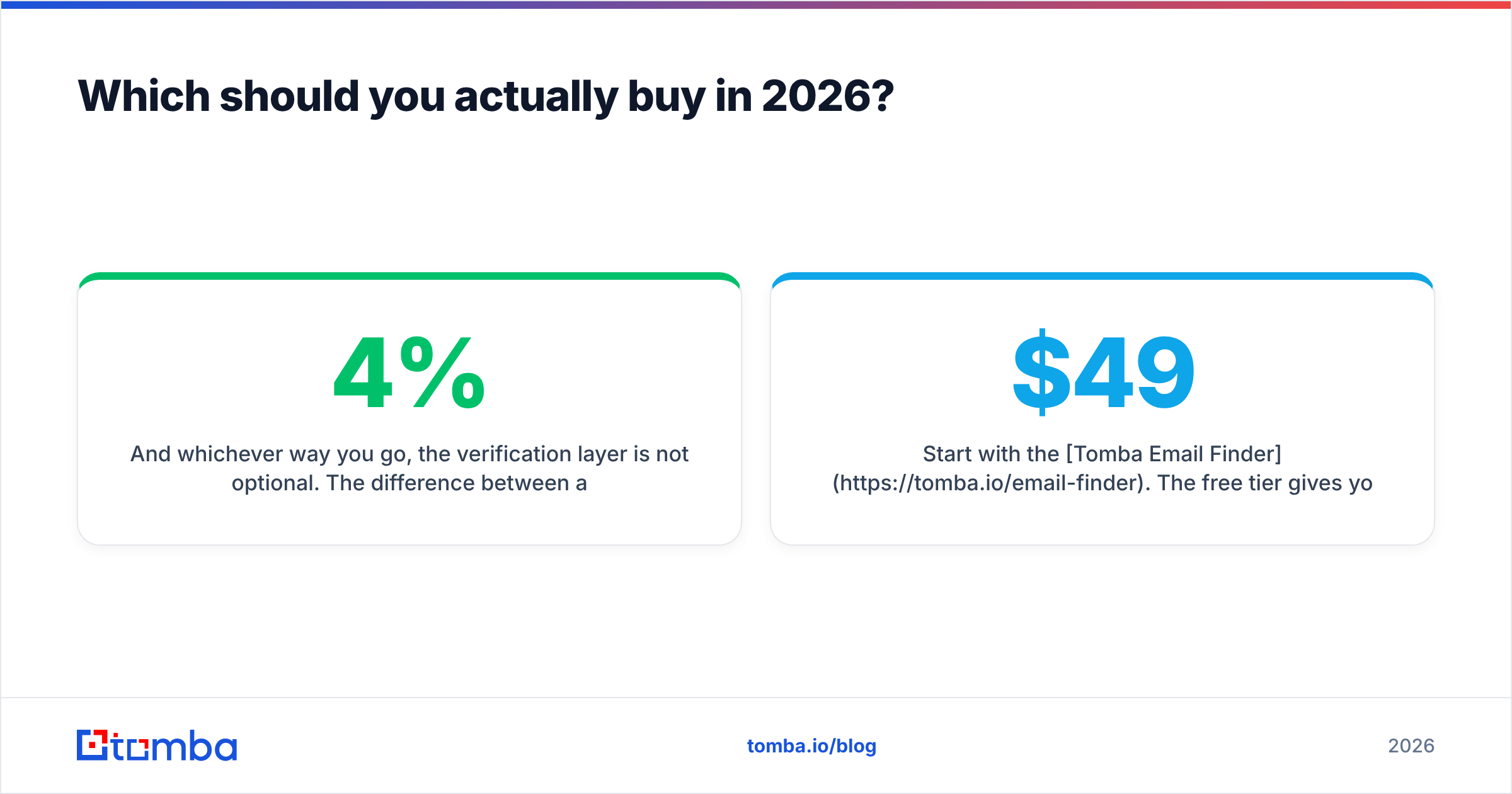
Either way, the check step is not optional. A 4% bounce rate and a 20% bounce rate are not the same kind of problem. One is noise. The other decides whether your mail reaches inboxes at all six months from now.
Start with the Tomba Email Finder. The free tier gives you 25 searches a month, no card. That is enough to test a sample from either side of the Istari.ai vs ReachStream debate against live checks. Keep the vendor if it holds up. If it does not, you found out for free. And at $49/mo, the Starter plan covers a lot of what you were about to sign for.
Related guides#
// get started
Find, verify and enrich your first contacts today
Start on the free plan with 25 searches a month, then scale when your team is ready.
Free plan · No credit card required · GDPR & CCPA
Get the Tomba newsletter
Product and data updates
// about the author