Istari.ai vs Seamless.AI (2026): Which B2B Data Tool Wins?
Istari.ai mines company websites to map markets. Seamless.AI sells contact records for outbound. They are not substitutes, and picking the wrong one wastes a year of budget. Here is the honest split.
Istari.ai vs Seamless.AI is a fight that never really happens. One tool maps markets. The other sells contacts. Here is the short version, then the detail.
TL;DR
- These two tools do not compete. Istari.ai reads company websites and turns them into data you can filter. Seamless.AI sells you names, emails, and phone numbers.
- Pick Istari.ai when your open question is "which 4,000 firms in Europe actually do X?" That is market mapping, ICP work, and TAM sizing. It goes past stale NACE and SIC codes.
- Pick Seamless.AI when your open question is "I know the account, where is the buyer's inbox?" That is high-volume US outbound with a big SDR bench.
- Neither one posts a price. Both use demo calls, annual deals, and seats plus credits. Plan for a slow buying cycle, not a credit card.
- The cheap, honest stack is a mapping layer plus a pay-as-you-go contact layer. A $49/mo email finder does the second job with no year-long lock-in.
Istari.ai vs Seamless.AI: what are they, exactly?#
They sit at opposite ends of the B2B data chain. That is why Istari.ai vs Seamless.AI gets framed wrong so often.
Istari.ai is a German web data firm. It grew out of research on how to sort companies by what their own sites say. Its engine crawls and reads company websites. Then it turns that raw text into fields you can filter. What does the firm sell? Which tools and topics does it name? Does it show signs of AI use? Does it ship abroad? How does it describe its own buyers? You get the output through an API or a screening tool. The unit here is the company, not the person.
Seamless.AI is a US sales data platform. It works like a live search engine for B2B contacts. You search a company or a job title. You get people back, with work emails, mobile numbers, and LinkedIn links. Those records push into your CRM or sequencer. Its own marketing claims well over a billion contact records and about 120 million company records. The unit here is the person.
Put it plainly. Istari.ai tells you who to go after. Seamless.AI tells you who to email. Buy one and expect the other's job, and month two will hurt.
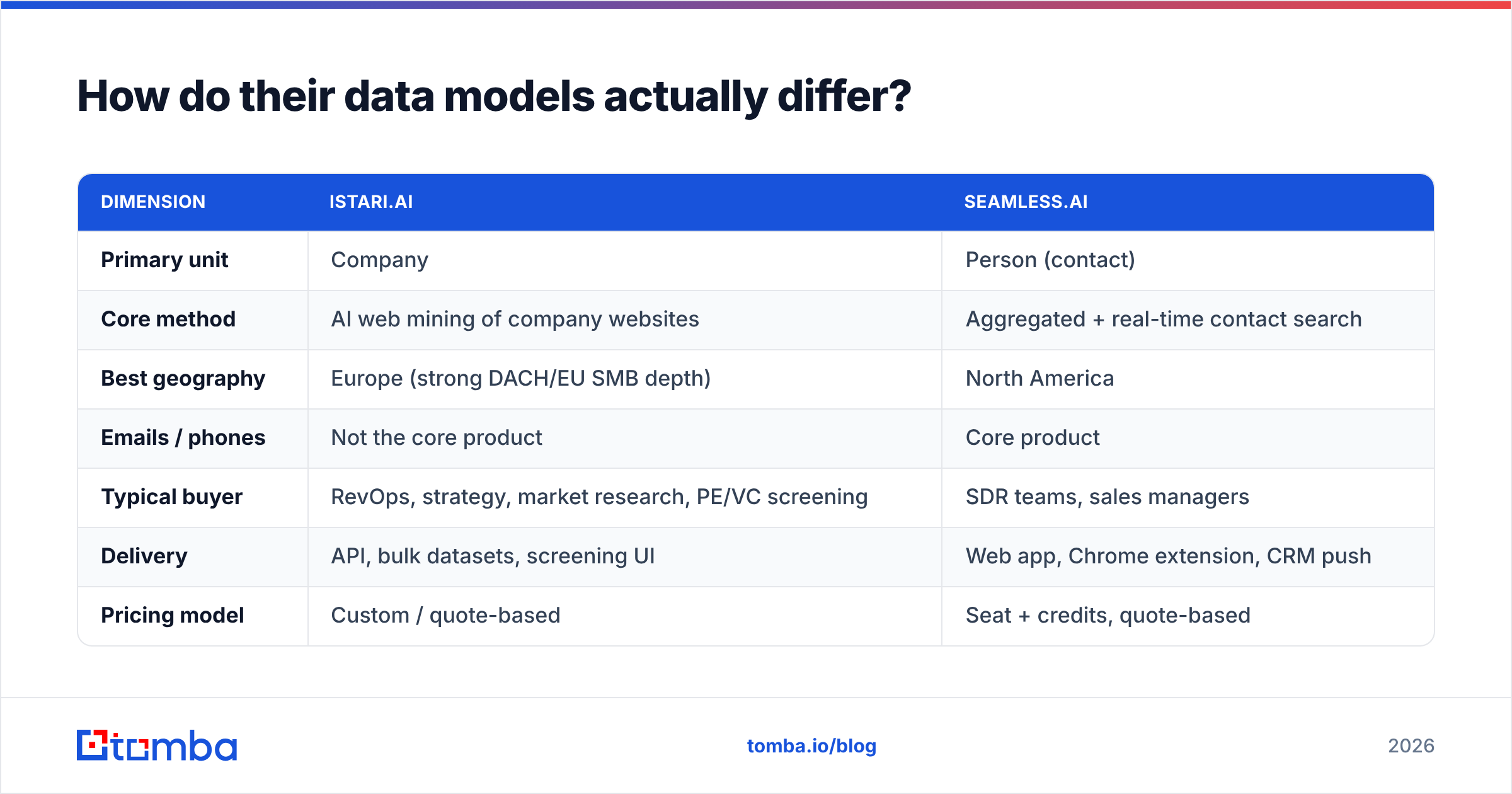
How do their data models actually differ?#
This is the section that should decide your purchase. The two platforms start from very different raw material.
- Source of truth. Istari.ai reads the open web, mostly company sites, and infers traits from the words. Seamless.AI pools records from public sources, partner feeds, and users. It then tries to check them at search time.
- Refresh. Website signals shift when a firm rewrites its own copy. That is slow, but it is honest. Contact records rot fast, because people change jobs. So a contact tool is only as fresh as its re-check cycle.
- Geography. Istari.ai is strongest in Europe, above all in DACH and the EU market. It can sort small firms that no US-built tool has ever heard of. Seamless.AI is strongest in North America.
- Grain. Istari.ai hands you thousands of firms with topic and fit scores. Seamless.AI hands you one human with a phone number. One is a map. The other is a doorbell.
- Shape. Istari.ai behaves like a data vendor: API, bulk delivery, screening for analysts. Seamless.AI behaves like a rep tool: Chrome add-on, CRM sync, list builder, daily credit burn.
| Dimension | Istari.ai | Seamless.AI |
|---|---|---|
| Primary unit | Company | Person (contact) |
| Core method | AI web mining of company websites | Aggregated + real-time contact search |
| Best geography | Europe (strong DACH/EU SMB depth) | North America |
| Emails / phones | Not the core product | Core product |
| Typical buyer | RevOps, strategy, market research, PE/VC screening | SDR teams, sales managers |
| Delivery | API, bulk datasets, screening UI | Web app, Chrome extension, CRM push |
| Pricing model | Custom / quote-based | Seat + credits, quote-based |
| Free self-serve entry | No public self-serve tier | Limited free credits |

Is Istari.ai better than Seamless.AI for finding contacts?#
No. And it does not try to be. Say you need a work email for a named VP of Operations at a 200-person plant. Istari.ai is the wrong tool. It will gladly tell you the plant runs three lines. It will note robotics, five export markets, and a careers page hiring automation staff. It will not hand you that VP's inbox.
Seamless.AI wins that job on paper. In practice, buyers argue about how accurate the records are. Scan the Seamless.AI listing on G2. The critical reviews repeat one pattern. Strong volume. Uneven emails. Mobile numbers that ring the wrong person. Credits spent on records that bounce. That tax hits every pooled contact database, not just this one. It still stings when credits are the currency.
The defence is simple, and you should not skip it. Never mail a contact export without your own check. Run the list through a dedicated email verifier before it hits your sequencer. That step usually strips the 10–25% of records that would hurt your sender score. Trusting the vendor's own "valid" flag is how deliverability dies quietly.
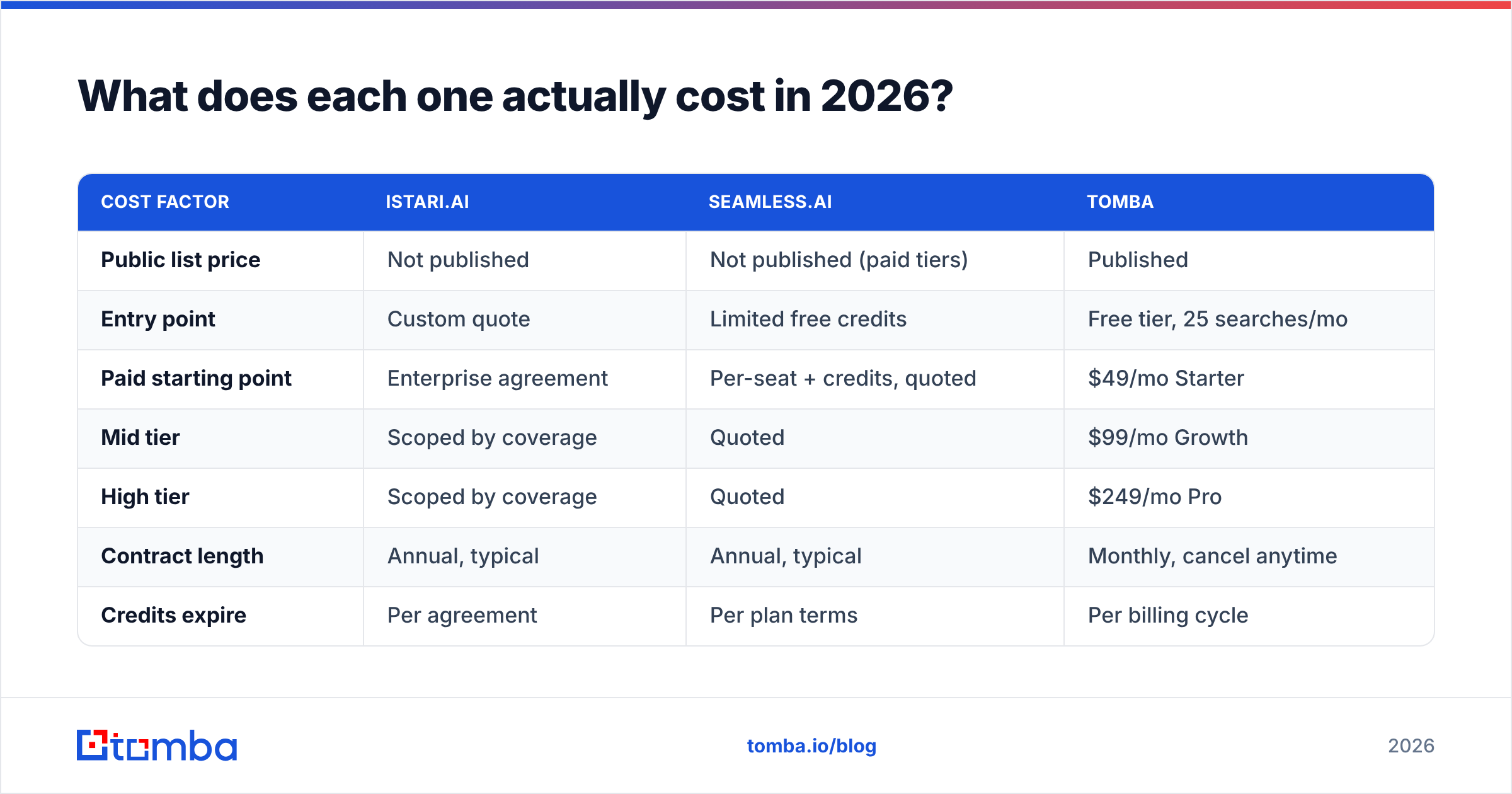
Istari.ai vs Seamless.AI: what does each one cost in 2026?#
Neither vendor makes this easy. That is a data point on its own.
Istari.ai posts no list price. Deals are scoped by coverage, by country, by refresh rate, and by how you get the data. Expect an annual agreement, built with a solutions team. Expect a yearly number in the four to five figure range, not a monthly one. A three-person startup is probably too small for this vendor today.
Seamless.AI also hides paid pricing behind a demo. There is a small free entry point with a few credits each month. Above that sit per-seat plans with credit packs on top. Two things catch buyers out. Credits burn per record revealed, not per record you can use. And deals are often annual, with little room to change mid-term. Read the renewal and exit clauses first. That is the top complaint theme in public reviews.
| Cost factor | Istari.ai | Seamless.AI | Tomba |
|---|---|---|---|
| Public list price | Not published | Not published (paid tiers) | Published |
| Entry point | Custom quote | Limited free credits | Free tier, 25 searches/mo |
| Paid starting point | Enterprise agreement | Per-seat + credits, quoted | $49/mo Starter |
| Mid tier | Scoped by coverage | Quoted | $99/mo Growth |
| High tier | Scoped by coverage | Quoted | $249/mo Pro |
| Contract length | Annual, typical | Annual, typical | Monthly, cancel anytime |
| Credits expire | Per agreement | Per plan terms | Per billing cycle |
The real split is not cheap versus dear. It is fixed versus haggled. Istari.ai can defend its silence, because each build is custom. A contact database that hides a seat price is another story. That is why buyers keep hunting for a Seamless.AI alternative with real numbers on the page. Tomba's pricing details sit in public, because there is nothing to haggle over.
When should you choose Istari.ai?#
Choose Istari.ai when your open question is about the market, not the mailbox.
- You are moving into Europe and the old industry codes are useless. One code can hide six different ICPs. Sorting by website language cuts through that.
- Your ICP is about behaviour, not size. Firms that name new reporting rules. Firms hiring for MLOps. Firms with a dealer network. A contact database cannot filter for any of that.
- You need TAM numbers you can defend in a board deck, an investment case, or a market-entry plan. Full coverage of a country beats a sample every time.
- You screen deals for PE, VC, or corp dev. Finding the forty firms in a split sector that match a thesis is the exact job this engine was built for.
- You want an API feed into your own warehouse, not one more rep-facing UI.
What will annoy you: no ready contact layer, no self-serve trial, and a wait measured in weeks rather than minutes.
When should you choose Seamless.AI?#
Choose Seamless.AI when the question is about how many people you can reach in North America.
- You run a big SDR floor. The daily job is build a list, load a sequence, dial. Seats and a browser add-on fit that motion.
- You need mobile numbers in bulk and you have the dial stack to use them.
- Your ICP is already set and stable, so mapping is not the constraint.
- Your CRM process can absorb messy records. That means you verify, dedupe, and suppress before you send.
What will annoy you: credit math, annual lock-in, thin European coverage, and a check step on every export.

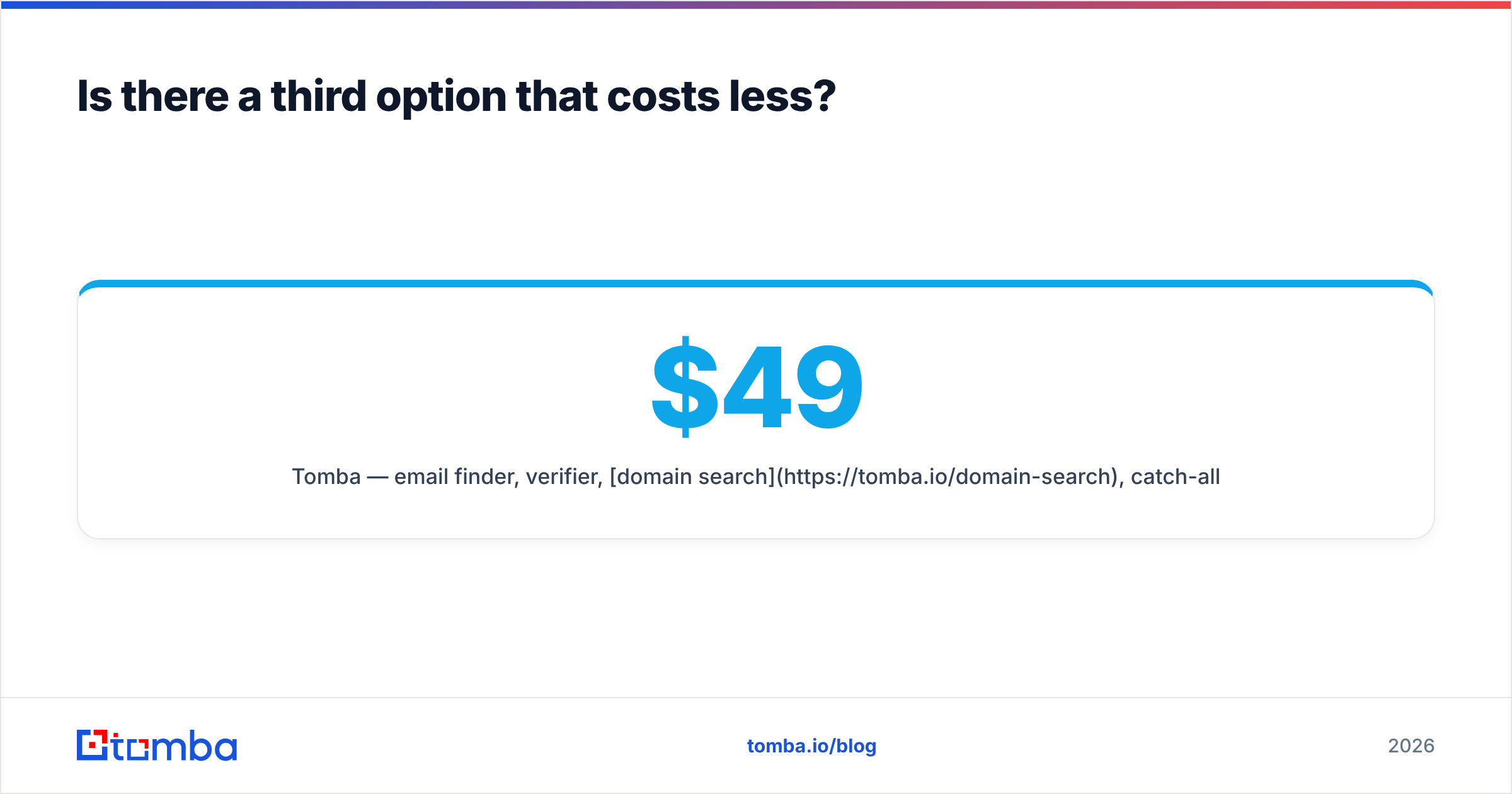
Is there a third option that costs less?#
For the contact half of the problem, yes. It is worth being blunt here. The market has split in two. Suites bundle data with sequencing and bill per seat. Focused vendors bill per lookup and stay out of your way.
Your real need may be simple. Good work emails and phone numbers, on demand, with no buying cycle. If so, the focused camp is cheaper and faster. Worth a shortlist:
- Tomba — email finder, verifier, domain search, catch-all handling, phone finder, and enrichment. All API-first. Free tier at 25 searches/mo. Starter $49/mo, Growth $99/mo, Pro $249/mo, Enterprise custom. Billed monthly, prices on the page.
- BookYourData — a strong pick when you want a ready-made list, paid as you go, with a stated accuracy promise. It suits one-off campaign pulls and teams that hate subscriptions.
- A contact suite — worth the price when you truly need dialer, sequencer, and data in one seat.
None of these replace Istari.ai. Market mapping and contact lookup are different jobs. Any vendor that claims to nail both deserves a hard look at which half is the loss leader.
How do you combine both layers in one workflow?#
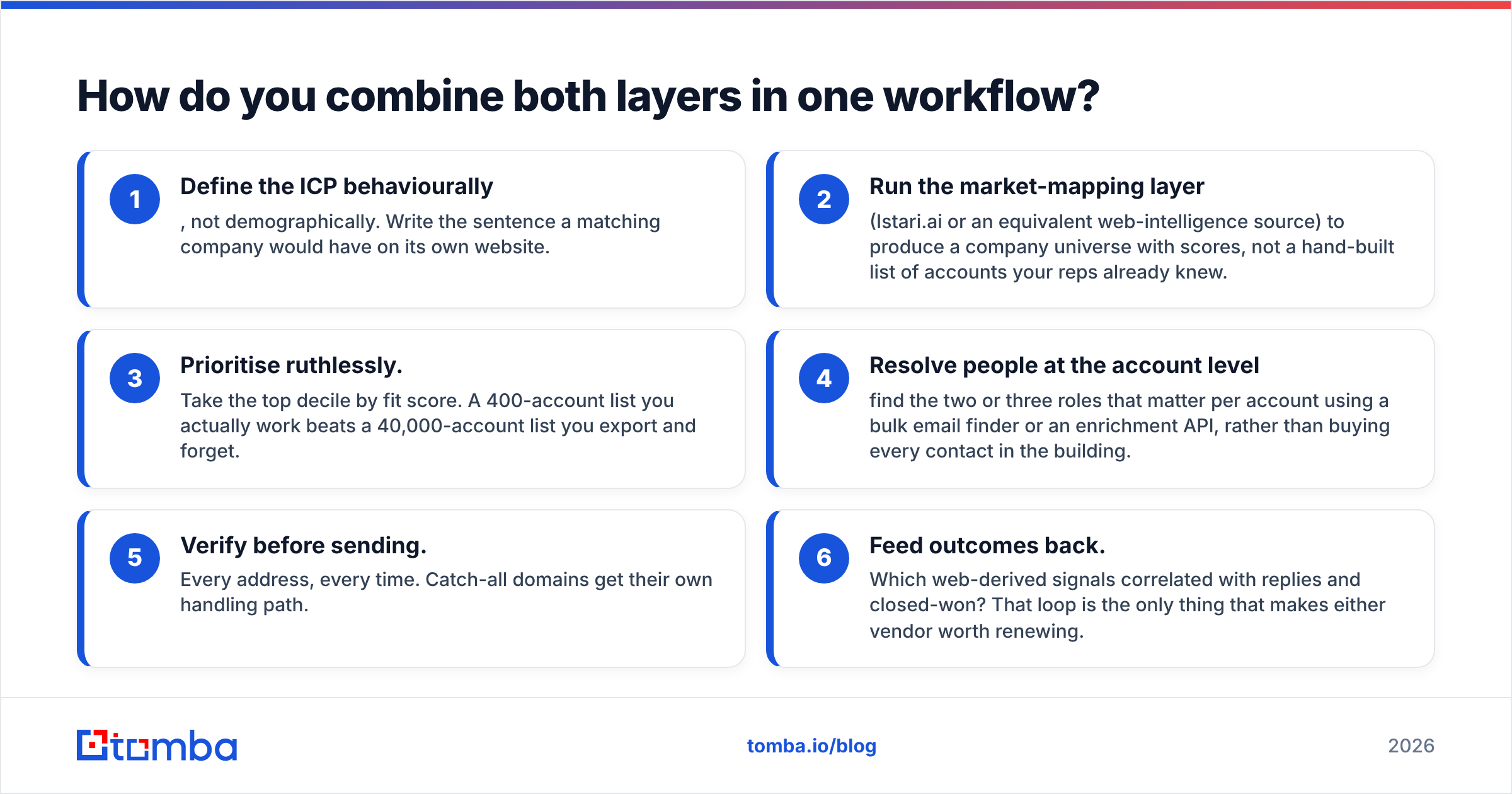
The strongest 2026 stacks treat this as two stages, not one purchase.
- Define the ICP by behaviour, not by size or sector. Write the sentence a matching firm would put on its own site.
- Run the mapping layer (Istari.ai or a peer) to build a scored list of firms. Not a hand-built list of accounts your reps already knew.
- Cut hard. Take the top tenth by fit score. A 400-account list you actually work beats a 40,000-account list you export and forget.
- Find the people who matter at each account. Two or three roles is plenty. Use a bulk email finder or an enrichment API, rather than buying every contact in the building.
- Verify before you send. Every address, every time. Catch-all domains get their own path.
- Feed results back. Which web signals led to replies and to closed-won deals? That loop is the only thing that makes a renewal worth signing.
Stage two is where teams overspend. You do not need a billion-record plan to find three people at four hundred accounts. You need good lookups, priced per lookup.
Istari.ai vs Seamless.AI: what is the verdict?#
Buy the one that fits your real bottleneck. And be honest about which bottleneck you have.
Most teams say "we need more leads." They mean "we do not know which accounts to work." That is an Istari.ai-shaped problem. No contact database will fix it. It will just help you mail the wrong firms faster.
Teams with a locked ICP and a full SDR bench have the other problem. For them, Seamless.AI belongs on the shortlist. Negotiate the contract with care. Model credit burn against the share of records you can use. Budget for a check step.
Then there is the large middle. You need decent account insight and clean contact data, without signing two enterprise deals. A light mapping process plus a focused, openly priced vendor will do the job.
That last slot is where Tomba fits. Start with the Tomba Email Finder on the free tier. Run twenty-five lookups on accounts you already care about. Check the hit rate against whatever you pay today. If it holds up, Starter is $49/mo, it is month to month, and procurement never has to hear about it. That is the plain answer to Istari.ai vs Seamless.AI for most teams.
Related guides#
// get started
Find, verify and enrich your first contacts today
Start on the free plan with 25 searches a month, then scale when your team is ready.
Free plan · No credit card required · GDPR & CCPA
// about the author