Jet Leads Pro vs Mattermark (2026): Which One Should You Buy?
One sells company signals, the other sells lead lists — and neither one is really an email tool. Here is an honest breakdown of what each platform does well, where both fall short, and what to pair them with in 2026.
TL;DR
- These two tools are not actually competitors. Mattermark is a company-signal and market-intelligence database; Jet Leads Pro is positioned as a lead-list and contact-export product for SMB outbound teams.
- Mattermark answers "which companies should I care about right now?" Jet Leads Pro answers "give me a list I can load into my sequencer today."
- Neither is primarily an email-accuracy product. If your bounce rate is the problem, adding either one will not fix it — you need a verification layer on top.
- Mattermark has changed ownership more than once since its 2012 launch, so check the current product and pricing directly before signing anything.
- Jet Leads Pro has a thin public footprint. Treat vendor-published accuracy claims as marketing until you run a sample of 200 records through an independent verifier.
What are Jet Leads Pro and Mattermark, actually?#
Start here, because most "X vs Y" pages skip the part that decides the purchase: these products sit in different layers of the same stack.
Mattermark launched in 2012 as a company-tracking database. Its original pitch was quantitative: score private companies on growth signals — headcount trajectory, funding events, web traffic, mobile downloads — so investors and sales teams could spot momentum before it became obvious. The company was acquired by FullContact in 2017 and has changed hands since; the product still lives at mattermark.com, but the version you can buy today is not the same one people wrote about in 2015. That matters when you read old reviews.
Jet Leads Pro sits in a different bucket. It is marketed as a lead-generation and contact-export tool: you filter by industry, geography, company size, and job title, then export a list. That is the same job Apollo, Seamless, and dozens of smaller vendors do. It is also a category with a wide quality spread, and Jet Leads Pro publishes far less about its data sourcing than the larger vendors do. There is no public technical documentation of the depth you would get from an established data provider, and third-party review coverage on G2 and Capterra is limited compared with the incumbents.
Here is the practical split:
- Signal layer (Mattermark's territory) — Who is growing, who just raised, who is hiring in the department you sell to. This drives account selection, not outreach.
- Contact layer (Jet Leads Pro's territory) — Names, titles, and contact details attached to those accounts. This drives list building.
- Verification layer (neither one) — Is this specific mailbox deliverable today? Catch-all domains, role accounts, and stale records get filtered out here.
- Enrichment layer — Filling gaps in records you already own: missing phone numbers, missing LinkedIn URLs, missing firmographics on inbound signups.
- Execution layer — The sequencer or dialer that actually sends the message and tracks replies.
Most teams buy one tool, discover it only covers one or two of these five, and then blame the tool. The comparison below is about which layers each product genuinely covers.

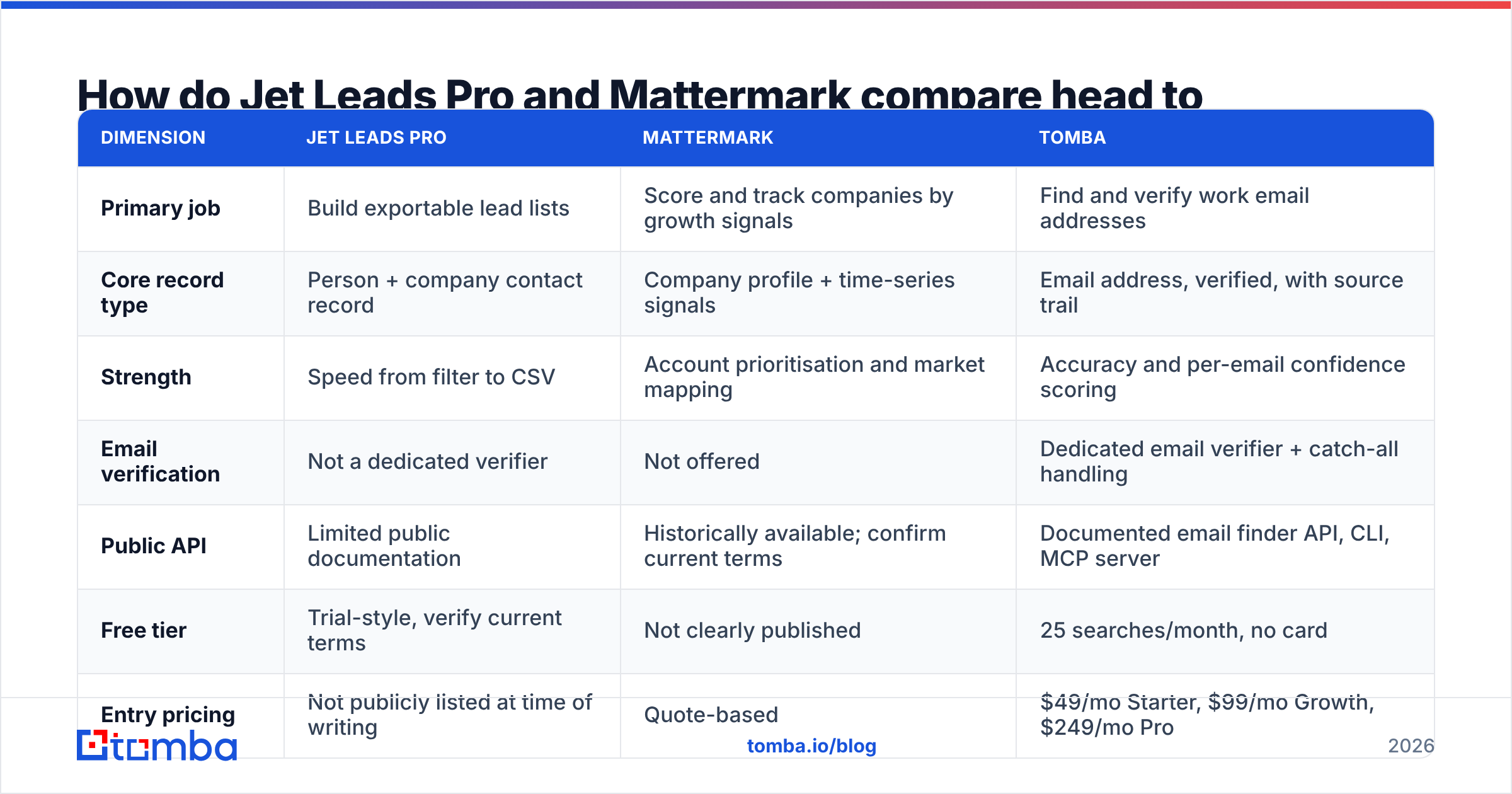
How do Jet Leads Pro and Mattermark compare head to head?#
| Dimension | Jet Leads Pro | Mattermark | Tomba |
|---|---|---|---|
| Primary job | Build exportable lead lists | Score and track companies by growth signals | Find and verify work email addresses |
| Core record type | Person + company contact record | Company profile + time-series signals | Email address, verified, with source trail |
| Strength | Speed from filter to CSV | Account prioritisation and market mapping | Accuracy and per-email confidence scoring |
| Email verification | Not a dedicated verifier | Not offered | Dedicated email verifier + catch-all handling |
| Public API | Limited public documentation | Historically available; confirm current terms | Documented email finder API, CLI, MCP server |
| Free tier | Trial-style, verify current terms | Not clearly published | 25 searches/month, no card |
| Entry pricing | Not publicly listed at time of writing | Quote-based | $49/mo Starter, $99/mo Growth, $249/mo Pro |
| Best fit | SMB teams that want volume fast | Investors, corp dev, ABM account selection | Anyone whose bounce rate is above 3% |
Two things stand out.
First, the pricing column is where the honest answer is "go check." Mattermark has moved to quote-based selling, and Jet Leads Pro does not maintain a clearly published, stable price list. Any number you see quoted on a third-party blog — including numbers presented confidently — should be treated as unverified. Ask for a written quote with the credit definition attached, because "credits" means something different at every vendor.
Second, the verification row is the one that quietly costs you the most money. Neither of these tools is built to tell you whether firstname.lastname@company.com will land in an inbox tomorrow. They tell you the address exists in their database. Those are different claims.
Which one has better data accuracy?#
Neither vendor publishes an independently audited accuracy figure, so the honest answer is: you have to test.
The test is cheap and takes an hour. Pull a sample of 200 records from each tool, in the same vertical and the same seniority band. Run all 400 through a neutral verifier. Then compare three numbers:
- Valid rate — percentage that come back deliverable.
- Catch-all rate — percentage sitting on domains that accept everything. High catch-all rates inflate a vendor's "valid" claim, because catch-all addresses pass naive SMTP checks without being real mailboxes.
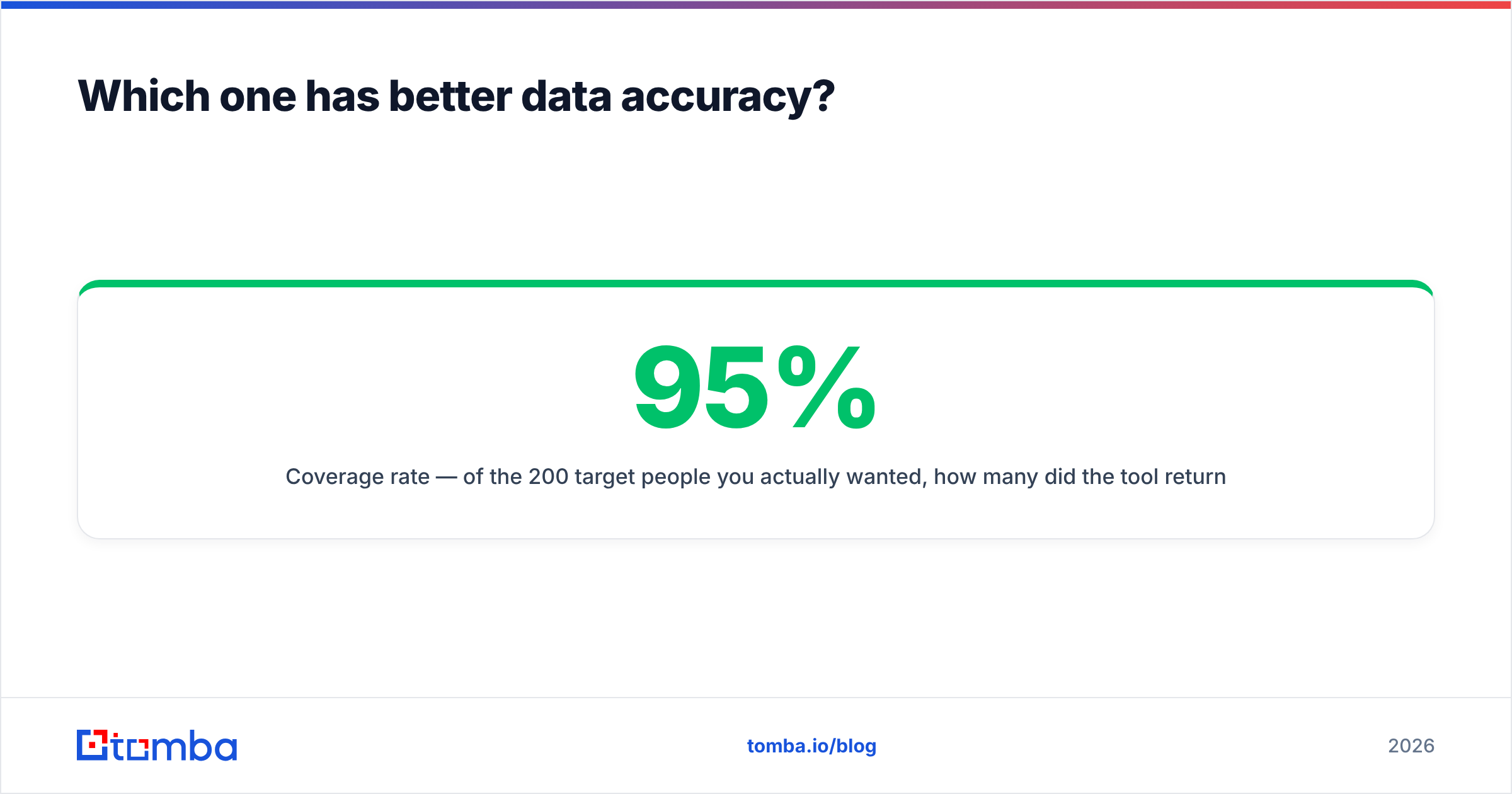
- Coverage rate — of the 200 target people you actually wanted, how many did the tool return anything for? A tool with 95% accuracy on 30% coverage is worse than one with 88% accuracy on 80% coverage.
That third number is where most list tools lose. Filter-and-export platforms are optimised to always return a full page of results, which means they will happily substitute adjacent titles or adjacent companies to fill the quota. You end up with 2,000 rows where 600 are the people you asked for.
Catch-all domains deserve their own paragraph. A meaningful share of B2B domains — particularly larger enterprises and anything behind certain security gateways — accept mail to every address at the SMTP layer. A list vendor can mark all of those "valid" without lying by their own definition. If your sample shows a suspiciously high valid rate and a high catch-all share at the same time, you are looking at a measurement artifact, not quality data. A catch-all verifier that scores these separately is the only way to see through it.
What does each one actually cost you?#
Sticker price is the smaller half of the bill. Model these four costs before you compare plans:
- Subscription — the headline number, annualised. Get it in writing.
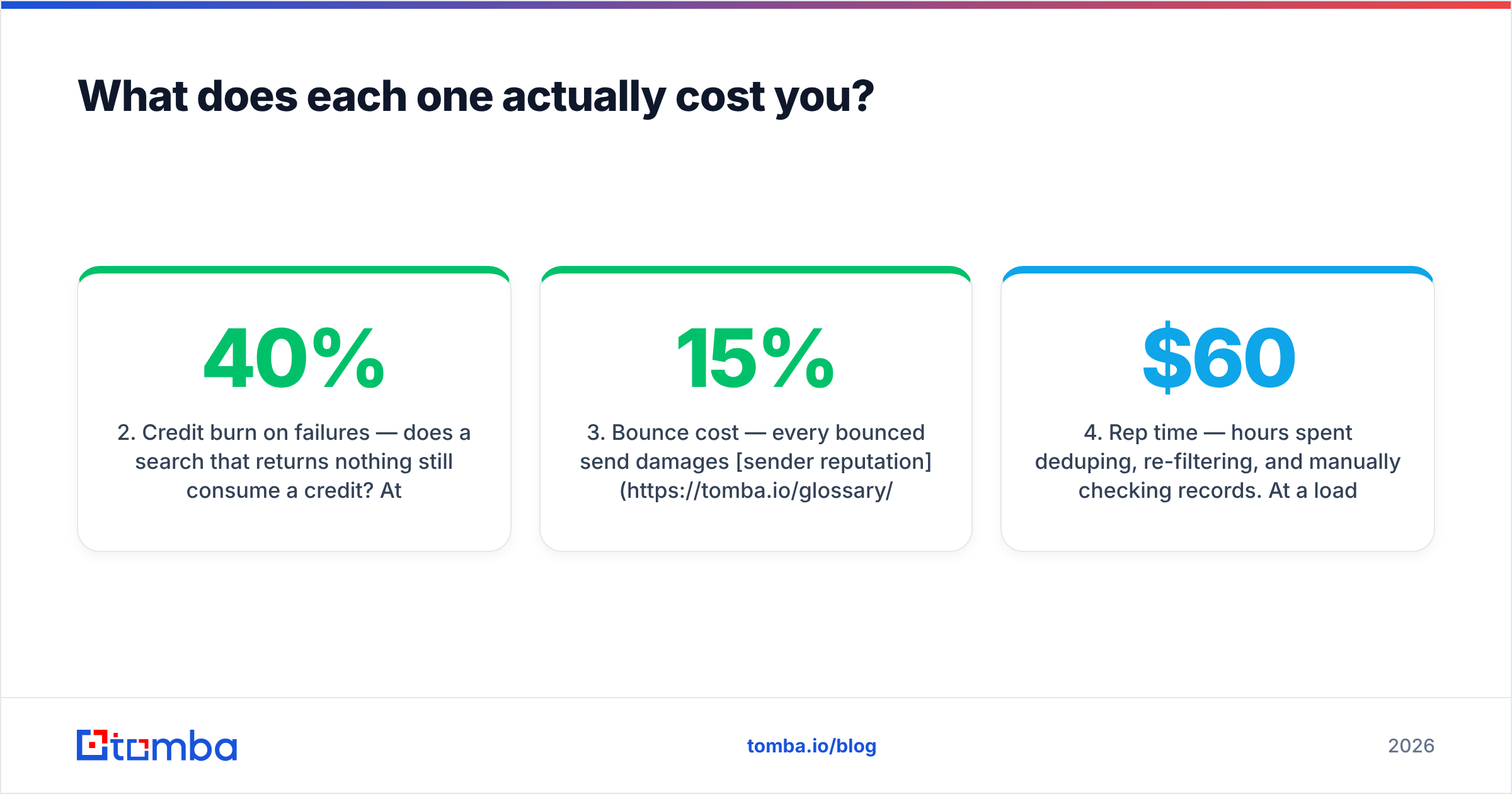
- Credit burn on failures — does a search that returns nothing still consume a credit? At some vendors it does. On a low-coverage dataset, that is a 20-40% effective price increase.
- Bounce cost — every bounced send damages sender reputation, which suppresses inbox placement for the good addresses on the same domain. A 15% bounce rate on a 5,000-send month is not 750 wasted emails; it is a degraded domain for the following month too.
- Rep time — hours spent deduping, re-filtering, and manually checking records. At a loaded cost of $60/hour, six hours a week of list hygiene is roughly $1,500 a month. That dwarfs most tool subscriptions.
Run those four lines for each option and the ranking usually inverts. The cheapest list tool is rarely the cheapest stack.

Is Mattermark still the right call in 2026?#
It depends entirely on whether you need signals or contacts.
Mattermark is still a reasonable buy if your job is account selection at the market level — you are an investor mapping a category, a corp-dev team tracking acquisition targets, or an ABM lead building a tiered account list from growth indicators rather than static firmographics. The original thesis, that growth velocity predicts buying intent better than company size does, has aged well. Most modern intent platforms are variations on it.
It is a poor buy if you expected a prospecting tool. Mattermark will not hand your SDRs a ready-to-send list with verified mailboxes. Teams who bought it for that reason are the source of most of the negative reviews you will find, and the mismatch is on the buyer, not the product.
Two practical cautions. The product has been through multiple ownership changes since 2017, which means roadmap continuity and support responsiveness are worth probing during the trial rather than assuming. And ask directly about signal freshness — a growth-signal database is only useful if the signals are current. Ask when a given company record was last refreshed, and ask for the distribution, not the average.
Where does Jet Leads Pro fit?#
It fits the "I need volume this week and my budget is small" slot.
That is a legitimate need. Early-stage teams testing three ICPs in parallel do not want a six-week procurement cycle for a data platform. A filter-and-export tool gets you to a testable list quickly, and if two of the three ICPs die in week two, you have not over-invested.
The caution is proportionate to the vendor's public footprint. Jet Leads Pro does not publish the depth of sourcing, compliance, and methodology documentation that established providers do. Before you send a single email from one of its lists, ask three questions in writing:
- Where does the data come from? Contributed contact books, public web, licensed partners, or user uploads? This determines your GDPR/CCPA exposure, not just quality.
- How often is a record re-checked? A contact record with no re-verification date is a snapshot of an unknown moment.
- What is the refund or credit policy on bounces? Vendors confident in their data offer one. Vendors who do not, tell you something.
If you want a sanity check against a mature competitor in the same list-building category, BookYourData publishes its accuracy guarantee and refund policy openly — that level of transparency is a reasonable bar to hold any list vendor to.
What should you pair with either one?#
A verification and finding layer, because that is the gap both leave open.
The workflow that actually holds up looks like this. Use Mattermark (or any signal source) to decide which 300 accounts matter this quarter. Use a list tool or domain search to map the humans inside those accounts. Then run every address through verification before it touches your sequencer, and route the catch-all segment to a separate, lower-volume track rather than blasting it.
That third step is where Tomba's email finder does its work. It finds addresses by name and domain, returns a confidence score and the public sources behind each result, and separates deliverable addresses from catch-all and role accounts rather than lumping them together. The enrichment endpoint fills gaps in records you already own — which is usually cheaper than re-buying a list you half-have.
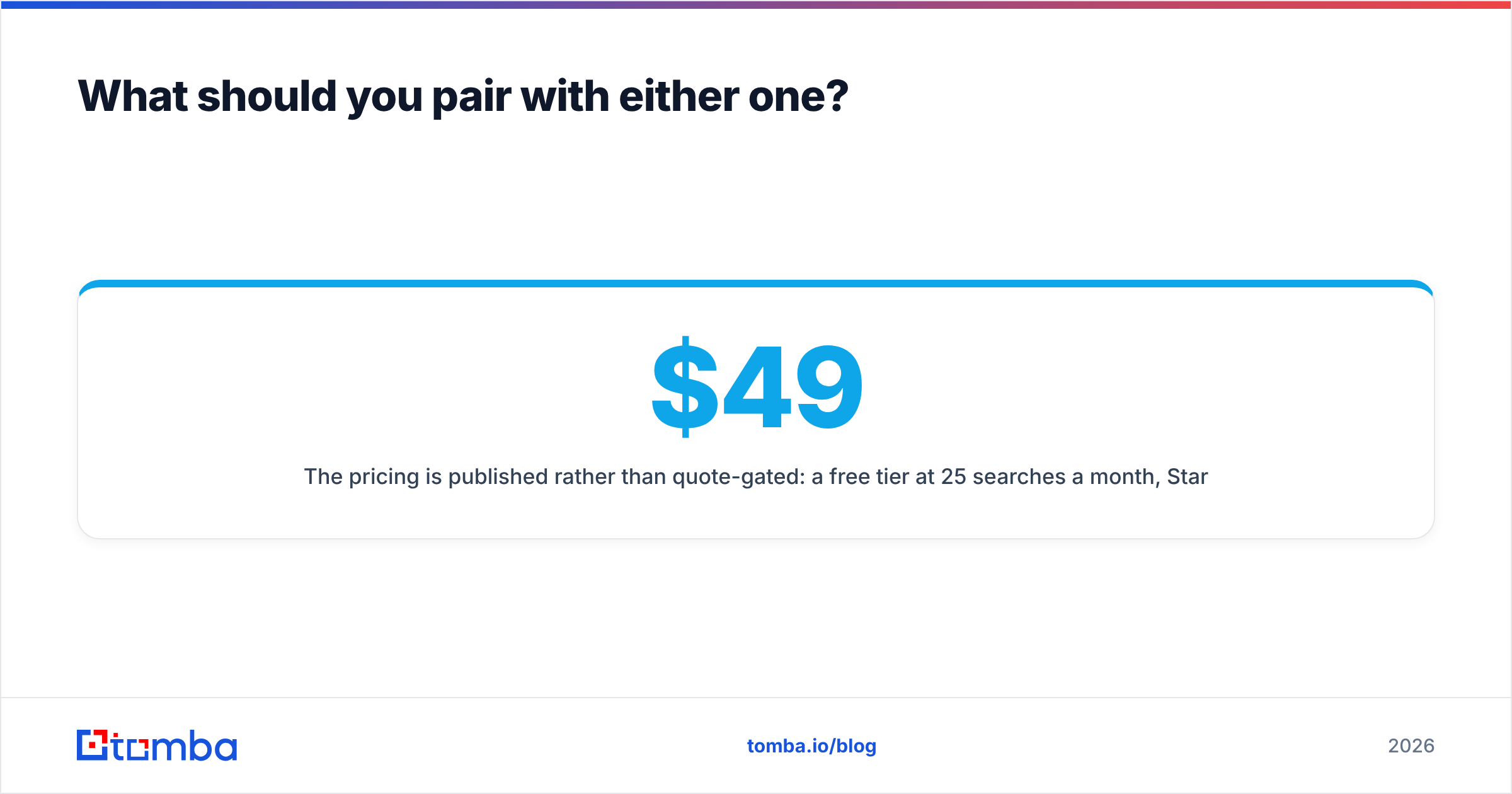
The pricing is published rather than quote-gated: a free tier at 25 searches a month, Starter at $49/mo, Growth at $99/mo, Pro at $249/mo, with enterprise quoted. Full Tomba pricing is on the site, so you can model credit burn before a sales call rather than after one.
Which one wins?#
For account intelligence and market mapping: Mattermark, with the caveat that you verify the current product state yourself rather than trusting 2016-era write-ups.
For fast, cheap list volume on a short leash: Jet Leads Pro, with a 200-record independent verification test run before you commit to an annual contract.
For the thing that both leave unsolved — knowing that the address you are about to email is real: neither. That is a separate layer, and it is the layer that determines whether the other two purchases pay off.
The common failure pattern is spending the entire data budget on the selection layer and nothing on the deliverability layer, then wondering why a beautifully targeted list produces a 19% bounce rate and a burned domain. Split the budget. The signals tell you who to contact; verification decides whether the contact attempt arrives at all.
Test the layer that decides your bounce rate. Run your next 25 target contacts through the Tomba Email Finder free — no card required — and compare the valid rate against whatever your current list tool returned for the same people. If the numbers match, keep your stack. If they do not, you just found where the money was going.
Related guides#
// get started
Find, verify and enrich your first contacts today
Start on the free plan with 25 searches a month, then scale when your team is ready.
Free plan · No credit card required · GDPR & CCPA
// about the author