Jet Leads Pro vs OutboundView (2026): Which One Should You Pick?
One sells productized lead lists, the other sells a full outbound team. Here's how Jet Leads Pro and OutboundView differ on pricing, data quality, and control — plus when building in-house beats both.
TL;DR
- Different products, not different prices. Jet Leads Pro sells productized lead lists and appointment volume. OutboundView sells a managed outbound team — strategy, copy, sequencing, and SDR follow-up. Comparing them on cost per lead alone will mislead you.
- OutboundView is the safer pick for complex, high-ACV B2B where a human needs to run discovery and iterate messaging over 90+ days. Expect an agency retainer and a ramp period.
- Jet Leads Pro is the faster pick when you already have a working playbook and just need contacts and meetings poured into it. Less strategy, less lock-in, less control over quality.
- Neither publishes transparent pricing. Both are quote-based, which means your real comparison happens on a sales call — go in with the questions listed below.
- A third option beats both for many teams: own your data layer with an email finder and verifier, then spend the agency budget on a single strong SDR. Often 3-5x cheaper per booked meeting.
What Are Jet Leads Pro and OutboundView?#
They solve the same business problem — "we need more qualified pipeline" — from opposite ends of the market.
OutboundView is an outbound sales agency. Its public positioning at outboundview.com centers on done-for-you outbound: ICP definition, list building, email and phone sequencing, and SDR execution on your behalf. You're buying a small outsourced sales development function, usually on a monthly retainer with a minimum commitment. The deliverable is meetings and, secondarily, a repeatable process you could bring in-house later.
Jet Leads Pro sits closer to the productized end. The pitch is volume: targeted contact lists and booked appointments delivered against a defined ICP, with less strategic overhead. Public documentation is thinner than OutboundView's, which matters — you should ask for a written scope before signing anything.
The practical distinction: OutboundView is a service layer on top of your GTM. Jet Leads Pro is closer to a supply layer feeding it. Some teams genuinely need both. Most need exactly one, and usually the one they're not currently shopping for.
How Do Jet Leads Pro and OutboundView Compare Head-to-Head?#
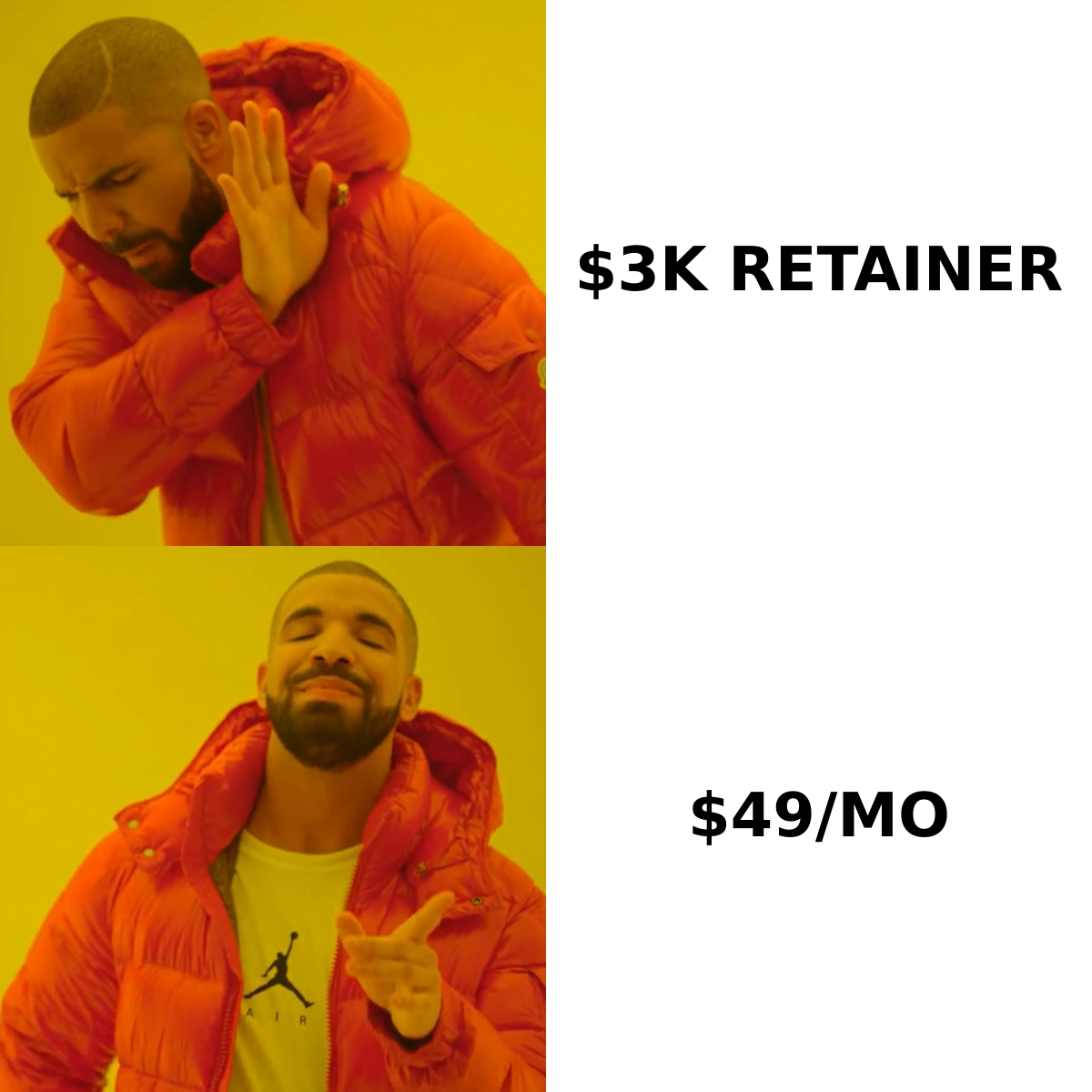
Here is the honest side-by-side. Where a vendor doesn't publish a number, this table says so rather than guessing — treat the "market range" rows as industry benchmarks for that category of service, not as either company's quoted price.
| Attribute | Jet Leads Pro | OutboundView | DIY stack (Tomba + sequencer + 1 SDR) |
|---|---|---|---|
| Core deliverable | Contact lists + booked appointments | Managed outbound program + meetings | Verified contacts you work yourself |
| Published pricing | Quote-based | Quote-based | $49/mo Starter, $99/mo Growth |
| Typical market range | ~$1.5K–$4K/mo (productized lead gen) | ~$3K–$10K/mo (full-service agency) | $49–$249/mo + SDR salary |
| Minimum commitment | Usually short (1–3 months) | Usually 3–6 months | Monthly, cancel anytime |
| Time to first meetings | 1–3 weeks | 4–8 weeks (ICP + copy + warmup) | 1–2 weeks if you already sell |
| Strategy included | Limited | Yes — core of the offer | You own it |
| Data ownership | Lists delivered to you | Varies by contract — ask | 100% yours |
| Best ACV range | $5K–$30K | $25K+ / complex sales cycles | Any, if you have a seller |
| Who it fails for | Teams with no follow-up capacity | Teams needing meetings this month | Teams with nobody to send the emails |
Two rows deserve a hard stare before you sign.
"Data ownership." Some agencies treat the contact list as a work product you keep; others treat it as licensed infrastructure that leaves when the contract does. That single clause determines whether you finish a six-month engagement with an asset or with a receipt. Ask in writing.
"Time to first meetings." An agency that promises meetings in week two is either skipping domain warmup or reusing a generic list. Both are how you burn a sending domain. Real ramp on a cold domain is four to eight weeks, and a vendor honest about that is a better sign than one who isn't.
How Should You Choose Between Them?#
Run these five checks in order. The first one that returns a clear answer usually decides it.
- Do you have a repeatable pitch that already closes? If yes, you need supply — lists and volume. If no, an agency's strategy work is the part you're actually buying, and a list vendor will just help you fail faster.
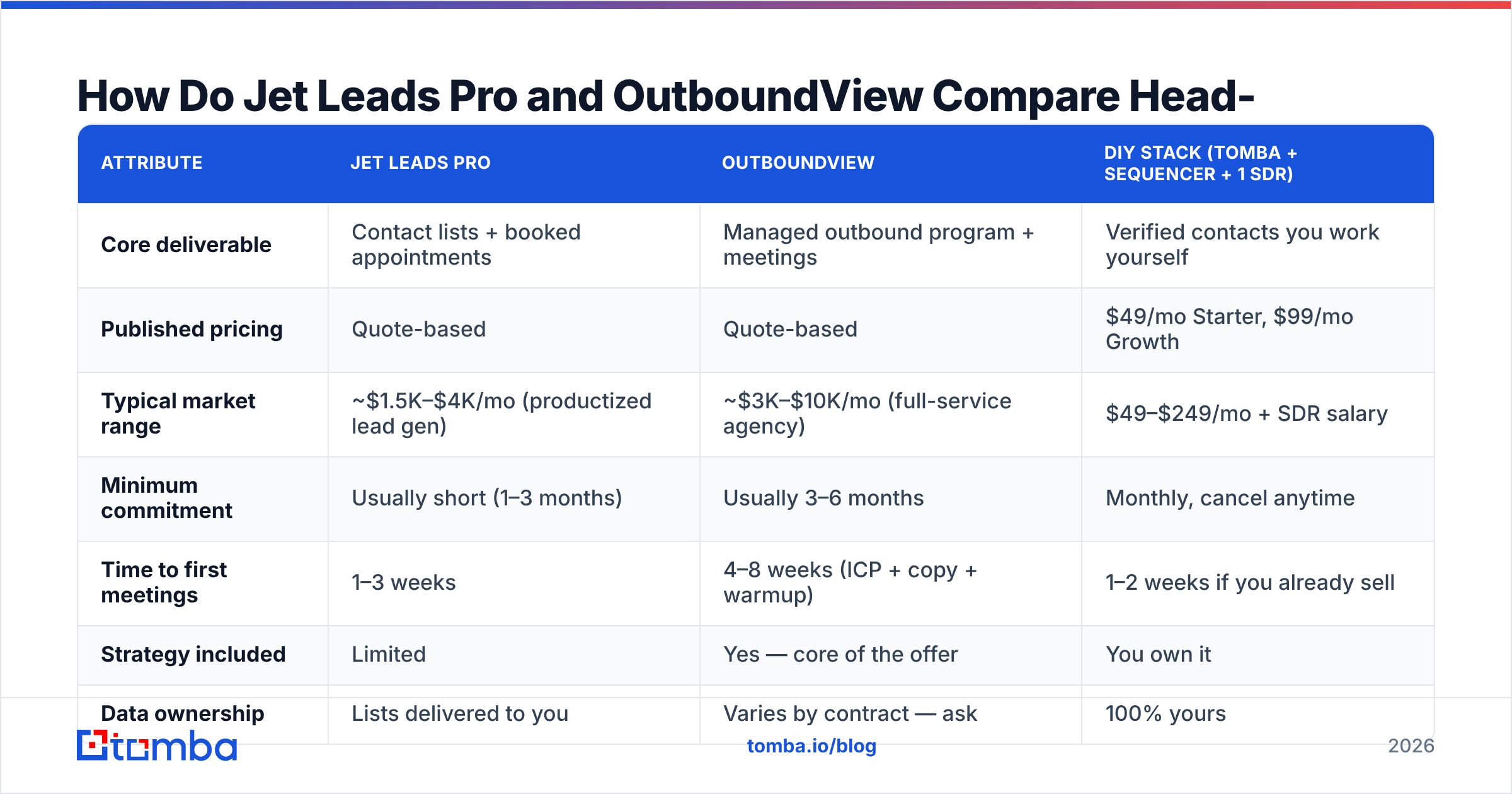
- Who follows up on a "maybe"? Booked meetings are worthless without a closer who works the 40% that reschedule or go dark. If nobody owns that, buy fewer meetings and more sales capacity.
- What's your ACV? Below roughly $10K, a $6K/mo retainer needs a lot of closed deals just to break even. Above $25K, one incremental deal pays for a quarter of agency fees, and the math flips hard toward full service.
- How niche is your ICP? Broad ICPs (all SaaS companies, 50–500 employees) are well served by productized lists. Narrow ones ("hospital systems running Epic in the Southeast") need human research that list products consistently get wrong.
- Can you tolerate a 60-day ramp? If your board wants pipeline in 30 days, no agency will deliver it honestly. That constraint alone should push you toward in-house sending on an already-warm domain.
Which One Produces Better Data Quality?#
This is where both models leak value, and where you have the most leverage as a buyer.
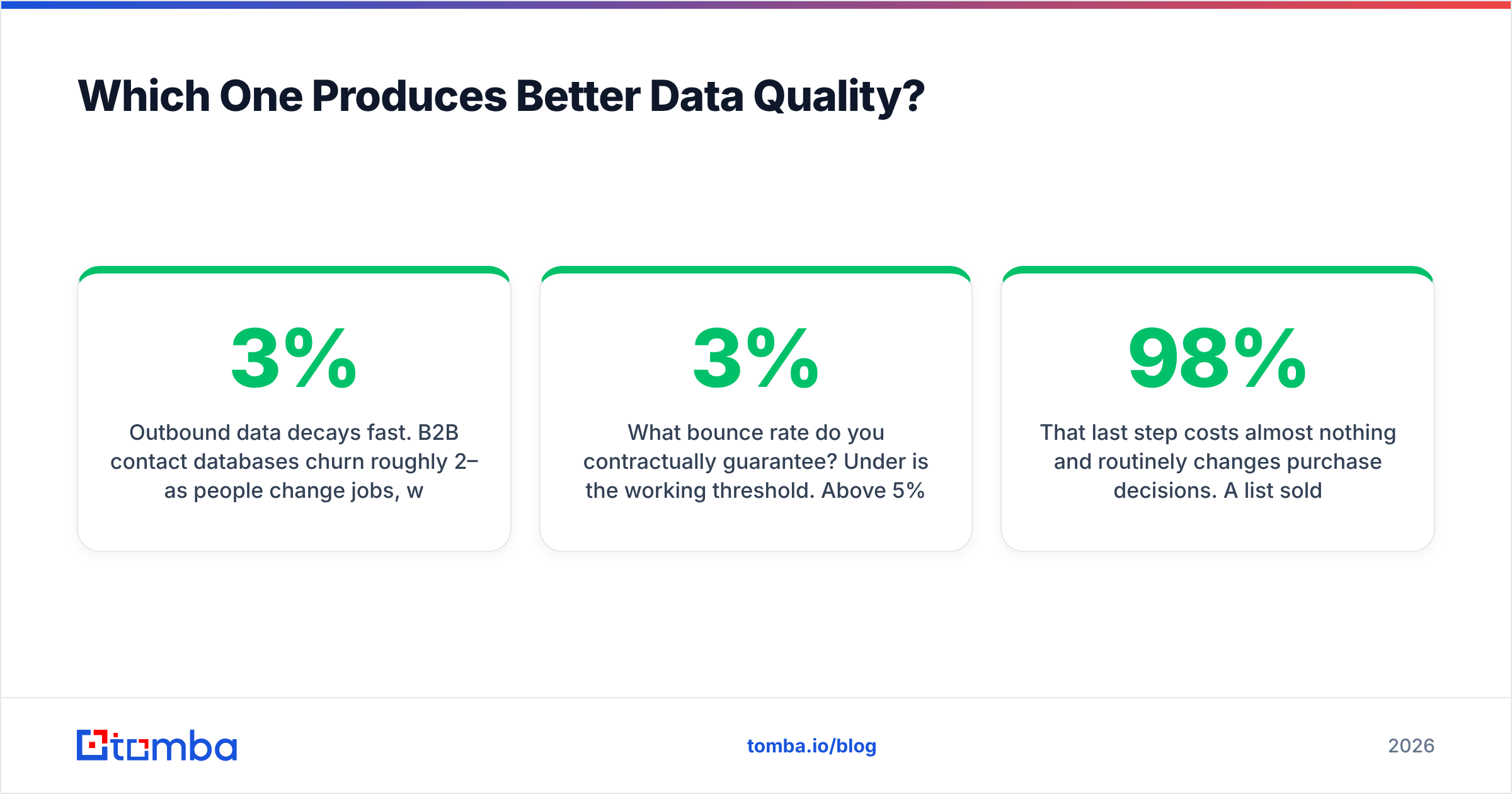
Outbound data decays fast. B2B contact databases churn roughly 2–3% per month as people change jobs, which compounds to about 25–30% annually — a widely cited figure across the lead generation industry. Any vendor working from a static database is selling you a snapshot that was already stale when it was assembled.
The questions that separate good vendors from bad ones:
- Do you verify at send time or at list-build time? Verification is perishable. A list verified six weeks ago and delivered today has already drifted.
- How do you handle catch-all domains? Catch-all servers accept everything, so naive verification marks them "valid" and your bounce rate finds out later. A serious answer involves a dedicated catch-all verifier, not a shrug.
- What bounce rate do you contractually guarantee? Under 3% is the working threshold. Above 5% and you're damaging sender reputation on your own domain to hit someone else's volume target.
- Can I audit a sample before signing? Take 100 rows, run them through an independent email verifier, and compare the result to the vendor's claim. If a vendor refuses a pre-purchase sample, that's your answer.
That last step costs almost nothing and routinely changes purchase decisions. A list sold as "98% deliverable" that audits at 71% isn't a negotiation — it's a disqualification.

What Does Each Option Actually Cost Per Meeting?#
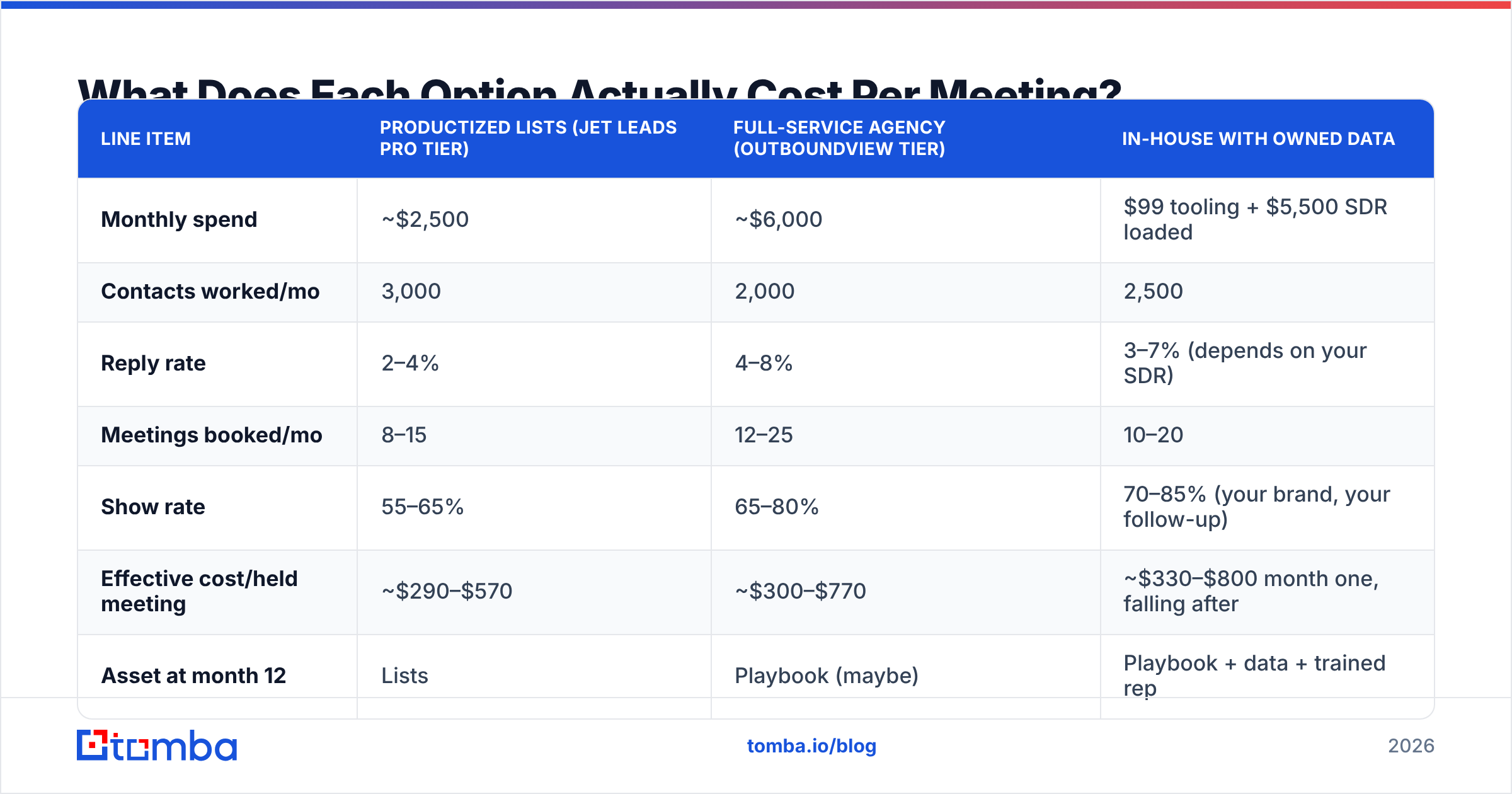
Cost per lead is a vanity metric. Cost per qualified meeting that shows up is the only number that survives contact with a board deck. Here's the structure of the math on a 90-day engagement, using conservative mid-market assumptions.
| Line item | Productized lists (Jet Leads Pro tier) | Full-service agency (OutboundView tier) | In-house with owned data |
|---|---|---|---|
| Monthly spend | ~$2,500 | ~$6,000 | $99 tooling + $5,500 SDR loaded |
| Contacts worked/mo | 3,000 | 2,000 | 2,500 |
| Reply rate | 2–4% | 4–8% | 3–7% (depends on your SDR) |
| Meetings booked/mo | 8–15 | 12–25 | 10–20 |
| Show rate | 55–65% | 65–80% | 70–85% (your brand, your follow-up) |
| Effective cost/held meeting | ~$290–$570 | ~$300–$770 | ~$330–$800 month one, falling after |
| Asset at month 12 | Lists | Playbook (maybe) | Playbook + data + trained rep |
The headline: on a pure 90-day basis, all three land in a similar band. The divergence shows up at month twelve. Agency spend resets to zero every month; in-house spend compounds into a rep who knows your product and a contact database you own outright. That's the real argument for keeping the data layer internal even if you outsource execution — a point that G2's lead generation category reviews surface repeatedly in the "what I dislike" sections.
When Is an Agency Genuinely the Right Call?#
Outsourcing outbound isn't a failure mode. It's correct in four specific situations:
- You're testing a new segment. Spending $18K over a quarter to learn whether healthcare IT responds to your pitch is cheaper than hiring an SDR you'd have to fire.
- You have no outbound muscle at all. Founder-led sales that worked to $1M ARR does not automatically become a repeatable SDR motion. Buying a functioning process is legitimate.
- Your ACV is high enough that one deal pays the year. At $50K+ ACV, the ROI question nearly answers itself.
- You need coverage while hiring. Agencies bridge the six-month gap between "we approved the headcount" and "the rep is ramped."
It's the wrong call when you're using it to avoid the harder work of figuring out who your buyer is. No vendor — not OutboundView, not Jet Leads Pro, not any of their competitors — can fix an ICP problem. They'll just find more of the wrong people, faster, and charge you for the privilege. HubSpot's ongoing State of Marketing research has made the same point for years: targeting quality dominates channel choice.
What Should You Ask on the Sales Call?#
Bring these six. Vague answers to any of them are informative.
- "Show me the last three clients in my segment and their meeting-to-opportunity rate." Meetings booked is the easy metric. Opportunities created is the honest one.
- "Who writes the copy, and do I approve it before it sends?" Your domain, your brand, your veto.
- "Which domains will you send from?" If it's your primary domain, walk. It should be dedicated sending domains they warm up.
- "What happens to the contact data when we end the contract?"
- "What's the ramp schedule, week by week, for the first 60 days?"
- "What's the out clause?" A vendor confident in results will offer a 30-day exit after the ramp period.
Should You Just Build It In-House Instead?#
For a lot of teams reading this comparison, yes — and the decision hinges on one question: do you have someone who can send and follow up?
If you do, the arithmetic is uncomfortable for both vendors. A data enrichment and email-finding layer runs $49–$249/mo depending on volume. Add a sequencer and one SDR, and you're at agency-equivalent cost with three advantages agencies structurally can't match: you keep the data, you control the brand voice, and your feedback loop is hours instead of a weekly call.
The failure case is real too. Teams that buy tooling with nobody to operate it end up with 40,000 verified emails and zero sent sequences. That's a worse outcome than an agency retainer, because at least the agency sends something. Be honest about which team you are.
A reasonable hybrid many companies land on: own the data layer permanently, rent execution temporarily. Build your contact database in-house, run your own verification, and hire an agency for a 90-day sprint to establish the playbook. When the contract ends, you keep the asset that matters.
Ready to Own Your Data Layer?#
Whichever way you go on Jet Leads Pro vs OutboundView, don't outsource the part you can own cheaply. Start with Tomba Email Finder — find and verify professional email addresses by domain, name, or company, with catch-all handling built in rather than bolted on. The free tier gives you 25 searches a month to audit a vendor's sample list before you sign anything; Starter is $49/mo and Growth is $99/mo when you're ready to scale. Full Tomba pricing is public, which is more than either vendor in this comparison can say.
Run a vendor's sample through it this week. The result will make your decision for you.
Related guides#
// get started
Find, verify and enrich your first contacts today
Start on the free plan with 25 searches a month, then scale when your team is ready.
Free plan · No credit card required · GDPR & CCPA
// about the author