Jet Leads Pro vs Xverum: Which B2B Data Source Wins in 2026?
One sells ready-made lead lists, the other sells raw data infrastructure at scale. Here is an honest breakdown of coverage, freshness, pricing models and which buyer each one actually fits in 2026.
TL;DR
- These two are not really competitors. Jet Leads Pro sells finished lead lists to sales teams. Xverum sells raw, large-scale B2B and company datasets to data teams. Choosing between them is mostly a question of who on your team consumes the output.
- Xverum wins on scale and structure. Hundreds of millions of company and professional profile records, delivered as feeds, S3 drops or API — built for enrichment pipelines, not for a rep with a Chrome tab open.
- Jet Leads Pro wins on time-to-first-email. You pick filters, you get contacts, you start sending today. No data engineer required.
- Neither is transparent about pricing. Both run quote-based or tier-gated models. Budget for a sales call before you budget for the data.
- Most teams under 50 reps need a third option: verify-on-demand contact lookup (Tomba starts free, $49/mo for Starter) rather than paying for a static dump they will re-verify anyway.
What are Jet Leads Pro and Xverum, exactly?#
Start here, because the category labels blur together and the wrong mental model costs you a quarter.
Xverum is a data-as-a-service provider. Its product is the dataset itself: company firmographics, professional profiles, job postings, and web data, refreshed on a schedule and delivered in bulk (JSON/CSV drops, cloud storage, or API). You can see the positioning on xverum.com — the language is about coverage counts, refresh cadence, and delivery formats, not about sequences or reply rates. Their buyer is usually a data engineer, an ML team, or a RevOps lead building an internal enrichment layer. If you have ever used a data-as-a-service vendor, the model will feel familiar: you license a slice of a very large table.
Jet Leads Pro sits at the opposite end. It is a self-serve lead generation tool: filter by industry, title, geography and company size, then export contacts into your outreach tool or CRM. The appeal is speed. A BDR can go from login to a 500-row prospect list in under an hour without touching a pipeline, a schema, or a cloud bucket.
One honest caveat before you go further: Jet Leads Pro publishes far less verifiable detail than Xverum does about where records originate, how often they refresh, and what its accuracy guarantee actually covers. That is not automatically disqualifying — plenty of good SMB tools are light on documentation — but it does mean you should treat any coverage claim as unverified until you run your own sample test. We describe how to do that below.

How do Jet Leads Pro and Xverum compare head-to-head?#
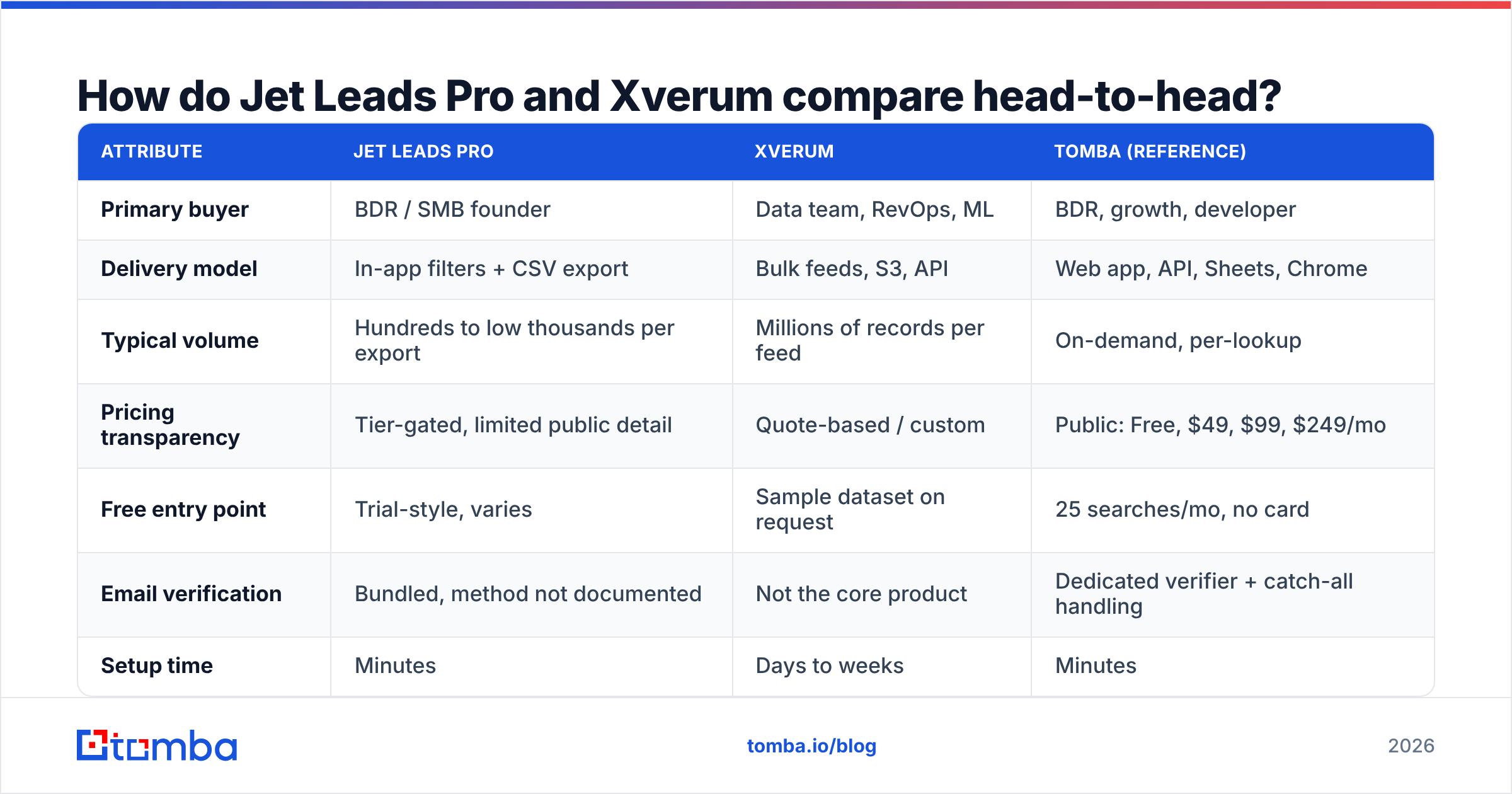
Here is the side-by-side, with a real-time lookup tool included as a reference point so you can see where the three models diverge.
| Attribute | Jet Leads Pro | Xverum | Tomba (reference) |
|---|---|---|---|
| Primary buyer | BDR / SMB founder | Data team, RevOps, ML | BDR, growth, developer |
| Delivery model | In-app filters + CSV export | Bulk feeds, S3, API | Web app, API, Sheets, Chrome |
| Typical volume | Hundreds to low thousands per export | Millions of records per feed | On-demand, per-lookup |
| Pricing transparency | Tier-gated, limited public detail | Quote-based / custom | Public: Free, $49, $99, $249/mo |
| Free entry point | Trial-style, varies | Sample dataset on request | 25 searches/mo, no card |
| Email verification | Bundled, method not documented | Not the core product | Dedicated verifier + catch-all handling |
| Setup time | Minutes | Days to weeks | Minutes |
| Best for | Quick outbound lists | Building an internal data layer | Precision lookups + enrichment at source |
The row that decides most evaluations is delivery model. If nobody on your team is going to write code against a feed, Xverum's biggest advantage is inert — you are paying for infrastructure-grade data and consuming it like a spreadsheet. Conversely, if you need 40 million company records normalized against your product taxonomy, a lead-list UI will never get you there no matter how many exports you queue.
Which one has fresher data?#
Neither vendor can escape the same physics: B2B contact data decays roughly 2–3% per month, and faster in segments with heavy job movement. Over twelve months that is a quarter to a third of any static list going stale.
The difference is how each model absorbs that decay:
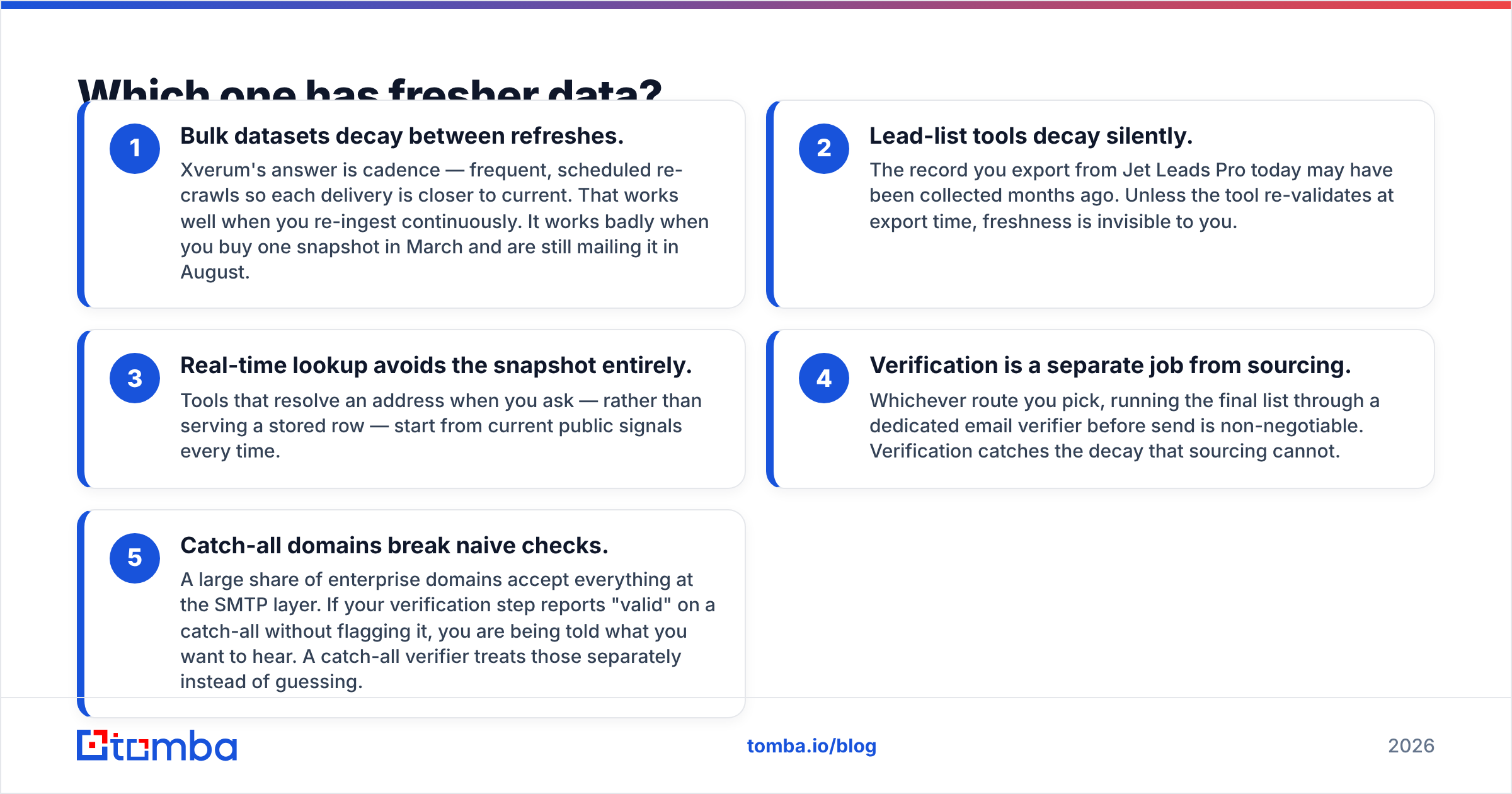
- Bulk datasets decay between refreshes. Xverum's answer is cadence — frequent, scheduled re-crawls so each delivery is closer to current. That works well when you re-ingest continuously. It works badly when you buy one snapshot in March and are still mailing it in August.
- Lead-list tools decay silently. The record you export from Jet Leads Pro today may have been collected months ago. Unless the tool re-validates at export time, freshness is invisible to you.
- Real-time lookup avoids the snapshot entirely. Tools that resolve an address when you ask — rather than serving a stored row — start from current public signals every time.
- Verification is a separate job from sourcing. Whichever route you pick, running the final list through a dedicated email verifier before send is non-negotiable. Verification catches the decay that sourcing cannot.
- Catch-all domains break naive checks. A large share of enterprise domains accept everything at the SMTP layer. If your verification step reports "valid" on a catch-all without flagging it, you are being told what you want to hear. A catch-all verifier treats those separately instead of guessing.

How to test freshness yourself, in 30 minutes: pull 100 records from each vendor's sample, restricted to one industry and one country. Verify all 200 with an independent verifier. Then manually check 20 of them against the person's current employer on LinkedIn or the company site. You are looking for two numbers: SMTP-valid rate, and job-still-current rate. The second number is the one vendors never quote, and it is the one that predicts your bounce and reply rates.
What does each actually cost?#
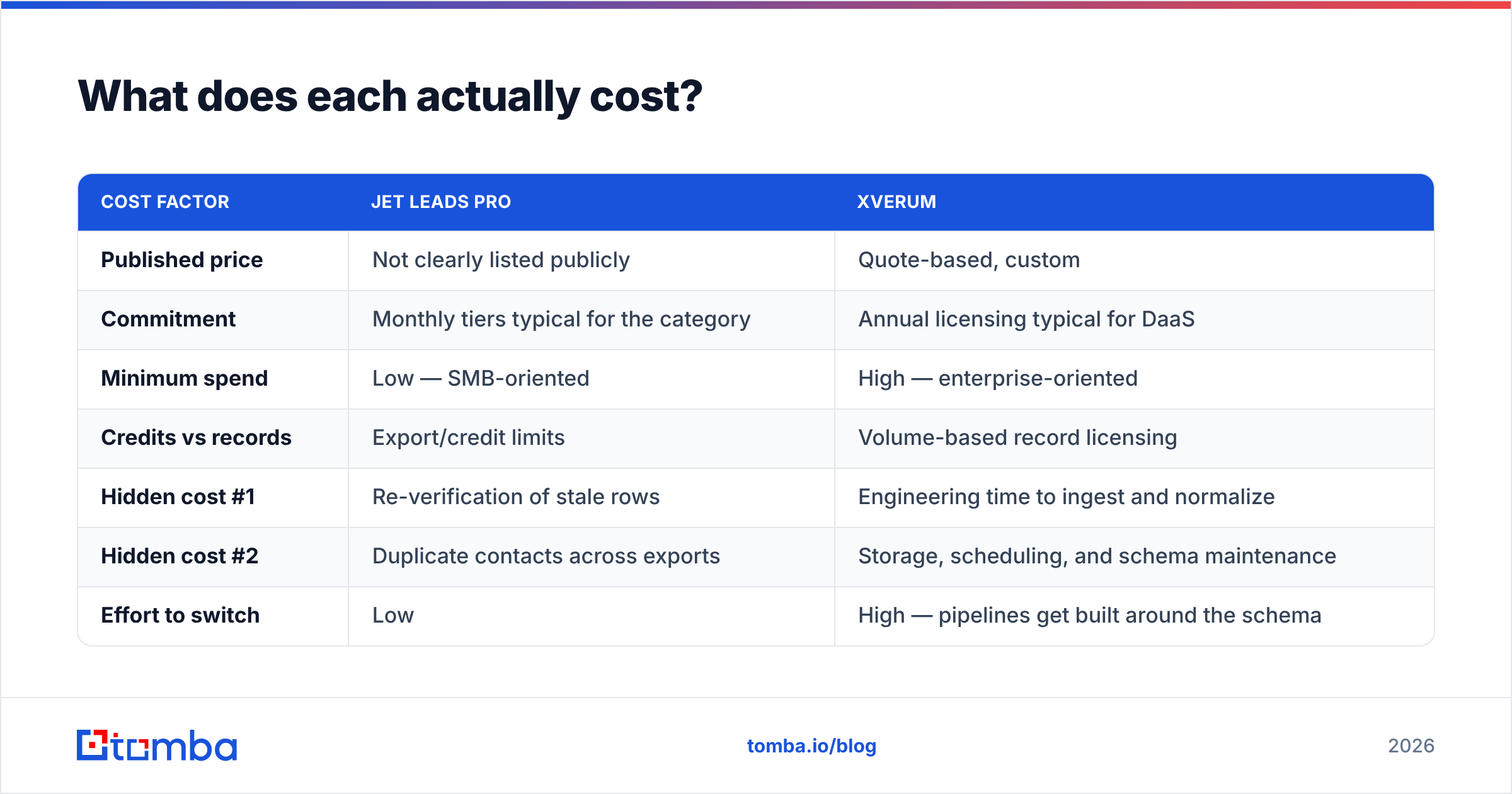
Neither publishes a clean price list, which tells you something about the intended buyer.
| Cost factor | Jet Leads Pro | Xverum |
|---|---|---|
| Published price | Not clearly listed publicly | Quote-based, custom |
| Commitment | Monthly tiers typical for the category | Annual licensing typical for DaaS |
| Minimum spend | Low — SMB-oriented | High — enterprise-oriented |
| Credits vs records | Export/credit limits | Volume-based record licensing |
| Hidden cost #1 | Re-verification of stale rows | Engineering time to ingest and normalize |
| Hidden cost #2 | Duplicate contacts across exports | Storage, scheduling, and schema maintenance |
| Effort to switch | Low | High — pipelines get built around the schema |
Do not skip the hidden-cost rows. On the Xverum side, the license fee is often the smaller half of total cost of ownership: someone has to map fields, dedupe against your CRM, handle schema drift between deliveries, and monitor the pipeline. Analysts at Gartner have been making this point about data acquisition for years — the acquisition cost is visible, the integration cost is not.
On the Jet Leads Pro side, the hidden cost is waste. If 18% of a 5,000-row export bounces or reaches someone who left, you did not buy 5,000 leads. You bought roughly 4,100 leads plus a deliverability hit. Price the list against the usable rows, not the exported rows.
For comparison, published per-seat tooling makes the math trivial: Tomba pricing runs Free (25 searches/mo), Starter $49/mo, Growth $99/mo, Pro $249/mo, with Enterprise on request. You can compute cost-per-verified-contact before you talk to anyone.
Who should choose Xverum?#
Pick Xverum when the answer to "who consumes this data?" is a system, not a person.
Concrete fits:
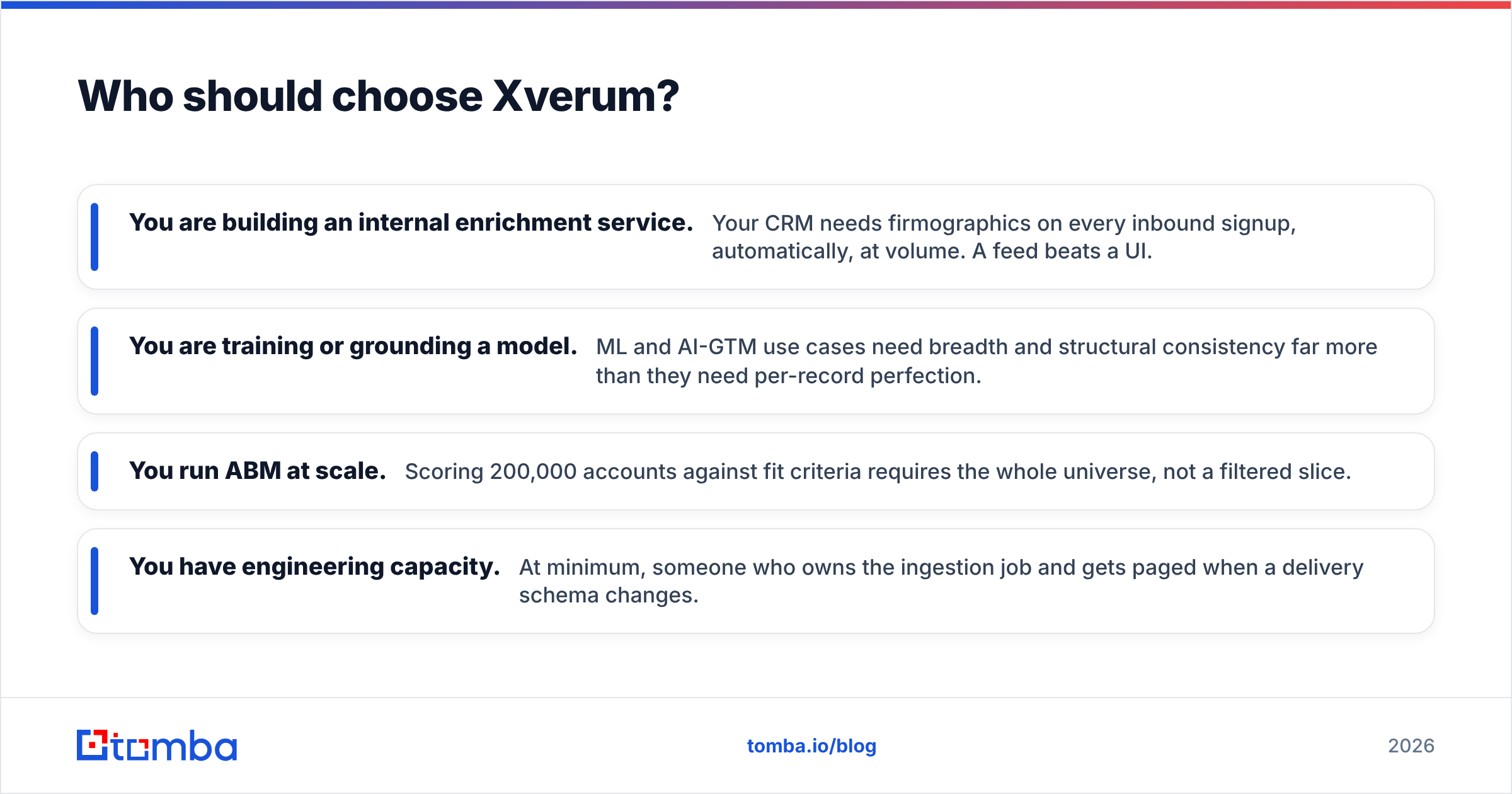
- You are building an internal enrichment service. Your CRM needs firmographics on every inbound signup, automatically, at volume. A feed beats a UI.
- You are training or grounding a model. ML and AI-GTM use cases need breadth and structural consistency far more than they need per-record perfection.
- You run ABM at scale. Scoring 200,000 accounts against fit criteria requires the whole universe, not a filtered slice.
- You have engineering capacity. At minimum, someone who owns the ingestion job and gets paged when a delivery schema changes.
If two or more of those are true, Xverum is a credible shortlist entry and the quote-based pricing is defensible — you are buying infrastructure.
If none are true, you will spend enterprise money to produce spreadsheets.
Who should choose Jet Leads Pro?#
Pick Jet Leads Pro when the constraint is time and the consumer is a human rep.
Concrete fits:
- You need pipeline this month. A founder-led sales motion cannot wait on a data project.
- Your ICP is broad and forgiving. SMB, common titles, major metros — the segments where list tools have the deepest coverage.
- Your volume is modest. Low thousands of contacts per quarter, not millions.
- Nobody on your team writes Python. That is a perfectly normal state for a ten-person company.
Two conditions before you sign, though. First, demand a sample export in your exact ICP — not a generic demo file — and verify it independently. Second, confirm what the accuracy guarantee actually refunds: credits, cash, or nothing. Vendor review sites like G2 are useful here mainly for the one-star reviews, which is where refund disputes surface.
Is there a better middle option?#
For most teams between those two poles, yes — and it is worth naming honestly rather than pretending the choice is binary.
The middle path is source at the moment of need, then verify before send. Instead of licensing a dump or buying a pre-built list, you resolve contacts against a known ICP account list when you are ready to work it. That means:
- Build the account list first (your ICP, your research, your intent signals).
- Run a domain search to see the real email pattern and who actually works there.
- Resolve the specific people you want with an email finder, not everyone the filter returned.
- Push the whole thing through verification, with catch-all domains flagged rather than assumed.
- For volume work, batch it through a bulk email finder or the API instead of clicking through a UI.
This model has a structural advantage: nothing sits in storage decaying. It also has a real limitation, and it is fair to state it — you must bring your own account list. If you have no ICP definition and want the tool to hand you one, a list product like Jet Leads Pro or a verified-list provider such as BookYourData, which is well regarded for pay-as-you-go verified B2B lists, will get you moving faster.
Also worth saying plainly: for genuinely large-scale, infrastructure-grade data work, Xverum does something a lookup tool does not. These models complement each other more often than they compete. Plenty of mature RevOps stacks license a bulk dataset for account-level coverage and run per-contact lookup for the people they actually email.
What is the verdict for 2026?#
No single winner — the matchup is decided by your team shape, not by feature count.
- Data team, millions of records, building a pipeline → Xverum.
- Small sales team, needs a list this week, no engineering → Jet Leads Pro, after you verify a sample in your own ICP.
- Defined ICP, quality over volume, want predictable per-contact cost → real-time lookup and verification.
The failure mode to avoid is buying at the wrong altitude: enterprise data licensing for a five-person sales team, or a filtered CSV export for a machine-learning project. Both mistakes are expensive, and both are common because the vendor categories sound similar in a pitch deck.
One last practical note. Whatever you buy, instrument it. Track bounce rate, job-still-current rate, and cost per replied-to contact per source. Run that for one quarter and the "which vendor" debate resolves itself with numbers instead of opinions.
Ready to test the third option? Point the Tomba Email Finder at 25 accounts from your ICP on the free tier — no card, no sales call — and compare its verified-contact rate against whatever sample Jet Leads Pro or Xverum sends you. If Starter at $49/mo produces more usable contacts than a quote-based dataset, you just saved yourself a procurement cycle.
Related guides#
// get started
Find, verify and enrich your first contacts today
Start on the free plan with 25 searches a month, then scale when your team is ready.
Free plan · No credit card required · GDPR & CCPA
Get the Tomba newsletter
Product and data updates
// about the author