Jet Leads Pro vs ZoomInfo: Which B2B Data Tool Wins?
One is a budget lead database you can buy on a card. The other is a six-figure GTM platform with a procurement cycle. Here is the honest breakdown of where each one earns its price — and where neither is the right answer.
TL;DR
- ZoomInfo is an enterprise platform, not a contact database. You are buying intent data, org charts, workflow automation and a CRM-embedded GTM layer — and paying five to six figures a year with a multi-seat annual contract to get it.
- Jet Leads Pro sits in the budget lead-list tier. Self-serve signup, card payment, credit-based exports, no procurement cycle. Its data depth and refresh cadence do not compete with ZoomInfo's, and it does not pretend to.
- The real question is not which is better — it is which layer you actually need. Most teams under 20 reps are buying an enterprise platform to use 8% of it.
- Verification is the variable that breaks both. Any static database decays roughly 25–30% a year. Whoever you buy from, re-verify at send time or your deliverability pays for it.
- A cheaper third path exists: pull contacts on demand with an email finder and verify them at the moment of outreach, instead of renting a static database you export once a quarter.
What are Jet Leads Pro and ZoomInfo?#
They solve the same surface problem — "I need contact data for people I want to sell to" — from opposite ends of the market.
ZoomInfo is the incumbent. It started as a contact database (and absorbed DiscoverOrg, Chorus, and Comparably along the way) and is now sold as a revenue operating system: contact and company records, technographics, intent signals from its Bidstream and website-visitor network, conversation intelligence, sequencing, and deep CRM sync. Pricing is quoted, not published. Contracts are annual, seat-based, and usually include export-credit caps that are negotiated separately from the seats themselves.
Jet Leads Pro belongs to the self-serve lead-data tier — the cluster of tools that let you search a B2B contact index, filter by title and industry and geography, and export a CSV the same afternoon. Because vendors in this tier change packaging frequently, treat any pricing you read (here or anywhere) as a starting point and confirm on the vendor's current pricing page before you buy. What is consistent across the tier is the shape of the offer: low monthly floor, credits instead of seats, immediate access, shallow-to-moderate data depth, and no intent layer.
That structural difference matters more than any feature checklist. One is a platform you adopt; the other is a list you buy.
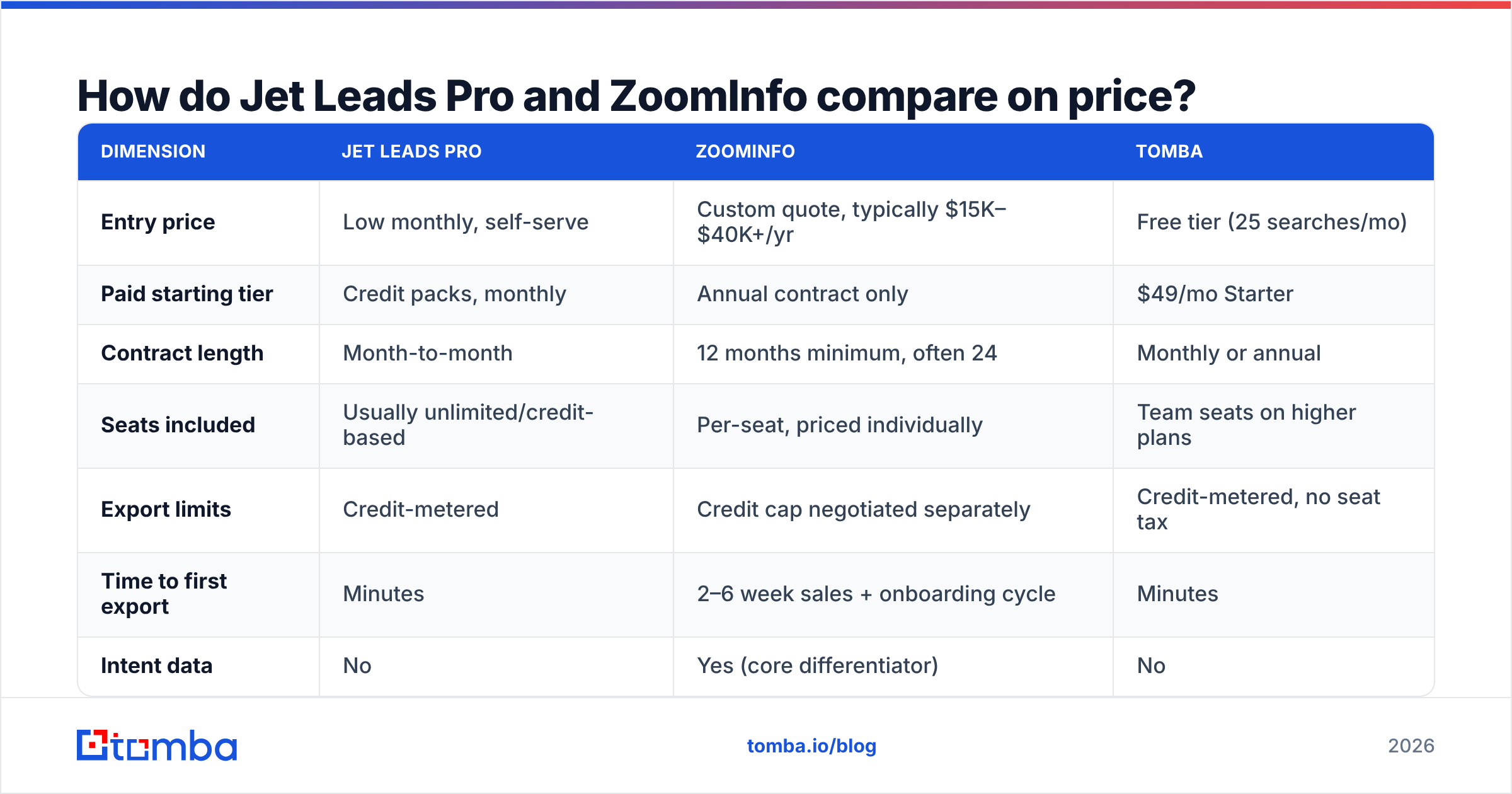
How do Jet Leads Pro and ZoomInfo compare on price?#
This is where most evaluations end, so let's be blunt about it.
| Dimension | Jet Leads Pro | ZoomInfo | Tomba |
|---|---|---|---|
| Entry price | Low monthly, self-serve | Custom quote, typically $15K–$40K+/yr | Free tier (25 searches/mo) |
| Paid starting tier | Credit packs, monthly | Annual contract only | $49/mo Starter |
| Contract length | Month-to-month | 12 months minimum, often 24 | Monthly or annual |
| Seats included | Usually unlimited/credit-based | Per-seat, priced individually | Team seats on higher plans |
| Export limits | Credit-metered | Credit cap negotiated separately | Credit-metered, no seat tax |
| Time to first export | Minutes | 2–6 week sales + onboarding cycle | Minutes |
| Intent data | No | Yes (core differentiator) | No |
| API access | Limited | Yes, enterprise-tier | Yes, on all paid plans |
The pattern buyers miss: ZoomInfo's headline seat price is rarely the real number. Export credits, intent topics, and integrations are separate line items, and credits typically do not roll over. Teams routinely burn through their annual export allowance in month seven and pay mid-contract for more. Read the credit clause before the seat clause.
On the other side, budget tools have a different hidden cost. A cheap list with 30% invalid addresses is not cheap — it is a deliverability liability that you pay for in bounce rate, domain reputation, and eventually inbox placement. Cost per usable contact is the only number worth comparing.

Which one has more accurate data?#
Neither vendor's marketing number will survive contact with your ICP. Accuracy is segment-specific, and the honest answer is that you have to test it on your own list.
ZoomInfo's advantage is contributory data: its community-edition users share contact records back into the network, which keeps job-change data unusually fresh in US mid-market and enterprise tech. Its weakness is geography and company size — coverage outside North America thins noticeably, and SMB records below ~50 employees are often stale or absent. If you sell to European or APAC mid-market, a ZoomInfo quote can look very different from a ZoomInfo demo.
Budget databases like Jet Leads Pro tend to inherit the opposite profile: broader crawled coverage of small companies and long-tail domains, but less rigorous job-change detection. A record that was correct nine months ago is still sitting in the index.

Run the same test on both before you sign anything:
- Build a 100-contact ground-truth sample from accounts you already closed or spoke to, where you know the correct email and current title.
- Query both tools blind for those same 100 people and record match rate (did it return anything?) separately from accuracy rate (was it right?).
- Push every returned address through an independent email verifier rather than trusting the vendor's own validity flag — vendors grade their own homework.
- Check job-change lag. Pick 10 people you know changed roles in the last six months. A database that still shows the old company on 7 of 10 is selling you bounced emails.
- Measure catch-all exposure. If 40% of your ICP domains are catch-all, both tools' "verified" labels mean far less than the vendors imply, and you need a dedicated catch-all verifier in the pipeline.
That five-step test costs you an afternoon and routinely saves teams from a $30K decision made on a polished demo.
What does ZoomInfo actually give you that a budget tool doesn't?#
Four things, and you should be able to name which ones you will use before you buy.
- Intent signals. Topic-level surges showing which accounts are researching your category. This is genuinely hard to replicate and it is the single most defensible reason to pay enterprise money.
- Org charts and reporting lines. For six-figure deals with seven stakeholders, knowing who reports to whom is worth real money. For a $400/mo SaaS product, it is decoration.
- Workflow and CRM embedding. Auto-enrichment on inbound forms, territory routing, and record hygiene inside Salesforce or HubSpot. Their own Salesforce and HubSpot integrations are the ones most buyers cite in G2 reviews.
- Compliance posture. Enterprise legal teams ask for GDPR/CCPA documentation, SOC 2, and suppression handling. Larger vendors answer those questionnaires routinely; smaller ones sometimes cannot.
If you looked at that list and only one item applies to you, you are not a ZoomInfo buyer. That is not a criticism of ZoomInfo — it is a criticism of buying a platform to use a feature.
Where does Jet Leads Pro win?#
Speed, reversibility, and blast radius.
You can sign up, run a search, export 2,000 contacts, and test a campaign before an enterprise vendor has returned your demo request. If the data is wrong for your niche, you cancel next month. Nobody has to explain a failed $28,000 line item to a CFO.
That optionality is worth more than most buyers price it at, especially in the first year of an outbound motion when you are still discovering which ICP actually replies. Lock into a 24-month enterprise contract in month two of experimentation and you have hard-coded an assumption you had no evidence for.
The honest limits: no intent layer, thinner firmographic enrichment, limited API depth, and support that is email-ticket rather than dedicated CSM. If your GTM depends on real-time enrichment inside a CRM workflow, the budget tier will frustrate you.
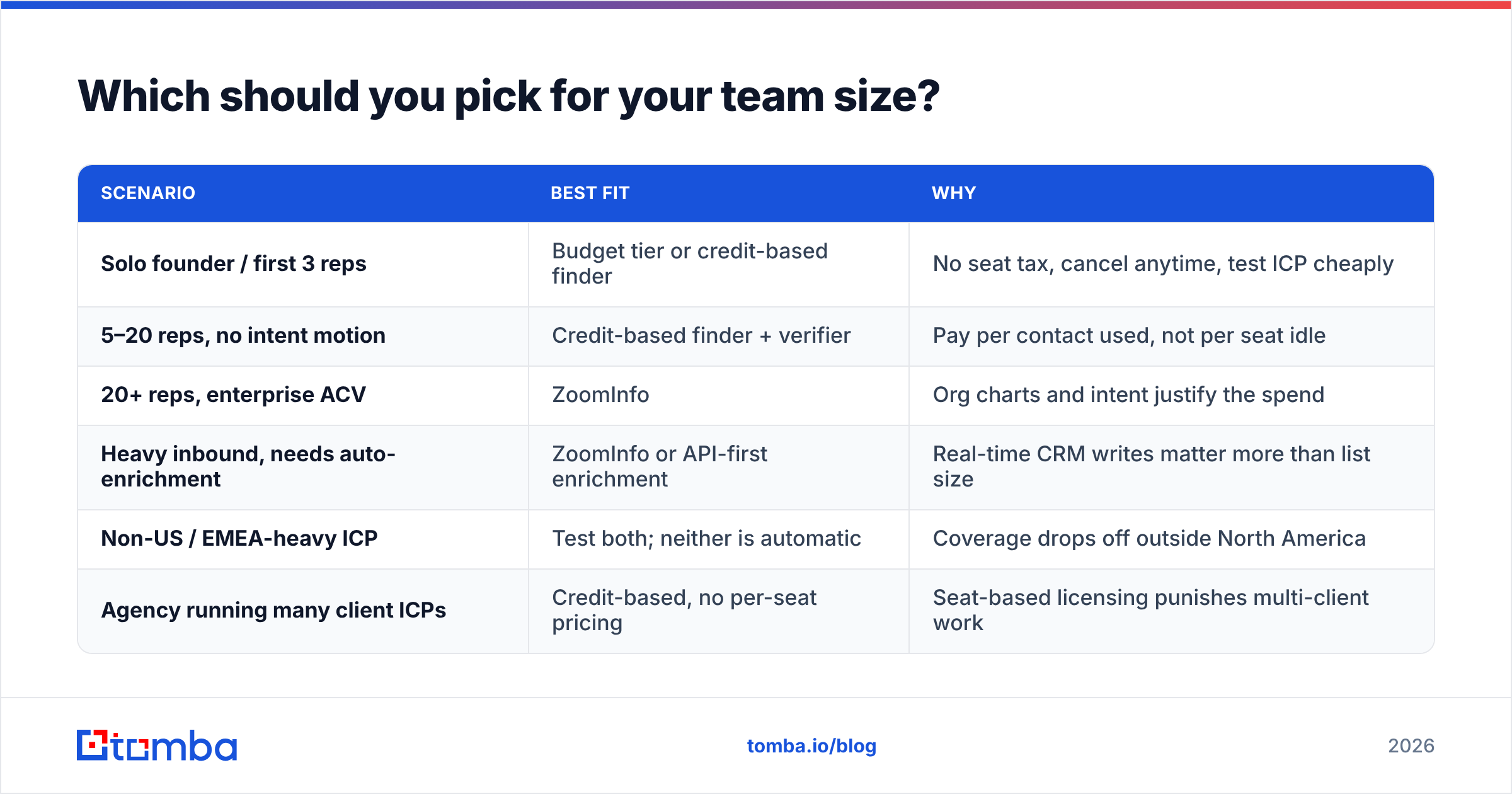
Which should you pick for your team size?#
| Scenario | Best fit | Why |
|---|---|---|
| Solo founder / first 3 reps | Budget tier or credit-based finder | No seat tax, cancel anytime, test ICP cheaply |
| 5–20 reps, no intent motion | Credit-based finder + verifier | Pay per contact used, not per seat idle |
| 20+ reps, enterprise ACV | ZoomInfo | Org charts and intent justify the spend |
| Heavy inbound, needs auto-enrichment | ZoomInfo or API-first enrichment | Real-time CRM writes matter more than list size |
| Non-US / EMEA-heavy ICP | Test both; neither is automatic | Coverage drops off outside North America |
| Agency running many client ICPs | Credit-based, no per-seat pricing | Seat-based licensing punishes multi-client work |

What about the third option most comparisons skip?#
There is a structural alternative to buying access to a static database: find and verify contacts at the moment you need them.
The database model assumes you want a snapshot of the world, exported quarterly. The finder model assumes you already know which companies you are targeting — from your CRM, a conference list, a funding announcement, a domain search across your ICP — and you need current, verified contact details for specific people right now. You pay for what you pull, not for the 40 million records you will never touch.
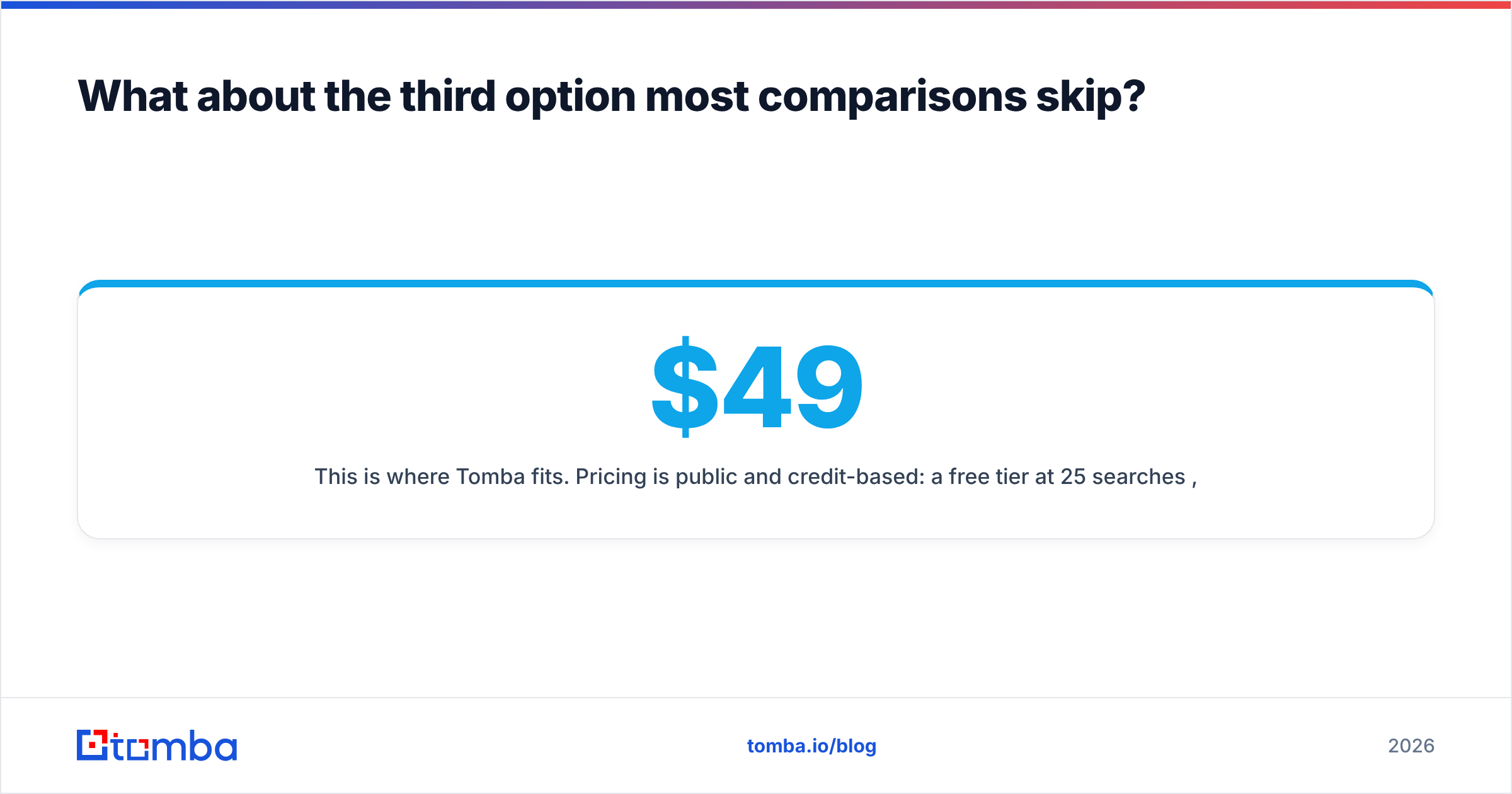
This is where Tomba fits. Pricing is public and credit-based: a free tier at 25 searches per month, Starter at $49/mo, Growth at $99/mo, Pro at $249/mo, and custom enterprise terms — full Tomba pricing is on the site, no quote call required. There is no intent graph and no org chart, and this post is not going to pretend otherwise. What you get is the contact layer — finder, verifier, catch-all handling, data enrichment, and a documented API — without the seat licensing or the annual commitment.

Worth naming a fourth option too: if what you actually want is a clean, pre-built list with straightforward per-record pricing and no subscription at all, BookYourData is a solid, well-regarded choice in that lane — pay-as-you-go lists with a verification guarantee. Different model, genuinely useful for one-off campaigns.
How do you avoid overpaying either way?#
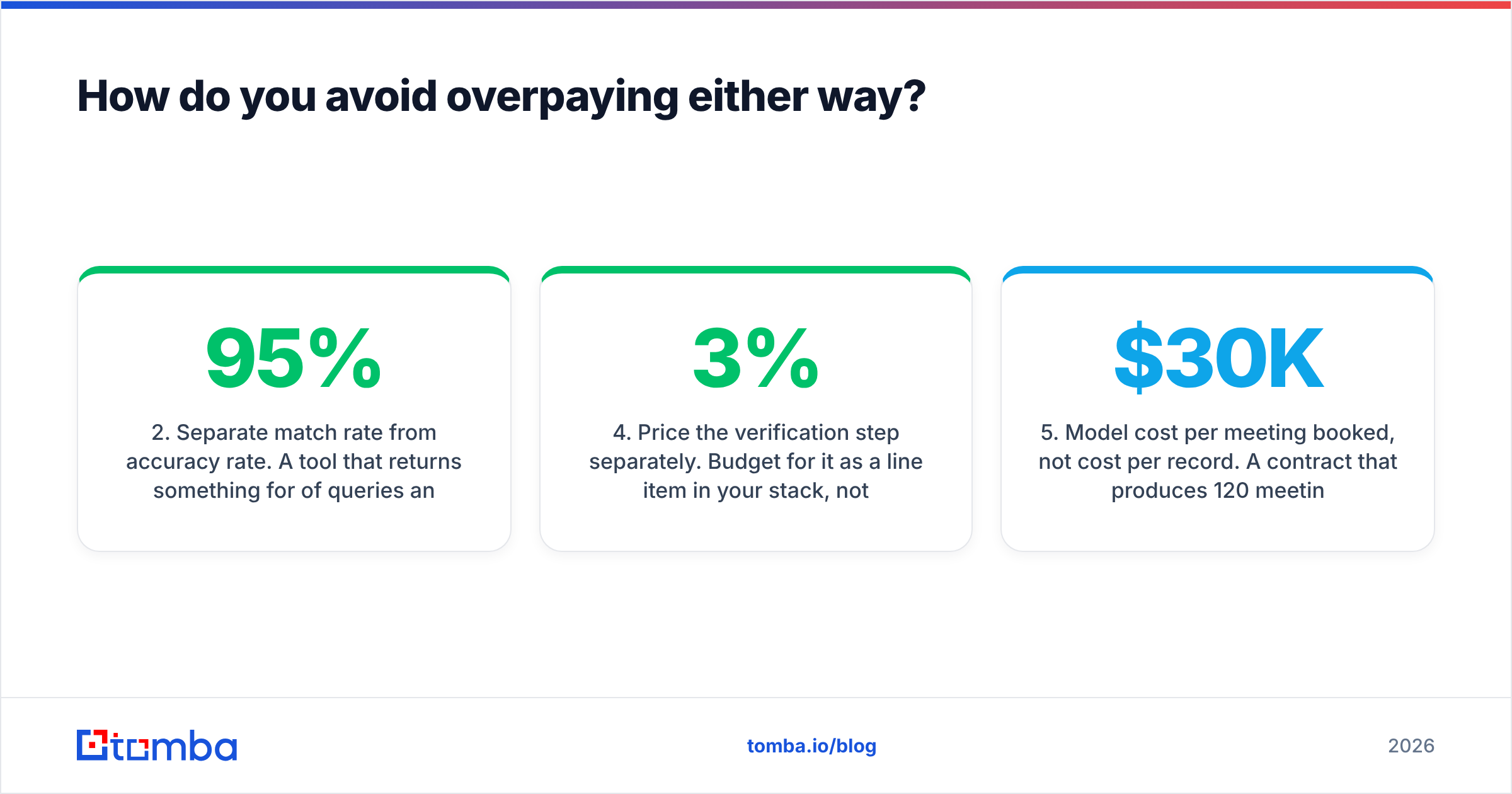
Five checks before you sign anything, regardless of which vendor you lean toward.
- Demand a trial on your own ICP. Not their sample list. Yours. Any vendor confident in coverage will agree; hesitation is information.
- Separate match rate from accuracy rate. A tool that returns something for 95% of queries and is right 60% of the time is worse than one that returns 70% and is right 95% of the time.
- Get export limits in writing, in the contract body. "Unlimited" in a deck and "unlimited" in an MSA are different words.
- Price the verification step separately. Budget for it as a line item in your stack, not an afterthought. Bounce rates above 3% start damaging domain reputation regardless of how much you paid for the list.
- Model cost per meeting booked, not cost per record. A $30K contract that produces 120 meetings beats a $600/yr tool that produces 15. The reverse is also frequently true. Run the number both ways.
Analysts at Gartner have been flagging the same trend for several cycles: B2B data spend is consolidating into fewer, deeper contracts at the enterprise end while fragmenting into cheap, composable tools everywhere else. The uncomfortable middle — mid-priced platforms that are neither cheapest nor deepest — is where most buyer's remorse lives.
The verdict#
Pick ZoomInfo if you sell enterprise deals, need intent data, have CRM workflows that must enrich in real time, and have budget authority that treats $25K as a line item rather than a decision. You will use enough of the platform to justify it.
Pick a budget tool like Jet Leads Pro if you are still proving out an ICP, want month-to-month exit rights, and can live with doing your own verification pass. Just do that verification pass — it is not optional.
And if what you actually need is accurate contact data on demand, without seats, quotes, or a 24-month commitment, start with the Tomba Email Finder. Run your ICP through the free tier's 25 searches, verify the results against your ground-truth list, and compare cost per usable contact against whatever quote is sitting in your inbox. If the numbers favor the enterprise platform, buy it with confidence. If they don't, you just saved your team a five-figure mistake and about six weeks of procurement.
Related guides#
// get started
Find, verify and enrich your first contacts today
Start on the free plan with 25 searches a month, then scale when your team is ready.
Free plan · No credit card required · GDPR & CCPA
// about the author