9 Best JobNimbus Alternatives for Contractors in 2026
JobNimbus works until your crew size, pricing tier, or commercial pipeline outgrows it. Here are nine JobNimbus alternatives compared on price, fit, and switching cost — plus how to keep your new CRM full.
TL;DR
- JobNimbus is a solid roofing and specialty-trades CRM, but it is quote-only on pricing, opinionated about workflow, and thin once you move from residential job tracking into commercial business development.
- The best JobNimbus alternatives split into three camps: roofing-native platforms (AccuLynx, Leap, Roofr), field-service operations suites (Jobber, Housecall Pro, ServiceTitan), and general-purpose CRMs you configure yourself (Pipedrive, HubSpot).
- Switching cost is almost never the subscription. It is data migration, photo/document history, and retraining crews who already know where the buttons are.
- No contractor CRM fills your pipeline for you. Every one of them assumes the lead already exists.
- If you sell commercial — property managers, GCs, facility directors, insurance adjusters — pair whichever CRM you pick with a contact-data layer so outbound stops depending on referrals.
What is JobNimbus and who actually uses it?#
JobNimbus is a CRM and project-management platform built mainly for roofing contractors, with meaningful adoption in siding, gutters, restoration, and general remodeling. It combines a visual job pipeline, estimating, photo documentation, scheduling, invoicing, and payments into one system, and it integrates with supplier ecosystems like Beacon and SRS for material ordering.
Its core users are residential contractors running somewhere between three and fifty field people. That is the sweet spot: big enough that whiteboards and text threads break down, small enough that an enterprise field-service platform would be overkill and overpriced.
What JobNimbus is genuinely good at:
- Job-centric pipeline. Every record is a job, not an abstract "deal," which matches how contractors actually think.
- Photo and document capture. Field-first mobile capture tied to the job record is the feature crews adopt without training.
- Supplier integrations. Material ordering from inside the CRM removes a real daily friction point.
- Templated automations. Status-change triggers that fire tasks, texts, and emails without you writing logic.
Where it starts to strain is the part nobody demos: business development. JobNimbus assumes leads arrive from canvassing, storm chasing, referrals, or paid ads. It manages what happens after the lead exists. It does not help you build a target list of 400 property-management companies in your metro.
Why do contractors look for JobNimbus alternatives?#
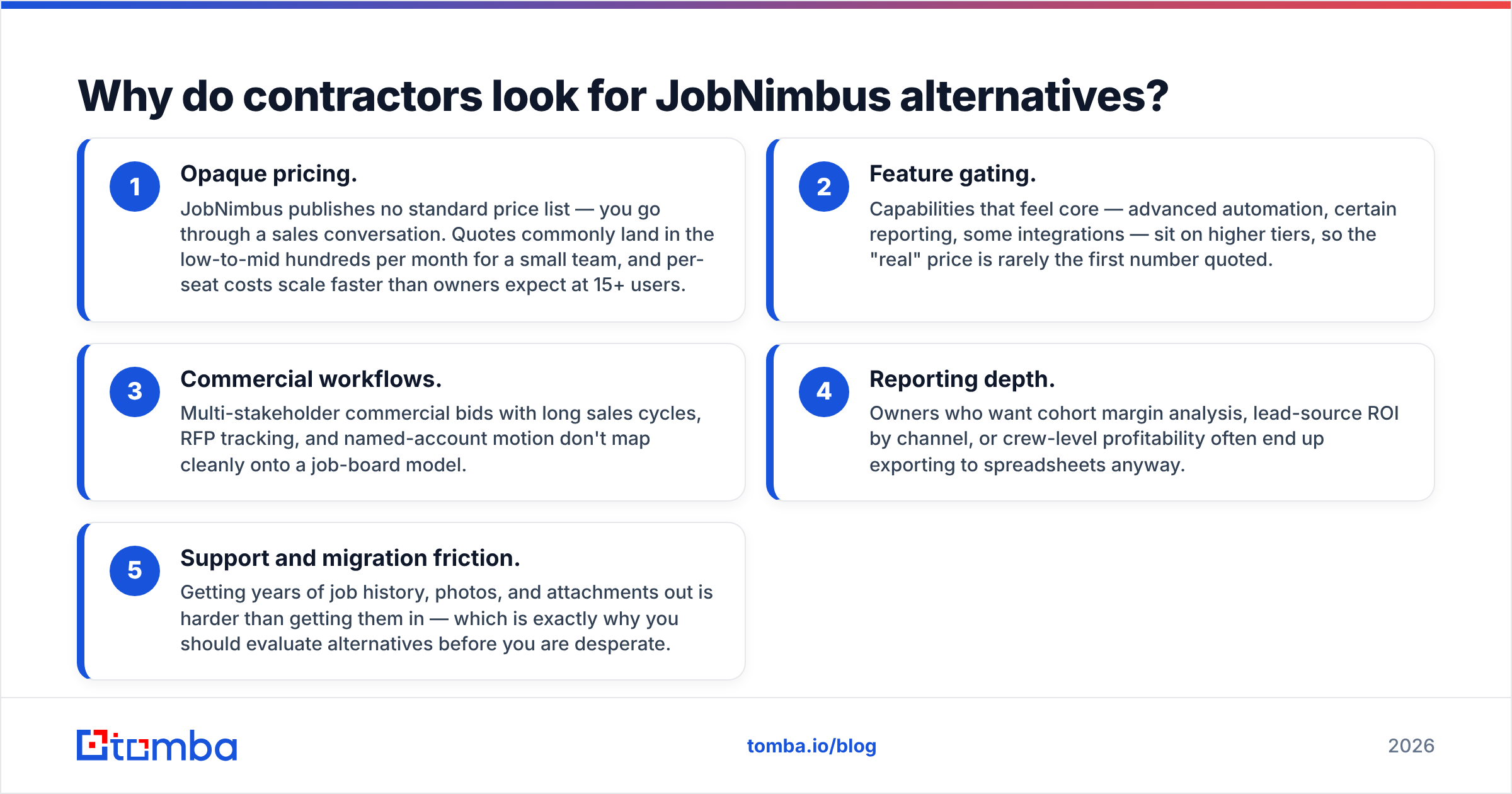
Five reasons come up repeatedly in G2 and Capterra reviews and in contractor forums:
- Opaque pricing. JobNimbus publishes no standard price list — you go through a sales conversation. Quotes commonly land in the low-to-mid hundreds per month for a small team, and per-seat costs scale faster than owners expect at 15+ users.
- Feature gating. Capabilities that feel core — advanced automation, certain reporting, some integrations — sit on higher tiers, so the "real" price is rarely the first number quoted.
- Commercial workflows. Multi-stakeholder commercial bids with long sales cycles, RFP tracking, and named-account motion don't map cleanly onto a job-board model.
- Reporting depth. Owners who want cohort margin analysis, lead-source ROI by channel, or crew-level profitability often end up exporting to spreadsheets anyway.
- Support and migration friction. Getting years of job history, photos, and attachments out is harder than getting them in — which is exactly why you should evaluate alternatives before you are desperate.
None of these make JobNimbus a bad product. They make it a specific product. The question is whether its specificity still matches your business.
What should you look for in a JobNimbus alternative?#
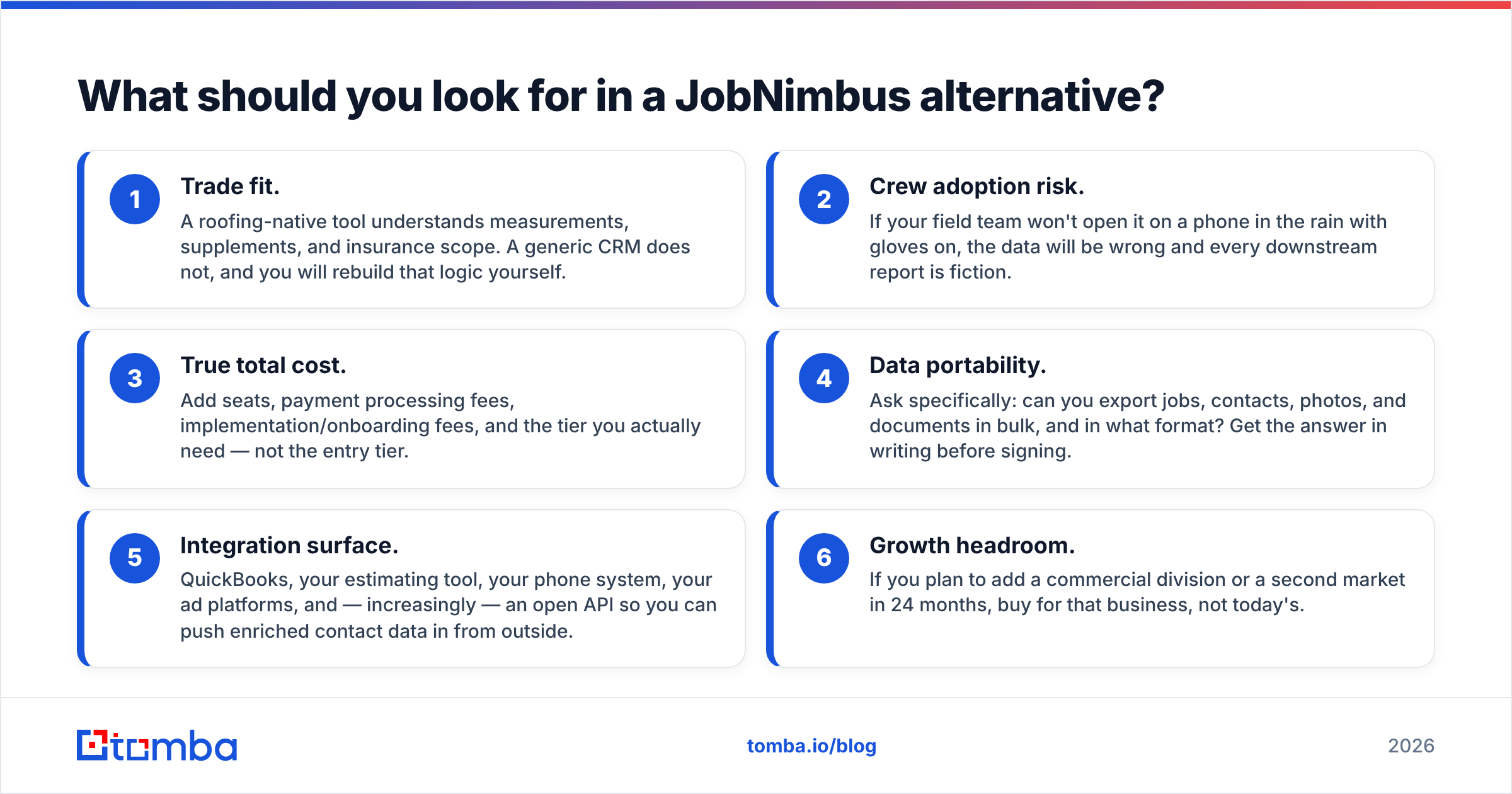
Evaluate on these six dimensions, in this order. Most contractors evaluate on feature lists and regret it.
- Trade fit. A roofing-native tool understands measurements, supplements, and insurance scope. A generic CRM does not, and you will rebuild that logic yourself.
- Crew adoption risk. If your field team won't open it on a phone in the rain with gloves on, the data will be wrong and every downstream report is fiction.
- True total cost. Add seats, payment processing fees, implementation/onboarding fees, and the tier you actually need — not the entry tier.
- Data portability. Ask specifically: can you export jobs, contacts, photos, and documents in bulk, and in what format? Get the answer in writing before signing.
- Integration surface. QuickBooks, your estimating tool, your phone system, your ad platforms, and — increasingly — an open API so you can push enriched contact data in from outside.
- Growth headroom. If you plan to add a commercial division or a second market in 24 months, buy for that business, not today's.
How do the top JobNimbus alternatives compare?#
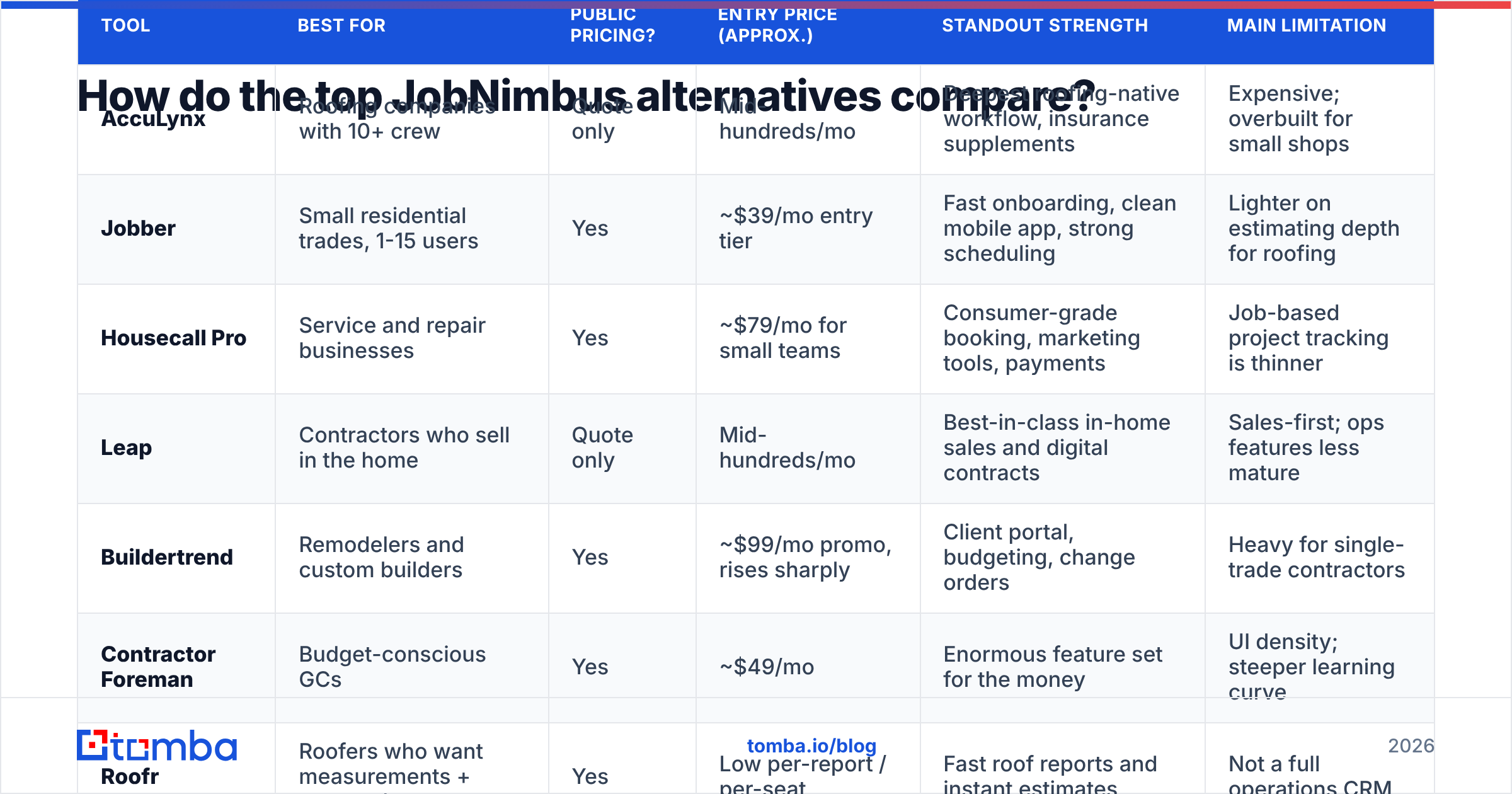
Prices below are approximate published starting points as of 2026 and change frequently — treat them as an order-of-magnitude guide, not a quote. Anything marked "quote only" means the vendor does not publish standard pricing.
| Tool | Best for | Public pricing? | Entry price (approx.) | Standout strength | Main limitation |
|---|---|---|---|---|---|
| AccuLynx | Roofing companies with 10+ crew | Quote only | Mid-hundreds/mo | Deepest roofing-native workflow, insurance supplements | Expensive; overbuilt for small shops |
| Jobber | Small residential trades, 1-15 users | Yes | ~$39/mo entry tier | Fast onboarding, clean mobile app, strong scheduling | Lighter on estimating depth for roofing |
| Housecall Pro | Service and repair businesses | Yes | ~$79/mo for small teams | Consumer-grade booking, marketing tools, payments | Job-based project tracking is thinner |
| Leap | Contractors who sell in the home | Quote only | Mid-hundreds/mo | Best-in-class in-home sales and digital contracts | Sales-first; ops features less mature |
| Buildertrend | Remodelers and custom builders | Yes | ~$99/mo promo, rises sharply | Client portal, budgeting, change orders | Heavy for single-trade contractors |
| Contractor Foreman | Budget-conscious GCs | Yes | ~$49/mo | Enormous feature set for the money | UI density; steeper learning curve |
| Roofr | Roofers who want measurements + proposals | Yes | Low per-report / per-seat | Fast roof reports and instant estimates | Not a full operations CRM |
| ServiceTitan | 30+ technician operations | Quote only | Four figures/mo | Enterprise reporting, call booking, capacity planning | Cost and implementation load |
| Pipedrive / HubSpot | Commercial-heavy contractors | Yes | ~$24-$100/user/mo | Real sales pipeline, sequences, forecasting | You build the trades workflow yourself |
Two patterns fall out of that table.
First, the roofing-native tools (AccuLynx, Leap, Roofr) beat JobNimbus on depth in their specific lane but rarely on breadth or price. If you left JobNimbus because it was expensive, AccuLynx is not your answer.
Second, the general CRMs win when your revenue mix shifts toward commercial. A property-management portfolio bid is a multi-month, multi-contact sale — that is exactly what HubSpot and Pipedrive are engineered for, and exactly what job boards are not.
Which JobNimbus alternative fits which contractor?#
If you are a small residential crew (1-10 people): Jobber. Onboarding is measured in days, the mobile app has the lowest adoption friction of anything in this list, and published pricing means no negotiation theater. You give up some roofing-specific estimating depth.
If you are a roofing company scaling past 15 field staff: AccuLynx. It is the most complete roofing-native system, with supplement workflows and production scheduling that JobNimbus handles more generically. Budget for implementation time, not just licenses.
If your bottleneck is closing in the living room: Leap. The in-home presentation, financing, and e-signature flow is the strongest here, and it pairs with an ops tool rather than replacing one.
If you are a remodeler or builder with long projects: Buildertrend. Change orders, selections, and the homeowner portal solve problems single-trade tools ignore.
If cost is the entire reason you are reading this: Contractor Foreman. Feature-per-dollar is unmatched. Accept that the interface will take your team longer to learn.
If you are moving into commercial and national accounts: Pipedrive or HubSpot, plus a lightweight field tool. You are now running a B2B sales org that happens to install roofs, and a job board cannot model that.
What does switching CRMs actually cost?#
The subscription line is the smallest number. Plan for four real costs:
- Migration. Contacts and jobs export cleanly. Photos, PDFs, and note histories usually do not. Budget 20-60 hours of admin time, or pay the new vendor's migration service.
- Parallel running. Most contractors run both systems for 30-60 days. That is double subscription cost plus double data entry.
- Retraining. Assume two weeks of reduced throughput while estimators and coordinators relearn muscle memory. Field crews adapt faster than office staff — the office owns the complex workflows.
- Integration rebuild. QuickBooks mappings, Zapier scenarios, and reporting dashboards do not port. Inventory every automation you rely on before you cancel anything.
A useful rule: if the new platform does not deliver a clearly articulated gain — a division you cannot run today, a reporting answer you cannot get today, a cost reduction above 30% — the switch will not pay for itself in year one.

How do you keep a new CRM full instead of just organized?#
Here is the uncomfortable truth about every tool on this list: none of them generate demand. They organize demand you already created. Contractors who switch CRMs hoping for more revenue are usually solving the wrong problem — a cleaner pipeline with the same number of leads in it produces roughly the same revenue.
This matters most for commercial work. Residential lead flow comes from ads, canvassing, storms, and referrals. Commercial lead flow comes from you deliberately reaching named people: facility directors, property managers, regional maintenance leads, GC estimators, REIT asset managers. Those people are not filling out your website form.
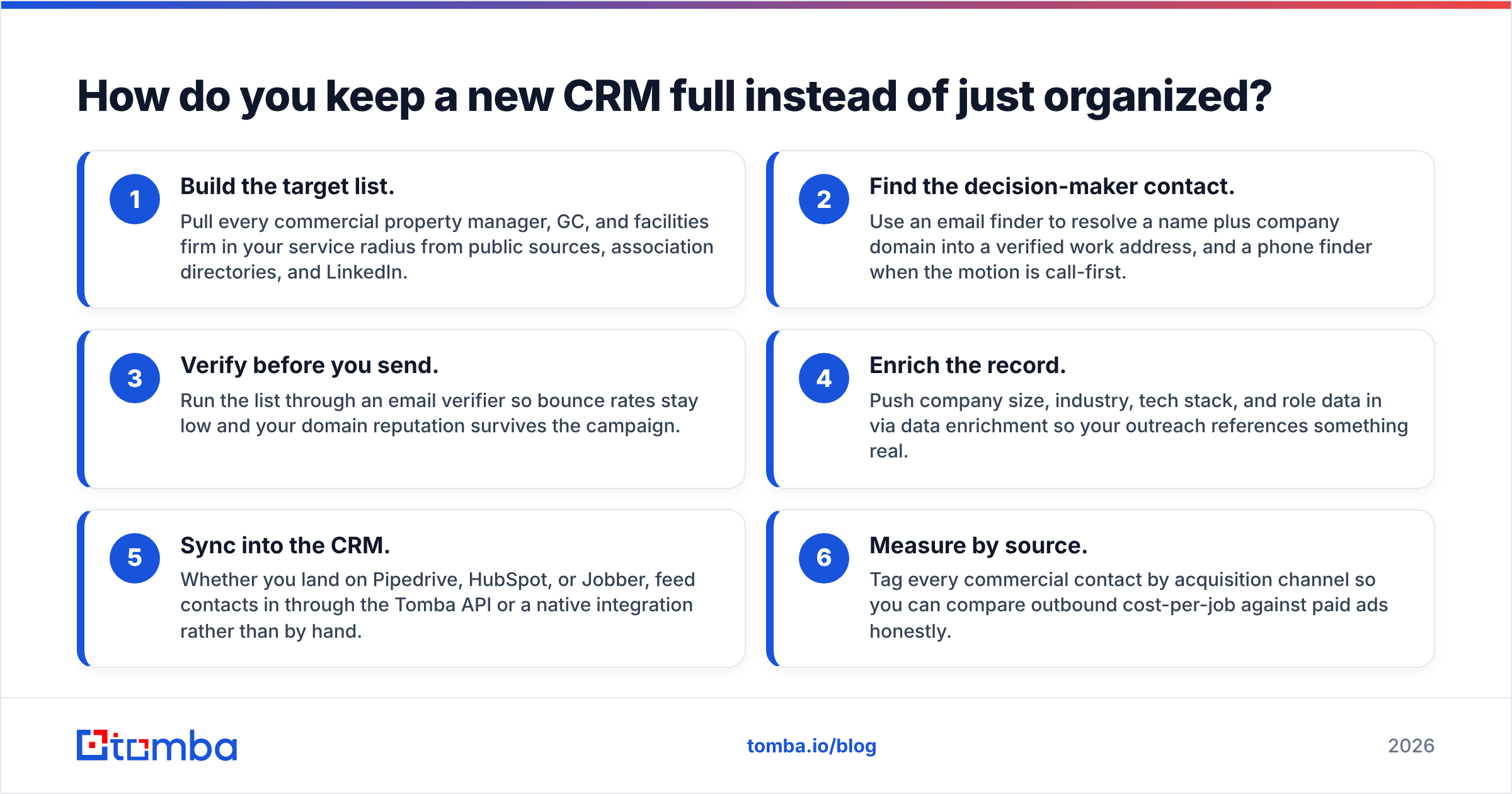
That is a data problem, not a CRM problem. The workflow that actually works:
- Build the target list. Pull every commercial property manager, GC, and facilities firm in your service radius from public sources, association directories, and LinkedIn.
- Find the decision-maker contact. Use an email finder to resolve a name plus company domain into a verified work address, and a phone finder when the motion is call-first.
- Verify before you send. Run the list through an email verifier so bounce rates stay low and your domain reputation survives the campaign.
- Enrich the record. Push company size, industry, tech stack, and role data in via data enrichment so your outreach references something real.
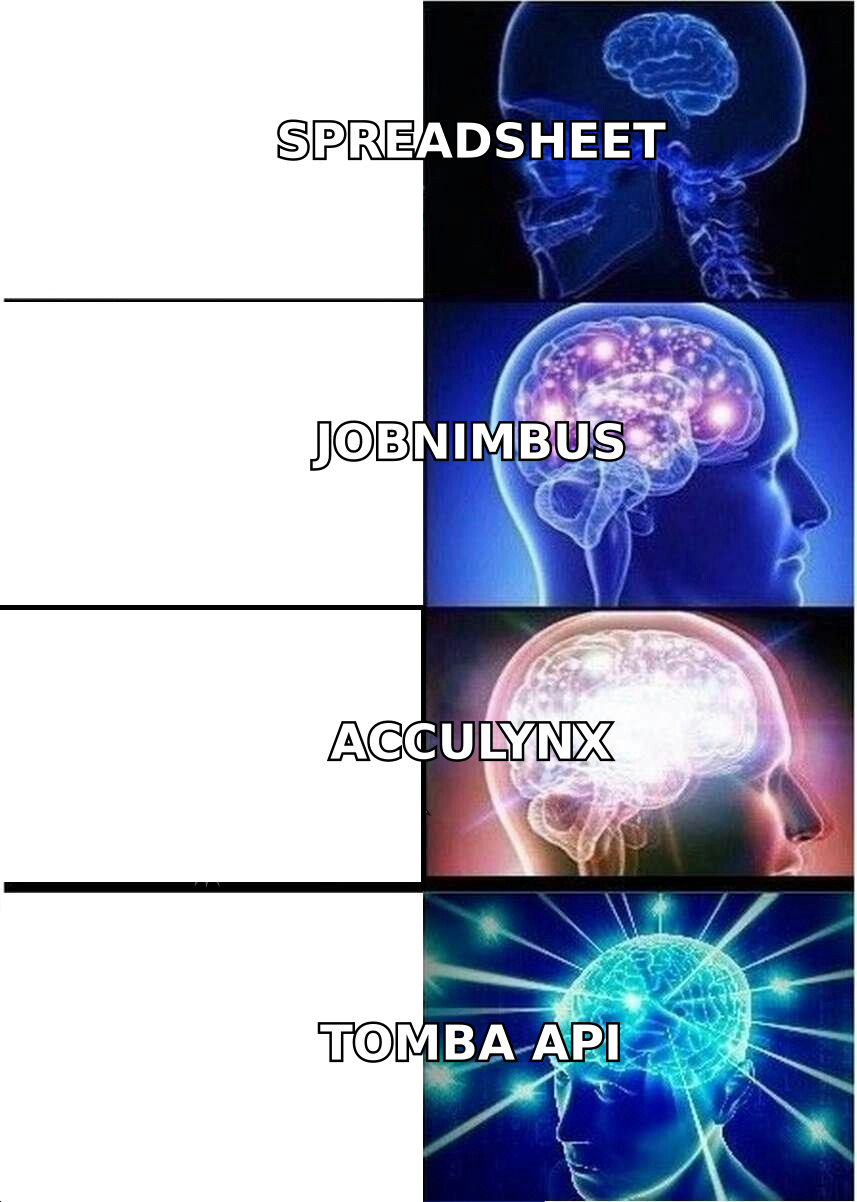
- Sync into the CRM. Whether you land on Pipedrive, HubSpot, or Jobber, feed contacts in through the Tomba API or a native integration rather than by hand.
- Measure by source. Tag every commercial contact by acquisition channel so you can compare outbound cost-per-job against paid ads honestly.
Tomba is not a contractor CRM and will not replace JobNimbus. It sits upstream of whatever CRM you choose, turning a list of company names into verified, contactable humans. Tomba pricing starts with a free tier at 25 searches per month, with Starter at $49/mo and Growth at $99/mo — which is usually less than the delta between two contractor-CRM tiers.
Is JobNimbus still worth keeping?#
Often, yes. Before you migrate, price the honest alternative: keep JobNimbus, renegotiate at renewal, and spend the difference on demand generation.
Stay if: your team uses it daily without complaint, your residential job flow is healthy, supplier integrations save you real ordering time, and your gaps are reporting gaps you can solve with an export.
Leave if: you are paying for seats that never log in, you have added a commercial division that does not fit the job-board model, your quoted renewal jumped materially without new value, or your crews have quietly reverted to texting photos to the office.
That last signal is the most reliable one in this entire article. When field staff route around the CRM, the tool has already lost, and no feature comparison table will bring them back.
Frequently asked questions#
Is there a free JobNimbus alternative? Not a full-featured one. Contractor Foreman and Jobber offer trials, and general CRMs like HubSpot have genuinely usable free tiers — but free contractor-specific platforms tend to be either abandonware or aggressive lead-resale plays. Read the data terms carefully.
Can I run a roofing business on a general CRM like Pipedrive? Yes, if your revenue skews commercial and you accept building estimating and production workflows elsewhere. For high-volume residential, a trade-native tool wins on speed.
How long does migration take? Plan 4-8 weeks end to end for a 10-30 person company: two weeks of data prep, two weeks parallel running, and several weeks of cleanup. Anyone promising a weekend is selling something.
Do these tools help with insurance claims? AccuLynx and JobNimbus both handle supplements and Xactimate-adjacent workflows better than generic CRMs. If restoration is a meaningful revenue share, treat it as a hard requirement.
Where does contact data fit if my CRM already has contacts? Your CRM stores contacts you already know. A data layer finds the ones you do not — and re-verifies the ones going stale, which is roughly 25-30% of B2B contact records per year as people change roles.
Ready to fill whichever CRM you choose?#
Pick the platform that matches your trade, your crew size, and your next 24 months — then solve the part none of them solve. Use the Tomba Email Finder to turn your list of target property managers, GCs, and facility directors into verified, reachable contacts, push them straight into your new CRM, and start measuring outbound as a real channel instead of a hope. Start free with 25 searches a month, and scale to Starter at $49/mo when the pipeline proves itself.
Related guides#
// get started
Find, verify and enrich your first contacts today
Start on the free plan with 25 searches a month, then scale when your team is ready.
Free plan · No credit card required · GDPR & CCPA
// about the author