JustCall vs RingCentral (2026): Which Sales Phone System Wins?
JustCall is built for outbound sales teams that live in the dialer. RingCentral is built for the whole company. Here's an honest breakdown of pricing, features, CRM fit, and which one your team should actually buy in 2026.
TL;DR
- JustCall is a sales-first dialer. Power dialer, AI call scoring, SMS sequences, and deep CRM writeback. Buy it if your reps spend four hours a day on the phone.
- RingCentral is a full communications platform. Phone, video, team messaging, contact center, and enterprise-grade uptime for the entire company — not just sales.
- Price is closer than you think. RingCentral's entry tier undercuts JustCall on paper, but the sales features you actually want sit on higher tiers or in RingCentral's separate contact-center product.
- Integration depth decides it. JustCall's HubSpot/Pipedrive/Salesforce sync is tighter out of the box; RingCentral's is broader but often needs admin work or a middleware layer.
- Neither one finds you numbers. Both tools dial what you feed them. Bad phone data wrecks connect rates faster than any dialer feature fixes them.
What are JustCall and RingCentral, really?#
They solve overlapping problems from opposite directions.
JustCall started as a cloud phone system for sales and support teams and grew into what it now calls an "AI communications platform." The product assumes you are running outbound: power and predictive dialing, SMS and WhatsApp campaigns, call transcription with coaching scores, and bi-directional CRM sync that logs every touch against a deal record.
RingCentral is a UCaaS (unified communications as a service) incumbent. Its core product, RingEX, replaces your entire business phone system — desk phones, softphones, SMS, fax, video meetings, and team chat — for everyone from the receptionist to the CFO. Outbound sales features exist, but many of them live in RingCentral's separate contact-center and sales-engagement SKUs rather than in the base plan.
That difference explains almost every disagreement you will read in review threads. A 12-rep SDR team evaluating justcall vs ringcentral is asking a different question than a 300-person company replacing its PBX, and each camp thinks the other is obviously wrong.
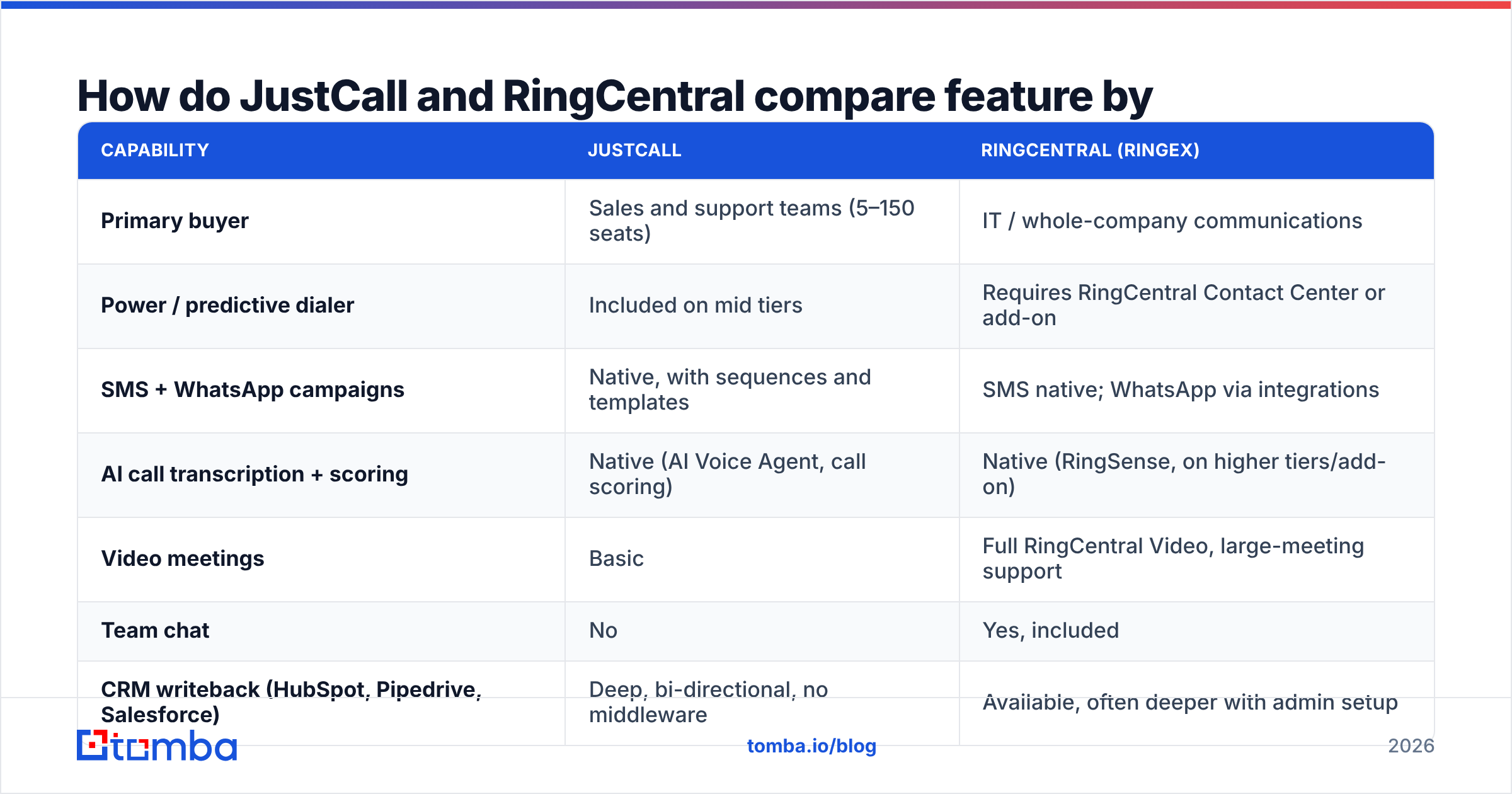
How do JustCall and RingCentral compare feature by feature?#
| Capability | JustCall | RingCentral (RingEX) |
|---|---|---|
| Primary buyer | Sales and support teams (5–150 seats) | IT / whole-company communications |
| Power / predictive dialer | Included on mid tiers | Requires RingCentral Contact Center or add-on |
| SMS + WhatsApp campaigns | Native, with sequences and templates | SMS native; WhatsApp via integrations |
| AI call transcription + scoring | Native (AI Voice Agent, call scoring) | Native (RingSense, on higher tiers/add-on) |
| Video meetings | Basic | Full RingCentral Video, large-meeting support |
| Team chat | No | Yes, included |
| CRM writeback (HubSpot, Pipedrive, Salesforce) | Deep, bi-directional, no middleware | Available, often deeper with admin setup |
| International numbers | 70+ countries | 100+ countries |
| Contact center / IVR routing | Light IVR, basic queues | Full omnichannel contact center (separate SKU) |
| Typical time-to-value | Days | Weeks, with IT involvement |
| Uptime / enterprise SLA | Solid, smaller footprint | 99.999% SLA, global carrier infrastructure |
The short version: JustCall wins on "how many conversations can one rep have today." RingCentral wins on "can this replace every phone in the building and survive an enterprise security review."
Which one is cheaper in practice?#
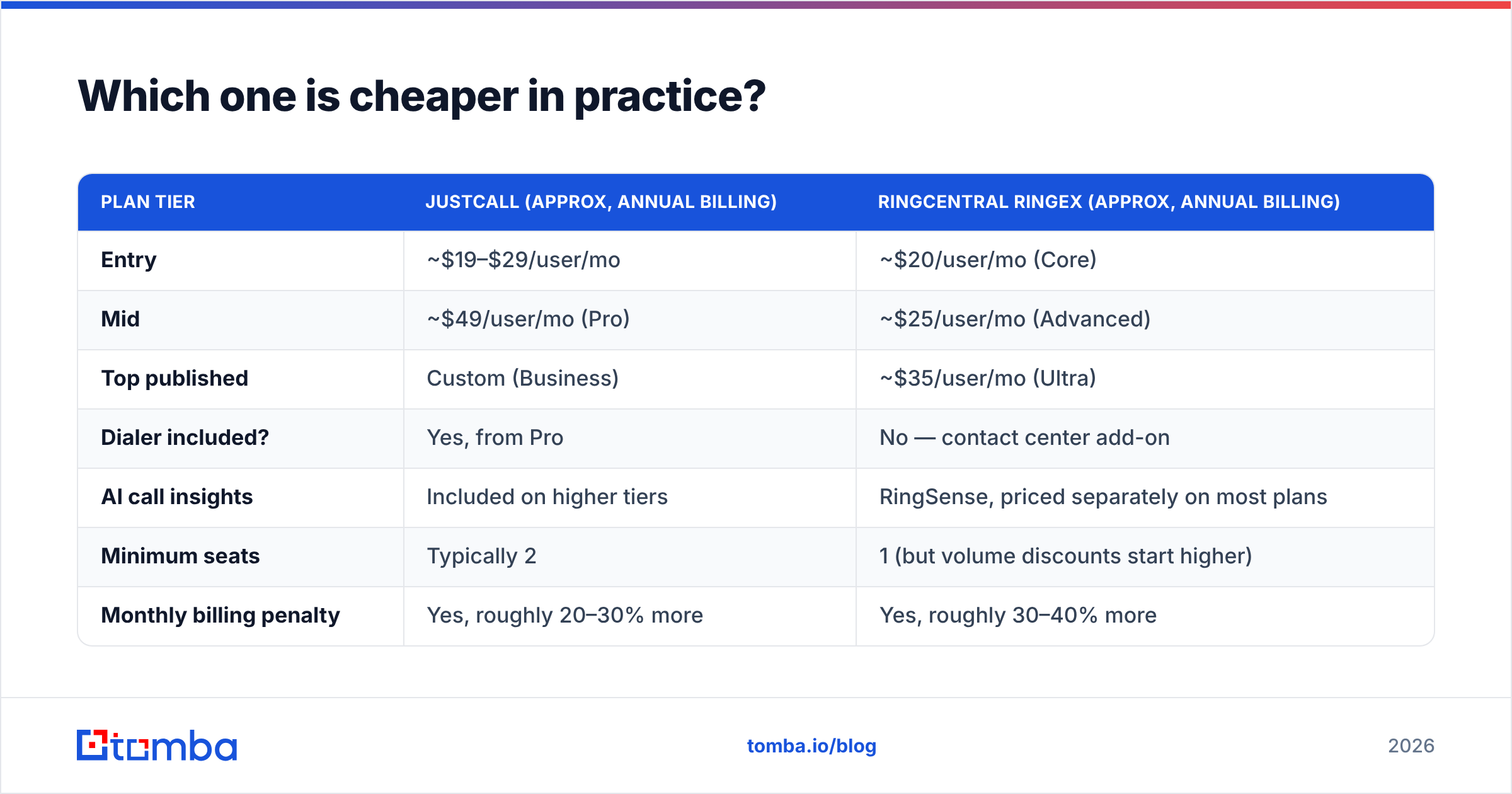
Sticker price favors RingCentral. Total cost for a sales team usually favors JustCall.
| Plan tier | JustCall (approx, annual billing) | RingCentral RingEX (approx, annual billing) |
|---|---|---|
| Entry | ~$19–$29/user/mo | ~$20/user/mo (Core) |
| Mid | ~$49/user/mo (Pro) | ~$25/user/mo (Advanced) |
| Top published | Custom (Business) | ~$35/user/mo (Ultra) |
| Dialer included? | Yes, from Pro | No — contact center add-on |
| AI call insights | Included on higher tiers | RingSense, priced separately on most plans |
| Minimum seats | Typically 2 | 1 (but volume discounts start higher) |
| Monthly billing penalty | Yes, roughly 20–30% more | Yes, roughly 30–40% more |
Pricing on both platforms moves, and both run promotional annual rates — check the vendor pages before you build a business case on these numbers.
The trap in the RingCentral column is the dialer line. If your reps need a power dialer, local presence, and campaign-level call analytics, you are not buying RingEX Core at $20 — you are buying RingEX plus RingCentral Contact Center, and per-seat cost typically lands north of JustCall's Pro plan. Conversely, if only six of your 200 employees are SDRs, buying JustCall for the whole company makes no sense; you would pay dialer prices for people who make four calls a week.
Model both quotes at your real seat count, split by persona:
- Outbound reps — need dialer, SMS, recording, CRM logging. JustCall Pro or RingCentral + Contact Center.
- Account executives — need reliable calling, video, and call notes. Either platform's mid tier works.
- Support agents — need queues, IVR, SLAs. RingCentral's routing is stronger here.
- Everyone else — needs a number and voicemail. RingCentral's cheapest tier, or a shared line.
- Managers — need coaching, scorecards, and dashboards. JustCall bundles more of this without an add-on.
Is JustCall better than RingCentral for outbound sales?#
For pure outbound, yes — with a caveat about scale.
JustCall's advantage is that the sales workflow is the product, not a module. A rep opens a call list, the dialer runs, dispositions fire automatically, the transcript lands on the contact record, and a follow-up SMS goes out from a sequence. Nobody has to configure a middleware step to make that happen. Managers get call scoring and talk-ratio analytics without buying a separate revenue-intelligence tool.
Reviews on G2 consistently reflect this split: JustCall scores well on ease of setup and CRM integration, RingCentral scores well on reliability and breadth. Both have the same recurring complaint categories you would expect from any VoIP product — occasional call quality issues on poor networks, and number-provisioning delays for certain countries.
Where JustCall gets strained is heavy contact-center work. Complex skills-based routing, 200-agent queues, workforce management, and omnichannel SLAs are not what it was designed for. If your "sales team" is really an inbound contact center with a sales function attached, RingCentral is the safer architecture.
Where does RingCentral clearly win?#
Four situations where the answer is not close:
- You are replacing a PBX. RingCentral handles desk phones, e911, porting at scale, fax, and directory sync. JustCall does not try to be your building's phone system.
- IT owns the decision. SSO, SCIM provisioning, granular admin roles, compliance certifications, and a 99.999% SLA all clear procurement faster.
- You need one vendor for voice, video, and chat. Consolidating three tools into one contract is a real budget argument, and RingCentral's messaging and video are genuinely competitive.
- You operate in many countries. Broader number coverage and carrier relationships matter when you are opening an office in a market JustCall does not provision numbers for.
There is also a quieter advantage: RingCentral's ecosystem is larger. If you use an unusual CRM, ticketing tool, or workforce-management suite, the odds of a maintained native connector are higher.
How do they handle CRM integration and reporting?#
This is where most evaluations actually get decided, because a phone system that does not write to your CRM creates silent data loss.
JustCall's integrations are opinionated. Connect HubSpot or Pipedrive and calls, recordings, transcripts, SMS threads, and dispositions sync to the right object without custom field mapping. Click-to-call works from inside the CRM. For Salesforce, JustCall supports both classic and Lightning with activity logging and reporting objects.
RingCentral integrates with the same platforms, but the depth varies by connector and plan. The RingCentral for Salesforce package is mature; some other connectors log the call but not the transcript, or require the RingSense add-on for AI summaries. Several teams end up routing RingCentral data through Zapier or a similar layer to get fields where they want them — workable, but it adds a failure point and a monthly cost.
Reporting follows the same pattern. JustCall gives sales managers rep-level call volume, connect rate, talk time, and sentiment in a dashboard aimed at coaching. RingCentral's analytics are broader and more IT-flavored — QoS, device health, department usage — with sales-specific insight living in the contact-center or RingSense products.
If your ops team already runs a clean pipeline, look at how each platform handles sales automation triggers: which events can fire a workflow, and whether disposition codes are exposed to your automation layer.
Does the dialer actually matter more than the list?#
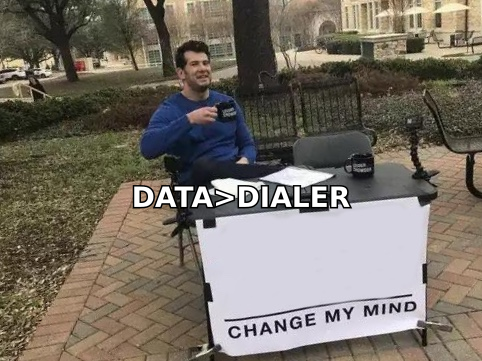
No. And this is the uncomfortable part of every dialer comparison.
A power dialer multiplies attempts. It does not improve the odds that the number you dial belongs to the person you want. If 30% of your list is wrong-number, disconnected, or a switchboard that never transfers, a faster dialer just gets you to the end of a bad list sooner — while burning caller reputation and getting your outbound numbers flagged as spam likely.
Run the math on your own data before you spend another dollar on seats:
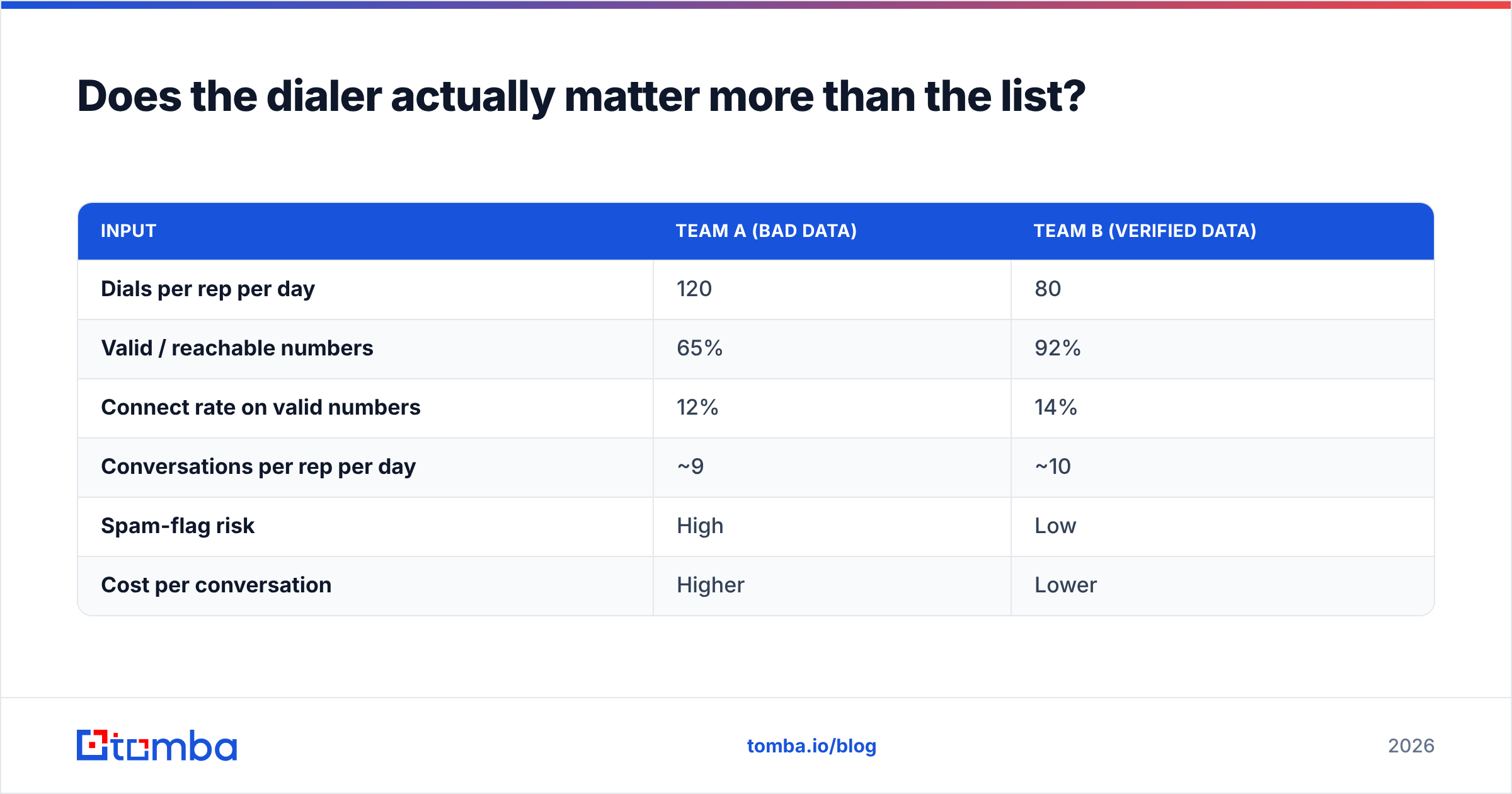
| Input | Team A (bad data) | Team B (verified data) |
|---|---|---|
| Dials per rep per day | 120 | 80 |
| Valid / reachable numbers | 65% | 92% |
| Connect rate on valid numbers | 12% | 14% |
| Conversations per rep per day | ~9 | ~10 |
| Spam-flag risk | High | Low |
| Cost per conversation | Higher | Lower |
Team B makes a third fewer dials and still has more conversations, with less carrier risk. The dialer was never the constraint.
That is why the sequencing matters: fix the list, then pick the dialer. Validate numbers with a phone validator before they enter a campaign, source direct dials with a phone finder rather than scraping switchboard numbers, and run data enrichment so reps see title, company size, and a working email before they press call.
Which one should you pick?#
Use these five tests, in order:
- Count your dialers. Fewer than 30 people making 50+ calls a day, and no PBX to replace? JustCall. More than 100 employees who all need a phone? RingCentral.
- Check who signs. If IT and security own the decision, RingCentral will clear review faster. If a VP of Sales owns the budget line, JustCall ships in days.
- Price the real bundle. Add the dialer and AI add-ons to RingCentral's quote. Add extra seats for non-sales staff to JustCall's. Compare the totals, not the entry tiers.
- Test your CRM path. Run a two-week pilot and check whether transcripts, dispositions, and SMS actually land on the right record without manual cleanup.
- Audit your list quality first. If your connect rate is below 8%, no platform on this page fixes that. Your data does.
For most B2B sales teams under 50 reps, JustCall is the better fit and the faster payback. For companies consolidating communications org-wide, or running a genuine contact center, RingCentral is the more defensible long-term platform. Both are legitimate products — the mistake is buying the enterprise platform for a 10-person SDR pod, or the sales dialer for a 400-person company.
What should you fix before you sign either contract?#
Your contact data. Every dial your reps place is only as good as the record behind it, and most CRMs carry 20–30% decay per year on phone and email fields.
Before you commit to a per-seat contract, run your target account list through Tomba's data enrichment to find the direct contacts your reps are missing, and pair every call with a verified email so the follow-up actually arrives. If you want to see how the underlying data is assembled and validated, Tomba publishes its data sources and pricing openly — Free covers 25 searches a month, Starter is $49/mo, Growth $99/mo, and Pro $249/mo.
Start with the Tomba Email Finder: feed it a domain and a name, get a verified professional email, and give your reps a second channel that does not depend on whichever dialer you end up buying. The dialer is the vehicle. The data is the road.
Related guides#
// get started
Find, verify and enrich your first contacts today
Start on the free plan with 25 searches a month, then scale when your team is ready.
Free plan · No credit card required · GDPR & CCPA
// about the author