Kaspr vs Thomson Data: Which B2B Data Source Wins in 2026?
One sells LinkedIn credits by the seat, the other sells a static file you own forever. Here's how Kaspr and Thomson Data compare on sourcing, accuracy, pricing and the workflows each one actually fits.
Kaspr vs Thomson Data is not a like-for-like fight. One sells LinkedIn credits by the seat. The other sells a static file you own forever. Here is how the two compare, and which one fits the way you actually work.
TL;DR
- Kaspr is a per-seat Chrome extension. It pulls phone numbers and emails off LinkedIn profiles in real time. You pay for seats and credits, and the data stops when you stop paying.
- Thomson Data is a traditional list vendor. You brief them on a target audience, they quote a file, and you buy it. You own the records outright, with accuracy guarantees and replacement clauses in the contract.
- They are not really competitors. Kaspr wins for reps who prospect one profile at a time. Thomson Data wins for marketers who need 20,000 records in a category Kaspr's LinkedIn-first coverage never reaches.
Two more things to weigh before you sign anything:
- Neither is a great fit if you want programmatic, pay-per-result lookups wired into your own stack. That is where an API-first email finder does the job for less.
- Whichever you pick, verify before you send. Bought files decay at roughly 2-2.5% per month, and LinkedIn-scraped emails are often personal, not corporate.
What are Kaspr and Thomson Data?#
Think of it like buying produce. Kaspr is the farmer's market stall: you walk up, point at one item, and pay for that one item. Thomson Data is the wholesale supplier. You place a bulk order, agree a price per crate, and a truck shows up.
Here's what that means in practice:
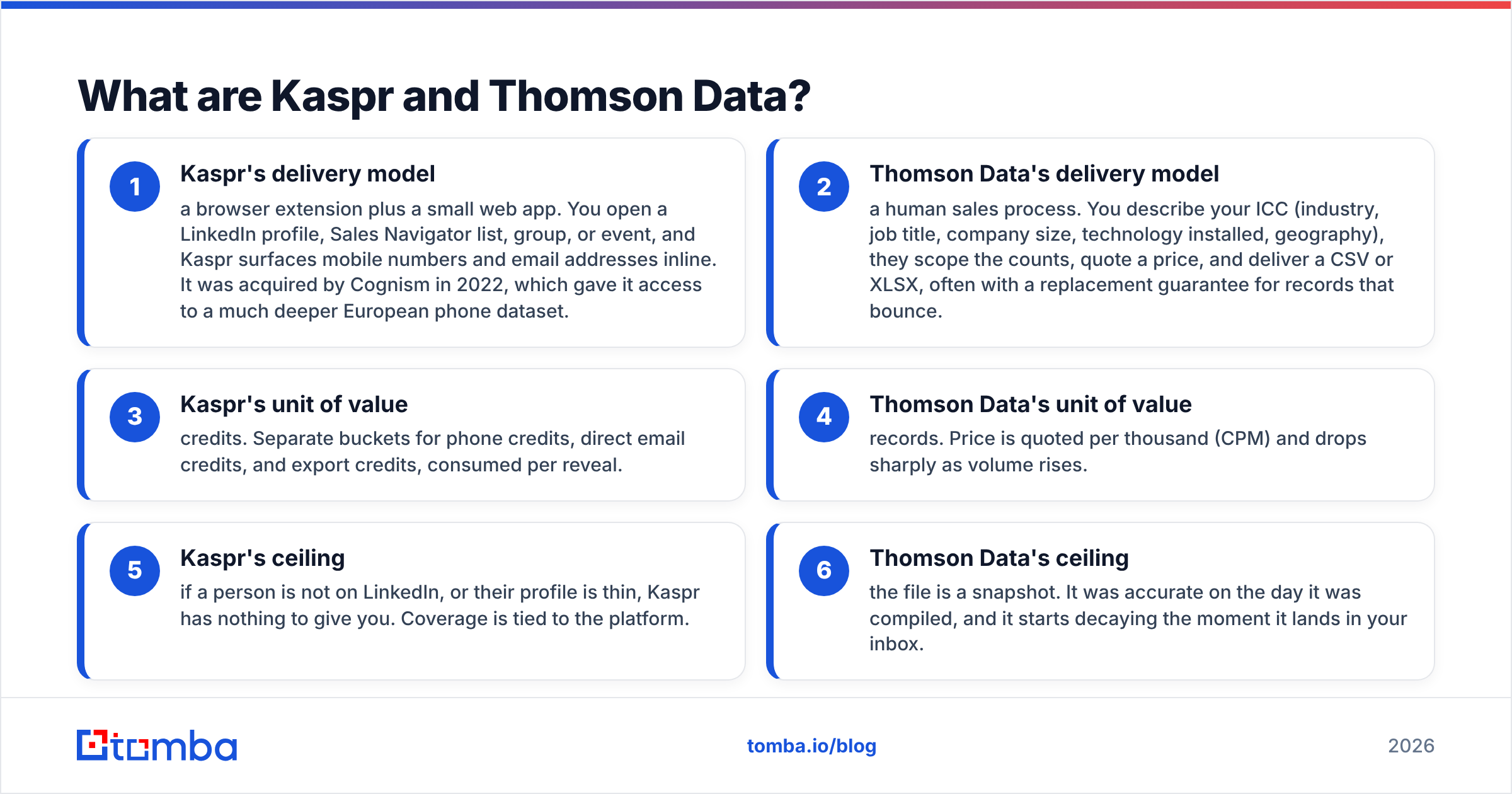
- Kaspr's delivery model — a browser extension plus a small web app. Open a LinkedIn profile, Sales Navigator list, group, or event, and Kaspr surfaces mobile numbers and email addresses inline. Cognism acquired it in 2022, which gave it a much deeper European phone dataset.
- Thomson Data's delivery model — a human sales process. You describe your ICP: industry, job title, company size, installed technology, geography. They scope the counts, quote a price, and deliver a CSV or XLSX. Most files come with a replacement guarantee for records that bounce.
How each one charges follows from that:
- Kaspr's unit of value — credits. Separate buckets for phone credits, direct email credits, and export credits, spent per reveal.
- Thomson Data's unit of value — records. Price is quoted per thousand (CPM) and drops sharply as volume rises.
And each model has a hard ceiling:
- Kaspr's ceiling — if a person is not on LinkedIn, or their profile is thin, Kaspr has nothing to give you. Coverage is tied to the platform.
- Thomson Data's ceiling — the file is a snapshot. It was accurate on the day it was compiled. It starts decaying the moment it lands in your inbox.
That last pair is the whole Kaspr vs Thomson Data comparison in miniature: real-time but narrow versus broad but static.

How does Kaspr compare to Thomson Data feature by feature?#
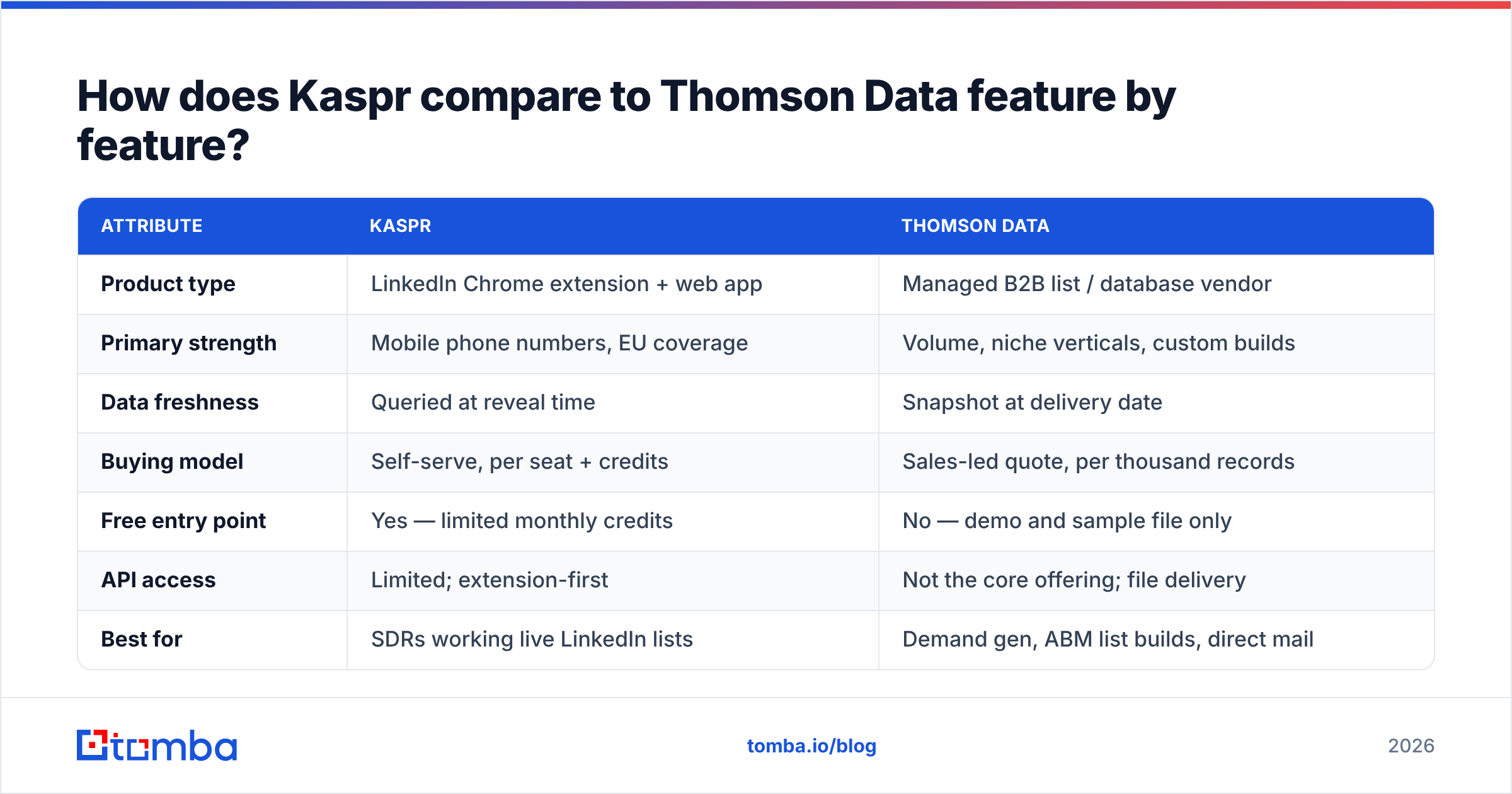
| Attribute | Kaspr | Thomson Data |
|---|---|---|
| Product type | LinkedIn Chrome extension + web app | Managed B2B list / database vendor |
| Primary strength | Mobile phone numbers, EU coverage | Volume, niche verticals, custom builds |
| Data freshness | Queried at reveal time | Snapshot at delivery date |
| Buying model | Self-serve, per seat + credits | Sales-led quote, per thousand records |
| Free entry point | Yes — limited monthly credits | No — demo and sample file only |
| API access | Limited; extension-first | Not the core offering; file delivery |
| Best for | SDRs working live LinkedIn lists | Demand gen, ABM list builds, direct mail |
| Contract | Monthly or annual subscription | One-off purchase or licence term |
| Ownership after cancel | You keep exported records only | You own the file permanently |
| Typical buyer | Sales rep / SDR manager | Marketing ops / demand gen lead |

The table hides one important nuance: Kaspr's email coverage is the weaker half of its product. Its reputation was built on direct dials. Reviews on G2 consistently praise the phone data more than the email data. A good share of the emails it returns are personal addresses (gmail.com, outlook.com) that the user attached to their profile. That is fine for a WhatsApp follow-up. It is a liability for a cold B2B sequence that needs to land in a work inbox.
Thomson Data's files skew the other way. They are almost entirely corporate addresses, because that is what a compiled business list is made of. The trade is that you have no idea how recently an address was validated unless you ask. Ask in writing, before you sign.
How accurate is each one in practice?#
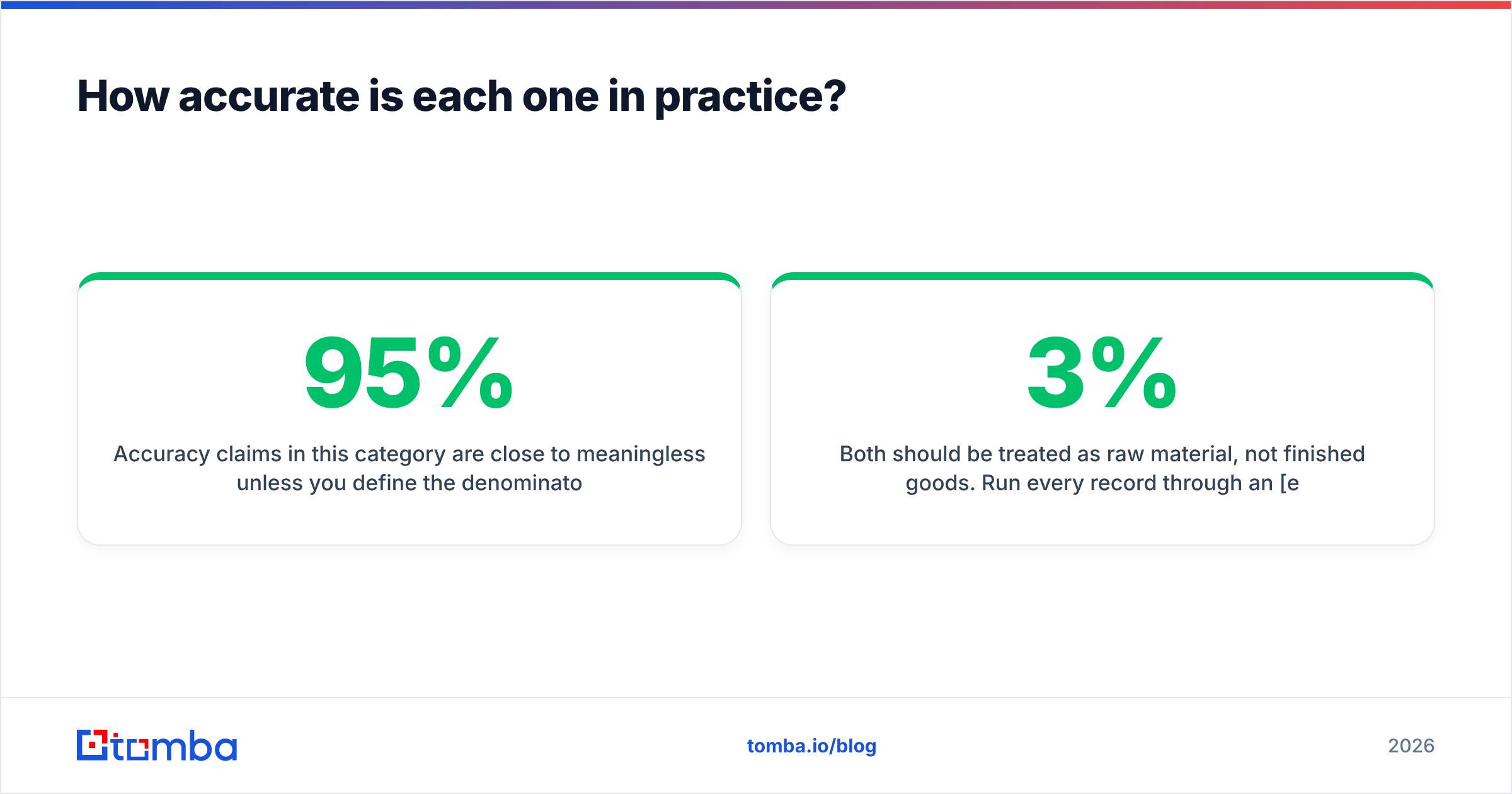
Accuracy claims in this category mean little unless you define the denominator. "95% accurate" can mean 95% of delivered records are syntactically valid, which is a low bar. It can also mean 95% pass an SMTP check on delivery day, which is a real one.

Here's how to read each vendor's number honestly:
- Kaspr returns what it has at query time, and its hit rate varies by geography. European mobile coverage is genuinely strong. US email hit rates on mid-market profiles are more ordinary, and Kaspr does not promise a blanket accuracy figure the way a list vendor does.
- Thomson Data publishes high accuracy figures and backs them with a replacement guarantee. Read the clause carefully. Replacement is not a refund, and the threshold often sits above the bounce rate that would already have damaged your sender reputation.
Treat both as raw material, not finished goods. Run every record through an email verifier before it touches a sending domain. A 3% bounce rate is the line where mailbox providers start treating you differently, and a bought file can blow past that in one send.
The practical rule: budget a verification pass into every data purchase. It costs a fraction of a cent per record. It is also the difference between a campaign and an incident. Large compiled lists always include catch-all domains, so a catch-all verifier is the only way to tell the deliverable ones from the black holes.
What do Kaspr and Thomson Data cost in 2026?#
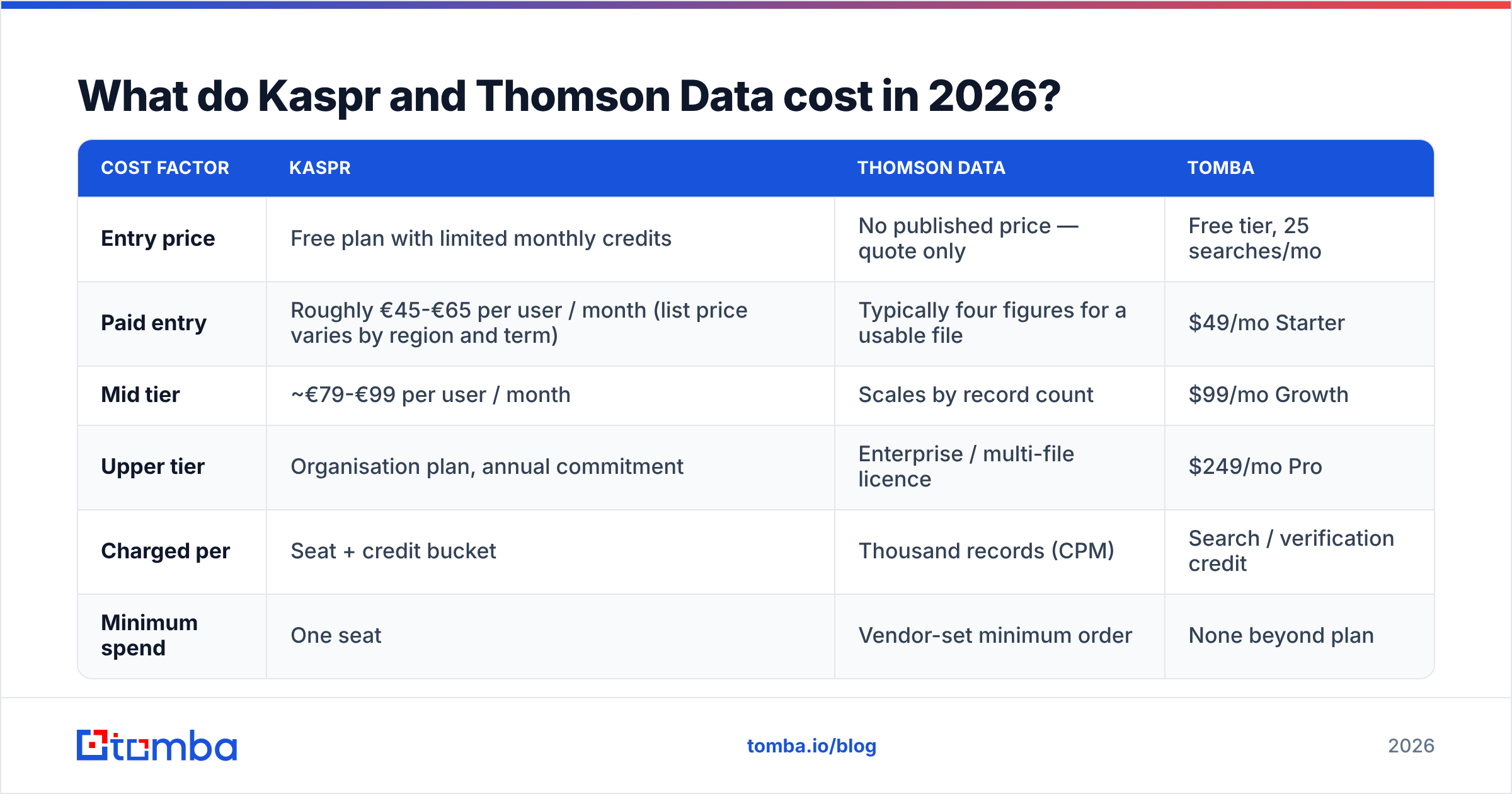
Kaspr vs Thomson Data pricing does not compare cleanly, because the two vendors do not price on the same axis at all.
| Cost factor | Kaspr | Thomson Data | Tomba |
|---|---|---|---|
| Entry price | Free plan with limited monthly credits | No published price — quote only | Free tier, 25 searches/mo |
| Paid entry | Roughly €45-€65 per user / month (list price varies by region and term) | Typically four figures for a usable file | $49/mo Starter |
| Mid tier | ~€79-€99 per user / month | Scales by record count | $99/mo Growth |
| Upper tier | Organisation plan, annual commitment | Enterprise / multi-file licence | $249/mo Pro |
| Charged per | Seat + credit bucket | Thousand records (CPM) | Search / verification credit |
| Minimum spend | One seat | Vendor-set minimum order | None beyond plan |
Two things to flag. First, Kaspr's list prices move. Check kaspr.io directly rather than trusting any blog post, including this one, on the exact figure. Second, Thomson Data's "cheap at volume" story only holds if you genuinely need the volume. A 25,000-record file at a good CPM is expensive if 19,000 of those records were never in your ICP.
For comparison, Tomba pricing starts at $49/mo for Starter and $99/mo for Growth, with no per-seat multiplier. That matters once you have four reps who each need the odd lookup, rather than one rep who needs thousands.

Kaspr vs Thomson Data: which one should you buy?#
Match the tool to the motion, not to the feature list.
- You run outbound off LinkedIn, one account at a time. Kaspr. The extension lives where your reps already work, phone numbers are its strongest asset, and the free tier lets you test hit rates on your own ICP before you commit a seat.
- You need 10,000+ records in a vertical LinkedIn under-indexes — regional manufacturers, healthcare practitioners, franchise operators. Thomson Data. Compiled databases reach segments that profile scraping structurally cannot.
- You are doing direct mail or multichannel ABM and need postal addresses, firmographics, and technographics in one file. Thomson Data, clearly. Kaspr is not built for that.
Three cases where neither vendor is the right answer:
- You need contact data inside a product, workflow, or CRM sync. You want an API-first provider that returns a result per call, with a bulk email finder for batch jobs and a documented email finder API for everything else.
- You already have a list of companies and need the people. Start with domain search before buying anything. You may already be sitting on 70% of the contacts you need.
- You have LinkedIn URLs but no emails. A dedicated LinkedIn finder turns profile URLs into work addresses without a per-seat extension licence.
What are the alternatives to Kaspr and Thomson Data?#
The category is crowded. Most teams that shortlist Kaspr vs Thomson Data end up running two tools anyway: one for real-time lookups, one for bulk.
- BookYourData — a strong option in the pay-as-you-go list space, with a self-serve builder and a bounce guarantee. If Thomson Data's sales-led process is friction you don't want, this gets you a similar outcome without a quote cycle.
- Cognism — Kaspr's parent. Same phone data lineage, enterprise pricing, a full platform rather than an extension. Worth a look if you expect to outgrow Kaspr within a year.
- Tomba — API-first email finding and verification, with a Chrome extension, Google Sheets add-on, and data enrichment for filling gaps in records you already own. You pay per result, not per seat or per file.
The setup that works for most mid-market teams is a compiled file for the top of the funnel, checked against a real-time verification layer before every send. Buying data once and treating it as permanent is the most common way teams torch a sending domain.
Frequently asked questions#
Is Kaspr GDPR compliant? Kaspr states that it operates under GDPR and CCPA frameworks and lets individuals request removal. If you sell into the EU, confirm the lawful basis and the notification process with their team in writing. That documentation is what your DPO will ask for, not a badge on a homepage.
Does Thomson Data guarantee its email lists? Thomson Data typically offers an accuracy commitment with record replacement for bounces above a stated threshold. Get the specific percentage, the measurement window, and the replacement process in the contract. A "guarantee" without those three details is marketing copy.
Can I use Kaspr without LinkedIn? Not meaningfully. The extension is the product, and LinkedIn is where it operates. Without a profile to sit on, there is little to reveal.
Which is cheaper, Kaspr or Thomson Data? Per record, a large Thomson Data file is almost always cheaper. Per usable record for a targeted outbound campaign, Kaspr often wins, because you only pull contacts you have already qualified by eye. Model both against your real reply rate, not against list price.
Do I still need an email verifier if I buy from either? Yes. Bought files decay continuously, and LinkedIn-sourced addresses are often personal rather than corporate. A verification pass before every send is non-negotiable.
Start with the contacts you can find for free#
Before you settle the Kaspr vs Thomson Data question, find out how much of your target list you can build yourself. Run your top 50 target domains through the Tomba Email Finder. It returns verified work addresses by domain, name, or company, with confidence scores and sources attached, so you can see why a result came back. The free tier gives you 25 searches a month, Starter is $49/mo, and every plan includes verification. The data you export is already clean when it reaches your sequencer.
Test it against 50 accounts you know well. If the hit rate holds, you have just avoided a purchase order.
Related guides#
// get started
Find, verify and enrich your first contacts today
Start on the free plan with 25 searches a month, then scale when your team is ready.
Free plan · No credit card required · GDPR & CCPA
// about the author