Kickbox vs RampedUp: Which B2B Email Tool Wins in 2026?
Kickbox verifies the emails you already have. RampedUp sources contacts you don't. Here's an honest breakdown of accuracy, pricing, and which one your pipeline actually needs in 2026.
TL;DR
- Kickbox and RampedUp are not really competitors. Kickbox is an email verification and deliverability service. RampedUp is a B2B contact data and sales intelligence platform. They sit at opposite ends of the same workflow.
- Pick Kickbox if you already own a list (CRM exports, form signups, newsletter subscribers) and need to scrub it before sending. Its real-time API and deliverability tooling are the strongest part of the product.
- Pick RampedUp if your problem is that you don't have contacts yet, and you want firmographics, tech stack, and org-chart context alongside the email address.
- Cost structures differ fundamentally: Kickbox charges per verification, RampedUp charges per seat plus credits. Comparing sticker prices without normalising for that will mislead you.
- If you need sourcing and verification in one place, a combined platform (Tomba, Findymail, Apollo) usually beats stitching two single-purpose vendors together — fewer credit pools, one API, one bill.
What are Kickbox and RampedUp, actually?#
Think of your outbound pipeline like a water system. RampedUp is the well: it goes and finds new water. Kickbox is the filter: it makes sure what comes out of the tap is safe to drink. Comparing them head-to-head is a category error unless you know which part of the system is broken.
Kickbox launched as an email verification API and has spent the last decade building around that core: real-time verification at signup, bulk list cleaning, disposable-address detection, and a deliverability suite (inbox placement testing, sending reputation monitoring, DMARC tooling). It does not find you new email addresses. It tells you whether the ones you have will bounce.
RampedUp sits in the sales intelligence category alongside ZoomInfo, Lusha, and Seamless.AI. It sells access to a B2B contact database with company and person records, and layers on enrichment, list building, and CRM data hygiene. It surfaces emails and phone numbers, plus the context sales teams want: headcount, funding, technologies in use, job-change alerts.
So the honest framing of Kickbox vs RampedUp is not "which tool is better" but "which half of the problem do I have right now?"
What does each tool actually do? A capability breakdown#
Here is the functional split, stated plainly:
- Email verification — Kickbox's core. Syntax checks, MX record lookups, SMTP handshake, role-account flags, disposable-domain detection, and a
deliverable / undeliverable / risky / unknownverdict per address. RampedUp validates records inside its own database but is not positioned as a standalone verification API. - Contact sourcing — RampedUp's core. You start from a company, a title filter, or a territory and get contacts out. Kickbox has no sourcing capability at all.
- Data enrichment — RampedUp appends firmographics, technographics, and role data to records you already have. Kickbox appends deliverability signals only.
- Deliverability infrastructure — Kickbox's differentiator. Inbox placement testing, blocklist monitoring, sender reputation tracking. RampedUp does not play here.
- CRM hygiene — Both touch this, differently. RampedUp refreshes stale CRM records with new job titles and companies. Kickbox flags addresses that have gone dead.
- Developer surface — Kickbox's API is mature, well-documented, and designed for real-time calls in signup forms. RampedUp leans toward CRM-native workflows (Salesforce, HubSpot) more than raw API usage.
Once you lay it out this way, the overlap is roughly one cell of a six-cell grid. That matters for budgeting: buying both is often correct, and buying either one alone often leaves a gap.
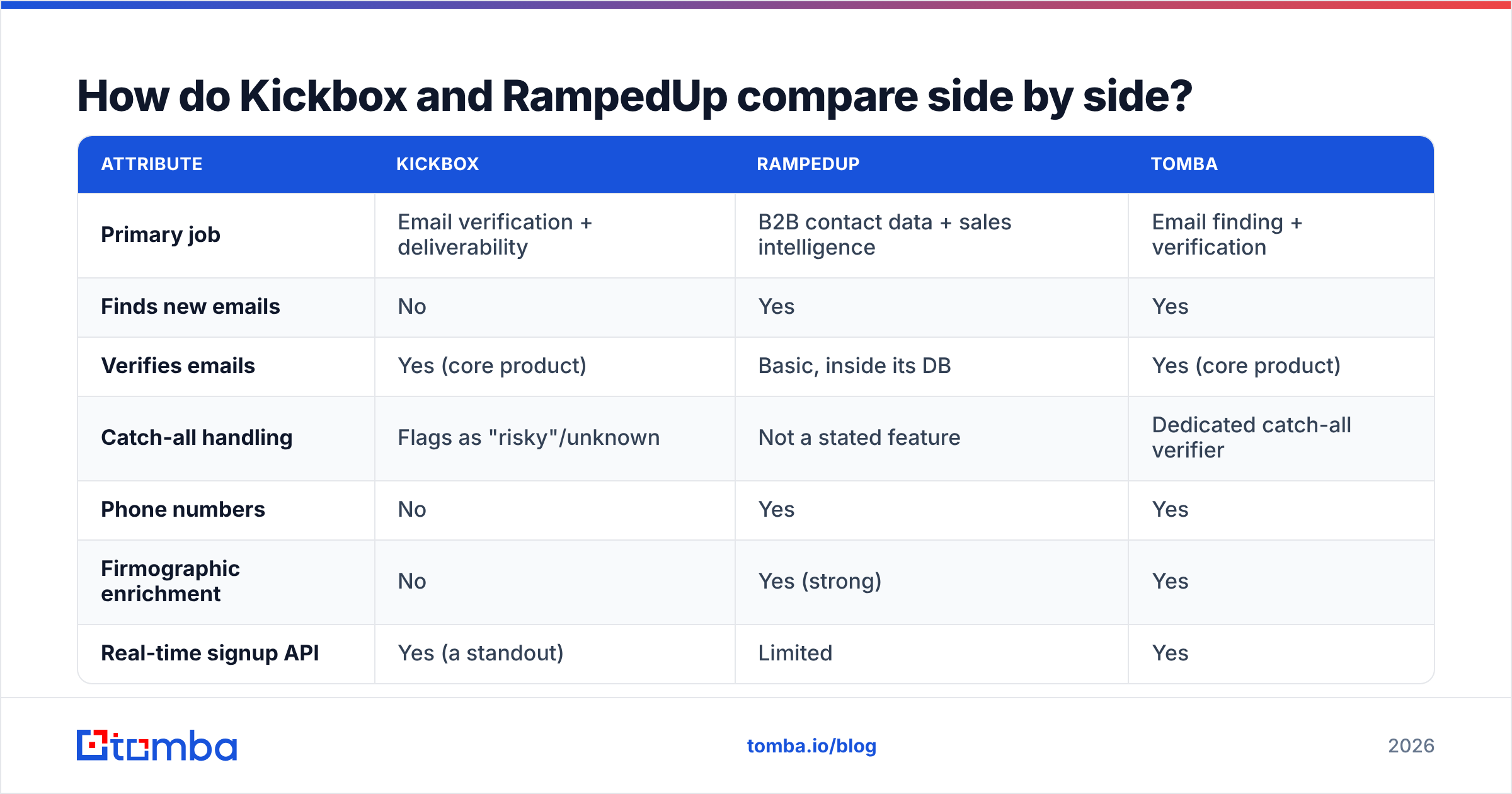
How do Kickbox and RampedUp compare side by side?#
| Attribute | Kickbox | RampedUp | Tomba |
|---|---|---|---|
| Primary job | Email verification + deliverability | B2B contact data + sales intelligence | Email finding + verification |
| Finds new emails | No | Yes | Yes |
| Verifies emails | Yes (core product) | Basic, inside its DB | Yes (core product) |
| Catch-all handling | Flags as "risky"/unknown | Not a stated feature | Dedicated catch-all verifier |
| Phone numbers | No | Yes | Yes |
| Firmographic enrichment | No | Yes (strong) | Yes |
| Real-time signup API | Yes (a standout) | Limited | Yes |
| Pricing model | Pay-per-verification | Per seat + credits | Flat monthly tiers |
| Entry price | Free trial credits, then usage-based | Quote-based, per user | Free tier (25 searches/mo), Starter $49/mo |
| Best for | Marketers protecting sender reputation | SDR teams building territory lists | Teams needing sourcing + verification in one |
| Chrome extension | No | Yes | Yes |
| Free tier | Trial credits only | Demo/trial | Yes, 25 searches/mo |
Two things to notice. First, the "finds new emails" row is the whole argument: if that is a No for your use case, Kickbox cannot be your only vendor. Second, the pricing models are not comparable on a single axis, which is the subject of the next section.
Which one is more accurate?#
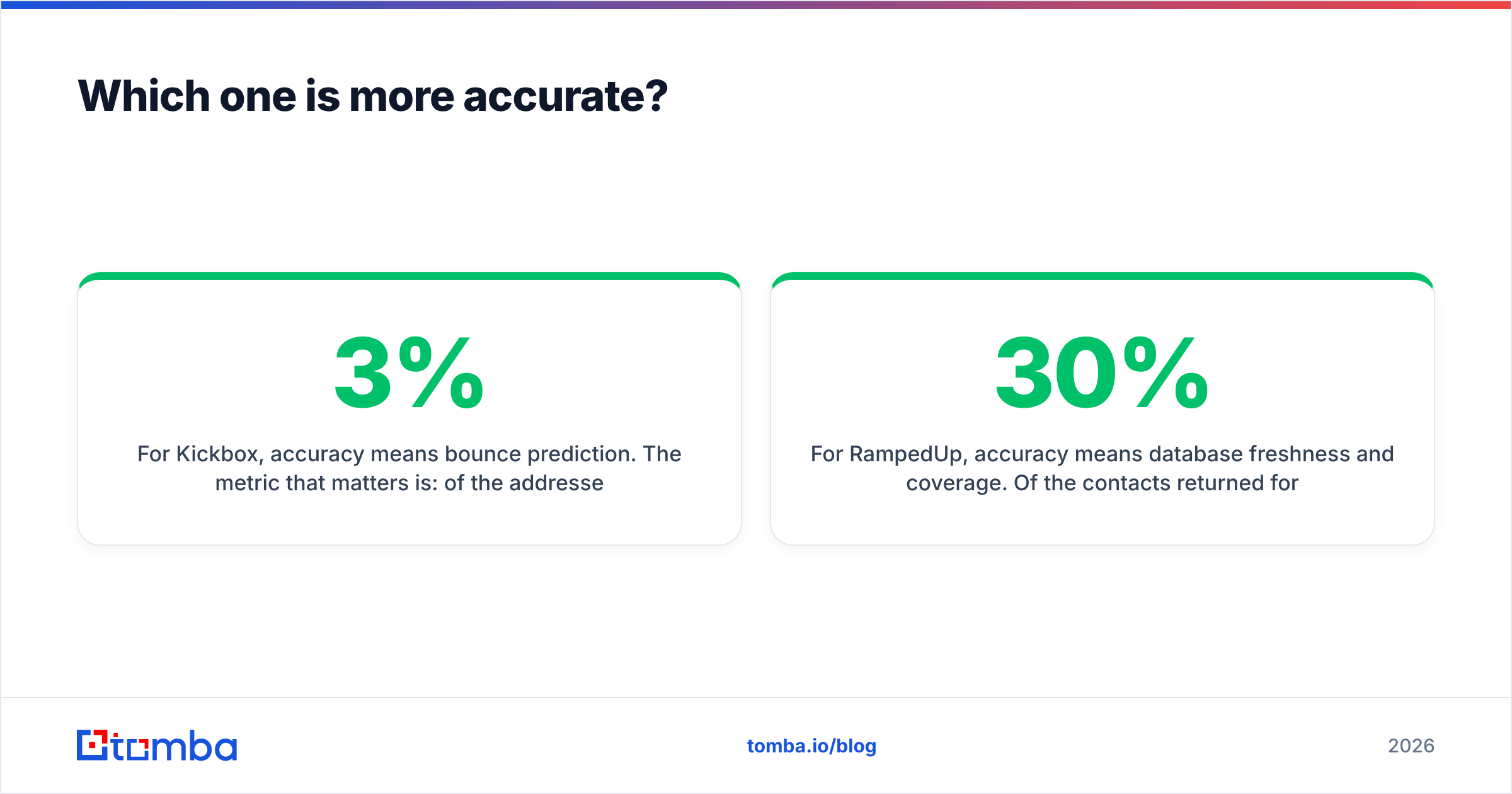
Wrong question, asked twice — because "accuracy" means something different for each tool.
For Kickbox, accuracy means bounce prediction. The metric that matters is: of the addresses it marked deliverable, what percentage actually bounced? Good verification providers land under 2–3% on clean B2B lists. The harder number to interrogate is the unknown rate — the share of addresses the provider refuses to rule on. A verifier that returns 25% unknown has technically made no errors and also given you very little. When you evaluate any verifier, ask for the unknown rate on catch-all-heavy B2B domains specifically, not the blended figure across consumer lists.
For RampedUp, accuracy means database freshness and coverage. Of the contacts returned for a given ICP query, how many still work there? How many emails are current? B2B contact data decays at roughly 25–30% per year as people change jobs, so a record sourced 14 months ago is a coin flip. Coverage also varies wildly by geography: most US-headquartered providers are noticeably thinner in EMEA and APAC.
The practical consequence: neither vendor's accuracy claim transfers to the other's job. A RampedUp export is not verified to Kickbox's standard, and a Kickbox-clean list tells you nothing about whether those people are still employed at the company on the record.
This is also where catch-all domains break most workflows. A catch-all server accepts mail to any address at the domain, so SMTP-level verification returns "accepted" for nonsense@company.com just as readily as for the real contact. Kickbox marks these as risky. Sourcing tools often return them without comment. If a meaningful share of your target accounts run catch-all (common in enterprise and in Microsoft 365 estates), you need a purpose-built catch-all verifier in the stack regardless of which of these two you buy.
What do Kickbox and RampedUp cost?#
Kickbox prices per verification, on a sliding scale that gets cheaper with volume — roughly a cent per address at small volumes, falling substantially into the hundreds of thousands. There are trial credits to test with. The model is clean and predictable: you can forecast the cost of cleaning a 40,000-row list before you run it.
RampedUp is quote-based and seat-oriented, in line with most sales intelligence vendors. Expect a per-user annual commitment with a credit allocation attached, and expect pricing to move depending on seat count, data modules, and contract length. Check current figures on G2 and directly with their team — quote-based pricing changes more often than published pricing does.
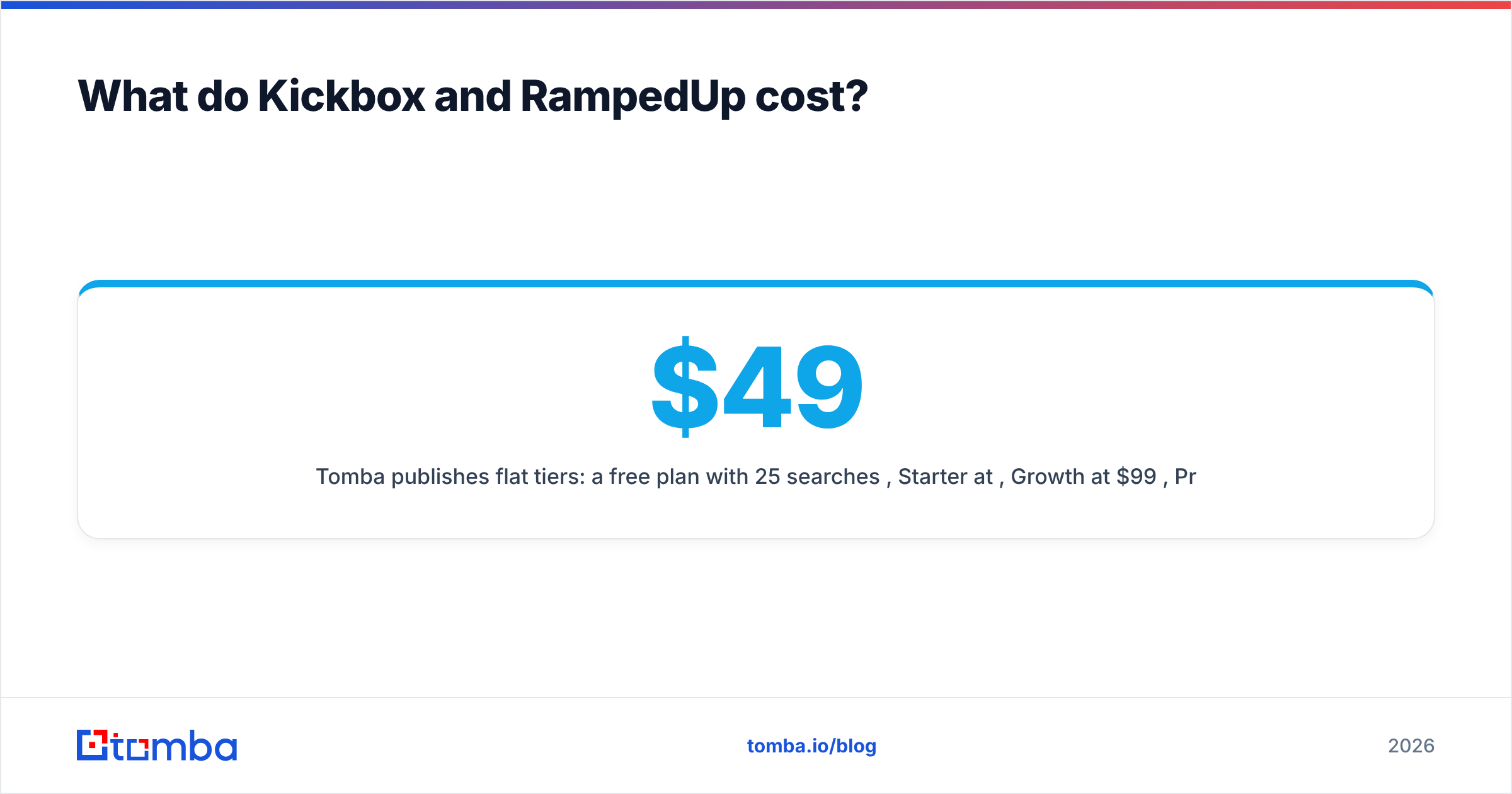
Tomba publishes flat tiers: a free plan with 25 searches per month, Starter at $49/mo, Growth at $99/mo, Pro at $249/mo, and custom enterprise pricing. Full details are on the Tomba pricing page.
The normalisation trap: a per-verification price looks trivially cheap next to a per-seat price, but they buy different things. If you need 5,000 new contacts a month, Kickbox's price is irrelevant because it cannot produce them. Model the total cost of the workflow you actually need — sourcing plus verification plus enrichment — not the cheapest line item in isolation.

When should you choose Kickbox?#
Choose Kickbox when the addresses already exist and the risk is reputational.
- You run a signup form or free trial. Real-time verification at the point of entry is the single highest-ROI use of a verification API. It stops typos and disposable addresses from ever entering your database, which is far cheaper than cleaning them later.
- You have an inherited list of unknown provenance. A 90,000-row export from a 2023 marketing campaign should never be mailed unscrubbed. One send to that list can cost you months of sender reputation repair.
- Deliverability is your actual bottleneck. If your open rates cratered and you suspect placement rather than copy, Kickbox's inbox testing and blocklist monitoring address that directly. Most sourcing tools do not.
- You are already sourcing elsewhere. If contacts come from your product, partners, events, or another data vendor, you only need the filter.
You should not choose Kickbox if your list is empty. It is a very good tool pointed at a problem you do not have yet.
When should you choose RampedUp?#
Choose RampedUp when the problem is that your SDRs have nobody to call.
- You are building territory lists from scratch. Filtering by industry, headcount, geography, and title to produce a named-account list is exactly what sales intelligence platforms are for.
- You need context, not just an address. Funding events, tech stack, headcount growth, and job changes are trigger events. An email address alone gives you no reason to reach out today rather than next quarter.
- Your CRM is decaying. Records go stale continuously. Enrichment platforms refresh titles and companies at scale, which matters more than most teams admit — a "clean" CRM full of people who left two years ago is not clean.
- You want phone numbers too. Multichannel sequences need both. Verification tools won't give you a mobile number.
The caveat, and it applies to every provider in this category including the well-known ones: run a coverage test on your ICP before signing an annual deal. Ask for 200 sample records against your actual target segment, then verify them independently. Vendor-reported accuracy is measured on the vendor's strongest segment.
Is there a tool that does both?#
Yes, and for most mid-market teams it is the better structural answer than buying two point solutions.
The cost of running Kickbox plus a sourcing platform is not just the two invoices. It is two credit pools that expire on different schedules, two APIs to integrate, two vendor relationships to manage, and a handoff step where records leave one system as CSVs and enter another. That handoff is where data quality quietly dies.
Combined platforms collapse that. Tomba's email finder sources addresses by name and domain, and every result passes through the same email verifier before it reaches you — one credit pool, one API key, one export. Domain search does the list-building job (every public address at a company, with roles and confidence scores), and data enrichment appends the firmographic context that sourcing platforms are bought for.
The trade-off is real and worth stating: a combined platform will not out-specialise Kickbox on pure deliverability infrastructure — inbox placement testing and DMARC monitoring are a genuinely separate discipline. And a focused sales intelligence vendor like RampedUp or BookYourData, which sells verified B2B contact lists with its own accuracy guarantee, will go deeper on intent signals and org-chart mapping than a finder-first tool does. If those specific capabilities are load-bearing for your motion, buy the specialist.
For everyone else — the team that needs a few thousand verified, current, reachable B2B contacts per month without running a data ops function — one platform is less machinery for the same outcome.
What's the verdict on Kickbox vs RampedUp?#
- Have a list, need it clean: Kickbox. Nothing here beats it for real-time signup verification and deliverability diagnostics.
- Have no list, need contacts with context: RampedUp, after a coverage test on your specific ICP.
- Need both halves and don't want two vendors: a combined finder-plus-verifier platform.
- Enterprise deliverability program with a dedicated owner: Kickbox alongside whatever sourcing vendor your ICP coverage test favours. Specialisation pays at that scale.
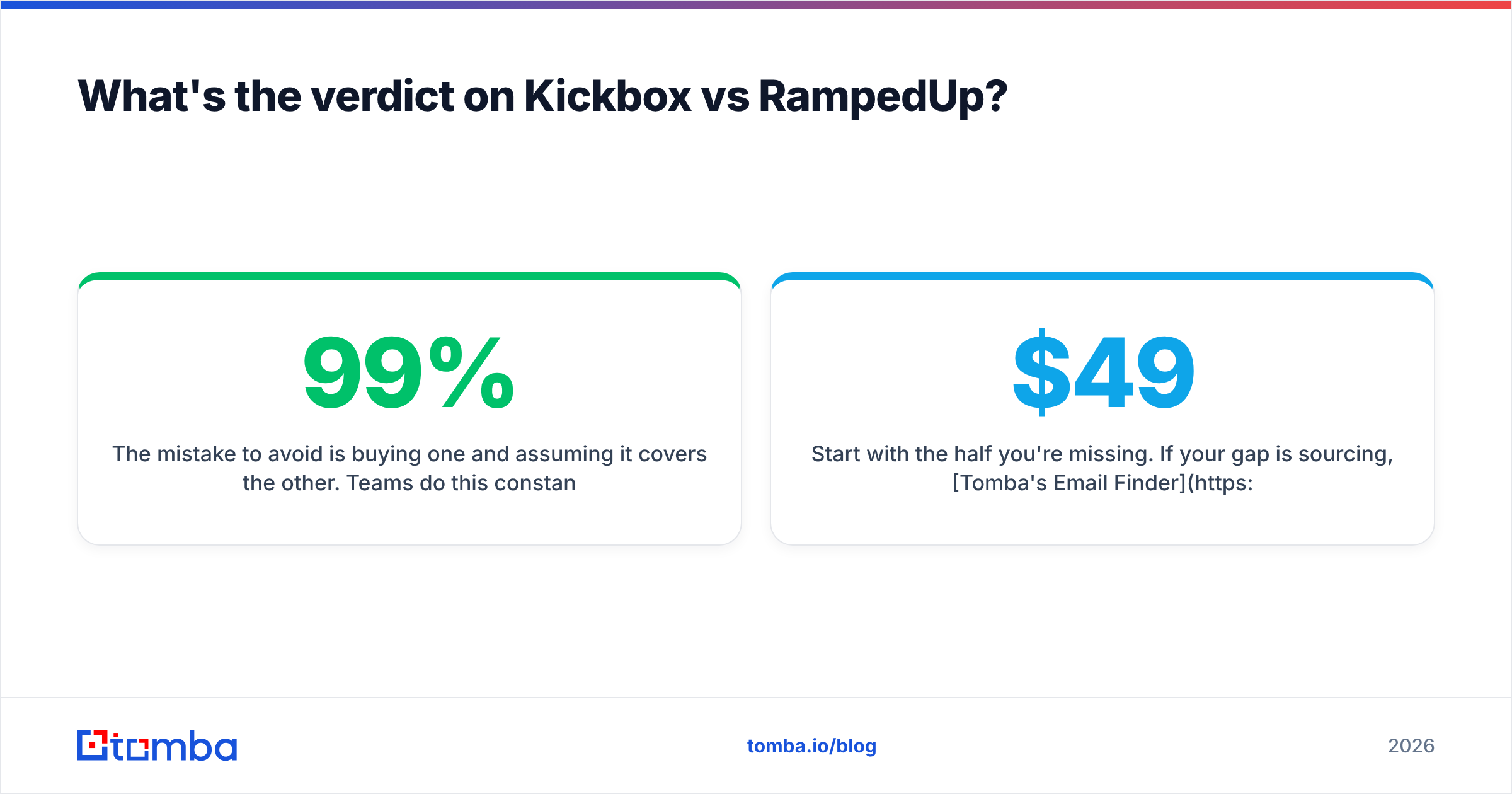
The mistake to avoid is buying one and assuming it covers the other. Teams do this constantly — they buy a verifier, scrub a stale list to a pristine 99% deliverable state, send to it, and get 3% reply rates because the addresses are valid but the people are gone. Valid is not the same as reachable, and reachable is not the same as relevant.
Start with the half you're missing. If your gap is sourcing, Tomba's Email Finder returns verified professional email addresses by name, domain, or company — with verification built into the same credit, not sold as a second subscription. The free tier gives you 25 searches a month to test coverage on your own ICP before you commit to anything, and Starter runs $49/mo when you're ready to scale. Test it against a list you already know the answers to; that's the only benchmark that counts.
Related guides#
Ready to find emails that actually work?
Join 150,000+ professionals who stopped guessing and started sending. Free credits on signup — no credit card required.
Get the Tomba newsletter
Practical outbound tactics and product updates — once every two weeks.
About the author