Kickbox vs Seamless.AI: Which Email Tool Do You Need?
Kickbox verifies emails. Seamless.AI builds lists with AI. They solve different halves of the same problem, so here is how they compare on accuracy, pricing, and fit — and when you actually need neither.
TL;DR
- Kickbox and Seamless.AI are not competitors. Kickbox is a verification engine that tells you whether an address you already have is safe to mail. Seamless.AI is a contact database that finds addresses you do not have yet.
- If your list already exists (CRM export, webinar signups, a scraped CSV), Kickbox is the correct tool and Seamless.AI is overkill.
- If you have zero contacts and need to build a target list, Kickbox does nothing for you — you need a finder or a database.
- Seamless.AI hides pricing behind a sales call and sells annual contracts; Kickbox is transparent pay-as-you-go. That difference matters more than any feature table.
- Teams that need both halves in one bill usually end up with a combined finder + verifier stack. Tomba covers both from $49/mo, with a free tier to test first.
What are Kickbox and Seamless.AI, actually?#
They sit at opposite ends of the same pipeline.
Kickbox is an email verification service. You feed it an address — one at a time via API, or a million at a time via list upload — and it returns a verdict: deliverable, undeliverable, risky, or unknown. It also returns a Sendex quality score, role-account flags, free-provider flags, and a suggested correction for obvious typos like gmial.com. Kickbox does not find anything. It has no contact database. Its entire job is to stop you from mailing addresses that will bounce.
Seamless.AI is a B2B contact search engine. You search by company, title, industry, or location, and it returns names with work emails and direct-dial phone numbers, assembled in real time from public web sources rather than served from a static file. It bolts on a Chrome extension, buyer-intent signals, job-change alerts, and an AI writer. Seamless.AI claims it validates addresses as it finds them, but validation is a side effect of its product, not the product.
So "Kickbox vs Seamless.AI" is really the question: do I have a data problem or a hygiene problem? Answer that first and the comparison mostly resolves itself.
What does Kickbox do well?#
Four things, and it does them without ceremony.
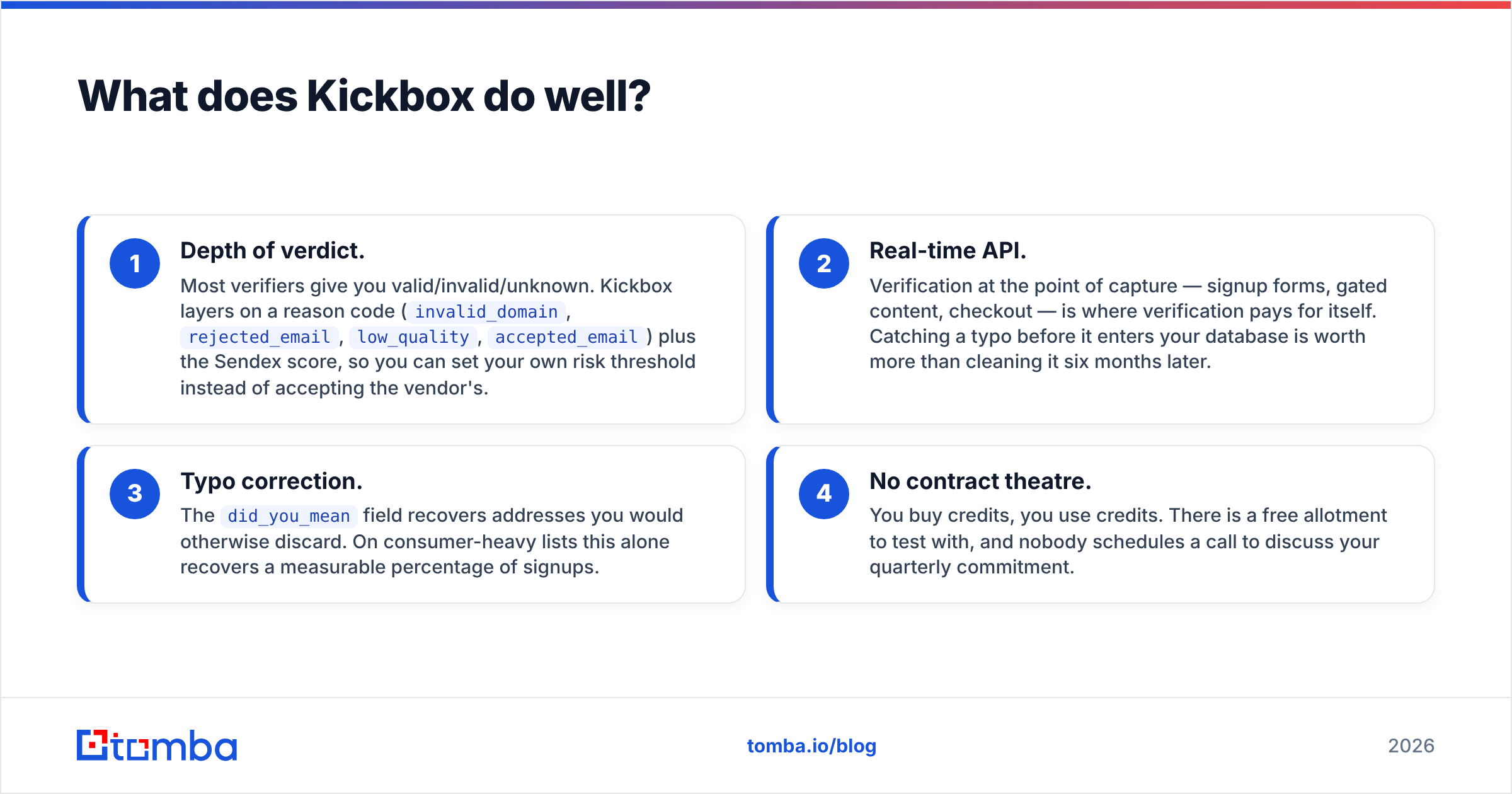
- Depth of verdict. Most verifiers give you valid/invalid/unknown. Kickbox layers on a reason code (
invalid_domain,rejected_email,low_quality,accepted_email) plus the Sendex score, so you can set your own risk threshold instead of accepting the vendor's. - Real-time API. Verification at the point of capture — signup forms, gated content, checkout — is where verification pays for itself. Catching a typo before it enters your database is worth more than cleaning it six months later.
- Typo correction. The
did_you_meanfield recovers addresses you would otherwise discard. On consumer-heavy lists this alone recovers a measurable percentage of signups. - No contract theatre. You buy credits, you use credits. There is a free allotment to test with, and nobody schedules a call to discuss your quarterly commitment.
The limitation is the obvious one: Kickbox cannot tell you that sarah.chen@acme.com exists until you have already guessed sarah.chen@acme.com. For prospecting teams starting from a target account list, that is the whole job.
What does Seamless.AI do well?#
Coverage of the long tail. Because Seamless.AI searches in real time rather than serving from a fixed snapshot, it often returns contacts at small or obscure companies that static databases miss. If your ICP is 20-person manufacturers in the Midwest, that matters.
Direct dials. Phone coverage is a genuine strength and a common reason teams pick it over pure-email tools. If your motion is call-first, that is a real differentiator.
Workflow bundling. Chrome extension, CRM push, intent data, and an AI writer in one login reduces tab-switching for SDR teams that live inside one tool all day.
The friction shows up in two places, and both are well documented in G2 reviews: data quality varies noticeably by segment, and the commercial model — annual contract, credits that expire, pricing disclosed only after a call — frustrates buyers who expected to swipe a card and start. Neither is disqualifying. Both are things you should know before the demo, not after.
How accurate is each tool, and can you even compare them?#
Not directly, and anyone who tells you otherwise is selling something.
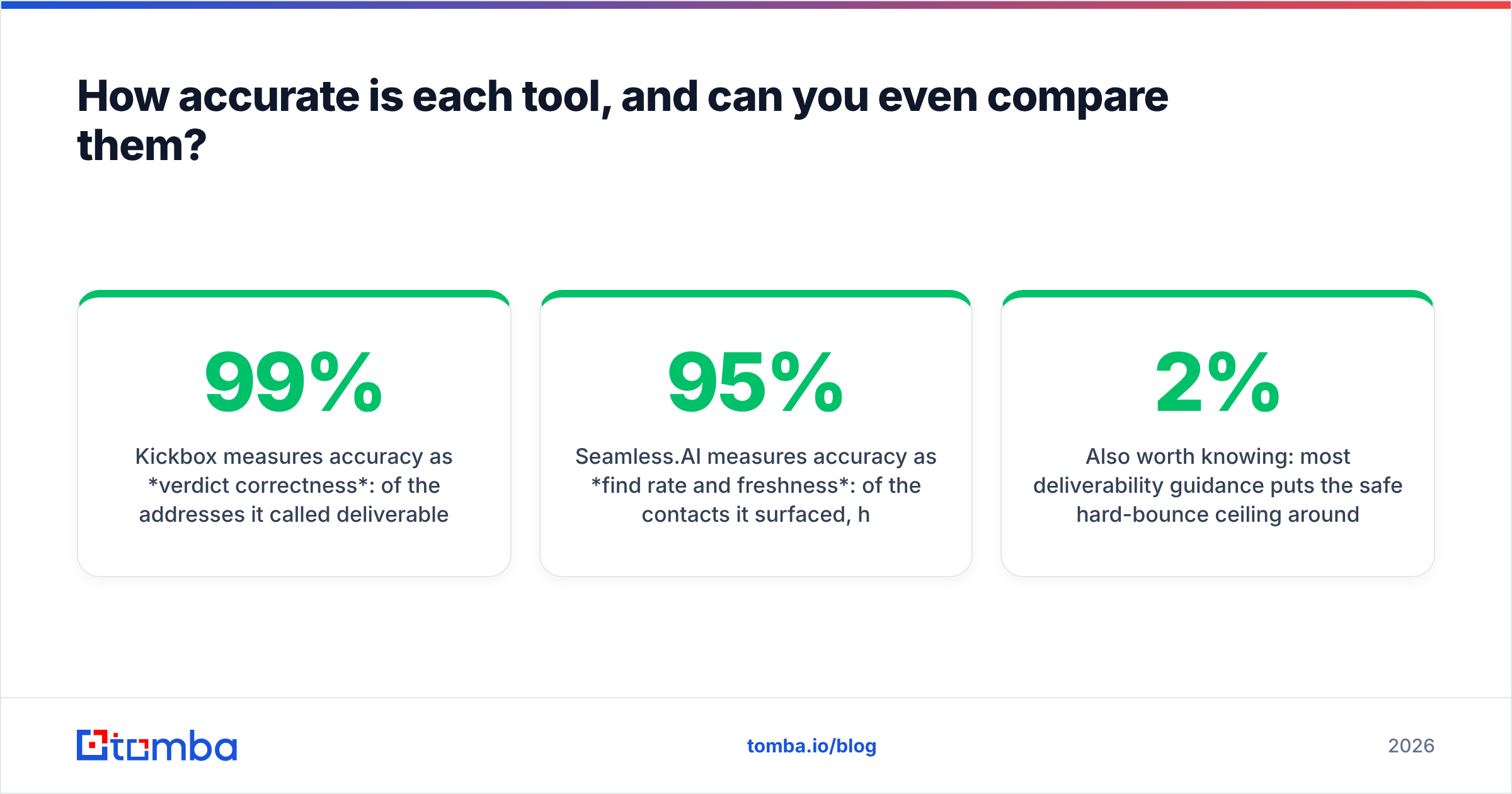
Kickbox measures accuracy as verdict correctness: of the addresses it called deliverable, how many actually delivered? Good verifiers land in the 95-99% range on standard mailbox providers, with the honest caveat that catch-all domains are genuinely unknowable through SMTP alone.
Seamless.AI measures accuracy as find rate and freshness: of the contacts it surfaced, how many emails are current? That number is far more volatile because it depends on the segment, the seniority, and how recently the person changed jobs. Independent reviewer accounts of AI-assembled contact data typically land well below the 95% mark that verification tools hit, which is exactly why mature teams run finder output through a verifier before it touches a sending domain.

The practical rule: never trust a finder's own validation as your last line of defence. Finders optimise for coverage — returning a plausible address is better for their metrics than returning nothing. Verifiers optimise for caution. Those incentives point in opposite directions, which is why the two-step stack exists. If you want to see how the verdict layer behaves on your own data, run a sample through an email verifier before you commit to any provider's accuracy claim.
Also worth knowing: most deliverability guidance puts the safe hard-bounce ceiling around 2%. A list that verifies at 97% is fine. A raw finder export at 78% valid is a reputation incident waiting to happen.
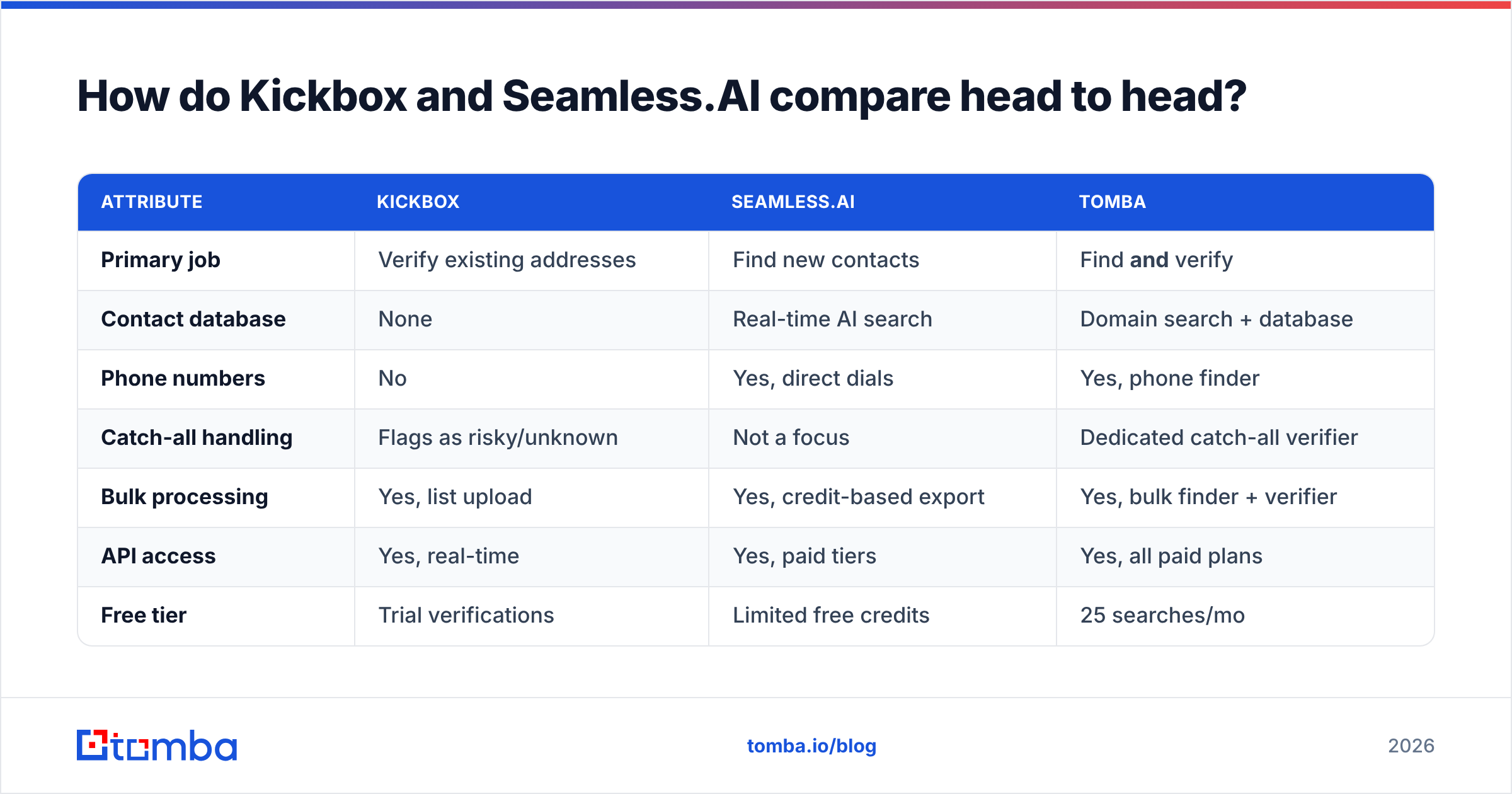
How do Kickbox and Seamless.AI compare head to head?#
| Attribute | Kickbox | Seamless.AI | Tomba |
|---|---|---|---|
| Primary job | Verify existing addresses | Find new contacts | Find and verify |
| Contact database | None | Real-time AI search | Domain search + database |
| Phone numbers | No | Yes, direct dials | Yes, phone finder |
| Catch-all handling | Flags as risky/unknown | Not a focus | Dedicated catch-all verifier |
| Bulk processing | Yes, list upload | Yes, credit-based export | Yes, bulk finder + verifier |
| API access | Yes, real-time | Yes, paid tiers | Yes, all paid plans |
| Free tier | Trial verifications | Limited free credits | 25 searches/mo |
| Entry paid price | Pay-as-you-go credits | Quote only, annual terms | $49/mo Starter |
| Pricing transparency | Published | Sales call required | Published |
| Contract | None | Typically annual | Monthly or annual |
| Best for | Hygiene on owned lists | Call-first SDR teams | Outbound teams needing both |

Two rows in that table do most of the decision-making work: contact database and pricing transparency. If you need the first, Kickbox is out. If you refuse the second, Seamless.AI is out. Confirm current numbers on each vendor's own pricing page before you buy — verification credit tiers and database plans both move, and ours are listed openly on the Tomba pricing page.
What does each one actually cost in 2026?#
Kickbox sells verification credits, pay-as-you-go, with volume discounts that bring the per-email cost down sharply as you scale. There is a free block of verifications to test with. No seats, no minimum term. Cost scales with list size, which means a one-off cleanup of a 50,000-record CRM is a single predictable charge rather than a subscription.
Seamless.AI publishes a free tier with a small daily credit allowance and then routes everything else through sales. Expect an annual agreement, per-seat pricing, and credit packages sized to your team. Buyers consistently report that the sticker is materially higher than self-serve alternatives and that credits do not roll over indefinitely. Get the renewal and credit-expiry terms in writing before signing.
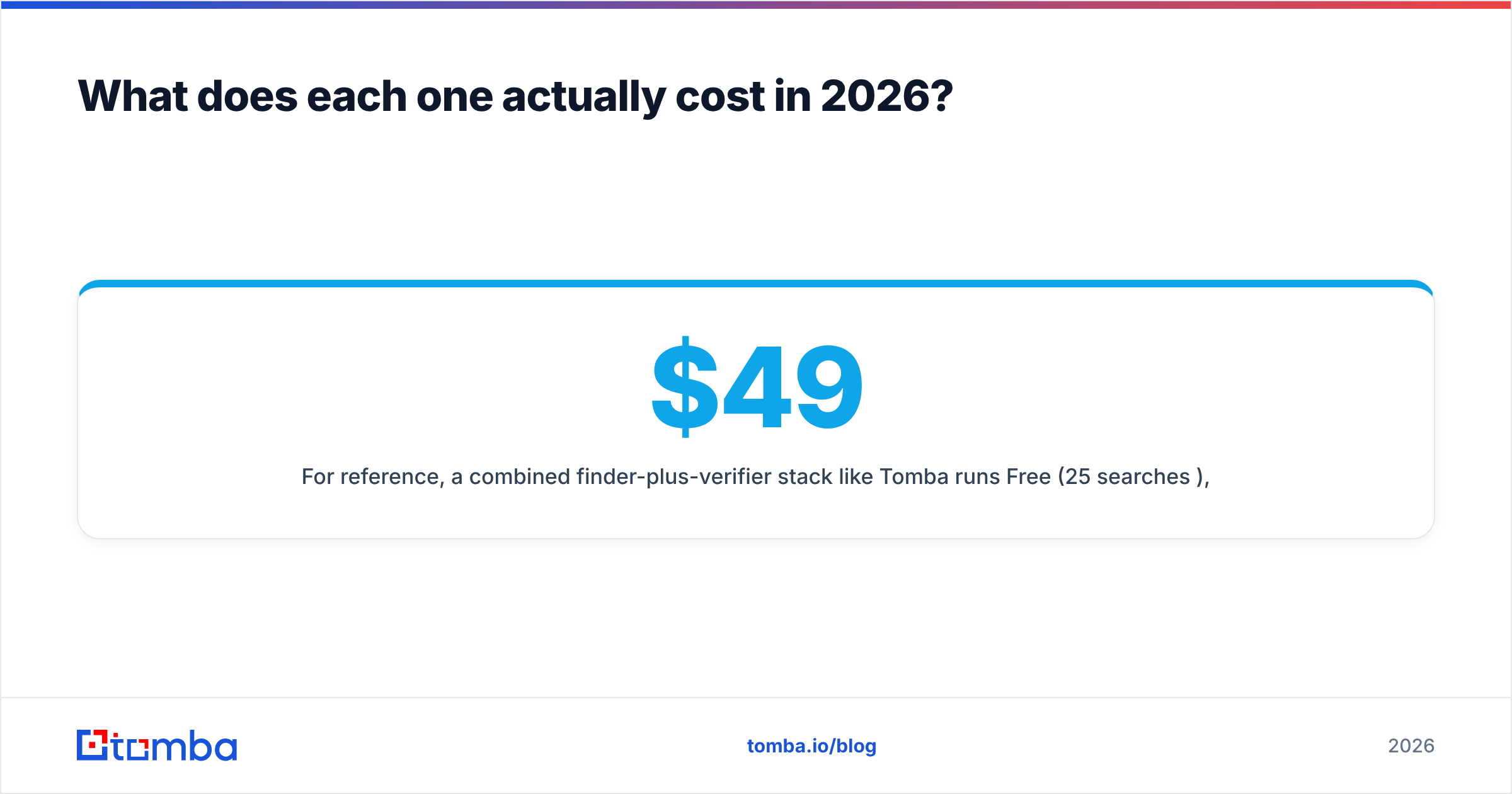
For reference, a combined finder-plus-verifier stack like Tomba runs Free (25 searches/mo), Starter $49/mo, Growth $99/mo, Pro $249/mo, and Enterprise custom — with the credits usable across email finder, verification, domain search, and enrichment rather than siloed per product.

The cost trap nobody prices in: a burned sending domain. If an unverified export drives your bounce rate past provider tolerance, you are not buying credits any more — you are buying new domains, a warmup cycle, and six weeks of lost pipeline. That is the real budget line behind the verification argument.
Which one should you pick for your use case?#
- You have a list and it is stale. Kickbox. Nothing about Seamless.AI helps you clean data you already own, and paying for a contact database to solve a hygiene problem is the most common overspend in this category.
- You have no list and a call-first motion. Seamless.AI, with verification bolted on. Its phone coverage is the strongest argument for it, and you should still validate the emails separately.
- You have no list and an email-first motion. Neither is ideal alone. You want a finder with built-in verification so the handoff does not cost you a second subscription and an export/import loop.
- You run form capture at volume. Kickbox's real-time API, or any equivalent, at the point of signup. This is the highest-ROI verification use case and it has nothing to do with outbound.
- You are handling catch-all domains. Neither tool is built for this. Catch-all servers accept everything at SMTP time, so a standard verdict is meaningless. You need a dedicated catch-all verifier that uses pattern and historical signals instead of SMTP alone.
- You are on a tight budget with under 10,000 contacts a month. Self-serve wins on principle. Annual contracts for volumes you can cover with a $49 plan are how small teams end up with shelfware.
Do you actually need both tools?#
Often, yes — but rarely these two specific products.
The canonical outbound stack is: find → verify → enrich → send. Kickbox covers step two beautifully and nothing else. Seamless.AI covers step one and part of step three, with a validation layer most practitioners do not fully trust. Running both means two contracts, two credit systems, and a CSV shuttle between them.
The consolidation argument is straightforward. A single provider that finds the address, verifies it in the same call, resolves catch-all domains, and enriches the record removes the handoff entirely. That is the design behind Tomba's bulk email finder — verification is not an upsell sitting downstream, it runs as part of the lookup. For teams already committed to Kickbox for form capture, keeping it there and using a combined tool for prospecting is a perfectly sane split.
One more consideration before you commit to any vendor: ask where the data comes from. Real-time web assembly, licensed panels, and contributory networks carry different freshness and compliance profiles, and any serious provider will document it. Ours is published under data sources.
What is the verdict on Kickbox vs Seamless.AI?#
Kickbox wins on verification, transparency, and honest pricing. Seamless.AI wins on phone data and long-tail company coverage. Neither wins the comparison outright because they were never built to answer the same question.
Pick Kickbox if your addresses exist and you need them clean. Pick Seamless.AI if you dial for a living and accept an annual commitment. Pick a combined finder-and-verifier if you are doing email-led outbound and do not want to maintain two vendors to send one campaign.
If that last description fits, start with the Tomba Email Finder. The free tier gives you 25 searches a month with verification included — enough to test find rate and bounce rate on your own ICP before any money changes hands, and no call with a rep to find out what it costs.
Related guides#
// get started
Find, verify and enrich your first contacts today
Start on the free plan with 25 searches a month, then scale when your team is ready.
Free plan · No credit card required · GDPR & CCPA
// about the author