Kipplo vs PrivCo: Which B2B Data Platform Wins in 2026?
Kipplo and PrivCo both sell B2B data, but they answer different questions: one builds prospect lists, the other explains private company financials. Here's the honest breakdown, including what each one still makes you buy separately.
TL;DR
- These tools answer different questions. PrivCo tells you how big and how healthy a private company is. Kipplo tells you who works there and how to reach them. Comparing them on a single scoreboard is how buyers waste budget.
- PrivCo is research-first. Private company revenue estimates, funding history, ownership, and M&A signals — useful for investors, corp dev, and account research, not for building a 5,000-line outbound list.
- Kipplo is prospecting-first. Company and contact records aimed at building target lists and pushing them into a sequencer or CRM.
- Neither replaces verification. Both categories ship stale and unverifiable addresses at some rate. If you send cold email, you need a verification layer regardless of which platform you license.
- Cheapest honest stack for most teams: one research source (only if you actually need private financials), one contact source, and a dedicated finder/verifier like Tomba at $49/mo to keep bounce rates survivable.
What are Kipplo and PrivCo, exactly?#
Start with the category, not the feature list.
PrivCo is a private company intelligence database. Its reason to exist is that public companies file with the SEC and private ones don't — so someone has to model revenue, headcount, funding, and ownership for the millions of businesses that never publish a 10-K. PrivCo has sold that dataset to investment banks, PE and VC firms, corporate development teams, and enterprise sellers who need to size an account before they touch it. You can see the current product framing on PrivCo's own site. The underlying problem is structural and well documented — see the general definition of a privately held company if you want the boring, accurate version.
Kipplo sits on the other side of the funnel. It's positioned as a B2B contact and company data platform: search a firmographic filter set, get a list of companies and the people inside them, export or sync. The workflow is list build → enrich → sequence. That's a prospecting database, and it competes with Apollo, Lusha, Cognism, ZoomInfo, and the long tail of newer entrants — not with a financial research terminal.
One caveat worth stating plainly: Kipplo is a newer entrant and its public documentation moves faster than any blog post can track. Treat every spec below as a starting point for your own trial, and verify current coverage and pricing on the vendor's site before you sign anything. The same applies to PrivCo's plan structure, which has changed more than once.

How do Kipplo and PrivCo compare head to head?#
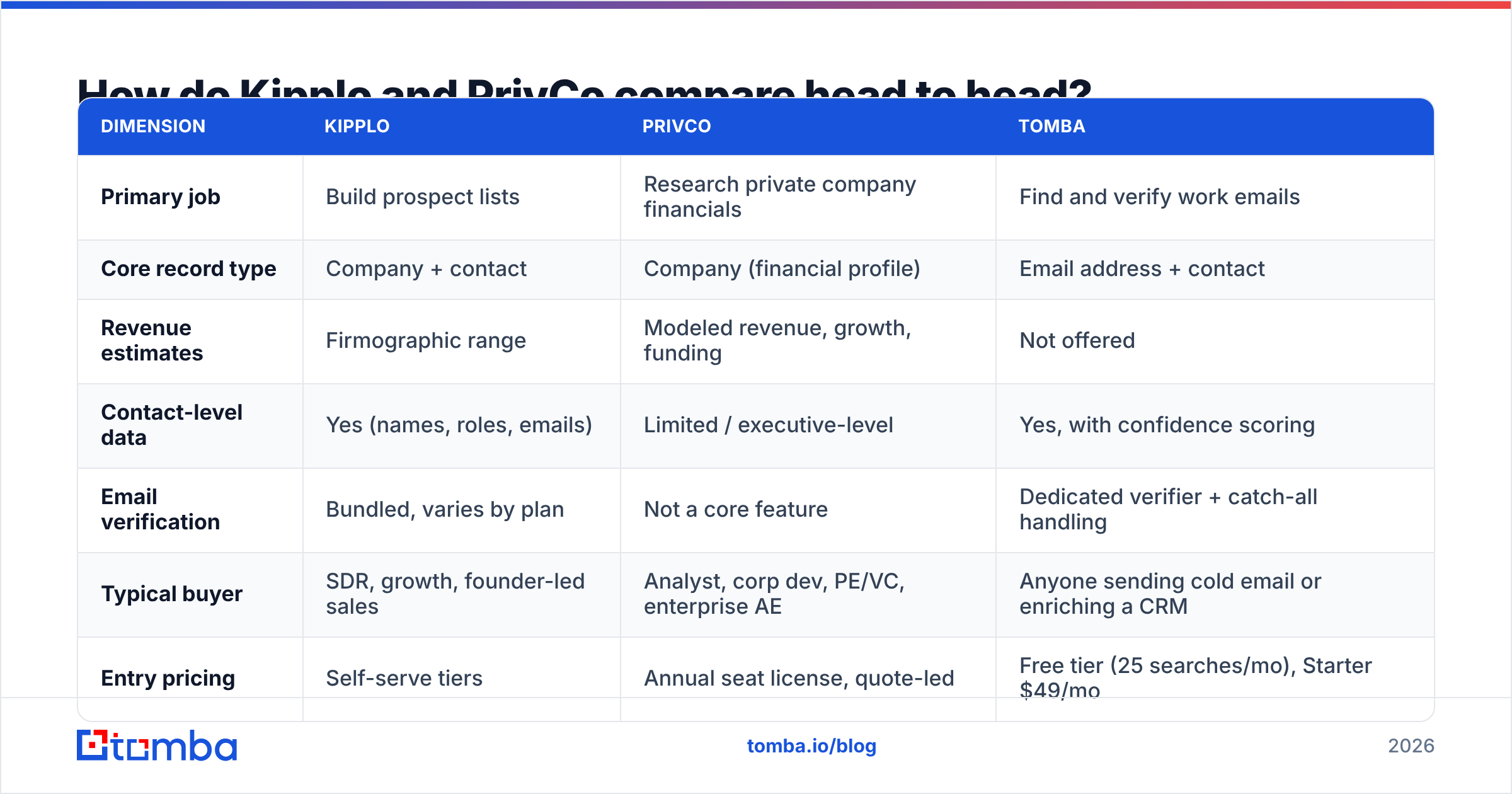
Here's the honest side-by-side, with a dedicated email-finding layer included as a third column because most buyers end up needing one anyway.
| Dimension | Kipplo | PrivCo | Tomba |
|---|---|---|---|
| Primary job | Build prospect lists | Research private company financials | Find and verify work emails |
| Core record type | Company + contact | Company (financial profile) | Email address + contact |
| Revenue estimates | Firmographic range | Modeled revenue, growth, funding | Not offered |
| Contact-level data | Yes (names, roles, emails) | Limited / executive-level | Yes, with confidence scoring |
| Email verification | Bundled, varies by plan | Not a core feature | Dedicated verifier + catch-all handling |
| Typical buyer | SDR, growth, founder-led sales | Analyst, corp dev, PE/VC, enterprise AE | Anyone sending cold email or enriching a CRM |
| Entry pricing | Self-serve tiers | Annual seat license, quote-led | Free tier (25 searches/mo), Starter $49/mo |
| Free tier | Limited trial | Limited preview, gated | Yes, 25 searches/mo |
| API access | Plan-dependent | Enterprise-tier | All paid plans |
The table makes the real decision obvious. If your question is "is this account worth a quarter of pipeline effort?", PrivCo is the tool. If your question is "give me 400 heads of ops at 50-200 person logistics companies", PrivCo will frustrate you and Kipplo won't.
What does PrivCo actually do well?#
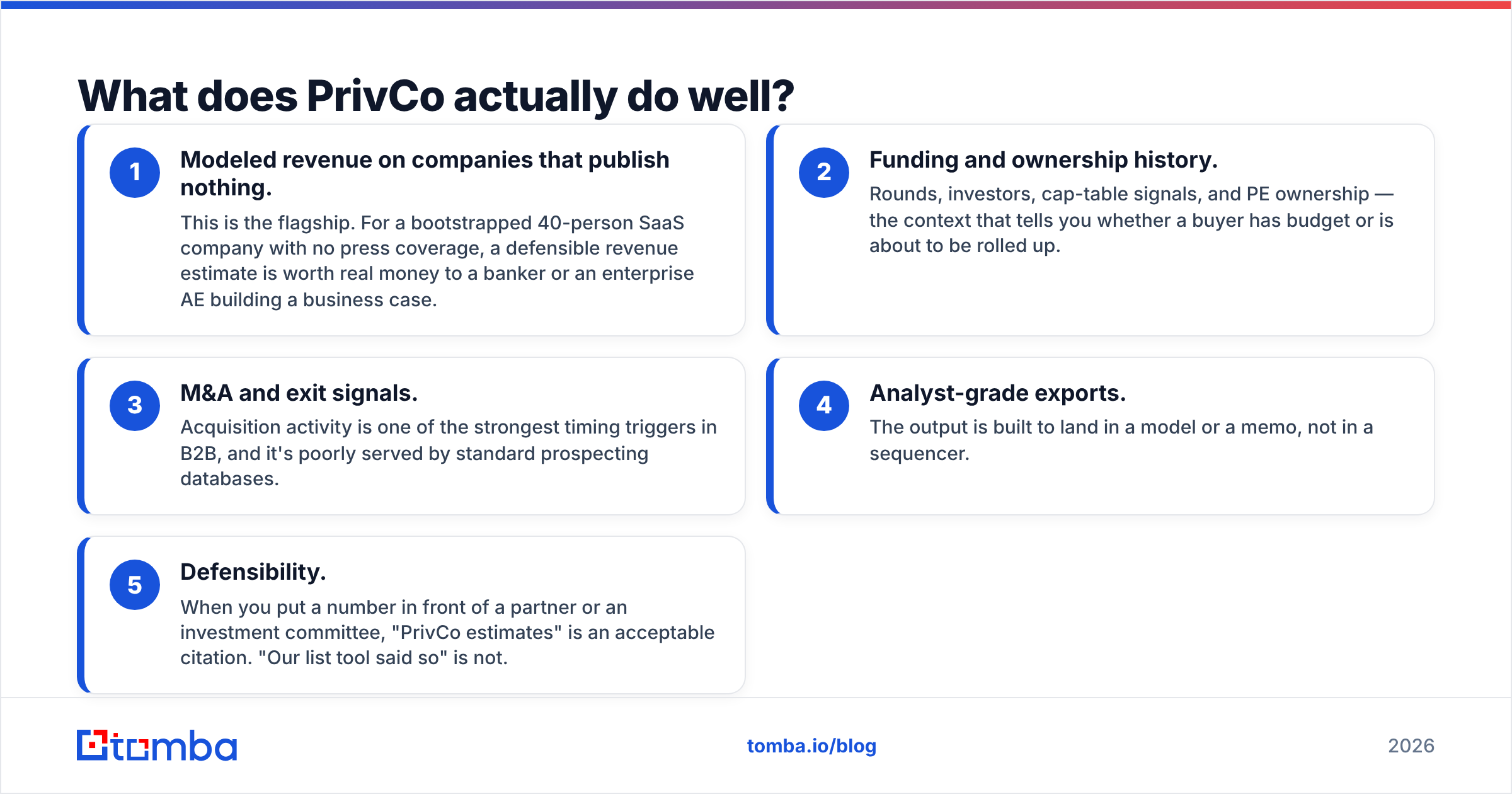
PrivCo's value is depth on a narrow set of records, not breadth.
- Modeled revenue on companies that publish nothing. This is the flagship. For a bootstrapped 40-person SaaS company with no press coverage, a defensible revenue estimate is worth real money to a banker or an enterprise AE building a business case.
- Funding and ownership history. Rounds, investors, cap-table signals, and PE ownership — the context that tells you whether a buyer has budget or is about to be rolled up.
- M&A and exit signals. Acquisition activity is one of the strongest timing triggers in B2B, and it's poorly served by standard prospecting databases.
- Analyst-grade exports. The output is built to land in a model or a memo, not in a sequencer.
- Defensibility. When you put a number in front of a partner or an investment committee, "PrivCo estimates" is an acceptable citation. "Our list tool said so" is not.
What PrivCo is not good at: volume contact data. You will not build an outbound engine on it, and pretending otherwise is the most common way teams end up paying for a research seat they use twice a quarter.
What does Kipplo actually do well?#
Kipplo's pitch is the standard modern prospecting-database pitch, and judged on that basis it holds up:
- Filter-to-list speed. Firmographic and role filters that turn an ICP definition into an exportable list in minutes.
- Contact-level coverage. Names, titles, and work emails — the raw material for sequences.
- Self-serve onboarding. No mandatory demo gauntlet before you can evaluate the data, which matters enormously for teams under 20 people.
- Export and CRM flow. CSV plus integrations into the usual suspects, so the data doesn't die in a browser tab.
The open question with every newer database — Kipplo included — is coverage depth outside North America and tech, and how aggressively stale records get pruned. Don't take a vendor's word for either. Pull 200 records in your actual ICP, run them through an independent email verifier, and count the invalids. That single test is worth more than every review you'll read, including this one. If you want third-party sentiment as a sanity check, G2 is the least-bad public source for this category.
Is Kipplo better than PrivCo for outbound prospecting?#
Yes — and that's not a knock on PrivCo. It's a category statement.
Outbound needs three things a research terminal doesn't provide: volume, contact-level records, and deliverable addresses. PrivCo optimizes for accuracy on a few thousand carefully modeled company profiles. Kipplo optimizes for pulling ten thousand contact rows before lunch. Those are opposing engineering priorities.
Where it gets interesting is the hybrid motion. Enterprise teams running account-based outbound often want both: PrivCo to decide which 200 accounts deserve attention, then a contact source to work them. That's a legitimate two-tool stack — but it's also where budgets quietly balloon, because you're now paying research prices and prospecting prices simultaneously.

What does this cost, and where do the hidden fees hide?#
Pricing is where these two diverge most sharply, and where buyers get surprised.
PrivCo sells like a research product: annual seat licenses, quote-led for anything beyond the base tier, and API access parked at the enterprise level. That model is normal for financial data — Bloomberg, PitchBook, and CB Insights all work this way — but it means a small team can't casually test it. Budget for a procurement cycle, not a credit card.
Kipplo sells like a SaaS tool: monthly tiers, credits, self-serve upgrade. The hidden cost here isn't the sticker price, it's credit burn on bad records. If 18% of the emails you export bounce, you paid full price for garbage and then paid again in sender reputation damage. Credit-based pricing only looks cheap when accuracy is high.
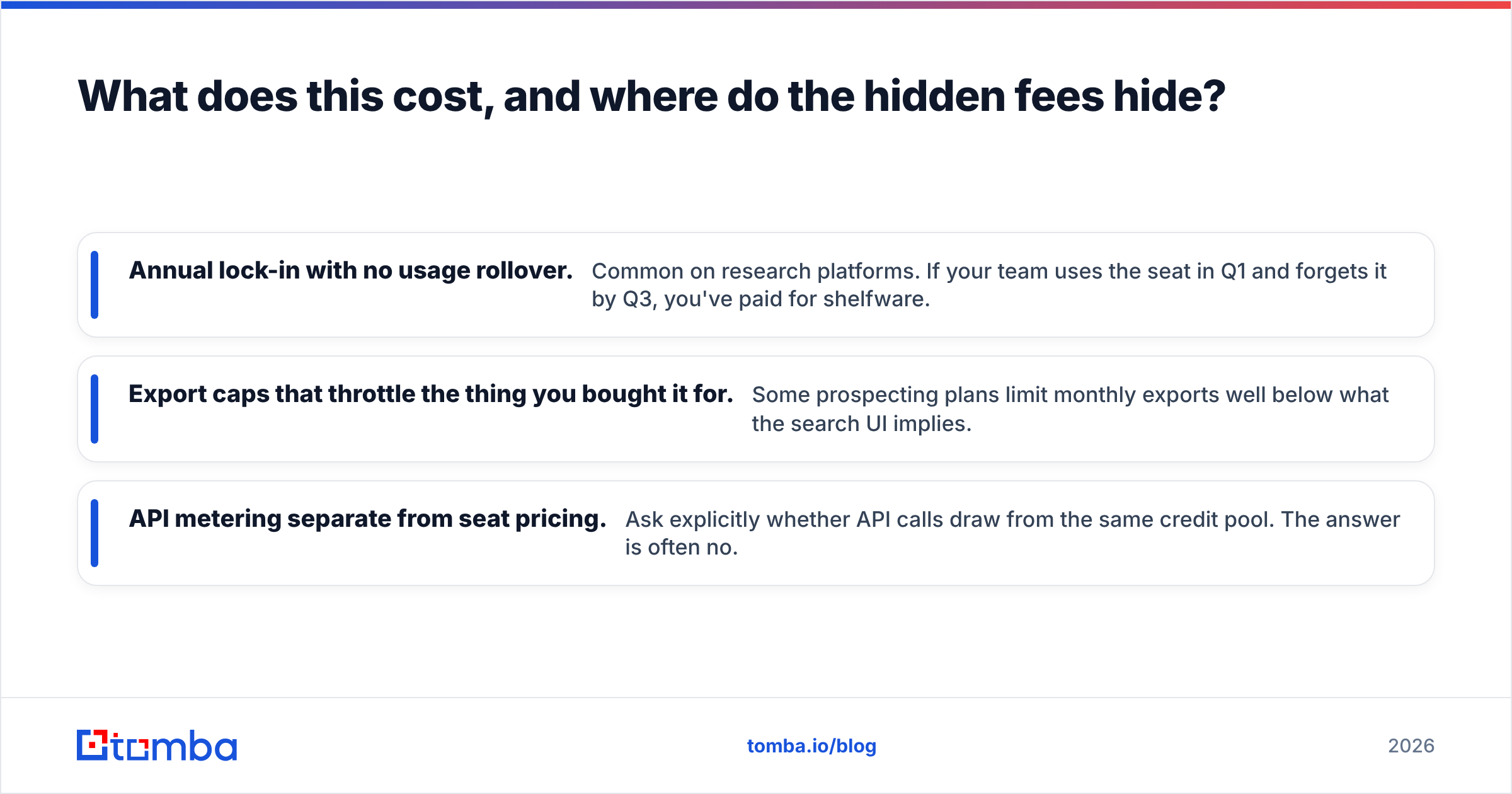
Three cost traps to check before signing either contract:
- Annual lock-in with no usage rollover. Common on research platforms. If your team uses the seat in Q1 and forgets it by Q3, you've paid for shelfware.
- Export caps that throttle the thing you bought it for. Some prospecting plans limit monthly exports well below what the search UI implies.
- API metering separate from seat pricing. Ask explicitly whether API calls draw from the same credit pool. The answer is often no.
Where does an email finder fit in this stack?#
Neither Kipplo nor PrivCo removes the need for a verification layer, and this is the part most comparison posts skip.
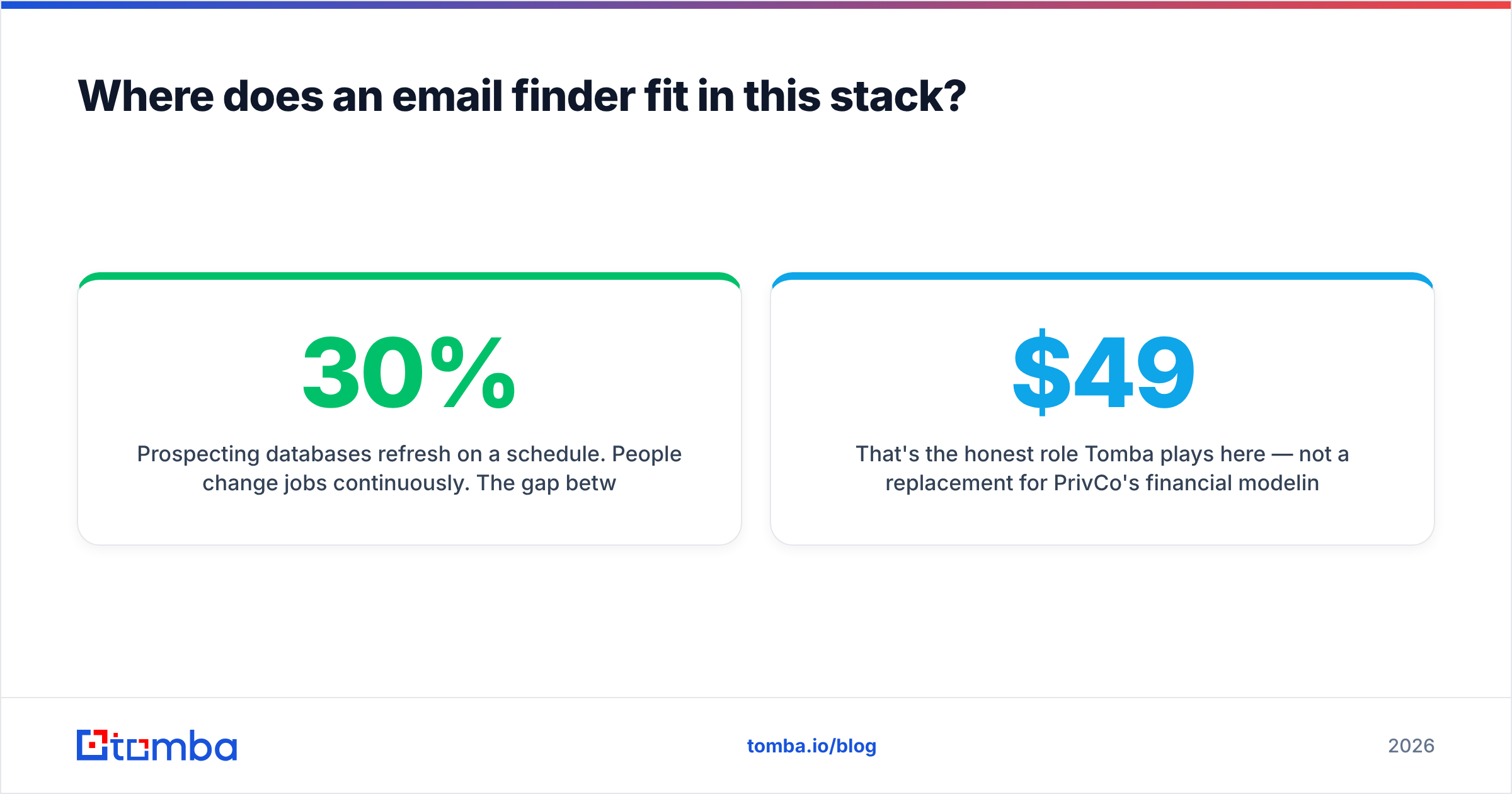
Prospecting databases refresh on a schedule. People change jobs continuously. The gap between those two facts is your bounce rate. B2B contact data decays at roughly 25-30% per year by most vendor estimates, which means a list exported in January is materially worse by summer. Google and Microsoft both tightened bulk-sender requirements in recent years, and HubSpot's research on email deliverability makes the same point every practitioner learns the hard way: a few percentage points of hard bounces is the difference between the inbox and the spam folder.
A dedicated finder/verifier solves three specific problems a database doesn't:
- Point-in-time verification. Check the address the day you send, not the day it was scraped.
- Catch-all handling. A large share of B2B domains accept everything at the SMTP layer. A proper catch-all verifier distinguishes "probably real" from "black hole" instead of returning a useless "unknown".
- Gap filling. When a database has the company and the person but no email, a domain search against the company's known pattern often recovers it.
That's the honest role Tomba plays here — not a replacement for PrivCo's financial modeling, and not a full prospecting database either. It's the layer that makes whatever list you bought actually deliverable. Free tier is 25 searches a month, Starter is $49/mo, Growth $99/mo, Pro $249/mo, with full Tomba pricing published rather than quote-gated.
Which should you pick in 2026?#
Match the tool to the question you're actually asking:
- Pick PrivCo if you're an analyst, investor, corp dev professional, or enterprise AE who needs defensible private company financials and can justify an annual seat.
- Pick Kipplo if you're building outbound lists at volume, want self-serve pricing, and your ICP falls inside its coverage strengths — which you should verify with a 200-record test, not a demo.
- Pick both only if you run genuine account-based selling with a target list small enough that research time per account is justified. Below ~500 target accounts, this stack is usually overkill.
- Pick neither if your real bottleneck is that half your existing CRM records bounce. Fix data hygiene first; new records on top of a broken foundation just costs more.
- Add a verifier regardless. Whichever column you land in, the last mile between "record in a database" and "email that lands" is verification.
The framing that saves money: databases are inventory, verification is quality control. You wouldn't run a warehouse without one.
Frequently asked questions#
Is PrivCo a competitor to Kipplo? Not directly. They overlap on company-level firmographics and diverge everywhere else. Buyers comparing them are usually deciding between two different projects, not two versions of the same one.
Can I use PrivCo for cold email? Technically you can extract some executive contacts, but the per-record cost and volume ceiling make it a poor fit. Use it to prioritize accounts, then source contacts elsewhere.
Does Kipplo verify emails before export? Vendor-stated verification varies by plan and changes over time. Run your own independent check on a sample before you trust the claim at scale — that's true of every database in this category, not just Kipplo.
What's the cheapest way to test both? Kipplo's self-serve tier lets you sample data without procurement. PrivCo generally requires a demo. For the verification layer, start on a free tier and only upgrade once you know your actual monthly volume.
Start with the layer that decides whether anything lands#
Whichever database you license, the emails still have to be real on the day you press send. Tomba's Email Finder covers that last mile — find addresses by domain, name, or company, verify them before they enter a sequence, and handle catch-all domains instead of guessing at them. Start free with 25 searches a month, and only move to the $49/mo Starter plan once your volume justifies it. If your bounce rate is the thing costing you meetings, fix that before you spend five figures on another data subscription.
Related guides#
// get started
Find, verify and enrich your first contacts today
Start on the free plan with 25 searches a month, then scale when your team is ready.
Free plan · No credit card required · GDPR & CCPA
// about the author