Kipplo vs Span Global Services: B2B Data Compared 2026
One sells you self-serve credits and a searchable database. The other sells you a quoted list and an appending service. Here is how Kipplo and Span Global Services actually differ on data sourcing, accuracy, pricing, and risk — plus a cheaper third path.
Kipplo vs Span Global Services comes down to one question: do you want a tool you log into, or a file someone emails you?
TL;DR
- Kipplo is a self-serve B2B account-intelligence platform. You search a database in a browser, filter, and burn credits to reveal emails and direct dials. Entry pricing is published. It starts in the low tens of dollars per month on annual billing.
- Span Global Services is a traditional list vendor and data-append house. You describe an audience, a rep runs a count, and you buy a delivered file. Pricing is quote-first and never listed publicly.
- The real difference is not features. It is who owns the verification risk. Kipplo puts verification in your workflow. Span Global delivers a file, and you learn what bounced after you send.
Then there is the money question.
- Buy-a-list economics look cheap per record until you divide by deliverable records. A file with a 25-30% decay rate quietly triples your true cost per usable contact.
- Need verified work emails for named accounts rather than a 50,000-row file? An on-demand finder plus verification usually wins on cost per inbox reached. Tomba starts free at 25 searches/mo, then $49/mo.
What are Kipplo and Span Global Services?#
They solve the same problem — "get me B2B contacts" — from opposite ends of the industry.
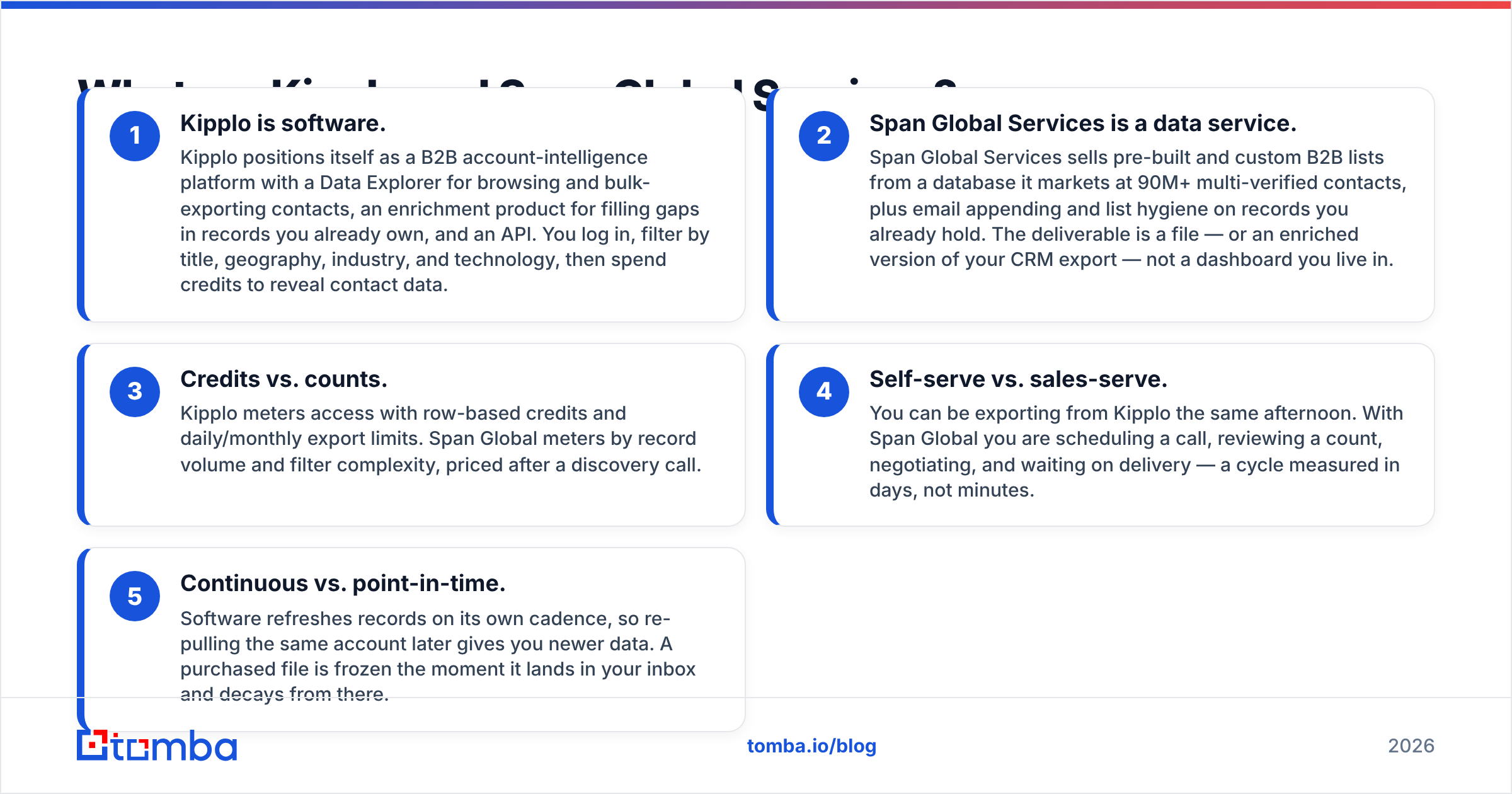
- Kipplo is software. Kipplo calls itself a B2B account-intelligence platform. It ships a Data Explorer for browsing and bulk-exporting contacts, an enrichment product for filling gaps in records you already own, and an API. You log in and filter by title, geography, industry, and technology. Then you spend credits to reveal contact data.
- Span Global Services is a data service. Span Global Services sells pre-built and custom B2B lists from a database it markets at 90M+ multi-verified contacts. It also sells email appending and list hygiene on records you already hold. The deliverable is a file — or a cleaned-up copy of your CRM export — not a dashboard you live in.
Three more differences follow from that split.
- Credits vs. counts. Kipplo meters access with row-based credits and daily or monthly export limits. Span Global meters by record volume and filter complexity, priced after a discovery call.
- Self-serve vs. sales-serve. You can be exporting from Kipplo the same afternoon. With Span Global you book a call, review a count, negotiate, and wait on delivery. That cycle takes days, not minutes.
- Continuous vs. point-in-time. Software refreshes records on its own cadence. Re-pull the same account later and you get newer data. A purchased file is frozen the moment it lands in your inbox, and it decays from there.
That last point drives almost everything downstream — accuracy, pricing, and deliverability risk.
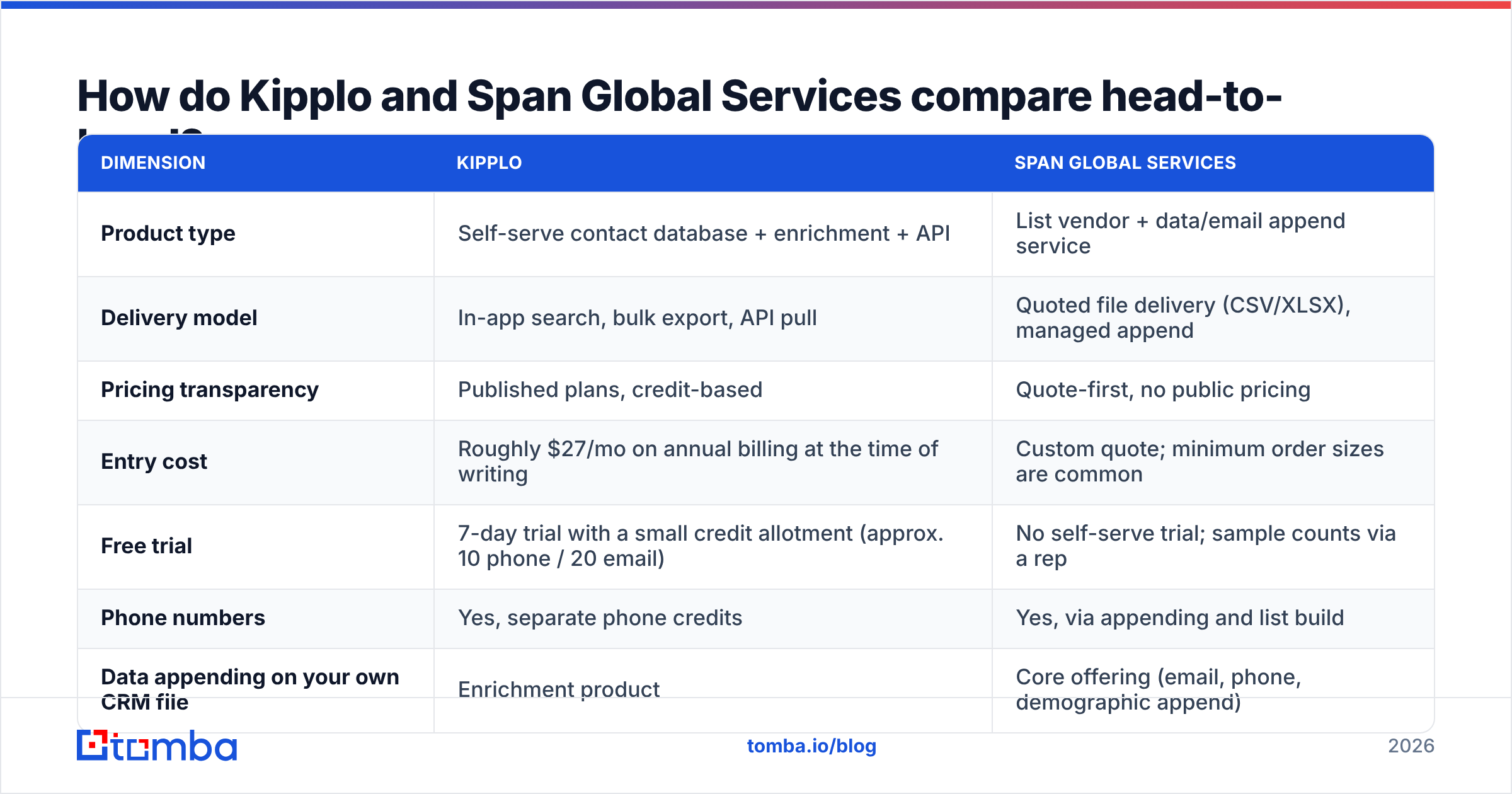
Kipplo vs Span Global Services: the head-to-head comparison#
| Dimension | Kipplo | Span Global Services |
|---|---|---|
| Product type | Self-serve contact database + enrichment + API | List vendor + data/email append service |
| Delivery model | In-app search, bulk export, API pull | Quoted file delivery (CSV/XLSX), managed append |
| Pricing transparency | Published plans, credit-based | Quote-first, no public pricing |
| Entry cost | Roughly $27/mo on annual billing at the time of writing | Custom quote; minimum order sizes are common |
| Free trial | 7-day trial with a small credit allotment (approx. 10 phone / 20 email) | No self-serve trial; sample counts via a rep |
| Phone numbers | Yes, separate phone credits | Yes, via appending and list build |
| Data appending on your own CRM file | Enrichment product | Core offering (email, phone, demographic append) |
| API access | Yes | Limited; service-led rather than developer-led |
| Time to first contact | Minutes | Days |
| Verification responsibility | Shared — you re-verify before send | Vendor claims verification; you validate on receipt |
| Best fit | SDR teams that pull lists weekly | Marketers buying a large one-off audience or cleaning a legacy database |

Read that table with one question in mind: how often do you need new contacts? A weekly need favors software you control. A single quarterly campaign against 40,000 contacts in a niche vertical is the classic list-broker job. Span Global has served that job for years.
Sorry — that image should render as the meme below.
Where does each vendor get its data?#
Kipplo describes a compiled global database of decision-makers. It is built from public web sources, business registries, and partner feeds, then shaped into structured contact and company records. That is the standard playbook for modern contact databases: crawl, resolve identity, guess email patterns, verify, expire.
Span Global markets its inventory as ethically sourced and multi-verified. It comes from opt-in channels, event and publication sign-ups, directories, and partnerships. Some products carry 70+ intelligence fields per record. Its appending business also means it holds the matching logic to stitch your existing records to its master file.
Neither vendor publishes a full audit trail. That is normal for this category. It is also why you should never take a coverage claim at face value. The practical move is to ignore the marketing number ("90M+ contacts") and measure coverage on your ICP. A database with 90 million records is worthless to you if only 300 of them are heads of procurement at mid-market manufacturers in Ontario.
Want a reference point for how vendors describe their sources? Tomba publishes its own data sources breakdown. Marketplaces like Datarade list Span Global's product-level descriptions side by side.
Which one gives you more accurate emails?#
Neither vendor deserves a blanket answer, because accuracy is segment-specific. What you can compare is how each model fails.
- Kipplo fails openly. You search, you see a record, you spend a credit. You can push that address straight through verification. A bad record costs you one credit and thirty seconds.
- Span Global fails after purchase. The verification happened on the vendor's side, on the vendor's timeline, to the vendor's standard. Public reviews reflect that split. Some buyers report high deliverability on delivered files. Others re-check purchased lists with third-party validators and find them weak. That variance is the risk premium you pay in the list-broker model.

B2B contact data decays at roughly 2-3% per month as people change jobs. So a file that was 95% accurate at build time is much worse six months later. That holds no matter who sold it to you. The only accuracy number that matters is the one you measure yourself — on a sample, on the day you plan to send.
Whichever vendor you pick, run every record through an independent email verifier before it touches your sending domain. Catch-all domains need extra care. A plain SMTP check returns "accept" for everything. Use a dedicated catch-all verifier to tell real mailboxes from black holes.

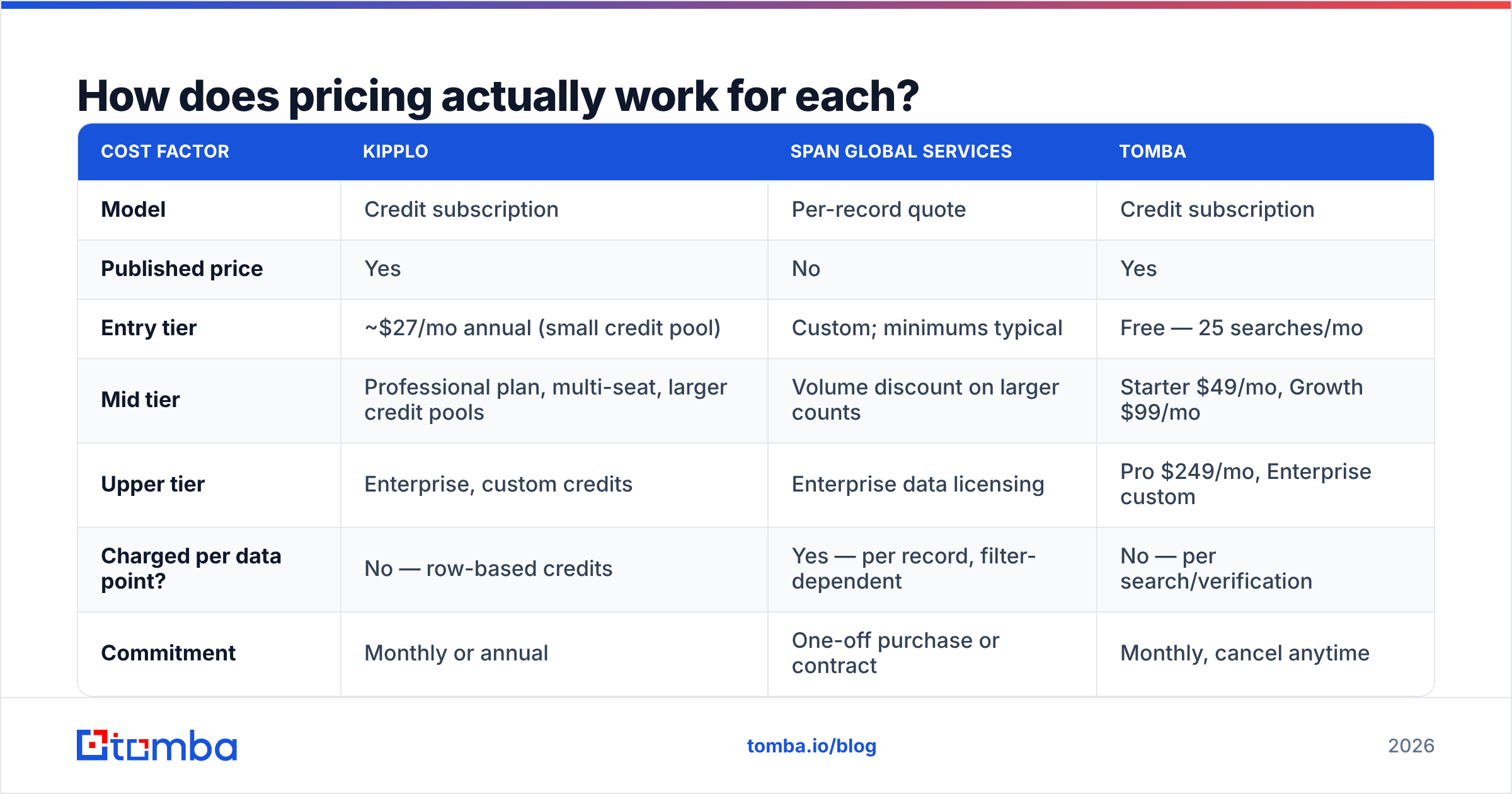
How does pricing actually work for each?#
| Cost factor | Kipplo | Span Global Services | Tomba |
|---|---|---|---|
| Model | Credit subscription | Per-record quote | Credit subscription |
| Published price | Yes | No | Yes |
| Entry tier | ~$27/mo annual (small credit pool) | Custom; minimums typical | Free — 25 searches/mo |
| Mid tier | Professional plan, multi-seat, larger credit pools | Volume discount on larger counts | Starter $49/mo, Growth $99/mo |
| Upper tier | Enterprise, custom credits | Enterprise data licensing | Pro $249/mo, Enterprise custom |
| Charged per data point? | No — row-based credits | Yes — per record, filter-dependent | No — per search/verification |
| Commitment | Monthly or annual | One-off purchase or contract | Monthly, cancel anytime |
| Hidden cost | Daily/monthly export caps | Decay + re-verification on delivered files | Re-verification included in workflow |
The arithmetic that catches people out is simple. Say you buy 10,000 records at $0.10 each — $1,000. If 22% are undeliverable and another 15% are wrong-role, your true cost per usable contact is about $0.16. You also spent part of your domain reputation finding that out.
Now compare that to pulling 1,200 precisely targeted, freshly verified contacts for a fraction of the spend. Volume is not leverage when most of the volume is noise.
Check current numbers before you commit. Kipplo's plans move, Span Global's are never public, and you can see Tomba pricing without talking to anyone.
Who should choose Kipplo?#
Choose Kipplo if most of these describe you:
- You prospect continuously. Weekly or daily list pulls justify a subscription and make credits cheaper per contact than repeat one-off purchases.
- You want phone and email in one place. Separate phone credits mean you can run a calls-plus-email sequence off a single export.
- You have engineers or ops. The API and enrichment endpoints push contact data into your CRM for you, so nobody shuttles CSVs.
- You need to start today. A published price and a self-serve trial beat a two-week procurement dance when you are testing a new segment.
- Your ICP is broad. Self-serve databases shine on common titles in common industries and thin out fast in niche verticals.
Who should choose Span Global Services?#
Choose Span Global if most of these describe you:
- You need one big, specific audience. A 40,000-record vertical list with unusual firmographic filters is exactly what list vendors are built for.
- You are cleaning a legacy database. Email appending and list hygiene on an old CRM is a service problem, not a search problem. It is Span Global's core specialty.
- You want a human accountable. A named account manager who runs counts, negotiates, and takes your call has real value in enterprise procurement.
- You have compliance review anyway. If legal already reviews every data purchase, the quote-first process fits your process rather than fighting it.
- Your filters are exotic. Intelligence fields that self-serve tools do not expose are often available through a custom build.
One caveat applies to any purchased list: make sure your use case is legal where your recipients live. Cold email to business addresses is allowed under the FTC's CAN-SPAM rules in the US, as long as you honor opt-outs and identify yourself. GDPR-covered contacts in the EU need a legitimate-interest assessment you can defend.
Is there a cheaper path than buying a list at all?#
Often, yes — and it is the option most teams skip.
Say your target account list is already defined: 400 companies you actually want. You do not need a database subscription or a 50,000-row file. You need work emails for named people at named domains, on demand. That is what an email finder does. Give it a name and a domain, and it returns a verified address with a confidence score and its sources. Pair it with domain search to see every public address and email pattern at a company. Use bulk email finder when you have a spreadsheet of accounts to process at once.
The cost profile is different in kind. You are not buying access to 90 million strangers. You pay only for the contacts you were going to email anyway. For a two-rep team working 400 accounts a quarter, that is usually the $49/mo Starter or $99/mo Growth tier. It costs less than one mid-size list purchase, and nothing decays, because every lookup happens the day you send.
Tomba is not the right answer for every case. If you genuinely need a 50,000-record audience for a display-and-email campaign in a narrow vertical, a list vendor is the more direct route. Span Global fits there, and so does a peer like BookYourData, which publishes self-serve per-record pricing. Use the tool that matches the shape of the job.
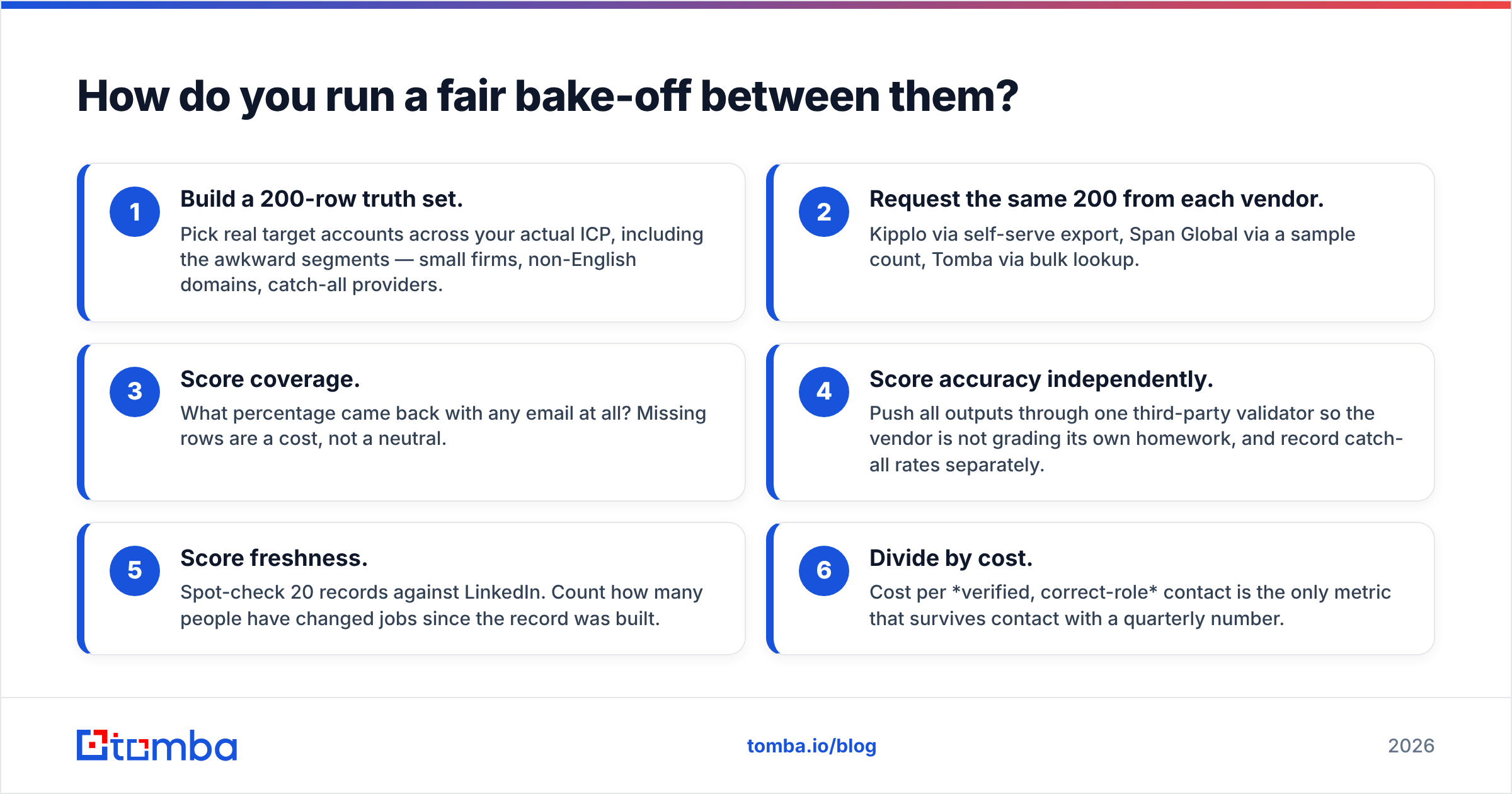
How do you run a fair Kipplo vs Span Global Services bake-off?#
Do not trust anyone's coverage claim, including ours. Run this in an afternoon.
- Build a 200-row truth set. Pick real target accounts across your actual ICP. Include the awkward segments: small firms, non-English domains, catch-all providers.
- Request the same 200 from each vendor. Kipplo via self-serve export, Span Global via a sample count, Tomba via bulk lookup.
- Score coverage. What share came back with any email at all? Missing rows are a cost, not a neutral.
- Score accuracy independently. Push all outputs through one third-party validator, so no vendor grades its own homework. Record catch-all rates separately.
- Score freshness. Spot-check 20 records against LinkedIn. Count how many people have changed jobs since the record was built.
- Divide by cost. Cost per verified, correct-role contact is the only metric that survives a quarterly number.
Vendor-reported benchmarks on sites like G2 help you spot support and billing complaints. They cannot tell you coverage on your specific segment. Only your own sample can.
What's the verdict for 2026?#
In Kipplo vs Span Global Services, Kipplo wins for continuous self-serve prospecting, and Span Global Services wins for one-off large audiences and CRM appending. They are not really competing for the same buyer. They compete for the same budget line, which is why they end up on the same shortlist.
Pick Kipplo if your team pulls contacts every week, wants published pricing, and will use an API. Pick Span Global if you need a managed build in a niche vertical. It also fits if you have a 60,000-record legacy database that needs email appending by people who do that for a living. In both cases, budget for independent verification before you send. That line item is not optional. Skipping it is the most common reason a bought list underperforms.
And if you look at your pipeline honestly and find you do not need a database at all — just reliable work emails for the accounts already on your target list — start with the Tomba Email Finder. The free tier gives you 25 searches a month, so you can test coverage on your own ICP before you spend anything. Starter is $49/mo. Every address comes back with verification and sources attached. Run the 200-row bake-off above against whichever vendors you are weighing, and let the numbers pick the winner.
Related guides#
// get started
Find, verify and enrich your first contacts today
Start on the free plan with 25 searches a month, then scale when your team is ready.
Free plan · No credit card required · GDPR & CCPA
// about the author