Kipplo vs ZoomInfo: Honest 2026 Comparison for B2B Data
ZoomInfo is the enterprise standard and priced like it. Kipplo is the lean, self-serve challenger. Here is how the two actually compare on cost, data quality, contracts, and what most teams should buy instead.
Kipplo vs ZoomInfo is a budget question more than a feature question. One tool is lean and self-serve. The other is a full go-to-market suite with a sales team attached. Here is how the two compare in 2026.
TL;DR
- ZoomInfo is an enterprise suite: a huge database, intent signals, org charts, and workflow tools. It sells on annual contracts that land in five figures, with seat minimums.
- Kipplo is the lean, self-serve end of the market. You sign up, search, and export the same afternoon. No demo gate, no purchase order.
- The real choice is not "who has more records." It is how much of the suite you will actually use.
Two more things to weigh first:
- If you only need verified emails, phone numbers, and enrichment in your CRM, both tools are the wrong shape. A focused stack like Tomba costs a fraction of either.
- Run a 300-contact test before you sign. Vendor accuracy claims are marketing. Your own list is the only benchmark that counts.
What are Kipplo and ZoomInfo?#
ZoomInfo is the incumbent. It started as a contact database. It now sells a full go-to-market platform: contact and company records, tech stack data, intent data, call recording, website visitor tracking, and sequencing. It is publicly traded. It sells through a sales team. In most mid-market budgets, it is the default line item. There is background on Wikipedia and the current lineup on zoominfo.com.
Kipplo sits at the other end. It is part of the newer wave of self-serve B2B data tools: sign up, search, export, done. No demo gate. No annual commitment. No account manager. It sells speed and price, not breadth. You get contact search and export, and not much else around it.
That gap in shape matters more than any feature list. ZoomInfo is sold to a department. Kipplo is sold to a person. Work out which buyer you are first. The rest of the Kipplo vs ZoomInfo debate follows from that.
One caveat. Kipplo moves fast, so its plans, credits, and coverage claims change. Treat every Kipplo number here as a rough guide. Check the vendor's own pricing page the week you buy. ZoomInfo's numbers move too, because each deal is priced by a rep rather than listed.

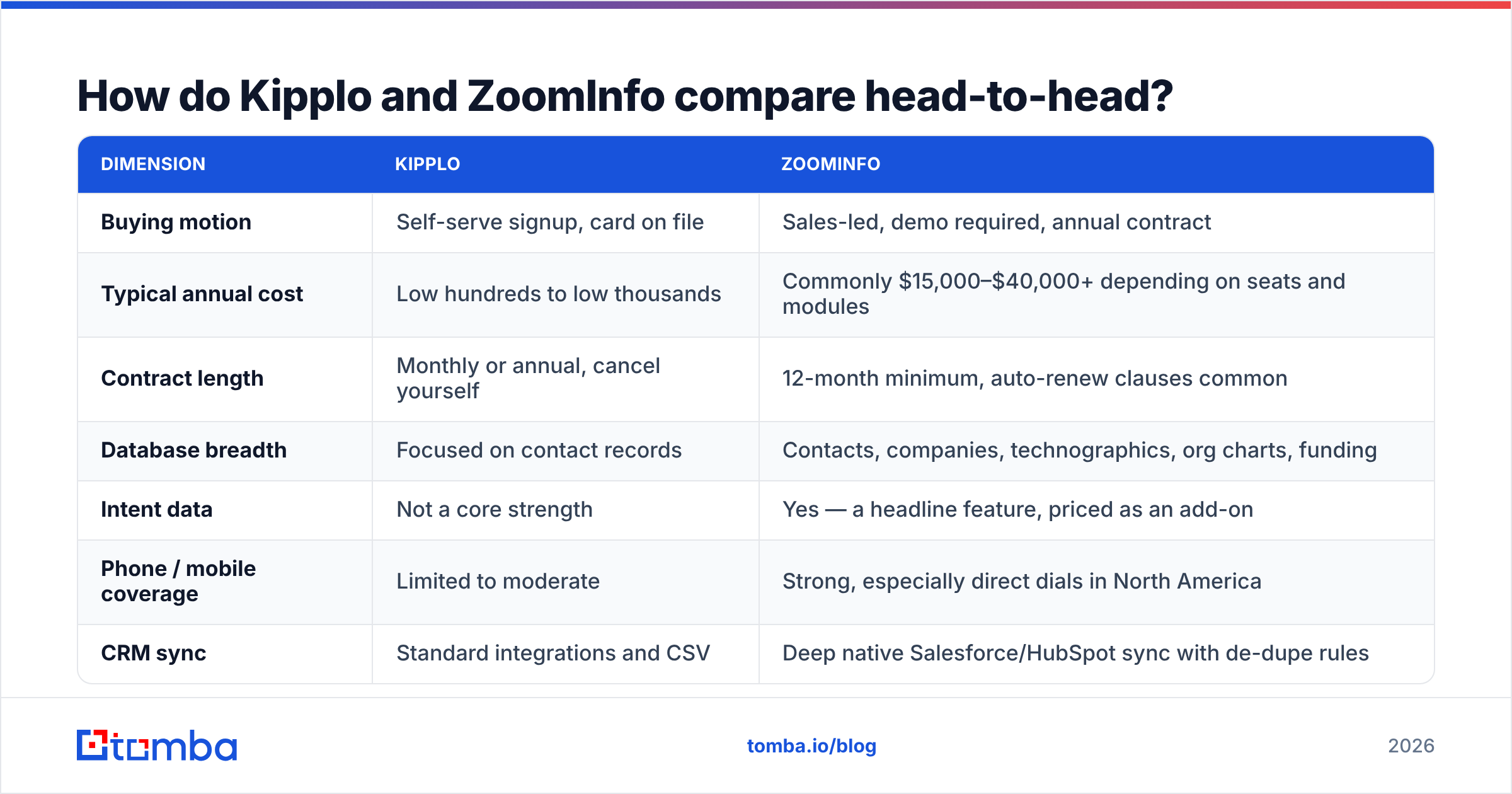
Kipplo vs ZoomInfo: how do they compare head-to-head?#
| Dimension | Kipplo | ZoomInfo |
|---|---|---|
| Buying motion | Self-serve signup, card on file | Sales-led, demo required, annual contract |
| Typical annual cost | Low hundreds to low thousands | Commonly $15,000–$40,000+ depending on seats and modules |
| Contract length | Monthly or annual, cancel yourself | 12-month minimum, auto-renew clauses common |
| Database breadth | Focused on contact records | Contacts, companies, technographics, org charts, funding |
| Intent data | Not a core strength | Yes — a headline feature, priced as an add-on |
| Phone / mobile coverage | Limited to moderate | Strong, especially direct dials in North America |
| CRM sync | Standard integrations and CSV | Deep native Salesforce/HubSpot sync with de-dupe rules |
| Credit model | Per-export credits, transparent | Credit blocks plus seat licences; overage negotiated |
| Support | Email / chat | Named CSM on larger plans, onboarding included |
| Best for | Founders, solo AEs, small outbound teams | 10+ seat sales orgs with a RevOps function |
Read that table twice and one thing stands out. You are not comparing two versions of the same product. You are comparing a tool with a platform. So the honest question is not "which one is better." It is "do I need a platform at all?"
Kipplo vs ZoomInfo pricing: what does each one cost in 2026?#
ZoomInfo does not publish list prices. That is a data point by itself. Buyer reports on G2 and public contract records point to this shape:
- A floor near $15,000 a year for a small team package
- Per-seat licences on top of a shared credit pool
- Modules priced apart — intent, websites, enrich, call recording
- Auto-renewal, unless you give written notice inside the cancel window
Kipplo works the other way round. Tiers are published. Billing is monthly. Credits map to exports. You will pay far less, and you get far less surface area.
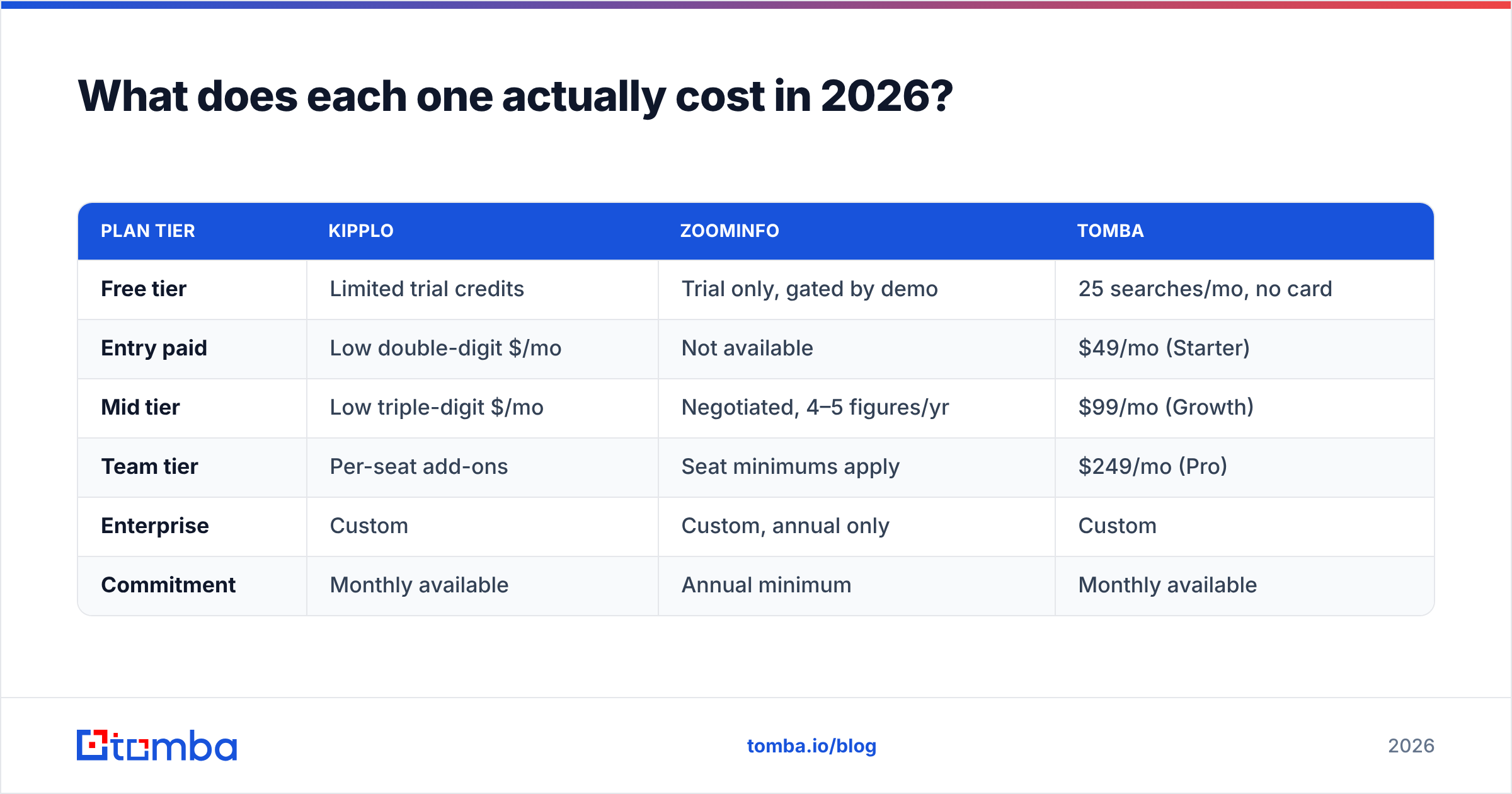
Here is the cost picture with a focused email-finding stack added for scale:
| Plan tier | Kipplo | ZoomInfo | Tomba |
|---|---|---|---|
| Free tier | Limited trial credits | Trial only, gated by demo | 25 searches/mo, no card |
| Entry paid | Low double-digit $/mo | Not available | $49/mo (Starter) |
| Mid tier | Low triple-digit $/mo | Negotiated, 4–5 figures/yr | $99/mo (Growth) |
| Team tier | Per-seat add-ons | Seat minimums apply | $249/mo (Pro) |
| Enterprise | Custom | Custom, annual only | Custom |
| Commitment | Monthly available | Annual minimum | Monthly available |
Full Tomba pricing is public for the same reason Kipplo's is. Neither tool needs a sales call to make sense. That is worth real money when you buy, because you can set a budget without booking a demo.
The trap here is to compare sticker prices. Compare cost per usable contact instead. Say a $15k ZoomInfo deal gives you 40,000 valid contacts a year. Per contact, that beats a $500 tool that gives you 800 with a 30% bounce rate. Do the division before you pick a side.
Which one has better data accuracy?#
Accuracy is where the Kipplo vs ZoomInfo debate usually stalls. ZoomInfo wins on breadth and on direct dials. Kipplo competes on fresh data in the slices it covers. Neither claim helps you until you test both against your own list.

Three things skew these comparisons:
- Geography. ZoomInfo is strongest in North American mid-market and enterprise. If you sell to small firms in Europe, German manufacturers, or LATAM buyers, the gap shrinks. Sometimes it flips.
- Seniority. Everyone has the VP of Sales at a 5,000-person company. Almost nobody has the ops manager at a 40-person trucking firm. Test at the level you actually email.
- Catch-all domains. Many B2B domains accept every address at the mail server. No tool can confirm those by handshake alone. Whether a tool calls them "valid," "risky," or "unknown" moves its score by 10 to 20 points, with no change to the data itself. A catch-all verifier is the only honest way to sort that bucket.
Here is the rule. An accuracy number with no named target list, no named region, and no stated catch-all policy is a marketing number. That holds for every vendor, including the ones you like.
Who should choose ZoomInfo?#
Pick ZoomInfo when at least three of these are true:
- You have 10 or more sellers, so the per-seat cost spreads out.
- You have a RevOps owner who will build the de-dupe rules, the routing, and the enrich jobs. Without one, ZoomInfo turns into a very costly search box.
- Intent data changes how you sell. If nobody acts on a signal within 48 hours, you are paying for a dashboard.
- You sell to North American enterprise, where its direct-dial coverage is hard to match.
- Your buyer prefers one vendor over five. One contract, one DPA, and one security review save real time.
Where it goes wrong: a small team buys the platform, uses 15% of it, and finds the auto-renewal clause eleven months later. If that sounds like your next year, do not sign.

Who should choose Kipplo?#
Pick Kipplo when your problem is narrow:
- You are a founder or solo rep with no room for a five-figure line item.
- You need exports, not plumbing — a list this week, not a data layer this quarter.
- Your sales cycle is short, so a year-long database licence buys you little.
- You want to cancel without a phone call if it does not work out.
Where it goes wrong: teams outgrow it in six months. Then they stitch together four tools that each do a third of the job. Tool sprawl costs real money, even when each line item looks cheap.
Is there a better-fit third option?#
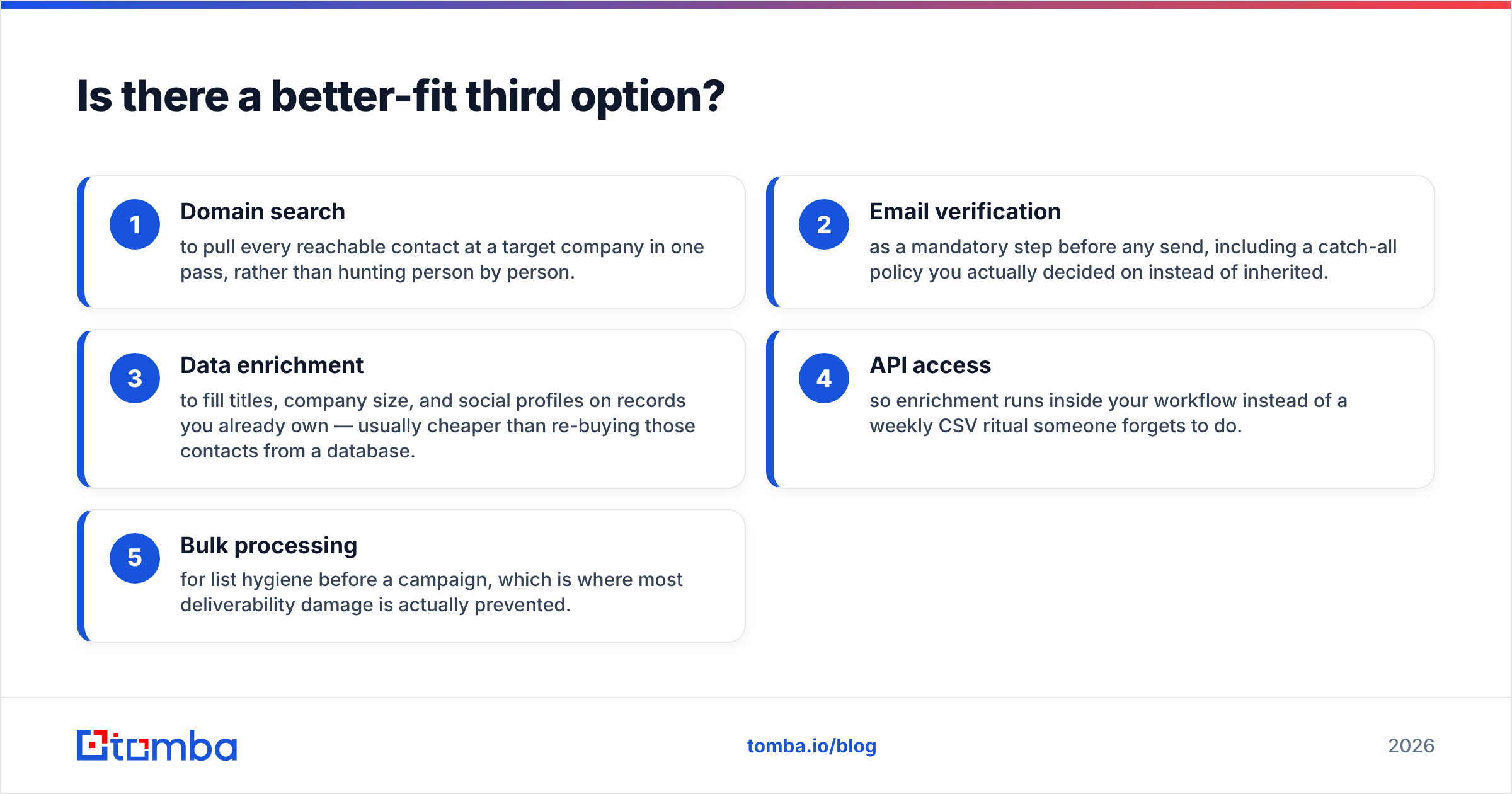
Often, yes. Most teams who search "Kipplo vs ZoomInfo" need three things: find the email, check the email, fill in the record. The rest of a suite is a nice-to-have they never set up.
If that sounds like you, a focused stack beats both:
- Domain search pulls every reachable contact at a target company in one pass, instead of one name at a time.
- Email verification runs before any send, with a catch-all policy you chose on purpose.
- Data enrichment fills in titles, company size, and social profiles on records you already own. That usually beats buying those contacts again.
- API access runs enrichment inside your workflow, not in a weekly CSV ritual someone forgets.
- Bulk processing cleans a list before a campaign. That is where most deliverability damage gets stopped.
One more option deserves a mention. BookYourData sells pay-as-you-go credits with an accuracy guarantee. That suits teams who buy lists in bursts rather than every week. It is a different buying pattern from both tools above, and a fair fit if your outbound runs in campaigns.
How do you run a fair Kipplo vs ZoomInfo bake-off?#
Do not decide from review sites. Run this in a week.
Start with the data pull:
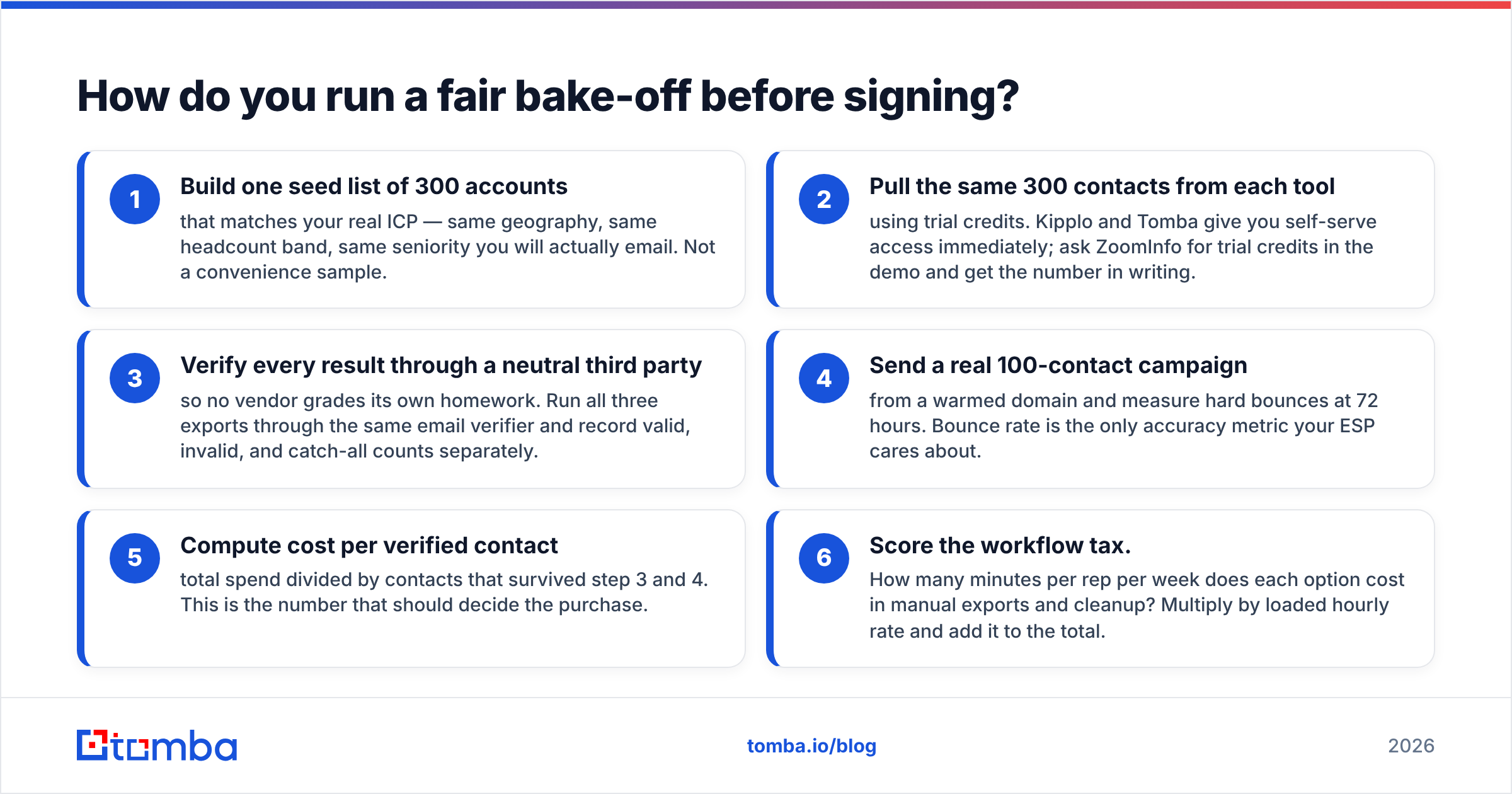
- Build one seed list of 300 accounts that matches your real target: same region, same headcount band, same job level you email. Not a convenience sample.
- Pull the same 300 contacts from each tool on trial credits. Kipplo and Tomba open up right away. Ask ZoomInfo for trial credits in the demo, and get the number in writing.
- Verify every result through a neutral third party, so no vendor grades its own homework. Run all three exports through the same email verifier. Record valid, invalid, and catch-all counts on their own.
Then price the result:
- Send a real 100-contact campaign from a warmed domain. Measure hard bounces at 72 hours. Bounce rate is the only accuracy metric your email platform cares about.
- Work out cost per verified contact. Take total spend and divide by the contacts that survived the checks above. That is the number that should decide the purchase.
- Score the workflow tax. How many minutes a week does each option cost in manual exports and cleanup? Multiply by an hourly rate and add it to the total.
Teams that run this honestly tend to find the same three results. The suite wins on direct dials. The lean tool wins on cost per verified email. And the gap in email accuracy is smaller than any vendor deck suggests.

What are the common mistakes in this decision?#
Buying for the pipeline you want, not the one you have. ZoomInfo's ROI math assumes outbound already works. If your reply rate is 0.4%, better data will not fix it. Your message will.
Ignoring the exit. Ask both vendors, in writing: what happens to exported data if I cancel? How long is the notice window? Can I export my enriched records? The answers differ a lot, and nobody offers them up front.
Treating credits as contacts. A credit spent on a record that bounces is a credit lost. Checking the address is not an extra layer. It is what turns credits into contacts.
Over-indexing on database size. Two hundred million records mean nothing if 900 of them fit your market. Test the 900.
Which should you pick?#
The Kipplo vs ZoomInfo answer comes down to shape, not to record counts.
Do you have a RevOps owner, ten or more sellers, and a North American enterprise motion? Then ZoomInfo earns its contract. Buy it, and set a calendar reminder 60 days before renewal.
Are you early, lean, or running short deals? Then Kipplo is a sane place to start, and it costs almost nothing to test.
And if what you really need is verified email addresses at a set price, skip the platform debate. Start with the Tomba Email Finder: 25 free searches a month with no card, then $49 a month when you outgrow it. The same verify engine sits under the app, the API, and bulk uploads. Run it against your 300-account seed list this week. Compare cost per verified contact, and let that number decide instead of a sales deck.
Related guides#
// get started
Find, verify and enrich your first contacts today
Start on the free plan with 25 searches a month, then scale when your team is ready.
Free plan · No credit card required · GDPR & CCPA
// about the author