Kitt AI Alternatives in 2026: 8 Tools That Replace It
KITT.AI was acquired by Baidu and Snowboy was retired, leaving teams searching for a replacement. Here are eight Kitt AI alternatives for wake words, NLU, and voice agents — with honest pricing, hosting, and fit notes.
TL;DR
- KITT.AI — the Seattle/UW spinout behind Snowboy hotword detection, an NLU engine, and ChatFlow — was acquired by Baidu in 2017, and the hosted Snowboy service was retired at the end of 2020. There is no drop-in successor from the original team.
- "Kitt AI alternatives" splits into three different shopping lists: wake-word detection, intent/NLU, and full voice agents. Buying the wrong layer is the most common mistake.
- For on-device wake words, Picovoice Porcupine is the closest spiritual replacement. For open-source NLU you own, Rasa. For managed conversational flows, Dialogflow CX or Amazon Lex. For LLM-native phone agents, Vapi and Retell AI.
- If you are building an outbound voice or email agent, the speech stack is rarely what breaks first — bad contact data is. Verified numbers and addresses decide whether the agent ever reaches a human.
- Budget reality: open-source is free to license and expensive to operate; managed platforms are cheap to start and expensive at volume. Model the 12-month cost, not the trial.
What happened to KITT.AI?#
KITT.AI was a conversational-AI startup founded in 2015 by researchers out of the University of Washington. It shipped three things people actually used: Snowboy, a lightweight always-on hotword detector that ran on a Raspberry Pi; a customizable NLU engine; and ChatFlow, a dialogue builder. Baidu acquired the company in 2017, and the Snowboy hosted training service was shut down at the end of December 2020.
That timeline matters because it explains the search traffic. People landing on "Kitt AI alternatives" are usually in one of two states: they have an old Raspberry Pi or robotics project whose Snowboy model no longer trains, or they inherited a chatbot built on a KITT.AI component and need a maintained path forward. Archived Snowboy code still floats around GitHub, but running a production wake word on unmaintained 2020-era models is a liability, not a strategy.
The honest framing: you are not replacing a product. You are replacing a layer — and 2026's market has split that layer into much better, much more specialized pieces.
What are you actually replacing?#
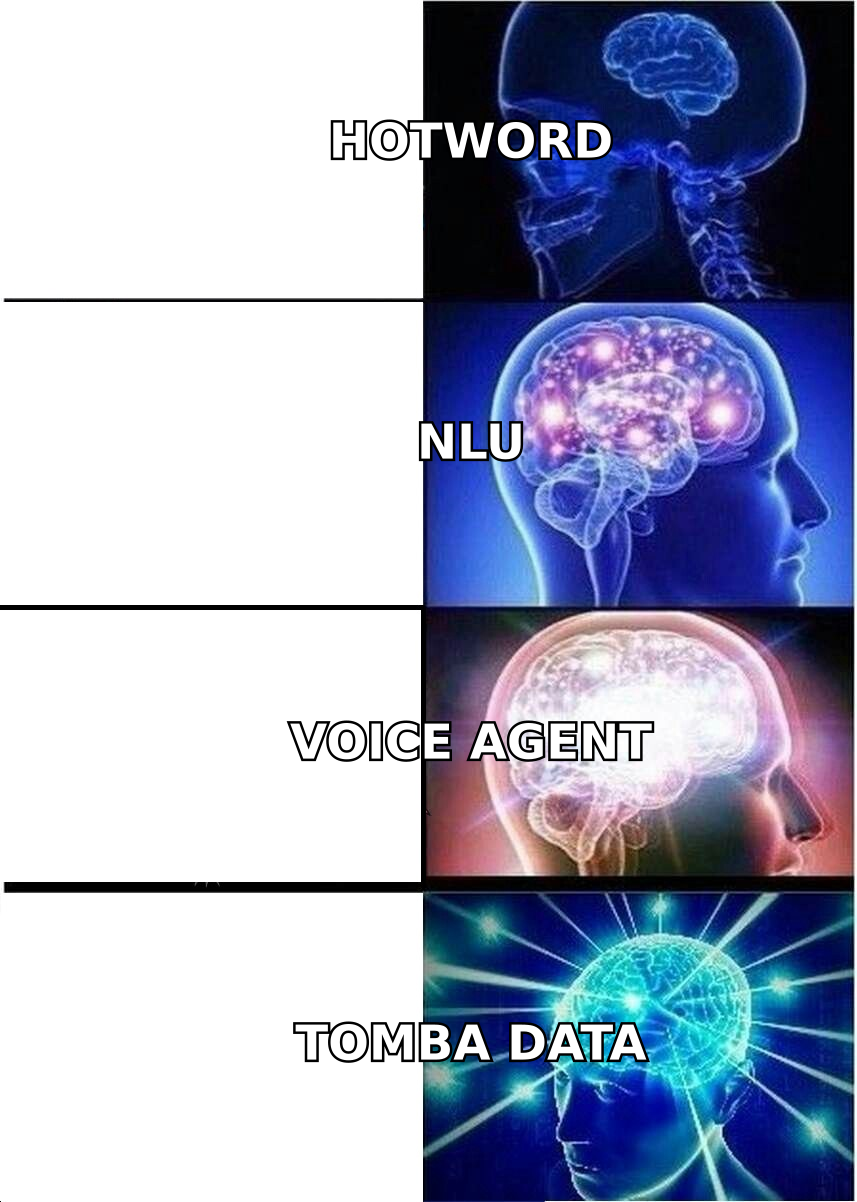
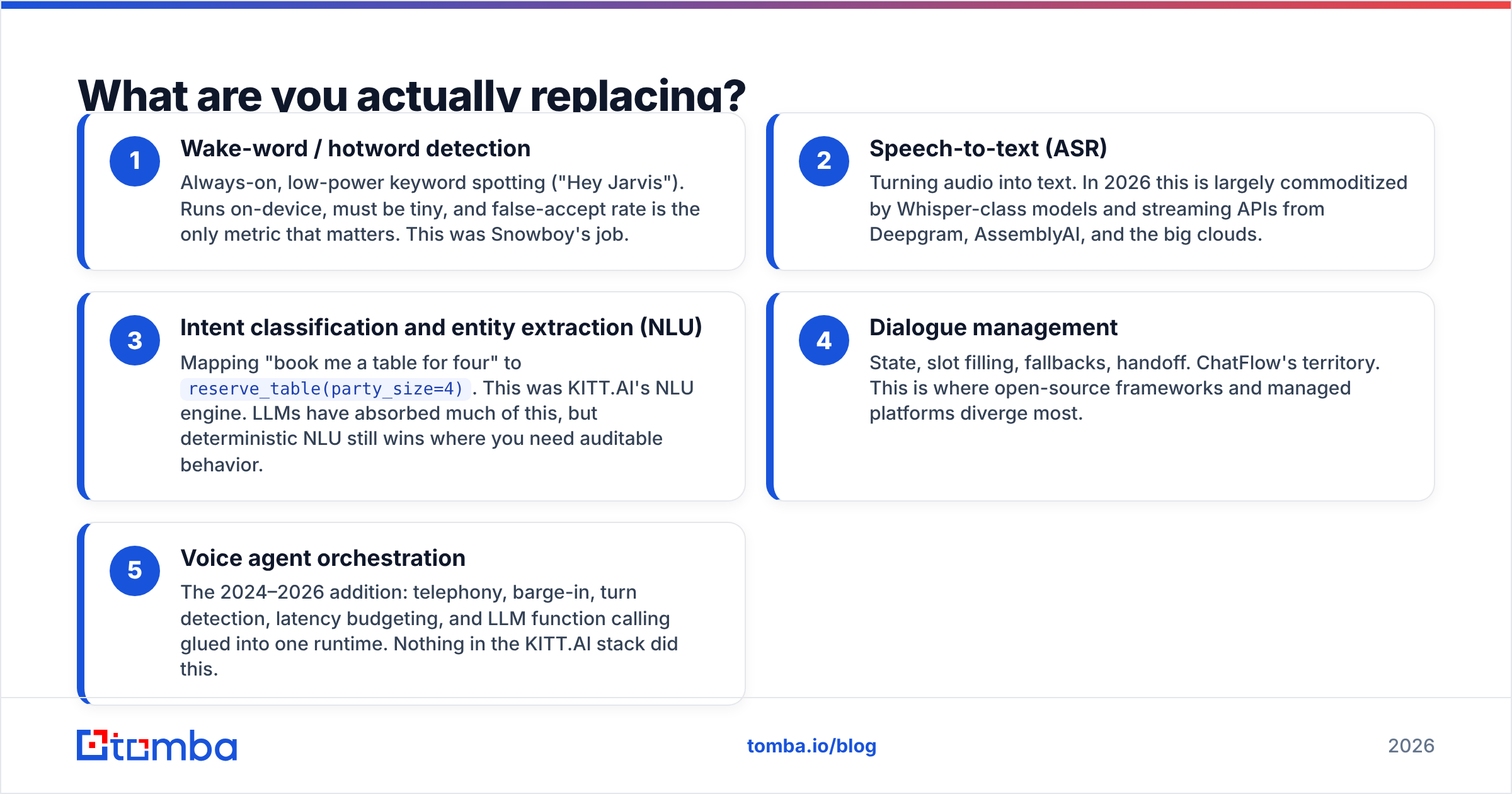
Before you compare vendors, decide which of these you need. Most teams need two, not all four.
- Wake-word / hotword detection — Always-on, low-power keyword spotting ("Hey Jarvis"). Runs on-device, must be tiny, and false-accept rate is the only metric that matters. This was Snowboy's job.
- Speech-to-text (ASR) — Turning audio into text. In 2026 this is largely commoditized by Whisper-class models and streaming APIs from Deepgram, AssemblyAI, and the big clouds.
- Intent classification and entity extraction (NLU) — Mapping "book me a table for four" to
reserve_table(party_size=4). This was KITT.AI's NLU engine. LLMs have absorbed much of this, but deterministic NLU still wins where you need auditable behavior. - Dialogue management — State, slot filling, fallbacks, handoff. ChatFlow's territory. This is where open-source frameworks and managed platforms diverge most.
- Voice agent orchestration — The 2024–2026 addition: telephony, barge-in, turn detection, latency budgeting, and LLM function calling glued into one runtime. Nothing in the KITT.AI stack did this.
What are the best Kitt AI alternatives in 2026?#
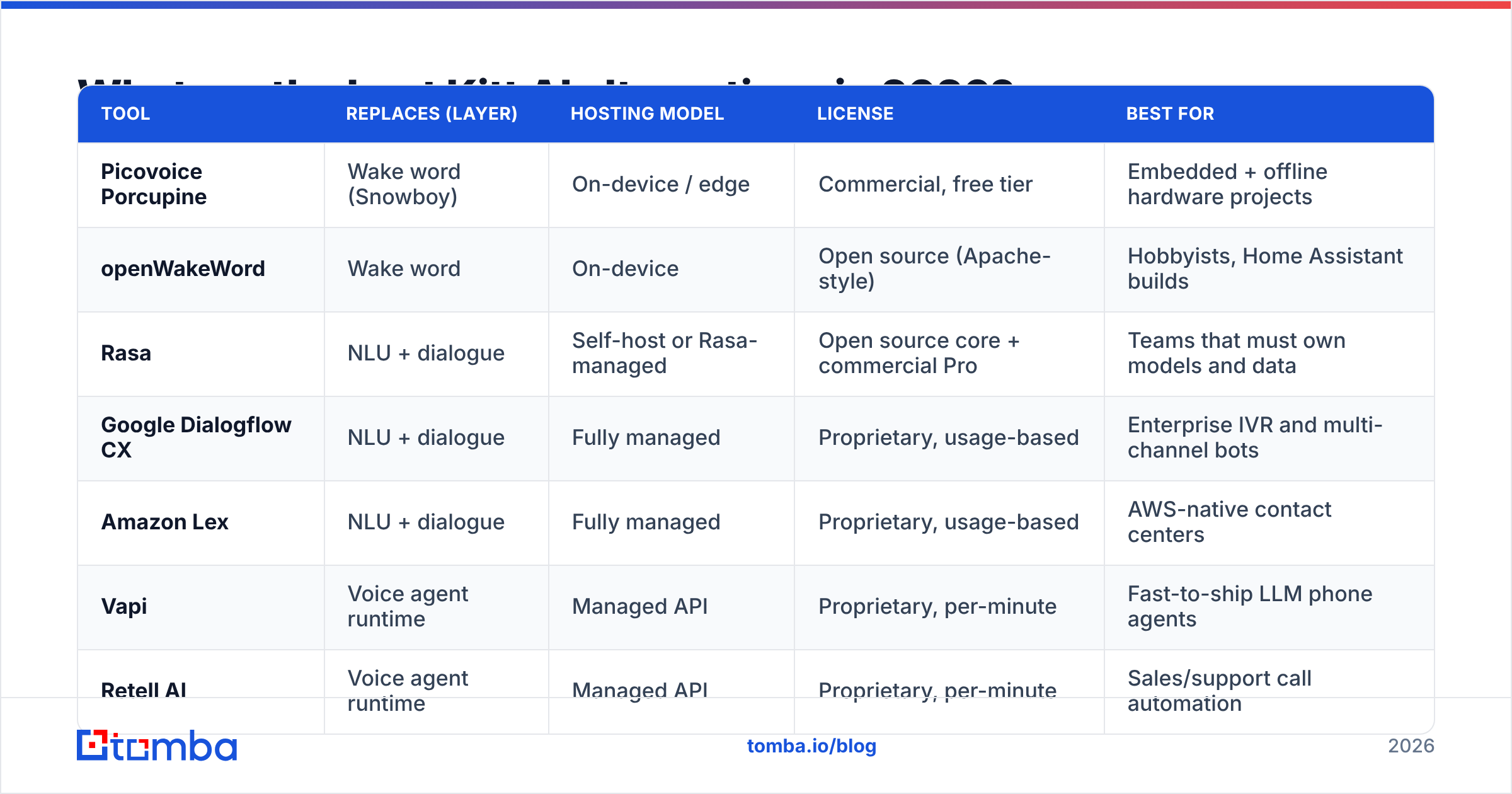
Here is the shortlist, mapped to the layer each one actually replaces.
| Tool | Replaces (layer) | Hosting model | License | Best for |
|---|---|---|---|---|
| Picovoice Porcupine | Wake word (Snowboy) | On-device / edge | Commercial, free tier | Embedded + offline hardware projects |
| openWakeWord | Wake word | On-device | Open source (Apache-style) | Hobbyists, Home Assistant builds |
| Rasa | NLU + dialogue | Self-host or Rasa-managed | Open source core + commercial Pro | Teams that must own models and data |
| Google Dialogflow CX | NLU + dialogue | Fully managed | Proprietary, usage-based | Enterprise IVR and multi-channel bots |
| Amazon Lex | NLU + dialogue | Fully managed | Proprietary, usage-based | AWS-native contact centers |
| Vapi | Voice agent runtime | Managed API | Proprietary, per-minute | Fast-to-ship LLM phone agents |
| Retell AI | Voice agent runtime | Managed API | Proprietary, per-minute | Sales/support call automation |
| Deepgram / AssemblyAI | ASR only | Managed API | Proprietary, per-hour audio | Swapping in better transcription |
Picovoice Porcupine — the closest Snowboy replacement#
If you came here because your Snowboy .pmdl file stopped training, Picovoice is where you should look first. Porcupine does exactly what Snowboy did — tiny, always-on, fully on-device keyword spotting — but it is actively maintained, ships SDKs for Python, C, Android, iOS, Rust, and web, and lets you generate custom wake words from text rather than recording hundreds of samples.
Trade-off: it is commercial software with a free tier for personal and evaluation use. Production and enterprise licensing is quoted, not published. That is the opposite of Snowboy's open origins, and some teams will hate it.
openWakeWord — the free, community option#
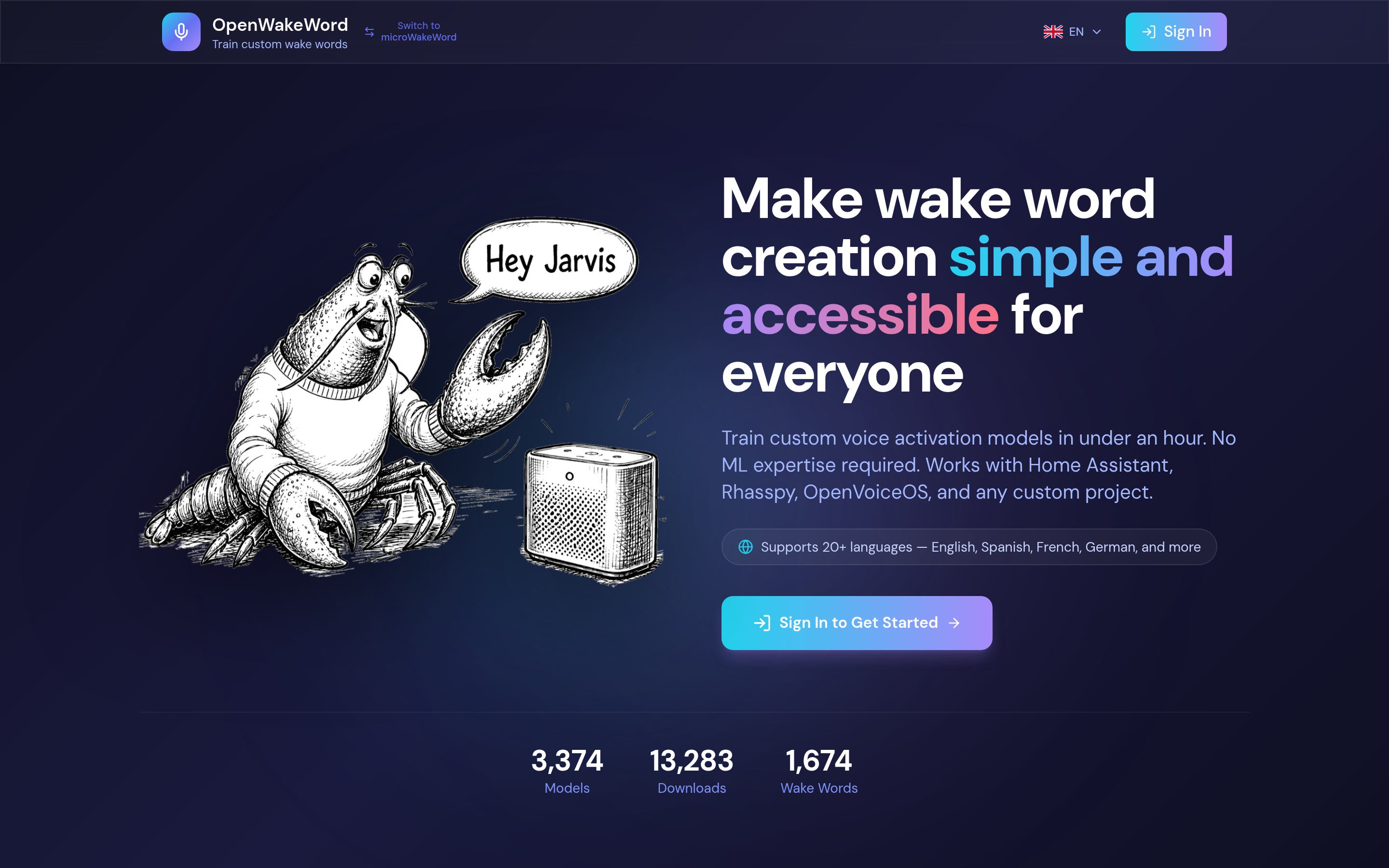
If licensing is the blocker, openWakeWord is the community answer. It is genuinely open, trains on synthetic data, and has a strong install base in the Home Assistant ecosystem. Expect more tuning work and a higher false-accept rate out of the box than Porcupine. For a smart-speaker side project, that's fine. For a shipped consumer device, budget engineering time you would otherwise spend on a license.
Rasa — if you need to own the whole stack#
Rasa is the most direct heir to KITT.AI's NLU-plus-dialogue combination. You define intents, entities, and stories; you train locally; nothing leaves your infrastructure. In regulated industries — health, finance, government — this is often the only viable answer.
Trade-off: Rasa is a platform, not a weekend integration. You need someone who can maintain training data, evaluate model drift, and run the infrastructure. The open-source core is free; the commercial tier is quoted.
Dialogflow CX and Amazon Lex — managed, boring, reliable#
Dialogflow CX is the enterprise option when you want visual flow design, built-in telephony integration, and someone else's SRE team. Amazon Lex is the equivalent if your contact center already lives in AWS Connect. Both charge per request or per session, both scale fine, and both make you a tenant rather than an owner.
Pick these when governance means "a vendor with a support SLA," not "our own weights."
Vapi and Retell AI — the layer KITT.AI never had#
These did not exist when Snowboy shipped. Both give you a hosted runtime that handles telephony, streaming ASR, LLM reasoning, TTS, interruption handling, and function calling — typically billed per minute of conversation. You supply the prompt, the tools, and the phone numbers.
If your real goal is "an AI that calls or answers leads," you want this category, not a wake-word engine. Read reviews on G2 before committing; this category churns fast and feature parity changes quarterly.
How do these Kitt AI alternatives compare on cost?#
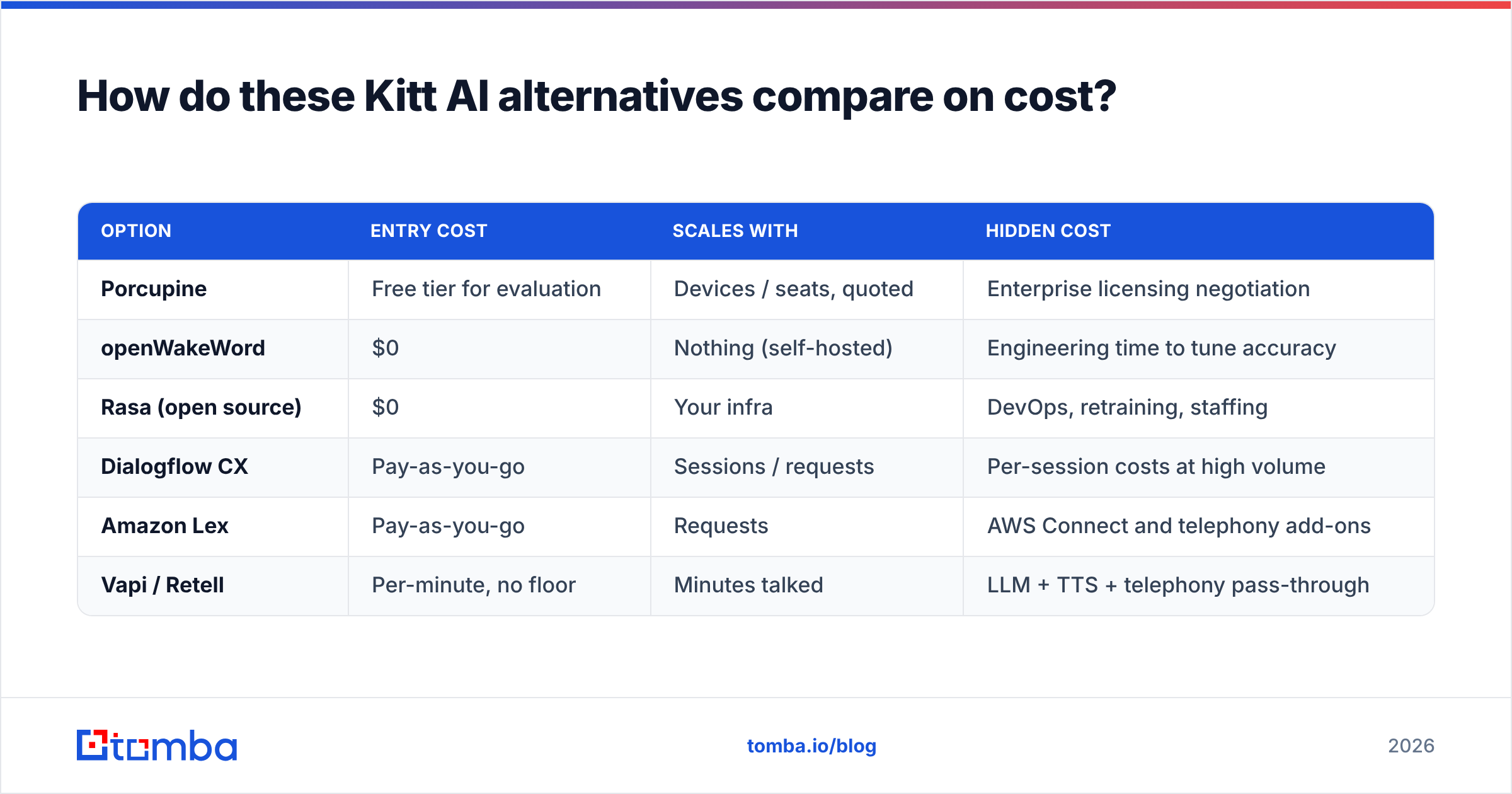
Pricing models differ enough that a straight per-month comparison misleads. Here is the shape of each, which is what actually drives your 12-month bill.
| Option | Entry cost | Scales with | Hidden cost |
|---|---|---|---|
| Porcupine | Free tier for evaluation | Devices / seats, quoted | Enterprise licensing negotiation |
| openWakeWord | $0 | Nothing (self-hosted) | Engineering time to tune accuracy |
| Rasa (open source) | $0 | Your infra | DevOps, retraining, staffing |
| Dialogflow CX | Pay-as-you-go | Sessions / requests | Per-session costs at high volume |
| Amazon Lex | Pay-as-you-go | Requests | AWS Connect and telephony add-ons |
| Vapi / Retell | Per-minute, no floor | Minutes talked | LLM + TTS + telephony pass-through |
The pattern is consistent: self-hosted options move cost from invoices to headcount, and managed options move it back. A two-engineer startup almost always overpays by self-hosting. A 200-person enterprise with a platform team almost always overpays by not.
Always price against your realistic volume. A voice agent at $0.07/minute handling 3,000 calls a month at four minutes each is roughly $840/month before LLM and telephony pass-through — which is a very different conversation than the $0 you saw on the landing page.
Is the speech stack really your bottleneck?#
Probably not. This is the part most "alternatives" posts skip.
If you are building an inbound assistant for a device, yes — wake-word quality and latency are everything. But if you are building an outbound agent, whether voice or email, the failure mode is almost never the model. It is that the agent dials a disconnected number, emails a bounced address, or reaches someone who left the company eighteen months ago. You paid for a perfect conversation with nobody.

The fix is unglamorous: validate the contact layer before the AI layer touches it.
- Run your list through an email verifier so your agent is not burning sender reputation on bounces.
- Check mobile and direct lines with a phone validator before your voice agent spends a minute per dead dial.
- Pull enrichment and contact discovery programmatically via the Tomba API so the same pipeline that feeds your agent also keeps it current.
Tomba is not a Kitt.ai replacement — it does not do wake words, ASR, or dialogue management, and anyone who tells you otherwise is selling. It sits one layer earlier, on the data your agent acts on. That distinction is worth keeping clear when you build your stack diagram.
Which alternative should you choose?#
Use this decision path rather than a feature checklist:
- You had a Snowboy model and need it working again → Porcupine if you can accept commercial licensing, openWakeWord if you cannot.
- You inherited a KITT.AI NLU or ChatFlow bot → Rasa if data residency matters; Dialogflow CX if speed to production matters more.
- You are already deep in AWS → Lex, and stop shopping.
- You want an AI that makes or answers phone calls for sales → Vapi or Retell, plus a verified contact source. Skip the wake-word layer entirely.
- You only need better transcription → Deepgram or AssemblyAI. Don't rebuild a platform for an ASR upgrade.
One more caution: the LLM-native voice category is young. Contracts should be month-to-month or short-term until you have run real volume through the vendor. The open-source options can't disappear on you, which is a real feature — and the exact lesson the Snowboy sunset taught everyone who built on it.
What should you do before you migrate?#
Write down three numbers first: your acceptable false-accept rate (for wake words), your acceptable p95 response latency (for agents), and your monthly conversation volume. Every vendor conversation gets faster and more honest once those exist. Without them, you will end up comparing marketing pages instead of systems.
Then prototype two options in parallel, not one. The cost of running a second proof-of-concept for a week is far lower than the cost of discovering, six months in, that the managed platform's per-session pricing does not survive your growth curve.
Feeding your AI agent contacts it can actually reach#
Whatever you pick to replace KITT.AI — Porcupine, Rasa, Dialogflow, Vapi — your agent is only as useful as the list it works from. Tomba Email Finder gives you verified professional email addresses by name, domain, or company, with a free tier of 25 searches per month, Starter at $49/mo, Growth at $99/mo, and Pro at $249/mo. See full Tomba pricing before you commit.
Start with the Tomba Email Finder, pipe verified contacts into whichever agent runtime you chose, and let the conversational AI spend its minutes on people who actually exist.
Related guides#
// get started
Find, verify and enrich your first contacts today
Start on the free plan with 25 searches a month, then scale when your team is ready.
Free plan · No credit card required · GDPR & CCPA
// about the author