Klenty vs Outreach (2026): Which Sales Engagement Wins?
Klenty is cheap, fast to deploy, and good enough for most SMB teams. Outreach costs several times more and earns it only in specific conditions. Here is the honest breakdown of where each one actually wins.
TL;DR
- Klenty wins on price and speed. Published seat pricing, no mandatory platform fee, and a team can be sending sequences the same week they sign up.
- Outreach wins on depth. Forecasting, conversation intelligence, deal management, and admin governance that a 200-rep org actually needs — at a price that only makes sense at that size.
- The break-even is roughly 15-25 reps. Below it, Outreach's per-seat cost plus implementation rarely pays back. Above it, Klenty starts creaking on reporting and permissions.
- Neither tool fixes your data. Both are send-and-track layers. If your contact list bounces at 20%, switching platforms changes nothing.
- Our pick for most teams: Klenty for SMB and mid-market outbound, Outreach for enterprise revenue orgs that need forecasting in the same system as sequencing.
What are Klenty and Outreach, and why are they compared?#
Both are sales engagement platforms: software that sequences multi-step outreach (email, calls, LinkedIn tasks), tracks replies, and syncs activity back to your CRM. They land in the same buying committee's shortlist because they solve the same core job — getting a rep to touch 300 prospects a week without a spreadsheet.
That is where the similarity stops.
Klenty launched as an email sequencing tool and grew outward into calls, LinkedIn steps, and a routing product. It sells self-serve and low-touch, publishes its pricing, and is priced per user with no separate platform fee. Its center of gravity is the SDR who needs to send and follow up reliably.
Outreach started in the same place but repositioned as a "sales execution platform." It now bundles sequencing with deal management, pipeline forecasting, conversation intelligence (Kaia), and a mature admin layer. Pricing is quote-only, annual, and typically carries a platform fee on top of seats. Its center of gravity is the VP of Sales who wants forecast accuracy, not just send volume.
So "Klenty vs Outreach" is really a question about scope: do you want a sequencing tool that does one job well, or a revenue platform that absorbs three tools and charges accordingly?
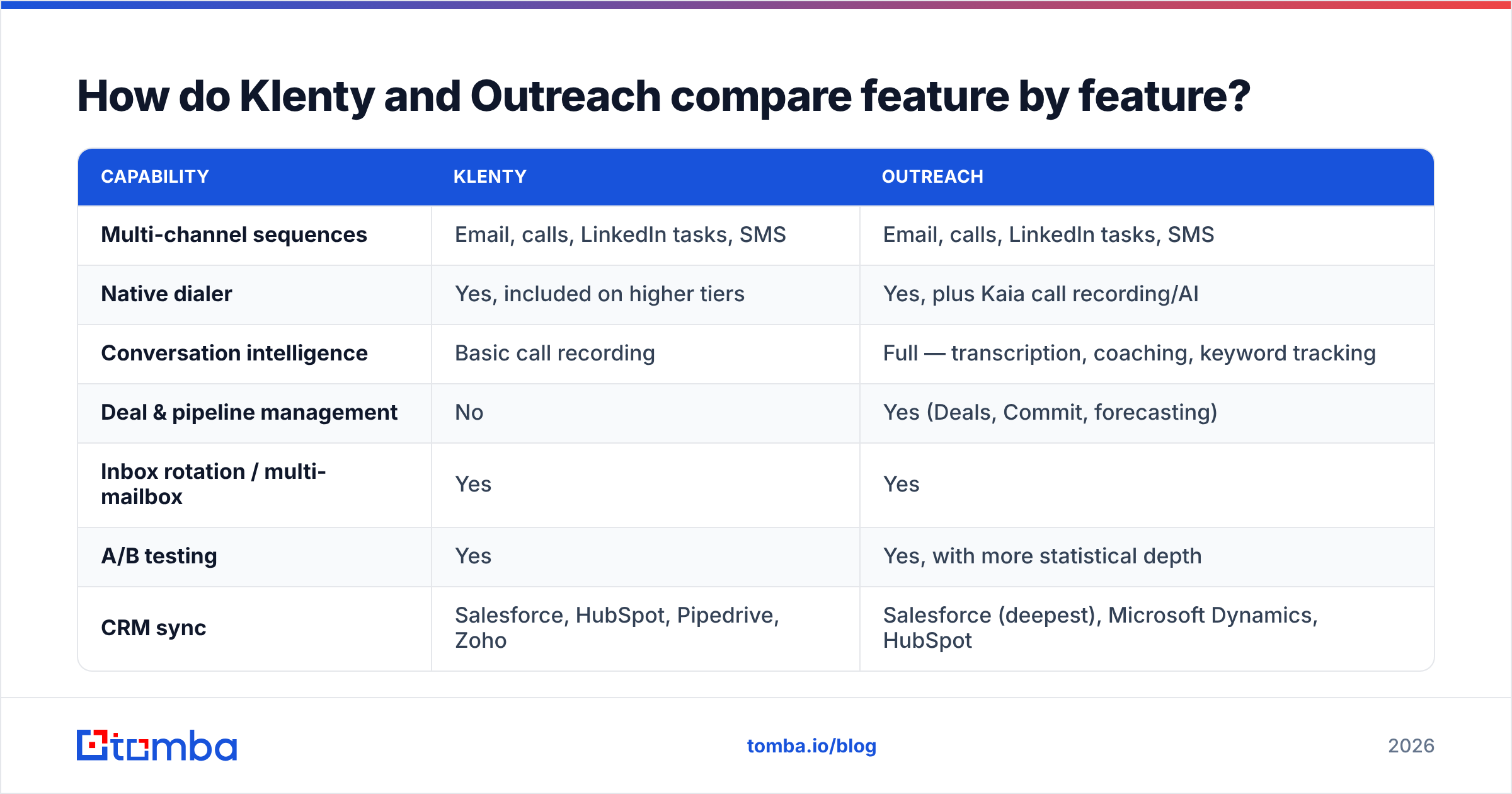
How do Klenty and Outreach compare feature by feature?#
| Capability | Klenty | Outreach |
|---|---|---|
| Multi-channel sequences | Email, calls, LinkedIn tasks, SMS | Email, calls, LinkedIn tasks, SMS |
| Native dialer | Yes, included on higher tiers | Yes, plus Kaia call recording/AI |
| Conversation intelligence | Basic call recording | Full — transcription, coaching, keyword tracking |
| Deal & pipeline management | No | Yes (Deals, Commit, forecasting) |
| Inbox rotation / multi-mailbox | Yes | Yes |
| A/B testing | Yes | Yes, with more statistical depth |
| CRM sync | Salesforce, HubSpot, Pipedrive, Zoho | Salesforce (deepest), Microsoft Dynamics, HubSpot |
| Admin & permissions | Basic roles | Granular governance, SSO, audit trails |
| Built-in contact data | Limited | Limited (Outreach positions partners for data) |
| Pricing transparency | Published per-seat tiers | Quote only, annual contract |
| Typical time to first send | Days | Weeks (implementation) |
| Support model | Chat/email, fast response | CSM on larger contracts |
Two lines in that table matter more than the rest.
Deal and pipeline management. If you strip this out, Outreach and Klenty do broadly the same sequencing job, and Klenty does it for a fraction of the price. Everything Outreach charges a premium for lives in the forecasting and coaching layer. If your RevOps team already runs forecasting in Salesforce, Clari, or a spreadsheet that works, you are paying twice.
Time to first send. Klenty is a tool you configure. Outreach is a system you implement. Teams routinely budget 4-8 weeks for an Outreach rollout including CRM field mapping, sequence migration, and admin training. That is real cost even when it is not on the invoice.
What does each one actually cost in 2026?#
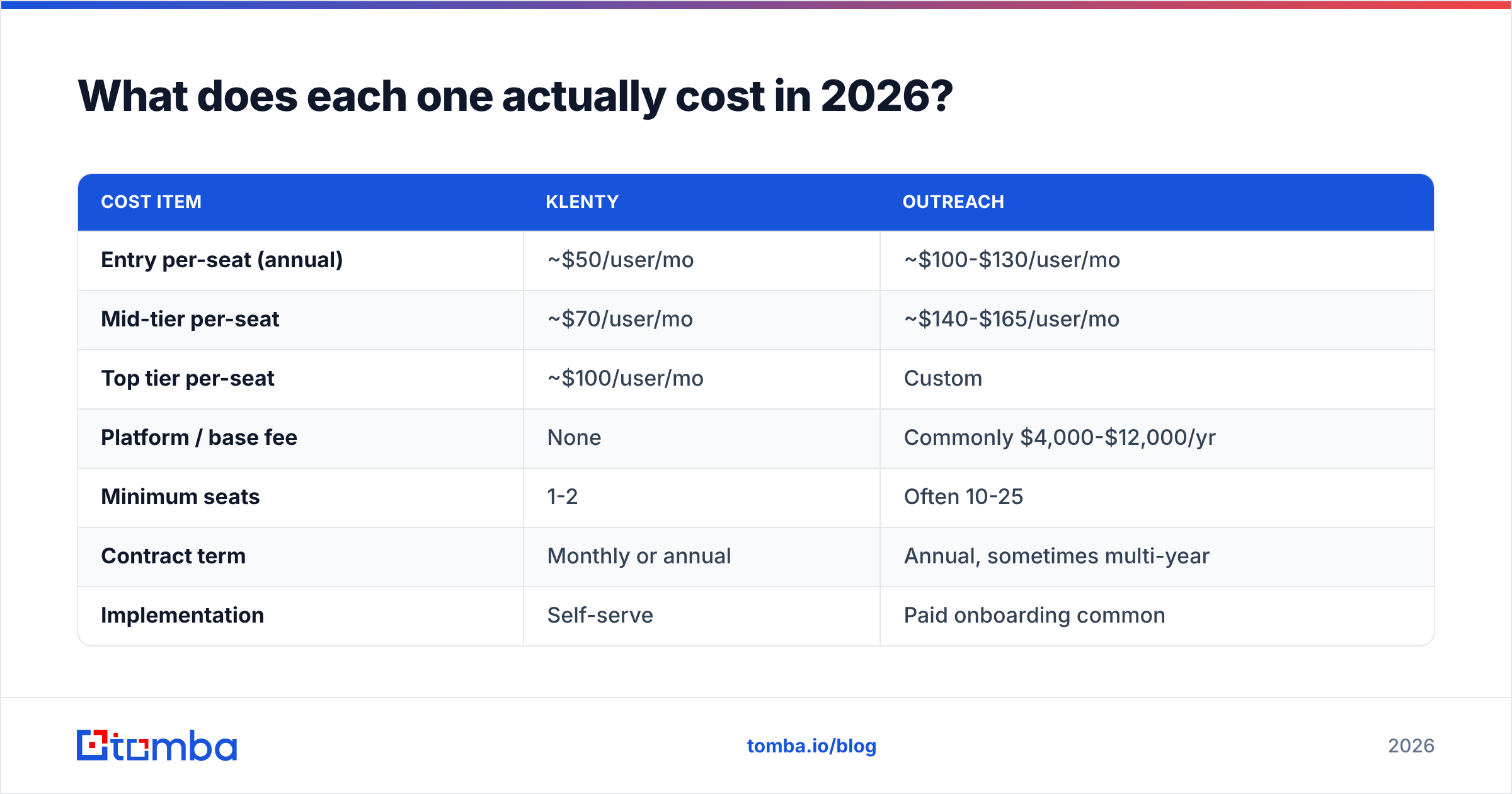
Klenty publishes tiers; Outreach does not. Treat the Outreach column as the range buyers consistently report on G2 and in procurement threads, not as a quoted price. Always confirm against the vendor.
| Cost item | Klenty | Outreach |
|---|---|---|
| Entry per-seat (annual) | ~$50/user/mo | ~$100-$130/user/mo |
| Mid-tier per-seat | ~$70/user/mo | ~$140-$165/user/mo |
| Top tier per-seat | ~$100/user/mo | Custom |
| Platform / base fee | None | Commonly $4,000-$12,000/yr |
| Minimum seats | 1-2 | Often 10-25 |
| Contract term | Monthly or annual | Annual, sometimes multi-year |
| Implementation | Self-serve | Paid onboarding common |
| 10-rep annual estimate | ~$6,000-$12,000 | ~$20,000-$35,000 |
Run the 10-rep line twice and the argument makes itself. A ten-person SDR team on Klenty spends roughly what a ten-person team on Outreach spends on the platform fee alone. For that delta you could fund a full-time SDR, or a year of accurate contact data, or both.
Where that math flips: at 100+ seats, Outreach's per-seat rate negotiates down, and the cost of not having governance — reps sending off-brand sequences, no audit trail, no territory-level reporting — starts producing real losses. Enterprise buyers are not overpaying out of ignorance. They are buying control.
Is Klenty good enough to replace Outreach?#
For most teams under 25 reps: yes, and the gap is smaller than the price difference suggests.
Here is what you actually lose by choosing Klenty:
- Forecasting inside the same tool. You will forecast in your CRM or a dedicated tool. For most SMB teams this is already true, so the loss is theoretical.
- Conversation intelligence depth. Klenty records; Outreach analyzes. If you coach reps off call transcripts weekly, that gap is real. If nobody has opened a recording in three months, it is not.
- Granular admin governance. SSO, audit logs, and fine-grained permissions matter at 50+ seats and rarely below 20.
- Salesforce sync sophistication. Outreach's Salesforce integration handles more edge cases — custom objects, complex field mapping, bidirectional rules. Klenty's sync is competent but simpler.
- Ecosystem gravity. More consultants, more prebuilt playbooks, more people who already know the tool when you hire them.
And what you gain:
- Budget back. Typically 60-70% of the platform spend at small team sizes.
- Speed. Sequences live in days, not after a six-week implementation.
- Less admin overhead. No dedicated Outreach admin role required.
- Contract flexibility. Monthly options mean a bad quarter does not lock you in.
Where does Outreach genuinely win?#
Be honest about these — they are not marketing points.
Multi-team governance. When you have five sales segments, three geographies, and a compliance team that cares which templates go out, Outreach's admin layer is the product. Klenty does not attempt this.
Forecast-to-activity attribution. Outreach can connect a sequence touch to a deal stage to a forecast call in one system. Stitching that across Klenty plus a CRM plus a BI tool is possible but becomes someone's full-time job.
Rep coaching at scale. Kaia transcribing and scoring every call, surfacing keyword patterns across 80 reps, is the kind of thing that only pays off with volume — and at volume, it genuinely pays off.
Procurement comfort. Enterprise security reviews, SOC 2 posture, MSA negotiation, dedicated CSM. If your buyer needs a vendor that survives an InfoSec questionnaire without drama, Outreach is the safer path.
What do both tools fail to solve?#
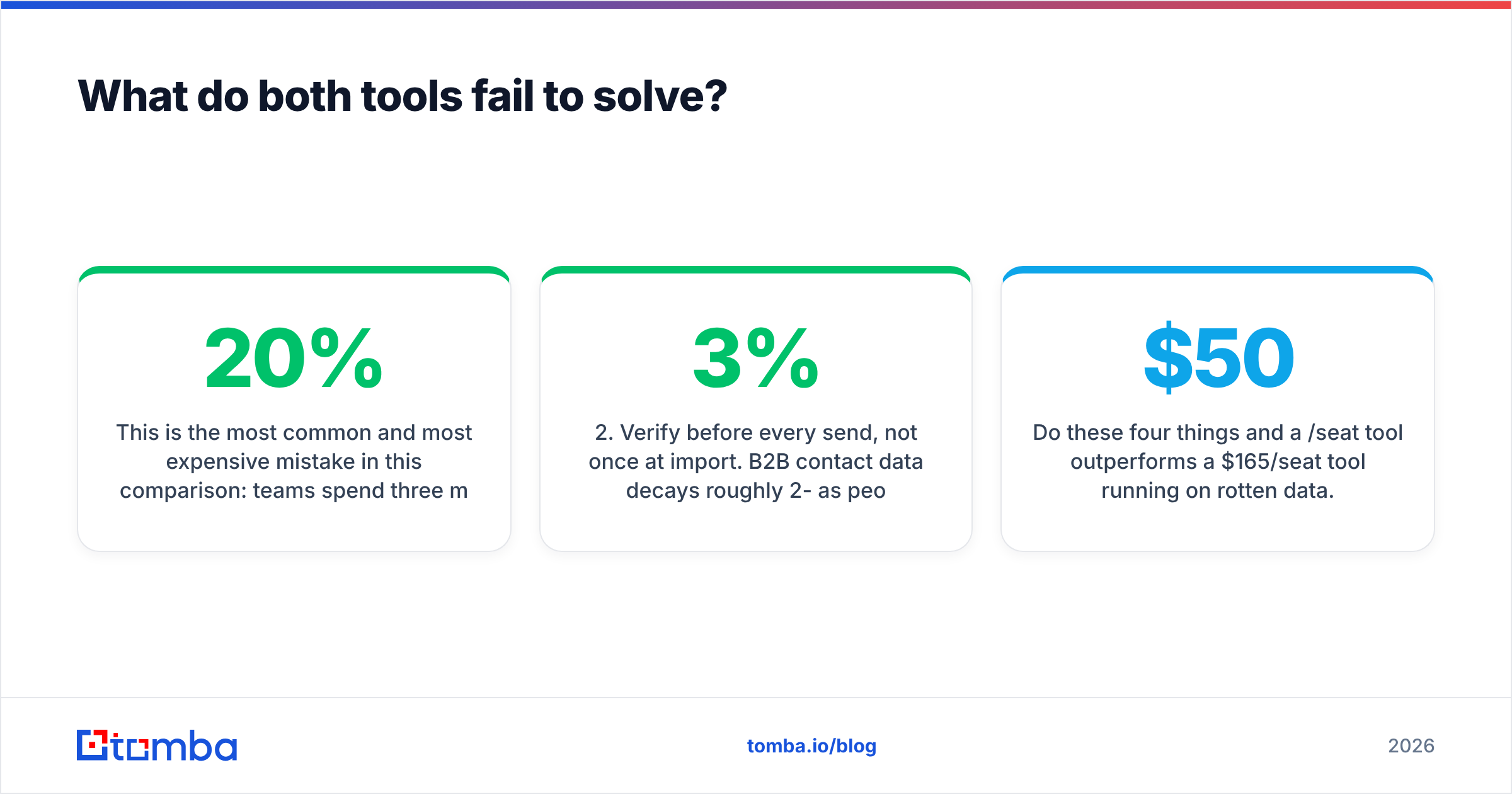
Data. Neither Klenty nor Outreach is a contact database, and both will happily send 5,000 emails to addresses that do not exist.
This is the most common and most expensive mistake in this comparison: teams spend three months evaluating sequencing platforms while their bounce rate sits at 20% and their sender reputation quietly collapses. Mailbox providers read hard bounces as a spam signal. Push past roughly 3% and your inbox placement degrades across every sequence, on whichever platform you picked.
The order of operations that actually works:
- Source contacts from a real provider. Whether that is a verified B2B database, a purpose-built list vendor like BookYourData, or an API you query at enrichment time, stop exporting stale CSVs from a 2023 scrape.
- Verify before every send, not once at import. B2B contact data decays roughly 2-3% per month as people change jobs. A list verified in January is measurably worse in June. Run addresses through an email verifier as part of the workflow, not as a one-time cleanup project.
- Handle catch-all domains explicitly. A large share of enterprise domains accept everything at the SMTP layer, which means a standard verification check returns "unknown." A catch-all verifier is what separates a usable enterprise list from a guess.
- Enrich at the point of sequencing. Pull title, company size, and current employer when the contact enters the sequence, not when it entered your CRM two years ago.
- Measure bounce rate per sequence, not per account. One bad segment can drag a healthy domain down; per-sequence visibility catches it in week one instead of month three.
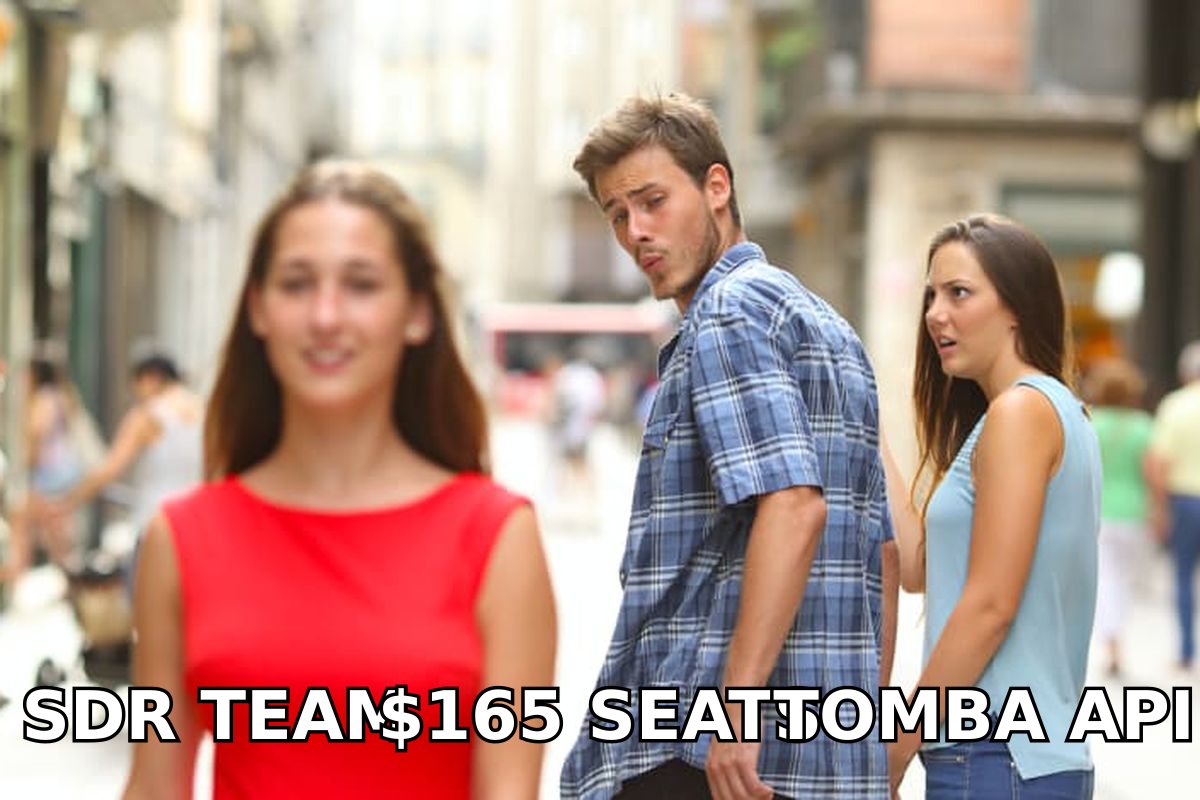
Do these four things and a $50/seat tool outperforms a $165/seat tool running on rotten data. The platform amplifies your list quality. It does not create it.
Which one should you pick?#
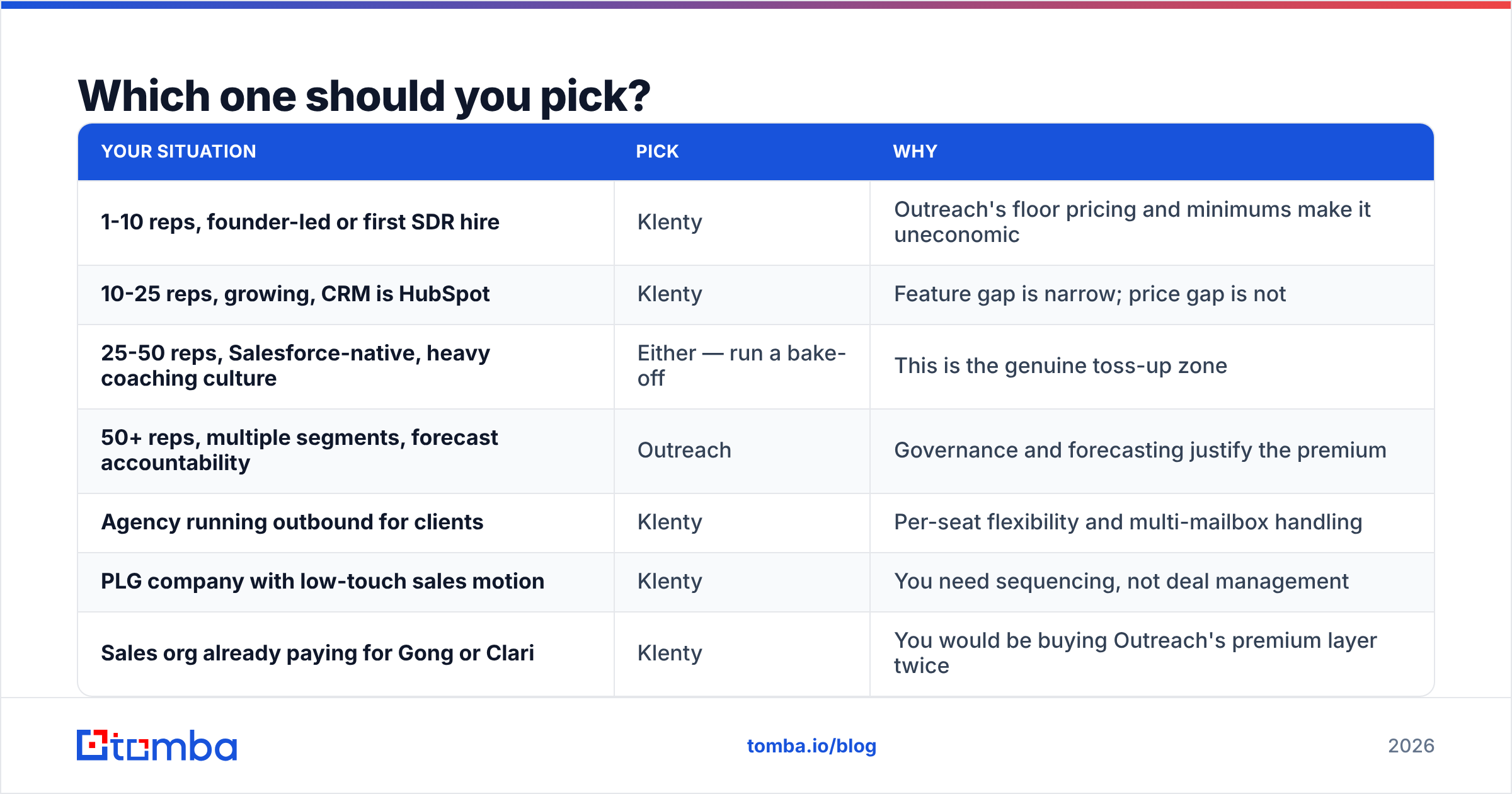
Match yourself to a row.
| Your situation | Pick | Why |
|---|---|---|
| 1-10 reps, founder-led or first SDR hire | Klenty | Outreach's floor pricing and minimums make it uneconomic |
| 10-25 reps, growing, CRM is HubSpot | Klenty | Feature gap is narrow; price gap is not |
| 25-50 reps, Salesforce-native, heavy coaching culture | Either — run a bake-off | This is the genuine toss-up zone |
| 50+ reps, multiple segments, forecast accountability | Outreach | Governance and forecasting justify the premium |
| Agency running outbound for clients | Klenty | Per-seat flexibility and multi-mailbox handling |
| PLG company with low-touch sales motion | Klenty | You need sequencing, not deal management |
| Sales org already paying for Gong or Clari | Klenty | You would be buying Outreach's premium layer twice |
That last row catches more teams than people expect. If you already own conversation intelligence and forecasting, Outreach's differentiators are duplicates, and you are paying enterprise pricing for a sequencing tool. Price it against Klenty honestly before renewing.
If you are already on Outreach and the renewal quote made you wince, the evaluation worth running is not just Klenty — look at the full field of Outreach alternatives before you assume the choice is binary.
How should you run the evaluation?#
Do not evaluate on feature lists. Both vendors will demo well.
Run a 30-day parallel test with the same list. Split a segment of 400 verified contacts in half, run identical sequences on each platform, and compare reply rate, bounce rate, and time-to-first-meeting. Identical copy, identical timing, identical data quality. Anything else and you are measuring noise.
Time the admin work. Have one person build the same three-step sequence on both, from scratch, and log the minutes. Klenty typically wins by a wide margin. If the gap is under 15 minutes, the ease-of-use argument is weaker than you assumed.
Test the CRM sync with real edge cases. Duplicate contacts, custom fields, a lead that converts to a contact mid-sequence. This is where integrations break, and it never surfaces in a demo.
Get the total contract, not the seat price. Ask both vendors for a three-year TCO including platform fees, implementation, mandatory training, and the cost of adding 10 seats in year two. Outreach's year-one and year-three numbers are often very different.
Check response rate against a baseline you trust. If your current baseline is 2% and both trials come back at 2.1%, the platform was never your bottleneck — your list or your copy was.
The verdict#
Klenty is the right default for teams under about 25 reps, and the burden of proof sits with anyone arguing for Outreach at that size. Outreach earns its price at enterprise scale, where governance, forecasting, and coaching infrastructure are genuinely load-bearing — not at ten seats where they are shelfware.
But run the diagnostic before you run the bake-off. If your bounce rate is above 3%, your reply rate is under 1%, or your CRM is full of contacts who changed jobs eighteen months ago, no sequencing platform on the market will move your number. Fix the input first.
Start with the data layer. Before you commit to a platform contract, run your target account list through Tomba Email Finder to get verified, deliverable addresses by domain, name, or company — then feed those into whichever platform you choose. The free tier covers 25 searches a month so you can validate list quality before spending anything; paid plans start at $49/mo, and full Tomba pricing is public. A clean list on a $50/seat tool beats a stale one on a $165/seat platform every single quarter.
Related guides#
Ready to find emails that actually work?
Join 150,000+ professionals who stopped guessing and started sending. Free credits on signup — no credit card required.
Get the Tomba newsletter
Practical outbound tactics and product updates — once every two weeks.
About the author