Labnify vs Seamless.AI: Which Tool Fits Your Outbound Stack
Labnify sends email. Seamless.AI sells contact data. They get compared constantly, but they solve opposite halves of the outbound problem. Here is the honest breakdown of what each one does, what it costs, and which one you actually need first.
TL;DR
- Labnify and Seamless.AI are not competitors in any meaningful sense. Labnify is sending and deliverability infrastructure. Seamless.AI is a contact database with an AI search layer on top.
- If your problem is "my emails land in spam," Labnify is the relevant category. If your problem is "I don't know who to email," Seamless.AI is.
- Seamless.AI is quote-based and seat-priced, with a small free credit allowance. Publicly reported seat costs cluster well above $100/month, and annual contracts are the norm.
- Seamless.AI's biggest recurring complaint across review sites is data freshness. You will need an independent verification step before you send, regardless of which sending tool you pick.
- The cheapest working stack for most teams is a dedicated email finder plus verifier feeding a sending tool you already trust, not a single vendor trying to do both badly.
What are Labnify and Seamless.AI, exactly?#
Start here, because the entire comparison collapses once you see the category split.
Labnify is an email sending platform. It handles the part of outbound that happens after you have a list: SMTP routing, sending volume, warmup behavior, campaign scheduling, bounce handling, and inbox placement. Its pitch is aimed at people who have been throttled, blocked, or spam-foldered by a general-purpose ESP and want infrastructure built for outbound volume. You can see its current positioning and plan structure on labnify.com.
Seamless.AI is a B2B contact database. Its pitch is the opposite half: it finds the people. You search by title, industry, company size, or technology, and it returns names with work emails and direct dials, sourced from a real-time crawl plus a large stored database. It exports to CRM and sequencer tools. Its own product pages live at seamless.ai.
So "Labnify vs Seamless.AI" is really the question "which half of my outbound machine is broken right now?" A lot of teams search this comparison because both tools showed up in a list of "cold email tools," which is a category so broad it includes three unrelated jobs: finding contacts, verifying contacts, and sending to them.
Here is the clean split:
- Contact discovery — who exists, what their title is, which company they're at. Seamless.AI plays here. So do Apollo, ZoomInfo, and BookYourData.
- Contact verification — does this mailbox actually accept mail today. A separate discipline; most databases do this poorly because a stale record still counts as a delivered credit.
- Sequencing and copy — what you say and when you follow up. Instantly, Smartlead, Salesloft, and Outreach live here.
- Sending infrastructure — SMTP, IPs, domains, warmup, throttling, inbox placement. Labnify plays here, alongside dedicated sending providers.
- CRM and reporting — where the reply becomes a pipeline record. HubSpot, Salesforce, Pipedrive.
Pick a tool for the layer that's actually failing. Buying a database when your domain reputation is burned is an expensive way to bounce more email.

How do Labnify and Seamless.AI compare feature by feature?#
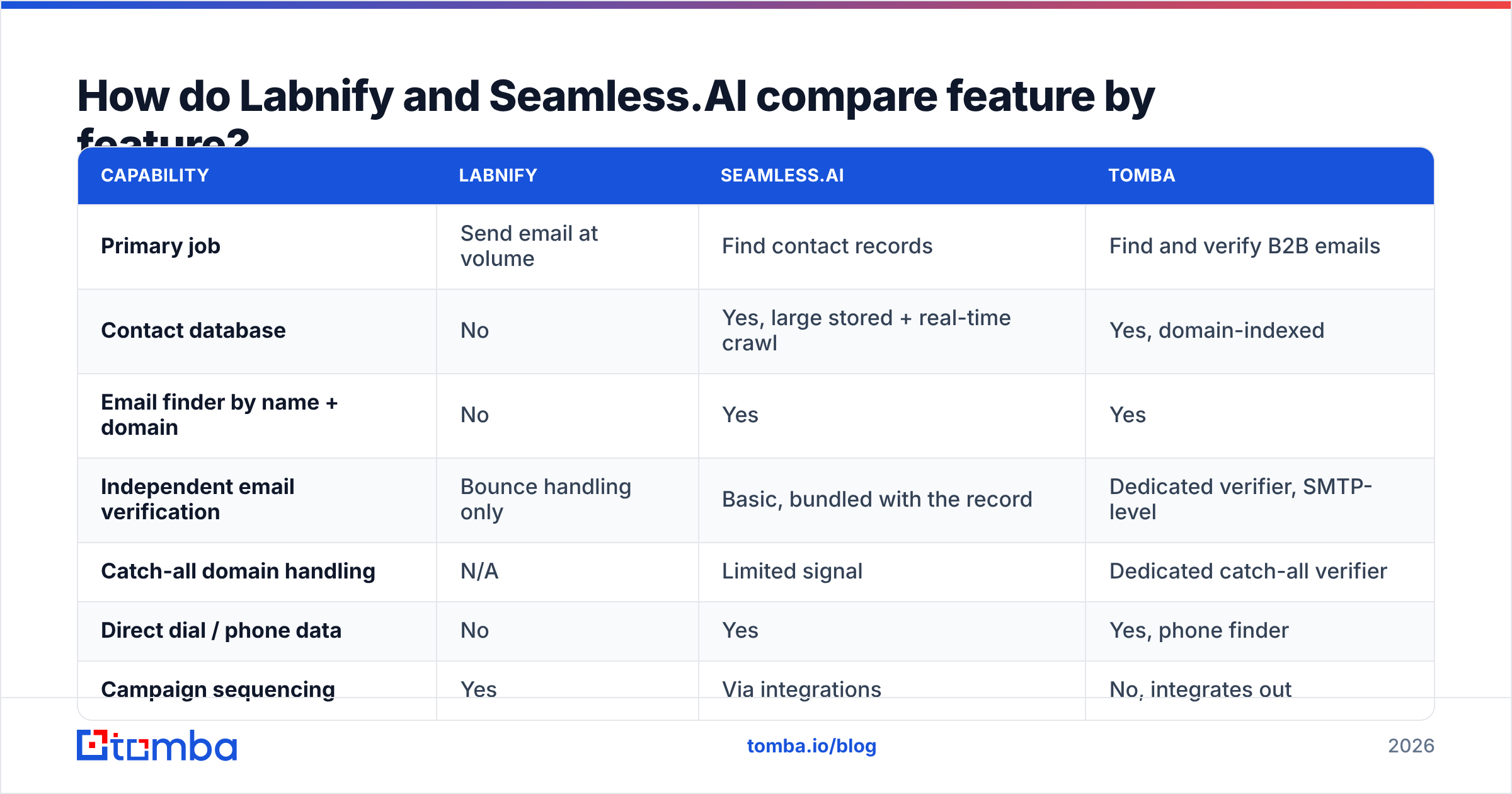
Because the two sit in different layers, a feature table looks lopsided by design. That lopsidedness is the point: it shows you which gaps you'd still have after buying either one.
| Capability | Labnify | Seamless.AI | Tomba |
|---|---|---|---|
| Primary job | Send email at volume | Find contact records | Find and verify B2B emails |
| Contact database | No | Yes, large stored + real-time crawl | Yes, domain-indexed |
| Email finder by name + domain | No | Yes | Yes |
| Independent email verification | Bounce handling only | Basic, bundled with the record | Dedicated verifier, SMTP-level |
| Catch-all domain handling | N/A | Limited signal | Dedicated catch-all verifier |
| Direct dial / phone data | No | Yes | Yes, phone finder |
| Campaign sequencing | Yes | Via integrations | No, integrates out |
| SMTP / sending infrastructure | Yes, core product | No | No |
| Warmup and inbox placement | Yes | No | No |
| API access | Yes | Yes, on higher tiers | Yes, on all paid plans |
| Free tier | Trial-style | Limited monthly credits | 25 searches/month |
| Entry paid price | Published on vendor site | Quote-based, seat-priced | $49/month |
| Contract model | Monthly options | Annual is standard | Monthly, no lock-in |
Two rows deserve more attention than the rest.
Contract model. Seamless.AI is a sales-led product. Public pricing is not posted, seats are quoted, and annual commitments are the default rather than the exception. Buyer reviews on G2 return to this repeatedly: the product itself gets reasonable marks, while the procurement and renewal experience is where the complaints concentrate. That's a real cost factor even when the per-record price looks fine.
Verification. Neither Labnify nor Seamless.AI gives you an independent verification pass. Labnify reports bounces after the fact, which means the damage to your domain reputation has already been done. Seamless.AI ships a validity signal attached to the record, but that signal was generated when the record was built, not when you exported it. Those are not the same thing.
Is Seamless.AI's data accurate enough to send at volume?#
Accurate enough to prospect with. Not accurate enough to send with, unverified.
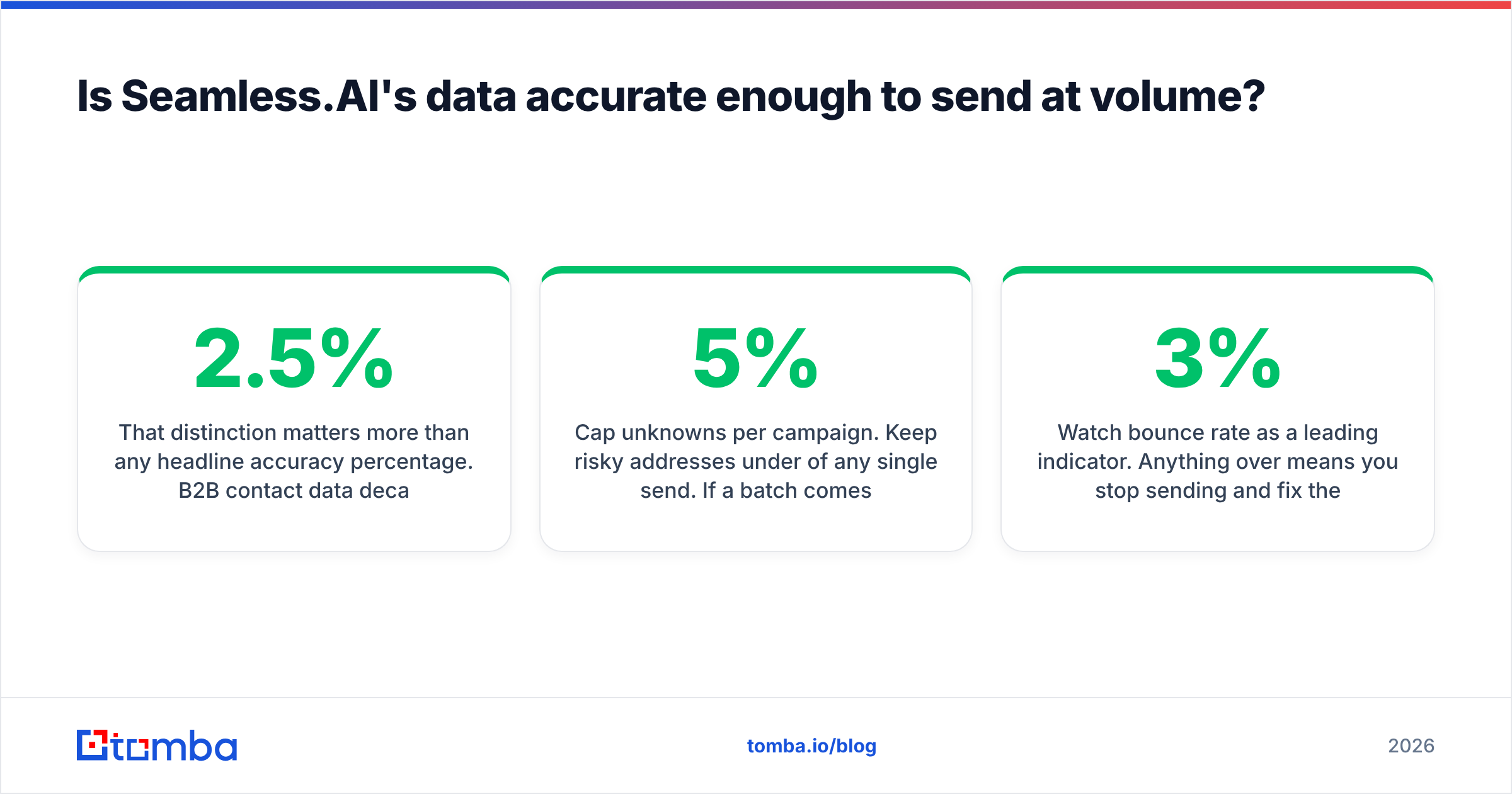
That distinction matters more than any headline accuracy percentage. B2B contact data decays at roughly 2.5% to 3% per month as people change jobs, companies restructure, and mail servers change policy. A record that was correct in January is a coin flip by autumn. Every database vendor lives with this, and every vendor's marketing page quietly rounds in its own favor.
What you can control is the gap between export and send. Three habits close it:
- Re-verify on export, not on import. Verify the day you send, not the day you bought the list. A list sitting in a spreadsheet for six weeks is a different list.
- Segment catch-all domains separately. A catch-all server accepts everything, so a standard SMTP check returns "valid" for addresses that will hard-bounce downstream. Run those through a catch-all verifier and treat the results as a lower-confidence segment with its own sending cadence.
- Cap unknowns per campaign. Keep risky addresses under 5% of any single send. If a batch comes back 20% unknown, the problem is the source, not the send.
- Watch bounce rate as a leading indicator. Anything over 3% means you stop sending and fix the list. Over 5% and providers start treating your domain as a problem.
Running an email verifier between your data source and your sending tool costs a fraction of either subscription and protects the asset that's hardest to replace: your sending domain. If you are specifically evaluating whether the database is worth its seat price, the Seamless.AI alternative breakdown goes deeper on per-credit economics.

Does Labnify actually solve deliverability, or just sending?#
It solves sending, and sending is roughly 40% of deliverability.
This is the most common misread in the category. Teams buy a sending platform expecting inbox placement to improve, then find their open rates unchanged. Sending infrastructure controls the transport layer: which IP the mail leaves from, how fast, with what authentication headers, on which schedule. That's necessary and it's genuinely hard to self-host well. Labnify and its peers earn their fee there.
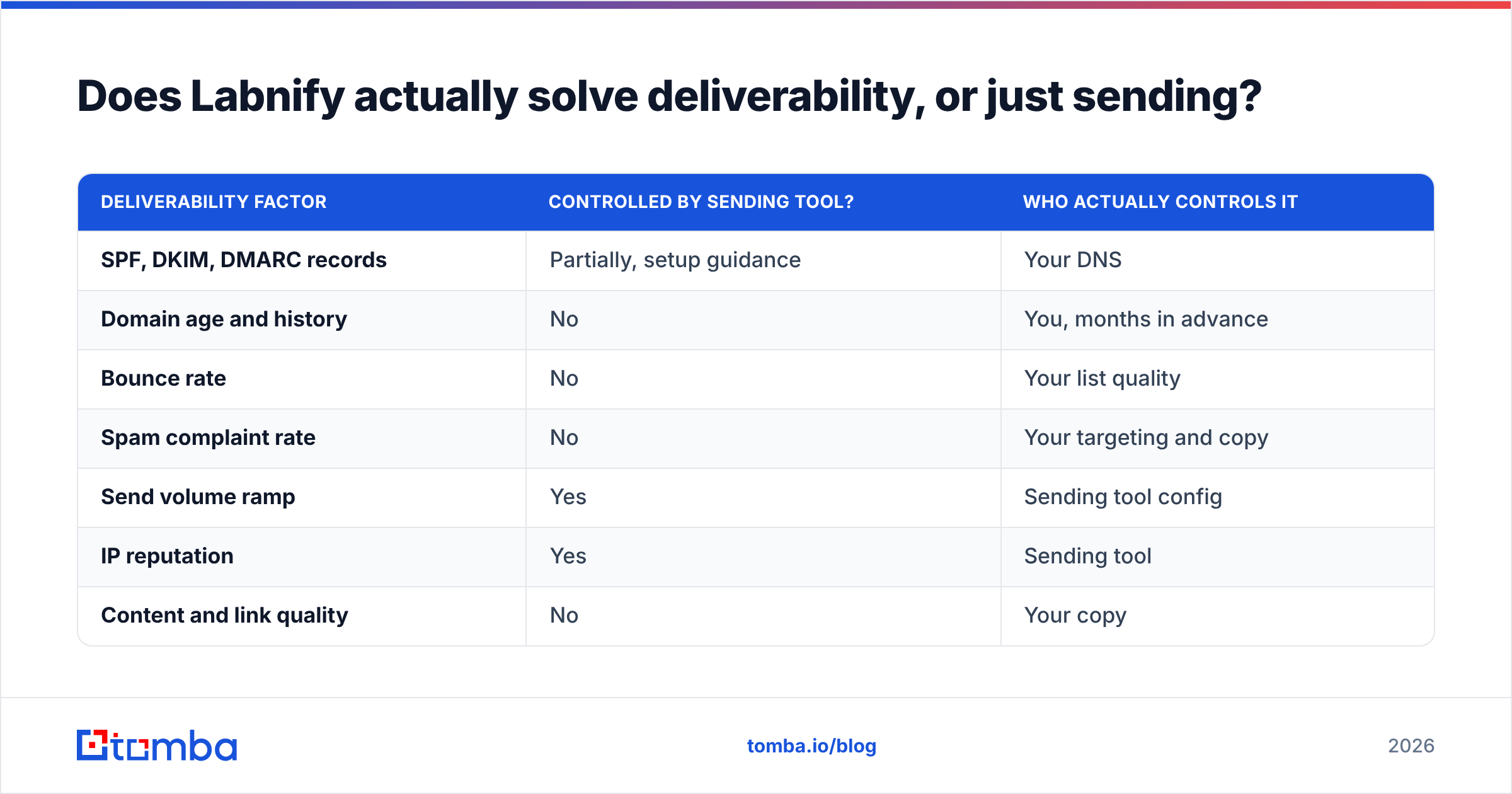
But inbox placement is decided by factors the sending platform can't touch:
| Deliverability factor | Controlled by sending tool? | Who actually controls it |
|---|---|---|
| SPF, DKIM, DMARC records | Partially, setup guidance | Your DNS |
| Domain age and history | No | You, months in advance |
| Bounce rate | No | Your list quality |
| Spam complaint rate | No | Your targeting and copy |
| Send volume ramp | Yes | Sending tool config |
| IP reputation | Yes | Sending tool |
| Content and link quality | No | Your copy |
| Reply rate signal | No | Your offer |
Read down that table and you'll notice most rows are upstream of the sending tool. Bounce rate and complaint rate, the two heaviest negative signals, are both determined entirely by list quality. A pristine sending setup mailing a stale list produces worse placement than a mediocre setup mailing a verified one. If the underlying concepts are new, the email deliverability primer covers the mechanics without vendor spin.
The practical implication: fixing deliverability by upgrading your sending platform is the second move. The first move is cleaning what you send.
What does each one really cost in practice?#
Compare total cost of a working setup, not sticker price of a single tool. Sticker price hides the fact that neither product is complete on its own.
If you buy Seamless.AI alone, you get contacts and no way to send them. You'll add a sequencer, and you'll want verification. Budget the seat cost, multiply by headcount (this is the part that surprises people, since seat pricing scales linearly with team size rather than with usage), and add the annual commitment as a risk factor if your team size might shrink.
If you buy Labnify alone, you get delivery and no one to deliver to. You'll add a data source, and that data source becomes your dominant variable cost as volume grows.
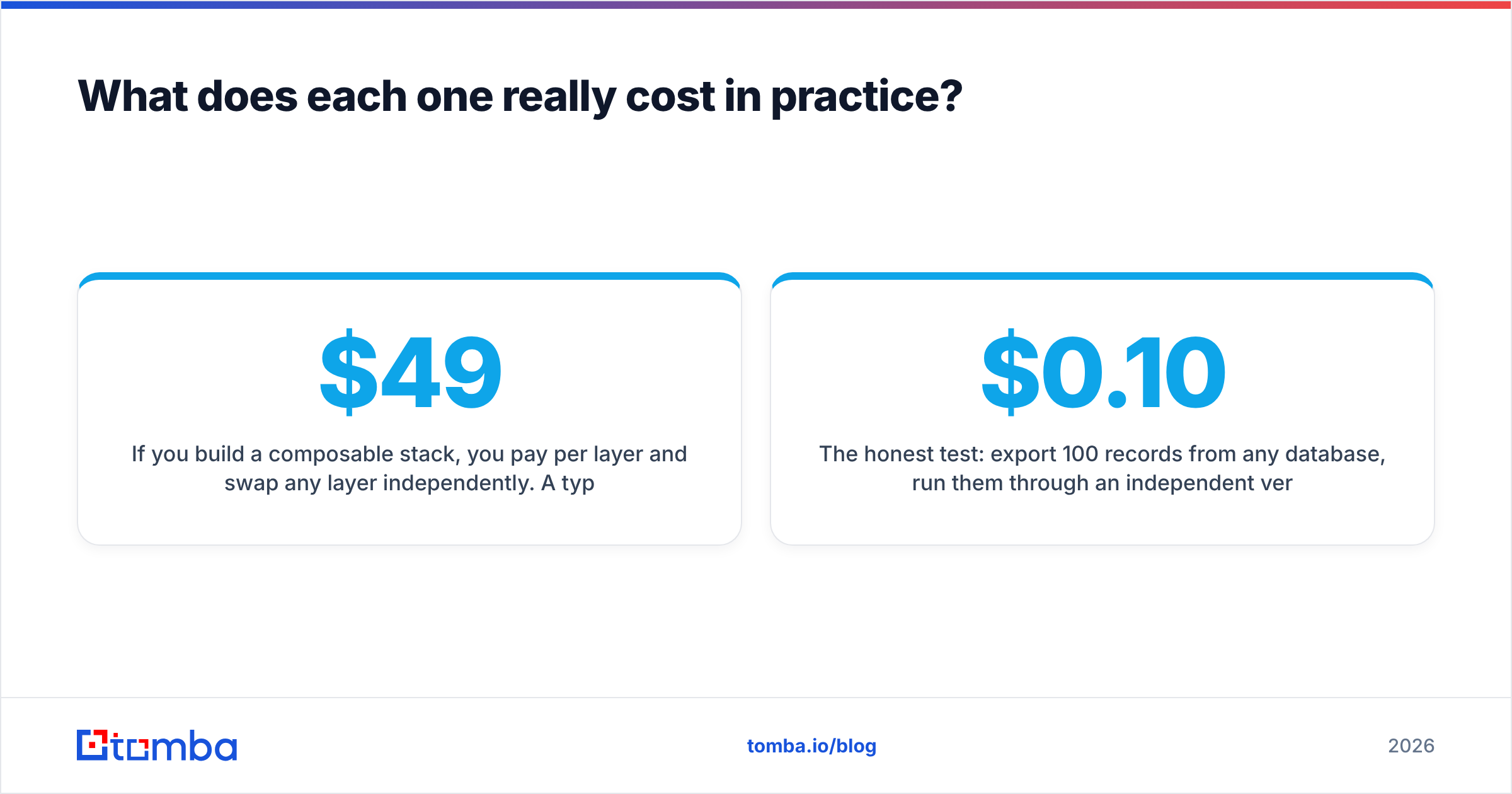
If you build a composable stack, you pay per layer and swap any layer independently. A typical shape: a finder and verifier for data, a sequencer for cadence, a sending provider for transport. Tomba pricing starts at $49/month for Starter, $99/month for Growth, and $249/month for Pro, with a free tier at 25 searches per month to test accuracy on your own domains before you commit anything. Usage-based, monthly, no seat multiplication.
The honest test: export 100 records from any database, run them through an independent verifier, and look at the pass rate. That single number tells you more about your real cost per usable contact than any pricing page. A list priced at $0.10 per record with a 60% pass rate costs $0.17 per usable contact. Cheap data isn't cheap.
Which should you choose for your situation?#
Match the tool to the symptom.
- Your emails bounce or land in spam, and your targeting is fine. Sending infrastructure is your bottleneck. Labnify's category is right. But fix list hygiene first, because it's cheaper and it's usually the actual cause.
- You have a sending setup that works but no one to send to. You need data. Seamless.AI is a reasonable option if you want phone numbers bundled and you're comfortable with seat pricing and a sales cycle. Compare it against usage-priced finders before signing annually.
- You're a small team or solo founder testing a new market. Skip both for now. Start with a usage-priced email finder and a verifier, send from a warmed domain through tooling you already have, and only buy infrastructure once volume justifies it.
- You're running multi-domain outbound at serious scale. You need both layers, plus a verification step neither vendor provides. That's three line items, not one, and pretending otherwise is how teams end up with a burned root domain.
- You're replacing a tool that underdelivered on accuracy. Don't take anyone's published accuracy figure, including ours. Test 100 records from your own ICP. The vendor that wins on your list is the vendor that wins.
What's the takeaway?#
Labnify vs Seamless.AI is the wrong question asked at the right time. It usually means outbound isn't working and you're looking for the single purchase that fixes it. There isn't one. The two tools sit on opposite ends of the pipeline, and the layer that most often determines whether outbound works at all sits between them: verified, current contact data.
Get that layer right and both of the others get cheaper. Send fewer, better-verified emails and your bounce rate drops, your domain reputation holds, your sending platform has less to compensate for, and your database burns fewer credits on records that were never going to convert.
Before you commit to a seat-priced annual contract or a sending platform upgrade, test the data layer. Tomba's Email Finder gives you 25 free searches per month, no card required, with SMTP-level verification built into every lookup. Run your next 25 target accounts through it, check the results against whatever you're paying for today, and let the pass rate decide your budget.
Related guides#
// get started
Find, verify and enrich your first contacts today
Start on the free plan with 25 searches a month, then scale when your team is ready.
Free plan · No credit card required · GDPR & CCPA
// about the author