LakeB2B vs SalesIntel (2026): Which B2B Data Vendor Wins?
LakeB2B sells custom-built lists. SalesIntel sells human-verified contacts with intent data. They are not the same product, and picking wrong costs you a year of budget. Here is the honest breakdown.
LakeB2B vs SalesIntel is not a fair fight, because the two tools do different jobs. LakeB2B builds a list for you. SalesIntel gives your reps a live database to search. Here is the short version.
TL;DR
- They are not competing products. LakeB2B builds lists and appends data — you describe an audience, they assemble and send a file. SalesIntel is a self-serve platform with a Chrome extension, intent signals, and CRM sync.
- SalesIntel wins on workflow. Real-time lookups, a browser extension, HubSpot and Salesforce push, plus research on demand for missing contacts.
- LakeB2B wins on niche audiences. Healthcare (NPI-level), education, and other segments that broad databases cover thinly.
- Both are quote-only and annual. Neither one publishes pricing. Expect a discovery call, a seat-and-credit bundle, and a 12-month deal.
- If you just need verified work emails, both are overkill. A per-lookup email finder at $49/mo does the same job for far less.
What are LakeB2B and SalesIntel?#
Think of it like buying produce. LakeB2B is the wholesale supplier. You give them a spec, they pack a crate and ship it. SalesIntel is the grocery store. You walk the aisles, pick items one at a time, and check each date.
LakeB2B has sold B2B data since the mid-2000s. Its model is service-led. You brief a team on the audience you want: job titles, industries, company size, tech stack, and location. They send back a targeted file as a CSV, or push it into your CRM.
Coverage runs to hundreds of millions of contact records across thousands of ready-made segments. The deep verticals are the draw: healthcare (physicians, NPI-coded specialties, hospital buyers), education, and manufacturing. LakeB2B also sells data appends. Hand over a list of company names or partial records, and get back enriched rows.
SalesIntel is a different animal. It is a sales intelligence platform built on human verification. A research team re-checks contact records on a rolling cycle, and the company markets a ~95% accuracy standard as its core differentiator.
On top of the database sit the things a rep touches daily. A Chrome extension reveals contacts on LinkedIn and company sites. Filters cover firmographics and technographics. Bombora powers the intent topics, and the CRM and sequencer links are native. "Research on Demand" is the unusual part: ask for a missing or stale contact, and a human sources it, usually within two business days.
The practical split: LakeB2B is a data supplier. SalesIntel is a data product. You buy the first as a project. You buy the second as infrastructure your team logs into.

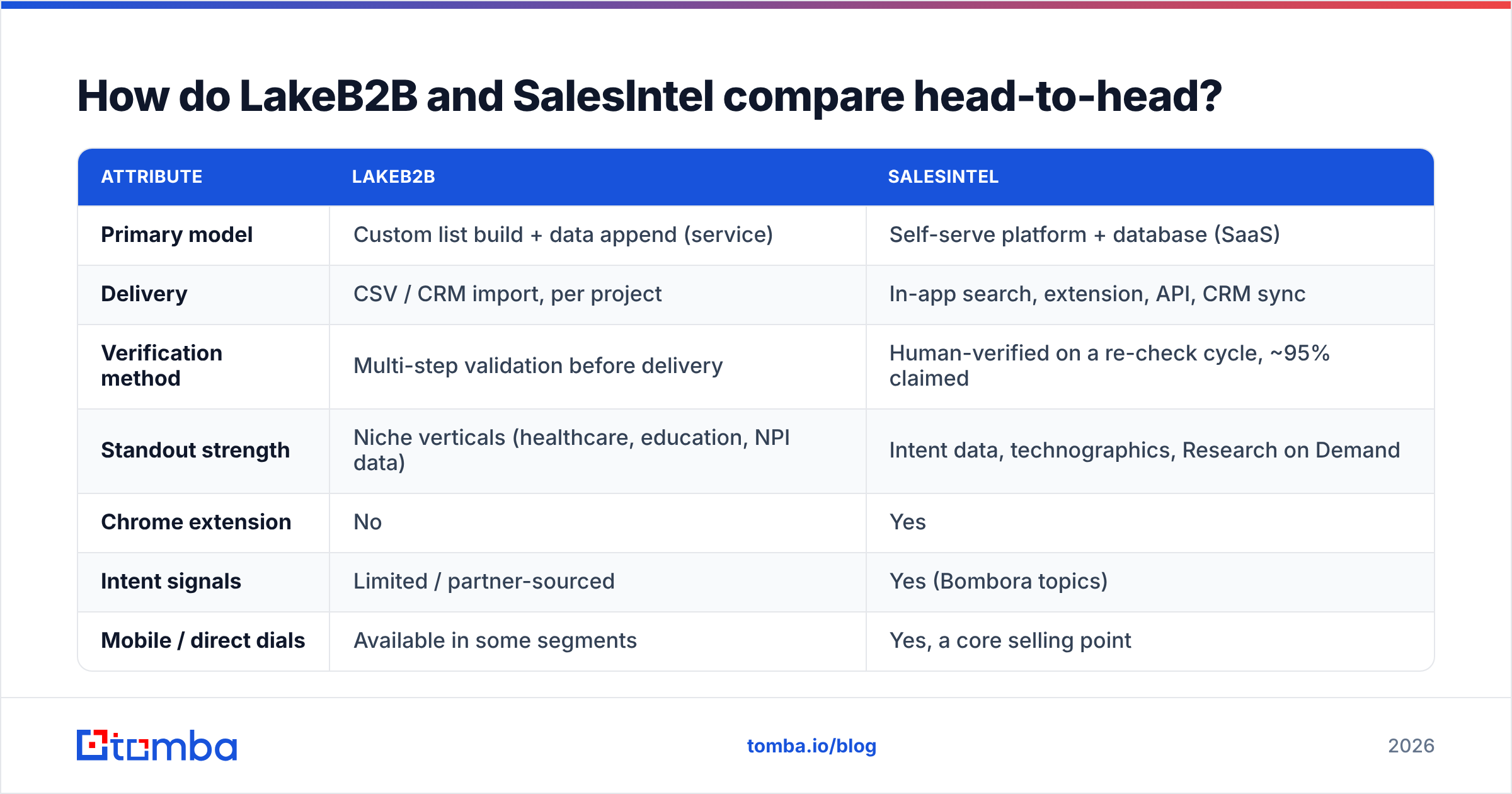
LakeB2B vs SalesIntel: how do they compare head-to-head?#
| Attribute | LakeB2B | SalesIntel |
|---|---|---|
| Primary model | Custom list build + data append (service) | Self-serve platform + database (SaaS) |
| Delivery | CSV / CRM import, per project | In-app search, extension, API, CRM sync |
| Verification method | Multi-step validation before delivery | Human-verified on a re-check cycle, ~95% claimed |
| Standout strength | Niche verticals (healthcare, education, NPI data) | Intent data, technographics, Research on Demand |
| Chrome extension | No | Yes |
| Intent signals | Limited / partner-sourced | Yes (Bombora topics) |
| Mobile / direct dials | Available in some segments | Yes, a core selling point |
| Pricing transparency | Quote only | Quote only |
| Typical contract | Per-project or annual | Annual, seat + credit bundle |
| Best for | Marketers buying a defined audience once or twice a year | SDR teams prospecting daily |
| Weakest for | Day-to-day rep workflow | Hyper-niche verticals outside tech/finance |
Read that table as two different buying decisions, not a scoreboard. Say your quarterly plan is "email 40,000 hospital procurement directors." LakeB2B's model fits, and SalesIntel's seat-based pricing will feel absurd. Say your plan is "eight SDRs build 60 accounts each per week." LakeB2B's CSV hand-off becomes a bottleneck by week three.
Which one has more accurate data?#
Neither vendor will settle this for you on a marketing page, and you should not try. Both publish accuracy figures they measured themselves, using their own definition of "accurate."

Four things actually move accuracy in this category. The first two are about the data itself.
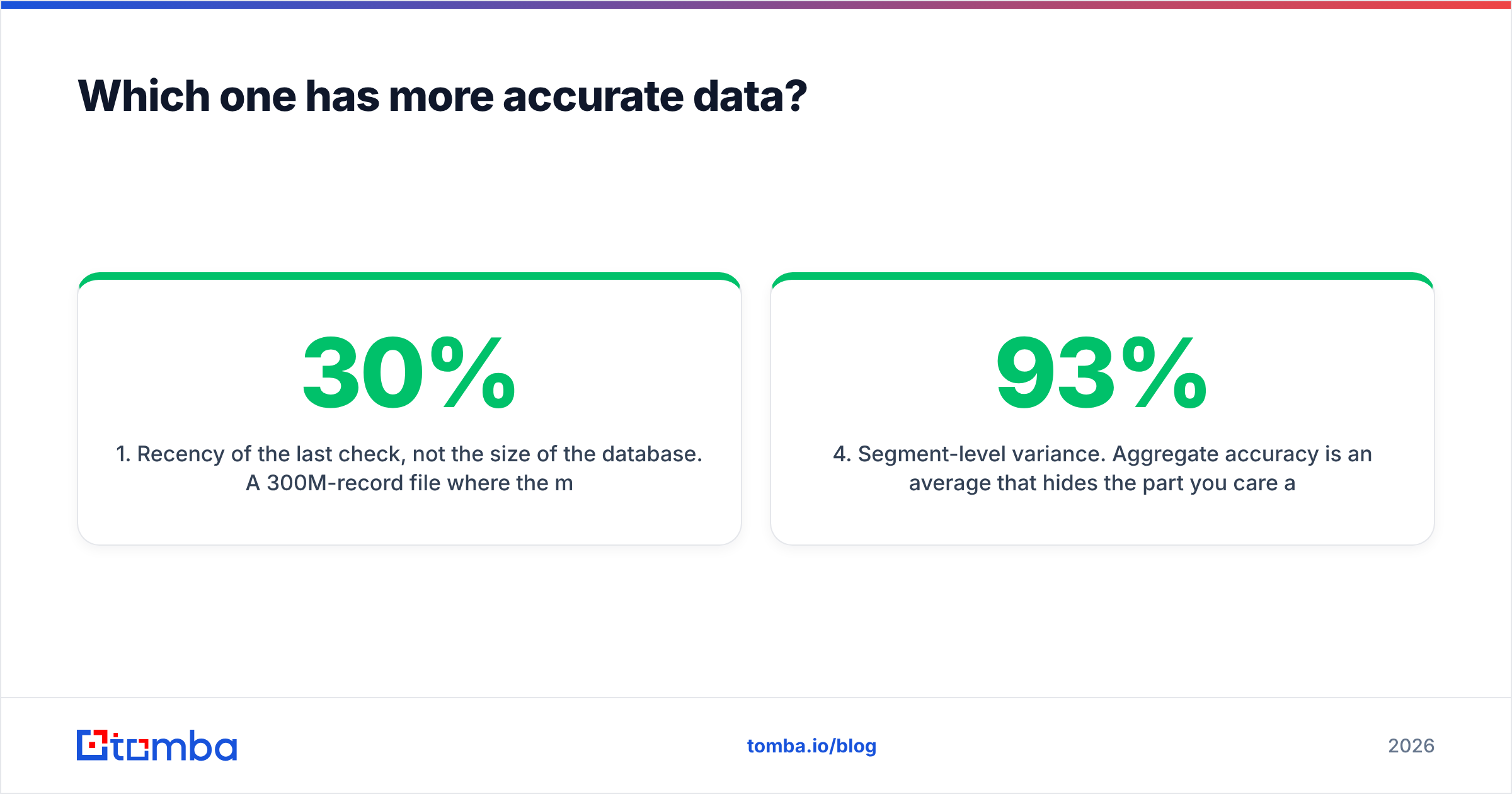
- Recency beats size. A 300M-record file checked 18 months ago is worse than a 40M-record file checked last quarter. Job-change churn in sales and marketing runs 20–30% a year, so stale rows pile up fast.
- "Verified" means two different things. SalesIntel leans on human re-checks, which catch role changes. An SMTP ping cannot: the mailbox still accepts mail after someone leaves. LakeB2B validates before delivery. That is strong at hand-off, but the file does not refresh once it sits in your CRM.
The other two decide what your own team actually sees.
- Catch-all domains. Any vendor's accuracy number gets shaky on domains that accept every address. If many target accounts run catch-all servers, ask both vendors how they score those rows. Then run your own catch-all verifier anyway.
- Segment-level variance. An overall score hides the slice you care about. A vendor at 93% overall can hit 97% on US software VPs and 71% on German mid-market operations managers.
The only honest test is a sample. Ask each vendor for 300–500 records in your exact ICP. Run the file through an independent email verifier. Then spot-check 30 rows by hand against LinkedIn. You will usually find a 10–20 point gap between the quoted number and your segment. That gap is your real negotiating position.
How does LakeB2B vs SalesIntel pricing work?#
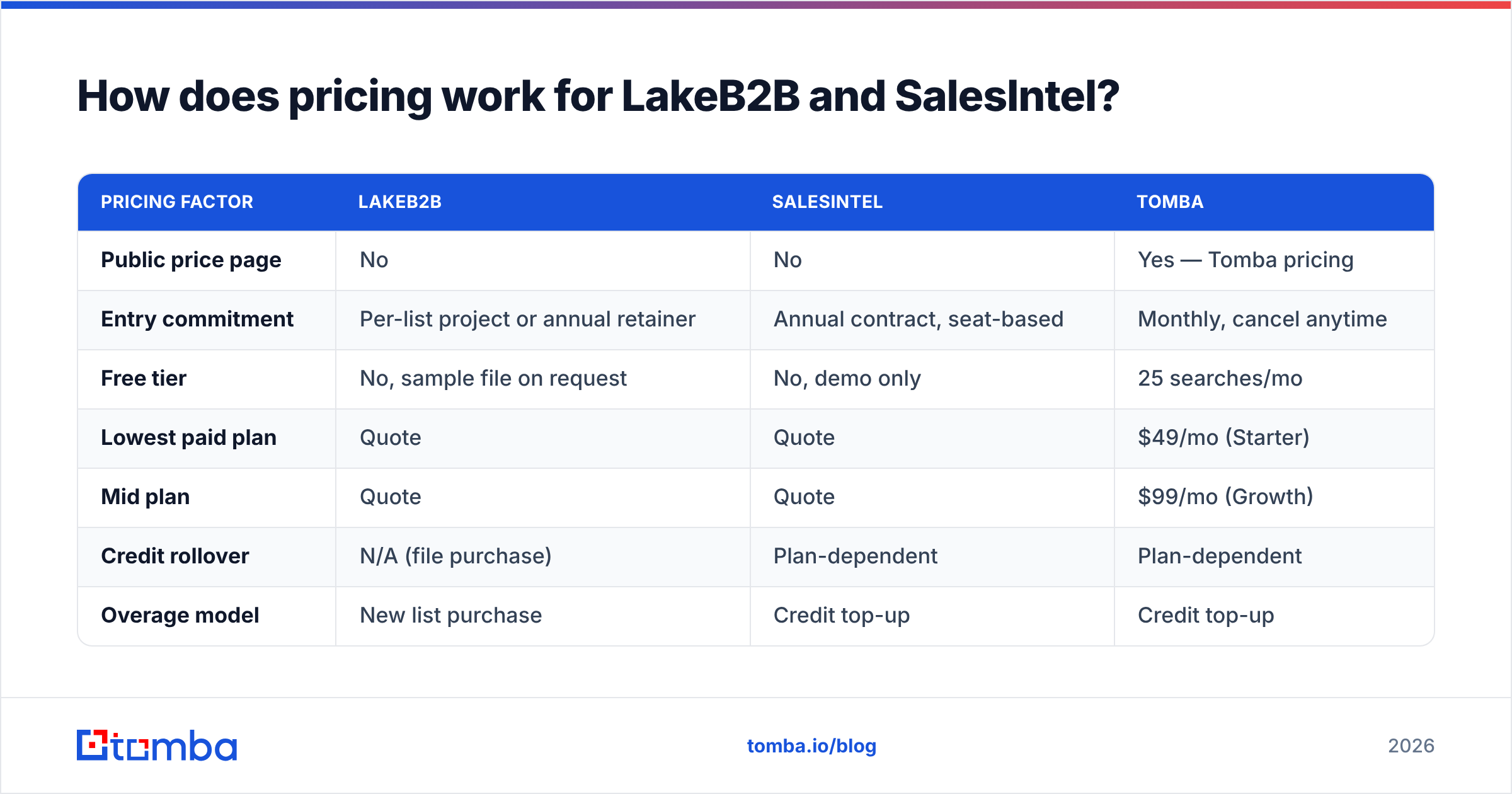
Neither one publishes a price. Both route you through a discovery call before you see a number. That is normal at the enterprise end of this market. It is also annoying if you are a five-person team trying to budget in an afternoon.
| Pricing factor | LakeB2B | SalesIntel | Tomba |
|---|---|---|---|
| Public price page | No | No | Yes — Tomba pricing |
| Entry commitment | Per-list project or annual retainer | Annual contract, seat-based | Monthly, cancel anytime |
| Free tier | No, sample file on request | No, demo only | 25 searches/mo |
| Lowest paid plan | Quote | Quote | $49/mo (Starter) |
| Mid plan | Quote | Quote | $99/mo (Growth) |
| Credit rollover | N/A (file purchase) | Plan-dependent | Plan-dependent |
| Overage model | New list purchase | Credit top-up | Credit top-up |
| Time to first record | Days (list build) | Minutes (self-serve) | Minutes (self-serve) |
Three cost traps show up again and again in buyer reviews on G2's sales intelligence category. They apply to most vendors at this tier.
- Seat minimums. Platform pricing often starts at 3–5 seats even when you need two. Ask for the single-seat number before you take the bundle.
- Credit expiry. Unused lookups often reset each month or quarter instead of rolling over. A 50,000-credit annual plan that resets quarterly is really four 12,500-credit plans.
- Export caps. Some platforms let you view more than you can export. Get the export number in the order form, not the deck.

Who should choose LakeB2B?#
Pick LakeB2B when the audience is the hard part and the workflow is simple.
- Healthcare and education outbound. NPI-level physician targeting, hospital administration, K-12 and higher-ed buyers. Broad databases return thin, badly titled records here.
- One-off campaign lists. You need 25,000 contacts for a Q2 webinar push, and you will not log into a tool every day.
- Data appends on existing records. You have 8,000 company names from a trade show and need matching decision-makers.
- Direct mail or multi-channel. Postal and firmographic fields matter to you, not just email.
- You already have internal hygiene. You run purchased files through validation before they touch your sending domain. If you do not, a bad import can cost months of email deliverability repair.
Who should choose SalesIntel?#
Pick SalesIntel when reps touch the data every day and timing matters.
- Active SDR teams. The Chrome extension and CRM push remove the CSV round-trip that kills rep momentum.
- Intent-led outbound. If you chase accounts researching your category this week, Bombora topics inside the same tool are worth real money.
- Direct dial dependence. Heavy calling teams generally rate SalesIntel's phone coverage above list vendors.
- Hard-to-source titles. Research on Demand is a real differentiator. No database can invent a record that does not exist, but a human researcher can find one.
- You need audit trails. Per-record verification timestamps help when compliance asks where a contact came from.
What are the cheaper alternatives to both?#
Here is the uncomfortable question most comparison posts skip. Do you actually need a full data platform, or do you need work email addresses?
Maybe you already know the companies and the people, and you only need reachable contact details. Then you are paying platform prices for a lookup problem. Lighter tools live in that gap.

- BookYourData works well if you want to own a file without an annual contract. The credit model suits campaign-based buying, and it skips the seat minimums that make platform pricing awkward for small teams.
- Tomba sits at the lookup layer. Use domain search to map every public contact at a company, the email finder for named prospects, and bulk email finder for list work. Verification is built in, and there is an API for engineering teams. The free tier is 25 searches a month; Starter is $49/mo and Growth is $99/mo, billed monthly with no annual lock.
- Running both is common, and often cheapest. Keep a platform seat or two for intent and research. Handle high-volume lookups on a per-credit tool instead of burning enterprise credits.
The decision rule is simple. If you cannot name the intent signal or the research workflow you will use weekly, you are buying a database. Databases are a commodity. Buy them by the record, not by the seat-year.
How do you test either vendor before you sign?#
Run the same evaluation on both. It takes about a week and often saves five figures.
- Define one narrow ICP and keep it narrow. Example: VP and above, RevOps or Sales Ops title, US-based, 200–2,000 employees, HubSpot installed. Vendors will push to widen the sample. Do not let them.
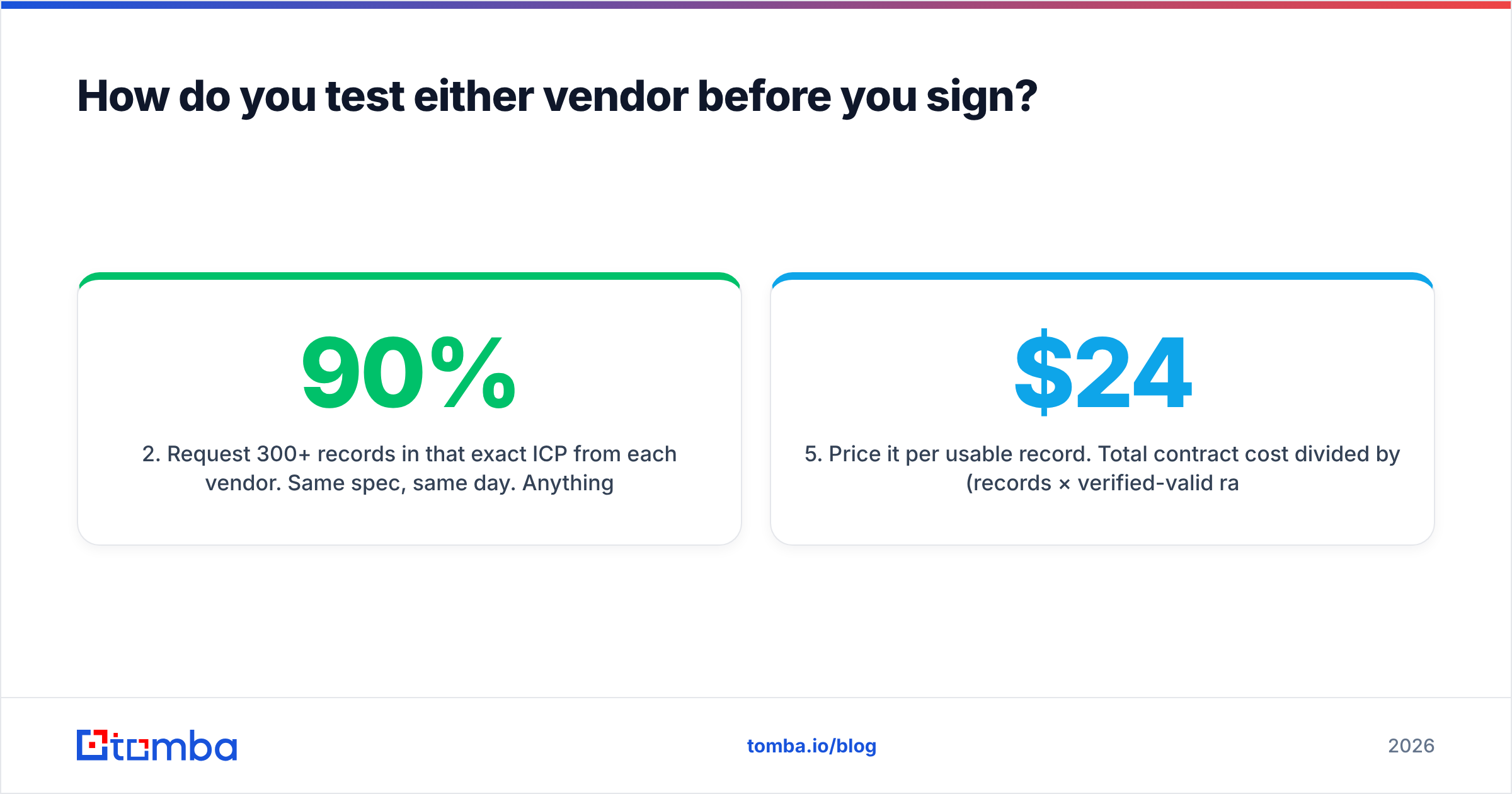
- Request 300+ records in that exact ICP. Same spec, same day, from each vendor. Under 300 rows cannot separate a 90% file from a 78% file.
- Verify independently. Run both files through a neutral verifier. Record valid, catch-all, and invalid rates per file. Skip the vendor's own score.
The last two steps are where most buyers stop early, and they are the ones that decide the deal.
- Hand-check 30 random rows. Open LinkedIn. Is the person still in that role, at that company, at that level? This catches what verification cannot: a deliverable address belonging to someone who left in March.
- Price it per usable record. Divide total contract cost by (records × verified-valid rate × still-in-role rate). A $24,000 platform at 62% usable costs more per contact than a $9,000 list at 81%. That single number ends most vendor debates.
Then negotiate. Quote-only vendors expect it, quarter-end is your friend, and a documented sample test beats a competitor's price sheet.
Frequently asked questions#
Is SalesIntel a direct LakeB2B competitor? Only partly. They overlap on "sell me B2B contact data" and split on everything after that. SalesIntel competes with ZoomInfo, Apollo, and Cognism. LakeB2B competes with list brokers and data-append services.
Does either offer a free trial? Neither has a real self-serve free tier today. Both offer demos and, if you push, a sample file. Ask for the sample in your ICP. A generic sample proves nothing.
Can I use purchased lists for cold email in the EU? Carefully, and with legal input. GDPR legitimate-interest outreach to business contacts is defensible. It needs documented sourcing, an easy opt-out, and relevance to the person's role. Get each vendor's compliance answer in writing, not on a call.
What happens to purchased data after 12 months? It decays. Re-verify anything older than one quarter before it enters a sending tool. Re-run data enrichment on core accounts at least twice a year.
LakeB2B vs SalesIntel: the bottom line#
LakeB2B wins when your audience is niche and you just need a file. SalesIntel wins when your reps live inside a tool and intent timing drives the play. Both want an annual commitment and a discovery call before they name a price. So run the 300-record sample test first, then negotiate on cost per usable record.
And if you mostly need verified work emails at companies you have already picked, skip the enterprise cycle. Start with the Tomba Email Finder. You get 25 free searches to test accuracy on your own ICP, then $49/mo when you are ready. Verification is included, and there is no annual contract to unwind. Run it against whatever sample the vendors send and let the numbers decide.
Related guides#
// get started
Find, verify and enrich your first contacts today
Start on the free plan with 25 searches a month, then scale when your team is ready.
Free plan · No credit card required · GDPR & CCPA
// about the author